- Product Description Description
- Table of Contents TOC
- List of Table & Figure LOT
- Get Free Sample PDF Sample PDF
Market Size, 2025
$11.54 BnMarket Estimate, 2026
$12.10 BnMarket Forecast, 2034
$17.71 BnCAGR, 2026–2034
4.88%Global Wood Coatings Market Summary
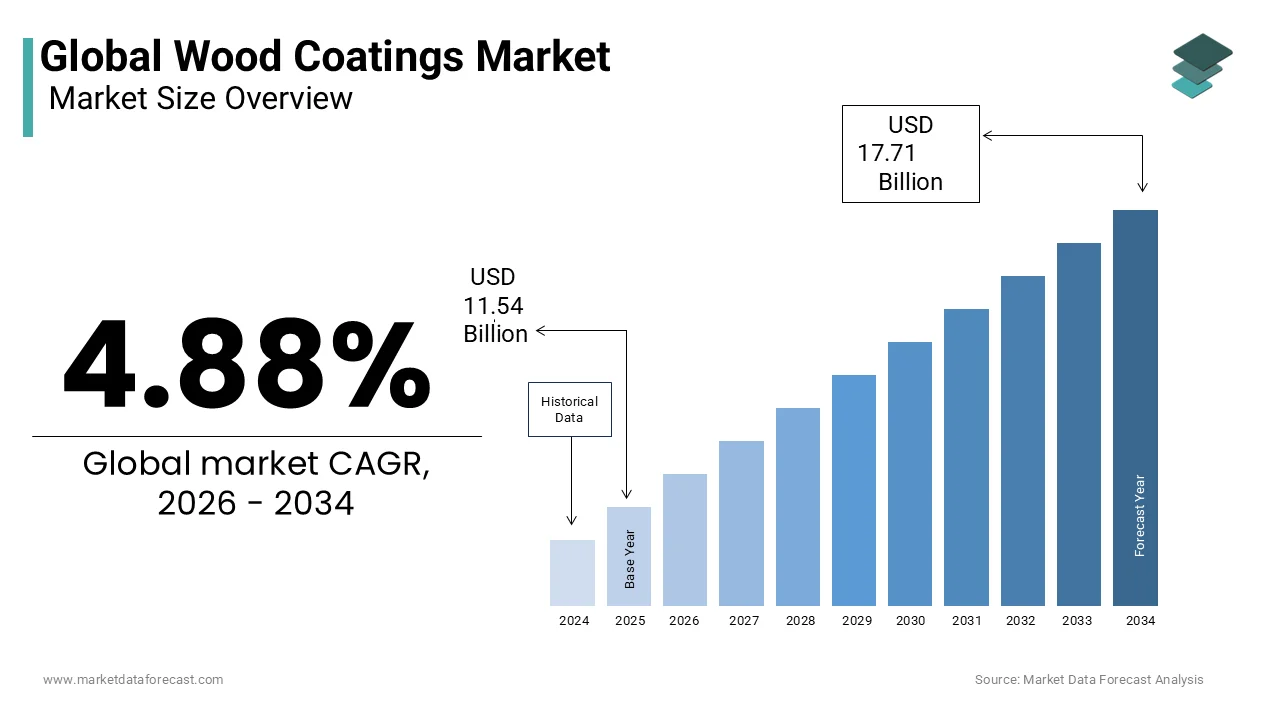
The global wood coatings market, valued at USD 11.54 billion in 2025, is projected to reach USD 17.71 billion by 2034 at a CAGR of 4.88%, driven by residential renovation, engineered wood adoption, and low-VOC technological advancements.
Market Snapshot
- 2025 Market Size: USD 11.54 billion
- 2026 Estimate: USD 12.10 billion
- 2034 Forecast: USD 17.71 billion
- CAGR (2026–2034): 4.88%
- Base Year: 2025
- Forecast Period: 2026–2034
Quick Growth Drivers
- Growth in residential construction and renovation
- Rising demand for engineered wood (CLT, MDF, LVL)
- Increasing consumer preference for low-VOC coatings
- Shift toward UV-cured and industrial automation finishes
- Export-driven furniture manufacturing in Asia
Principal Restraints
- Volatility in petrochemical-derived resin prices
- Stringent environmental regulations on solvent-borne systems
- Skilled labor shortages in emerging economies
- Supply chain disruptions for titanium dioxide and additives
High-Value Opportunities
- Mass timber (CLT) and modular construction finishes
- UV-curable and energy-efficient coating systems
- Bio-based polyurethane and acrylic formulations
- Fire-retardant and intumescent coatings for structural wood
- Smart/self-healing antimicrobial finishes
Key Market Challenges
- Performance limitations of waterborne systems in humid climates
- Fragmented application standards in small-scale workshops
- Transition costs from solvent to waterborne/UV systems
- Margin pressure due to raw material cost inflation
Global Wood Coatings Market Summary
SEO One-Liner
The global wood coatings market, valued at USD 11.54 billion in 2025, is projected to reach USD 17.71 billion by 2034 at a CAGR of 4.88%, driven by residential renovation, engineered wood adoption, and low-VOC technological advancements.
Market Snapshot
- 2025 Market Size: USD 11.54 billion
- 2026 Estimate: USD 12.10 billion
- 2034 Forecast: USD 17.71 billion
- CAGR (2026–2034): 4.88%
- Base Year: 2025
- Forecast Period: 2026–2034
Quick Growth Drivers
- Growth in residential construction and renovation
- Rising demand for engineered wood (CLT, MDF, LVL)
- Increasing consumer preference for low-VOC coatings
- Shift toward UV-cured and industrial automation finishes
- Export-driven furniture manufacturing in Asia
Principal Restraints
- Volatility in petrochemical-derived resin prices
- Stringent environmental regulations on solvent-borne systems
- Skilled labor shortages in emerging economies
- Supply chain disruptions for titanium dioxide and additives
High-Value Opportunities
- Mass timber (CLT) and modular construction finishes
- UV-curable and energy-efficient coating systems
- Bio-based polyurethane and acrylic formulations
- Fire-retardant and intumescent coatings for structural wood
- Smart/self-healing antimicrobial finishes
Key Market Challenges
- Performance limitations of waterborne systems in humid climates
- Fragmented application standards in small-scale workshops
- Transition costs from solvent to waterborne/UV systems
- Margin pressure due to raw material cost inflation
Leading Players
Some of the companies that are playing a dominating role in the global wood coatings market include:
- Akzo Nobel N.V.
- The Sherwin-Williams Company
- Axalta Coating Systems
- Nippon Paint Holdings Co., Ltd.
- Asian Paints
- Teknos Group
- Stahl Holdings
- RPM International Inc.
Global Wood Coatings Market Size
The global wood coatings market was valued at USD 11.54 billion in 2025, is estimated to reach USD 12.10 billion in 2026, and is projected to reach USD 17.71 billion by 2034, growing at a CAGR of 4.88% from 2026 to 2034.
Wood coatings are specialized protective and decorative finishes applied to wooden surfaces in furniture, flooring, cabinetry, and architectural elements to enhance durability, appearance, and resistance to environmental degradation. The global industrial roundwood production reached notable cubic meters, with a portion used in construction and furniture, which emphasizes the vast substrate base for coatings. As per the study, a portion of newly constructed single-family homes in the United States feature hardwood or engineered wood flooring, necessitating high-performance finishes. Apart from these, untreated wood degrades up to five times faster in humid climates, which strengthens the functional necessity of coatings.
MARKET DRIVERS
Growth in Residential Construction and Renovation Activities
The global surge in residential construction and home renovation is propelling the growth of the wood coatings market. The demand is particularly in flooring, cabinetry, and interior finishes. In Europe, renovation rates in existing housing stock have remained consistently low, despite facing pressure from energy efficiency mandates and aging infrastructure. Similarly, in India, the Ministry of Housing and Urban Affairs launched the PM Awas Yojana, which aims to provide affordable "pucca" (durable) homes for millions. Instead of creating a market for wood finishes, the construction uses diverse materials, including eco-friendly and innovative options, to provide durable, all-weather housing.
Increasing Consumer Preference for Sustainable and Low-VOC Coatings
Environmental and health concerns are driving a structural shift toward eco-friendly wood coatings with low volatile organic compound (VOC) content and bio-based formulations, which accelerates the expansion of the wood coatings market. According to the study, exposure to indoor air pollutants, many of which originate from solvent-based coatings, contributes to millions of premature deaths annually. In response, regulatory bodies have tightened VOC limits. The European Union’s Paints Directive caps VOCs for interior wood finishes, while California’s South Coast Air Quality Management District (SCAQMD) enforces even stricter standards.
MARKET RESTRAINTS
Volatility in Raw Material Supply and Pricing of Resins and Solvents
Cost and supply chain instability due to its reliance on petrochemical-derived resins, solvents, and additives hinders the growth rate of the wood coatings market. Acrylics, polyurethanes, and alkyds, key binder systems, are sensitive to fluctuations in crude oil and natural gas prices. According to the study, benzene prices, a precursor to styrene, surged due to supply disruptions. As styrene is a component used in some styrene-acrylic resins for coatings, this can impact coating formulation costs. In addition, European producers faced an increase in isocyanate prices following plant closures in Germany, as per the study. Apart from these, the war in Ukraine disrupted titanium dioxide and additive supplies, essential for opacity and UV resistance. These price swings compress margins for formulators, especially small and medium enterprises.
Stringent Environmental Regulations Limiting Solvent-Borne Coatings
Solvent-borne wood coatings are being phased out in many regions due to their high VOC emissions and environmental impact, which is a limiting factor for the wood coatings market. The European Union's Industrial Emissions Directive (IED) governs the reduction of solvent use across industrial sectors, and separate rules exist for painting activities like wood finishing under the VOC Paints Directive. China's Ministry of Ecology and Environment has implemented national standards and regional regulations to phase out solvent-borne coatings in industries like furniture manufacturing.
MARKET OPPORTUNITIES
Expansion of Engineered Wood and Mass Timber Construction
The rise of engineered wood products, such as cross-laminated timber (CLT), laminated veneer lumber (LVL), and medium-density fiberboard (MDF), is paving the way for new opportunities for the wood coatings market. The demand for specialized and high-performance wood coatings. These materials expose more surface area and are more porous than solid wood, which requires deeper penetration and enhanced protection against moisture and delamination. In the United States, mass timber construction projects increased, driven by carbon sequestration benefits. Coatings must now offer not only aesthetics but also fire retardancy, UV stability, and dimensional stability. Companies like Hempel and Sika have developed intumescent and moisture-resistant finishes specifically for CLT panels.
Advancements in UV-Curable and Smart Coatings
Innovations in UV-curable and smart wood coatings are opening high-value applications in industrial finishing and premium furniture, which is setting up new opportunities for the growth of the wood coatings market. UV-curable coatings, which harden instantly under ultraviolet light, offer superior scratch resistance, chemical stability, and zero VOC emissions. According to a study, UV coatings cover a portion of MDF furniture in Europe due to their durability and energy efficiency, consuming less energy than thermal curing. In Asia, China’s furniture export sector adopted UV coatings on a portion of its production lines, according to research, to meet EU environmental standards. Besides, smart coatings with self-healing, antimicrobial, or color-changing properties are emerging. These technological leaps are transforming wood finishes from passive layers into active performance components, particularly in healthcare, hospitality, and luxury interiors.
MARKET CHALLENGES
Technical Limitations in Waterborne Coatings for High-End Applications
Waterborne wood coatings face performance limitations that hamper the expansion of the wood coatings market. Issues such as longer drying times, reduced chemical resistance, and poor film formation in humid conditions restrict their use. In tropical regions like Southeast Asia, where humidity is high year-round, blistering and whitening are common, as reported by the Malaysian Timber Council. Furthermore, waterborne systems often require multiple coats and specialized sanding, increasing labor costs. According to a study, a portion of professional finishers still prefer solvent-based products for fine furniture due to superior gloss and flow. Waterborne coatings will remain constrained to mid-tier and residential segments until formulation chemistry improves to match the durability and ease of application of traditional systems.
Fragmented Application Standards and Lack of Skilled Labor
Operational difficulties due to inconsistent application standards and a global shortage of skilled applicators in emerging economies slow down the growth of the wood coatings market. Unlike industrial coatings with automated lines, artisanal and small-scale woodworking relies on manual spraying, brushing, or wiping, methods that are highly dependent on technician expertise. According to research, a portion of furniture workshops in India and Indonesia lack certified coating applicators, leading to defects such as runs, pinholes, and uneven curing. In Europe, improper application accounts for a portion of coating failures, increasing warranty claims and brand damage. Apart from these, the transition to advanced systems, such as UV-curable or two-component polyurethanes, requires training and safety protocols that many small shops cannot afford.
REPORT COVERAGE
| REPORT METRIC | DETAILS |
| Market Size Available | 2025 to 2034 |
| Base Year | 2025 |
| Forecast Period | 2026 to 2034 |
| Segments Covered | By Resins, Formulating Technology, Application, and Region. |
| Various Analyses Covered | Global, Regional, and Country-Level Analysis, Segment-Level Analysis, Drivers, Restraints, Opportunities, Challenges; PESTLE Analysis; Porter’s Five Forces Analysis, Competitive Landscape, Analyst Overview of Investment Opportunities |
| Countries Covered | Asia Pacific Europe North America Latin America Middle East & Africa |
| Market Leaders Profiled | Evonik (Essen, Germany), DSM (Heerlen, Netherlands), Dow (Michigan, U.S.), Akzo Nobel N.V. (Amsterdam, Netherlands), Asian Paints (Mumbai, India), Kansai Nerolac Paints Limited (Osaka, Japan), RPM International Inc. (Ohio, U.S.), The Sherwin-Williams Company (Ohio, U.S.), Teknos Group (Helsinki, Finland), Axalta Coating Systems (Pennsylvania, U.S.), Nippon Paint Holdings Co., Ltd (Osaka, Japan), Stahl Holdings (Waalwijk, Netherlands), Valspar (Minnesota, U.S.), IVM Group (Milan, Italy). |
SEGMENTAL ANALYSIS
By Resins Insights
The polyurethane resins segment dominated the wood coatings market by capturing 42.6% of the global market share in 2025. The domination of the polyurethane resins segment is primarily driven by their superior durability, chemical resistance, and aesthetic versatility, making them ideal for high-traffic applications such as flooring and furniture. According to research, a portion of newly constructed homes in the United States feature hardwood or engineered wood flooring, which is finished with polyurethane coatings due to their ability to withstand abrasion and moisture. Besides, aliphatic polyurethanes provide excellent UV stability, preventing yellowing in sun-exposed interiors, a vital advantage over nitrocellulose.
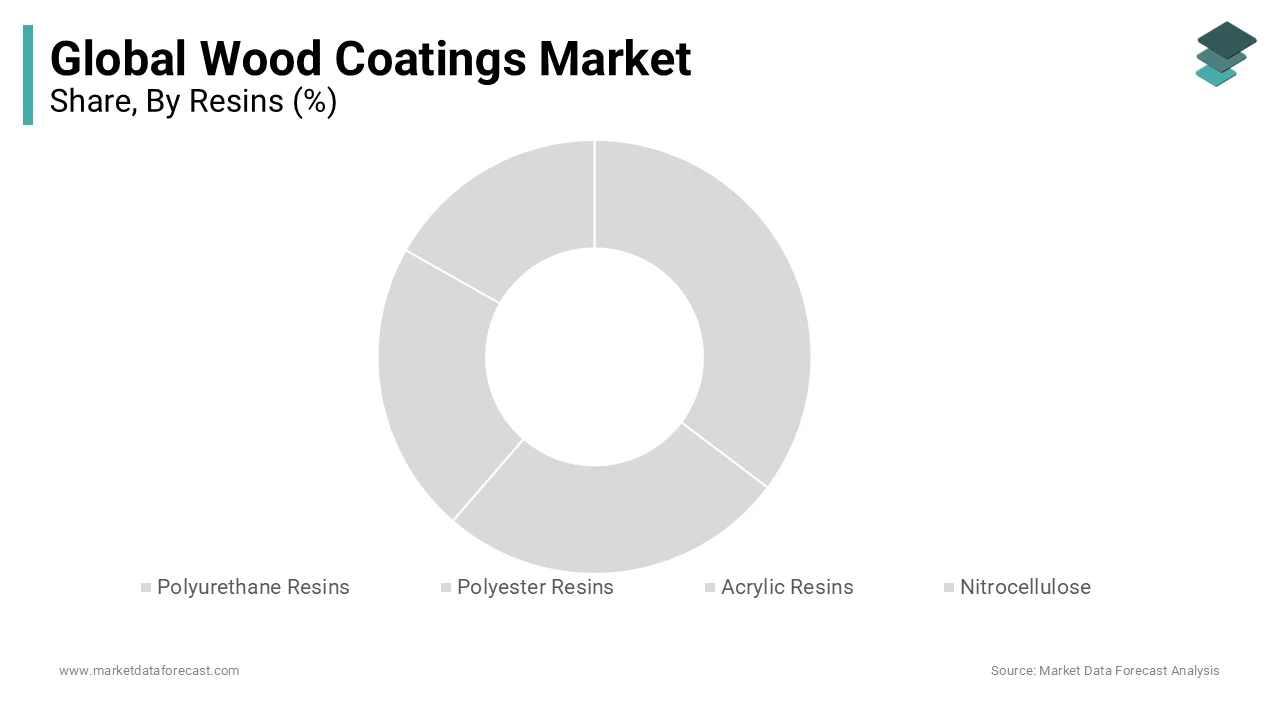
The polyester resins segment is expected to lead the wood coatings market with A CAGR of 7.6% from 2025 to 2033. The rapid growth of the polyester resins segment is propelled by their widespread use in high-gloss and durable finishes for medium-density fiberboard (MDF) furniture and kitchen cabinets, particularly in mass production environments. Unsaturated polyester coatings offer exceptional hardness, scratch resistance, and rapid curing, especially when combined with UV technology, which makes them ideal for industrial wood finishing lines. According to a study, a portion of MDF-based furniture exported from China was coated with UV-curable polyester systems to meet European environmental and performance standards.
By Formulating Technology Insights
The solvent-borne coatings segment was the largest in the wood coatings market by capturing 48.6% share of the global market in 2025. The prominence of the solvent-borne coatings segment is due to superior film formation, deep penetration, and fast drying. These are qualities essential for high-end furniture, cabinetry, and restoration work. According to research, solvent-borne nitrocellulose and acid-curing coatings achieve higher gloss and better leveling than water-based alternatives, making them the preferred choice for luxury wood finishes. Apart from these, in tropical regions like Southeast Asia, where humidity hampers waterborne curing, solvent systems remain indispensable.
The UV-cured coatings segment is likely to experience the fastest CAGR of 9.3% from 2025 to 2033. Their near-zero VOC emissions, instant curing, and energy efficiency are majorly contributing to the growth of the UV-cured coatings segment. It is important for industrial automation and sustainability compliance. According to the study, UV curing consumes less energy than thermal drying, reducing carbon emissions and operational costs. In Europe, a share of MDF furniture production lines use UV-curable coatings, as per research, driven by EU Ecolabel requirements and circular economy mandates. Besides, UV coatings offer superior hardness and chemical resistance, which makes them ideal for kitchen cabinets and commercial interiors.
By Application Insights
The furniture segment dominated, holding the leading share of 36.4% of the global wood coatings market in 2025. The global scale of furniture manufacturing and the important role of coatings in enhancing both aesthetics and longevity are the factors contributing to the furniture segment in the global market. According to research, millions of cubic meters of engineered wood, primarily MDF and particleboard, were used in furniture production globally, requiring protective and decorative finishes. In India, the organized furniture business grew, fueled by urbanization and rising disposable incomes, according to a study. Coatings must meet diverse requirements, from scratch resistance in office furniture to low-VOC emissions in children’s products, which makes formulation versatility essential.
The flooring application segment is likely to grow with an expected CAGR of 8.7% from 2025 to 2033. The rising demand for hardwood and engineered wood flooring in both new construction and renovation projects is accelerating the expansion of the flooring application segment. In Europe, a portion of apartment renovations included floor refinishing, driven by aesthetic preferences and durability needs. Engineered wood flooring, which requires multi-layer protective coatings, accounts for a portion of global wood flooring sales. Furthermore, commercial applications in retail, hospitality, and healthcare are adopting high-performance polyurethane and UV-cured systems for their abrasion and chemical resistance.
REGIONAL ANALYSIS
Asia-Pacific Wood Coatings Market Insights
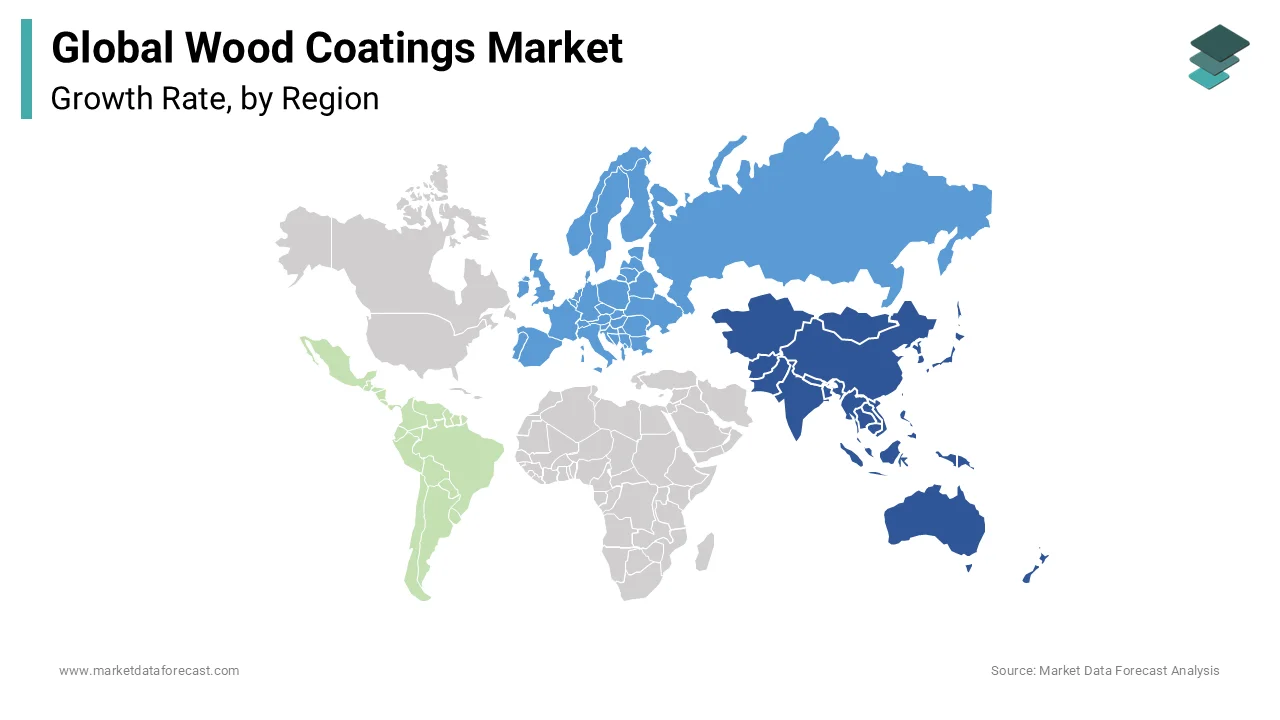
Asia-Pacific outperformed other regions in the wood coatings market by capturing 3a 9.5% share in 2025. China and India are the primary drivers, with China dominating global furniture exports. The country has banned solvent-borne wood coatings in major cities, accelerating the shift to waterborne and UV-cured systems. In India, the housing and infrastructure boom under PM Awas Yojana is fueling demand for interior wood finishes. Vietnam and Indonesia are major furniture manufacturing hubs, exporting a notable amount of wood products. These exports require coatings compliant with EU and U.S. environmental standards, driving investment in low-VOC technologies.
Europe Wood Coatings Market Insights: The
Europe market held 26.2% of the share in 2025 due to its regulatory prominence and emphasis on sustainability. The European Union’s VOC Solvents Emission Directive and Ecolabel standards have reshaped the market, which mandates low-emission formulations and promotes circular design. A portion of the EU’s existing housing stock underwent renovation, many involving wood floor refinishing, kitchen upgrades, and key coating applications. Germany, the region’s largest market, consumes notable metric tons of wood coatings annually, as per a study. The country’s advanced industrial base relies heavily on UV-cured and waterborne systems for MDF furniture and cabinetry.
North America Wood Coatings Market Insights
North America market growth is likely to grow with the residential construction and a mature renovation sector. The United States is the primary consumer. Millions of square feet of wood flooring are installed annually in the U.S., requiring protective coatings. Besides, the DIY landscape is a major driver. Canada’s growing modular housing sector is also increasing demand for factory-applied finishes. According to the study, waterborne coatings account for a portion of architectural wood finishes sold in North America.
Latin America Wood Coatings Market Insights
Latin America is growing moderately in the wood coatings market, with Brazil and Mexico emerging as key growth centers despite infrastructural and regulatory challenges. Brazil is the largest furniture producer in the region, generating a notable amount in domestic sales, as per research. The country’s tropical climate demands coatings with high moisture and UV resistance by favoring solvent-borne and modified polyurethane systems. However, urban centers are adopting low-VOC regulations aligned with European standards. In Mexico, the rise of export-oriented furniture manufacturing, particularly to the U.S., has increased demand for compliant, high-performance finishes. Furthermore, Argentina and Chile are expanding engineered wood production, creating new demand for industrial coatings. Government incentives and export burdens are driving a gradual shift toward modern and sustainable coating technologies, while small workshops still rely on traditional methods.
Middle East and Africa Wood Coatings Market Insights
The Middle East and Africa are predicted to expand in the global wood coatings market over the forecast period. The United Arab Emirates leads the region, with Dubai’s luxury real estate and hospitality sectors driving demand for high-end wood finishes in interiors and furniture. Saudi Arabia’s Vision 2030 includes massive urban development projects like NEOM and the Red Sea Project, which will require millions of square meters of premium wood finishes. Egypt has emerged as a regional manufacturing hub, exporting furniture to North Africa and the Levant.
COMPETITIVE LANDSCAPE
KEY MARKET PLAYERS
Some of the leading companies in the global wood coatings market are
- Evonik (Essen, Germany)
- DSM (Heerlen, Netherlands)
- Dow (Michigan, U.S.)
- Akzo Nobel N.V. (Amsterdam, Netherlands)
- Asian Paints (Mumbai, India)
- Kansai Nerolac Paints Limited (Osaka, Japan)
- RPM International Inc. (Ohio, U.S.)
- The Sherwin-Williams Company (Ohio, U.S.)
- Teknos Group (Helsinki, Finland)
- Axalta Coating Systems (Pennsylvania, U.S.)
- Nippon Paint Holdings Co., Ltd (Osaka, Japan)
- Stahl Holdings (Waalwijk, Netherlands)
- Valspar (Minnesota, U.S.)
- IVM Group (Milan, Italy)
TOP STRATEGIES USED BY THE KEY MARKET PARTICIPANTS
Key players in the wood coatings market are leveraging technological innovation, regulatory anticipation, and regional customization to secure a competitive advantage. Companies are investing heavily in waterborne, UV-cured, and bio-based formulations to comply with tightening VOC regulations in Europe, North America, and China. Strategic partnerships with furniture OEMs, flooring manufacturers, and construction firms enable co-development of application-specific solutions. Firms are expanding technical service networks and innovation centers in Asia and Latin America to support local customers in reformulation and compliance. Digital tools such as color-matching apps, formulation calculators, and sustainability dashboards are being deployed to enhance customer engagement. Mergers and acquisitions are being used to gain access to niche technologies and regional distribution.
COMPETITION OVERVIEW
The competition in the wood coatings market is intensifying as global chemical giants, regional formulators, and specialty innovators converge in a race to balance performance, sustainability, and regulatory compliance. Unlike commoditized segments, differentiation here is driven by formulation expertise, application support, and environmental credentials rather than price alone. Incumbents like AkzoNobel and PPG compete with agile regional players through technical superiority and brand trust, while startups are emerging with bio-based and smart coating technologies. The shift from solvent-borne to waterborne and UV-cured systems is reshaping competitive dynamics, favoring companies with R&D agility and manufacturing adaptability.
TOP LEADING PLAYERS IN THE MARKET
AkzoNobel
AkzoNobel has established a strong presence in the Asia-Pacific wood coatings market through its Sikkens and International brands, delivering high-performance, sustainable finishes for furniture, flooring, and architectural applications. The company has tailored its solvent-free and waterborne polyurethane systems to meet stringent environmental regulations. In India, the company expanded its technical service team to support modular kitchen and flooring brands transitioning to low-emission finishes.
PPG Industries
PPG has strengthened its position in the Asia-Pacific wood coatings market by delivering innovative, high-durability finishes for industrial and consumer applications. The company’s BEMCOT and PSX product lines are widely used in furniture and flooring manufacturing across China, Thailand, and Indonesia, where demand for export-compliant, low-VOC coatings is rising. PPG is shaping the future of high-quality, sustainable wood finishes in Asia by combining performance innovation with regional customization.
Sherwin-Williams
Sherwin-Williams has significantly expanded its footprint in the Asia-Pacific wood coatings market through strategic acquisitions and localized product development. Following its acquisition of Comex in Latin America and increased investment in Asian operations, the company launched its SuperDeck and Minwax Pro series, targeting contractors and high-end residential projects. Furthermore, Sherwin-Williams enhanced its digital color-matching tools for distributors, which improves customer experience and reduces waste. The company is building a scalable and customer-centric wood coatings business across the region by integrating global expertise with regional needs.
MARKET SEGMENTATION
This research report on the global wood coatings market is segmented and sub-segmented into the following categories.
By Resins
- Polyurethane Resins
- Polyester Resins
- Acrylic Resins
- Nitrocellulose
- Others
By Formulating Technology
- Solvent-Borne Coatings
- Waterborne Coatings
- UV-Cured Coatings
- Powder Coatings
- Others
By Application
- Furniture
- Flooring
- Cabinetry & Joinery
- Doors & Windows
- Others
By Region
- Asia Pacific
- Europe
- North America
- Latin America
- Middle East & Africa