- Product Description Description
- Table of Contents TOC
- List of Table & Figure LOT
- Get Free Sample PDF Sample PDF
Market Size, 2025
$43.51 BnMarket Estimate, 2026
$45.08 BnMarket Forecast, 2034
$59.82 BnCAGR, 2026–2034
3.6%Global Wool Market Summary
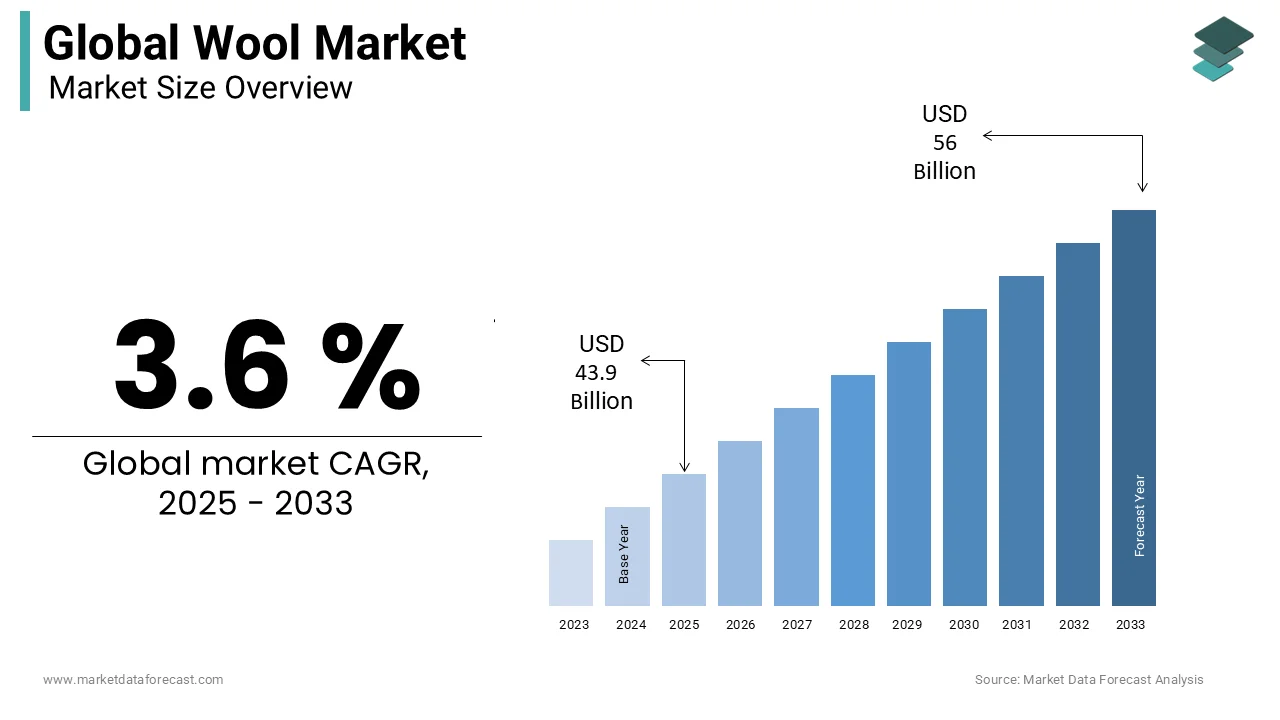
The global wool market was valued at USD 43.51 billion in 2025, is estimated to reach USD 45.08 billion in 2026, and is projected to grow to USD 59.82 billion by 2034, registering a CAGR of 3.6% from 2026 to 2034. Growth is being supported by rising demand for sustainable fibers, performance apparel expansion, regenerative agriculture adoption, and premium luxury textile consumption.
Key Market Highlights
- 2025 Market Size: USD 43.51 Billion
- 2026 Estimate: USD 45.08 Billion
- 2034 Forecast: USD 59.82 Billion
- CAGR (2026–2034): 3.6%
- Largest Source: Sheep Wool
- Dominant Type: Merino (45.3% share in 2025)
- Fastest-Growing Type: Cashmere (11.3% CAGR)
- Fastest-Growing Source: Alpaca Fiber (10.7% CAGR)
- Leading Region: Asia Pacific (38.2% share in 2025)
Quick Growth Drivers
- Consumer shift toward biodegradable and microplastic-free fibers
- Performance and activewear integration of Merino wool
- Luxury fashion demand for cashmere and fine fibers
- Carbon-positive regenerative grazing initiatives
- Wool-based building insulation adoption in Europe
Principal Restraints
- Climate-driven sheep population decline
- Land-use conversion toward dairy and meat farming
- Animal welfare scrutiny (mulesing controversy)
- Increasing certification and traceability costs
- Supply volatility in drought-prone regions
High-Value Opportunities
- Plasma-treated and antimicrobial wool fibers
- Wool-polymer composites for automotive interiors
- Keratin extraction for medical hydrogels and wound dressings
- Carbon-negative regenerative wool branding
- Blockchain-enabled farm-to-fashion traceability
Key Market Challenges
- Competition from recycled polyester and bioengineered synthetics
- Fragmented global supply chains
- Inconsistent fiber grading and documentation
- Limited farm-level traceability (≈40% fully traceable globally)
- Climate vulnerability in pastoral regions
Fastest-Growing Segments
By Source
- Sheep Wool: Largest share — global distribution and scale
- Alpaca Fiber: 10.7% CAGR — luxury hypoallergenic demand
By Type
- Merino: 45.3% share — activewear and next-to-skin garments
- Cashmere: 11.3% CAGR — premium fashion expansion
By End-Use
- Apparel & Fashion: Dominant segment
- Industrial & Technical Textiles: Emerging high-margin applications
Regional Leadership & Dynamics
Asia Pacific (38.2% Share – 2025 Leader)
China processes over 40% of global raw wool and leads global cashmere production from Inner Mongolia. India’s textile clusters and Japan’s premium apparel demand further strengthen regional leadership.
Europe (29.3% Share)
Italy remains Europe’s processing hub, with Prato leading wool recycling. Strong luxury brand concentration and circular economy initiatives reinforce demand.
North America
Driven by performance apparel and outdoor brands. Merino adoption is accelerating across activewear and travel clothing.
Latin America
Peru dominates alpaca production with government-backed traceability programs aimed at export expansion.
Middle East & Africa
South Africa leads Merino exports, while camel fiber innovation is emerging in dryland resilience programs.
What Wins Commercially (Competitive Edge)
- Verified traceability and Responsible Wool Standard certification
- Regenerative and carbon-labeled wool products
- Hybrid fiber innovation (wool blends & composites)
- Premium branding and heritage storytelling
- Direct sourcing partnerships with herders
Top Strategic Ask for Executives
- Invest in blockchain-based supply chain transparency
- Expand regenerative grazing certification programs
- Diversify fiber sourcing beyond drought-prone regions
- Accelerate hybrid wool material R&D
- Strengthen luxury and performance segment positioning
Leading Players
Some of the companies that are playing a dominating role in the global wool market include:
- Indorama Ventures Public Company Limited
- Loro Piana S.p.A.
- Xinao Textiles Inc.
- Marzotto Group
- Südwolle Group GmbH
- Pendleton Woolen Mills
- The Woolmark Company
Global Wool Market Size
The global wool market was valued at USD 43.51 billion in 2025, is estimated to reach USD 45.08 billion in 2026, and is projected to reach USD 59.82 billion by 2034, growing at a CAGR of 3.6% from 2026 to 2034.
The wool is a natural fiber derived from sheep, valued for its thermal regulation, moisture-wicking, and biodegradable properties. Unlike synthetic textiles, wool fibers are composed of keratin, enabling resilience, flame resistance, and low environmental persistence. Australia and New Zealand remain pivotal producers, collectively managing over 100 million sheep, according to the Australian Bureau of Agricultural and Resource Economics and Sciences. Wool’s hygroscopic nature allows it to absorb up to 30% of its weight in moisture without feeling damp, a trait leveraged in performance apparel and bedding.
MARKET DRIVERS
Rising Consumer Preference for Sustainable and Biodegradable Fibers
The growing consumer shift toward environmentally responsible textiles, which is driven by awareness of microplastic pollution and synthetic fiber persistence, is driving the growth of the wool market. According to the Ellen MacArthur Foundation, polyester and nylon account for over 60% of global fiber production, with each garment releasing a high number of microplastic fibers per wash, which is contributing to marine contamination. As per the European Environment Agency, wool garments generate 64% lower carbon footprint over their lifecycle compared to equivalent polyester items when accounting for production, use, and disposal. Retailers such as Patagonia and Allbirds have publicly committed to increasing wool-based product lines, citing lifecycle assessments that favor natural fibers. This ecological advantage, combined with increasing regulatory scrutiny on synthetic textiles in the EU and Canada, is reinforcing wool’s appeal among eco-conscious consumers and brands pursuing circular economy models.
Expansion of Technical and Performance Wool Applications
The wool is increasingly transcending traditional apparel uses and penetrating high-performance sectors due to its innate thermoregulatory and odor-resistant properties, which additionally enhance the growth of the wool market. The outdoor and activewear industries are integrating Merino wool into base layers, socks, and sportswear, capitalizing on its ability to regulate body temperature across extreme conditions. As per the Outdoor Industry Association, wool-based activewear sales in the U.S. grew by 18% between 2021 and 2023, outpacing synthetic alternatives. NASA has utilized wool insulation in space suit prototypes due to its non-flammability and thermal stability, as documented in a 2022 technical bulletin from the Johnson Space Center. Additionally, wool is being adopted in building insulation. Sheep’s wool insulation products have been installed in over 25,000 homes across the UK and Germany, according to the International Wool Bureau, offering comparable R-values to fiberglass without off-gassing.
MARKET RESTRAINTS
Volatility in Sheep Farming Due to Climate Change and Land Use Pressures
The wool supply chain is increasingly vulnerable to climatic disruptions and shifting agricultural priorities, which are major factors hampering the growth of the wool market. In East Africa, recurrent droughts have diminished pastoralist flocks by up to 60% in Kenya and Somalia, as per the Intergovernmental Authority on Development. Simultaneously, competition for arable land from crop farming and livestock for meat production is marginalizing wool sheep rearing. In New Zealand, beef and dairy conversions have reduced sheep numbers from a peak of 70 million in 1982 to under 27 million in 2023, according to Stats NZ. The raw wool availability, increased price volatility, and threat to long-term supply stability are limiting the growth of the wool market.
Animal Welfare Concerns and Ethical Sourcing Scrutiny
The rising criticism over animal husbandry practices, which is a surgical procedure used to prevent flystrike in Merino sheep, is additionally degrading the growth of the wool market. As per the Royal Society for the Prevention of Cruelty to Animals Australia, over 70% of Merino flocks in Australia underwent mulesing in 2022, though the practice is increasingly opposed by international retailers. Brands including H&M, Zara, and Marks & Spencer have implemented strict no-mulesing policies, restricting procurement to certified suppliers. Additionally, Greenpeace’s 2023 “Fashion Detox” campaign highlighted traceability gaps in wool supply chains, with only 35% of major brands able to verify full farm-level sourcing, according to the Changing Markets Foundation. These ethical challenges erode consumer trust and necessitate costly certification and auditing systems, increasing operational complexity and limiting market access for non-compliant producers.
MARKET OPPORTUNITIES
Advancements in Wool Fiber Modification and Hybrid Textile Development
Innovations in fiber engineering are unlocking new performance dimensions for wool, enabling hybrid materials that combine natural benefits with enhanced durability and functionality. Researchers at the Commonwealth Scientific and Industrial Research Organisation (CSIRO) have developed plasma-treated wool fibers with water-repellent and antimicrobial surfaces, eliminating the need for chemical coatings. The University of Leeds has pioneered wool-polymer composites for use in biodegradable packaging and automotive interiors, with mechanical strength comparable to synthetic foams. Additionally, wool keratin is being extracted for use in bio-based adhesives and hydrogels; a 2023 study in Advanced Functional Materials demonstrated keratin-based wound dressings with 90% cell viability and accelerated healing. These advancements position wool not just as a textile, but as a platform for sustainable biomaterials in medical, industrial, and packaging sectors.
Growth of Regenerative Agriculture and Carbon-Positive Farming Models
The increasing alignment with regenerative agricultural practices that sequester carbon and restore soil health is creating new opportunities for the growth of the wool market. As per the Savory Institute, well-managed grazing systems using sheep can increase soil organic carbon by 0.5 to 1 ton per hectare annually, turning pastures into carbon sinks. In Patagonia, Argentina, over 1 million hectares of rangeland are now certified under regenerative wool standards, verified by the Land to Market program. The Soil Carbon Initiative has measured net carbon-negative wool production in select Australian farms, where methane emissions are offset by soil carbon capture. Brands such as Icebreaker and Woolmark are launching carbon-labeled wool garments, providing transparency on environmental impact. This integration of wool into climate-positive agriculture enhances its appeal to sustainability-driven investors and consumers.
MARKET CHALLENGES
Competition from Recycled and Bioengineered Synthetic Alternatives
The intensifying competition from advanced synthetic fibers engineered to mimic wool’s properties while offering lower cost and consistent supply is slightly declining the growth of wool. Recycled polyester is now constituting 15% of global polyester production as per the Textile Exchange, which is being enhanced with phase-change materials to emulate wool’s thermoregulation. Companies like Infinited Fiber and Renewcell are producing bio-based viscose with wool-like softness and breathability, scalable from textile waste. Additionally, bioengineered spider silk proteins, such as those developed by Bolt Thread, offer high tensile strength and moisture management, with performance metrics rivaling Merino wool. These alternatives benefit from controlled production environments, which avoid climatic and ethical vulnerabilities associated with animal farming.
Fragmented Supply Chain and Lack of Standardized Traceability
The wool supply chain spans remote pastoral regions to global textile hubs, resulting in opacity and inconsistent quality control. According to the International Wool Textile Organisation, only 40% of wool bales traded globally are fully traceable from farm to fabric, limiting transparency for brands and consumers. In regions like Central Asia and North Africa, informal trading networks dominate, bypassing certification systems such as ZQ or Responsible Wool Standard. The absence of blockchain-enabled tracking or universal grading protocols leads to variability in fiber diameter, cleanliness, and ethical compliance. A 2023 audit by Textile Exchange revealed that 30% of wool labeled as “non-mulesed” lacked verifiable documentation. This fragmentation increases compliance risks and discourages large-scale procurement by ethical retailers.
REPORT COVERAGE
| REPORT METRIC | DETAILS |
| Market Size Available | 2025 to 2034 |
| Base Year | 2025 |
| Forecast Period | 2026 to 2034 |
| Segments Covered | By Source, Type, End-Use Application, and Region. |
| Various Analyses Covered | Global, Regional, and Country-Level Analysis, Segment-Level Analysis, Drivers, Restraints, Opportunities, Challenges; PESTLE Analysis; Porter’s Five Forces Analysis, Competitive Landscape, Analyst Overview of Investment Opportunities |
| Countries Covered | North America, Europe, APAC, Latin America, Middle East & Africa |
| Market Leaders Profiled | Indorama Ventures Public Company Limited, Loro Piana S.P.A., Xinao Textiles Inc., Marzotto Group, Südwolle Group GmbH, Merinotex, Pendleton Woolen Mill, The Woolmark Company |
SEGMENTAL ANALYSIS
By Source Insights
The sheep-sourced segment accounted for a prominent share of the wool market in 2025, with the species’ global distribution, high fleece yield, and adaptability to diverse climates. Merino sheep alone contribute over 60% of fine apparel wool, prized for fiber diameters averaging 17–21 microns, as verified by the International Wool Textile Organisation. Additionally, established shearing infrastructure, standardized grading systems like the Australian Wool Testing Authority protocols, and decades of breeding refinement have optimized quality and consistency.
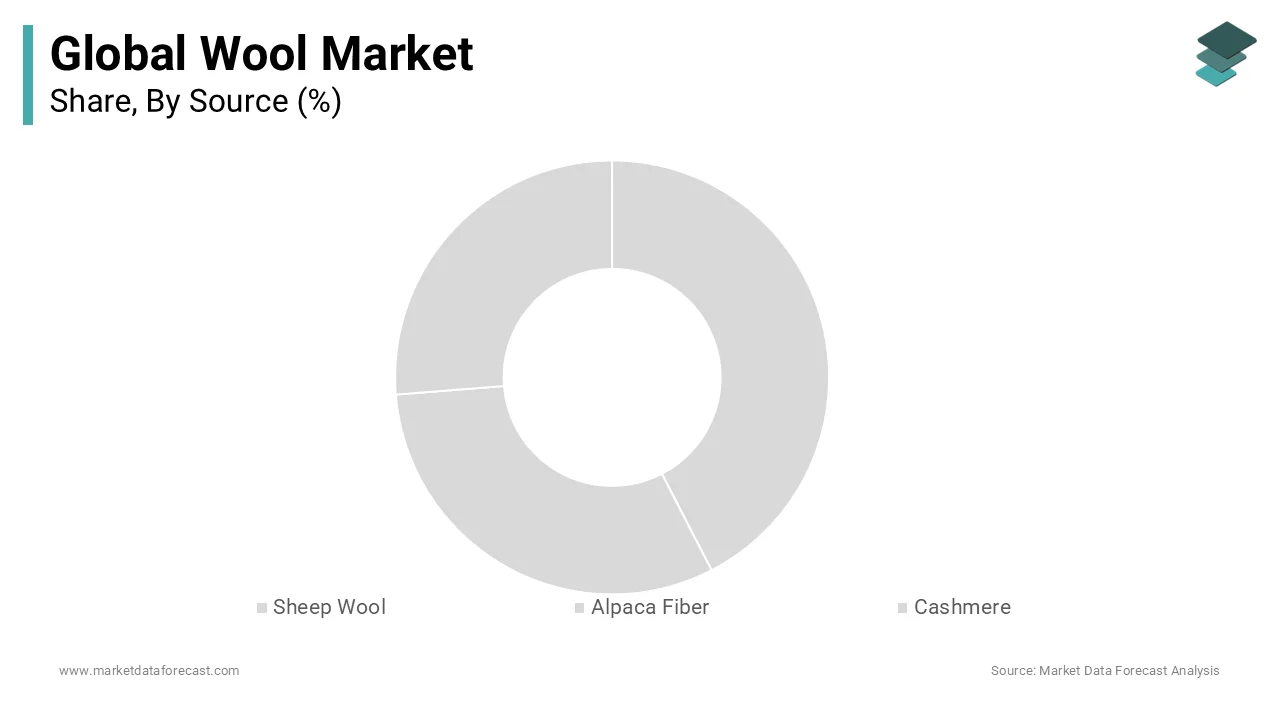
The alpaca fiber segment is likely to grow with an expected CAGR of 10.7% during the forecast period, with the rising demand for hypoallergenic, ultra-soft luxury fibers in high-end fashion and sustainable apparel. Unlike sheep wool, alpaca fiber lacks lanolin, reducing processing costs and allergenic potential, a trait increasingly valued by eco-conscious consumers. The U.S. Department of Commerce reports a 32% increase in alpaca fiber imports between 2021 and 2023 for premium knitwear. Additionally, alpaca farming requires less water and land degradation than sheep, aligning with regenerative agriculture trends.
By Type Insights
The Merino segment held 45.3% of wool market share in 2025 with an exceptional balance of fineness, softness, and performance, with average fiber diameters ranging from 15 to 24 microns, enabling use in next-to-skin garments without irritation. The Australian Merino industry produces over 300,000 tonnes of greasy wool annually, according to the Australian Wool Innovation Limited, with 70% exported to premium textile manufacturers in Italy, China, and Germany. Independent testing by the Hohenstein Institute confirms that Merino regulates body temperature effectively across -5°C to 35°C, making it ideal for activewear and travel clothing. The rise of performance lifestyle brands such as Icebreaker and Smartwool, which rely exclusively on Merino, has further amplified demand.
The cashmere segment is likely to grow with an expected CAGR of 11.3% during the forecast period, by escalating demand from luxury fashion houses and affluent consumers in North America and Asia seeking premium, sustainable textiles. China produces over 70% of the world’s raw cashmere, primarily from the arid regions of Inner Mongolia, where climate conditions enhance fiber fineness. According to the European Fashion Council, cashmere now features in 60% of winter collections from top-tier designers, including Max Mara and Brunello Cucinelli. Additionally, advancements in dehairing technology have improved yield efficiency by 20%, according to the Scottish Cashmere Cluster.
REGIONAL ANALYSIS
Asia Pacific Wool Market Insights
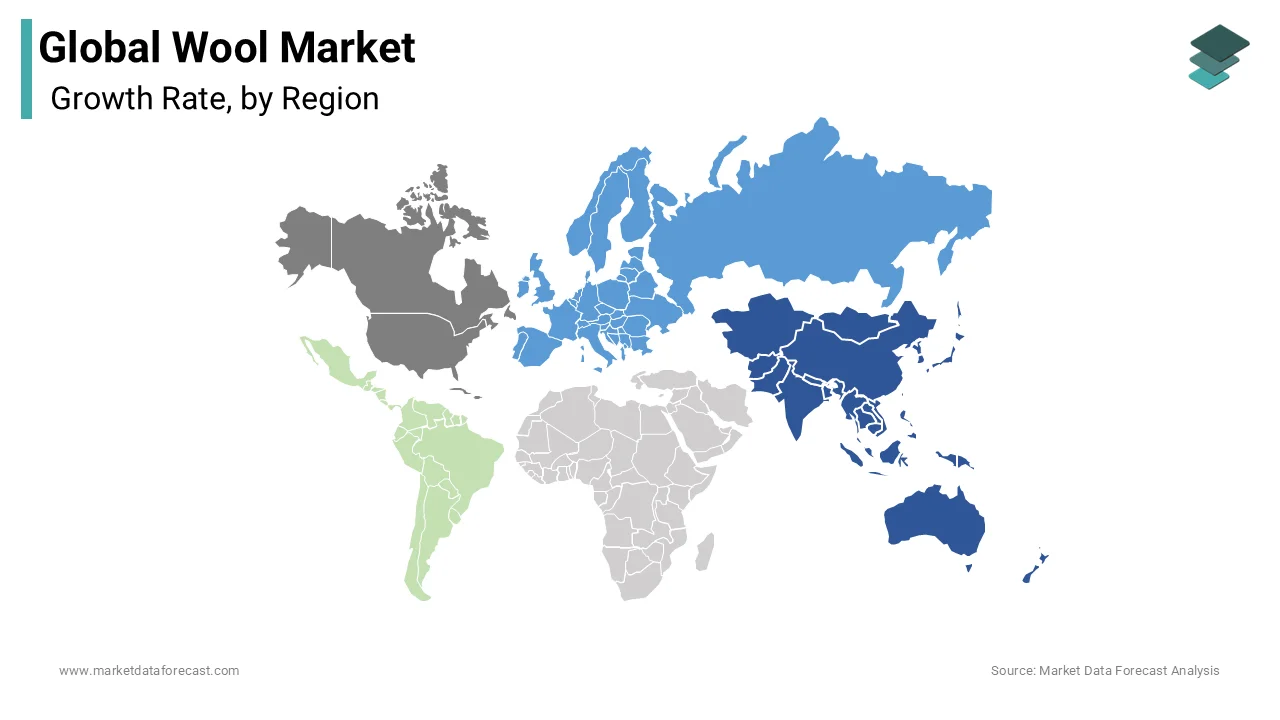
Asia Pacific was the top performer of the global wool market with 38.2% share in 2025. China is processing over 40% of the world’s raw wool, as per the China Wool Textile Association. The country is also the leading producer of cashmere, which is sourced from Inner Mongolian herders who manage more than 80% of the global goat herds. India’s woolen textile industry, concentrated in Punjab and Himachal Pradesh, processes over 45,000 tonnes annually, according to the Office of the Development Commissioner (Handicrafts). Simultaneously, domestic demand is rising—Japan’s Ministry of Economy, Trade and Industry reports a 12% annual increase in premium wool apparel sales, driven by aging demographics seeking thermal comfort.
Europe Wool Market Insights
Europe held 29.3% of the global wool market share in 2025, with its legacy in high-value textile finishing and luxury fashion. Italy is the continent’s processing leader, converting over 50,000 tonnes of raw wool annually into premium fabrics, as reported by the Italian National Fashion Chamber. Prato in Tuscany alone recycles and reprocesses 15% of Europe’s wool waste, according to the European Environment Agency, supporting circular economy initiatives. The United Kingdom maintains a strong heritage in wool production, with Shetland and Yorkshire mills producing region-specific blends protected under geographical indication schemes.
North America Wool Market Insights
North America's wool market growth is expected to grow with growing consumer demand for performance and sustainable textiles. The United States is the largest importer of raw and processed wool in the region, with annual imports exceeding 35,000 tonnes, as documented by the U.S. International Trade Commission. Domestic production is concentrated in Merino farming in Texas and New Mexico, where selective breeding has improved fiber fineness to match Australian standards, according to the American Sheep Industry Association. Canada’s growing alpaca and yak wool sectors, particularly in British Columbia and Alberta, are supplying niche luxury markets. The Outdoor Industry Association reports that 68% of outdoor apparel brands now incorporate Merino wool into base layers due to its odor resistance and moisture management. Retail giants like REI and Patagonia have launched wool-centric sustainability campaigns, amplifying consumer awareness.
Latin America Wool Market Insights
The American wool market is growing steadily, with production centered on camelid fiber and regional sheep breeds. Peru is the world’s leading producer of alpaca fiber, generating over 4,000 tonnes annually, as per the National Institute for the Defense of Competition and the Protection of Intellectual Property (INDECOPI). The Peruvian government has established the National Alpaca Program to improve breeding, shearing, and traceability, aiming to increase export value by 50% by 2027.
Middle East & Africa Wool Market Insights
The Middle East and Africa wool market is likely to grow, with production primarily focused on traditional and subsistence-level pastoralism. South Africa is the region’s most advanced player, producing high-quality Merino wool with fiber diameters below 19 microns, comparable to Australian standards, as verified by the South African Wool Board. The country exports over 90% of its greasy wool, mainly to China and Europe. Intergovernmental Authority on Development’s dryland resilience programs. The United Nations Development Programme reports that camel fiber, naturally insulating and durable, is being piloted in eco-tourism apparel.
COMPETITIVE LANDSCAPE
KEY MARKET PLAYERS
Some of the major companies in the global wool market include
- Indorama Ventures Public Company Limited
- Loro Piana S.P.A.
- Xinao Textiles Inc.
- Marzotto Group
- Südwolle Group GmbH
- Merinotex
- Pendleton Woolen Mills
- The Woolmark Company
TOP STRATEGIES USED BY THE KEY MARKET PARTICIPANTS
Key players in the wool market are deploying integrated strategies focused on traceability, sustainability certification, and product differentiation to strengthen their competitive edge. Companies are investing in blockchain-enabled supply chain transparency to meet consumer and regulatory demands for ethical sourcing. Strategic partnerships with farming communities ensure long-term fiber quality and animal welfare compliance. Innovation in processing technologies, such as plasma treatment and water dyeing, enhances performance while reducing environmental impact. Brands are also leveraging storytelling and heritage branding to position wool as a premium, eco-conscious alternative to synthetics. Expansion into high-growth markets in Asia and North America is supported by localized product development and collaborations with fashion designers.
COMPETITION OVERVIEW
The competitive landscape of the wool market is shaped by a blend of heritage brands, certification bodies, and emerging sustainable textile innovators vying for influence across fragmented geographies and applications. Unlike commoditized fibers, competition is driven by quality differentiation, traceability, and brand equity rather than price alone. European luxury houses dominate the high-end segment, while Australian and New Zealand organizations lead in fiber standards and scientific validation. In Asia, processors and retailers are gaining leverage through vertical integration and domestic demand growth. The rise of eco-labeling and carbon footprint transparency is intensifying pressure on suppliers to demonstrate ethical and environmental compliance. Smaller producers of specialty fibers like alpaca and cashmere are carving niches through exclusivity and storytelling.
TOP LEADING PLAYERS IN THE MARKET
The Woolmark Company
The Woolmark Company has played a transformative role in advancing the quality, traceability, and global acceptance of Merino wool across the Asia Pacific region. In 2023, Woolmark launched the “Woolprint” digital passport in collaboration with blockchain provider TextileGenesis, enabling real-time tracking of wool from Australian farms to finished garments in Bangladesh and Indonesia. It also initiated educational campaigns with fashion institutions in South Korea and Japan to promote wool’s environmental advantages over synthetics. Woolmark is reinforcing the fiber’s alignment with circular economy principles by funding research at the CSIRO on low-impact dyeing techniques and carbon-neutral processing.
Loro Piana S.p.A.
Loro Piana has established itself as a benchmark for luxury wool sourcing and craftsmanship, with deep engagement across the Asia Pacific’s premium textile and apparel sectors. The company maintains long-term partnerships with herders in Inner Mongolia for cashmere and in Patagonia for guanaco fiber, ensuring exclusive access to the finest raw materials. In Japan, Loro Piana’s collaborations with traditional textile artisans have resulted in limited-edition wool blends that merge Italian tailoring with Japanese aesthetics. In 2023, the company opened a flagship innovation lab in Shanghai to develop climate-responsive wool fabrics tailored to Asian consumer preferences. It also strengthened its supply chain transparency by integrating satellite monitoring of grazing lands into its sustainability reporting.
Falabella S.A.
Falabella, through its textile and retail divisions, has emerged as a key regional player in promoting wool-based apparel across South America and increasingly in Southeast Asia. While primarily known for its retail footprint, the company has invested in vertical integration by sourcing directly from Peruvian alpaca cooperatives and Australian Merino suppliers, ensuring premium fiber quality for its private-label brands. In 2023, Falabella launched a sustainable fashion line in Chile and Colombia featuring traceable wool certified by the Responsible Wool Standard. It also partnered with the Pontifical Catholic University of Chile to study the carbon footprint of wool garments across their lifecycle. Expanding its e-commerce platform, the company introduced augmented reality try-ons for wool outerwear, enhancing consumer engagement.
MARKET SEGMENTATION
This research report on the Global Wool Market is segmented and sub-segmented into the following categories.
By Source
- Sheep Wool
- Alpaca Fiber
- Cashmere
- Others (Yak, Camel, etc.)
By Type
- Merino
- Cashmere
- Alpaca
- Others
By End-Use Application
- Apparel & Fashion
- Home Textiles
- Industrial & Technical Textiles
- Carpets & Rugs
- Others
By Region
- Asia Pacific
- Europe
- North America
- Latin America
- Middle East & Africa