- Product Description Description
- Table of Contents TOC
- List of Table & Figure LOT
- Get Free Sample PDF Sample PDF
Market Size, 2025
$23.92 BnMarket Estimate, 2026
$25.22 BnMarket Forecast, 2034
$38.56 BnCAGR, 2026–2034
5.45%Global Uterine Cancer Therapeutics Market Size, Growth, Trends & Forecast (2026–2034)
The global uterine cancer therapeutics market size was valued at USD 23.92 billion in 2025, is anticipated to reach USD 25.22 billion in 2026, and is projected to scale up to USD 38.56 billion by 2034, registering a compound annual growth rate (CAGR) of 5.45% during the forecast period from 2026 to 2034. Driven by rising global incidences of endometrial carcinoma, growing female obesity rates, widening cancer awareness, and expanded government healthcare expenditures, the market continues to experience steady, accelerated expansion.
Key Executive Metrics (At-a-Glance)
- 2025 Base Valuation: USD 23.92 Billion
- 2026 Current Valuation: USD 25.22 Billion
- 2034 Forecast Valuation: USD 38.56 Billion
- Compound Annual Growth Rate (CAGR): 5.45% (2026–2034)
- Dominant Type Segment: Endometrial Carcinoma (holding the largest share due to high global prevalence and obesity links)
- Fastest-Growing Therapy Segment: Immunotherapy (expanding rapidly via breakthrough immune checkpoint inhibitor approvals)
- Dominant Region: North America (accounting for the highest market share backed by advanced screening and high healthcare expenditure)
- Fastest-Growing Region: Asia-Pacific (accelerating through improved oncology infrastructure and government screening programs)
Core Market Drivers
- Rising Disease Prevalence: Growing rates of risk factors like obesity, metabolic syndromes, and an aging female demographic worldwide.
- Targeted Therapy Advancements: Breakthrough approvals of precision medicines, antibody-drug conjugates, and immunotherapies (e.g., pembrolizumab and lenvatinib combinations).
- Increased Screening & Awareness: Government and institutional initiatives, such as Gynecologic Cancer Awareness Month and national cancer control programs.
Primary Market Restraints & Challenges
- High Treatment Costs: Expensive multi-drug regimens, combination immunotherapies, and advanced surgical interventions causing affordability gaps.
- Clinical Hurdles: High clinical trial failure rates for rare conditions like uterine sarcoma alongside severe toxicity profiles associated with traditional chemotherapy.
Global Uterine Cancer Therapeutics Market Segmentation Breakdown
| Segment Category | Leading Sub-Segment (2025 Base) | Fastest-Growing Sub-Segment (2026–2034) |
|---|---|---|
| By Type | Endometrial Carcinoma (Accounts for ~68%–80% of total uterine cancers) | Uterine Sarcoma (Growing at a higher relative growth trajectory across specialized care centers) |
| By Therapy | Surgery & Chemotherapy (Core traditional foundations of uterine cancer management) | Immunotherapy & Hormone Therapy (Scaling rapidly via targeted biomarker and precision medicine protocols) |
| By Region | North America (Leading market share due to mature healthcare frameworks and early tech adoption) | Asia-Pacific (Expanding rapidly via improved screening infrastructure in India and China) |
Major Industry Players Profiled
Key enterprises shaping the competitive global uterine cancer therapeutics market include Abbott Laboratories, Ariad Pharmaceuticals, Inc., Becton, Dickinson and Company, F. Hoffmann-La Roche AG, GlaxoSmithKline Plc, Merck & Co., Inc., Novartis AG, Sanofi, Siemens Healthcare GmbH, and Takeda Pharmaceutical Company Ltd.
 Download Free Sample Report
Global Uterine Cancer Therapeutics Market Size
The Global Uterine Cancer Therapeutics Market is projected to grow from USD 23.92 billion in 2025 to USD 25.22 billion in 2026 and reach USD 38.56 billion by 2034, registering a CAGR of 5.45% during the forecast period from 2026 to 2034.
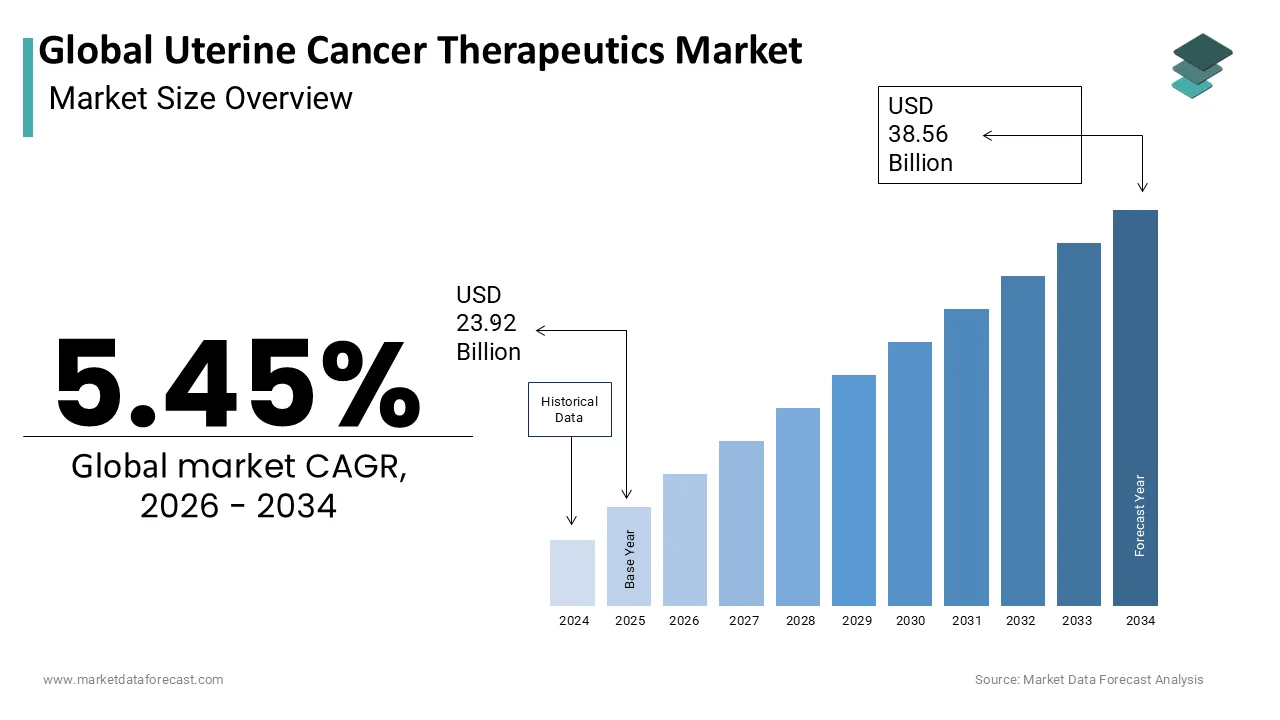
During the forecast period, the global Uterine Cancer Therapeutics Market is estimated to hike at a promising growth rate due to the widening awareness of uterine cancer and increasing healthcare expenditure. In the United States, September is Gynecologic Cancer Awareness Month. The American Association for Cancer Research has stated that endometrial carcinoma is prevalent globally, whereas Uterine Sarcoma is a rare cancer type. CDC has affirmed that around 68% of uterine cancers are endometrial carcinomas. Besides, developing nations like India has a National Cancer Control Programme founded in 1975–76. It has added to the expansion of Regional Cancer Centres (RCCs), oncology departments in medical institutes, and aid for teletherapy machine purchases. Further, awareness programs about cancer are being conducted, creating awareness among women about uterine cancer's severity. After studying the disease's critical nature and its importance, healthcare providers and governments are introducing awareness programs in several areas such as North America, Europe, and Asia-Pacific. With increasing government and healthcare providers' focus, it has been indicated that the market will increase during the forecast period.
MARKET DRIVERS
Increasing healthcare expenditure, the rising focus of the government to provide adequate healthcare solutions, growing advancements in cancer screening & treatment methods, and an increasing number of newly diagnosed uterine cancer cases are driving the growth of the global Uterine Cancer Therapeutics market. Besides, increasing advancements in the molecular diagnostics industry to support target-specific therapies and rising awareness among patients is further stimulating the global Uterine Cancer Therapeutics market.
There is a growing awareness of the prevalence of uterine cancer among both physicians and healthcare providers, who are now learning more deeply about the treatments available to treat these diseases. It is among the leading drivers of uterine cancer therapy and diagnosis on the global market. Also, massive increases in urban healthcare expenditures and initiatives by different governments to improve their healthcare infrastructure fuel the uterine cancer therapy and diagnosis market. Besides, advances in medical innovation and the launch of new drugs for uterine cancer encourage patients' investment in proper treatment.
MARKET RESTRAINTS
In particular, some of the factors that are likely to impede global market growth in uterine cancer therapy and diagnosis are the low success rate of cancer drug clinical trials, expensive treatment methods, adverse side effects, and severe toxicity of these medications.
REPORT COVERAGE
| REPORT METRIC | DETAILS |
| Market Size Available | 2025 to 2034 |
| Base Year | 2025 |
| Forecast Period | 2026 to 2034 |
| Segments Covered | By Type, Therapy and Region |
| Various Analyses Covered | Global, Regional & Country Level Analysis, Segment-Level Analysis, Drivers, Restraints, Opportunities, Challenges, PESTLE Analysis, Porter’s Five Forces Analysis, Competitive Landscape, Analyst Overview on Investment Opportunities |
| Regions Covered | North America, Europe, Asia Pacific, Latin America, Middle East & Africa |
| Market Leaders Profiled | Abbott Laboratories, Ariad Pharmaceuticals, Inc., Becton, Dickinson and Company, F. Hoffmann-La Roche AG, GlaxoSmithKline Plc, Merck & Co., Inc., Novartis AG, Sanofi, Siemens Healthcare GmbH & Takeda Pharmaceutical Company Ltd. |
SEGMENTAL ANALYSIS
By Type Insights

Based on type, the Endometrial Carcinoma segment is expected to hold the largest market share throughout the forecast period. According to Cancer.gov, the most frequent type of cancer found in women is endometrial adenosarcoma, and about 75-80% of uterine cancers are adenocarcinomas, which differ in severity. Increasing female obesity is considered a key factor accountable for the rising incidence of endometrium carcinoma, as about 90 percent of uterine cancers affect the endometrium. With the increasing prevalence of the disease and growing awareness of disease, substantial segment growth is expected to occur in the near future.
By Therapy Insights
Based on therapy, the segment of Immunotherapy is projected to be the fastest-growing segment during the forecast period.
REGIONAL ANALYSIS

The Global Uterine Cancer Therapeutics Market is expected to be dominated by North America shortly. The primary reason for market growth in this region is the increasing disease incidence and growing awareness among the general population. Furthermore, rapid diagnostic technological advances and quicker adoption of new technologies in the nation are causing the overall growth of the studied market.
The generality of endometrial cancer is much more considerable in developed nations such as the United States and North America, and the United Kingdom, according to recent World Health Organization (WHO) surveys. In the European region, this is a consequence of changing women's lifestyles in all these countries. The prevalence of uterine cancer in women over 50 years of age is more severe. It has also been disclosed that in developing nations such as India and China, the occurrence of cervical cancer is higher, making up 80% of the total incidence.
KEY MARKET PLAYERS
Companies leading the global uterine cancer therapeutics market profiled in the report are
- Abbott Laboratories
- Ariad Pharmaceuticals
- Inc., Becton
- Dickinson and Company
- F. Hoffmann-La Roche AG
- GlaxoSmithKline Plc
- Merck & Co., Inc.
- Novartis AG, Sanofi
- Siemens Healthcare GmbH
- Takeda Pharmaceutical Company Ltd.
RECENT HAPPENINGS IN THIS MARKET
- In August 2018, Merck & Co. Inc, in collaboration with Eisai Co., Ltd, received the Breakthrough Therapy designation from the US FDA to combine lenvatinib (Lenvima) pembrolizumab (Keytruda) for the treatment of patients with endometrial cancer. This designation enables the company to all fast-track designation features.
- In April 2018, the Swiss authority for the licensing and monitoring of therapeutic products (Swissmedic) approved Roche's Alecensa (alectinib) as a first-line treatment for patients with advanced or metastatic ALK (anaplastic lymphoma kinase)-positive, non-small cell lung cancer (NSCLC).
- In November 2017, The U.S. FDA approved Roche's skin cancer drug Zelboraf for treatment of patients with Erdheim-Chester Disease, a rare type of blood cancer.
- In May 2017, Merck & Co. Inc received the US FDA approval for pembrolizumab (Keytruda) to treat tumors with specific genetic changes, including endometrial cancer. For the first time, the FDA has approved a drug based on genetic differences. The main reason behind the approval of Keytruda was for the new indication using accelerated approval and priority review to speed up the availability of drugs in treating severe diseases.
MARKET SEGMENTATION
This research report on the global uterine cancer therapeutics market has been segmented and sub-segmented based on the type, therapy, and region.
By Type
-
Uterine Sarcoma
-
Endometrial Carcinoma
- Adenocarcinoma
- Carcinosarcoma
- Squamous cell carcinoma
- Others
By Therapy
-
Surgery
- Chemotherapy
- Radiation Therapy
- Immunotherapy
- Hormone Therapy
By Region
- North America
- Europe
- Asia Pacific
- Latin America
- The Middle East and Africa