- Product Description Description
- Table of Contents TOC
- List of Table & Figure LOT
- Get Free Sample PDF Sample PDF
Market Size, 2025
$64.41 BnMarket Estimate, 2026
$67.17 BnMarket Forecast, 2034
$93.92 BnCAGR, 2026–2034
4.28%Africa Tire Market Report Summary
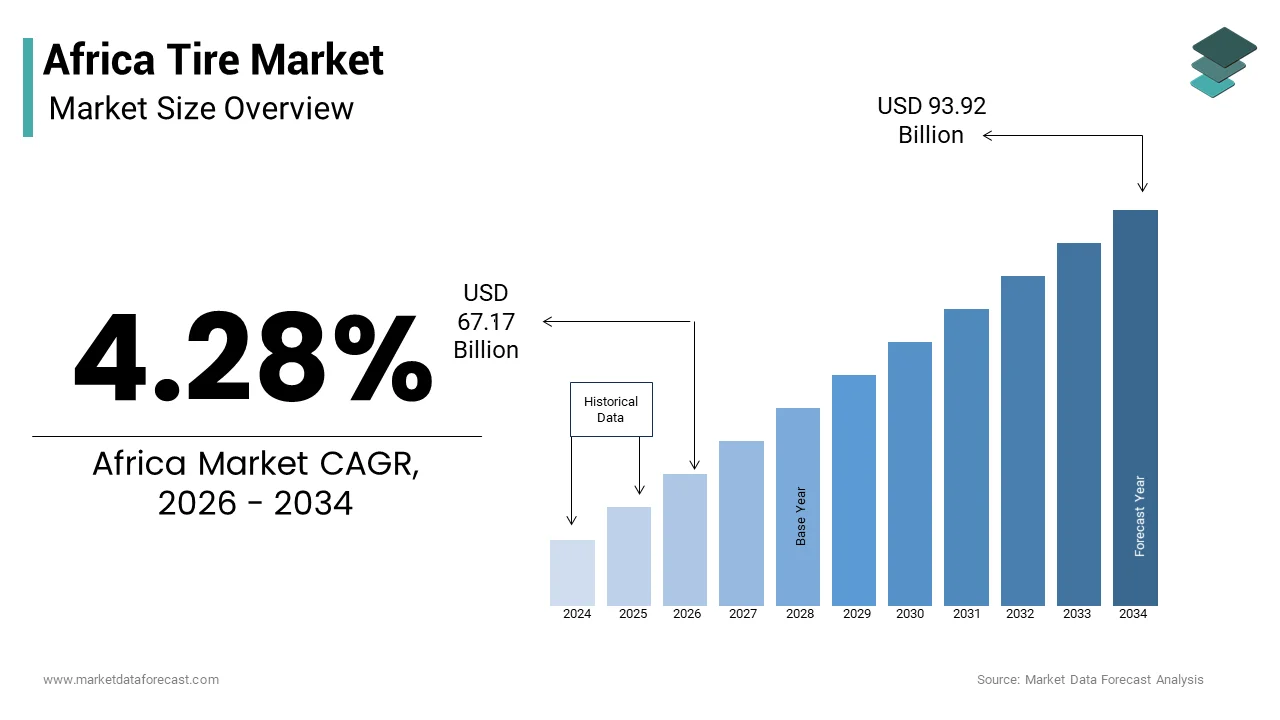
The African tire market was valued at USD 64.41 billion in 2025, and is estimated to reach USD 67.17 billion in 2026, and is projected to grow to USD 93.92 billion by 2034, expanding at a CAGR of 4.28% from 2026 to 2034. Market growth is supported by rising vehicle ownership, expansion of commercial transportation networks, and increasing demand for replacement tires due to aging fleets and challenging road conditions. Additionally, infrastructure development, logistics expansion, and the growing import of used vehicles continue to boost tire consumption across Africa.
Key Market Trends
- Increasing demand for radial tires due to longer lifecycle, fuel efficiency, and smoother ride performance.
- Significant growth of replacement tire sales is driven by frequent wear, poor road conditions, and rising aftermarket availability.
- Expansion of commercial transport fleets and construction activity is fueling M&HCV tire demand. The growing presence of global brands and partnerships is encouraging deeper distribution networks and localized production.
- Rising consumer preference for durable, affordable, and region-specific tire solutions suitable for varied terrain.
Segmental Insights
- Based on design, the radial tire segment led the market in 2024 with 68.4% share, supported by improved durability and enhanced performance benefits.
- Based on end use, the replacement tire segment dominated consumption due to sustained demand from aging vehicle fleets and aftermarket purchasing trends.
- Based on vehicle type, Medium and Heavy Commercial Vehicles (M&HCVs) accounted for 42.1% of total tire demand, driven by expanding transport and logistics activity across the continent.
Regional Insights
- South Africa emerged as the leading market in 2024, contributing 24.6% of regional demand owing to its advanced automotive base and extensive logistics network.
- Egypt also holds a major share backed by its large population, growing car fleet, and trade connectivity.
- Nigeria’s strong import-driven automotive sector underpins its notable market share.
- Kenya plays an important role as a logistics and transport hub for East Africa, supporting continuous tire consumption growth.
Competitive Landscape
The African tire market is competitive, dominated by global and regional manufacturers investing in localized distribution, brand expansion, and aftermarket service. Key players include Apollo Tyres Ltd., Bridgestone Corporation, Continental AG, Hankook Tire & Technology Co., Ltd., Kumho Tire Co., Inc., Michelin, MRF Tyres, Pirelli Tyre C. S.p.A., Sumitomo Rubber Industries Ltd., The Goodyear Tire & Rubber Company, The Yokohama Rubber Co., Ltd., and Toyo Tire Corporation. These companies are focusing on durability-led innovation, strategic imports, and regional supply chain enhancement to strengthen market presence.
Africa Tire Market Size
The African tire market size was valued at USD 64.41 billion in 2025 and is anticipated to reach USD 67.17 billion in 2026 and USD 93.92 billion by 2034, growing at a CAGR of 4.28% during the forecast period from 2026 to 2034.
The tire market covers the manufacturing, distribution, and replacement of pneumatic tires for passenger vehicles, commercial trucks, buses, agricultural machinery, and off-road equipment across the continent. Unlike mature markets driven by vehicle production, Africa’s tire demand is predominantly replacement-led, shaped by poor road conditions, high vehicle utilization, and extended operational cycles. According to the African Development Bank, over 85% of freight in sub-Saharan Africa is transported by road, placing immense stress on tire integrity and lifespan. As per the International Road Union, only 34% of rural roads in Africa are paved, accelerating tread wear and increasing replacement frequency. Furthermore, the average commercial truck in East Africa travels over 120,000 kilometers annually under overloaded and high-temperature conditions, as documented by the United Nations Economic Commission for Africa. These operational realities create a persistent demand cycle independent of new vehicle sales, anchoring the tire market in real-world transport exigencies rather than industrial output alone.
MARKET DRIVERS
African Tire Market Growth Fueled by High Replacement Cycles in Road Freight Transport
The continent’s rapidly expanding road freight transport sector, which sustains high tire replacement cycles due to intense vehicle usage and underdeveloped infrastructure, is a primary driver of the African tire market. As per the International Transport Forum, road transport accounts for more than 80% of intercity passenger and freight movement in sub-Saharan Africa, with truck fleets operating continuously under demanding conditions. As per the African Union’s Agenda 2063, intra-African trade volumes increased by 24% between 2021 and 2023, necessitating greater cross-border trucking activity. In corridors such as the Northern Corridor linking Mombasa to Kampala and Kigali, heavy-duty trucks average tire replacement every 45,000 kilometers, less than half the lifespan observed in Europe, due to unpaved stretches and overloading, as per the East African Road Transport Federation in 2023. This accelerated wear pattern ensures consistent demand for commercial tires, particularly radials designed for durability, reinforcing market growth across Kenya, Uganda, and Rwanda.
Motorcycle and Minivan Usage Drives Tire Replacement Growth in Sub-Saharan Africa
The rising ownership and utilization of personal and informal transport vehicles, including motorcycles and minivans, which constitute a growing share of tire consumption,n is another significant driver. The taxi motorcycles average 150–200 km per day, leading to tire replacement every three to four months, as per a 2023 survey conducted by the Uganda Bureau of Statistics. The United Nations Human Settlements Programme estimates that over 40 million informal transport trips occur daily across sub-Saharan Africa, most relying on tire-intensive two- or four-wheeled vehicles. This grassroots mobility ecosystem generates sustained, decentralized demand for affordable, durable tires, particularly in the 12–16 inch segment, fueling market expansion beyond formal automotive channels.
MARKET RESTRAINTS
Counterfeit Tire Proliferation Poses a Major Market Restraint in Africa
The widespread circulation of counterfeit and substandard tires, which undermines safety, erodes consumer trust, and distorts pricing dynamics, is a major restraint in the African tire market. As per the Standards Council of South Africa, over 55% of tires sold in informal markets across Gauteng and KwaZulu-Natal in 2023 failed basic quality and load-rating compliance tests. These non-certified tires, often imported from unregulated manufacturing hubs, exhibit poor tread integrity and overheating risks, contributing to road accidents. In Ethiopia, the Ethiopian Conformity Assessment Enterprise seized more than 120,000 illicit tires in 2022, highlighting the scale of illegal trade. This proliferation of inferior products not only endangers road users but also discourages investment by legitimate manufacturers, who struggle to compete with artificially low-priced fakes.
High Input Costs and Supply Chain Volatility Create Major Constraints for African Tire Producers
The high cost and inconsistent availability of raw materials, particularly synthetic rubber and carbon black, which affect local tire production and pricing stability, ty is another critical restraint. As per the United Nations Conference on Trade and Development, Africa imports over 90% of its rubber compounds, making manufacturers vulnerable to global price swings and supply chain disruptions. The price of styrene-butadiene rubber rose by 32% in 2022 due to energy shocks in Asia and Europe, directly impacting production costs for assemblers in Nigeria and Kenya, according to the African Chemicals and Materials Association. Additionally, carbon black, a key reinforcing agent, faces import dependency, with only two production facilities on the continent, located in South Africa and Algeria. The South African Department of Trade, Industry, and Competition noted in 2023 that logistics bottlenecks at ports like Lagos and Mombasa delay raw material deliveries by up to six weeks, disrupting manufacturing schedules and inflating end-user prices.
MARKET OPPORTUNITIES
Growing Local Manufacturing and Retreading Create Major Opportunities in Africa’s Tire Market
The expansion of local tire manufacturing and retreading industries, which can reduce import dependency and cater to region-specific performance demands, is one transformative opportunity. As per the African Continental Free Trade Area (AfCFTA) Secretariat, intra-African trade in automotive components grew by 19% in 2023, creating favorable conditions for regional value chains. In Ethiopia, the Addis Ababa Tire Factory increased production capacity to 2.4 million units annually in 2023, targeting the East African commercial vehicle segment. Retreading, in particular, presents a high-growth avenue. South Africa’s Safway Tyre Services expanded its retreading plants in Durban and Cape Town in 2023, aligning with mining and logistics firms seeking sustainable tire solutions. This shift supports economic localization and circular economy principles within the tire lifecycle.
Digital Platforms and E-Commerce Expansion Unlock New Growth in Africa’s Tire Market
The integration of digital sales and distribution platforms, enabling broader market access and improved supply chain transparency, is another emerging opportunity. Companies like TyreDirect Africa and Carzzy in Kenya and Nigeria have launched online marketplaces offering branded tires with doorstep delivery and installation booking, capturing urban consumers seeking convenience. Additionally, blockchain-based tracking is being piloted by distributors in Ghana to verify tire authenticity and warranty status, as per the Accra-based Center for Digital Innovation. These digital innovations are reshaping customer engagement and enabling data-driven inventory management across fragmented regional markets.
MARKET CHALLENGES
Lack of Tire Disposal Systems Undermines Sustainability Efforts in the African Tire Industry
The inadequate infrastructure for end-of-life tire management, leading to environmental degradation and missed circular economy potential, is a critical challenge in the African tire market. As per the United Nations Environment Programme, over 70% of discarded tires in Africa are either dumped illegally or burned openly, releasing toxic fumes and breeding grounds for disease vectors. In Lagos alone, an estimated 2.4 million waste tires accumulate annually, with less than 5% being recycled, according to the Lagos State Waste Management Authority. This lack of regulated disposal systems not only creates public health hazards but also discourages international tire brands from investing in take-back programs, limiting sustainability initiatives.
Regulatory Fragmentation and Weak Enforcement Remain Key Challenges in Africa’s Tire Market
The lack of standardized regulation and enforcement across national markets, resulting in inconsistent quality control and market fragmentation, is another persistent challenge. According to the African Organization for Standardization, only 18 of 54 African countries have adopted harmonized tire safety and labeling regulations under the African Quality Assurance Framework. In countries like Tanzania and Zambia, enforcement of load-index and speed-rating compliance remains weak, allowing non-standard tires to dominate informal retail channels. As per the East African Community in 2023, cross-border tire shipments frequently bypass conformity assessments, undermining regional trade integrity. This regulatory asymmetry complicates operations for multinational suppliers and enables low-cost, non-compliant imports to undercut legitimate businesses. Without coordinated policy enforcement, the market remains vulnerable to distortion, impeding long-term investment and consumer protection.
REPORT COVERAGE
| REPORT METRIC | DETAILS |
| Market Size Available | 2025 to 2034 |
| Base Year | 2025 |
| Forecast Period | 2026 to 2034 |
| CAGR | 4.28% |
| Segments Covered | By Design, End-use, vehicle, Region |
| Various Analyses Covered | Global, Regional, and Country Level Analysis; Segment-Level Analysis; DROC; PESTLE Analysis; Porter’s Five Forces Analysis; Competitive Landscape; Analyst Overview of Investment Opportunities |
| Regions Covered | Sudan, Egypt, Kenya, Ethiopia, South Africa, Rest of Africa |
| Market Leaders Profiled | Apollo Tyres Ltd, Bridgestone Corporation, Continental AG, Hankook Tire & Technology Co., Ltd., Kumho Tire Co., Inc., Michelin, MRF Tyres, Pirelli Tyre C. S.p.A, Sumitomo Rubber Industries, Ltd., The Goodyear Tire & Rubber Company, The Yokohama Rubber Co., Ltd., Toyo Tire Corporation. |
SEGMENTAL ANALYSIS
By Design Insights
The radial tire segment dominated the African tire market by capturing 68.4% of total unit sales in 2024. The prominence of this segment is primarily driven by superior performance characteristics that align with Africa’s demanding transport conditions. The extended tread life and improved fuel efficiency of radial tires, which are critical for commercial fleets operating under high mileage and load stress, a key factors. According to the United Nations Economic Commission for Africa, long-haul trucks on the Trans-African Highway corridors average 80,000 km annually, and radial tires last up to 40% longer than bias-ply counterparts under such conditions. Besides, as per the International Road Transport Union, radial tires reduce rolling resistance by 20–30%, directly lowering diesel consumption—a crucial advantage given Africa’s high fuel prices. As transport operators seek to minimize operational costs, the total cost of ownership favors radial tires despite their higher upfront price, reinforcing their dominance.
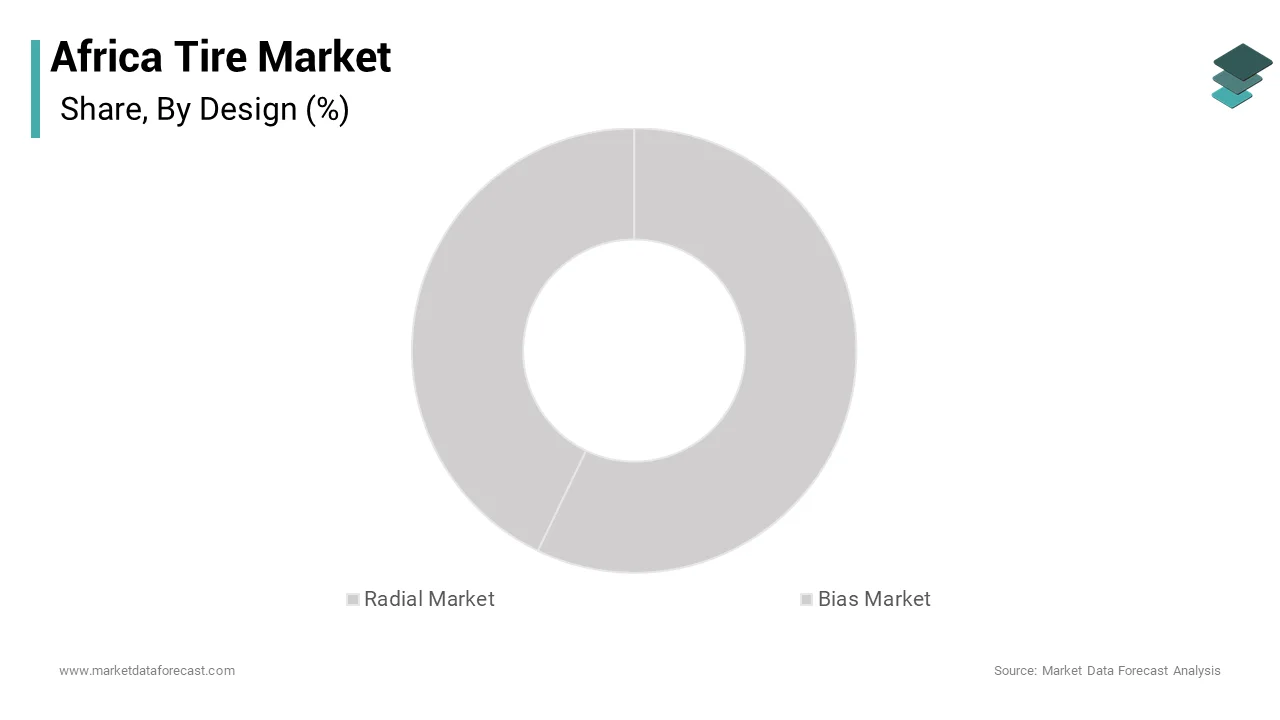
The bias-ply tire segment is experiencing the fastest growth in specific niches and is registering a CAGR of 6.7% from 2025 to 2033 in off-road and agricultural applications. This resurgence is not due to technological superiority but rather its suitability for low-speed, high-load applications on unpaved and rugged terrain. In sub-Saharan Africa, over 60% of farmland lacks mechanized access roads, and tractors and harvesters equipped with bias-ply tires perform more effectively on soft or uneven ground due to their stiffer sidewalls and load-bearing resilience, according to the Alliance for a Green Revolution in Africa. Furthermore, in artisanal mining zones across Mali and Burkina Faso, small-scale operators favor bias tires for their lower replacement cost and availability in remote markets. Chinese and Indian manufacturers have increased exports of affordable bias tires to West and Central Africa, fueling segment growth in sectors where radial penetration remains limited.
By End-Use Insights
The replacement tire segment led the African tire market by accounting for a substantial share of total consumption in 2024. This dominance of the segment is due to the continent’s reliance on used vehicle imports and the high operational intensity of existing fleets. According to the World Bank, over 90% of vehicles in circulation in sub-Saharan Africa are second-hand imports, primarily from Japan and the UAE, with average ages exceeding 12 years. These aging vehicles require frequent tire replacements due to degraded suspension systems and poor road conditions. As per the International Road Assessment Programme, only 38% of major roads in Africa are paved, subjecting tires to severe wear. This accelerated wear cycle, combined with the absence of large-scale domestic vehicle manufacturing, ensures that replacement demand far exceeds OEM volumes.
The OEM tire segment is expanding at the fastest rate with a CAGR of 9.2% during the forecast period. This growth is driven by the gradual expansion of vehicle assembly plants across the continent, particularly in countries implementing local content policies. In Egypt, the government’s automotive localization strategy has attracted investments from Nissan, Hyundai, and BMW, increasing domestic production capacity to over 100,000 units annually by 2023, according to the Egyptian Ministry of Trade and Industry. Similarly, Kenya’s introduction of the Automotive Industry Development Policy has led to the establishment of six new assembly lines, including for Isuzu and Volkswagen, as confirmed by the Kenya Association of Manufacturers. While still modest in scale, these initiatives are creating new demand for OEM-spec tires. Besides, commercial vehicle OEMs such as Scania and MAN have localized final assembly in South Africa and Ghana, further stimulating original equipment tire procurement and signaling a structural shift in the supply chain.
By Vehicle Insights
The Medium and Heavy Commercial Vehicles (M&HCVs) segment represents the prominent part in the African tire market by contributing 42.1% of total tire demand by unit volume in 2024. This dominance is credited to the continent’s heavy dependence on road freight for logistics and supply chain continuity. According to the African Union’s Infrastructure Development Report, over 85% of intra-regional cargo is transported by trucks. Each long-haul truck requires between six and ten tire replacements per year due to overload, poor road surfaces, and continuous operation, as per the Southern African Development Community’s Freight Logistics Unit. In Nigeria, the Federal Road Safety Corps estimates that over 70% of commercial trucks exceed legal weight limits, accelerating tire degradation. This relentless operational demand ensures that M&HCV tires constitute the backbone of the market, particularly in radial configurations designed for durability and heat resistance.
The two-wheeler tire segment is emerging as the fastest-growing category and is recording a CAGR of 10.4% from 2025 to 2033. This surge is fueled by the explosive expansion of motorcycle-based mobility services in urban and peri-urban areas. In cities like Kampala, Kigali, and Lagos, motorcycles account for over 60% of daily commutes, with ride-hailing platforms such as SafeBoda and Max.ng deploying over 250,000 registered riders, as documented by the African Centre for Urban Management. Besides, rising youth mobility demand and the affordability of small-displacement bikes have increased ownership. Chinese manufacturers like TVS and Bajaj dominate this segment, and local tire producers in Ethiopia and Kenya have begun specializing in high-wear, low-cost two-wheeler tires, signaling a structural shift in consumer mobility patterns.
COUNTRY ANALYSIS
South Africa Tire Market Analysis
South Africa held a preeminent position in the Middle East and Africa tire market by commanding an estimated 24.6% share of regional demand in 2024. As the continent’s most industrialized economy, it hosts the largest concentration of tire manufacturing, retreading, and distribution infrastructure. The country’s well-developed road freight network, which handles over 60% of domestic cargo, drives consistent commercial tire demand. Bridgestone, Continental, and Sumitomo operate local plants, while retreaders like Safway service mining and logistics fleets. Despite economic headwinds, the persistence of load-shedding and reliance on backup transport has sustained vehicle utilization, reinforcing tire replacement cycles across both urban and industrial zones.
Egypt Tire Market Analysis
Egypt is another key player in the market, which is shaped by its large population, growing vehicle fleet, and strategic role in North African trade logistics. The government’s push for infrastructure development, including the New Alamein City and the expansion of the Suez Canal Economic Zone, has increased construction and freight activity, boosting demand for OTR and M&HCV tires. As per the Egyptian Road Transport Authority, over 75% of goods are moved by road, and the national truck fleet grew by 11% between 2021 and 2023. Chinese tire brands such as Triangle and Double Coin have expanded distribution networks in Cairo and Alexandria, while local assemblers like El Nasr Tyre are modernizing facilities to meet rising demand.
Nigeria Tire Market Analysis
Nigeria accounts for a significant share of the MEA tire market and is driven by its status as Africa’s most populous nation and a major hub for used vehicle imports. According to the Nigerian Automotive Industry Development Plan, over 97% of vehicles on Nigerian roads are imported used units, many with mismatched or worn tires requiring immediate replacement. The country’s poor road infrastructure, with only 20% of federal roads in good condition, as per the World Bank’s 2023 Nigeria Infrastructure Review, accelerates tire wear.
Kenya Tire Market Analysis
Kenya holds a notable share of the MEA tire market and is distinguished by its role as a regional logistics and transport hub for East Africa. As per the Kenya National Bureau of Statistics, over 70% of landlocked countries in the region, including Uganda, South Sudan, and Rwanda, rely on Kenyan ports and highways for cargo movement. The Port of Mombasa handles more than 25 million tons of cargo annually, necessitating a large and active trucking fleet. Besides, the rise of motorcycle taxis has increased demand for small-diameter tires. Nairobi has become a distribution center for Chinese and Indian tire brands, with wholesale markets in Gikomba supplying neighboring countries, reinforcing Kenya’s strategic position.
Ethiopia Tire Market Analysis
Ethiopia captures a small share of the market, which is driven by state-led industrialization and the expansion of road infrastructure in a rapidly growing economy. The Addis Ababa–Djibouti Railway has reduced cargo transit time, but last-mile delivery still depends on trucks, creating demand for M&HCV tires. The government’s push for local manufacturing in industrial parks has also increased logistics activity. The Ethiopian Tire Manufacturing PLC expanded production to 1.8 million units in 2023, supported by Chinese technical partnerships, indicating growing domestic capacity and market maturity.
COMPETITIVE LANDSCAPE
Competition in the African tire market is characterized by a dynamic interplay between global OEMs, regional distributors, and emerging local assemblers, each vying for dominance across varied economic and infrastructural landscapes. Multinational brands such as Bridgestone, Continental, and Michelin compete on technology, durability, and service networks, while Indian and Chinese manufacturers like Apollo, CEAT, and Double Coin leverage cost efficiency and aggressive pricing. The market is highly fragmented, with informal trade channels accounting for a significant share of sales, particularly in West and Central Africa. Brand trust, after-sales support, and product suitability for extreme conditions are critical differentiators. The absence of uniform quality enforcement allows counterfeit and substandard tires to persist, complicating consumer choice. However, rising fleet professionalism, digital sales platforms, and government localization policies are reshaping competitive dynamics. Companies that combine technical resilience with localized service models and sustainability initiatives are gaining a strategic advantage in this complex and evolving market.
KEY MARKET PLAYERS
These are the market players that are dominating the African tires market.
- Apollo Tyres Ltd
- Bridgestone Corporation
- Continental AG
- Hankook Tire & Technology Co., Ltd.
- Kumho Tire Co., Inc.
- Michelin
- MRF Tyres
- Pirelli Tyre C. S.p.A
- Sumitomo Rubber Industries, Ltd.
- The Goodyear Tire & Rubber Company
- The Yokohama Rubber Co., Ltd.
- Toyo Tire Corporation.
Top Players In The Market
- Bridgestone Corporation has established a resilient footprint across Africa through strategic distribution partnerships and localized service networks, particularly in South Africa, Kenya, and Nigeria. The company emphasizes durability-focused radial tires engineered for harsh road conditions and high-load applications in commercial transport and mining sectors. It also introduced a digital tire inspection program in collaboration with fleet operators in Gauteng to enhance safety and lifecycle management. Bridgestone has expanded its retreading services through authorized centers in Cape Town and Nairobi, supporting sustainability and cost efficiency. Additionally, the company has invested in technician training via its Africa Technical Academy, strengthening after-sales reliability and brand trust in key logistics corridors.
- Continental AG has positioned itself as a technology-driven tire provider in Africa, focusing on high-performance commercial and off-the-road (OTR) segments. The company operates a major distribution and logistics hub in Johannesburg, enabling rapid deployment across Southern and East Africa. Its ContiPressureCheck system, which monitors tire pressure in real time, has been adopted by major logistics fleets in Egypt and Ghana. Continental has also partnered with transport associations in Nigeria and Tanzania to promote tire safety standards.
- Apollo Tyres Ltd. has emerged as a key player in the African tire market by leveraging cost-competitive manufacturing and agile distribution models from its Indian and South African production bases. The company’s Baroda and Chennai plants supply high-mileage radial tires to commercial fleets across East and West Africa, while its Durban facility caters to Southern African demand. It strengthened its presence in Nigeria through a partnership with Lagos-based AutoXpress, expanding retail reach into secondary cities. Apollo also initiated a tire recycling pilot in collaboration with the South African Waste Tyre Producers Responsibility Organisation, aligning with circular economy goals. Its focus on value engineering and localized marketing has enabled rapid penetration in price-sensitive but volume-rich markets.
Top Strategies Used By Key Market Participants
Key players in the African tire market are deploying differentiated strategies to navigate fragmented regulations, infrastructure deficits, and diverse consumer needs. A central approach is the expansion of localized distribution and service networks to improve accessibility and response times in remote regions. Companies are increasingly investing in retreading and tire lifecycle programs to appeal to cost-conscious commercial operators. Strategic partnerships with logistics firms, mining companies, and government transport agencies are enhancing brand integration into high-utilization sectors. Digitalization is gaining traction, with firms introducing mobile tire clinics, IoT-based pressure monitoring, and e-commerce platforms to streamline sales and maintenance. Localization of production or assembly, particularly in South Africa, Kenya, and Ethiopia, reduces import dependency and customs delays. Additionally, manufacturers are launching region-specific tire compounds engineered for high heat, rough terrain, and overloading. Training programs for mechanics and fleet managers are being used to build technical credibility and long-term brand loyalty across informal and formal market segments.
RECENT MARKET NEWS
- In July 2023, Bridgestone launched its M740 long-haul truck tire in Kenya, specifically engineered for East Africa’s unpaved highways and high-temperature environments, enhancing durability and fuel
- efficiency for commercial fleets.
- In March 2022, Continental AG introduced the ContiLifeCycle retreading system in Zambia, targeting mining and logistics operators seeking cost-effective and sustainable tire solutions with extended service life.
- In October 2023, Apollo Tyres partnered with AutoXpress in Lagos to expand retail distribution across Nigeria, strengthening its presence in West Africa’s high-volume replacement tire segment.
- In May 2023, Michelin initiated a mobile tire service unit in Ethiopia, providing on-site inspections and maintenance for long-haul trucking fleets operating on remote transport corridors.
- In January 2024, CEAT opened a new distribution warehouse in Nairobi, enabling faster delivery and improved supply chain reliability for East African markets, including Uganda and Rwanda.
MARKET SEGMENTATION
This research report on the African Tires market is segmented and sub-segmented into the following categories.
By Design Type
- Radial Market
- Bias Market
By End-Use
- OEM Market
- Replacement Market
By Vehicle Type
- Passenger Cars
- Light Commercial Vehicles
- Medium and Heavy Commercial Vehicles
- Two Wheelers
- Three Wheelers
- Off-The-Road (OTR)
By Distribution Channel
- Offline
- Online
By Season
- All-Season Tires
- Winter Tires
- Summer Tires
By Country
- Sudan
- Egypt
- Kenya
- Ethiopia
- South Africa
- Rest of Africa