- Product Description Description
- Table of Contents TOC
- List of Table & Figure LOT
- Get Free Sample PDF Sample PDF
Market Size, 2025
$175.16 BnMarket Estimate, 2026
$191.27 BnMarket Forecast, 2034
$386.75 BnCAGR, 2026–2034
9.2%Global Airport Lighting Market Summary
Market Size & Growth
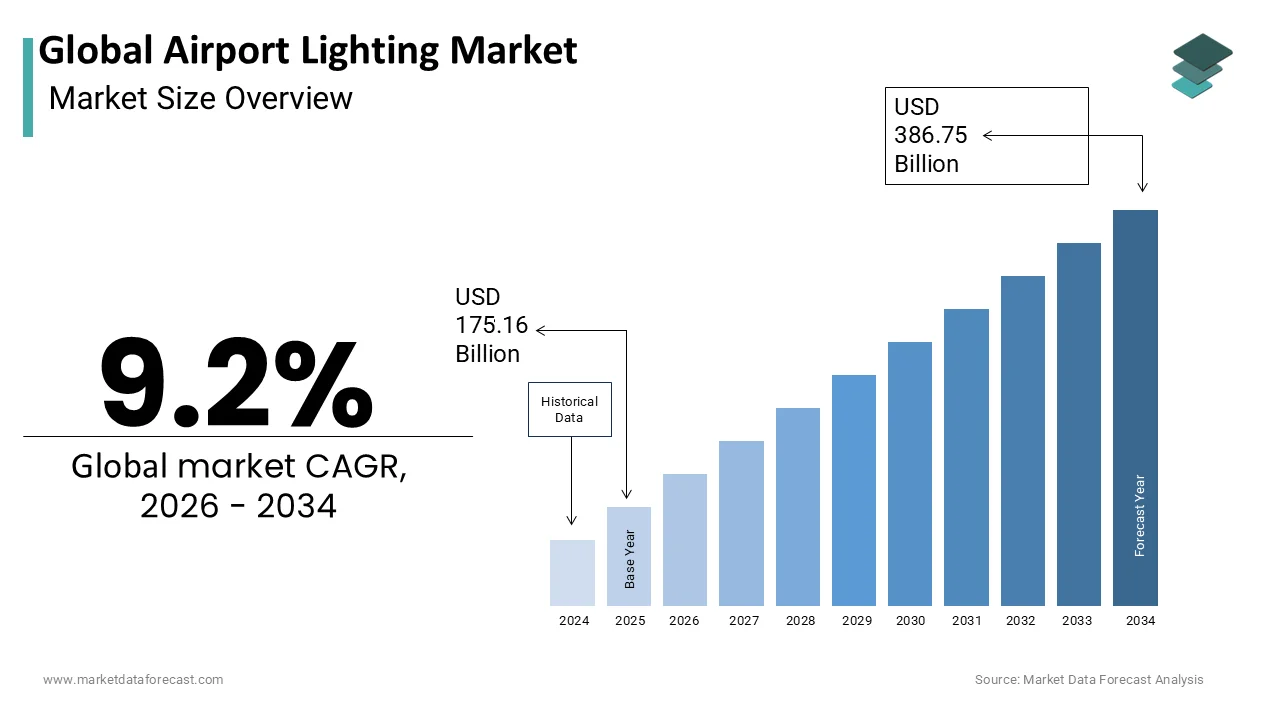
- The global airport lighting market was valued at USD 175.16 billion in 2025.
- Expected to reach USD 191.27 billion in 2026 and USD 386.75 billion by 2034, growing at a CAGR of 9.2% from 2026 to 2034.
- North America led the market, capturing 36.1% of global share in 2025.
Key Market Segments
- By type: Runway and Taxiway Lighting (largest share, 2025), Apron Lighting (fastest growing)
- By position: Elevated Lighting and PAPI (largest share, 2025), In-Pavement Lighting (fastest growing)
- By region: North America leads; China is the fastest-growing market in Asia-Pacific.
Key Drivers
- Regulatory mandates for energy efficiency are accelerating LED adoption over legacy incandescent systems.
- Expansion of low-visibility operations infrastructure is increasing demand for high-intensity, Category III ILS-compatible lighting.
- Rising global air traffic, which reached approximately 37 million flights in 2024, is straining existing lighting infrastructure.
Key Players
ADB SAFEGATE, TKH Airport Solutions, Eaton Corporation plc, Honeywell International Inc., Siemens AG, Crouse-Hinds (Eaton), OCEM Airfield Technology, Astronics Corporation, Vosla GmbH, HELLA GmbH & Co. KGaA, Avlite Systems (SPX Technologies), Carmanah Technologies Corporation.
 Download Free Sample Report
Global Airport Lighting Market Size
The Global Airport Lighting Market is projected to grow from USD 175.16 billion in 2025 to USD 191.27 billion in 2026 and reach USD 386.75 billion by 2034, registering a CAGR of 9.2% during the forecast period from 2026 to 2034.
Airport lighting constitutes a critical safety infrastructure network designed to guide aircraft during all phases of flight operations, including approach, landing, taxiing, and takeoff under varying visibility conditions. This specialized system encompasses runway edge lights, threshold lights, touchdown zone lights, centerline lights, stop bars, and taxiway guidance signs that collectively form the visual aid framework essential for aviation safety. The integrity of these systems is paramount as they provide pilots with precise spatial orientation when instrument landing systems are insufficient or unavailable. According to the International Civil Aviation Organization, global air traffic movements reached approximately 37 million flights in 2024, reflecting a robust recovery that places immense pressure on existing lighting infrastructure to maintain operational continuity. The European Union mandates strict luminance and chromaticity standards for all certified aerodromes,s ensuring that lighting systems meet rigorous performance criteria for color consistency and intensity. Furthermore, the increasing frequency of adverse weather events due to climate change necessitates high-intensity lighting systems capable of penetrating fog, rain, and snow. Airports are increasingly integrating LED technology to enhance reliability and reduce maintenance intervals while improving energy efficiency. The transition from traditional incandescent bulbs to solid-state lighting represents a fundamental shift in how airports manage their visual aids, offering longer lifespans and reduced power consumption. This technological evolution supports the broader industry goal of sustainable airport operations while maintaining the highest levels of safety for passengers and crew across global aviation networks.
MARKET DRIVERS
Regulatory Mandates for Energy Efficiency Drive Adoption of LED Lighting Systems
Stringent environmental regulations and sustainability targets imposed by international aviation bodies are compelling airports to replace legacy incandescent lighting with energy-efficient LED alternatives, which is a major factor propelling the growth of the global airport lighting market. The International Civil Aviation Organization Annex 14 sets forth detailed specifications for aerodrome design and operations, which increasingly emphasize energy conservation and reduced carbon footprints in ground infrastructure. According to the Airports Council International, over 60% of major global airports have committed to net-zero carbon emissions by 2050, driving urgent investments in low-power-consumption technologies. LED runway and taxiway lights consume up to 80% less electricity than traditional halogen bulbs, significantly reducing the operational costs associated with powering extensive lighting networks that operate continuously during night hours and low visibility conditions. Furthermore, LEDs generate minimal heat, which reduces thermal stress on surrounding pavement and embedding materials, thereby extending the structural integrity of runway surfaces. The long lifespan of LED fixtures, which can exceed 100,000 hours of operation, minimizes the frequency of maintenance interventions that often require costly runway closures and disrupt flight schedules. Airports such as London Heathrow and Frankfurt have reported substantial reductions in energy bills following comprehensive LED retrofits, validating the economic viability of these upgrades. Regulatory frameworks in Europe and North America also offer financial incentives and grants for airports that demonstrate measurable improvements in energy efficiency, further accelerating the transition. This regulatory push ensures that LED adoption remains a primary driver in the airport lighting market as operators seek to comply with environmental mandates while optimizing operational expenditures.
Expansion of Low Visibility Operations Infrastructure Increases Demand for High Intensity Lighting
The growing prevalence of adverse weather conditions and the need to maintain schedule reliability during fog, rain, and snow are driving demand for high-intensity approach and runway lighting systems, which is further aiding the global market expansion. According to the World Meteorological Organization, the frequency of extreme weather events has risen, contributing to more frequent low-visibility procedures at major aviation hubs. To mitigate delays and cancellations, airports are upgrading to Category III Instrument Landing System-compatible lighting, which requires precise alignment and high luminance levels to guide aircraft safely to the runway surface when visibility drops below 200 meters. High-intensity runway edge lights and centerline lights provide critical visual cues that allow pilots to maintain situational awareness during the final stages of landing. Additionally, the installation of advanced stop bar lighting systems on taxiways prevents runway incursions by clearly indicating holding positions to pilots and ground vehicle operators in poor visibility. Airports in regions prone to fog, such as San Francisco and Mumbai, are investing heavily in these high-performance lighting arrays to ensure continuous operations regardless of meteorological conditions. The ability to maintain high throughput during adverse weather is a key competitive advantage for major hubs, attracting airlines that prioritize schedule reliability. This operational necessity drives consistent procurement of advanced lighting solutions that meet the stringent performance requirements of modern all-weather aviation operations.
MARKET RESTRAINTS
High Initial Capital Expenditure Constraints Infrastructure Upgrades in Emerging Markets
The substantial upfront investment required for installing and upgrading airport lighting systems poses a significant barrier to market expansion, particularly in developing economies with limited financial resources. A complete runway lighting installation, including embedded fixtures, control cables, constant current regulators, and monitoring systems, can cost several million dollars depending on the runway length and category. According to the World Bank, many airports in emerging markets operate with tight budget constraints and rely on government subsidies or international loans for infrastructure development, which often prioritizes terminal expansions or runway paving over lighting upgrades. The complexity of retrofitting existing runways with LED systems involves extensive civil works, including cutting into concrete or asphalt pavements to embed new fixtures, which disrupts ongoing operations and adds to the total project cost. Furthermore, the need for specialized engineering expertise and certified installation contractors further elevates the financial burden for airport authorities. The return on investment for lighting upgrades is primarily realized through long-term energy savings and reduced maintenance costs, which may take several years to materialize, making it difficult for cash-strapped operators to justify immediate expenditure. Consequently, many airports in Latin America and Africa continue to rely on aging incandescent systems that are prone to frequent failures and higher energy consumption. This financial hesitation slows the adoption of advanced lighting technologies and limits the overall growth potential of the market in regions with the highest projected air traffic growth rates.
Technical Complexity of Integrating Smart Control Systems with Legacy Infrastructure
Integrating modern smart lighting control systems with legacy airport infrastructure is further hindering the airport lighting market expansion. Many older airports utilize analog control circuits and proprietary communication protocols that are incompatible with modern digital management platforms based on Internet of Things standards. According to the American Society of Civil Engineers, infrastructure compatibility issues account for nearly 25% of delays in airport modernization projects, as engineers must devise custom interface solutions to bridge the gap between old and new technologies. The transition to smart lighting requires the installation of individual addressable controllers for each fixture, which allows for remote monitoring, dimming, and fault detection, but necessitates extensive rewiring and software configuration. This complexity is exacerbated by the need to maintain continuous airport operations during the upgrade process, which restricts work windows to nighttime hours and extends project timelines. Additionally, the lack of standardized data formats among different lighting manufacturers creates interoperability issues, making it difficult to create a unified management dashboard for the entire airfield. The risk of system failures during the transition phase poses safety concerns as inconsistent lighting outputs can confuse pilots and ground personnel. As a result, airport authorities often hesitate to undertake comprehensive smart lighting upgrades, opting instead for incremental replacements that do not fully realize the benefits of centralized control and predictive maintenance, thereby slowing the adoption of advanced digital lighting solutions.
MARKET OPPORTUNITIES
Integration of Solar-Powered Lighting Solutions Offers Sustainable Alternatives for Remote Stands
The advancement of solar photovoltaic technology presents a significant opportunity for the airport lighting market, particularly for remote stands, taxiways, and general aviation areas where grid connectivity is expensive or impractical. Modern solar-powered runway and taxiway lights incorporate high-efficiency panels and advanced battery storage systems that ensure reliable operation even during extended periods of low sunlight. According to the International Renewable Energy Agency, the cost of solar photovoltaic modules has decreased by approximately 80% over the last decade, making solar lighting economically viable for a wider range of airport applications. These self-contained units eliminate the need for extensive trenching and cabling, reducing installation time and civil works costs significantly. Airports in sunny regions such as Australia and the Middle East are increasingly deploying solar lights for peripheral taxiways and apron areas to reduce their reliance on the main electrical grid and lower overall energy consumption. Furthermore, solar lights offer enhanced resilience against power outages as they operate independently of the central airport power supply, ensuring that critical guidance remains available during emergencies. The modular nature of solar lighting allows for easy expansion and reconfiguration as airport layouts change, providing flexibility that fixed wired systems cannot match. This sustainability-driven innovation aligns with global green airport initiatives and opens new market segments for manufacturers who can provide reliable and cost-effective off-grid lighting solutions.
Development of Adaptive Lighting Systems Enhances Operational Flexibility and Safety
The emergence of adaptive lighting systems that dynamically adjust intensity and configuration based on real-time operational needs offers a promising opportunity for the airport lighting market. These intelligent systems utilize data from air traffic control radar, weather sensors, and flight schedules to automatically dim or brighten specific sections of the runway and taxiway network. According to SITA, over 50% of airports are investing in smart infrastructure technologies that enable dynamic resource allocation, including adaptive lighting controls. By dimming lights when no aircraft are present or reducing intensity during daylight hours, airports can achieve significant energy savings without compromising safety. Adaptive systems also enhance safety by highlighting active taxi routes and closing off unused sections to prevent pilot confusion and runway incursions. For example, during low-traffic periods, the system can illuminate only the necessary path for an arriving aircraft while keeping other areas dark to reduce visual clutter. This level of customization improves pilot situational awareness and reduces cognitive load during complex ground maneuvers. Manufacturers who integrate artificial intelligence algorithms into their lighting control units can offer predictive capabilities that anticipate traffic patterns and optimize lighting configurations proactively. This technological advancement creates a new value proposition for airports seeking to maximize operational efficiency and minimize environmental impact through intelligent infrastructure management.
MARKET CHALLENGES
Supply Chain Volatility for Semiconductor Components Disrupts Production of Smart Lighting Units
The airport lighting market faces significant challenges due to supply chain volatility affecting the availability of critical semiconductor components used in LED drivers and smart control modules. Global disruptions caused by geopolitical tensions, trade restrictions, and raw material shortages have led to extended lead times for microcontrollers and power management chips essential for modern lighting systems. According to the Institute for Supply Management, manufacturing procurement managers reported that 70% of companies experienced delays in receiving key electronic components in 2024, impacting their ability to meet delivery deadlines for airport infrastructure projects. The shortage of specific integrated circuits forces manufacturers to redesign circuit boards or seek alternative suppliers, which requires lengthy requalification processes and regulatory approvals for aviation safety compliance. This uncertainty complicates production planning and increases inventory costs as companies hold larger safety stocks of available components to mitigate future shortages. Additionally, logistics bottlenecks at ports and transportation networks further exacerbate delivery delays, making it difficult to coordinate complex installation projects that require precise timing with airport construction schedules. The resulting price inflation for electronic components also squeezes profit margins for lighting manufacturers who may struggle to pass on increased costs to price-sensitive airport authorities. This supply chain instability undermines confidence in project planning and may lead airports to postpone smart lighting upgrades until component availability stabilizes, thereby slowing market growth.
Stringent Certification Requirements Delay Time to Market for New Lighting Technologies
The rigorous certification process mandated by aviation authorities such as the Federal Aviation Administration and the European Union Aviation Safety Agency poses a significant challenge to the airport lighting market expansion. New lighting systems must undergo extensive testing to verify compliance with strict standards for luminance, chromaticity, flash rate, and durability under extreme environmental conditions. According to the Federal Aviation Administration, the certification process for new airfield lighting equipment can take 12 to 18 months, involving laboratory tests, field trials, and documentation reviews to ensure absolute safety and reliability. This lengthy timeline delays the commercialization of new products and increases research and development costs for manufacturers who must maintain multiple prototype versions during the approval phase. Furthermore, any minor design change requires re-certification, which stifles innovation and discourages manufacturers from introducing incremental improvements to existing products. The high barrier to entry created by these regulatory requirements protects incumbent players but limits competition from smaller innovators who may lack the resources to navigate the complex approval process. Additionally, differences in certification standards between regions require manufacturers to undergo separate approval processes for each market, further complicating global product launches. This regulatory burden slows the pace of technological adoption in the airport lighting market as operators wait for certified solutions rather than adopting cutting-edge but unapproved technologies.
REPORT COVERAGE
| REPORT METRIC | DETAILS |
| Market Size Available | 2025 to 2034 |
| Base Year | 2025 |
| Forecast Period | 2026 to 2034 |
| Segments Covered | By Type, Position, and Region |
| Various Analyses Covered | Global, Regional and Country-Level Analysis, Segment-Level Analysis, Drivers, Restraints, Opportunities, Challenges; PESTLE Analysis; Porter’s Five Forces Analysis, Competitive Landscape, Analyst Overview of Investment Opportunities |
| Countries Covered | North America Europe Asia-Pacific Latin America Middle East & Africa |
| Market Leaders Profiled | ADB SAFEGATE, TKH Airport Solutions, Eaton Corporation plc, Honeywell International Inc., Siemens AG, Crouse-Hinds (Eaton), OCEM Airfield Technology, Astronics Corporation, Vosla GmbH, HELLA GmbH & Co. KGaA, Avlite Systems (SPX Technologies), Carmanah Technologies Corporation. |
SEGMENTAL ANALYSIS
By Type Insights
The runway and taxiway lighting segment led the market by capturing the largest share of the global market in 2025. The domination of the runway and taxiway lighting segment is fundamentally driven by the critical safety mandates that require continuous visual guidance for aircraft during takeoff and landing operations. According to the International Civil Aviation Organization Annex 14 standards, every certified runway must be equipped with specific lighting configurations, including edge lights, threshold lights, and centerline lights,s to ensure safe operations under all visibility conditions. The sheer volume of global air traffic, ic which exceeded 37 million flights in 2,024 necessitates robust and reliable lighting infrastructure at thousands of airports worldwide. Runway lighting systems are subject to intense wear and tear due to direct aircraft wheel loads and exposure to harsh weather conditions, requiring frequent replacement and upgrades. The expansion of airport capacity through new runway construction projects, particularly in emerging economies, further amplifies demand for these essential safety systems. Furthermore, regulatory authorities mandate regular testing and maintenance of runway lighting intensity and color consistency, ensuring a steady stream of replacement demand. The critical nature of these systems means that airports prioritize quality and reliability over cost, leading to sustained investment in high-performance lighting solutions that meet stringent international aviation safety standards.

On the other side, the apron lighting segment is expected to see steady growth and showcase a promising CAGR during the forecast period owing to the rapid expansion of terminal infrastructure and the increasing complexity of ground handling operations. According to Airports Council International, global passenger traffic is on an upward trajectory, necessitating the construction of new terminals and aprons to accommodate larger fleets. Apron areas require comprehensive lighting solutions, including floodlights for general illumination and specialized docking guidance lights to assist pilots in parking aircraft precisely at gates. The rise of wide-body aircraft such as the Airbus A350 and Boeing 787, which have larger wingspans and require more precise positioning, has increased the demand for advanced apron lighting systems that provide clear visual cues to ground crews and pilots. Furthermore, the push for faster turnaround times among low-cost carriers has led to the adoption of automated docking systems integrated with intelligent lighting controls that illuminate specific zones only when needed. This trend toward smart apron management reduces energy consumption while enhancing operational efficiency, driving the rapid adoption of modern lighting technologies in this segment.
By Position Insights
The elevated lighting and PAPI segment led the market by holding the major share of the global market in 2025. The elevated lighting and Precision Approach Path Indicator segment holds the leading position in the market due to its critical role in providing vertical and horizontal guidance to pilots during the final approach phase. According to the Federal Aviation Administration, all instrument runways must be equipped with PAPI systems to help pilots maintain the correct glide slope, typically at 3 degrees during landing. These systems consist of arrays of lights that change color from red to white depending on the aircraft's angle of approach, providing immediate visual feedback to the pilot. The widespread installation of PAPI systems at airports globally is mandated by international aviation safety standards, ensuring consistent demand for these specialized fixtures. Elevated runway edge lights and threshold lights are also essential for defining the runway boundaries, especially during night operations or low visibility conditions. The durability and visibility of elevated fixtures make them preferred choices for many airports, as they are easier to maintain and inspect compared to embedded systems. Furthermore, the expansion of regional airports and the upgrading of existing facilities to meet international standards drive continuous procurement of elevated lighting and PAPI systems.
On the other side, the in-pavement lighting segment is projected to maintain strong growth and is estimated to register a healthy CAGR in the global market during the forecast period,d owing to the rising need for unobstructed runway surfaces and enhanced safety for high-speed operations. According to the European Union Aviation Safety Agency, in-pavement lights are increasingly preferred for runway centerlines and touchdown zones as they eliminate the risk of foreign object damage caused by loose elevated fixtures. These embedded fixtures are flush with the runway surface, allowing aircraft to taxi and land without any physical obstructions, which is critical for preventing tire damage and ensuring smooth operations. The adoption of in-pavement lighting is particularly strong at major international hubs that handle large volumes of wide-body aircraft, which generate significant jet blast and require robust infrastructure. Furthermore, the integration of LED technology into in-pavement fixtures has overcome previous limitations regarding heat dissipation and lifespan, making them a viable and attractive option for modern airports. The aesthetic appeal of seamless runway surfaces also contributes to the growing preference for in-pavement solutions among airport designers and operators.
COUNTRY LEVEL ANALYSIS
North America Airport Lighting Market Analysis
North America dominated the market by capturing 36.1% of the global market share in 2025. The United States is expected to maintain its dominant position in the North American market over the next few years due to ongoing infrastructure modernization efforts. The United States holds the largest share of the North American airport lighting market, driven by its vast network of over 5,000 public-use airports. According to the Federal Aviation Administration, the agency allocates billions of dollars annually through the Airport Improvement Program to fund infrastructure upgrades, including lighting modernization. The primary driver in this region is the aging infrastructure at major hubs such as Chicago O'Hare and Atlanta Hartsfield-Jackson, which require comprehensive replacements of incandescent systems with LED alternatives. Strict environmental regulations in states like California and New York mandate reductions in energy consumption and carbon emissions, accelerating the adoption of efficient lighting solutions. Furthermore, the high frequency of severe weather events, including snowstorms and hurricanes, necessitates robust and reliable lighting systems that can withstand extreme conditions. The presence of leading lighting manufacturers and technology providers in the region fosters innovation and ensures a steady supply of advanced products. The focus on enhancing safety and operational efficiency amidst growing passenger volumes ensures that the United States remains the dominant market for airport lighting in North America.
Germany Airport Lighting Market Analysis
Germany is likely to continue leading the European market by prioritizing high-tech sustainability and regulatory compliance in the coming years. Germany serves as the central hub for the European airport lighting market, characterized by strict regulatory compliance and sustainability goals. According to the German Airports Association, the country handles over 250 million passengers annually, requiring world-class infrastructure at hubs like Frankfurt and Munich. The European Union Green Deal mandates significant reductions in greenhouse gas emissions, compelling airports to accelerate the transition to LED lighting and smart control systems. Germany is also a leader in aerospace engineering and manufacturing, contributing to the development of high-quality and innovative lighting solutions. The region places a strong emphasis on noise reduction and light pollution control, leading to the adoption of directional and shielded lighting fixtures. Additionally, the Schengen Area facilitates seamless air travel, driving the need for standardized and efficient lighting systems across member states. The combination of regulatory pressure, technological expertise, and high passenger traffic ensures that Europe remains a key market for advanced airport lighting technologies.
China Airport Lighting Market Analysis
China is poised for substantial growth in the Asia-Pacific region as it continues to execute its massive airport construction plans over the next several years. China stands as the fastest-growing market in the Asia-Pacific region, driven by unprecedented infrastructure expansion. According to the Civil Aviation Administration of China, the nation plans to construct over 100 new civil airports by 2035 to support its booming domestic and international travel demand. This massive construction boom requires the installation of millions of lighting fixtures for runways, taxiways, and aprons, creating immense opportunities for manufacturers. The Chinese government promotes the use of domestically produced high-tech equipment, reducing reliance on imports and stimulating local industry growth. Furthermore, the adoption of smart airport concepts in cities like Beijing and Shanghai drives demand for intelligent lighting systems integrated with central management platforms. The region's focus on becoming a global aviation hub, coupled with increasing disposable incomes and tourism, ensures sustained growth in the airport lighting market. The scale of investment and the pace of development make Asia-Pacific the most dynamic region for airport lighting innovations.
Brazil Airport Lighting Market Analysis
Brazil is expected to sustain its market position through continued privatization and modernization initiatives in the coming years. Brazil leads the Latin American airport lighting market, marked by gradual modernization and private sector participation. According to the Brazilian Airport Infrastructure Company, recent concession agreements for major airports, including Guarulhos and Brasilia, have unlocked significant capital for infrastructure upgrades. Private operators are mandated to invest in modernizing terminal and airfield facilities, including the replacement of outdated lighting systems with energy-efficient LED solutions. The recovery of air traffic post-pandemic has increased the urgency for improving operational efficiency and safety standards to attract international carriers. Additionally, environmental concerns in urban areas surrounding airports are driving the adoption of lighting systems that minimize light pollution and energy consumption. Although economic volatility poses challenges, the ongoing privatization trend and the need to meet international safety standards provide a stable foundation for market growth. The focus on enhancing passenger experience and operational reliability ensures steady demand for modern airport lighting solutions in Brazil and the broader region.
United Arab Emirates Airport Lighting Market Analysis
The United Arab Emirates is likely to maintain its regional leadership by investing in ultra-modern, resilient infrastructure to support high passenger throughput over the next few years. The United Arab Emirates dominates the Middle East and Africa airport lighting market and is known for its ultra-modern aviation hubs. According to the General Civil Aviation Authority, the UAE is home to Dubai International Airport, one of the busiest in the world, requiring state-of-the-art lighting infrastructure to handle high traffic volumes. The region's extreme climate conditions, including high temperatures and sandstorms, necessitate durable and high-performance lighting systems that can withstand harsh environments. Massive expansion projects, such as Al Maktoum International Airport and new developments in Saudi Arabia under Vision 2030, drive significant demand for advanced lighting solutions. The focus on luxury and premium passenger experience leads to the adoption of aesthetically pleasing and highly efficient lighting designs. Furthermore, the region's commitment to sustainability and renewable energy encourages the integration of solar-powered lighting for remote areas. The ambition to remain a global aviation transit hub ensures continuous investment in cutting-edge airport lighting technologies in the Middle East and Africa.
COMPETITIVE LANDSCAPE
Competition in the airport lighting market is characterized by a mix of established global conglomerates and specialized regional manufacturers who compete on technology reliability and service quality. The market features high barriers to entry due to stringent safety certifications and the need for proven track records in critical aviation infrastructure. Leading companies differentiate themselves through advanced LED efficiency, smart control integration,n and comprehensive lifecycle support services that appeal to modern smart airport initiatives. Price competition remains intense for standardized components like basic runway edgelights, ts where multiple suppliers offer similar specifications. However, very premium segments such as intelligent docking guidance and adaptive lighting systems see less price sensitivity as airports prioritize operational efficiency and safety. Strategic alliances with airport authorities and long-term maintenance contracts create sticky customer relationships that protect incumbent players from new entrants. The shift toward sustainable solutions has intensified rivalry as companies race to develop eco-friendly technologies that comply with evolving environmental mandates. Regional players often compete on cost and local support while global leaders leverage brand reputation and broad product portfolios to secure large-scale infrastructure projects. Innovation in digital connectivity and data analytics further distinguishes top-tier providers who can offer holistic airport management solutions beyond mere hardware supply.
KEY MARKET PLAYERS
Some of the companies that are playing a dominant role in the Global Airport Lighting Market include
- ADB SAFEGATE
- TKH Airport Solutions
- Eaton Corporation plc
- Honeywell International Inc.
- Siemens AG
- Crouse-Hinds (Eaton)
- OCEM Airfield Technology
- Astronics Corporation
- Vosla GmbH
- Hella GmbH & Co. KGaA
- Avlite Systems (SPX Technologies)
- Carmanah Technologies Corporation
TOP LEADING PLAYERS IN THE MARKET
- Honeywell International stands as a pivotal leader in airport lighting solutions, providing advanced visual aid systems that ensure safe aircraft operations globally. The company specializes inhigh-intensityy runway lights and precision approach path indicators that meet stringent international aviation standards. Recent strategic initiatives include the integration of Internet of Things sensors into lighting fixtures, enabling real-time monitoring and predictive maintenance capabilities for airport authorities. Honeywell actively collaborates with major airports to implement smart lighting networks that reduce energy consumption and enhance operational efficiency. Their commitment to sustainability is evident in the widespread adoption of LED technology across their product portfolio, which significantly lowers carbon footprints. By focusing on innovation and reliability,y Honeywell continues to set industry benchmarks for safety and performance in critical airfield infrastructure projects worldwide.
- Signify N V contributes significantly to the airport lighting market through its Philips brand, offering comprehensive LED-based visual aid solutions for runways and taxiways. The company leverages its extensive expertise in solid-state lighting to deliver energy-efficient and durable fixtures that withstand harsh environmental conditions. Recent actions to strengthen its position include launching adaptive lighting systems that dynamically adjust brightness based on real-time weather and traffic conditions. Signify also expands its service network globally to provide rapid maintenance support and technical assistance to airport operators. The company focuses on integrating digital control platforms that allow centralized management of airfield lighting assets, improving situational awareness for ground controllers. By prioritizing technological advancement and customer-centric solutions, Signify maintains a strong reputation for delivering reliable and sustainable lighting infrastructure for modern airports.
- ADB Safegate plays a crucial role in the global airport lighting market by providing integrated airfield ground lighting and docking guidance systems. The company specializes in innovative LED solutions that enhance visibility and safety during low-visibility operations and night flights. Recent efforts to bolster its market presence involve developing smart lighting controls that interface seamlessly with airport operation centers for optimized resource management. ADB Safegate actively partners with airport developers to design customized lighting layouts that maximize efficiency and minimize light pollution. The company emphasizes robust engineering and compliance with international safety standards, ensuring long-term reliability of its installations. By combining advanced technology with deep industry knowledge, ADB Safegate delivers critical infrastructure solutions that support the continuous growth and modernization of aviation hubs around the world.
TOP STRATEGIES USED BY THE KEY MARKET PARTICIPANTS
Key players in the airport lighting market prioritize research and development to createenergy-efficientt LED systems that reduce operational costs and environmental impact for airport authorities. Strategic partnerships with airport construction firms enable companies to integrate lighting solutions into new infrastructure projects from the initial design phase. Expansion into emerging markets through localized manufacturing and service centers helps participants capture growth opportunities in regions with rapidly expanding aviation sectors. Investment in digital technologies such as Internet of Things connectivity and predictive maintenance software allows manufacturers to offer value-added services that enhance equipment reliability. Focus on sustainability drives the adoption of solar-powered and smart adaptive lighting solutions to comply with strict environmental regulations and meet green goals.
MARKET SEGMENTATION
This research report on the Global Airport Lighting Market is segmented and sub-segmented into the following categories.
By Type
- Runway and Taxiway Lighting
- Apron Lighting
By Position
- Elevated Lighting and PAPI
- In-Pavement Lighting
By Country
- North America
- Europe
- Asia-Pacific
- Latin America
- Middle East & Africa