- Product Description Description
- Table of Contents TOC
- List of Table & Figure LOT
- Get Free Sample PDF Sample PDF
Market Size, 2025
$1.83 BnMarket Estimate, 2026
$19.5 BnMarket Forecast, 2034
$3.31 BnCAGR, 2026–2034
6.8%Global Analytical Standards Market Size
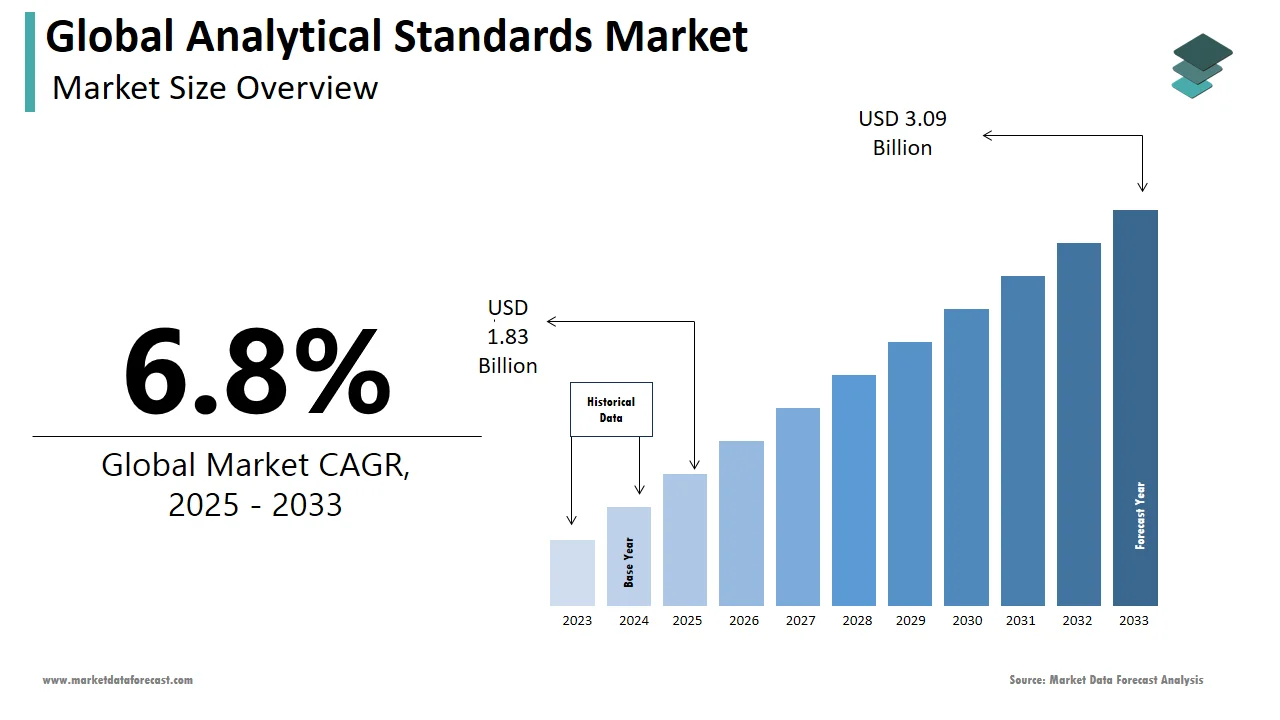
The size of the global analytical standards market was worth USD 1.83 billion in 2025. The global market is anticipated to grow at a CAGR of 6.8% from 2026 to 2034 and be worth USD 3.31 billion by 2034, up from USD 19.5 billion in 2026.
Analytical standards are the specific rules that support producers in achieving their objectives. For example, an analytical standard is referred to as a high-grade purity test substance employed as a calibration standard for a particular experiment. Analytical standards focus on offering these recommendations and valuable products to assure food safety. The industries it supports include food, beverage, environmental, life sciences, petrochemistry, veterinary medicine, forensics, pharmaceutical testing, etc. The analytical techniques that are most used in food quality testing and control include spectroscopy and chromatography. In addition, the analytical procedures help to evaluate the purity, efficacy, and product quality of the medication made by different pharmaceutical corporations. Therefore, this segment is of utmost importance from the consumer's point of view.
MARKET DRIVERS
The growing worries regarding food safety majorly drive the growth of the analytical standards market.
In addition, the expanding applications of analytical standards in proteomics and metabolomics, encouraging government initiatives, and an increasing need to check the patent expiration of patented products, along with growing healthcare quality concerns and regulatory emphasis on efficient pollution, are all anticipated to help the market revenue progress. Food tampering is a severe problem. Eating tainted or unhealthy food can lead to foodborne infections, mercury poisoning, allergic responses, and food intoxication. Mass spectrometry, chromatography, and other analytical methods are often used in food testing facilities to check for adulteration and guarantee food safety. Therefore, the food industry is a significant revenue bearer for the industry.
Drug and pharmaceutical applications are further expected to expand the analytical standards market.
Analytical standards are widely used in the biopharmaceutical sectors for drug discovery, biologic drug manufacture, and therapeutic drug monitoring. In addition, the significant rise in infectious diseases, HIV, cancers, and other illnesses worldwide has made it vital to create innovative therapies and diagnostic techniques. Management and supervision and the growing need for pollution control monitoring on a global scale are all factors driving the market's expansion—increasingly rigorous standards for the quality of pharmaceutical procedures. Therefore, the market is expected to return from the damage during the covid-19 situation.
MARKET RESTRAINTS
The analytical standards market growth is anticipated to be hindered because the productive methods for monitoring pollution, which require analytical standards, are not well known to the public and are deemed unnecessary. Little knowledge of how governments operate and how air and water pollutants affect health and ignorance is anticipated to impact the adoption of pollution monitoring tests which is expected to impede the market growth.
REPORT COVERAGE
| REPORT METRIC | DETAILS |
| Market Size Available | 2025 to 2034 |
| Base Year | 2025 |
| Forecast Period | 2026 to 2034 |
| Segments Covered | By Technique, Product, Methodology, Category, and Region. |
| Various Analyses Covered | Global, Regional, and Country-Level Analysis, Segment-Level Analysis, Drivers, Restraints, Opportunities, Challenges; PESTLE Analysis; Porter’s Five Forces Analysis, Competitive Landscape, Analyst Overview of Investment Opportunities |
| Regions Covered | North America, Europe, Asia Pacific, Latin America, Middle East & Africa |
| Market Leaders Profiled | SPEX CertiPrep, RICCA Chemical Company, US Pharmacopeial Convention, GFS Chemicals, Chiron AS, Merck KGaA, Agilent Technologies, LGC Standards, PerkinElmer, Waters Corporation, Restek Corporation, AccuStandard, Thermo Fisher Scientific, Mallinckrodt, Cayman Chemical Company, and Others. |
SEGMENTAL ANALYSIS
By Technique Insights
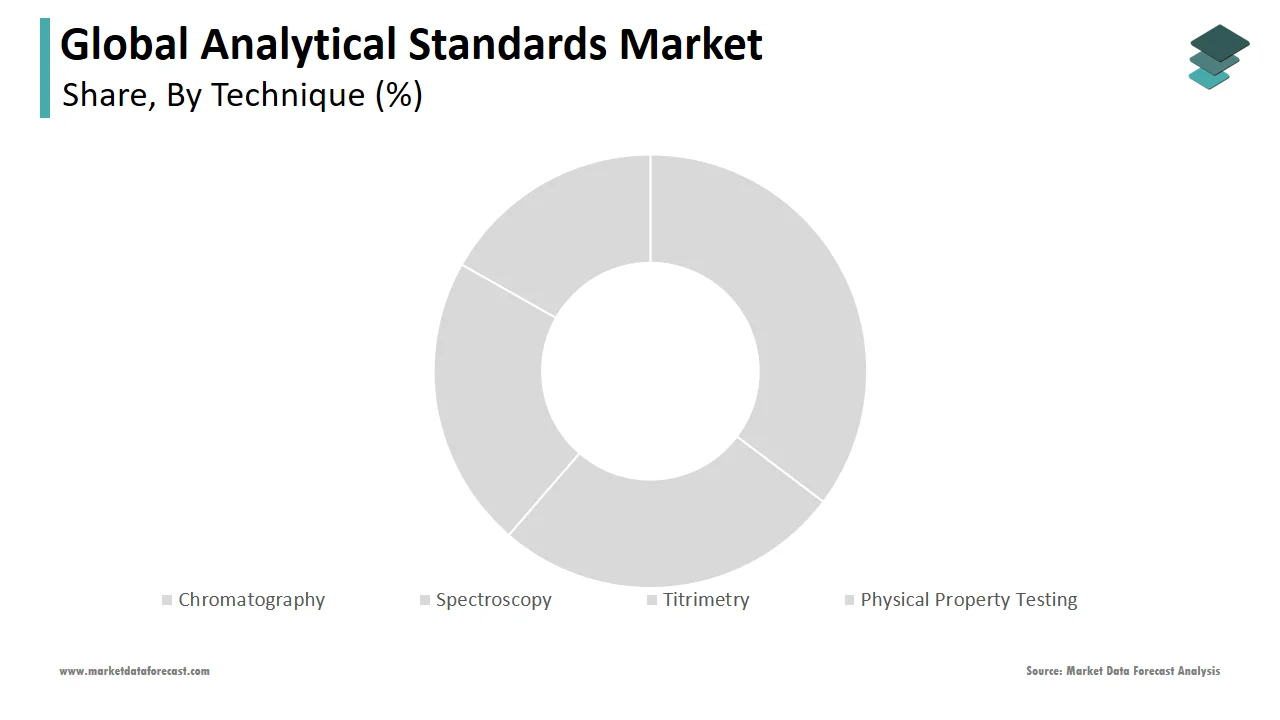
Based on technique, the chromatography segment led the analytical standards market in 2025 and is anticipated to continue being the leader among all the other types throughout the forecast period. Due to its advantages over other analytical techniques, including its high selectivity, sensitivity, reliability, and versatility, chromatography is increasingly used in the oil & petrochemical, forensic, cosmetic, and chemical industries as well as the environmental, food, cosmetic, and chemical testing sectors, thus leading to its dominance over the market. In addition, well-established and up-and-coming providers provide various chromatographic standards internationally, further promoting market development.
By Product Insights
Based on the product, the environmental segment accounted for a significant market share in 2025. The market share of the environmental category is substantial, and it is anticipated that it will dominate the market. The rise in pollutant emissions, environmental regulatory requirements, elevated public awareness of the value of a clean environment, the deterioration of environmental quality, and the production of solid waste are the leading causes of this sizeable share in the market.
By Methodology Insights
Based on the methodology, the raw materials segment is estimated to hold a significant market share during the forecast period. The raw materials testing segment is expanding as a result of many causes. First, the production of food and drink and medicinal and petrochemical goods is growing. Globally, there is also a significant regulatory focus on the quality of medicines, food, and drink.
REGIONAL ANALYSIS
The analytical standards market in North America held the largest share of the market in 2025 and is dominating the world due to factors such as key players' presence, high penetration of analytical technologies, rising life science research funding, expanding pharmaceutical R&D initiatives as well as growing environmental concerns. Additionally, the establishment of food testing labs, drug testing labs, environmental pollution monitoring labs, and forensic laboratories in North America, a significant amount of research activities, and well-established distribution channels for analytical standards product manufacturers and suppliers in countries like the U.S. and Canada are helping the region contribute the most share.
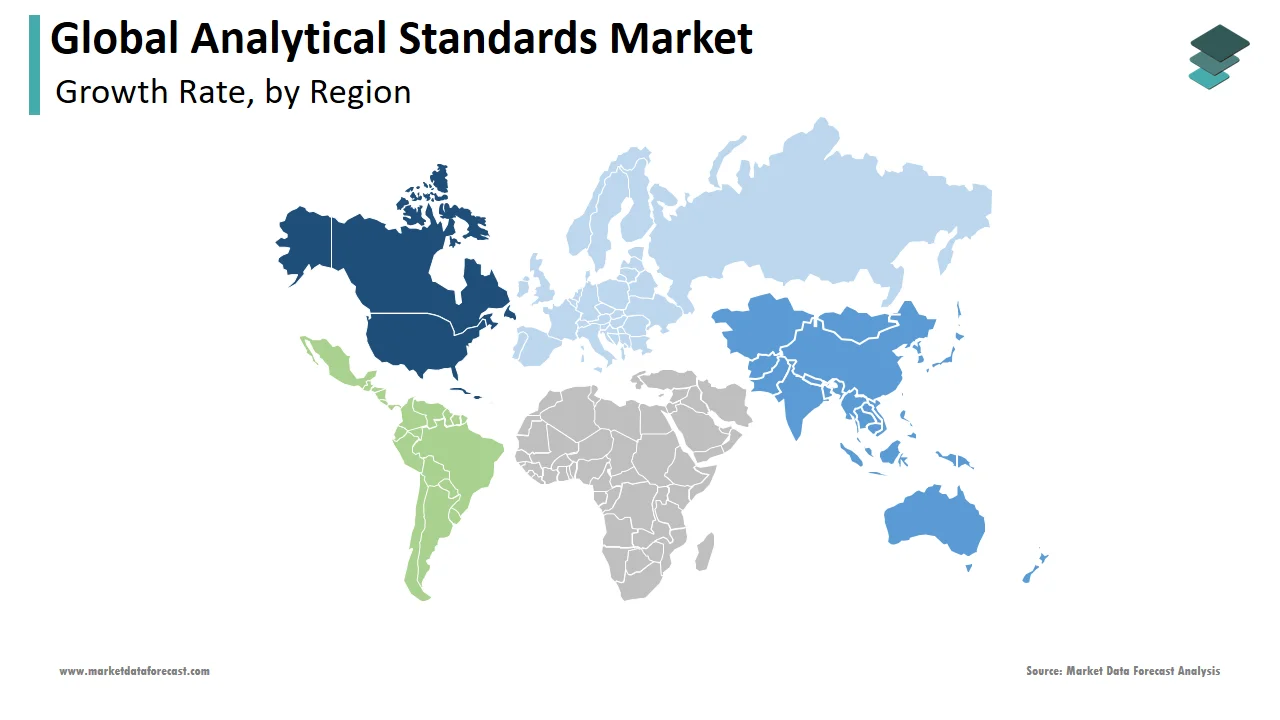
The analytical standards market in Asia-Pacific is also continuously growing due to the growing pharmaceutical industry, increased spending by significant players on clinical research and the development of new drugs, and increased clinical trials in developing nations. Furthermore, growing chromatography research, an increase in clinical trial outsourcing, significant government initiatives to expand healthcare infrastructure, environmental safety measures, an increase in the prevalence of infectious diseases like HIV, tuberculosis, influenza, and malaria, and a rise in the demand for analytical services in countries like China, India, and Japan are promoting the market growth in Asia-Pacific.
KEY MARKET PLAYERS
Some of the key players in the global analytical standards market are
- SPEX CertiPrep
- RICCA Chemical Company
- US Pharmacopeial Convention
- GFS Chemicals
- Chiron AS
- Merck KGaA
- Agilent Technologies
- LGC Standards
- PerkinElmer
- Waters Corporation
- Restek Corporation
- AccuStandard
- Thermo Fisher Scientific
- Mallinckrodt
- Cayman Chemical Company
GLOBAL ANALYTICAL STANDARDS MARKET NEWS
- In June 2025, Analytica is an international event based on environmental, foodstuff, industrial analysis, and biochemistry, which occurs every two years. It is a meeting place for specialists in these different fields. The Analytics 2023, which is taking place in Munich, includes analytics for environmental protection techniques. The event is going to discuss more ways to nano-plastics and pollutants in the environment and ways to get rid of them.
- In March 2025, Fitch Ratings rated PerkinEkmer's (PKI) IDR long-term issuer default rating at 'BBB' with a stable outlook. The confirmation following PKI's eight acquisitions in 2021, including BioLegend, which added $2.9 billion in debt, reflects the strategic value of the acquisitions in fostering PKI's long-term growth and PKI's operational strengths, which led to EBITDA and FCF margins competitive with industry peers.
- In September 2025, On Cloud Nine, a PMR was transmitted, beginning a revolutionary partnership with "AKARA" and "AUSIRIS." Establishing precious metal processing and refinery process standards is essential to Precious Metal Refining Enterprise Limited, or PMR, a worldwide standard precious metal processing and refinery company. It does this to reassure both service users and customers that the precious metals are processed and refined following international standards, most notably ISO 9001, 14001, and 45001 and the Responsible Jewellery Council or RJC Certification, in addition to being certified following the Gem and Jewelry Institute of Thailand's or GIT Analytical Standards, a Thai gem and jewelry standard that is widely acknowledged.
MARKET SEGMENTATION
This global analytical standards market research report is segmented and sub-segmented into the following categories.
By Technique
- Chromatography
- Thin-Layer Chromatography
- Gas Chromatography
- Liquid Chromatography
- Ion Chromatography
- Other Chromatography
- Spectroscopy
- Ir Spectroscopy
- Nuclear Magnetic Resonance Spectroscopy
- Uv/Vis Spectroscopy
- Mass Spectroscopy
- Atomic Absorption Spectroscopy
- Other Spectrometry
- Titrimetry
- Physical Property Testing
- Viscosity Testing
- Color Reference Testing
- Sieve Calibration & Particle Size Testing
- Others
By Product
- Food & Beverages Standards
- Flavour & Fragrance Standards
- Peptide/Amino Acid Standards
- Fatty Acid/Lipid/Fame Standards
- Carbohydrates Standards
- Food Addictive Standards
- GMO (Genetically Modified Organisms) B Standards
- Mycotoxin Standards
- Forensic Standards
- Doping Standards
- Drugs Of Abuse Standards
- Veterinary Drug Standards
- Hormone Standards
- Antibiotic Standards
- Petrochemistry Standards
- Biofuel Standards
- Gasoline, Diesel, And Petroleum Standards
- Environmental
- Volatiles/Semivolatile Standards
- Flame Retardant Standards
- Solid Waste Standards
- Alkyl Phenol Standards
- Pesticide Standards
- Aroclor/Pcb and Dioxin Standards
- Pharmaceutical And Life Science Standards
- Herbal Drug/Phytopharmaceutical Standards
- Cosmetic Standards
- Fluorescent Microparticle Standards
- Pharmacopeia Standards
- Pharmaceutical Secondary Standards
- Pharmaceutical Impurity Reference Standards
By Methodology
- Dissolution Testing
- Stability Testing
- Raw Material Testing
- Bioanalytical Testing
- Other Methodologies
By Category
- Inorganic Analytical Standards
- Organic Analytical Standards
By Region
- North America
- Europe
- Asia Pacific
- Latin America
- Middle East and Africa