- Product Description Description
- Table of Contents TOC
- List of Table & Figure LOT
- Get Free Sample PDF Sample PDF
Market Size, 2025
$351.12 MnMarket Estimate, 2026
$378.51 MnMarket Forecast, 2034
$690.28 MnCAGR, 2026–2034
7.8%Asia Pacific Agricultural Surfactants Market Size, Growth, Trends & Forecast (2026–2034)
The Asia Pacific agricultural surfactants market size was valued at USD 351.12 million in 2025, is anticipated to reach USD 378.51 million in 2026, and is projected to expand up to USD 690.28 million by 2034, registering a compound annual growth rate (CAGR) of 7.80% during the forecast period from 2026 to 2034. Market expansion is driven by the rising demand for high-yield crop solutions amid shrinking arable land, increased adoption of precision farming and drone-based spraying technologies, and a growing shift toward organic farming and bio-based agrochemicals.
Key Executive Metrics (At-a-Glance)
- 2025 Base Valuation: USD 351.12 Million
- 2026 Current Valuation: USD 378.51 Million
- 2034 Forecast Valuation: USD 690.28 Million
- Compound Annual Growth Rate (CAGR): 7.80% (2026–2034)
- Dominant Type Segment: Non-Ionic Surfactants (38.6% share in 2025)
- Fastest-Growing Type Segment: Amphoteric Surfactants (7.4% CAGR)
- Dominant Application Segment: Herbicides (34.5% share in 2024)
- Fastest-Growing Application Segment: Fungicides (6.9% CAGR)
- Dominant Fertilizer Segment: Nitrogenous Fertilizers (42% share in 2024)
- Fastest-Growing Fertilizer Segment: Phosphate Fertilizers (6.7% CAGR)
- Dominant Country Market: China (28.6% share in 2024)
Core Market Drivers
- Shrinking Arable Land & High-Yield Pressures: Urbanization-induced reduction of per capita farmland necessitating advanced agrochemical enhancements to maximize food production.
- Organic Farming & Bio-Based Formulations: Surging consumer demand for residue-free food leading to a rise in organic farming acres and eco-friendly natural surfactants derived from coconut oil, soybean, and molasses.
Primary Market Restraints & Challenges
- Regulatory Scrutiny & Smallholder Awareness: Government restrictions on toxic chemical additives (e.g., APEs), coupled with low technical awareness and limited training among smallholder farmers.
Asia Pacific Agricultural Surfactants Market Segmentation Breakdown
| Segment Category | Largest (Dominant) Sub-Segment | Fastest-Growing Sub-Segment |
|---|---|---|
| By Type | Non-Ionic Surfactants (38.6% share, 2025) | Amphoteric Surfactants (7.4% CAGR) |
| By Application | Herbicides (34.5% share, 2024) | Fungicides (6.9% CAGR) |
| By Fertilizer Type | Nitrogenous Fertilizers (42% share, 2024) | Phosphate Fertilizers (6.7% CAGR) |
| By Country | China (28.6% share, 2024) | India / South Korea / Australia |
Major Industry Players Profiled
Key corporations leading the Asia-Pacific agricultural surfactants market include Evonik Industries AG, AkzoNobel N.V., The Dow Chemical Company, BASF SE, Solvay S.A., Clariant AG, and Croda International.
Asia Pacific Agricultural Surfactants Market Size
The Asia Pacific agricultural surfactants market size was valued at USD 351.12 million in 2025 and is anticipated to reach USD 378.51 million in 2026 to reach USD 690.28 million by 2034, growing at a CAGR of 7.8%, during the forecast period from 2026 to 2034.

Agricultural surfactants are chemical compounds that lower the surface tension between two substances, such as a liquid and a solid or between two liquids. In agriculture, these additives are crucial for enhancing the performance of agrochemicals like herbicides, insecticides, and fertilizers by improving their spreading, wetting, and penetration properties on plant surfaces. The Asia Pacific Agricultural Surfactants Market encompasses a diverse range of products, including non-ionic, anionic, cationic, and amphoteric surfactants, each serving specific roles in optimizing agricultural yield.
The market has been gaining momentum due to rising demand for high-efficiency crop protection solutions and the growing need to maximize output from limited arable land. Countries such as India, China, and Australia have witnessed a surge in the adoption of precision farming techniques, which directly supports the use of surfactants in agrochemical formulations.
Besides, increasing awareness among farmers regarding sustainable agricultural practices is further driving the integration of surfactants into modern farming systems across the region.
MARKET DRIVERS
Rising Demand for High-Yield Crops Amid Shrinking Arable Land
One of the key drivers fueling the growth of the Asia Pacific Agricultural Surfactants Market is the increasing pressure to produce more food from diminishing arable land. With rapid urbanization and industrial expansion, countries like China and India are experiencing a steady decline in cultivable land area.
According to the World Bank, China's arable land per capita dropped from 0.15 hectares in 2000 to approximately 0.09 hectares in 2020. This shrinking availability of farmland has compelled farmers to adopt high-input agricultural strategies aimed at maximizing productivity.
Surfactants play a pivotal role in this context by enhancing the efficacy of agrochemicals, allowing for better coverage and absorption of nutrients and pesticides. For instance, in rice cultivation—a staple crop across Asia—surfactant-modified sprays have shown up to a 20% improvement in pest control efficiency, as reported by the International Rice Research Institute (IRRI).
Moreover, government initiatives promoting mechanized and precision agriculture, particularly in Southeast Asian nations, are accelerating the adoption of surfactant-based formulations. These factors collectively underline how the urgent need for higher yields from limited land resources is significantly boosting the regional surfactants market.
Expansion of Organic Farming and Bio-Based Agrochemicals
Another critical driver of the Asia Pacific Agricultural Surfactants Market is the growing shift toward organic farming and the use of bio-based agrochemicals. Consumers across the region are increasingly demanding safer, residue-free food products, prompting a rise in organic farming activities.
As per the Research Institute of Organic Agriculture (FiBL), the total organic agricultural land in Asia increased from 6.3 million hectares in 2018 to over 8.2 million hectares by 2021. While organic farming typically avoids synthetic chemicals, it heavily relies on natural pesticides and bio-stimulants, which often require surfactants to enhance their performance. Natural surfactants derived from sources like coconut oil, soybean, and molasses are increasingly being integrated into eco-friendly agrochemical formulations. Similarly, in India, the Ministry of Agriculture has been actively promoting the use of neem-based formulations enhanced with surfactants to increase their effectiveness without leaving harmful residues. This transition toward sustainable agriculture, coupled with regulatory support and rising consumer awareness, is creating substantial opportunities for surfactant manufacturers in the region.
MARKET RESTRAINTS
Regulatory Scrutiny and Environmental Concerns
Among the primary restraints impeding the growth of the Asia Pacific Agricultural Surfactants Market is the tightening of environmental regulations concerning the use of chemical additives in agrochemicals. Governments across the region are increasingly focusing on reducing the ecological footprint of agriculture, leading to stricter norms on the discharge of surfactant-containing runoff into water bodies.
For example, in China, the Ministry of Ecology and Environment introduced new guidelines in 2022 that limit the concentration of alkylphenol ethoxylates (APEs)—a class of nonylphenol surfactants—in agricultural applications due to their toxic effects on aquatic life. Also, several manufacturers have had to reformulate their products using costlier alternatives such as polyether siloxanes or sugar esters, thereby increasing production costs.
These evolving regulatory landscapes, while beneficial for environmental sustainability, pose challenges for market players aiming to maintain profitability and product accessibility.
Limited Awareness Among Smallholder Farmers
A further significant barrier to the expansion of the Asia Pacific Agricultural Surfactants Market is the low level of awareness and technical understanding among smallholder farmers, who constitute a large portion of the agricultural workforce in countries like India, Indonesia, and the Philippines. Despite the proven benefits of surfactants in improving pesticide and fertilizer efficiency, many farmers continue to apply agrochemicals without adjuvants due to a lack of education and training.
According to the International Fund for Agricultural Development (IFAD), over 80% of farm holdings in India are classified as small or marginal, with limited access to modern agronomic knowledge. A field survey conducted by the Indian Council of Agricultural Research (ICAR) in 2023 revealed that only 22% of surveyed farmers were aware of the role and benefits of surfactants in pesticide application.
Furthermore, misinformation and reliance on traditional farming methods persist, especially in rural areas where extension services are underdeveloped. The absence of structured outreach programs by both governments and private companies exacerbates this issue.
MARKET OPPORTUNITY
Growth of Precision Agriculture and Smart Farming Technologies
One of the most promising opportunities in the Asia Pacific Agricultural Surfactants Market is the expanding adoption of precision agriculture and smart farming technologies. With advancements in drone-based spraying, automated irrigation systems, and variable rate application (VRA) tools, there is a growing need for surfactant-enhanced formulations that ensure uniform coverage and optimal droplet dispersion.
In China alone, over 120,000 agricultural drones were deployed in 2023, covering more than 14 million hectares of farmland. These technologies rely heavily on surfactants to reduce surface tension and prevent drift, ensuring that active ingredients reach target areas effectively.
Besides, precision farming platforms such as IoT-enabled soil sensors and AI-driven crop monitoring systems generate real-time data that inform targeted agrochemical application, further reinforcing the need for high-performance surfactant blendsAs governments and private stakeholders continue investing in digital agriculture infrastructure, the demand for specialized surfactants tailored for precision applications is expected to grow significantly across the region.
Increasing Adoption of Integrated Pest Management (IPM) Practices
The rising implementation of Integrated Pest Management (IPM) strategies across Asia presents a strong opportunity for the Agricultural Surfactants Market. IPM emphasizes the use of multiple pest control tactics—including biological agents, cultural practices, and reduced chemical inputs—to manage pests sustainably. Surfactants play a crucial role in this system by enhancing the effectiveness of biopesticides and low-dose synthetic chemicals, enabling farmers to achieve desired results with minimal environmental impact.
According to the Food and Agriculture Organization (FAO), over 15 million hectares of farmland in Asia were under IPM programs by the end of 2022, with India, Vietnam, and the Philippines leading the adoption. In India, the Department of Agriculture & Cooperation launched the National IPM Program, which encourages the use of adjuvants like surfactants to boost the performance of botanical and microbial pesticides. As per the field trials conducted by the Tamil Nadu Agricultural University showed that surfactant-assisted neem-based biopesticides achieved a 40% reduction in pest incidence compared to conventional applications. As IPM gains traction across the region, supported by government incentives and farmer education initiatives, the demand for compatible surfactants is set to expand, opening new growth avenues for market participants.
MARKET CHALLENGES
Volatility in Raw Material Prices
A significant challenge facing the Asia Pacific Agricultural Surfactants Market is the fluctuating prices of raw materials used in surfactant production. Most agricultural surfactants are derived from petrochemical feedstocks such as ethylene oxide, propylene oxide, and fatty alcohols, which are subject to global price volatility. The geopolitical tensions affecting crude oil supply, along with fluctuations in international trade policies, have led to sharp increases in input costs.
According to the International Energy Agency (IEA), crude oil prices saw a 35% increase between early 2022 and mid-2023, directly impacting the cost of surfactant manufacturing. In China, one of the largest producers and consumers of surfactants, the average price of ethylene oxide rose by approximately 18% during the same period, as reported by the China National Chemical Information Center (CNCIC). These cost escalations place pressure on manufacturers to either absorb the financial burden or pass it on to agrochemical formulators and farmers, potentially dampening demand.
Besides, supply chain disruptions caused by events such as the pandemic and recent shipping bottlenecks have further exacerbated raw material shortages. While some companies are exploring bio-based alternatives to stabilize input costs, these substitutes often come with higher production expenses and scalability issues.
Formulation Complexity and Compatibility Issues
Another pressing challenge in the Asia Pacific Agricultural Surfactants Market is the complexity involved in developing surfactant formulations that are compatible with diverse agrochemicals and environmental conditions. Surfactants must be precisely matched with active ingredients in pesticides, herbicides, and fertilizers to avoid antagonistic reactions that can reduce efficacy or cause phytotoxicity.
In tropical climates like those found in Thailand and Indonesia, where high humidity and temperature variations are common, surfactant behavior can change significantly, requiring tailored formulations that add to development time and cost. Moreover, the increasing use of multi-component pesticide cocktails to combat resistant pests further complicates surfactant compatibility. Addressing these formulation complexities demands extensive research, testing, and collaboration between surfactant manufacturers and agrochemical developers—an endeavor that can delay product launches and increase R&D expenditures. As a result, navigating formulation challenges remains a critical hurdle for market participants striving to deliver effective and reliable surfactant solutions.
REPORT COVERAGE
| REPORT METRIC | DETAILS |
| Market Size Available | 2025 to 2034 |
| Base Year | 2024 |
| Forecast Period | 2026 to 2034 |
| CAGR | 7.8% |
| Segments Covered | By Type, Application, Fertilizers, And Region. |
| Various Analyses Covered | Global, Regional, and Country-Level Analysis, Segment-Level Analysis, DROC, PESTLE Analysis, Porter’s Five Forces Analysis, Competitive Landscape, Analyst Overview of Investment Opportunities |
| Regions Covered | India, China, Japan, South Korea, Australia, New Zealand, Thailand, Malaysia, Vietnam, Philippines, Indonesia, Singapore, and the Rest of APAC |
| Market Leaders Profiled | Evonik Industries AG (Germany), AkzoNobel N.V. (The Netherlands), The Dow Chemical Company (U.S.), BASF SE (Germany), and Solvay S.A.A (Belgium), among others. |
SEGMENTAL ANALYSIS
By Type Insights
The Non-Ionic surfactants dominate the market, holding an estimated 38.6% share in 2025. This segment's dominance is largely attributed to its broad compatibility with a wide range of agrochemicals, including herbicides, insecticides, and fungicides. Non-ionic surfactants such as alcohol ethoxylates and organosilicones are preferred for their ability to enhance droplet spreadability and reduce evaporation loss, especially under high-temperature conditions prevalent across much of the region.
Besides, increasing adoption of precision spraying technologies—such as drone-based applications in China and Japan—has further boosted demand for these surfactants, which ensure uniform coverage and minimal drift. As governments push for more efficient use of agrochemicals to mitigate environmental impact, the preference for non-ionic surfactants is expected to remain strong, reinforcing their leadership in the regional market.
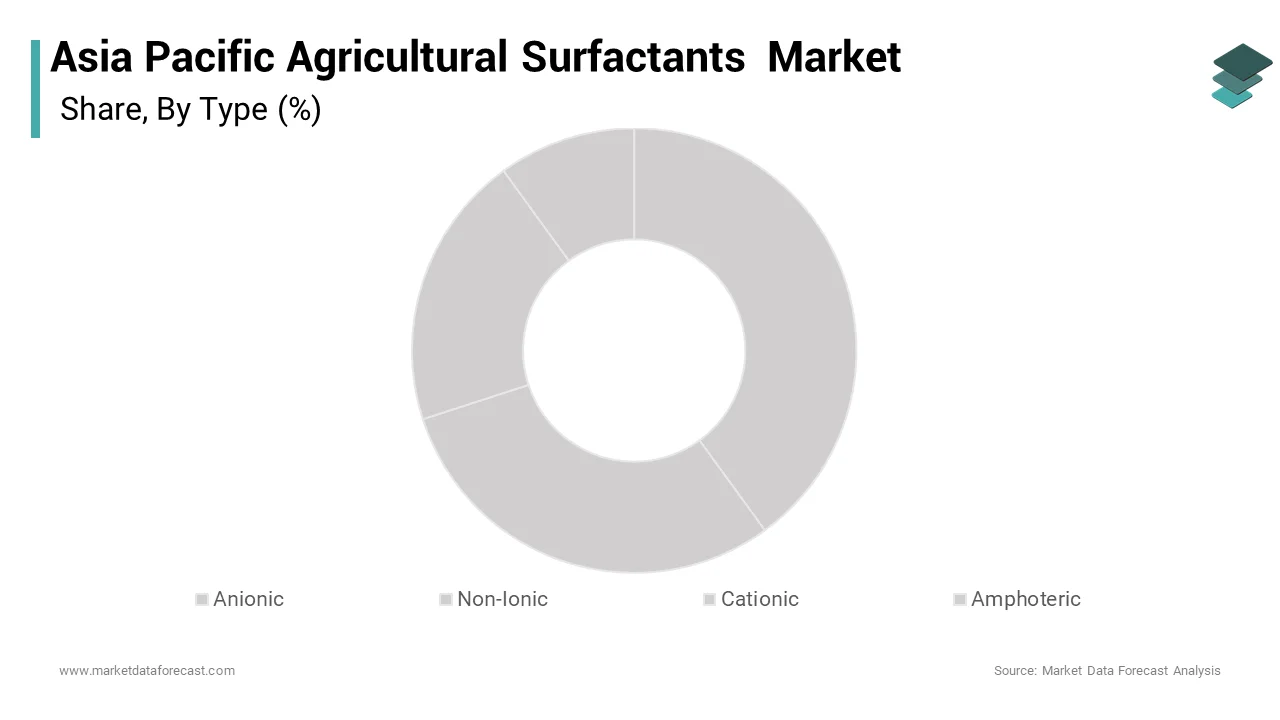
The fastest-growing segment in the Asia Pacific Agricultural Surfactants Market is Amphoteric surfactant, projected to expand at a CAGR of 7.4%. This rapid growth is driven by rising demand for surfactants that can function effectively across a wide pH range and exhibit low toxicity profiles, making them ideal for eco-friendly agricultural formulations. Amphoteric surfactants, such as betaines and amino acid derivatives, are increasingly being integrated into biopesticide and organic fertilizer blends, aligning with regional trends toward sustainable farming.
Moreover, Japan and South Korea have witnessed growing interest in amphoteric surfactants due to stringent regulations on chemical residues in food and water systems. These surfactants also demonstrate superior performance when combined with glyphosate-based herbicides, a widely used product across rice and soybean fields in Vietnam and Thailand. With increasing R&D investments focused on developing biodegradable and multifunctional surfactant variants, the amphoteric segment is poised for robust expansion in the coming years.
By Application Insights
The Herbicides represented the biggest segment, accounting for 34.5% of total surfactant consumption in 2024. The widespread use of herbicides in large-scale commercial farming, particularly in staple crops such as rice, wheat, and corn, drives this dominance. Surfactants play a crucial role in herbicide formulations by improving leaf penetration and ensuring even distribution of active ingredients.
For instance, in China, where herbicide usage exceeded 1.2 million metric tons in 2022, surfactants were incorporated in over 80% of post-emergence herbicide sprays as noted by the Chinese Pesticide Industry Association (CPIA).
Another key driver is the rise in no-till and reduced-till farming practices, especially in Australia and New Zealand, where minimizing soil disturbance necessitates higher reliance on effective weed control solutions.
Also, the proliferation of glyphosate-resistant weeds has led to increased surfactant usage to enhance herbicidal efficacy. Government-backed campaigns promoting integrated weed management strategies in countries like India and Indonesia further reinforce this trend, ensuring sustained demand for surfactant-enhanced herbicides across the region.
The booming application segment in the Asia Pacific Agricultural Surfactants Market is Fungicides, anticipated to grow at a CAGR of 6.9% during the forecast period. This growth is fueled by the increasing prevalence of fungal diseases in crops due to erratic climatic patterns and rising humidity levels, particularly in tropical regions like Southeast Asia. Countries such as Thailand, Malaysia, and the Philippines experience frequent outbreaks of rice blast, sheath blight, and banana wilt, prompting farmers to adopt fungicidal sprays enhanced with surfactants for improved coverage and retention.
In addition, the growing cultivation of high-value crops such as fruits, vegetables, and plantation crops—including tea, coffee, and rubber—in countries like India and Indonesia has further stimulated demand. Unlike insecticides or herbicides, fungicides often require multiple applications per growing season, thereby enhancing surfactant consumption. Furthermore, the introduction of new-generation systemic fungicides that rely heavily on surfactants for cellular penetration is contributing to the accelerated growth of this segment.
By Fertilizer Insights
Nitrogenous fertilizers commanded the market, capturing 42% of surfactant usage in 2024. This dominance stems from the widespread application of nitrogen-based fertilizers in staple crop production, particularly urea and ammonium nitrate, which are extensively used in rice, wheat, and maize cultivation across countries like India, China, and Indonesia. Surfactants enhance the efficiency of nitrogenous fertilizers by improving solubility, reducing runoff, and increasing root absorption.
According to the International Fertilizer Development Center (IFDC), over 70% of liquid nitrogen fertilizers applied in China now include surfactant additives, helping to achieve better nutrient uptake and minimize volatilization losses.
Also, the increasing adoption of foliar fertilization techniques, particularly in horticulture and plantation crops, has amplified the need for surfactants that facilitate rapid leaf penetration. Governments in the region, including India’s Department of Fertilizers, have been promoting micro-dosing and controlled-release fertilizers, which also depend on surfactants to optimize nutrient delivery. These factors collectively reinforce the leading position of the nitrogenous fertilizer segment in driving surfactant demand across the Asia Pacific.
The fastest-growing fertilizer segment in the Asia Pacific Agricultural Surfactants Market is Phosphate fertilizers, projected to expand at a CAGR of 6.7%. This growth is primarily driven by the increasing focus on improving soil phosphorus availability, especially in areas suffering from chronic phosphate deficiency. Phosphorus plays a critical role in root development and early plant growth, yet much of it becomes fixed in the soil and unavailable to plants. Surfactants help overcome this challenge by enhancing the mobility and uptake of phosphate ions.
Additionally, the rising adoption of hydroponics and fertigation in controlled-environment agriculture, particularly in urban farms in Japan and Singapore, is further stimulating demand for phosphate-based surfactant formulations. As awareness grows about the benefits of optimizing phosphate use efficiency to reduce dependency on imported rock phosphate, the surfactant-integrated phosphate fertilizer segment is gaining momentum across the region.
COUNTRY-LEVEL ANALYSIS
China Agricultural Surfactants Market Analysis
China held the largest market share in the Asia Pacific Agricultural Surfactants Market, accounting for 28.6% of total consumption in 2024. As the world's leading agricultural producer, China consumes vast quantities of agrochemicals, particularly herbicides and nitrogenous fertilizers, both of which rely heavily on surfactants for optimal performance. The country's rapid mechanization of farming, coupled with the widespread use of drones and automated sprayers, has significantly increased the demand for high-performance surfactants that enhance spray coverage and reduce drift.
Moreover, regulatory mandates introduced by the Ministry of Ecology and Environment have pushed manufacturers to develop safer, biodegradable surfactant alternatives to replace traditional alkylphenol ethoxylates, which are now restricted due to environmental concerns. Domestic companies such as Sinochem and Zhejiang Satellite Petrochemical have ramped up production of polyether siloxane-based surfactants to meet evolving industry needs. With continued investment in smart agriculture and sustainability-focused policies, China remains the dominant force shaping the regional surfactants landscape.
India Agricultural Surfactants Market Analysis
India is another key player in the Asia Pacific Agricultural Surfactants Market. The country’s extensive reliance on agrochemicals, particularly in cereal and pulse production, makes it a major consumer of surfactant-integrated formulations. With over 80% of Indian farms classified as smallholdings, there is a growing emphasis on maximizing yield efficiency through enhanced pesticide and fertilizer application methods.
Government-led initiatives such as the Pradhan Mantri Fasal Bima Yojana (PMFBY) and Paramparagat Krishi Vikas Yojana (PKVY) have also contributed to increased surfactant use by encouraging farmers to adopt modern agronomic practices and bio-based inputs.
Also, India's thriving domestic agrochemical manufacturing sector, supported by companies like UPL Limited and Atul Ltd., has led to greater integration of surfactants in pesticide formulations. The country’s expanding export base for agrochemical products further amplifies the need for high-quality surfactant additives to meet international standards. As India continues to invest in digital agriculture and farmer education programs, surfactant demand is expected to grow steadily in the coming decade.
Japan Agricultural Surfactants Market Analysis
Japan is positioned among the top five contributors in the region. Despite its relatively smaller landmass, Japan maintains a technologically advanced agricultural system that relies heavily on precision farming and high-efficiency agrochemical applications. Surfactants are integral to Japan’s pesticide and fertilizer formulations, particularly in greenhouse horticulture and rice cultivation, where minimizing chemical waste and maximizing nutrient uptake are priorities.
The country has also seen a notable shift toward amphoteric and silicone-based surfactants due to their low toxicity and environmental safety profile, aligning with Japan’s strict regulatory framework on agrochemical residues. With ongoing advancements in AI-driven crop monitoring and bio-stimulant formulations, Japan continues to be a key market for next-generation surfactant technologies in agriculture.
Australia Agricultural Surfactants Market Analysis
Australia is reflecting its well-developed agricultural infrastructure and export-oriented farming model. The country’s reliance on high-yield grain and pastureland cultivation necessitates efficient agrochemical application, where surfactants play a vital role in improving herbicide and fertilizer effectiveness. The increasing adoption of conservation tillage and no-till farming practices, which cover over 30 million hectares of farmland, has further intensified the demand for surfactants that ensure uniform spray coverage and deeper soil penetration. The country also serves as a regional hub for surfactant research and formulation testing, with institutions like the Commonwealth Scientific and Industrial Research Organisation (CSIRO) actively involved in developing surfactant blends tailored for local climatic conditions. As climate change continues to impact rainfall patterns and soil moisture levels, Australia’s surfactant demand is expected to remain resilient.
South Korea Agricultural Surfactants Market Analysis
South Korea is emerging as a key player due to its advanced agricultural technology and high-value crop production systems. The country’s intensive use of greenhouses, vertical farming, and precision spraying equipment has created a consistent demand for surfactants that enhance nutrient and pesticide delivery. South Korean regulators have been proactive in enforcing surfactant quality standards. This has spurred innovation in the sector, with companies like Kolon Industries and LG Chem investing in eco-friendly surfactant development. In addition, the country’s growing participation in global agrochemical exports has increased the requirement for surfactant-enhanced formulations that meet international phytosanitary norms. With rising investment in smart farming technologies and sustainable agricultural practices, South Korea is set to maintain a steady growth trajectory in surfactant adoption within the broader Asia Pacific context.
COMPETITIVE LANDSCAPE
The competition in the Asia Pacific Agricultural Surfactants Market is marked by a mix of global chemical giants and regional specialty chemical manufacturers, all vying for a stronger foothold in an increasingly dynamic and regulated environment. As demand for high-efficiency agrochemicals grows, companies are focusing not only on product differentiation but also on localized adaptability, sustainability, and technological integration. The market features intense rivalry driven by ongoing innovation in surfactant chemistry, especially toward bio-based and multifunctional formulations that align with evolving agricultural practices. Additionally, regulatory pressures regarding environmental safety and residue control are compelling manufacturers to reformulate existing products and develop greener alternatives. While large multinational corporations leverage their extensive R&D capabilities and global distribution networks, domestic players are capitalizing on cost advantages and deep-rooted relationships with local farmers and agrochemical producers. This competitive landscape fosters continuous evolution, prompting companies to adopt agile business strategies, including strategic acquisitions, collaborative R&D, and localized marketing initiatives to capture and retain market share across diverse agricultural ecosystems.
KEY MARKET PLAYERS
Some of the major competitors dominating the Asia-Pacific Agricultural Surfactants market are
- Evonik Industries AG (Germany)
- AkzoNobel N.V. (The Netherlands)
- The Dow Chemical Company (U.S.)
- BASF SE (Germany)
- Solvay S.A. (Belgium)
Top Players In the Market
- One of the leading players in the Asia Pacific Agricultural Surfactants Market is BASF E The company has a strong global presence and plays a pivotal role in developing high-performance surfactant solutions tailored for agrochemical applications. BASF offers a diverse portfolio of adjuvants that enhance the efficacy of pesticides and fertilizers, supporting sustainable farming practices. Its continuous R&D initiatives and strategic collaborations with regional agrochemical firms have enabled it to maintain a competitive edge in the market.
- Another major player is Dow Inc., which has established itself as a key contributor to the agricultural surfactants industry through its innovative silicone-based and non-ionic surfactant technologies. Dow’s focus on delivering efficient, low-drift, and environmentally responsible formulations has made its products highly sought after across the Asia Pacific region. The company’s emphasis on sustainability and product performance has strengthened its position among formulators and end-users alike.
- Clariant AG is also a significant participant in the market, known for its bio-based and eco-friendly surfactant solutions. With a strong commitment to green chemistry, Clariant has been instrumental in promoting sustainable agriculture by offering biodegradable surfactants that align with evolving regulatory standards in the Asia Pacific region. Its customer-centric approach and continuous innovation in formulation science have reinforced its relevance in the agricultural sector.
Top Strategies Used By Key Market Participants
A primary strategy employed by key players in the Asia Pacific Agricultural Surfactants Market is product innovation and development of specialty surfactants. Companies are investing heavily in research to create advanced formulations that offer improved efficiency, lower environmental impact, and compatibility with modern application technologies such as drone spraying and fertigation systems. These innovations help manufacturers differentiate their offerings in a competitive landscape.
Another crucial strategy is strategic partnerships and collaborations with regional agrochemical producers . By aligning with local formulators and distributors, global surfactant suppliers can better understand regional needs and tailor their products accordingly. These alliances also facilitate market penetration and faster adoption of new technologies across diverse farming ecosystems.
Lastly, expansion into emerging markets and strengthening local production capabilities is a key focus area. Many companies are setting up manufacturing units or joint ventures in high-growth countries within the Asia Pacific region to reduce costs, ensure supply chain reliability, and comply with local regulations. This localization strategy enhances responsiveness to customer demands and strengthens long-term market positioning.
RECENT MARKET NEWS
- In February 2024, BASF launched a new line of silicone-based agricultural surfactants specifically designed for precision spraying applications in Southeast Asia. The product was developed to enhance droplet spreadability and retention on waxy leaf surfaces, improving overall pesticide efficacy while reducing chemical usage.
- In May 2023, Dow partnered with a leading Indian agrochemical manufacturer to co-develop customized surfactant blends for smallholder farming applications. This collaboration aimed at addressing specific challenges related to water hardness and spray drift commonly faced in Indian farmlands.
- In September 2024, Clariant expanded its production facility in Singapore to include a dedicated unit for bio-based agricultural surfactants. This move supports the company's broader commitment to sustainable chemistry and meets growing regional demand for eco-friendly agrochemical additives.
- In November 2023, Croda International introduced a new range of natural surfactants derived from soybean oil for use in organic farming across Japan and South Korea. The launch aligned with increasing consumer demand for residue-free food and stricter regulatory norms in these markets.
- In January 2025, AkzoNobel signed a technical collaboration agreement with a major Australian pesticide formulator to integrate its Ethomeen-based surfactants into broad-acre herbicide applications. The initiative focuses on enhancing weed control efficiency under variable climatic conditions prevalent in Australian farmlands.
MARKET SEGMENTATION
This research report on the Asia Pacific agricultural surfactants market is segmented and sub-segmented into the following categories:
By Type
- Anionic
- Non-Ionic
- Cationic
- Amphoteric
By Application
- Fungicides
- Insecticides
- Herbicides
- Others
By Substrate Type
- Bio-Based And Synthetic
By Fertilizer Type
- Nitrogenous
- Potassium
- Phosphate Segments
By Country
- India
- China
- Japan
- South Korea
- Australia
- New Zealand
- Thailand
- Malaysia
- Vietnam
- Philippines
- Indonesia
- Singapore
- Rest of APAC