- Product Description Description
- Table of Contents TOC
- List of Table & Figure LOT
- Get Free Sample PDF Sample PDF
Market Size, 2025
$322.93 millionMarket Estimate, 2026
$347.15 millionMarket Forecast, 2034
$619.13 millionCAGR, 2026–2034
7.5%APAC Facial Treatment Market Size, Growth, Trends & Forecast (2026–2034)
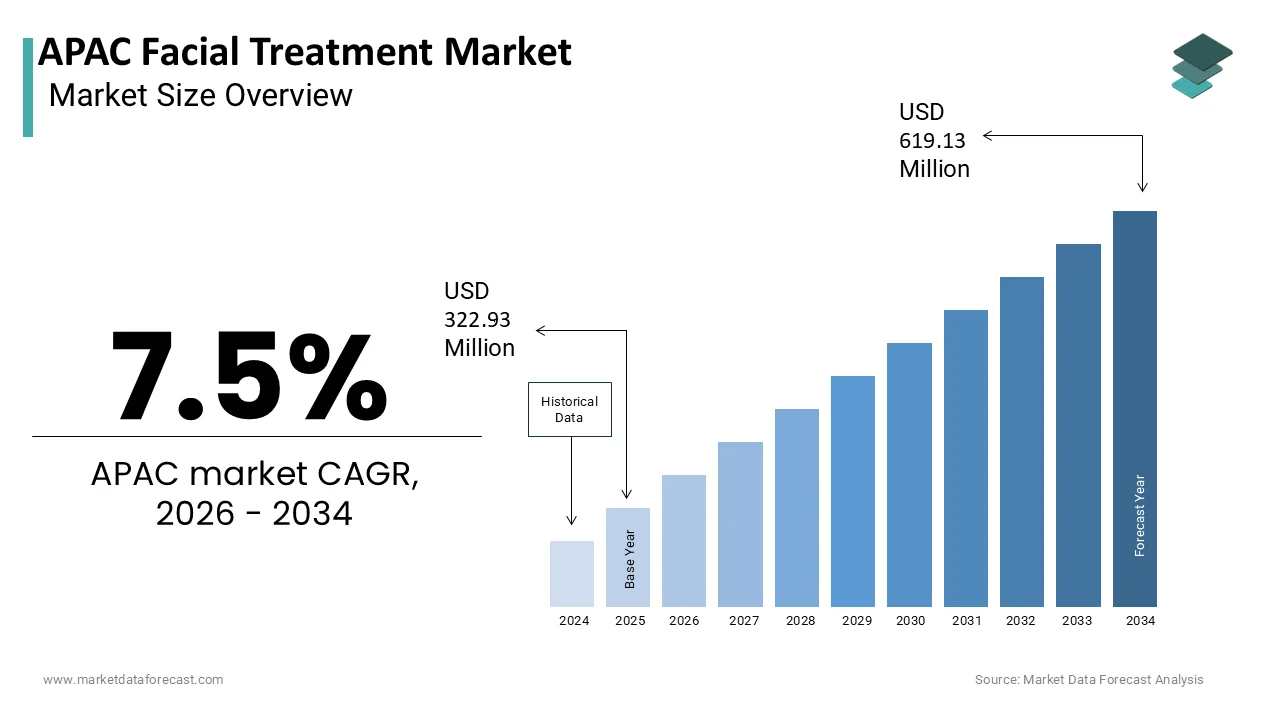
The Asia-Pacific (APAC) facial treatment market size was valued at USD 322.93 million in 2025, is anticipated to reach a valuation of USD 347.15 million in 2026, and is projected to scale to USD 619.13 million by 2034, growing at a compound annual growth rate (CAGR) of 7.50% during the forecast period from 2026 to 2034. Market expansion across the region is primarily driven by rising health and hygiene awareness, increasing demand for organic skincare solutions, higher adoption of advanced cosmetic treatments among men, and expanding e-commerce internet penetration.
Key Executive Metrics (At-a-Glance)
- 2025 Base Valuation: USD 322.93 Million
- 2026 Current Valuation: USD 347.15 Million
- 2034 Forecast Valuation: USD 619.13 Million
- Compound Annual Growth Rate (CAGR): 7.50% (2026–2034)
- Leading Country Markets: China (most lucrative beauty hotspot) and India (fastest-growing consumer base)
- Key Countries Covered: India, China, Japan, South Korea, Australia, New Zealand, Thailand, Malaysia, Vietnam, Philippines, Indonesia, Singapore, and Rest of APAC
Core Market Drivers & Opportunities
- Skincare Awareness & Personalization: Surging demand for anti-aging, skin-whitening, and personalized prescription skincare products tailored to lifestyle parameters.
- Male Grooming Growth: Rising adoption of advanced cosmetic products and skin/sun care regimens among male consumers in emerging markets like China, Japan, and India.
- Digital & E-Commerce Expansion: Increasing internet penetration boosting online retail channels for personal care and specialized dermatology procedures.
Primary Market Restraints & Challenges
- Channel Limitations: Heavy reliance on traditional supermarkets and departmental stores for physical distribution, alongside intense price competition among retail cosmetic brands.
Market Segmentation
| Segment Category | Sub-Segments & Categories |
|---|---|
| By Product Type | IPL Devices, RF Devices, Ultrasound Devices, LED Devices, and Laser-Based Devices |
| By End User | Dermatology Clinics and Beauty Clinics |
Major Industry Players Profiled
Key medical aesthetics and laser technology companies dominating the APAC facial treatment market include Lutronic Corporation, Cutera Inc., Lynton Lasers Ltd., Sciton Inc., Alma Lasers Ltd., Solta Medical Inc., Lumenis Ltd., Cynosure Inc., Strata Skin Sciences Inc., Syneron Medical Ltd., Venus Concept Canada Corporation, and Fotona d.d.
APAC Facial Treatment Market Size
The APAC Facial Treatment Market is projected to grow from USD 322.93 million in 2025 to USD 347.15 million in 2026 and reach USD 619.13 million by 2034, registering a CAGR of 7.50% from 2026 to 2034.
A facial treatment is a multi-step professional skin care service designed to clean, exfoliate, and hydrate the skin on the face. It helps clear clogged pores, remove dead skin cells, and target specific issues like acne, dryness, or aging to improve overall skin health. This market is uniquely defined by the convergence of traditional beauty rituals and advanced medical aesthetics, reflecting deep cultural significance attached to skin quality across the region. As per the World Health Organization, the proportion of the world's population over 60 years old will nearly double from 12% to 22% between 2015 and 2050, accelerating infrastructure strain on age-friendly communities and public health systems. Furthermore, according to the International Society of Aesthetic Plastic Surgery, non-surgical cosmetic treatments performed worldwide by board-certified plastic surgeons reached an active volume of 20.5 million procedures. This market definition extends beyond mere service provision to include regulatory frameworks governing practitioner qualifications, device safety standards, and consumer protection mechanisms that vary significantly across jurisdictions from highly regulated Australia to emerging markets with evolving oversight structures.
MARKET DRIVERS
Rising Disposable Income and Middle Class Expansion Fueling Discretionary Spending
The unprecedented expansion of the middle class across developing nations in the region drives the growth of the Asia Pacific facial treatments market. It is the main economic engine that converts facial treatments from elite indulgences into mainstream consumer expenditures. As per the Asian Development Bank, regional infrastructure strategies prioritize the scaling of creative services and integrated digital systems to drive sustainable macroeconomic value inside expanding urban markets. According to World Bank macroeconomic data, household final consumption expenditure in the Philippines expanded beyond USD 330 billion, which steadily advances baseline purchasing power for elective beauty and grooming commodities. As per the Financial Services Authority, out-of-pocket health and wellness expenditure borne directly by Indonesian households reached approximately 175 trillion rupiah due to gaps in commercial insurance coverage. Unlike durable goods purchases subject to deferral during uncertainty, facial treatments benefit from recurring consumption patterns driven by maintenance protocols and social media-influenced beauty standards. The broad based prosperity ensures demand resilience independent of luxury segment volatility, establishing sustainable volume floors across diverse price points and treatment categories throughout the region.
Social Media Penetration and Digital Beauty Culture Accelerating Treatment Adoption
Digital connectivity and visual social media platforms have fundamentally reshaped beauty aspirations and normalized professional facial treatments across the regional demographics, which in turn propels the expansion of the Asia Pacific facial treatments market. As per DataReportal, active global social media user identities scaled to approximately 5.79 billion, accounting for 69.9% of the overall international population. TikTok and Instagram Reels have democratized aesthetic education. According to Meta regional platform advertising insights, potential digital marketing reach inside dense metropolitan hubs like Hong Kong expanded by 7.1% year over year to improve cross-channel consumer acquisition. As per the Korea Creative Content Agency, digital lifestyle media influencers leverage interactive content, styling competencies, and localized product links to guide the grooming behaviors of the younger generation. The digital normalization creates self-reinforcing demand cycles where visible results generate user-generated content that attracts new clients, transforming facial treatments from private indulgences into publicly validated lifestyle markers embedded in digital identity construction.
MARKET RESTRAINTS
Regulatory Fragmentation and Practitioner Qualification Disparities Undermining Consumer Trust
Regulatory heterogeneity across jurisdictions in the region severely constrains the Asia Pacific facial treatments market maturation. This fragmentation creates uneven safety standards and erodes consumer confidence in treatment legitimacy. As per the World Health Organization, international healthcare standardization platforms like the Asian Harmonization Working Party promote unified baseline guidelines to eliminate regulatory variations for biomedical equipment and medical technologies across member borders. According to the Ministry of Health, standard medical oversight frameworks prioritize the alignment of regional safety reporting and localized clinical monitoring to eliminate public healthcare service execution gaps. As per sources, compliance operations require systematic facility tracking and standard code enforcement to ensure transparency across local services. Trust deficits will persist and suppress addressable market size regardless of underlying demand fundamentals. This will happen until harmonized practitioner certification and facility accreditation standards achieve meaningful implementation across jurisdictions.
High Out of Pocket Costs and Limited Insurance Coverage Restricting Accessibility
High out-of-pocket expenses continue to restrict advanced facial treatments to a wealthy minority across most nations in the region, which impedes the expansion of the Asia Pacific facial treatments market. This market limitation persists despite generally rising incomes in the region. According to the OECD health expenditure metrics, national safety nets prioritize essential treatments and public care models, leaving completely elective cosmetic practices outside universal health coverage benefit boundaries. As per the Department of Statistics, household expenditure allocations prioritize core essential materials and baseline provisions before adjusting for peripheral leisure or personal grooming activities. According to the National Health Authority, structural welfare programs reduce financial vulnerability and expand foundational healthcare reach for lower-income populations across developing regions. Financing options remain limited, further constraining accessibility. Until innovative pricing models or partial coverage mechanisms emerge, financial exclusion will persist as a dominant restraint limiting market expansion to privileged enclaves.
MARKET OPPORTUNITIES
Integration of Traditional Medicine with Modern Aesthetics Creating Differentiated Offerings
Strategic integration of traditional healing modalities with contemporary aesthetic technologies offers a transformative opportunity for the Asia Pacific facial treatment market. This approach creates culturally resonant facial treatments that distinguish the region’s offerings from Western standardized protocols. As per the World Health Organization, over 170 member states actively utilize traditional, complementary, and integrative medicine, with global strategies actively encouraging countries to integrate standardized policies, regulations, and multidisciplinary clinical research into national health systems. According to the National Administration of Traditional Chinese Medicine, regulatory bodies enforce the standardization of specific decoction piece categories to regularize product quality and guarantee patient safety metrics during clinical interventions. The fusion strategy transforms cultural heritage from a marketing narrative into a clinically validated differentiator, capturing value from consumers seeking treatments aligned with regional identity rather than imported Western beauty paradigms.
Male Grooming and Gender Neutral Aesthetics Expanding Addressable Demographics
The rapid evolution of gender norms and male self-care acceptance across the region provides a substantial, untapped opportunity to expand the Asia Pacific facial treatment market. This trend goes beyond the traditionally female-dominated clientele. According to the Ministry of Commerce, expanding demographics and urban household spending shifts are creating sustained commercial opportunities for lifestyle grooming product and wellness asset suppliers. As per research, clinical facial maintenance and acne management therapies are seeing rising adoption among younger demographic clusters to address urban dermatological conditions. The demographic expansion potentially doubles addressable market size while diversifying revenue streams away from female-centric seasonality and competitive saturation.
MARKET CHALLENGES
Proliferation of Counterfeit Devices and Unapproved Products Compromising Safety Standards
Widespread availability of counterfeit aesthetic devices and unapproved injectable products through informal channels is an existential threat to the legitimate Asia Pacific facial treatment market integrity. As per the OECD, global illicit trade networks in fake and pirated commodities reached an active market valuation of USD 467 billion, which undermines consumer safety metrics and compromises international intellectual property rights. According to official regulatory updates from the National Medical Products Administration, strict new inspection standards for cosmetic manufacturing and distribution channels enforce compliance codes to systematically lower market risks and protect public health. Consumer harm incidents linked to counterfeit products increased across Southeast Asia, generating negative publicity affecting entire sector reputation. Legitimate providers face impossible competition from sector operators using substandard inputs at a fraction of the cost, distorting price signals and forcing ethical practitioners to either compromise margins or lose price-sensitive clients to unsafe alternatives.
Workforce Skill Gaps and Training Standardization Deficits Limiting Service Quality
Severe shortages of qualified aesthetic practitioners and the absence of standardized training curricula across the region are critical barriers to the Asia-Pacific facial treatment market. This prevents market scaling and quality assurance. According to studies, specialized service businesses establish continuous internal training workflows to bridge localized technical expertise gaps across urban medical centers. As per sources, integrated certification networks roll out standardized vocational education paths to regularize practitioner competencies across service sectors. High staff turnover rates annually further compound knowledge retention challenges and increase recruitment costs. Workforce constraints will remain a strict ceiling on service delivery capacity. This will happen regardless of demand strength or technological advancement, unless we invest together in standardized vocational education and portable cross-border credentials.
REPORT COVERAGE
| REPORT METRIC | DETAILS |
| Market Size Available | 2025 to 2034 |
| Base Year | 2025 |
| Forecast Period | 2026 to 2034 |
| Segments Covered | By Product Type, End User, and Region. |
| Various Analyses Covered | Global, Regional, and Country-Level Analysis, Segment-Level Analysis, Drivers, Restraints, Opportunities, Challenges; PESTLE Analysis; Porter’s Five Forces Analysis, Competitive Landscape, Analyst Overview of Investment Opportunities |
| Countries Covered | India, China, Japan, South Korea, Australia, New Zealand, Thailand, Malaysia, Vietnam, Philippines, Indonesia, Singapore, Rest of APAC |
| Market Leaders Profiled | Lutronic Corporation, Cutera, Inc., Lynton Lasers Ltd., Sciton, Inc., Alma Lasers Ltd., Solta Medical, Inc., Lumenis Ltd., Cynosure, Inc., Strata Skin Sciences, Inc., Syneron Medical Ltd., Venus Concept Canada Corporation, Fotona d.d. |
SEGMENTAL ANALYSIS
By Product Type Insights
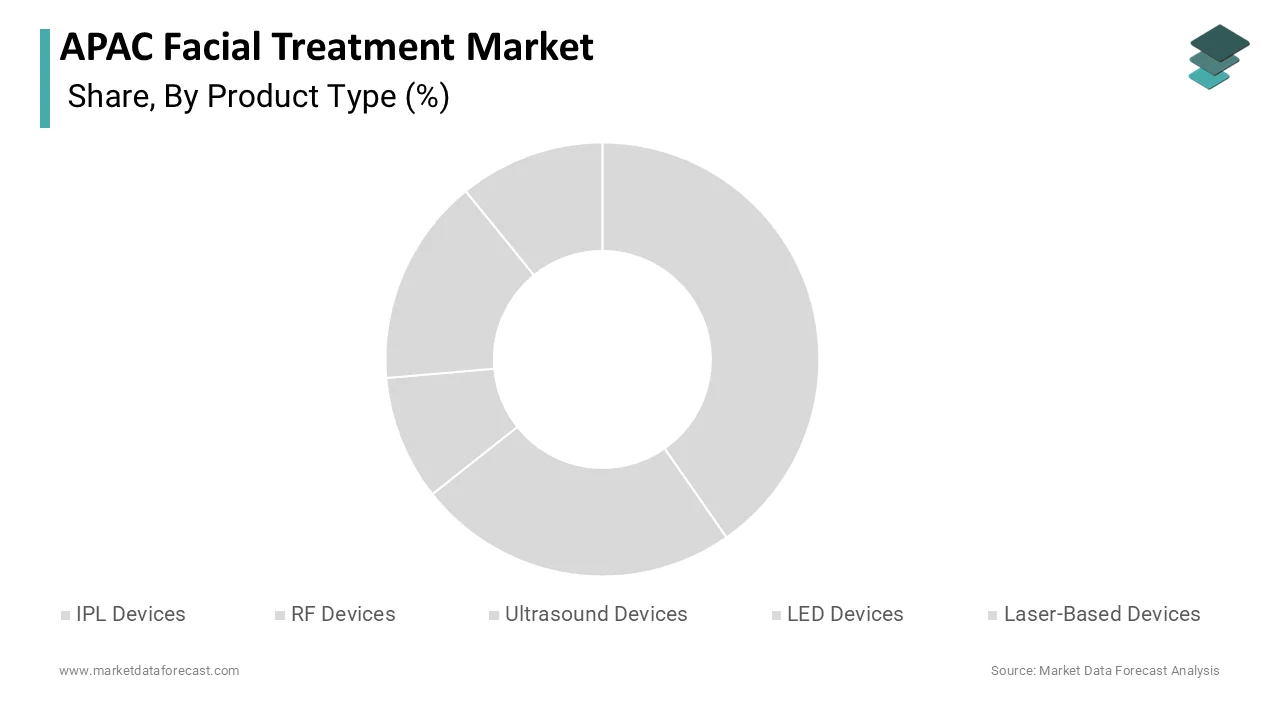
The Intense Pulsed Light (IPL) devices segment maintained dominance in the Asia Pacific facial treatment market and accounted for a substantial share in 2025. This dominance of the segment was driven by its multifunctional capability, addressing diverse dermatological concerns prevalent across regional skin types with single platform investment. As per sources, medical providers utilize intense pulsed light platforms to resolve a wide range of superficial vascular abnormalities and pigmentary imperfections. According to the World Health Organization, public healthcare frameworks monitor chronic medical conditions and demographic risk variations across urban centers to prioritize state health initiatives. Cost per treatment makes IPL accessible to middle-income consumers while maintaining healthy provider margins, according to studies. This combination of clinical versatility, demographic alignment, and economic accessibility creates self reinforcing adoption cycles where practitioner familiarity drives self-reinforcement, which in turn justifies continued equipment investment over specialized single-indication devices.
Two decades of clinical use have established a single-indication trusted energy-based facial treatment modality among Asia Pacific practitioners, creating an entrenched market position resistant to newer technology displacement. As per the International Society of Aesthetic Plastic Surgery, international statistical registers calculate the frequency of minimally invasive treatments across clinical networks to track broad global cosmetic procedural shifts. According to studies, clinical competency paths require structured device handling certifications to safeguard patient safety outcomes. This institutionalized familiarity creates switching costs for alternative technologies requiring retraining and rebuilding of patient trust, sustaining IPL dominance despite technological advances in competing modalities.
The radiofrequency (RF) devices segment is projected to grow at CAGR of 11.8% from 2026 to 2034 due to intensifying demand for non-invasive skin tightening solutions aligned with rapidly aging Asia Pacific populations. According to the United Nations Population Division, global demographic profiles show rapid shifts toward aging, setting unique structural constraints for public infrastructure and community resilience across regions. As per the Cabinet Office, senior population segments express varying demand preferences for non-surgical well-being options and aesthetic infrastructure systems. According to sources, upper-income household allocations shift fluidly between alternative premium service providers based on clinical safety certifications. This demographic and regulatory convergence creates structural tailwinds independent of marketing efforts, ensuring sustained growth as aging cohorts expand and treatment acceptance normalizes across generations.
Accelerated RF segment growth stems from continuous technological innovation enabling synergistic combination protocols that address multiple aging concerns simultaneously, overcoming historical limitations of standalone RF treatments. As per studies, multi-modality energy applications optimize sub-dermal thermal distribution patterns to achieve higher tissue contraction outcomes. According to research, international engineering suppliers scale their multi-energy product pipelines to resolve diverse tissue tightening demands across local clinical centers. As per sources, practicing physicians expand cross-border clinical clinical updates focused on specialized non-invasive energy applications. This innovation ecosystem transforms RF from a niche tightening tool into a comprehensive facial rejuvenation platform capable of competing with surgical alternatives, driving adoption among younger demographics seeking preventive maintenance alongside older patients requiring corrective interventions.
By End User Insights
The dermatology clinics segment led the Asia Pacific facial treatment market and captured a significant share in 2025. This leading position of the segment was attributed to superior medical credibility, regulatory compliance, and access to prescription adjunctive therapies enhancing treatment outcomes. As per the World Health Organization, public health and dermatological care frameworks prioritize standardized physician-supervised delivery methods to systematically minimize risks linked to unregulated clinical operations. According to the Japanese Dermatological Association, specialized health institutions systematically align patient treatment paths with formal physician diagnostic proficiencies to guarantee procedural safety. Pharmaceutical partnerships enable dermatology clinics to offer integrated protocols combining devices with prescription topicals like retinoids and hydroquinone, improving efficacy and patient retention. Medical malpractice insurance requirements and facility accreditation standards further concentrate complex procedures in dermatology settings where risk management infrastructure exists. This regulatory and clinical superiority ensures dermatology clinics retain leadership despite higher price points, as safety conscious consumers prioritize qualified supervision over cost, particularly for invasive or high energy treatments.
Dermatology clinics maintain market dominancehigh-energyility to integrate device treatments with prescription medications creating comprehensive care models unachievable in non-medical settings. As per the British Journal of Dermatology, clinical-medical assessments evaluate the diagnostic parameters and structural therapeutic responses of complex epidermal tissue conditions. According to the National Medical Products Administration, strict new inspection standards govern the manufacturing and commercial circulation of topical formulations to eliminate public safety gaps. Referral networks between dermatologists and plastic surgeons create bidirectional patient flows concentrating facial treatment demand in medical ecosystems. Continuing medical education requirements ensure dermatologists maintain current knowledge of emerging combination protocols, sustaining clinical differentiation against beauty clinics relying solely on device technology. This integration capability transforms facial treatments from isolated cosmetic services into components of comprehensive skin health management, anchoring demand in medical settings where holistic care coordination is possible.
The beauty clinics segment is on the rise and is expected to be the fastest-growing segment in the market, witnessing a CAGR of 13.2% during the forecast period. This growth expands access to facial treatments through lower price points, extended operating hours, and convenient neighborhood locations. As per the Ministry of Commerce, the availability of entry-level personal care services expands rapidly across provincial zones to capture broad mass-market consumer traffic. According to Thailand’s Ministry of Commerce, expanding small-business networks are opening local commercial setups to meet the daily grooming demands of urban consumers. Extended evening and weekend operating hours accommodate working professionals unable to visit dermatology clinics during standard business hours. Franchise models enable rapid geographic expansion with standardized service protocols, achieving scale efficiencies impossible for independent medical practices. This accessibility advantage converts latent demand into realized consumption among price-sensitive and convenience-oriented segments, driving growth in the price-sensitive premium medical segment despite lower per-transaction values.
Beauty clinics achieve accelerated growth through sophisticated digital marketing strategies leveraging social media influencers and user-generated content to drive client acquisition at a fraction of traditional advertising costs. As per studies, online lifestyle entertainment channels generate significant content engagement to optimize consumer acquisition across commercial retail brands. According to Vietnam’s Ministry of Information and Communications, young metropolitan populations leverage peer-to-peer social media applications as their main discovery mechanism for daily personal lifestyle selections. Booking platform integrations enable seamless appointment scheduling directly from social media posts, reducing friction between inspiration and conversion. This digital native marketing approach enables beauty clinics to build brand awareness and acquire clients at customer acquisition costs lower than dermatology clinics relying on referral networks and medical directory listings, sustaining growth momentum through efficient, scalable customer generation.
COUNTRY LEVEL ANALYSIS
China Facial Treatment Market Analysis
China was the top performer in the Asia Pacific facial treatment market and accounted for a 32.7% share in 2025. This supremacy of the segment was driven by massive population base, sophisticated domestic device manufacturing ecosystem, and aggressive digital commerce integration transforming service discovery and booking. According to the National Bureau of Statistics, China's total retail sales of consumer goods grew 3.5% year over year while domestic cosmetic consumption sectors maintained positive baseline expansions across key regional hubs. As per corporate disclosures recorded via HKEXnews, leading medical equipment manufacturers are expanding domestic supply operations to fulfill specific surgical and clinical therapy hardware demands across municipal hospitals. According to the Central Cyberspace Affairs Commission, the application of e-commerce livestream marketing and social audio platforms is scaling up consumer acquisition frameworks through standardized regulatory protocols. As per studies, demand for advanced demographic therapeutic solutions is dispersing significantly from top-tier coastal hubs into lower-tier inland municipalities. However, according to the State Administration for Market Regulation, joint enforcement agencies implemented newly updated oversight codes to systematically counter fraudulent profit structures and commercial marketplace chaos. China’s scale and digital sophistication make it an indispensable trendsetter whose trajectory significantly influences regional product development and marketing strategies.
Japan Facial Treatment Market Analysis
Japan was positioned second in the Asia Pacific facial treatment market and held an 18.3% share in 2025. This expansion of the Japanese market was supported by the highest per capita spending, stringent regulatory oversight, and a cultural emphasis on preventive skin maintenance beginning in early adulthood. As per the Ministry of Economy, Trade and Industry regional baseline economic mappings, household allocations for localized clinical aesthetic and maintenance services are heavily concentrated within major metropolitan infrastructure corridors. According to the Pharmaceuticals and Medical Devices Agency, medical hardware evaluations adhere strictly to categorized national health screening protocols to enforce public safety. As per the Ministry of Health, Labour and Welfare, domestic medical engineering suppliers in Takasago manufacture specialized clinical systems configured for localized institutional treatment setups. According to the Japan Aesthetic Medicine Association, active patient registries for medical aesthetic injectables in urban centers like Tokyo and Osaka have expanded significantly, driven by a post-pandemic shift toward rapid, low-downtime procedures. As per the Ministry of Health, Labour and Welfare specialized registry mappings, certified practitioners in clinical internal medicine and dermatology are redistributing operational resources to ease professional capacity deficits across suburban medical districts. Aging society dynamics ensure sustained structural demand.
South Korea Facial Treatment Market Analysis
South Korea contributes significantly to the Asia Pacific facial treatment market due to global K-Beauty cultural influence, highest procedure density per capita, and sophisticated integration of facial treatments into mainstream lifestyle and entertainment industries. As per the Korea Health Industry Development Institute, the national health system balances public infrastructure expansions with growing demand for specialized medical and aesthetic delivery options across urban environments. According to the Ministry of Health and Welfare, standard health coverage frameworks prioritize medically urgent, chronic clinical conditions and essential therapeutic healthcare access pathways. As per localized registry tracking compiled by the Seoul Metropolitan Government, medical infrastructure in the Gangnam district is highly concentrated with hundreds of dedicated clinics operating across specialized business zones. According to the Korea Tourism Organization, international patient arrivals to South Korea surpassed 1.1 million, driven significantly by global clinical demand and the broad popularity of regional medical wellness infrastructure.
India Facial Treatment Market Analysis
India is rapidly expanding in the Asia Pacific facial treatment market, owing to a massive young population, rising disposable incomes, and a rapidly evolving regulatory framework formalizing the previously informal sector. According to Invest India, the domestic beauty and personal care market is accelerating rapidly, supported by rising consumer incomes and geographic expansion into lower-tier cities. As per the Central Drugs Standard Control Organization, medical devices used for dermatological and plastic surgery applications are structured under a four-tier risk classification system ranging from Class A to Class D. According to corporate tracking across retail channels, scaled domestic wellness and aesthetic chains expand their footprint to capture consistent baseline consumer traffic using corporate network efficiencies. Ayushman Bharat scheme indirectly stimulates demand by improving overall healthcare access and normalizing professional health services among previously underserved populations. However, extreme practitioner qualification disparities persist, creating quality variability undermining consumer confidence. Currency volatility and import tariffs inflate device costs versus global benchmarks, constraining technology adoption outside premium urban enclaves.
Australia Facial Treatment Market Analysis
Australia is also a key player in the Asia Pacific facial treatment market. The country serves as a Southern Hemisphere regulatory and clinical excellence hub. It features a smaller population, but sophisticated consumer protection frameworks, mandatory practitioner registration, and internationally harmonized standards facilitate global trial participation. According to the Australian Health Practitioner Regulation Agency, national medical practice frameworks oversee a structured practitioner monitoring system to maintain public clinical and cosmetic safety. As per Australian Bureau of Statistics household consumption data, elective medical maintenance and grooming expenditures fluctuate in response to macro disposable income trends across states. Private health insurance rebates are available for dermatologist performed treatments for medically indicated conditions; the dermatologist-performed model is unique in the region, improving affordability for qualifying patients. However, a small domestic population limits commercial attractiveness for late-stage clinical trials focused solely on the Australian market, positioning the country primarily as a regulatory gateway and early-phase innovation site. Geographic isolation necessitates robust domestic distribution infrastructure, adding logistics costs absent in continental markets.
COMPETITIVE LANDSCAPE
Competition in the Asia Pacific facial treatment market exhibits pronounced stratification between multinational technology leaders dominating premium device segments and regional service providers capturing volume-driven consumer markets through accessibility and cultural resonance. Global players leverage clinical evidence generation and regulatory expertise to justify premium positioning in accredited medical facilities seeking international standards compliance. Regional chains compete aggressively on price convenience and localized service experiences in beauty clinic segments where standardized specifications limit technology differentiation. Emerging domestic manufacturers increasingly penetrate mid-tier device markets, offering acceptable quality at intermediate price points, challenging traditional binary competition structures. Innovation competition focuses on hybrid platforms combining multiple energies rather than single-modality breakthroughs due to practitioner preference for versatile solutions maximizing return on investment. Geographic coverage capabilities often outweigh technological superiority in determining commercial success given infrastructure limitations across vast territories. Digital marketing sophistication creates new competitive dimensions where social media engagement metrics correlate strongly with client acquisition efficiency. Competitive dynamics continue evolving as regulatory harmonization progresses, gradually reducing historical fragmentation barriers that protected incumbent positions while enabling cross-border expansion for well-capitalized operators pursuing regional scale advantages.
KEY MARKET PLAYERS
Some of the companies that are playing a dominating role in the APAC Facial Treatment Market include:
- Lutronic Corporation
- Cutera, Inc.
- Lynton Lasers Ltd.
- Sciton, Inc.
- Alma Lasers Ltd.
- Solta Medical, Inc.
- Lumenis Ltd.
- Cynosure, Inc.
- Strata Skin Sciences, Inc.
- Syneron Medical Ltd.
- Venus Concept Canada Corporation
- Fotona d.d.
TOP LEADING PLAYERS IN THE MARKET
- Lumenis Ltd maintains significant involvement in the Asia Pacific facial treatment market through its comprehensive portfolio of laser and intense pulsed light platforms optimized for diverse Asian skin types. Lumenis partnered with leading dermatology associations in China and Australia to establish certified training centers,s ensuring practitioner competency and safe device utilization. Strategic collaborations with hospital groups enable integrated aesthetic medicine protocols combining devices with pharmaceutical adjuncts. These initiatives reinforce Lumenis's position as a trusted technology partner supporting clinical excellence rather than a mere equipment vendor throughout diverse regional markets.
- Cutera Inc contributes substantially to the Asia Pacific facial treatment landscape through innovative radiofrequency and laser technologies addressing specific regional concerns including pigmentation and skin laxity common in Asian populations. Cutera established regional headquarters in Singapore providing localized technical support and rapid service response re, reducing equipmentt downtime for clinics. Their partnership with Korean aesthetic research institutions generated clinical validation data specific to Asian skin physiology supporting evidence based marketing claims. Its multifaceted engagement strategy demonstrates a commitment to llong-termmarket development through education and local adaptation rather than transactional sales approaches alone.
- Alma Lasers strengthens its position in the Asia Pacific facial treatment market through hybrid technology platforms combining multiple energy modalities enabling versatile treatment protocols for diverse patient needs. Al, ma partnered with Thai and Malaysian spa chains to develop wellness-integrated aesthetic protocols, bridging medical and beauty clinic segments and expanding the addressable customer base. Their digital marketing collaboration with regional influencers generated significant social media engagement, driving awareness among younger demographics traditionally underserved by clinical channels. Manufacturing facility expansion in China reduced supply chain lead times by fortypercent,t improving equipment availability for rapidly growing tier two city markets. Its strategic actions position Almaas as an innovation leader, adapting global technologies to regional preferences and distribution realities.
TOP STRATEGIES USED BY KEY MARKET PARTICIPANTS
Key players employ localized product adaptation strategies modifying device parameters and treatment protocols for Asian skin,characteristicsand cultural beauty preferences. Companies invest heavily in practitioner education programs, establishing certified training networks that build clinical competencies while embedding brand loyalty through experiential learning. Regulatory engagement prioritizes early dialogue with national authorities accelerating approval timelines and shaping technical standards favoring proprietary technologies. Strategic partnerships with hospital groups and spa chains enable integrated service models expanding distribution beyond traditional channels. Digital marketing collaborations leverage social media influencers and user generated content creating authentic peer validation that driuser-generatedwareness an,d trial. Clinical research investments generate region-specific efficacy data supporting evidence-based positioning distinct from Western validation studies. Manufacturing localization reduces supply chain vulnerabilities and currency exposure while demonstrating long term commitment to regional markets. Hybrid technology development combines multiple energy modalities, enabling versatile platforms addressing diverse concerns with a single device investment, improving clinic economics. After sales service infrastructure expansion ensures rapid technicalsupportt, minimizing equipment downtime and maintaining practitioner confidence. Public-private partnerships align corporate capabilities with national health priorities, securing preferential procurement treatment and policy support in regulated markets.
MARKET SEGMENTATION
This research report on the APAC facial treatment market has been segmented and sub-segmented into the following categories.
By Product Type
- IPL Devices
- RF Devices
- Ultrasound Devices
- LED Devices
- Laser-Based Devices
By End User
- Dermatology Clinics
- Beauty Clinics
By Country
- India
- China
- Japan
- South Korea
- Australia
- New Zealand
- Thailand
- Malaysia
- Vietnam
- Philippines
- Indonesia
- Singapore
-
Rest of APAC