- Product Description Description
- Table of Contents TOC
- List of Table & Figure LOT
- Get Free Sample PDF Sample PDF
Market Size, 2025
$42.52 BnMarket Estimate, 2026
$47.97 BnMarket Forecast, 2034
$125.91 BnCAGR, 2026–2034
12.82%Asia-Pacific Healthcare BPO Market Size, Growth, Trends & Forecast (2026–2034)
The Asia-Pacific Healthcare BPO Market size was valued at USD 42.52 billion in 2025, is anticipated to reach USD 47.97 billion in 2026, and is projected to scale up to USD 125.91 billion by 2034, registering a compound annual growth rate (CAGR) of 12.82% during the forecast period from 2026 to 2034. Driven by ongoing digital transformation, an aging population, and significant healthcare workforce shortages, outsourcing administrative, clinical, and payer functions has become critical for medical organizations across the region.
Key Executive Metrics (At-a-Glance)
- 2025 Base Valuation: USD 42.52 Billion
- 2026 Current Valuation: USD 47.97 Billion
- 2034 Forecast Valuation: USD 125.91 Billion
- Compound Annual Growth Rate (CAGR): 12.82% (2026–2034)
- Dominant Provider Service: Medical Billing (capturing 54.6% of the regional market share in 2025)
- Fastest-Growing Provider Service: Medical Coding (projected with a promising CAGR of 12.7%)
- Dominant Payer Service: Claims Management (holding 60.6% share in 2025)
- Fastest-Growing Payer Service: Analytics & Fraud Management (projected at a CAGR of 15.4%)
- Dominant Country Market: India (commanding 34.5% of the regional market share in 2025)
Core Market Drivers
- Aging Population & Healthcare Expenditure: Escalating medical needs driven by rapid demographic shifts, particularly in East Asia (Japan, China, South Korea), increasing the volume of insurance claims and records.
- Digital Transformation & EHR Adoption: Accelerated implementation of electronic health records (EHR), health information exchanges, and telemedicine platforms requiring robust backend support.
- Administrative Efficiency: The necessity for healthcare providers to reduce overhead costs, manage multi-payer systems, and minimize claim denial rates.
Primary Market Restraints & Challenges
- Stringent Data Privacy Regulations: Fragmented and rigorous compliance mandates across individual jurisdictions (e.g., PDPA in Singapore, Privacy Act in Australia, PIPL in China) complicating vendor selection.
- Skilled Labor Shortages & Attrition: Critical deficits in professionals trained in medical terminology, coding standards (ICD-10/ICD-11), and health information management paired with high staff turnover.
- Cybersecurity Vulnerabilities: Heightened threat landscapes targeting sensitive patient data, necessitating continuous investments in secure infrastructure.
Asia-Pacific Healthcare BPO Market Segmentation Breakdown
| Segment Category | Leading Sub-Segment (2025 Base) | Fastest-Growing Sub-Segment (2026–2034) |
|---|---|---|
| By Provider Service | Medical Billing (54.6% share, essential for revenue cycle management and denial mitigation) | Medical Coding (12.7% CAGR, driven by transition to ICD-11 and value-based care models) |
| By Payer Service | Claims Management (60.6% share, managing high volumes of administrative processing) | Analytics & Fraud Management (15.4% CAGR, utilizing AI to curb cyber-enabled fraud and audit claims) |
| By Country | India (34.5% share, global back office for revenue cycle management and export services) | Australia & South Korea (expanding via compliance-driven outsourcing and advanced smart healthcare tech) |
Major Industry Players Profiled
Key enterprises shaping the competitive Asia-Pacific healthcare BPO market include Infosys BPO Ltd., Cognizant Technology Solutions Corporation, Genpact Limited, Xerox Corporation, Tata Consultancy Services Ltd. (TCS), and Accenture plc.
Asia-Pacific Healthcare BPO Market Size
The APAC Healthcare BPO Market is projected to grow from USD 42.52 billion in 2025 to USD 47.97 billion in 2026 and reach USD 125.91 billion by 2034, registering a CAGR of 12.82% during the forecast period from 2026 to 2034.
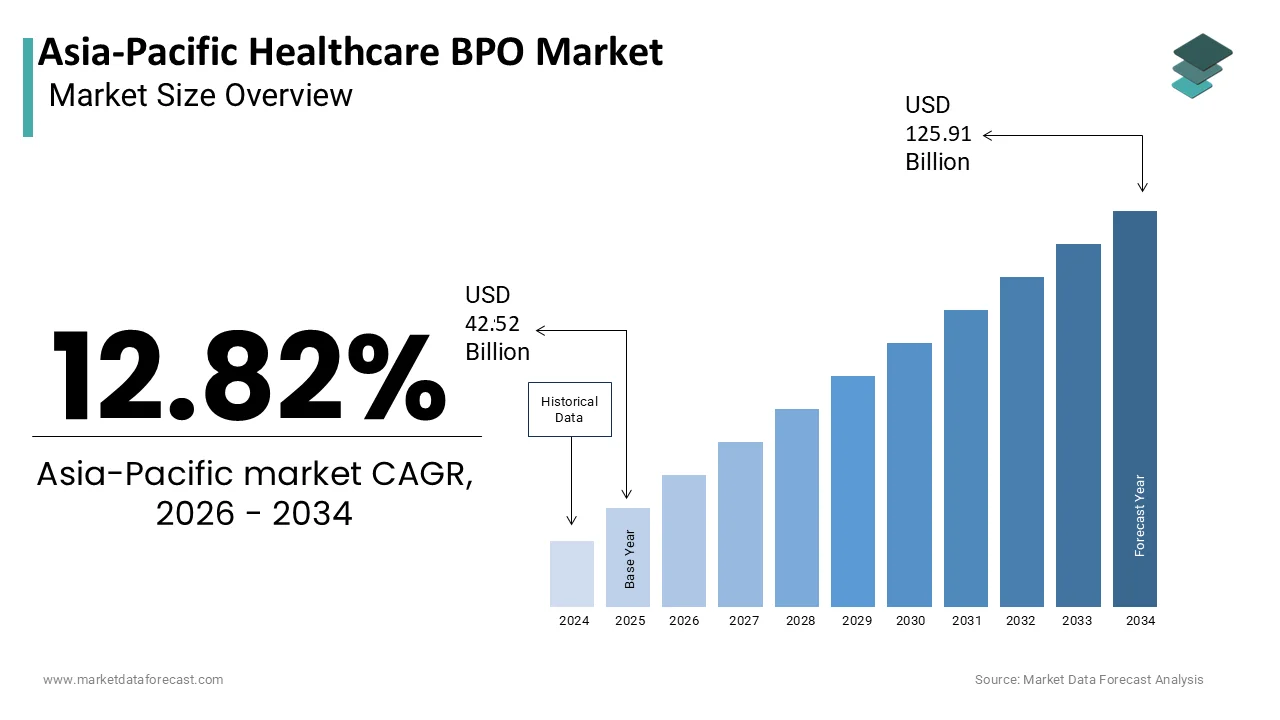
The Asia Pacific region is expected to grow steadily over the next few years, driven by ongoing digital transformation and rising healthcare demands. According to the World Health Organization, the Asia Pacific region faces a significant shortage of healthcare workers with a projected deficit of 4.5 million health professionals by 2030, which drives the adoption of outsourced solutions to bridge gaps in administrative capacity. Furthermore, the rising burden of non-communicable diseases such as diabetes and cardiovascular disorders necessitates efficient management of patient records and claims processing. According to the International Diabetes Federation, over 300 million adults in the Western Pacific region live with diabetes, creating substantial administrative workload for healthcare providers. As per data from the Asian Development Bank, digital transformation in healthcare is accelerating,g with governments investing heavily in electronic health records and telemedicine platforms. This digital shift requires robust backend support, rt which BPO firms are well positioned to provide. The integration of artificial intelligence and automation in healthcare processes further enhances the value proposition of outsourcing, enabling providers to focus on core clinical activities while ensuring compliance, accuracy, and cost-effectiveness in an increasingly complex regulatory environment.
MARKET DRIVERS
Rising Healthcare Expenditure and Aging Population
The escalating healthcare expenditure coupled with a rapidly aging population in the Asia Pacific region is a primary catalyst for the expansion of the Asia-Pacific healthcare BPO market. Countries such as Japan, China, and South Korea are experiencing unprecedented demographic shifts, with the proportion of individuals aged 65 and older increasing significantly. According to the United Nations Department of Economic and Social Affairs, by 2050 nearly 25% of the population in East Asia will be over 65 years old, leading to higher utilization of medical services and chronic disease management. This demographic trend results in a surge of insurance claims, medical records, and billing transactions that overwhelm internal administrative teams. According to the Ministry of Health,h Labour and Welfare, national healthcare expenditure in Japan has exceeded 40 trillion yen annually, requiring efficient processing mechanisms to manage costs. Healthcare providers are increasingly turning to BPO partners to handle revenue cycle management, claims adjudication, and patient eligibility verification to reduce operational bottlenecks. The complexity of multi-payer systems in countries like Australia and India further necessitates specialized expertise in coding and compliance. Outsourcing allows hospitals and clinics to scale their administrative capabilities without incurring the high fixed costs of hiring and training additional staff. By leveraging external expertise, healthcare organizations can improve cash flow, reduce claim denials, and enhance patient satisfaction through faster processing times. This strategic shift enables providers to navigate the financial pressures of an aging society while maintaining high standards of care delivery.
Digital Transformation and Adoption of Electronic Health Records
The rapid digitization of healthcare systems across the Asia-Pacific region is another major driver propelling the Asia-Pacific healthcare BPO market growth. Governments and private entities are aggressively implementing electronic health records, health information exchanges, and telemedicine platforms to improve care coordination and accessibility. According to the World Health Organization, over 60% of member states in the Western Pacific Region have established national eHealth strategies aiming to integrate digital tools into routine practice. This transition generates vast amounts of structured and unstructured data that require meticulous management, indexing, and analysis. BPO firms equipped with advanced technologies such as natural language processing and machine learning are essential for converting paper-based records into digital formats and ensuring data integrity. In India, the National Digital Health Mission aims to create a unified digital health ecosystem connecting millions of patients and providers, which necessitates robust backend support for data entry and verification. Similarly, in Australia, the My Health Record system requires continuous maintenance and user support services often provided by outsourcing partners. The need for interoperability between different healthcare IT systems also drives demand for specialized BPO services that can manage data migration and integration projects. By outsourcing these technical and administrative tasks, healthcare organizations can accelerate their digital transformation journeys, ensure compliance with data standards, and leverage analytics for better decision-making. This technological imperative ensures sustained demand for sophisticated healthcare BPO solutions in the region.
MARKET RESTRAINTS
Stringent Data Privacy Regulations and Compliance Risks
The implementation of rigorous data privacy laws and regulatory frameworks across various Asia-Pacific countries poses a significant restraint on the Asia-Pacific healthcare BPO market. Healthcare data is highly sensitive and subject to strict protection mandates such as the Personal Data Protection Act in Singapore, the Privacy Act in Australia, and the Personal Information Protection Law in China. According to the Office of the Australian Information Commissioner, healthcare entities must ensure that third-party providers adhere to equivalent privacy standards, which complicates vendor selection and contract negotiations. Non-compliance can result in severe penalties, legal liabilities, and reputational damage, deterring some healthcare organizations from outsourcing critical functions. For instance, the Singapore Personal Data Protection Commission has imposed fines exceeding $1 million on organizations for data breaches, highlighting the high stakes involved. BPO providers must invest heavily in secure infrastructure, encryption technologies, and regular audits to meet these diverse regulatory requirements, increasing operational costs. Additionally, the lack of harmonized data protection laws across the region creates uncertainty for multinational BPO firms operating in multiple jurisdictions. Each country may have different definitions of personal health information, consent requirements, and data localization rules, forcing providers to maintain separate compliance protocols. This regulatory fragmentation increases the complexity of service delivery and limits the ability of BPO firms to offer standardized solutions. Consequently, some healthcare providers prefer to keep data management in-house to maintain direct control over compliance, thereby restricting the potential expansion of the outsourcing market.
Shortage of Skilled Professionals with Specialized Healthcare Knowledge
A critical shortage of professionals possessing both domain expertise in healthcare and proficiency in business process operations is a major restraint on the Asia Pacific healthcare BPO market. Effective healthcare outsourcing requires staff who understand medical terminology, coding systems such as ICD-10 and CPT, insurance policies, and clinical workflows. According to the World Health Organization, the Asia Pacific region faces a significant gap in trained health information managers and medical coders, particularly in developing economies. In countries like the Philippines and India, where the BPO industry is mature, finding talent with specialized healthcare knowledge remains challenging due to high attrition rates and competition from other sectors. According to the Association of Healthcare Providers in India, turnover rates in healthcare BPOs can exceed 20% annually, leading to inconsistencies in service quality and increased training costs. Retraining new employees takes time and resources, delaying project implementation and affecting client satisfaction. Furthermore, the rapid evolution of medical guidelines and insurance regulations requires continuous education, which many BPO firms struggle to provide at scale. This skills gap can result in coding errors, claim denials, and delayed reimbursements, undermining the value proposition of outsourcing. Healthcare providers may hesitate to outsource complex tasks if they perceive a risk of errors due to inadequate staff competence. Until the pipeline of skilled healthcare BPO professionals is strengthened through targeted education and retention strategies, the market will face limitations in delivering high-quality, reliable services.
MARKET OPPORTUNITIES
Integration of Artificial Intelligence and Automation
The incorporation of artificial intelligence, robotic process automation, and machine learning into healthcare business processes offers a substantial opportunity for market expansion and service enhancement in the Asia Pacific region. These technologies enable BPO providers to automate repetitive tasks such as data entry, claims processing, and appointment scheduling, reducing human error and increasing efficiency. According to research by the McKinsey Global Institute, automation could potentially automate up to 45% of current healthcare administrative activities, freeing up human resources for higher-value tasks. AI-powered algorithms can analyze large datasets to identify patterns in claim denials, predict patient no-shows, and optimize resource allocation. In South Korea, major BPO firms are deploying chatbots and virtual assistants to handle patient inquiries and triage symptoms, improving access to care and reducing call center volumes. The Korean Ministry of Science and ICT supports AI innovation in healthcare, encouraging partnerships between technology companies and service providers. Additionally, predictive analytics can help insurers detect fraud and abuse more effectively, saving billions of dollars annually. According to the Asia Pacific Insurance Association, fraud detection using AI has improved accuracy by 30% in pilot programs. By adopting these advanced technologies, BPO firms can offer superior service levels, faster turnaround times, and cost savings to their clients. This technological differentiation allows providers to move beyond traditional transactional services to strategic consulting and analytics, driving higher margins and deeper client relationships in the evolving healthcare landscape.
Expansion of Medical Tourism
The booming medical tourism industry in the Asia Pacific region presents a lucrative opportunity for healthcare BPO providers to offer specialized multilingual and cross-border support services. Countries such as Thailand, Malaysia, India, and Singapore are popular destinations for international patients seeking affordable and high-quality medical treatments. According to the Global Wellness Institute, the medical tourism market in Asia is growing at an annual rate of 15%, attracting millions of visitors annually. These patients require comprehensive support, including visa assistance, travel coordination, appointment scheduling, translation services, and post-treatment follow-up. BPO firms can capitalize on this trend by offering end-to-end patient concierge services that enhance the overall experience for international travelers. According to the Ministry of Public Health in Thailand, over 1 million medical tourists visited the country in recent years, creating a need for seamless communication and administrative support in multiple languages. BPO providers with multilingual capabilities can bridge cultural and linguistic gaps, ensuring that patients receive clear information and timely assistance. Additionally, managing insurance claims for international patients involves navigating complex cross-border reimbursement processes, which specialized BPOs can handle efficiently. By partnering with hospitals and clinics catering to medical tourists, BPO firms can expand their service portfolios and tap into a high-value segment. This opportunity not only drives revenue growth but also positions Asia Pacific BPO providers as global leaders in patient-centric healthcare support services.
MARKET CHALLENGES
Cybersecurity Threats and Data Breaches
The increasing frequency and sophistication of cyberattacks targeting healthcare organizations is a major challenge for the Asia-Pacific healthcare BPO market. Healthcare data is a prime target for criminals due to its high value on the black market, leading to ransomware attacks, phishing scams, and data theft. According to the Interpol Cybercrime Directorate, cyberattacks against healthcare entities in the Asia-Pacific region increased by 40% in the last two years, disrupting operations and compromising patient safety. BPO providers handling sensitive health information must maintain robust cybersecurity defenses, including firewalls, intrusion detection systems, and employee training programs. However, maintaining such high levels of security requires continuous investment and vigilance, which can strain resources, especially for smaller firms. A single breach can result in significant financial losses, legal consequences, and loss of client trust. According to the Office of the Australian Information Commissioner, over 1,000 eligible data breaches were recorded in the health sector recently, highlighting the vulnerability of the industry. Additionally, the interconnected nature of healthcare IT systems means that vulnerability in a BPO provider’s network can compromise the entire healthcare ecosystem. Ensuring zero-trust architecture and regular penetration testing is essential, but challenging given the evolving threat landscape. This constant pressure to stay ahead of cybercriminals adds complexity and cost to operations, making cybersecurity a critical yet daunting challenge for healthcare BPO firms in the region.
Fragmented Regulatory Landscape across Countries
The diverse and fragmented regulatory environment across Asia Pacific countries creates significant operational challenges for healthcare business process outsourcing providers seeking to standardize services. Each nation has its own unique healthcare policies, insurance structures, coding standards, and legal requirements, which prevents the implementation of uniform processes. For example, medical coding practices in Japan differ significantly from those in India or Australia, requiring specialized teams and tailored workflows for each market. According to the World Health Organization, harmonization of health information standards in the Asia Pacific region remains limited, leading to inefficiencies in cross-border data exchange. BPO firms must navigate these complexities by maintaining separate operational units for different countries, increasing overhead costs and reducing economies of scale. Additionally, changes in local regulations such as updates to reimbursement rates or privacy laws require rapid adaptation, which can disrupt service delivery. According to the National Healthcare Security Administration in China, drug lists and pricing policies are frequently updated, requiring BPOs to constantly update their databases and billing systems. This lack of regulatory consistency makes it difficult for multinational BPO providers to offer scalable solutions and forces them to invest heavily in local compliance expertise. The inability to standardize processes limits operational efficiency and hinders the ability to leverage global best practices. Until greater regional harmonization is achieved, healthcare BPO firms will continue to face hurdles in optimizing their service models and achieving seamless cross-border operations.
REPORT COVERAGE
| REPORT METRIC | DETAILS |
| Market Size Available | 2025 to 2034 |
| Base Year | 2025 |
| Forecast Period | 2026 to 2034 |
| Segments Covered | By Provider Service, Payer Service, Pharmaceutical Service, and Region. |
| Various Analyses Covered | Global, Regional, and Country-Level Analysis, Segment-Level Analysis, Drivers, Restraints, Opportunities, Challenges; PESTLE Analysis; Porter’s Five Forces Analysis, Competitive Landscape, Analyst Overview of Investment Opportunities |
| Countries Covered | India, China, Japan, South Korea, Australia, New Zealand, Thailand, Malaysia, Vietnam, Philippines, Indonesia, Singapore, Rest of APAC |
| Market Leaders Profiled | Infosys BPO Ltd., Cognizant Technology Solutions Corporation, Genpact Limited, Xerox CorporationTata Consultancy Services Ltd.Accenture plc |
SEGMENTAL ANALYSIS
By Provider Service Insights
The medical billing segment dominated the market and captured 54.6% of the regional market share in 2025. This segment dominates because accurate and timely billing is essential for healthcare providers to maintain financial stability and cash flow. The domination is driven by the increasing volume of medical claims and the high rate of claim denials resulting from coding errors or incomplete documentation. According to the American Academy of Family Physicians, approximately 10% of all medical claims are denied on the first submission, leading to significant revenue loss for providers. In the Asia Pacific region, where private insurance penetration is growing rapidly in countries like India and Thailand, the administrative burden of managing multiple payer requirements has intensified. Healthcare providers often lack the internal resources to handle the intricate details of billing regulations, which vary significantly between insurers. Outsourcing medical billing allows hospitals and clinics to leverage specialized expertise in claim submission, follow-up, and denial management. According to the World Health Organization, administrative inefficiencies account for a substantial portion of healthcare spending in developing nations, highlighting the value of streamlined billing operations. Furthermore, the adoption of electronic health records has generated large volumes of data that require professional interpretation and conversion into billable codes. BPO firms utilize advanced software and trained personnel to ensure compliance with payer guidelines, reducing denial rates and accelerating payment cycles. This financial imperative ensures that medical billing remains the most sought-after service in the provider segment, driving consistent market leadership.
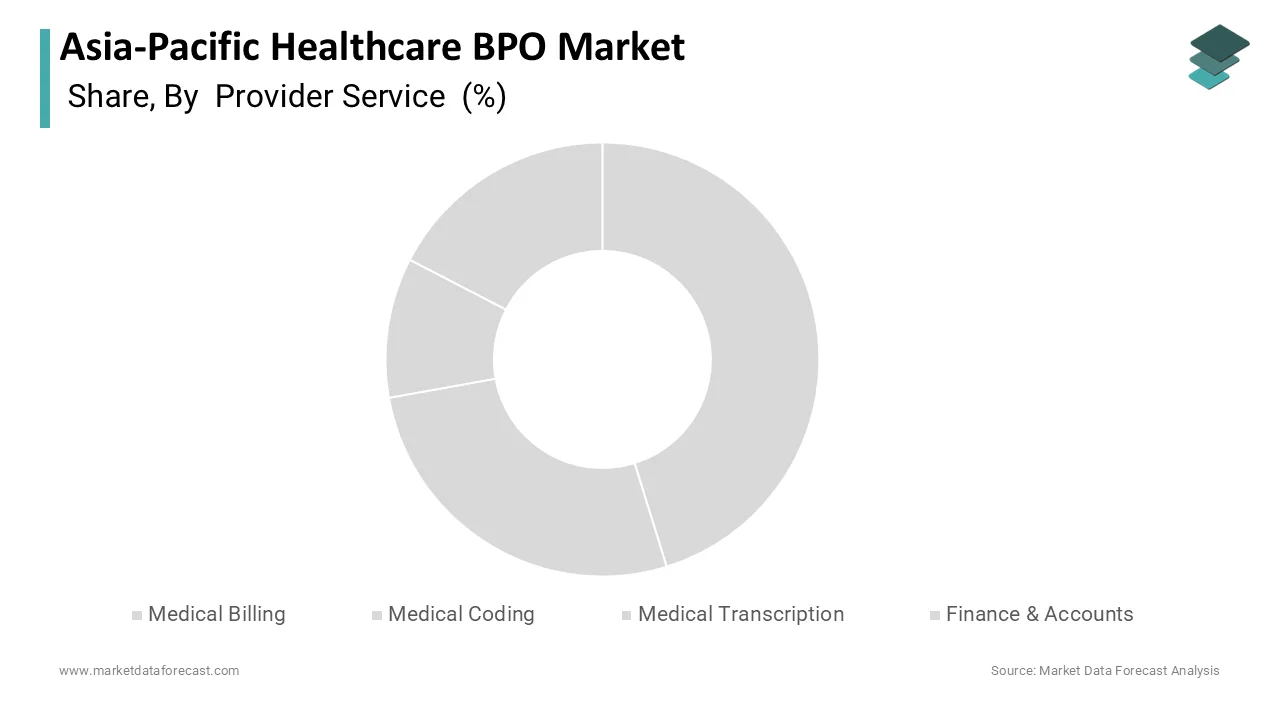
On the other hand, the medical coding segment is estimated to witness a promising CAGR of 12.7% over the forecast period. The shift from ICD-9 to ICD-10 and the upcoming implementation of ICD-11 have created a massive demand for skilled coders who can accurately translate medical diagnoses and procedures into universal alphanumeric codes. According to the World Health Organization, ICD-11 contains over 55,000 unique codes compared to 14,000 in ICD-10, requiring extensive training and precision. In countries like Australia and South Korea, regulatory bodies mandate strict adherence to coding standards for reimbursement and statistical reporting, creating a steady stream of outsourcing opportunities. According to the American Health Information Management Association, the average cost of a coding error can exceed $25 per claim when considering rework and delayed payments, incentivizing providers to outsource to expert firms. Additionally, the rise of value-based care models requires detailed coding to capture patient severity and resource utilization accurately. BPO providers are investing heavily in artificial intelligence-assisted coding tools that enhance accuracy and speed, further accelerating adoption. The shortage of certified coders in many Asia Pacific nations forces healthcare organizations to rely on external partners who can provide scalable and compliant coding services. This combination of regulatory pressure, technological advancement, and workforce gaps fuels the rapid expansion of the medical coding segment.
By Payer Service Insights
The claims management segment held the dominant position in the healthcare market with 60.6% in 2025. Insurance companies and third-party administrators rely on efficient claims processing to manage costs, prevent fraud, and ensure member satisfaction. The dominance of this segment is driven by the increasing number of insured individuals and the rising frequency of healthcare utilization across the region. According to the International Labour Organization, social health protection coverage has expanded significantly in Asia, yet administrative bottlenecks remain a major challenge. In countries like Japan and South Korea, where national health insurance schemes cover the majority of the population, the volume of claims is enormous, requiring robust backend support. BPO firms provide end-to-end claims management services, including intake, adjudication, payment, and explanation of benefits generation. According to the Centers for Medicare and Medicaid Services in the United States, which influences global best practices, automated claims processing can reduce administrative costs by up to 30%. Asia Pacific insurers are adopting similar efficiencies by outsourcing to BPOs that offer scalable infrastructure and advanced analytics. These providers help payers reduce turnaround times, minimize manual intervention, and improve accuracy in benefit determination. As healthcare costs continue to rise, effective claims management becomes crucial for controlling expenditure and maintaining profitability for insurance carriers. This operational necessity secures the leading position of claims management in the payer services segment.
On the other hand, the analytics and fraud management segment is anticipated to record a CAGR of 15.4% over the forecast period in the Asia-Pacific healthcare BPO market. Healthcare fraud costs the global economy billions of dollars annually, with the National Health Care Anti-Fraud Association estimating that fraud accounts for 3% to 10% of total healthcare expenditures. In the Asia Pacific region, where digital health records and online claims submission are becoming standard, the risk of cyber-enabled fraud has increased. Insurers and government agencies are increasingly turning to BPO providers equipped with advanced predictive analytics and machine learning capabilities to detect anomalous patterns in claims data. These technologies can identify suspicious billing practices, duplicate claims, and upcoding in real time, preventing financial losses before they occur. According to the Asian Development Bank, digital transformation in financial services is enabling more sophisticated fraud detection mechanisms, which are now being applied to healthcare. BPO firms offer specialized services that combine human investigation with algorithmic monitoring, providing a comprehensive defense against fraud. Regulatory pressures in countries like Australia and Singapore are also mandating stricter oversight of healthcare spending, encouraging payers to invest in analytics-driven solutions. As data volumes grow and fraud schemes become more complex, the demand for specialized analytics and fraud management services will continue to accelerate, making it the most dynamic segment in the payer services category.
COUNTRY LEVEL ANALYSIS
India Healthcare BPO Market Analysis
India dominated the healthcare BPO market in Asia-Pacific by commanding 34.5% of the regional market share in 2025, and the market is anticipated to expand steadily through continued digital adoption and strong export demand. The country is recognized as the global back office for healthcare services, serving clients primarily from the United States, Europe, and other Asia Pacific nations. According to the National Association of Software and Service Companies, the Indian IT BPM sector generates over $190 billion in revenue, with healthcare BPO being a significant contributor. The presence of numerous accredited medical coding and billing specialists makes India a preferred destination for revenue cycle management and clinical data processing. The Indian government’s Digital India initiative has further enhanced connectivity and digital literacy, supporting the growth of knowledge-intensive services. Major global healthcare BPO firms have set up large delivery centers in cities like Bangalore, Hyderabad, and Pune, leveraging the local talent base. The cost advantage remains a key driver, with operational costs in India being 40% to 50% lower than in Western countries. Additionally, the strong educational system produces thousands of life science graduates annually who are trained in medical terminology and healthcare processes. This combination of affordability, skill, and scale ensures India’s continued dominance in the regional healthcare BPO market.
China Healthcare BPO Market Analysis
China occupies the second-largest position in the regional market and is characterized by modernizing medical infrastructure and increasing domestic adoption of health technologies. The National Healthcare Security Administration in China has implemented comprehensive health insurance reforms, leading to a surge in claims processing and data management needs. Chinese BPO firms are increasingly focusing on serving the domestic market while also expanding their capabilities to support international clients in clinical trials and regulatory affairs. The Chinese Ministry of Science and Technology promotes innovation in biotechnology, attracting global pharmaceutical companies to conduct research in the country. This has created demand for specialized BPO services such as clinical data management and pharmacovigilance. The large population provides a vast dataset for medical research, enhancing the value of Chinese BPO providers in analytics and real-world evidence generation. However, language barriers and data privacy regulations such as the Personal Information Protection Law pose challenges for cross-border operations. Despite these hurdles, China’s market size and technological advancements ensure its significant presence in the Asia Pacific healthcare BPO landscape.
Japan Healthcare BPO Market Analysis
Japan holds a notable share of the Asia Pacific healthcare BPO market, and the country is projected to experience robust demand for automated back-office solutions driven by acute workforce shortages. The country faces severe labor shortages in the healthcare sector, prompting institutions to adopt automation and outsourcing solutions. According to the Ministry of Health, Labour and Welfare, healthcare expenditure continues to rise, necessitating cost containment measures through efficient back-end operations. Japanese BPO providers specialize in high-value services such as medical transcription, data analytics, and patient support, catering to the domestic market’s stringent quality standards. The country is also a leader in robotic process automation, which is integrated into healthcare BPO workflows to enhance accuracy and speed. Cultural emphasis on precision and reliability means that Japanese clients prefer local or highly trusted international partners. The government’s promotion of digital health records under the My Number Card system creates opportunities for data management services. While the market is mature, growth is driven by the need to manage the complex administrative burden of long-term care insurance and elderly care services. Japan’s focus on quality and innovation maintains its strong position in the regional market.
South Korea Healthcare BPO Market Analysis
South Korea represents a dynamic and technologically advanced segment of the Asia Pacific healthcare BPO market. The country is known for its robust IT infrastructure and high internet penetration, which facilitates the adoption of digital healthcare solutions. The National Health Insurance Service in Korea processes millions of claims annually, driving demand for efficient claims management and data analytics services. Korean BPO firms are increasingly leveraging artificial intelligence and big data to offer predictive analytics and fraud detection services to insurers and providers. The government’s Smart Healthcare Initiative encourages the integration of technology into medical practices, creating opportunities for BPOs to support telemedicine and remote patient monitoring platforms. South Korea is also a hub for biomedical research, attracting pharmaceutical companies that outsource clinical trial management and regulatory compliance tasks. The highly educated workforce proficient in both technology and healthcare domains enables the delivery of sophisticated services. While the domestic market is significant, Korean BPO providers are also expanding into Southeast Asia, offering their technical expertise to emerging markets. This blend of technological prowess and healthcare specialization sustains South Korea’s competitive edge in the region.
Australia Healthcare BPO Market Analysis
Australia is predicted to register a healthy CAGR in the Asia-Pacific healthcare BPO market over the forecast period, and the sector is forecasted to expand moderately with an emphasis on compliance-driven outsourcing. The country serves as a key market for high-quality BPO services, particularly in medical coding, claims processing, and compliance management. The Australian Digital Health Agency oversees the My Health Record system, which requires ongoing maintenance and support services often provided by BPO firms. According to the Private Health Insurance Ombudsman, the complexity of private health insurance claims drives demand for specialized adjudication and customer support services. Australian healthcare providers increasingly outsource non-core functions to improve efficiency and reduce costs amidst rising labor expenses. The country also acts as a gateway for international BPO providers entering the Asia Pacific market due to its common law legal framework and English-speaking environment. Strict privacy laws under the Privacy Act require BPO partners to maintain high security standards, influencing vendor selection. The focus on value-based care and patient outcomes is driving demand for analytics and population health management services. Australia’s emphasis on quality and compliance ensures a steady demand for premium healthcare BPO solutions.
COMPETITIVE LANDSCAPE
The competition in the Asia Pacific healthcare BPO market is characterized by intense rivalry among global IT services giants, specialized healthcare outsourcing firms,s and emerging regional players. Large multinational corporations leverage their scale, le technological expertise, and established client relationships to dominate high-value segments such as revenue cycle management and clinical data services. These firms compete on innovation by integrating artificial intelligence, machine learning,g and automation into their offerings to improve efficiency and reduce errors. Regional players often focus on niche services or specific geographic markets where they possess local knowledge and cost advantages. Price competition remains significant,nt particularly for transactional services like medical transcription and data entry, prompting providers to differentiate through quality and speed. The entry of technology-driven startups disrupts traditional models by offering agile and specialized solutions. Regulatory compliance and data security are critical differentiators as clients prioritize partners who can navigate complex legal frameworks. Strategic partnerships and alliances are common as companies seek to expand their service portfolios and geographic reach. The market remains dynamic with continuous evolution driven by technological advancements changing healthcare policies and increasing demand for operational efficiency across the region.
KEY MARKET PLAYERS
Some of the companies that are playing a dominant role in the Asia Pacific Healthcare BPO Market include:
- Infosys BPO Ltd.
- Cognizant Technology Solutions Corporation
- Genpact Limited
- Xerox Corporation
- Tata Consultancy Services Ltd.
- Accenture plc
TOP LEADING PLAYERS IN THE MARKET
- Cognizant Technology Solutions Corporation maintains a dominant presence in the Asia Pacific healthcare BPO market by delivering comprehensive revenue cycle management and clinical data services. The company leverages its extensive network of delivery centers in India and the Philippines to provide cost-effective solutions for global healthcare providers. Cognizant recently expanded its artificial intelligence capabilities by launching specialized platforms for automated medical coding and claims adjudication. These innovations help clients reduce denial rates and accelerate cash flow while ensuring regulatory compliance. The firm also strengthened its partnerships with major electronic health record vendors to offer seamless integration services. By focusing on digital transformation and process automation, Cognizant enhances operational efficiency for hospitals and insurers. This strategic emphasis on technology-driven solutions solidifies its position as a preferred partner for healthcare organizations seeking to optimize administrative workflows and improve patient outcomes across the diverse Asia Pacific region.
- Wipro Limited contributes significantly to the Asia Pacific healthcare BPO market through its robust portfolio of payer and provider services, including member management and pharmacy benefit administration. The company utilizes advanced analytics and cloud computing to streamline complex healthcare processes for insurance companies and pharmaceutical firms. Wipro recently established innovation hubs in Singapore and Bangalore focused on developing next-generation healthcare automation tools. These facilities support the creation of intelligent bots that handle repetitive tasks such as eligibility verification and prior authorization. The firm also invested in upskilling its workforce in medical terminology and regulatory compliance to ensure high-quality service delivery. By integrating cognitive technologies with traditional BPO operations, Wipro offers scalable and flexible solutions. This approach enables clients to adapt to changing market dynamics and regulatory requirements. Wipro’s commitment to continuous improvement and technological innovation strengthens its reputation as a reliable and forward-thinking partner in the evolving Asia Pacific healthcare landscape.
- Genpact LLC plays a pivotal role in the Asia Pacific healthcare BPO market by providing specialized services in clinical research support and pharmacovigilance for pharmaceutical companies. The company capitalizes on the region’s growing importance in global drug development by offering end-to-end clinical data management solutions. Genpact recently expanded its operations in Malaysia and Vietnam to tap into emerging talent pools and reduce operational costs. The firm implemented advanced machine learning algorithms to enhance the accuracy of adverse event reporting and regulatory documentation. These technological upgrades help pharmaceutical clients accelerate drug approval timelines and maintain compliance with international standards. Genpact also strengthened its collaborations with leading life sciences organizations to co-create innovative process improvements. By focusing on niche high-value services, Genpact differentiates itself from generalist BPO providers. This strategic specialization allows the company to deliver superior value to clients in the competitive pharmaceutical sector while reinforcing its leadership in the Asia Pacific healthcare BPO market.
TOP STRATEGIES USED BY THE KEY MARKET PARTICIPANTS
Key players in the Asia Pacific healthcare BPO market primarily focus on integrating artificial intelligence and robotic process automation to enhance service efficiency and accuracy. Companies invest heavily in developing proprietary digital platforms that automate repetitive tasks such as medical coding, claims processing, ng and data entry. Strategic acquisitions of niche technology firms enable providers to expand their capabilities in analytics and cybersecurity. Establishing delivery centers in emerging economies like Vietnam and the Philippines helps firms leverage cost advantages and access skilled talent pools. Partnerships with electronic health record vendors and healthcare technology companies facilitate seamless integration and interoperability. Continuous upskilling of employees in medical terminology and regulatory compliance ensures high-quality service delivery. Providers also emphasize data security and privacy compliance to build trust with clients facing stringent regulatory environments. These multifaceted strategies allow companies to differentiate themselves through innovation, cost-effectiveness, and reliability while addressing the complex needs of healthcare organizations across the diverse Asia Pacific region.
MARKET SEGMENTATION
This research report on the Asia-Pacific Healthcare BPO Market has been segmented and sub-segmented into the following categories.
By Provider Service
- Medical Billing
- Medical Coding
- Medical Transcription
- Finance & Accounts
By Payer Service
- Claims Management
- Integrated Front-end Services
- Back-office Operations
- Member Management
- Provider Management
- Billing and Accounts Management
- Analytics and Fraud Management
- HR Services
By Pharmaceutical Service
-
Research and Development
-
Manufacturing
-
Non-clinical Services
-
Sales and Marketing Services
-
Supply Chain Management
-
Other Non-Clinical Applications
-
By Country
- India
- China
- Japan
- South Korea
- Australia
- New Zealand
- Thailand
- Malaysia
- Vietnam
- Philippines
- Indonesia
- Singapore
- Rest of APAC