- Product Description Description
- Table of Contents TOC
- List of Table & Figure LOT
- Get Free Sample PDF Sample PDF
Market Size, 2025
$0.54 BnMarket Estimate, 2026
$0.62 BnMarket Forecast, 2034
$2 BnCAGR, 2026–2034
15.66%Asia Pacific Automated Breast Ultrasound Systems (ABUS) Market Size
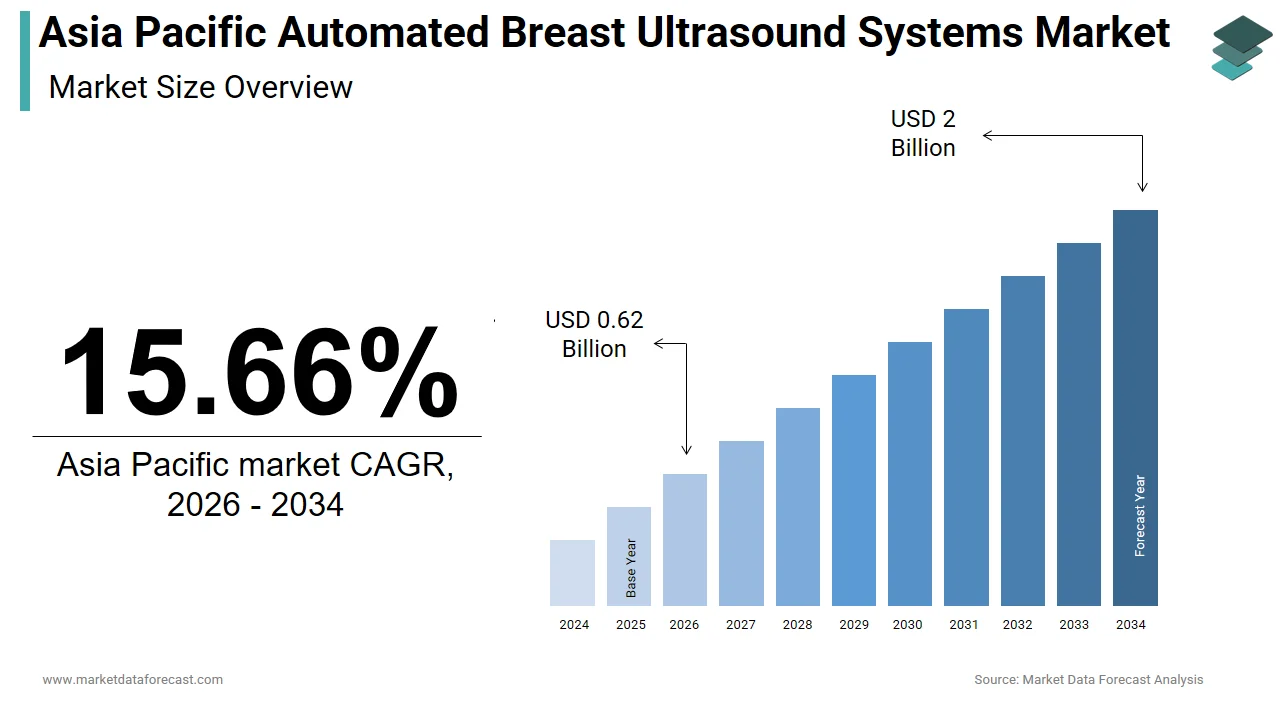
The Asia Pacific automated breast ultrasound systems (ABUS) market was valued at USD 0.54 billion in 2025, is estimated to reach USD 0.62 billion in 2026, and is projected to reach USD 2 billion by 2034, growing at a CAGR of 15.66% from 2026 to 2034.
Automated breast ultrasound systems (ABUS) refer to the advanced medical imaging devices designed to provide three-dimensional, standardized ultrasound scans of the breast, primarily for early cancer detection in women with dense breast tissue. Unlike conventional handheld ultrasound, ABUS ensures consistent image acquisition, reduces operator dependency, and enables reproducible longitudinal monitoring. This technology is increasingly integrated into secondary screening protocols, particularly in countries where mammography sensitivity is limited by the high prevalence of dense breast tissue among Asian women. The system’s compatibility with digital archiving and AI-based interpretation platforms further enhances its relevance in modern radiology workflows.
MARKET DRIVERS
High Prevalence of Dense Breast Tissue Among Asian Women
The exceptionally high incidence of dense breast tissue among women in the region is a primary factor fueling demand for automated breast ultrasound systems in the Asia Pacific. According to the National Cancer Center Singapore, 60-75% of women under the age of 50 exhibit dense breast composition, a condition that reduces the sensitivity of mammography by up to 50%, as per the American College of Radiology. In South Korea, the Korean Society of Breast Imaging now recommends ultrasound as a first-line adjunct for women with dense breasts, contributing to a surge in ABUS installations across major hospitals.
Rising Incidence of Breast Cancer and Strengthening Early Detection Policies
Breast cancer has become the most commonly diagnosed cancer among women in the Asia Pacific, driving urgent investments in advanced screening technologies. According to the International Agency for Research on Cancer, over 900,000 new breast cancer cases were reported in the region in 2023, accounting for nearly 45% of global diagnoses. In China, breast cancer incidence has increased over the past decade, with urban centers reporting rates comparable to Western countries. This surge has prompted governments to enhance early detection frameworks. India is piloting ABUS in tertiary care centers. As per the World Health Organization, early-stage detection through technologies can improve survival rates.
MARKET RESTRAINTS
Limited Reimbursement Coverage for ABUS Procedures
A significant barrier to the widespread adoption of automated breast ultrasound systems in the Asia Pacific is the lack of standardized reimbursement policies for ABUS-based screenings. In India, patients must pay out-of-pocket for ABUS scans, with average costs ranging from USD 120 to USD 200, placing it beyond the reach of low- and middle-income populations. Even in countries with advanced healthcare systems, private insurers often classify ABUS as investigational. Also, a smaller share of ABUS procedures in Thailand and Malaysia are reimbursed, discouraging hospitals from investing in the technology. Without financial incentives, healthcare providers remain hesitant to integrate ABUS into routine screening pathways.
High Initial Capital Investment and Infrastructure Requirements
The deployment of automated breast ultrasound systems is constrained by their substantial acquisition cost and infrastructure demands, particularly in resource-limited settings. This financial burden is compounded by the need for dedicated imaging suites, PACS integration, and specialized training for radiologists and technicians. Additionally, ABUS generates large volumes of digital data, requiring robust IT infrastructure for storage and analysis capabilities that remain underdeveloped in rural and provincial hospitals across Indonesia and the Philippines.
MARKET OPPORTUNITIES
Integration with Artificial Intelligence for Enhanced Diagnostic Accuracy
The convergence of automated breast ultrasound systems with artificial intelligence (AI) presents a transformative opportunity to improve diagnostic precision and workflow efficiency across the Asia Pacific. AI algorithms trained on ABUS datasets can detect malignant lesions with sensitivity and reduce false positives, outperforming conventional interpretation methods. In China, companies like Huiying Medical have developed AI-powered ABUS platforms that provide real-time lesion segmentation and risk stratification, now deployed in over 200 hospitals. As per the Lancet Digital Health, AI integration can reduce radiologist reading time by up to 40%, addressing workforce shortages in countries like Indonesia and India. Japan’s Pharmaceuticals and Medical Devices Agency has approved multiple AI-ABUS solutions since 2022, accelerating regulatory acceptance. So, AI-enhanced ABUS offers a scalable solution to diagnostic bottlenecks.
Expansion of Breast Cancer Screening Programs in Emerging Economies
Governments in emerging Asia Pacific nations are increasingly prioritizing structured breast cancer screening, creating fertile ground for ABUS adoption. According to the World Health Organization, only 30% of low- and middle-income countries in the region had population-based screening programs in 2020, but this is rapidly changing. India is expanding cancer care infrastructure, including district cancer centers. These initiatives, supported by development funding from organizations like the Global Fund and WHO, are enabling public hospitals to procure advanced imaging systems, positioning ABUS as a cornerstone of next-generation preventive care infrastructure.
MARKET CHALLENGES
Shortage of Trained Radiologists and Technologists for ABUS Interpretation
Despite technological advancements, the effective utilization of automated breast ultrasound systems is hindered by a critical shortage of medical professionals trained in ABUS operation and interpretation. Even in countries with higher capacity, specialized training in breast ultrasound remains limited. ABUS generates voluminous 3D datasets requiring expertise in multiplanar reconstruction and lesion characterization, skills not routinely taught in medical curricula. This knowledge gap leads to underutilization and misinterpretation, undermining the technology’s clinical impact.
Cultural and Societal Barriers to Breast Cancer Screening Uptake
Cultural stigma, lack of awareness, and low health literacy significantly impede the effective deployment of automated breast ultrasound systems, regardless of technological availability. This delay diminishes the value of early detection tools like ABUS. Public awareness campaigns remain underfunded, and India allocates a smaller share of its national health budget to cancer education. As a result, even when ABUS units are installed, patient throughput remains low. Without sustained community engagement and gender-sensitive outreach, the full potential of ABUS in reducing breast cancer mortality will remain unrealized.
REPORT COVERAGE
| REPORT METRIC | DETAILS |
| Market Size Available | 2025 to 2034 |
| Base Year | 2025 |
| Forecast Period | 2026 to 2034 |
| Segments Covered | By Product, End-use, and Region. |
| Various Analyses Covered | Global, Regional and Country-Level Analysis, Segment-Level Analysis, Drivers, Restraints, Opportunities, Challenges; PESTLE Analysis; Porter’s Five Forces Analysis, Competitive Landscape, Analyst Overview of Investment Opportunities |
| Countries Covered | India, China, Japan, South Korea, Australia, New Zealand, Thailand, Malaysia, Vietnam, Philippines, Indonesia, Singapore, Rest of APAC |
| Market Leaders Profiled | GE HealthCare, Koninklijke Philips N.V., Siemens Healthcare Private Limited, Canon Medical Systems Corporation, TELEMED Medical Systems srl, Hologic, Inc., SuperSonic Imagine, Lunit Inc., and Delphinus Medical Technologies, Inc. |
SEGMENTAL ANALYSIS
By Product Insights
The Automated Breast Volume Scanner (ABVS) led the Asia Pacific automated breast ultrasound systems market by accounting for 66.3% of total product demand in 2024. This dominance of the segment is due to its ability to generate high-resolution, three-dimensional volumetric images of the entire breast, enabling standardized, reproducible assessments critical for longitudinal monitoring and early cancer detection. ABVS systems, such as GE Healthcare’s Invenia ABVS, are increasingly integrated into structured screening protocols in countries with high breast density prevalence. Its compatibility with picture archiving and communication systems (PACS) allows seamless integration into radiology workflows in large hospitals. Its growing validation in clinical guidelines and regulatory approvals is a key driver of ABVS dominance. In Japan, the Ministry of Health, Labour and Welfare has included ABVS in its official recommendations for supplemental screening in women with dense breasts, leading to widespread adoption in major cancer centers. Additionally, the system supports tele-radiology, critical in geographically dispersed nations like Indonesia and the Philippines, where central review of ABVS datasets by expert radiologists improves diagnostic accuracy in remote locations. ABVS-generated datasets are increasingly being used in AI training models, further reinforcing their role as a foundational imaging platform in next-generation breast care.
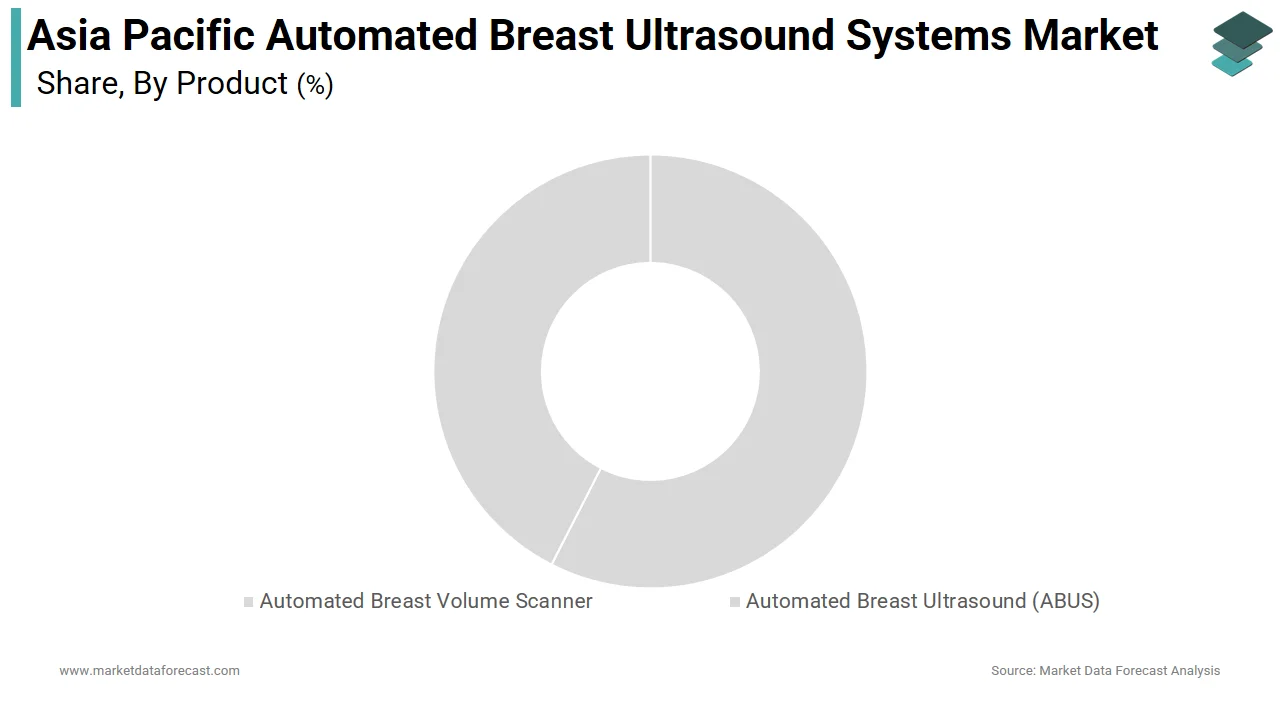
The Automated Breast Ultrasound (ABU) segment is emerging as the fastest-growing in the Asia Pacific market and is projected to expand at a CAGR of 12.6% from 2026 to 2034. Unlike volumetric scanners, ABU systems offer real-time, operator-guided scanning with automated tracking and image optimization, making them more adaptable to point-of-care settings and smaller clinics. This flexibility is particularly valuable in countries with limited radiology infrastructure, where trained sonographers are scarce. In India, ABU systems are being deployed in mobile screening vans operated by state health departments, enabling outreach to rural populations. The rapid growth of ABU is fueled by its cost-effectiveness and ease of integration. Additionally, ABU systems require less space and lower data storage capacity, addressing infrastructure limitations in developing economies. Their compatibility with handheld probes and portable consoles enables use in decentralized settings, including community health centers and private clinics.
By End Use Insights
The hospitals segment represented the prominent end-use in the Asia Pacific automated breast ultrasound systems market by capturing an estimated 64.3% of total demand in 2024. This dominance is driven by the concentration of advanced diagnostic infrastructure, specialized radiology departments, and multidisciplinary breast care teams within hospital settings. In countries like Japan and South Korea, national cancer screening guidelines mandate the use of supplemental imaging in tertiary hospitals, where ABUS and ABVS are routinely integrated into diagnostic pathways. Like, most of the breast imaging procedures for high-risk women are conducted in hospitals equipped with automated ultrasound systems. The presence of oncology, surgery, and pathology units within hospitals enables immediate follow-up and biopsy planning, increasing the clinical utility of ABUS findings. A further critical factor reinforcing hospital dominance is their access to capital and government funding for advanced equipment. Similarly, in Australia, public and private hospitals receive funding through Medicare and state health budgets to adopt evidence-based screening technologies. The integration of ABUS with hospital information systems (HIS) and electronic medical records (EMR) further enhances data continuity and auditability. Also, hospitals using ABVS have demonstrated an improvement in reporting turnaround time, reinforcing their role as primary hubs for advanced breast imaging.
The diagnostic Imaging Laboratories segment is the fastest-growing end-use in the Asia Pacific automated breast ultrasound systems market and is projected to grow at a CAGR of 11.8% from 2026 to 2034. This growth is driven by the rising outsourcing of imaging services, increasing patient preference for standalone centers, and the expansion of private radiology chains in urban and semi-urban areas. In India, diagnostic labs are integrating ABUS into comprehensive women’s health packages, targeting middle- and upper-income women seeking preventive screening. The scalability and operational efficiency of imaging labs make them ideal for deploying ABUS technologies. These labs often operate with shorter wait times and greater appointment flexibility than hospitals, enhancing patient compliance. Besides, many labs are forming partnerships with insurance providers and corporate wellness programs to offer subsidized screenings. With rising health awareness and increasing out-of-pocket spending on preventive care, diagnostic imaging laboratories are positioning themselves as key access points for advanced breast screening in the region.
COUNTRY LEVEL ANALYSIS
China Automated Breast Ultrasound Systems (ABUS) Market Insights
China led the Asia Pacific automated breast ultrasound systems market by accounting for 33.5% of regional demand in 2024. The country’s lead position is underpinned by aggressive national health initiatives, rising breast cancer incidence, and substantial investments in diagnostic infrastructure. With over 420,000 new breast cancer cases reported in 2023, as per the National Cancer Center China, the government has prioritized early detection through programs, which include ABUS as a supplemental tool in high-density populations. Major cities such as Beijing, Shanghai, and Guangzhou have integrated ABVS into tier-3 hospitals. It has fast-tracked approvals for AI-enhanced ABUS platforms, accelerating adoption. Additionally, domestic manufacturers like Mindray and Shenzhen Sonoscape are reducing costs and improving accessibility, further driving market expansion.
Japan Automated Breast Ultrasound Systems (ABUS) Market Insights
Japan is also a market. The country’s mature healthcare system and high prevalence of breast cancer among aging women have created strong demand for advanced screening technologies. The government’s Cancer Control Act mandates regional screening programs, many of which now incorporate ABUS for women with dense breasts. Japanese radiology departments are also leaders in AI integration, enhancing diagnostic precision and workflow efficiency.
South Korea Automated Breast Ultrasound Systems (ABUS) Market Insights
South Korea occupies the third position in the regional market, holding a 16% share of automated breast ultrasound system demand in 2023, as per the Korean Society of Breast Imaging. The country’s advanced healthcare infrastructure and high health literacy have facilitated the rapid adoption of ABUS technologies. Seoul-based institutions like Samsung Medical Center and Asan Medical Center have pioneered ABUS-AI integration, improving detection accuracy and reducing false positives. Government support through the Medical Device Innovation Program has incentivized local R&D, with companies like Medison developing next-generation ABUS platforms.
Australia Automated Breast Ultrasound Systems (ABUS) Market Insights
Australia is positioning it as a key innovator and policy leader in breast cancer screening. The country’s healthcare system emphasizes evidence-based medicine, and while mammography remains the primary screening tool under BreastScreen Australia, ABUS is increasingly used as a supplemental modality for women with dense breasts. Major Private Radiology providers such as I-MED Radiology and Sonic Healthcare have integrated ABVS into their women’s health divisions, offering it through referral networks. The Therapeutic Goods Administration has approved several AI-ABUS platforms since 2021, supporting digital transformation. As per the Australian Institute of Health and Welfare, the five-year survival rate for breast cancer exceeds 91%, reflecting the effectiveness of early detection strategies enhanced by advanced imaging.
India Automated Breast Ultrasound Systems (ABUS) Market Insights
India is emerging as a high-potential growth market. Despite lower current penetration, rising breast cancer incidence is driving demand for advanced diagnostics. Urban private hospitals in Mumbai, Delhi, and Chennai have begun adopting ABVS, while mobile screening units equipped with ABU systems are expanding access in rural areas. Domestic manufacturers are also entering the space, with startups like Niramai developing AI-driven thermal and ultrasound-based solutions. With increasing health insurance coverage and awareness, India is poised for accelerated ABUS adoption in the coming decade.
COMPETITIVE LANDSCAPE
Competition in the Asia Pacific automated breast ultrasound systems market is intensifying as global medtech leaders and regional innovators vie for leadership in a rapidly evolving diagnostic landscape. The market is characterized by technological differentiation, with companies competing on imaging precision, AI integration, and workflow compatibility rather than price alone. Established players like GE Healthcare and Siemens Healthineers leverage brand credibility and extensive clinical validation, while emerging domestic manufacturers in China and India focus on cost-effective, localized solutions. Regulatory alignment, reimbursement policies, and participation in public health initiatives are becoming critical competitive levers. The scarcity of trained radiologists is driving demand for AI-augmented systems, favoring firms with advanced software capabilities. As breast cancer screening gains policy priority across the region, companies that combine clinical excellence with scalable deployment models are gaining a strategic advantage in this high-impact, specialized segment.
KEY MARKET PLAYERS
Some of the noteworthy companies in the Asia Pacific automated breast ultrasound systems (ABUS) market profiled in this report are
- GE HealthCare
- Koninklijke Philips N.V.
- Siemens Healthcare Private Limited
- Canon Medical Systems Corporation
- TELEMED Medical Systems srl
- Hologic, Inc.
- SuperSonic Imagine
- Lunit Inc.
- Delphinus Medical Technologies, Inc.
TOP LEADING PLAYERS IN THE MARKET
- GE Healthcare has established a dominant presence in the Asia Pacific automated breast ultrasound systems market through its Invenia ABVS (Automated Breast Volume Scanner), a pioneering technology adopted in major hospitals across Japan, South Korea, China, and Australia. The system is widely recognized for delivering standardized 3D breast imaging, particularly beneficial for women with dense breast tissue, which is prevalent across Asian populations. The company has also partnered with public health programs in India and Thailand to support breast cancer screening initiatives using mobile ABVS units. GE’s strong distribution network, regulatory expertise, and continuous R&D investments in imaging workflows have solidified its reputation as a leader in advanced breast diagnostics across the region.
- Siemens Healthineers has strengthened its position in the Asia Pacific automated breast ultrasound systems market through technological innovation and strategic collaborations with radiology networks and national health systems. The company’s ABUS solutions, integrated within its broader ultrasound portfolio, emphasize high-resolution imaging and compatibility with AI-based decision support tools. The company has also expanded its service infrastructure, establishing training centers in Shanghai and Singapore to upskill radiologists and technicians in ABUS interpretation. By aligning with national cancer control strategies in countries like Malaysia and Vietnam, Siemens is positioning its systems as essential tools in structured screening programs. Its focus on digital integration and workflow efficiency has enhanced adoption in both public and private diagnostic centers.
- Hologic has emerged as a key player in the Asia Pacific automated breast ultrasound systems market by leveraging its expertise in women’s health diagnostics and comprehensive breast care ecosystems. While best known for its 3D mammography platforms, Hologic has strategically expanded into adjunctive ultrasound imaging through partnerships and technology integration. Hologic has also invested in clinical education, sponsoring training programs for radiologists in India and Indonesia on the use of supplemental ultrasound in dense breast screening. By collaborating with governments and NGOs on breast cancer awareness campaigns, Hologic is driving demand for advanced imaging solutions. Its emphasis on integrated diagnostics and preventive care positions it as a forward-looking contributor to the region’s evolving breast health infrastructure.
TOP STRATEGIES USED BY THE KEY MARKET PARTICIPANTS
Key players in the Asia Pacific automated breast ultrasound systems market are employing multifaceted strategies to consolidate their influence and accelerate adoption. A primary approach is technological integration, particularly the incorporation of artificial intelligence to enhance image analysis, reduce radiologist workload, and improve diagnostic accuracy. Companies are also focusing on strategic partnerships with healthcare providers, government agencies, and insurance firms to expand reimbursement coverage and inclusion in national screening programs. Geographic expansion into high-growth emerging markets such as India, Indonesia, and Vietnam is being pursued through localized distribution networks and mobile screening solutions. Product bundling linking ABUS systems with mammography or PACS platforms is enhancing value propositions for hospitals. Additionally, firms are investing in clinical training and education to address skill gaps and ensure proper utilization of automated systems in diverse healthcare environments.
RECENT MARKET DEVELOPMENTS
- In June 2023, GE Healthcare integrated its Invenia ABVS with an AI-powered lesion detection algorithm developed in collaboration with Tokyo Women’s Medical University, enhancing diagnostic precision in Japanese clinical settings.
- In January 2024, Siemens Healthineers launched AI-Rad Companion for Breast in Singapore and South Korea, enabling automated analysis of ABUS datasets and reducing radiologist interpretation time by up to 35%.
- In September 2023, Hologic partnered with Australia’s BreastScreen Queensland to support a pilot program using ABUS as a supplemental tool for women with dense breasts, expanding clinical validation and awareness.
- In February 2024, Mindray unveiled its new ABUS system at the China International Medical Equipment Fair, featuring real-time 3D imaging and cloud-based data sharing for remote diagnostics in rural hospitals.
- In May 2023, Fujifilm introduced an AI-enhanced ABVS workflow in collaboration with the National Cancer Center Hospital East in Japan, streamlining image acquisition, storage, and multi-disciplinary review processes.
MARKET SEGMENTATION
This Asia Pacific automated breast ultrasound systems (ABUS) market research report is segmented and sub-segmented into the following categories.
By Product
- Automated Breast Volume Scanner
- Automated Breast Ultrasound (ABUS)
By End Use
- Hospital
- Diagnostics Imaging Laboratories
- Others
By Country
- India
- China
- Japan
- South Korea
- Rest Of APAC