- Product Description Description
- Table of Contents TOC
- List of Table & Figure LOT
- Get Free Sample PDF Sample PDF
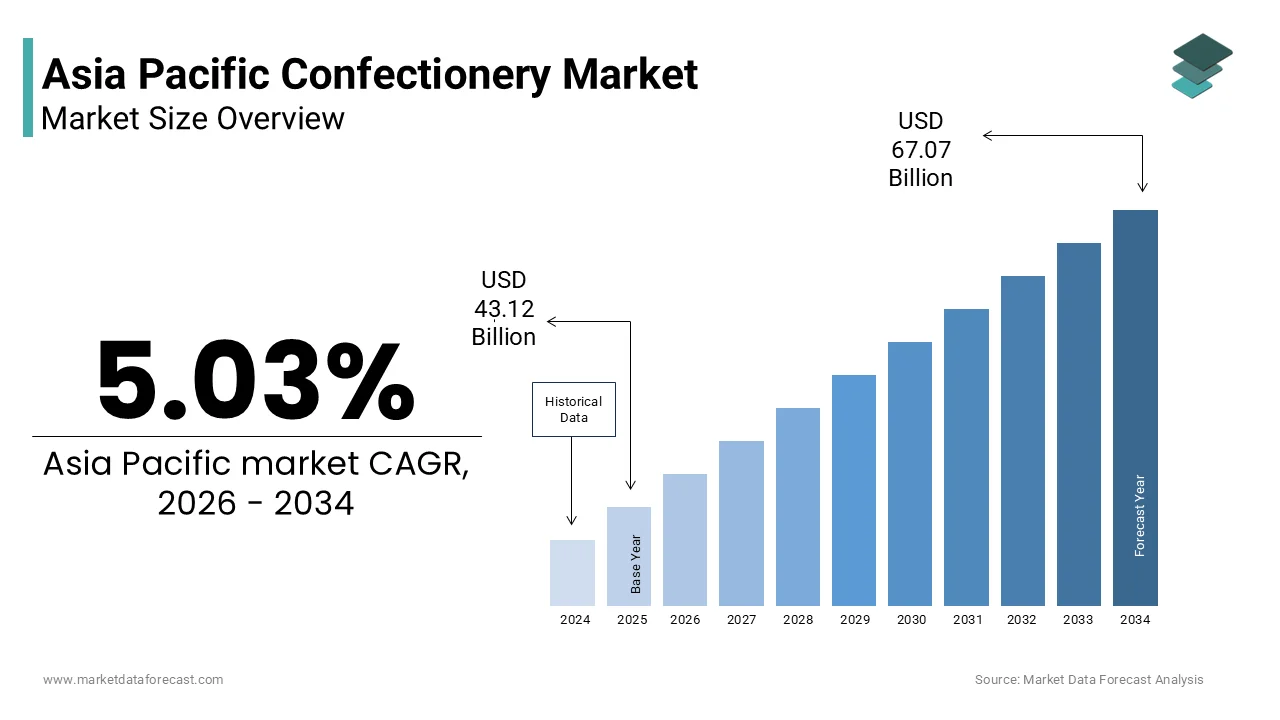
Market Size, 2025
$43.12 BnMarket Estimate, 2026
$45.29 BnMarket Forecast, 2034
$67.07 BnCAGR, 2026–2034
5.03%Asia Pacific Confectionery Market Size
The Asia Pacific Confectionery market size was valued at USD 43.12 billion in 2025, and the market size is expected to reach USD 67.07 billion by 2034 from USD 45.29 billion in 2026. The market's promising CAGR for the predicted period is 5.03%.
Confectionery are products including chocolates, sugar confectionery, gum, and other sweet treats that serve both indulgence and functional purposes. In the Asia Pacific region, this market has evolved significantly due to shifting consumer lifestyles, increasing disposable incomes, and a growing appetite for premium and innovative products. The industry spans mass-market offerings as well as niche segments such as organic, sugar-free, and health-focused confections.
Asia Pacific is one of the fastest-growing regions in the global confectionery landscape, driven by rapid urbanization and the expansion of organized retail formats. Countries like India, China, Japan, Australia, and Southeast Asian nations are witnessing a surge in demand for both local and international brands. According to the Food and Agriculture Organization (FAO), rising middle-class populations across the region are contributing to increased consumption of discretionary food items, with confectionery emerging as a favored category.
Moreover, the influence of Western culture, coupled with aggressive marketing strategies by multinational confectionery firms, has led to higher brand awareness and product adoption. As per the International Trade Centre, traditional gifting cultures in many Asia Pacific countries have also bolstered seasonal and festive sales cycles. These factors contribute to a dynamic and evolving confectionery market in the Asia Pacific, marked by innovation, localization, and digital transformation in distribution channels.
MARKET DRIVERS
Rising Disposable Incomes and Urbanization
The significant increase in disposable incomes and rapid urbanization across key economies is a major driver of the Asia Pacific confectionery market. As per the Asian Development Bank, urban populations in countries like India, Indonesia, and the Philippines are expanding at an accelerated pace, leading to greater exposure to modern retail formats and branded products. This demographic shift has created a burgeoning middle class that spends more on discretionary goods, including confectionery items.
In China, rising affluence has led to increased consumption of premium chocolates and novelty candies, particularly among younger consumers who associate confectionery with lifestyle and self-indulgence. Similarly, in India, where the World Bank reports a steady rise in per capita income over the past decade, there has been a notable uptick in impulse purchases of sweets and gums in urban centers.
Moreover, the growth of organized retail and e-commerce platforms has made confectionery products more accessible to a wider audience.
 Growing Influence of Festive and Gifting Culture
The deeply rooted tradition of gift-giving during festivals, weddings, and cultural celebrations is another key driver fueling the Asia Pacific confectionery market. Like, confectionery remains a preferred gifting option in countries like India, China, and Malaysia, where it symbolizes prosperity, happiness, and goodwill. Major festivals such as Diwali, Chinese New Year, and Eid witness a sharp spike in confectionery sales, especially for premium chocolate boxes and decorative candy hampers.
In India alone, festive season confectionery sales often account for a notable share of annual revenue for domestic manufacturers. This trend is mirrored in Southeast Asia, where occasions like Lunar New Year and Hari Raya generate strong demand for branded and artisanal confectionery.
Apart from these, the influence of Western holidays such as Valentine’s Day and Christmas has further expanded seasonal buying behavior. Companies capitalize on these periods through limited-edition packaging and promotional campaigns. This enduring cultural affinity toward gifting ensures consistent demand and drives long-term growth in the Asia Pacific confectionery sector.
MARKET RESTRAINTS
Increasing Health Awareness and Regulatory Pressure
The growing consumer awareness regarding health risks associated with excessive sugar consumption is one of the primary restraints affecting the Asia Pacific confectionery market. According to the World Health Organization (WHO), non-communicable diseases such as obesity, diabetes, and cardiovascular conditions are on the rise across the region, prompting governments to implement stricter regulations on sugary food products.
In addition, several Asia Pacific countries have introduced sugar taxes and labeling mandates aimed at discouraging excessive confectionery intake. For instance, Thailand and the Philippines have imposed excise duties on sugar-sweetened beverages, which has indirectly influenced consumer perceptions of all high-sugar foods, including confectionery. In addition, public health campaigns warning against added sugars have led to a decline in impulse buying of traditional sweets and chocolates, especially among health-conscious urban consumers.
Moreover, regulatory bodies such as Australia’s Therapeutic Goods Administration (TGA) and India’s Food Safety and Standards Authority (FSSAI) have mandated clearer nutritional labeling, pushing companies to reformulate products or introduce healthier alternatives.
Volatility in Raw Material Prices
Volatility in raw material prices, particularly for cocoa, sugar, dairy, and palm oil, is another significant constraint impacting the Asia Pacific confectionery market. These commodities form the backbone of confectionery production, and their fluctuating costs directly affect manufacturing expenses and profit margins.
In China and India, where domestic sugar production is subject to monsoon variability and policy interventions, manufacturers face unpredictable input costs that hinder pricing stability. As per the Indian Sugar Mills Association, erratic government policies on sugar exports have led to price swings, making it difficult for confectionery producers to plan long-term strategies.
Besides, rising energy costs and transportation bottlenecks further compound financial pressures on small and mid-sized manufacturers. As per the McKinsey, many regional players struggle to absorb these fluctuations without passing them on to consumers, potentially reducing demand elasticity. This economic sensitivity limits the ability of confectionery companies to scale operations efficiently, particularly in cost-sensitive markets across Southeast Asia.
MARKET OPPORTUNITIES
Expansion of Premium and Functional Confectionery Products
Growing demand for premium and functional confectionery products is a major opportunity emerging in the Asia Pacific confectionery market. Consumers, particularly in urban centers, are increasingly seeking high-quality, gourmet, and health-enhancing options that go beyond traditional sweets. In addition, there is a rising preference for dark chocolate, probiotic gums, and fortified candies infused with vitamins, proteins, and adaptogens.
Japan and South Korea have been early adopters of functional confectionery, with products designed for cognitive enhancement, stress relief, and digestive wellness gaining traction.
Similarly, in India and China, the demand for organic, vegan, and low-sugar confectionery is surging. Domestic and international brands are launching plant-based chocolates and sugar-free gums tailored to diabetic and fitness-oriented demographics. With increasing disposable incomes and evolving taste preferences, the premium and functional confectionery segment is expected to be a key growth driver across the Asia Pacific region, offering lucrative opportunities for innovation-driven brands.
Digital Transformation and Direct-to-Consumer Channels
The digital transformation of the confectionery market presents a significant opportunity for brands in the Asia Pacific region. With the proliferation of smartphones, social media engagement, and e-commerce platforms, companies are leveraging digital tools to enhance consumer interaction, personalize marketing, and streamline distribution. Also, online retail sales in the Asia Pacific grew by over 15% in 2023, with confectionery being a prominent category in impulse-driven purchases.
In China, platforms like Tmall, Pinduoduo, and WeChat Mini Programs allow confectionery brands to reach millions of consumers directly, bypassing traditional trade barriers. Also, digital campaigns featuring influencer endorsements and interactive content have significantly boosted engagement and conversion rates, especially among Gen Z and millennial shoppers.
India and Southeast Asia are witnessing similar trends, with startups and legacy brands investing in direct-to-consumer (DTC) models.
This digital shift not only enhances brand visibility but also provides valuable consumer insights, enabling companies to refine product portfolios and launch targeted promotions, thereby strengthening their market position in the Asia Pacific confectionery space.
MARKET CHALLENGES
Intense Competition and Market Saturation in Mature Markets
Intense competition and market saturation in mature economies such as Japan, Australia, and South Korea is one of the key challenges facing the Asia Pacific confectionery market. These markets are characterized by a high density of both global and local brands, resulting in aggressive pricing strategies and frequent product launches to capture consumer attention. According to McKinsey, brand differentiation has become increasingly difficult, with consumers exhibiting brand loyalty primarily based on price, convenience, and novelty rather than intrinsic product attributes.
In Japan, for example, the confectionery market is highly fragmented, with established players like Meiji, Lotte, and Ezaki Glico continuously innovating to maintain shelf space dominance. As per the Japan External Trade Organization (JETRO), new entrants face steep entry barriers due to entrenched distribution networks and limited retail space availability.
Similarly, in Australia, the market is dominated by a few large players who control a majority of supermarket placements and promotional slots. Independent confectionery brands often struggle to gain visibility despite offering unique or premium offerings. This competitive pressure forces companies to invest heavily in marketing and product development, which can strain profitability, especially for smaller firms operating in saturated environments.
Cultural and Taste Preference Variations Across the Region
The vast diversity in cultural preferences, taste profiles, and ingredient acceptability across different countries is another significant challenge in the Asia Pacific confectionery market. Unlike the relatively homogenous European or North American markets, the Asia Pacific region features a complex landscape where flavor expectations vary widely from one country to another. According to the International Journal of Gastronomy and Food Science, consumer perception of sweetness, texture, and even color plays a crucial role in determining product success.
For instance, in India, milk-based sweets such as barfi and kheer remain highly popular, influencing the formulation of locally adapted chocolates and candies. Conversely, in China, there is a stronger preference for bitter-sweet flavors, particularly in premium chocolates, while in Southeast Asia, fruit-based and floral notes are more commonly favored.
Moreover, religious and dietary restrictions further complicate standardization efforts. In Muslim-majority countries like Indonesia and Malaysia, halal certification is mandatory, requiring strict compliance with ingredient sourcing and production processes. According to the Halal Development Corporation, failure to meet these requirements can result in lost market access or reputational damage. These variations necessitate localized product development, which increases costs and slows down time-to-market, posing a strategic challenge for global confectionery players.
REPORT COVERAGE
| REPORT METRIC | DETAILS |
| Market Size Available | 2025 to 2034 |
| Base Year | 2025 |
| Forecast Period | 2026 to 2034 |
| CAGR | 5.03% |
| Segments Covered | By Sugar, Chocolate, and Region |
|
Various Analyses Covered | Regional & Country Level Analysis, Segment-Level Analysis, DROC, PESTLE Analysis, Porter’s Five Forces Analysis, Competitive Landscape, Analyst Overview on Investment Opportunities |
| Regions Covered | India, China, Japan, South Korea, Australia, New Zealand, Thailand, Malaysia, Vietnam, Philippines, Indonesia, Singapore, and the Rest of Asia-Pacific |
| Market Leaders Profiled | Delfi Limited (Singapore), Ezaki Glico Co., Ltd. (Japan), Ferrero SpA (Italy), Lindt & Sprüngli AG (Switzerland), Lotte Confectionery Co. Ltd. (South Korea), Mars, Incorporated (U.S.), Mondelez International, Inc. (U.S.), Nestlé S.A., and others |
SEGMENTAL ANALYSIS
By Sugar Insights
The hard-boiled sweets segment led the Asia Pacific confectionery market by accounting for 28.6% of total revenue in 2025. Their association with traditional gifting practices and festive consumption is one key driver behind the continued growth of hard-boiled sweets. This dominance is also attributed to their widespread availability, affordability, and strong consumer preference across both urban and rural demographics.
Further, the portability and long shelf life of hard-boiled sweets make them ideal for impulse purchases through convenience stores and local kirana shops.
Furthermore, manufacturers have introduced variants with functional benefits such as throat relief, breath freshening, and herbal ingredients, enhancing their appeal beyond mere indulgence and reinforcing their position as the leading sugar confectionery category in the Asia Pacific region.
The medicated confectionery segment is emerging as the fastest-growing segment within the Asia Pacific sugar confectionery market and is projected to expand at a CAGR of 9.7% from 2026 to 2034. Increasing consumer interest in wellness-focused treats that offer therapeutic benefits beyond taste satisfaction is driving the growth of medicated confectionery segment. The rising prevalence of respiratory issues, allergies, and stress-related ailments, prompting consumers to seek convenient health solutions is a major factor fueling this trend of the medicated confectionery segment. Like, respiratory diseases remain a leading cause of morbidity in densely populated countries like India and China, encouraging demand for lozenges and candies containing menthol, eucalyptus, and ginger extracts.
Moreover, regulatory support for functional foods has encouraged manufacturers to develop confectionery with added vitamins, probiotics, and Ayurvedic ingredients. In Japan, companies like Taisho Pharmaceutical have launched cough-dissolving candies that combine pharmaceutical efficacy with confectionery appeal, gaining popularity among working professionals and elderly populations.
This convergence of health and indulgence is expected to sustain high growth rates for this segment across the Asia Pacific region.
By Chocolate Insights
The milk chocolate segment commanded the Asia Pacific confectionery market under the chocolate category by capturing a 46.4% of total chocolate confectionery sales in 2025. Its dominance stems from Its mild flavor profile, which aligns well with regional taste preferences, particularly in countries with large youth and female consumer bases is one of the reasons behind the commanding position of milk chocolate segment. Also, its widespread use in everyday snacking, gifting, and promotional offers is among the primary drivers of milk chocolate’s popularity.
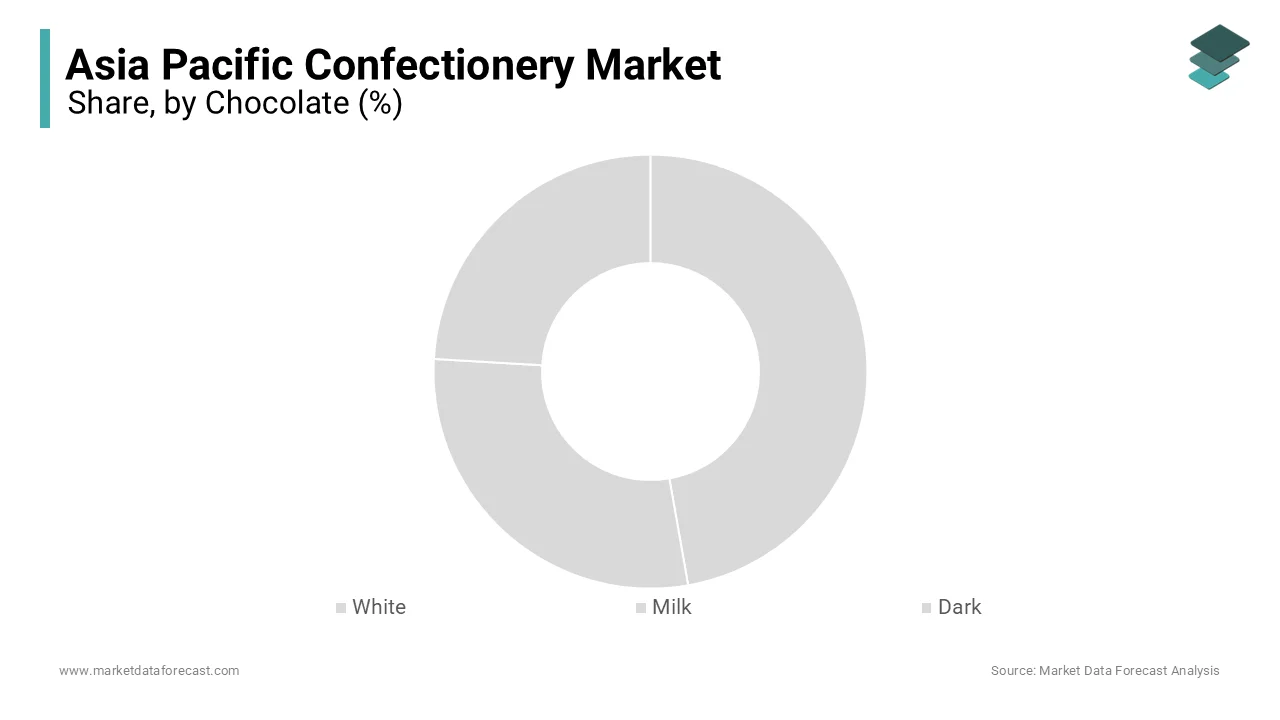
In India, the Indian Brand Equity Foundation notes that milk chocolate accounts for more than 60% of all chocolate sales, driven by localized innovations such as masala-flavored chocolates and fusion products combining milk chocolate with nuts and spices.
Apart from these, aggressive marketing campaigns by global players like Nestlé, Mondelez, and Ferrero have reinforced milk chocolate as a symbol of indulgence and modern lifestyle choices.
The dark chocolate segment is the fastest-growing in the Asia Pacific chocolate confectionery market and is anticipated to grow at a CAGR of 11.2% between 2026 and 2034. Growing health consciousness and the perceived wellness benefits associated with dark chocolate consumption is primarily fuelling the surge of dark chocolate segment.
The increasing awareness of antioxidants, flavonoids, and low-sugar alternatives, which have made dark chocolate a preferred choice among fitness enthusiasts and diabetic consumers, is a key driver of this segment.
Moreover, product innovation has played a crucial role in expanding consumer adoption. Companies like Lindt, Hershey’s, and Amul have introduced flavored dark chocolate variants with sea salt, berries, and plant-based formulations to cater to evolving taste preferences.
REGIONAL ANALYSIS
India Market Analysis
India held the largest share of the Asia Pacific confectionery market with 23.2% of total regional revenues in 2025. The country's dominant position is attributed to its vast population base, rising disposable incomes, and deep-rooted cultural traditions that emphasize confectionery gifting during festivals and weddings. A major growth driver is the expanding presence of organized retail and online marketplaces, making confectionery products more accessible to tier-2 and tier-3 cities. According to the Associated Chambers of Commerce and Industry of India (ASSOCHAM), a significant portion of confectionery sales in India occur during festive seasons such as Diwali, Eid, and Christmas, reinforcing seasonal demand patterns.
Apart from these, the proliferation of domestic brands like Cadbury (Mondelez), Parle, and local artisanal producers has diversified the product landscape. The Indian Brand Equity Foundation highlights that milk chocolate remains the most popular variant, while innovations in sugar-free and nut-infused chocolates are attracting health-conscious consumers.
China Market Analysis
China is another major player in the Asia Pacific confectionery market which is driven by rapid urbanization, evolving consumer tastes, and strong foreign brand penetration. The country's confectionery industry has expanded significantly due to increased exposure to Western confectionery trends and a growing middle-class population with discretionary spending power. A key growth factor is the increasing influence of Valentine’s Day, Christmas, and other Western holidays on Chinese consumer behaviour.
Moreover, health-conscious eating habits have spurred demand for dark chocolate, sugar-free gums, and fortified confections. Domestic players such as Qingdao Golden Corral and international giants like Nestlé and Mars have adapted their offerings to include low-sugar and organic variants tailored to Chinese preferences.
The rise of cross-border e-commerce platforms like Tmall Global and JD.com has also facilitated easier access to imported confectionery products, further boosting market expansion.
Japan Market Analysis
Japan occupies a significant position in the Asia Pacific confectionery market. The country's mature yet highly innovative confectionery industry is characterized by a blend of traditional craftsmanship and cutting-edge product development, catering to discerning consumer tastes. A major growth driver is the high level of brand loyalty and frequent new product launches by domestic giants such as Meiji, Ezaki Glico, and Lotte. According to the Japan External Trade Organization (JETRO), Japanese consumers place a strong emphasis on quality, packaging aesthetics, and limited-time seasonal flavors, creating a dynamic and competitive marketplace.
Besides, Japan is a leader in functional confectionery, offering products infused with collagen, probiotics, and caffeine aimed at addressing specific wellness needs. As per the Ministry of Economy, Trade and Industry (METI), nearly 40% of new confectionery launches in 2023 included health-enhancing ingredients.
The integration of vending machines and convenience store networks ensures wide distribution of confectionery products across urban and rural areas.
South Korea Market Analysis
South Korea holds a notable share in the Asia Pacific confectionery market. The country's confectionery industry is marked by a strong affinity for novelty, branding, and digital engagement, particularly among younger consumers. A key growth factor is the influence of K-pop culture and celebrity endorsements, which drive impulse buying of branded snacks and collectible packaging.
Moreover, South Korea is at the forefront of developing functional and premium confectionery products. Companies like Orion and Lotte have introduced melatonin-infused gummies, vitamin-enriched chocolates, and probiotic gums targeting health-conscious consumers.
E-commerce and mobile-first retail strategies have further expanded market reach. As noted by McKinsey, direct-to-consumer platforms enable real-time consumer feedback, allowing brands to refine product offerings quickly. These factors collectively reinforce South Korea’s strong foothold in the Asia Pacific confectionery landscape.
Australia & New Zealand Market Analysis
Australia and New Zealand collectively distinguished by their preference for premium, sustainable, and health-focused confectionery options. Both nations exhibit high per capita consumption of chocolates and specialty candies, supported by strong retail infrastructure and a well-established food culture.
A major growth driver in Australia is the increasing demand for organic, fair-trade, and plant-based confectionery. Like, in Australia, the number of certified organic confectionery brands has grown notably in the past three years, reflecting shifting consumer priorities.
In New Zealand, government-backed initiatives promoting clean-label ingredients and eco-friendly packaging have influenced product development strategies. Also, sustainability claims on confectionery packaging have become a key differentiator in supermarkets and specialty stores.
Moreover, both countries benefit from a thriving café and hospitality industry that drives impulse purchases of premium chocolates and artisanal confections. With a focus on quality and responsible sourcing, Australia and New Zealand remain influential markets shaping the future direction of the Asia Pacific confectionery industry.
COMPETITIVE LANDSCAPE
KEY MARKET PLAYERS
Some of the key market players of Asia Pacific Confectionery market are
-
Delfi Limited (Singapore)
-
Ezaki Glico Co., Ltd. (Japan)
-
Ferrero SpA (Italy)
-
Lindt & Sprüngli AG (Switzerland)
-
Lotte Confectionery Co. Ltd. (South Korea)
-
Mars, Incorporated (U.S.)
-
Mondelez International, Inc. (U.S.)
-
Nestlé S.A. (Switzerland)
-
The Hershey Company (U.S.)
-
Wm. Wrigley Jr. Company (U.S.)
TOP STRATEGIES USED BY KEY PLAYERS
Key players in the Asia Pacific confectionery market are increasingly focusing on product innovation and customization to capture diverse consumer preferences. Companies are launching region-specific flavors, limited-edition packaging, and functional ingredients to differentiate themselves in a highly competitive landscape.
Another major strategy involves expanding through digital channels and direct-to-consumer platforms. Leading brands are leveraging e-commerce, mobile apps, and social media-driven campaigns to engage younger demographics, enhance brand visibility, and streamline distribution in both urban and rural markets.
Further, strategic partnerships and acquisitions are being used to strengthen market position and accelerate growth. By acquiring local brands or forming alliances with regional distributors, multinational companies can gain deeper market insights, expand their retail footprint, and adapt more effectively to cultural and regulatory nuances across the Asia Pacific confectionery sector.
COMPETITON OVERVIEW
The competition in the Asia Pacific confectionery market is marked by a dynamic interplay between global giants and nimble regional players, all vying for consumer attention in a culturally diverse and rapidly evolving landscape. Multinational corporations leverage brand equity, advanced R&D capabilities, and large-scale distribution networks to maintain dominance, particularly in premium and imported segments. At the same time, domestic manufacturers capitalize on deep-rooted consumer familiarity, localized flavor profiles, and cost-effective production models to challenge international incumbents.
A defining characteristic of this competition is the emphasis on differentiation through innovation, whether in taste, packaging, or functionality. Companies are not only competing on price and availability but also on storytelling, ethical sourcing, and health-conscious positioning. The rise of niche players offering artisanal, organic, or plant-based confectionery further intensifies the battle for shelf space and consumer loyalty.
Moreover, the increasing influence of digital commerce and influencer-driven marketing has created new battlegrounds where agility and creativity often outweigh traditional brand strength. As a result, the Asia Pacific confectionery market remains one of the most vibrant and fiercely contested sectors in the global food and beverage industry.
TOP PLAYERS IN THE MARKET
- One of the leading players in the Asia Pacific confectionery market is Mondelez International, a global powerhouse known for its extensive portfolio that includes Cadbury, Toblerone, and Oreo. In the Asia Pacific region, Mondelez has made significant contributions through product localization, digital marketing, and strategic acquisitions. The company has played a pivotal role in shaping consumer preferences by introducing fusion flavors and premium chocolate variants tailored to regional tastes.
- Another key player is Nestlé, which has a strong presence across multiple confectionery categories including chocolates, candies, and gums. Nestlé’s commitment to innovation and sustainability has influenced industry standards in responsible sourcing and eco-friendly packaging. Its investment in R&D centers across Asia has enabled the development of culturally relevant products that resonate with local consumers.
- Lastly, Meiji Co., Ltd. stands out as a dominant domestic force in Japan and a growing influence across the broader Asia Pacific region. Meiji has contributed significantly to the evolution of functional confectionery, integrating wellness benefits into everyday snacks. Its focus on quality and health-conscious formulations has inspired a shift toward value-added confectionery products across the region.
Asia Pacific Confectionery Market News
- In February 2025, Mondelez launched a limited-edition range of Diwali-themed chocolate gift boxes in India, incorporating locally inspired flavors such as cardamom and rose, reinforcing its festive marketing strategy.
- In May 2025, Nestlé partnered with a South Korean skincare brand to introduce melatonin-infused gummy candies designed for stress relief, targeting young professionals and expanding its functional confectionery line.
- In September 2023, Meiji expanded its presence in Southeast Asia by opening a new regional distribution center in Singapore, enhancing supply chain efficiency and enabling faster product delivery across the region.
- In January 2025, Ferrero acquired a stake in an Australian organic chocolate startup, signaling its intent to strengthen foothold in the premium and clean-label confectionery segment within the Australasian market.
- In July 2025, Lotte Confectionery introduced AI-powered vending machines in Tokyo, offering personalized product recommendations based on consumer preferences, demonstrating its commitment to tech-driven retail innovation.
MARKET SEGMENTATION
This research report on the Asia Pacific confectionery market has been segmented and sub-segmented based on the following categories.
By Sugar
- Hard-boiled sweets
- Caramels & Toffees
- Gums & Jellies
- Medicated Confectionary
- Mints
By Chocolate
- White
- Milk
- Dark
By Country
- India
- China
- Japan
- South Korea
- Australia
- New Zealand
- Thailand
- Malaysia
- Vietnam
- Philippines
- Indonesia
- Singapore
- Rest of Asia-Pacific