- Product Description Description
- Table of Contents TOC
- List of Table & Figure LOT
- Get Free Sample PDF Sample PDF
Market Size, 2025
$7.18 BnMarket Estimate, 2026
$8.21 BnMarket Forecast, 2034
$24.05 BnCAGR, 2026–2034
14.38%Asia Pacific IP Camera Market Report Summary
The Asia Pacific IP camera market was valued at USD 7.18 billion in 2025, is estimated to reach USD 8.21 billion in 2026, and is projected to reach USD 24.05 billion by 2034, growing at a CAGR of 14.38% during the forecast period from 2026 to 2034. The growth of the Asia Pacific IP camera market is driven by increasing investments in smart city projects, rising security and surveillance requirements, and rapid adoption of AI-powered video analytics. Growing deployment of IP-based surveillance systems across government, commercial, industrial, and residential sectors, along with advancements in cloud computing, IoT, and edge analytics, is further accelerating market expansion. Additionally, increasing infrastructure development and stringent public safety initiatives are supporting long-term market growth across the region.
Key Market Trends
-
Rising investments in smart city initiatives and intelligent surveillance infrastructure are driving demand for IP camera systems across Asia Pacific.
-
Growing adoption of AI-enabled video analytics, facial recognition, and real-time monitoring is enhancing surveillance capabilities.
-
Increasing deployment of cloud-based and IoT-connected security solutions is improving operational efficiency and remote monitoring.
-
Rising concerns over public safety, critical infrastructure protection, and crime prevention are accelerating the installation of IP cameras.
-
Continuous advancements in high-resolution imaging, low-light performance, and edge computing are expanding application opportunities.
Segmental Insights
-
Based on component, the hardware segment dominated the Asia Pacific IP camera market in 2025. The segment's leadership is attributed to strong demand for advanced cameras, image sensors, storage devices, and networking equipment required for modern surveillance systems.
-
Based on product type, the fixed IP cameras segment held the largest share of 58.5% of the Asia Pacific IP camera market in 2025. The segment's dominance is driven by its cost-effectiveness, ease of installation, and widespread adoption across commercial buildings, public infrastructure, and industrial facilities.
-
Based on connection type, the centralized segment accounted for 62.3% of the Asia Pacific IP camera market share in 2025. The segment's growth is supported by simplified system management, centralized data storage, improved network security, and efficient monitoring of large-scale surveillance deployments.
-
Based on end user, the government and public sector segment dominated the Asia Pacific IP camera market by accounting for 47.5% of the market share in 2025. The segment's leadership is driven by increasing investments in public safety, smart city programs, transportation infrastructure, and border security initiatives.
Regional Insights
-
The Asia Pacific IP camera market is witnessing rapid growth due to increasing urbanization, expanding digital infrastructure, and growing demand for intelligent surveillance solutions.
-
China dominated the Asia Pacific IP camera market by accounting for 38.5% of the regional market share in 2025. The country's leadership is supported by extensive smart city projects, large-scale surveillance deployments, strong domestic manufacturing capabilities, and continuous investments in AI-enabled security technologies.
-
Japan remains a significant market due to increasing adoption of advanced surveillance technologies, smart infrastructure development, and strong demand for public safety solutions.
Competitive Landscape
The Asia Pacific IP camera market is highly competitive, with manufacturers focusing on artificial intelligence, cloud-based surveillance, high-resolution imaging, and integrated security solutions to strengthen their market positions. Companies are investing in research and development, strategic partnerships, and next-generation video analytics technologies to enhance security, operational efficiency, and smart surveillance capabilities. Key players operating in the Asia Pacific IP camera market include Avigilon Corporation (Motorola Solutions), Belkin International, Inc. (Hon Hai Precision Industry Co., Ltd.), Bosch Security Systems GmbH (Robert Bosch GmbH), D-Link Corporation, Hangzhou Hikvision Digital Technology Co., Ltd., Honeywell International, Inc., Johnson Controls International PLC, Panasonic Corporation, and Samsung Electronics Co., Ltd.
Asia Pacific IP Camera Market Size
Asia Pacific IP Camera market size was valued at USD 7.18 billion in 2025, and is expected to reach USD 24.05 billion by 2034 from USD 8.21 billion in 2026. The market's promising CAGR for the predicted period is 14.38%.
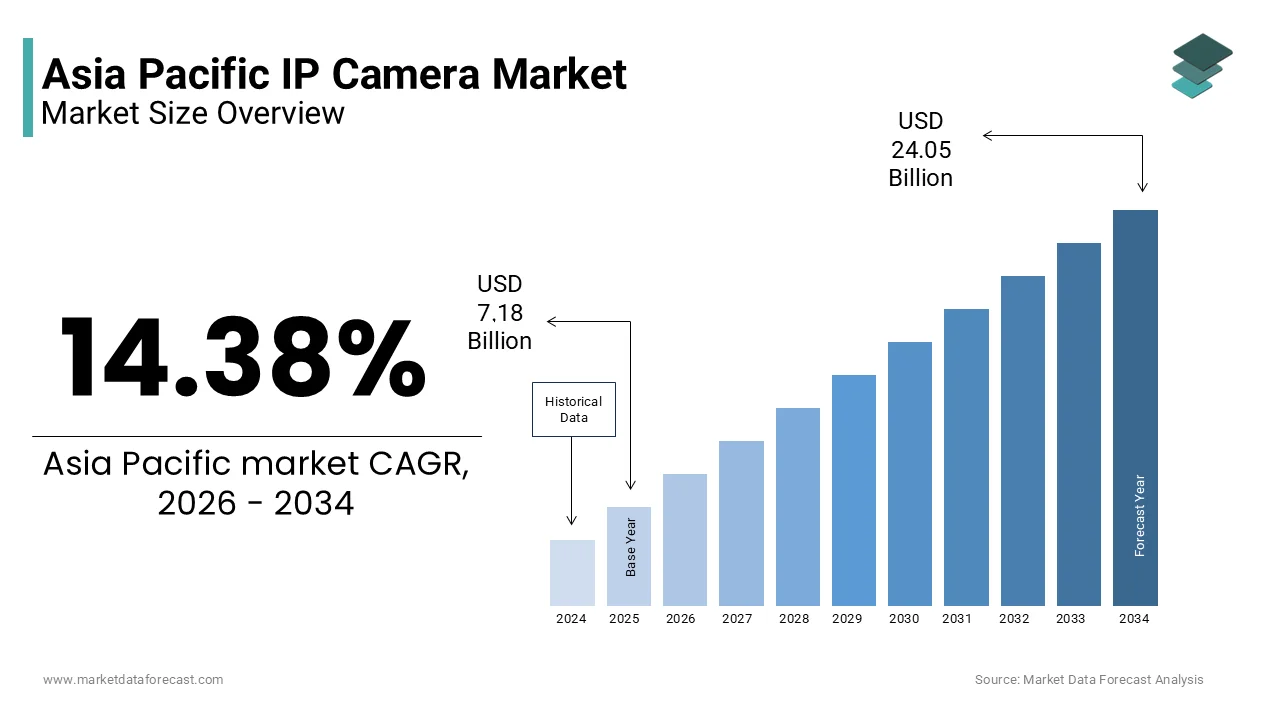
The Asia Pacific IP camera market refers to the part of networked video surveillance systems that transmit and store digital video footage via an IP network. Unlike traditional analog closed-circuit television (CCTV) systems, IP cameras offer higher resolution, remote accessibility, scalability, and integration with intelligent analytics which is making them a preferred choice for security applications across urban, industrial, and residential environments. The region has emerged as a global epicenter for IP camera adoption due to rapid urbanization, increasing concerns about public safety, and growing investments in smart city infrastructure.
Governments across several APAC countries have taken proactive measures to enhance surveillance capabilities as part of national security and law enforcement strategies. In addition to government-led projects, private sector demand is also driving market growth. Industries such as banking, retail, logistics, and healthcare are increasingly deploying IP cameras to monitor premises, protect assets, and improve operational efficiency. In India, the Smart Cities Mission has spurred investment in integrated surveillance solutions, including cloud-connected IP camera systems. Meanwhile, Australia and Japan are witnessing rising adoption among small businesses and homeowners who seek advanced security options beyond conventional CCTV setups.
MARKET DRIVERS
Expansion of Smart City Initiatives Across the Region
One of the primary drivers fueling the Asia Pacific IP camera market is the ongoing implementation of smart city programs aimed at enhancing urban governance, traffic management, and public safety. Governments in countries like China, India, and South Korea have launched large-scale infrastructure modernization plans that heavily rely on real-time surveillance data collected through IP-based camera networks.
According to the World Bank, over 50% of the world’s urban population now resides in Asia, making effective monitoring and emergency response systems essential. Similarly, in India, the Ministry of Housing and Urban Affairs reported that more than 60 cities under the Smart Cities Mission had established integrated command and control centers by 2023, many of which relied on IP camera feeds for situational awareness.
China’s prowess in this space is particularly notable. With support from the Ministry of Public Security, the country has rolled out extensive public surveillance networks incorporating AI-powered facial recognition and license plate recognition technologies. These systems depend on high-resolution IP cameras capable of streaming and storing vast amounts of data seamlessly.
Rising Demand for Cloud-Based Surveillance Solutions
Another critical factor propelling the Asia Pacific IP camera market is the increasing preference for cloud-based surveillance platforms that offer scalable storage, remote access, and enhanced cybersecurity features. Unlike traditional on-premise video recording systems, cloud-integrated IP cameras allow users to securely store and retrieve footage from any location, reducing dependency on local servers and hardware maintenance.
According to study, the Asia Pacific region experienced a 40% year-over-year increase in cloud-based video surveillance subscriptions in 2023, driven by both enterprise and consumer demand. Small and medium-sized enterprises (SMEs), especially in sectors such as retail, hospitality, and logistics, are shifting toward cloud-managed IP camera solutions due to their cost-effectiveness and ease of deployment. In Japan, major telecom operators like NTT Communications and SoftBank have introduced bundled IP surveillance services that combine connectivity, cloud storage, and mobile app interfaces, further accelerating adoption. Australia has also seen a surge in residential IP camera usage, particularly among homeowners seeking smart home integration. A report by Deloitte noted that over 15% of Australian households owned at least one smart surveillance device in 2023, with cloud-based models dominating sales due to their user-friendly experience and automatic software updates. Moreover, service providers are offering flexible pricing models—including subscription-based and pay-per-camera options—that make cloud surveillance accessible even in emerging markets like Indonesia and Vietnam.
MARKET RESTRAINTS
Cybersecurity Vulnerabilities and Data Privacy Concerns
A major restraint affecting the Asia Pacific IP camera market is the persistent concern regarding cybersecurity vulnerabilities and data privacy risks associated with connected surveillance devices. Unlike standalone analog systems, IP cameras rely on network connectivity and often lack robust built-in security protocols, making them susceptible to hacking, unauthorized access, and data breaches.
Many small businesses and residential users fail to update device settings or implement multi-layer authentication, leaving their surveillance networks exposed to malicious actors. This issue is particularly pronounced in rapidly adopting markets such as Thailand and the Philippines, where awareness of digital security best practices remains relatively low.
Also, governments across the region are enacting stricter privacy regulations that complicate the deployment of facial recognition and biometric surveillance technologies. In Australia, the Office of the Australian Information Commissioner has issued guidelines requiring organizations using IP cameras to ensure compliance with the Privacy Act 1988, imposing limitations on continuous data retention and personal identification without consent. Japan and South Korea have also introduced stringent cybersecurity frameworks for IoT-based surveillance infrastructure, mandating encryption standards and periodic vulnerability assessments. While these measures aim to enhance trust in digital security, they simultaneously raise compliance costs and slow down procurement processes for both manufacturers and end-users.
 High Initial Investment and Maintenance Costs
Another significant constraint impeding the growth of the Asia Pacific IP camera market is the relatively high initial investment required for installation and the ongoing costs associated with system maintenance, upgrades, and professional monitoring. While IP cameras offer superior performance compared to legacy analog systems, their deployment often involves infrastructure modifications, such as network upgrades, storage provisioning, and integration with existing security platforms—resulting in elevated capital expenditures. In India, where SMEs form a substantial portion of commercial activity, only a small number of surveyed establishments opted for IP-based surveillance in 2023, citing affordability as the primary deterrent. Beyond upfront costs, recurring expenses such as cloud storage subscriptions, cybersecurity enhancements, and firmware licensing further add financial pressure on end-users. Furthermore, the technical expertise required to configure and manage IP camera networks poses another barrier, especially in rural and less digitally literate regions. Many businesses either invest in external consultancy or hire dedicated personnel, adding to the overall expense.
MARKET OPPORTUNITIES
Integration with Artificial Intelligence and Video Analytics
A compelling opportunity shaping the Asia Pacific IP camera market is the growing integration of artificial intelligence (AI) and advanced video analytics into surveillance systems. AI-enhanced IP cameras can perform real-time object detection, behavior tracking, anomaly recognition, and predictive analysis which is offering significantly greater value than traditional passive monitoring. Companies like Huawei and Dahua have developed AI-integrated IP camera lines tailored for use in law enforcement, traffic control, and retail analytics. In Japan, AI-driven IP cameras are being deployed in railway stations and airports to detect suspicious activities, identify missing persons, and optimize crowd flow. Similarly, in South Korea, smart city developers are leveraging video analytics to enhance urban planning and emergency response coordination. Retail and logistics sectors across the region are also adopting AI-enabled IP cameras to monitor customer behavior, prevent theft, and assess store layout effectiveness.
Expansion of Commercial and Residential Security Demand
An emerging opportunity influencing the Asia Pacific IP camera market is the rising demand for security solutions in both commercial and residential sectors, driven by increasing crime rates, urbanization, and heightened awareness of digital safety tools. Businesses and homeowners are investing in IP cameras not only for protection but also for operational insights, remote monitoring, and insurance benefits. According to the Asian Development Bank, urban populations across the region are projected to grow significantly by 2030, necessitating more sophisticated security mechanisms to safeguard expanding commercial hubs and residential complexes. India has witnessed a similar trend, with gated communities and apartment complexes installing IP surveillance networks to monitor access points and common areas. Small and medium enterprises (SMEs) in Southeast Asia are also embracing IP surveillance as a cost-effective means of securing retail outlets, warehouses, and offices.
MARKET CHALLENGES
Regulatory Hurdles and Compliance Requirements
A pressing challenge facing the Asia Pacific IP camera market is the complex and varying regulatory landscape governing data collection, storage, and surveillance rights. Governments across the region are increasingly scrutinizing the use of video monitoring systems, particularly those equipped with facial recognition, behavioral analytics, and biometric identification capabilities. Similarly, Japan’s Personal Information Protection Commission (PIPC) mandates transparency in data handling and limits the duration for which surveillance footage can be retained without explicit justification. South Korea has imposed additional restrictions following a landmark court ruling in 2023, which deemed certain mass surveillance practices unconstitutional unless accompanied by clear legal oversight. These evolving policies create uncertainty for technology vendors and integrators, forcing them to modify product functions or implement additional safeguards to meet compliance requirements. Moreover, in India, the proposed Digital Personal Data Protection Bill seeks to regulate the deployment of surveillance technologies in public spaces, potentially impacting municipal and corporate IP camera rollouts.
Rapid Technological Obsolescence and Compatibility Issues
Another critical challenge confronting the Asia Pacific IP camera market is the fast-paced evolution of surveillance technology, leading to frequent product obsolescence and compatibility issues. As manufacturers introduce newer models with enhanced resolution, AI integration, and improved connectivity, older IP camera units quickly lose relevance, forcing end-users to upgrade more frequently than anticipated. Like, the average lifecycle of an enterprise-grade IP camera in the Asia Pacific region has shrunk from five years to just under three years due to continuous innovation in sensor quality, compression formats, and cloud APIs. This accelerated obsolescence increases total cost of ownership for businesses and reduces return on investment, particularly for smaller organizations with limited IT budgets.
Compatibility challenges also arise when integrating newer IP cameras with existing security management systems or third-party analytics software. Enterprises deploying hybrid networks of legacy and next-generation devices often face interoperability hurdles, resulting in fragmented data streams and suboptimal performance.
REPORT COVERAGE
| REPORT METRIC | DETAILS |
| Market Size Available | 2025 to 2034 |
| Base Year | 2025 |
| Forecast Period | 2026 to 2034 |
| CAGR | 14.38% |
| Segments Covered | By Component, Product Type, Connection Type, End-User, and Region |
|
Various Analyses Covered | Regional & Country Level Analysis, Segment-Level Analysis, DROC, PESTLE Analysis, Porter’s Five Forces Analysis, Competitive Landscape, Analyst Overview on Investment Opportunities |
| Regions Covered | India, China, Japan, South Korea, Australia, New Zealand, Thailand, Malaysia, Vietnam, Philippines, Indonesia, Singapore, and the Rest of Asia-Pacific |
| Market Leaders Profiled | Avigilon Corporation (Motorola Solutions), Belkin International, Inc. (Hon Hai Precision Industry Co., Ltd.), Bosch Security Systems GmbH (Robert Bosch GmbH), D-Link Corporation, Hangzhou Hikvision Digital Technology Co., Ltd., Honeywell International, Inc., Johnson Controls International PLC, Panasonic Corporation, Samsung Electronics Co., Ltd, and others |
SEGMENTAL ANALYSIS
By Component Insights
The hardware segment dominated the Asia Pacific IP camera market by capturing a substantial portion of total revenue in 2025. This overwhelming share is primarily attributed to the foundational requirement of physical IP cameras in all deployment scenarios, whether for residential, commercial, or government applications. As demand surges across urban centers and industrial zones, the procurement and installation of high-resolution, AI-enabled, and cloud-compatible IP cameras continue to drive significant expenditure. These projects necessitate thousands of fixed and PTZ (pan-tilt-zoom) cameras integrated with facial recognition and real-time tracking capabilities. In India, rapid urbanization and rising security concerns have led to a surge in IP camera installations in smart cities and private enterprises. Meanwhile, Japan and South Korea are witnessing increased adoption of ultra-HD and thermal imaging cameras in transportation hubs and critical infrastructure sites.
The services segment is projected to grow at the fastest CAGR of a 13.8% from 2026 to 2034. This rapid expansion is fueled by increasing demand for managed surveillance solutions, system integration, maintenance contracts, cloud storage, and cybersecurity services associated with IP camera deployments. In Australia, major telecom providers like Telstra and Optus introduced bundled IP surveillance packages that include remote monitoring, data retention, and AI-driven alerts, contributing significantly to service revenue growth. Japan has also seen a rise in outsourcing trends where corporations and municipalities contract third-party providers to manage their entire surveillance ecosystem—from software updates to threat detection. Moreover, escalating cyber threats targeting connected IP cameras have heightened the need for professional security services, including firmware upgrades, intrusion detection, and compliance management. Companies in Singapore and Malaysia are increasingly adopting these services to ensure regulatory adherence and operational continuity.
By Product Type Insights
The fixed IP cameras segment held the largest market share in the Asia Pacific IP camera market by accounting for a 58.5% of total revenue in 2025. Their widespread adoption stems from their cost-effectiveness, ease of installation, and suitability for continuous monitoring in static environments such as offices, retail stores, and residential complexes. China remains the single largest consumer of fixed IP cameras, with municipal authorities incorporating them extensively into public surveillance networks. A report by the Centre for Development of Telematics highlighted that over 2 million fixed IP cameras were installed in Tier-1 and Tier-2 cities during 2023 alone, reflecting strong institutional demand. In addition, in Southeast Asian countries like Thailand and Vietnam, the proliferation of small businesses opting for affordable yet effective security solutions has further boosted sales of fixed IP cameras. Retailers, convenience store chains, and logistics warehouses rely on these devices for round-the-clock monitoring without requiring advanced features found in more expensive PTZ or infrared models.
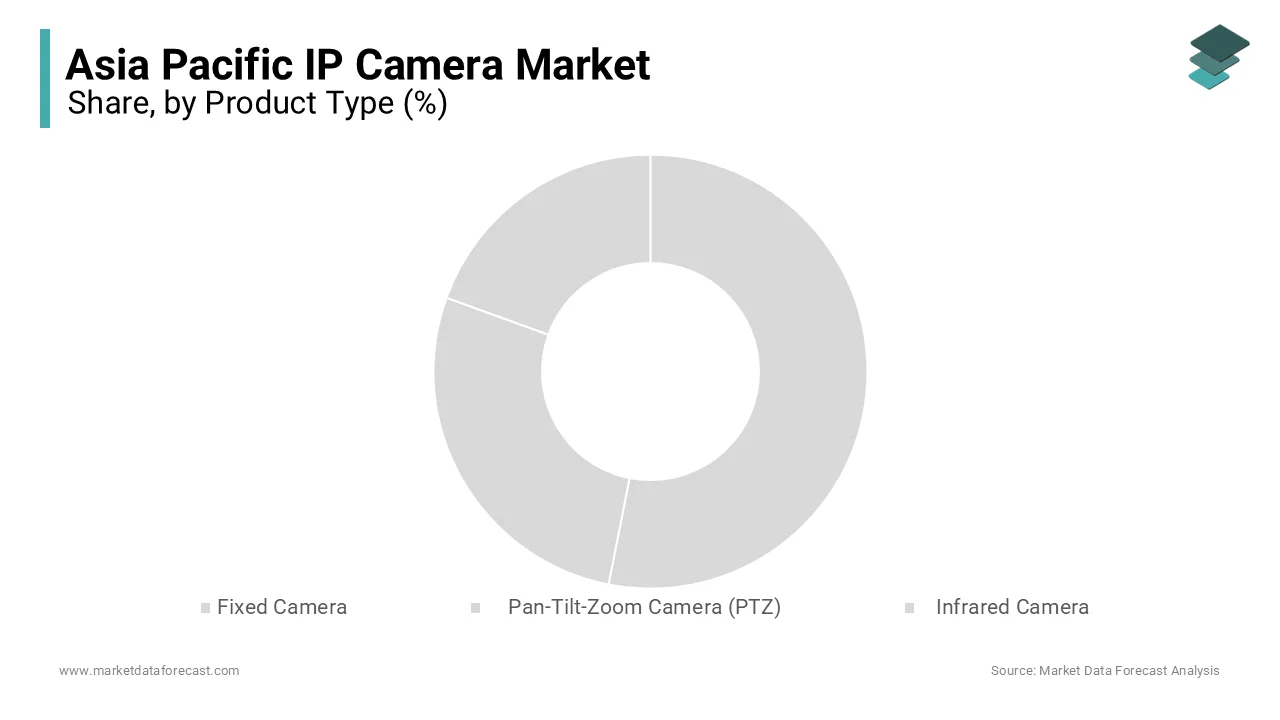
The infrared IP camera segment is anticipated to witness the highest growth rate, expanding at a CAGR of approximately 15.2%. This surge is driven by the increasing demand for night vision capabilities in both urban and rural security applications, especially in regions prone to low-light conditions and outdoor hazards. Countries like Japan and South Korea are leveraging infrared technology to monitor sensitive military and border areas, where visibility beyond daylight hours is crucial. Australia has also seen a notable uptick in infrared camera usage within agricultural and mining sectors, where 24/7 site surveillance is essential. The Australian Bureau of Agricultural and Resource Economics and Sciences reported that over 200 mining companies incorporated infrared-enabled IP cameras into their site monitoring strategies in 2023 to detect unauthorized access and environmental threats. Furthermore, in India and Indonesia, law enforcement agencies are deploying infrared-equipped IP cameras in forested and coastal regions to combat illegal activities such as poaching and smuggling.
By Connection Type Insights
The centralized connection type segment accounted for around 62.3% of the Asia Pacific IP camera market in 2025. This dominance is primarily attributed to the preference for unified video management systems that allow operators to control, monitor, and analyze multiple camera feeds from a single location—an essential feature for large-scale deployments in urban and industrial settings. Governments in China have been the most aggressive adopters of centralized IP camera infrastructures as part of nationwide smart city and public safety initiatives. According to the State Council Information Office, over 80% of China’s urban surveillance networks utilize centralized architectures, enabling real-time coordination between police departments, traffic control centers, and emergency response units. In South Korea, municipalities have implemented centralized IP camera networks in major cities like Seoul and Busan to integrate with AI-powered analytics tools that support crowd management, crime prediction, and traffic optimization. The Korean National Police Agency reported that centralized surveillance systems contributed to a 22% improvement in incident response times in 2023. Moreover, in Japan, large-scale transit operators such as JR East and Tokyo Metro rely on centralized IP camera setups to oversee railway operations, station footfall, and passenger behavior across thousands of locations simultaneously. These systems are often linked to national security databases for enhanced situational awareness.
The distributed connection type is coming up as the swiftest expanding segment in the Asia Pacific IP camera market, projected to expand at a CAGR of approximately 14.5% between 2026 and 2034. This progress is being driven by the increasing adoption of decentralized surveillance architectures tailored for edge computing, localized decision-making, and bandwidth efficiency particularly in remote and semi-urban areas. Retail shops, convenience stores, and logistics hubs in Indonesia, Malaysia, and the Philippines are increasingly deploying edge-capable IP cameras equipped with onboard storage and processing capabilities. In India, the distributed model is gaining traction in rural banking and microfinance branches that lack robust internet connectivity but require reliable surveillance coverage. The Reserve Bank of India reported that over 15% of rural ATMs installed in 2023 featured distributed IP camera systems capable of local recording and periodic cloud synchronization.
By End-User Insights
The government and public sector possessed the largest share of the Asia Pacific IP camera market by accounting for a 47.5% of total revenue in 2025. This dominance is due to extensive investments in national security, law enforcement, and urban infrastructure modernization programs across several key countries in the region. China leads in public-sector IP camera deployment, driven by its Safe City initiative and national surveillance policies aimed at enhancing internal security. According to the Chinese Ministry of Public Security, over 1.2 billion IP camera feeds were processed daily through public monitoring centers in 2023, many of which integrated AI-driven facial recognition and behavioral analysis technologies. India has also ramped up government-led surveillance efforts under its Smart Cities Mission. In Japan, the National Police Agency has expanded the use of IP surveillance in train stations, airports, and densely populated districts to support anti-terrorism measures and disaster preparedness plans. Similarly, governments in Thailand and Vietnam have launched city-wide surveillance drives to combat crime and improve civic governance.
The residential segment is projected to advance at the highest CAGR of a 16.1% from 2026 to 2034, fueled by rising disposable incomes, growing home security awareness, and the popularity of smart home ecosystems. Unlike previous years, when IP surveillance was primarily reserved for commercial and government users, households across the region are now investing in advanced security solutions tailored for personal protection. This trend is supported by e-commerce platforms like Amazon India, Flipkart, and Tokopedia, which offer bundled deals and easy financing options to encourage adoption. Australia has witnessed a similar surge. Internet service providers such as Telstra and Optus have responded by bundling IP camera subscriptions with broadband packages, effectively lowering entry barriers.
REGIONAL ANALYSIS
China was the largest contributor to the Asia Pacific IP camera market by commanding a 38.5% of total revenue in 2025. The country's unparalleled scale of government-led surveillance programs, combined with strong industrial and commercial demand, positions it as the dominant force in the regional market. According to the Chinese Ministry of Public Security, over 90,000 public IP cameras were deployed across major cities in 2023 alone, as part of the ongoing Safe City and Peaceful Society initiatives. These programs leverage AI-integrated surveillance systems for real-time facial recognition, license plate tracking, and predictive policing. In addition, the country’s state-backed security firms, including Hikvision and Dahua, have cemented their global leadership by supplying cutting-edge IP camera solutions to both domestic and international markets. Commercial adoption is equally robust, with banks, shopping malls, and logistics centers rapidly upgrading their security infrastructure. In manufacturing hubs like Shenzhen and Shanghai, IP cameras are deployed for perimeter monitoring, asset tracking, and employee safety compliance. Moreover, the rise of smart homes and community surveillance schemes has spurred residential purchases, especially in Tier-1 and Tier-2 cities.
India is a rapidly emerging player. The country is undergoing a transformation in its surveillance landscape, driven by urban modernization, increasing crime rates, and a push toward digital infrastructure development. Beyond government initiatives, the commercial sector is also experiencing a surge in IP camera adoption. Banks, retail chains, and logistics companies are investing in high-definition surveillance systems to protect assets and deter theft. The Confederation of Indian Industry reports that organized retail alone installed over 250,000 IP cameras in 2023 to enhance loss prevention and customer experience.
Further, the residential market is gaining momentum, with mid-income families in metro and semi-urban areas prioritizing digital security solutions. E-commerce platforms like Amazon India and Flipkart have played a crucial role in driving adoption by offering budget-friendly IP cameras with remote viewing capabilities via smartphones.
Japan holds a stable position in the Asia Pacific IP camera market. The country’s mature technology infrastructure, high digital literacy, and proactive approach to public safety have made it a key player in the region. According to the National Police Agency of Japan, the number of publicly monitored areas using IP-based surveillance systems increased by 18% in 2023 compared to the previous year. Japan's commercial sector is also a major contributor to IP camera adoption. Railway operators, including JR East and Keisei Electric Railway, have upgraded their station security with high-definition IP cameras featuring thermal imaging and facial recognition capabilities. Also, the hospitality industry is leveraging IP surveillance to enhance guest safety and streamline facility management. In the residential space, homeowners are increasingly opting for smart security solutions, particularly in densely populated urban areas. Companies like Sony and Panasonic have expanded their offerings in IP-based home monitoring systems, incorporating features such as remote access, motion-triggered alerts, and cloud storage.
South Korea is a strategic innovation hub by leveraging its reputation as a leader in technological innovation and smart infrastructure. The country’s strategic focus on digital governance, cybersecurity, and AI-driven surveillance has positioned it as a forward-looking market in the region. The commercial sector is another major growth driver. Large enterprises, particularly in finance, healthcare, and logistics, are adopting high-resolution IP cameras with biometric authentication and anomaly detection capabilities. In addition, the residential market is witnessing increased adoption of smart home IP cameras, especially among young professionals and urban dwellers seeking remote monitoring and automated alerts.
Australia is representing a niche but rapidly evolving segment characterized by high technology penetration, increasing demand for smart security solutions, and growing public-private collaboration. According to the Australian Institute of Criminology, property-related crimes increased by 15% in 2023 compared to the previous year, prompting both individuals and businesses to invest in advanced surveillance systems. The rise in home break-ins, particularly in suburban and regional areas, has led to a surge in residential IP camera installations, with brands like Ring, Swann, and Hikvision gaining popularity among consumers. In the commercial sector, the retail and logistics industries have adopted IP cameras for inventory tracking, staff safety, and fraud detection. The Australian Retailers Association noted that over 30% of surveyed businesses had upgraded to IP-based surveillance in 2023 to enhance loss prevention and customer insights. Government initiatives are also playing a role in market expansion. The Department of Home Affairs has implemented IP camera networks in airports, seaports, and border checkpoints to strengthen national security. In addition, local councils in Sydney and Melbourne have introduced smart city pilot projects integrating IP surveillance with AI-driven analytics for traffic management and public safety monitoring.
COMPETITIVE LANDSCAPE
The competition in the Asia Pacific IP camera market is intense and multifaceted, characterized by a mix of global leaders, regional powerhouses, and emerging local brands vying for dominance in one of the world’s fastest-growing surveillance technology arenas. While established players like Hikvision, Dahua, and Axis Communications maintain significant market influence through technological superiority and extensive distribution networks, they face growing pressure from cost-effective alternatives offered by domestic manufacturers. Many local firms are leveraging affordability, indigenous customization, and government procurement policies to capture market share in rapidly expanding economies such as India, Indonesia, and Vietnam.
Innovation remains a key battleground, with companies racing to integrate artificial intelligence, edge computing, and cybersecurity features into next-generation IP cameras. As demand shifts toward smart, cloud-connected surveillance systems, vendors are investing heavily in R&D to deliver differentiated products that cater to diverse end-user segments—from national security agencies to individual homeowners. Additionally, the rise of digital ecosystems and bundled security-as-a-service models is reshaping how IP camera solutions are marketed and consumed.
Beyond product development, strategic positioning through localized supply chains, compliance certifications, and public-private partnerships plays a crucial role in determining competitive advantage.
KEY MARKET PLAYERS
Some of the key players in the Asia Pacific IP camera market are
- Avigilon Corporation (Motorola Solutions)
- Belkin International, Inc. (Hon Hai Precision Industry Co., Ltd.)
- Bosch Security Systems GmbH (Robert Bosch GmbH)
- D-Link Corporation
- Hangzhou Hikvision Digital Technology Co., Ltd.
- Honeywell International, Inc.
- Johnson Controls International PLC
- Panasonic Corporation
- Samsung Electronics Co., Ltd.
TOP PLAYERS IN THE MARKET
- Hikvision is a dominant force in the global and regional IP camera markets, particularly in the Asia Pacific region. Known for its comprehensive portfolio of surveillance solutions, the company excels in offering high-resolution IP cameras integrated with advanced technologies such as artificial intelligence, deep learning algorithms, and thermal imaging. Hikvision’s strong R&D capabilities and extensive distribution network have made it a preferred choice among government agencies, infrastructure developers, and enterprise customers across China and neighboring countries. The company's ability to customize solutions for smart cities, public safety, and industrial applications has solidified its leadership position.
- Dahua Technology plays a critical role in shaping the Asia Pacific IP camera landscape through continuous innovation and strategic partnerships. The company offers a wide range of IP-based video surveillance products tailored for urban security, commercial enterprises, and residential users. Dahua emphasizes AI-powered analytics, cloud-based management systems, and cybersecurity enhancements, making its offerings highly adaptable to evolving market demands. With a strong presence in both domestic and international markets, Dahua supports large-scale deployments and contributes significantly to the expansion of intelligent surveillance ecosystems across the region.
- Although headquartered in Europe, Axis Communications maintains a robust presence in the Asia Pacific IP camera market due to its reputation for quality, open-platform architecture, and superior image resolution. Axis focuses on providing scalable and interoperable IP camera solutions designed for complex environments such as transportation hubs, healthcare facilities, and retail chains. Their commitment to sustainability and data privacy aligns well with regulatory trends in Japan, Australia, and Singapore, where compliance and ethical use of surveillance technology are prioritized. Axis continues to expand its partner ecosystem and localized support networks to strengthen its foothold in the region.
TOP STRATEGIES USED BY KEY PLAYERS
Expansion of AI-Integrated Surveillance Offerings
A primary strategy among leading players in the Asia Pacific IP camera market is the development and deployment of AI-enhanced surveillance solutions. Companies like Hikvision and Dahua are embedding machine learning capabilities into their IP cameras to enable real-time facial recognition, behavior analysis, and anomaly detection. These features are increasingly being adopted by city administrators, law enforcement agencies, and private enterprises seeking smarter, more proactive security measures that go beyond passive monitoring.
Strategic Partnerships with Local Distributors and System Integrators
To ensure deeper market penetration and faster response times, major IP camera vendors are forging alliances with local distributors, value-added resellers, and system integrators. By collaborating with regional partners, companies can offer customized installation, maintenance, and after-sales services that meet specific regulatory and operational requirements. This approach also allows manufacturers to better understand local security needs and tailor product designs accordingly.
Investment in Cloud-Based and Cybersecure Solutions
With increasing concerns about data privacy and cyber threats targeting surveillance networks, key players are focusing on developing secure, cloud-enabled IP camera platforms. Companies are integrating end-to-end encryption, multi-factor authentication, and automatic firmware updates to protect against unauthorized access and hacking attempts. Also, cloud-based storage and remote management features are being emphasized to attract small businesses and residential users who prioritize flexibility and ease of use without compromising security.
RECENT HAPPENINGS IN THE MARKET
- In March 2025, Hikvision launched an AI-driven video analytics platform tailored specifically for smart city projects in Southeast Asia. This initiative was aimed at enhancing real-time crime detection and traffic monitoring capabilities, strengthening Hikvision’s presence in municipal surveillance contracts across Thailand and Malaysia.
- In June 2025, Dahua Technology introduced a new line of compact, AI-enabled IP cameras designed for small business and residential use in India. The launch was supported by strategic tie-ups with local e-commerce platforms, making these smart surveillance devices more accessible to budget-conscious consumers seeking enhanced home and office security.
- In September 2025, Axis Communications expanded its regional technical support center in Sydney, Australia, to provide faster deployment assistance and customer service for enterprise clients in the financial, healthcare, and transportation sectors. This move reinforced Axis’s commitment to data privacy, scalability, and interoperability in the Australian IP surveillance market.
- In November 2025, Hanwha Techwin entered into a partnership with a Japanese system integrator to deploy AI-powered IP camera networks across Tokyo’s public transport system. This collaboration focused on improving passenger safety, crowd density tracking, and incident response efficiency in metro stations and railway hubs.
- In January 2026, CP Plus, an Indian surveillance solutions provider, announced the opening of a dedicated R&D facility in Bengaluru to develop cloud-native IP camera software tailored for hybrid surveillance environments. This investment was intended to accelerate product localization and improve integration with third-party analytics tools used in commercial and government settings
MARKET SEGMENTATION
This research report on the Asia Pacific IP camera market has been segmented and sub-segmented based on the following categories.
By Component
- Hardware
- Services
By Product Type
- Fixed Camera
- Pan-Tilt-Zoom Camera (PTZ)
- Infrared Camera
By Connection Type
- Centralized
- Distributed
By End-User
- Residential
- Commercial
- Government and Public
By Country
- India
- China
- Japan
- South Korea
- Australia
- New Zealand
- Thailand
- Malaysia
- Vietnam
- Philippines
- Indonesia
- Singapore
- Rest of Asia-Pacific