- Product Description Description
- Table of Contents TOC
- List of Table & Figure LOT
- Get Free Sample PDF Sample PDF
Market Size, 2025
$40.03 BnMarket Estimate, 2026
$43.31 BnMarket Forecast, 2034
$81.36 BnCAGR, 2026–2034
8.2%Asia Pacific Nonwoven Fabrics Market Size
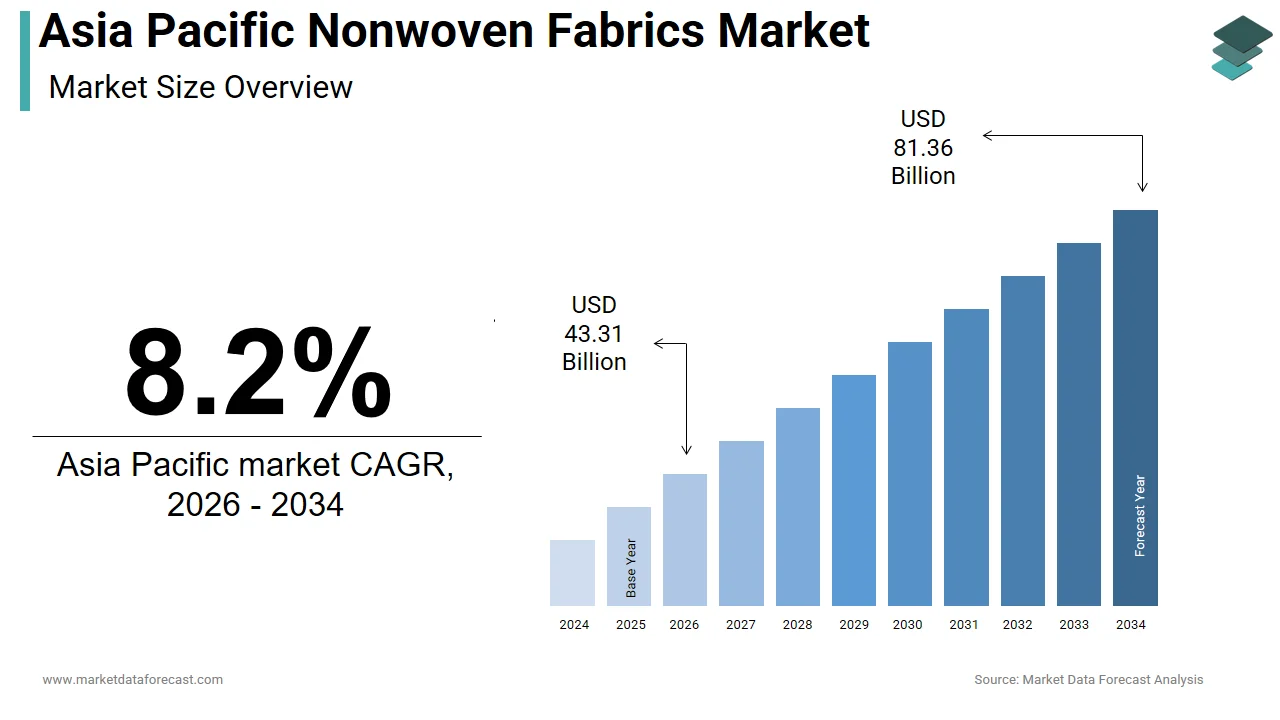
The size of the Asia Pacific nonwoven fabrics market was valued at USD 40.03 billion in 2025. This market is expected to grow at a CAGR of 8.2% from 2026 to 2034 and be worth USD 81.36 billion by 2034 from USD 43.31 billion in 2026.
Nonwoven fabrics are engineered materials produced by bonding fibers together through mechanical, thermal, or chemical processes without weaving. These fabrics are widely used across industries such as healthcare, hygiene, automotive, construction, and agriculture due to their cost-effectiveness, durability, and versatility. In the Asia Pacific region, nonwoven fabrics have become integral to both industrial applications and everyday consumer products, particularly in personal care items like diapers, sanitary napkins, and wipes.
MARKET DRIVERS
Rapid Growth of the Healthcare and Sanitation Sector
The expansion of the healthcare and sanitation industry in response to growing public health concerns and an aging population is majorly propelling the growth of the Asia Pacific nonwoven fabrics market. Governments across the region are investing heavily in medical infrastructure, which has led to increased demand for disposable protective gear such as surgical gowns, masks, drapes, and sterilization wraps, all of which are largely made from nonwoven materials.
According to the World Health Organization (WHO), hospital-acquired infections affect millions of patients annually in Asia, prompting hospitals and clinics to adopt single-use nonwoven-based products to reduce cross-contamination risks. The National Centre for Disease Control (NCDC) in India reported that over 60% of tertiary hospitals have transitioned to disposable nonwoven protective wear since 2020.
Expansion of the Personal Hygiene Products Industry
Another major driver contributing to the growth of the Asia Pacific nonwoven fabrics market is the expanding personal hygiene products industry, including baby diapers, feminine hygiene products, and adult incontinence items. According to Euromonitor International, sales of disposable hygiene products in Southeast Asia grew by nearly 9% in 2023, with Indonesia, Thailand, and Vietnam emerging as key markets. This trend is being reinforced by aggressive marketing campaigns and product innovations from global and regional brands. In India, the Federation of Indian Chambers of Commerce & Industry (FICCI) reported that the diaper market alone expanded by 12% in recent years, with leading manufacturers increasingly using airlaid and spunmelt nonwovens for improved softness, absorbency, and breathability. Similarly, in Japan, where the aging population is significantly higher than the global average, companies like Unicharm and Daio Paper Corporation have ramped up production of adult incontinence products using advanced nonwoven composites.
MARKET RESTRAINTS
Environmental Concerns and Regulatory Pressure on Single-Use Plastics
A major restraint affecting the growth of the Asia Pacific nonwoven fabrics market is the increasing scrutiny surrounding environmental impact, particularly regarding single-use plastics and synthetic fiber waste. As per the United Nations Environment Programme (UNEP), several countries in the region, including China, India, and South Korea, have introduced bans or restrictions on single-use plastic items, indirectly influencing policies around nonwoven disposable products. For instance, in 2023, China's Ministry of Ecology and Environment mandated stricter guidelines for the disposal of medical and hygiene waste, encouraging the adoption of compostable alternatives. In India, the Plastic Waste Management Rules have prompted state governments to promote biodegradable substitutes, which is pushing manufacturers to invest in bio-based and recyclable nonwoven solutions. However, these alternatives often come with higher production costs and limited scalability, making them less attractive to price-sensitive consumers.
Volatility in Raw Material Prices and Supply Chain Disruptions
Another critical constraint impacting the Asia Pacific nonwoven fabrics market is the fluctuation in raw material prices, particularly for petroleum-based polymers such as polypropylene and polyester. Since nonwovens are primarily derived from these petrochemical feedstocks, any instability in crude oil prices directly affects production costs and profit margins for manufacturers. According to S&P Global Commodity Insights, polypropylene prices saw a sharp increase of over 20% in 2023 due to supply chain disruptions and geopolitical tensions affecting global oil markets. This volatility has placed financial pressure on small and medium-sized enterprises (SMEs) in countries like Indonesia, the Philippines, and Vietnam, where cost competitiveness is crucial. Moreover, as per the Korea International Trade Association (KITA), semiconductor shortages and logistical bottlenecks during the past two years have delayed the import of essential production equipment and additives, slowing down new capacity expansions. These challenges have forced some companies to delay product launches or pass on additional costs to end consumers, thereby dampening demand elasticity.
MARKET OPPORTUNITIES
Surge in Demand for Sustainable and Biodegradable Nonwovens
A promising opportunity for the Asia Pacific nonwoven fabrics market lies in the growing demand for sustainable and biodegradable alternatives, driven by shifting consumer preferences and regulatory mandates aimed at reducing plastic waste. Governments and environmental agencies across the region are encouraging the development of plant-based, compostable, and recyclable nonwoven materials that align with circular economy principles. In India, the Ministry of Environment, Forest and Climate Change has initiated pilot programs to support startups developing compostable nonwoven sanitary products, aiming to replace conventional plastic-based variants. The Indian Nonwoven Association (INWA) reported that the biodegradable segment of the nonwoven market grew by over 18% in 2023 compared to the previous year.
Rising Use in Automotive and Industrial Applications
An emerging opportunity within the Asia Pacific nonwoven fabrics market is the increasing use of nonwovens in automotive and industrial applications. These include components such as interior linings, filtration media, insulation materials, and geotextiles, all of which benefit from the lightweight, durable, and cost-effective properties of nonwoven textiles. According to McKinsey & Company, the automotive industry in China and India is transforming, with electric vehicle (EV) manufacturers seeking lighter, more efficient materials to enhance fuel economy and battery performance. Nonwoven fabrics are increasingly being integrated into car headliners, seat covers, and air filters to meet these evolving requirements. In Japan, the Ministry of Economy, Trade and Industry (METI) has encouraged automakers to incorporate recyclable nonwoven materials in cabin components as part of the country’s Green Manufacturing Program.
MARKET CHALLENGES
Technological Limitations in High-Performance Applications
One of the key challenges facing the Asia Pacific nonwoven fabrics market is the technological limitations associated with achieving high-performance characteristics in demanding applications such as filtration, medical barriers, and technical textiles. According to the Textile Research Journal, standard nonwoven materials used in medical masks and protective clothing often exhibit lower filtration efficiency beyond a certain particle size threshold, raising concerns about efficacy in high-risk environments. The Japan Society of Fibre Science and Technology has conducted extensive research into improving melt-blown nonwoven structures to enhance filtration performance while maintaining breathability. These technical constraints necessitate continuous innovation and investment in advanced production technologies, which limits the accessibility of high-performance nonwovens to only a few large-scale producers who can afford cutting-edge R&D and capital-intensive manufacturing capabilities.
Intense Competition from Woven and Alternative Materials
Another pressing challenge confronting the Asia Pacific nonwoven fabrics market is the intense competition from traditional woven textiles and alternative materials such as paper, film laminates, and knit fabrics. While nonwovens offer advantages in terms of cost-efficiency and disposability, they face stiff competition from established textile sectors and newer eco-friendly substitutes that promise similar functionality with greater sustainability. According to Frost & Sullivan, in several Southeast Asian countries, traditional cotton and woven fabric-based hygiene products still hold a considerable share among rural populations due to affordability and cultural preference. The Indonesian Textile Association reported that nearly 30% of women in rural regions prefer reusable cloth sanitary products over disposable nonwoven alternatives. Furthermore, as per the Australian Packaging Forum, the introduction of compostable paper-based wipes and bamboo fiber alternatives is gaining traction in Australia and New Zealand, offering environmentally conscious consumers a perceived green alternative to synthetic nonwovens.
REPORT COVERAGE
| REPORT METRIC | DETAILS |
| Market Size Available | 2025 to 2034 |
| Base Year | 2025 |
| Forecast Period | 2026 to 2034 |
| Segments Covered | By Technology, Material, End-User Industry, and Country. |
| Various Analyses Covered | Global, Regional, and Country-Level Analysis, Segment-Level Analysis, Drivers, Restraints, Opportunities, Challenges; PESTLE Analysis; Porter’s Five Forces Analysis, Competitive Landscape, Analyst Overview of Investment Opportunities |
| Countries Covered | UK, France, Spain, Germany, Italy, Russia, Sweden, Denmark, Switzerland, Netherlands, Turkey, Czech Republic, and the Rest of Europe. |
| Market Leaders Profiled | DuPont, TORAY INDUSTRIES, INC., Toray Industries, Inc., Berry Global Inc., Asahi Kasei Corporation, Ahlstrom, Fiberweb, and Autotech Nonwovens Pvt Ltd. |
SEGMENTAL ANALYSIS
By Technology Insights
The spun-bond technology held 38.4% of the Asia Pacific nonwoven fabrics market share in 2024. A key factor behind this dominance is the versatility and cost-effectiveness of spun-bond nonwovens, which offer high tensile strength, durability, and ease of processing. Additionally, the Chinese Ministry of Industry and Information Technology reported that domestic manufacturers have significantly expanded their spun-bond production capacity since 2020, which aligns with rising demand from both domestic and export markets. Moreover, spun-bond nonwovens are increasingly being used in agricultural covers, geotextiles, and automotive interiors, further reinforcing their position as the most widely adopted manufacturing method in the region.
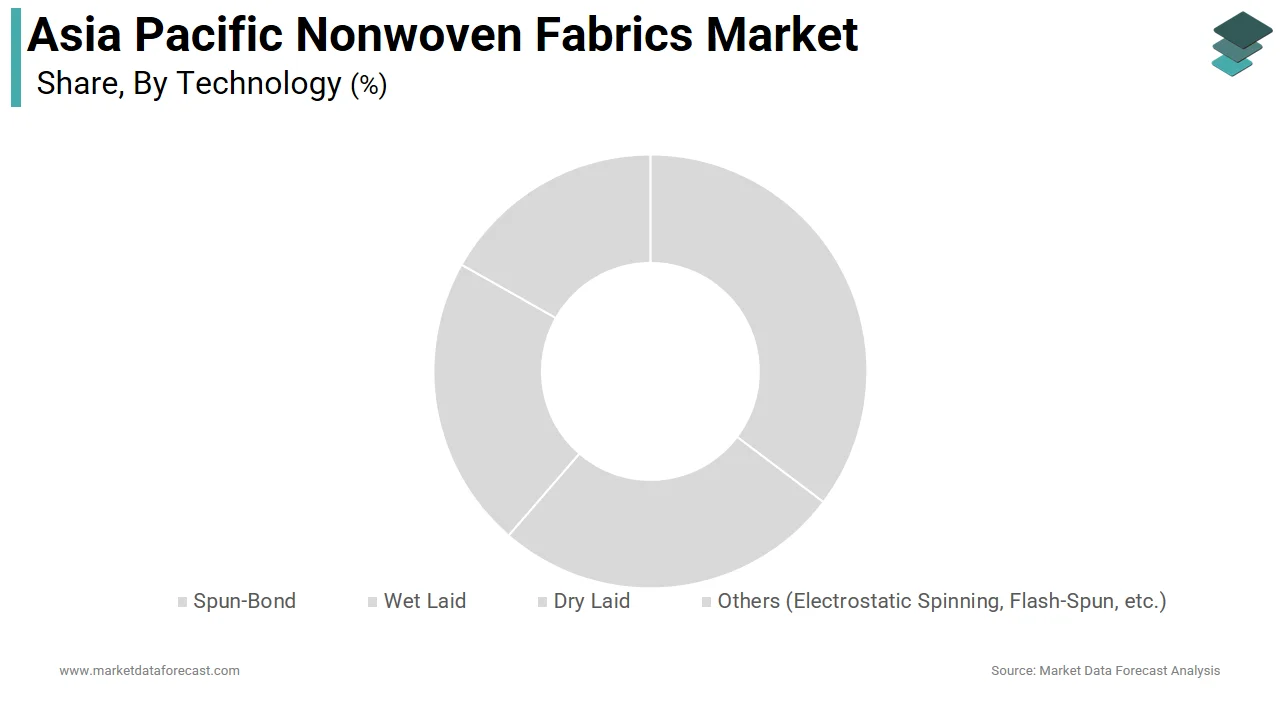
The wet laid nonwoven fabric technology is projected to expand with a CAGR of 9.4% in the coming years. One of the primary growth drivers is the rising adoption of wet laid nonwovens in liquid filtration and absorbent core applications, particularly in the healthcare and food processing sectors. According to the Japan Filtration Society, over 60% of new air and water filtration systems introduced in Japan in 2023 incorporated wet-laid-based media due to their superior fiber dispersion and uniformity. In South Korea, the Korea Institute of Industrial Technology (KITECH) noted an uptick in the use of wet laid nonwovens for electronic component packaging, where dust-free environments require highly refined fiber structures.
By Material Insights
The polypropylene segment was accounted in holding 42.3% of the Asia Pacific nonwoven fabrics market share in 2024. A major reason for this segment’s dominance is polypropylene’s favorable properties, such as lightweight, moisture resistance, chemical inertness, and cost-efficiency, making it suitable for disposable products. Additionally, the Indian Petrochemicals Association reported that domestic polypropylene consumption increased by 11% in recent years, largely attributed to the expansion of the hygiene product industry and government initiatives promoting sanitation infrastructure. Furthermore, in Japan, the Ministry of Economy, Trade and Industry (METI) encouraged automakers to adopt polypropylene nonwovens for interior components such as door panels and trunk liners due to their acoustic dampening and recyclability advantages.
The bio-based segment is expected to grow with a CAGR of 11.2% throughout the forecast period. One of the key factors fueling this growth is the increasing demand for compostable and biodegradable nonwoven products in the personal care and food service industries. In India, the Ministry of Environment, Forest, and Climate Change initiated pilot programs supporting startups developing PLA (polylactic acid)-based nonwovens for sanitary napkins and wipes, leading to a surge in eco-friendly product launches.
By End-User Industry Insights
The healthcare sector was the largest by occupying 35.4% of the Asia Pacific nonwoven fabrics market share in 2024. A key factor behind this dominance is the heightened focus on infection control and hygiene following the global health crisis. The World Health Organization (WHO) emphasized the importance of single-use medical textiles in reducing cross-contamination, prompting hospitals and clinics across the region to increase procurement of nonwoven-based surgical gowns, masks, and drapes. According to the National Centre for Disease Control (NCDC) in India, over 60% of tertiary hospitals have transitioned to disposable nonwoven protective wear since 2020, significantly boosting demand.
The construction sector is likely to grow with expected to grow with a CAGR of 10.6% from 2025 to 2033. A major growth driver is the integration of nonwoven geotextiles in road construction, drainage systems, and erosion control projects. According to the International Road Federation (IRF), governments across Southeast Asia have been investing heavily in road modernization, with Indonesia alone allocating USD 12 billion towards highway upgrades between 2021 and 2023 Additionally, in Japan, the Ministry of Land, Infrastructure, Transport and Tourism has promoted the use of nonwoven reinforcement materials in seismic-resistant building designs, further boosting adoption.
COUNTRY-LEVEL ANALYSIS
China Nonwoven Fabrics Market Insights
China was the top performer in the Asia Pacific nonwoven fabrics market with 36.4% of the share in 2024 with the country’s aggressive push toward hygiene infrastructure and medical preparedness. According to the National Centre for Medical Equipment Development, China saw a 50% increase in domestic production of medical-grade nonwovens between 2020 and 2023, largely due to government-backed initiatives aimed at strengthening pandemic response capabilities. Additionally, the rapid expansion of the personal care industry has fueled demand for baby diapers, feminine hygiene products, and adult incontinence items. The China Association of Personal Care and Sanitary Products reported that sales of disposable hygiene goods grew by 10% annually during this period.
India Nonwoven Fabrics Market Insights
India was positioned second in the Asia Pacific nonwoven fabrics market with 18.2% of share in 2024, with the expansion of the hygiene and personal care industry, particularly in rural and semi-urban areas. As per the Federation of Indian Chambers of Commerce & Industry (FICCI), the Indian diaper market alone expanded by 12% in recent years, with leading manufacturers increasingly using airlaid and spunmelt nonwovens for improved softness and breathability.
Additionally, the government’s Swachh Bharat Mission has significantly boosted the adoption of disposable sanitary napkins and wipes, many of which are made from nonwoven materials. The Ministry of Health and Family Welfare reported that menstrual hygiene coverage among women aged 15–49 increased from 36% in 2015 to over 78% in 2023.
Japan Nonwoven Fabrics Market Insights
Japan nonwoven fabrics market is likely to grow with an expected CAGR in the coming years, with the developmentof advanced nonwoven solutions for filtration, automotive, and medical applications. According to the University of Tokyo’s Institute of Industrial Science, Japanese researchers have pioneered breakthroughs in nanofiber-based nonwovens used in high-efficiency particulate air (HEPA) filters and precision manufacturing processes. Moreover, the Japanese Ministry of Economy, Trade and Industry (METI) has implemented strict occupational health and safety regulations requiring continuous improvement in cleanroom and industrial hygiene standards. The Japan Filtration Society reported that over 75% of semiconductor fabrication plants in Japan had upgraded their air purification systems with high-performance nonwoven filter media in 2023.
South Korea Nonwoven Fabrics Market Insights
South Korea nonwoven fabrics market is growing in the coming years. A major growth driver is the country’s dominance in high-tech manufacturing, particularly in memory chip and display panel production. These industries require ultra-clean environments where nonwoven filtration media play a crucial role in maintaining air and fluid purity. According to SEMI Korea, over 80% of semiconductor fabrication plants in South Korea utilize nonwoven-based HEPA filters to ensure process integrity. Additionally, the government’s Green New Deal initiative has encouraged the adoption of energy-efficient and recyclable nonwoven products in the construction and transportation sectors. The Korea Environment Corporation reported that new commercial buildings in Seoul and Busan increasingly feature nonwoven-based insulation and acoustic-damping materials to enhance energy efficiency.
Australia Nonwoven Fabrics Market Insights
Australia nonwoven fabrics market is growing with booming pharmaceutical and healthcare sectors, which rely heavily on nonwoven-based protective apparel and sterilization wraps. According to the Australian Department of Health, hospital-acquired infections have prompted increased procurement of disposable nonwoven garments and barrier fabrics in clinical settings. Additionally, the Australian government’s commitment to sustainable industrial practices has influenced the selection of nonwoven materials based on recyclability and emissions reduction.
COMPETITIVE LANDSCAPE
The competition in the Asia Pacific nonwoven fabrics market is marked by a dynamic mix of global giants and regional manufacturers striving to capture market share through differentiation, innovation, and strategic expansion. Multinational corporations leverage their R&D capabilities, brand recognition, and extensive distribution networks to maintain their dominant positions, while domestic players capitalize on cost advantages and deep-rooted relationships with local distributors and government agencies. The market also faces increasing pressure from environmental concerns, which are reshaping product development strategies toward eco-friendly alternatives. While traditional segments like hygiene and healthcare continue to dominate, emerging applications in automotive, construction, and filtration are redefining competitive dynamics.
KEY MARKET PLAYERS
Some of the noteworthy companies in the Asia Pacific nonwoven fabrics market profiled in this report are
- DuPont
- TORAY INDUSTRIES, INC.
- Toray Industries, Inc.
- Berry Global Inc.
- Asahi Kasei Corporation
- Ahlstrom
- Fiberweb
- Autotech Nonwovens Pvt Ltd
TOP LEADING PLAYERS IN THE MARKET
Asahi Kasei is a leading Japanese manufacturer with a strong presence in the Asia Pacific nonwoven fabrics market. The company offers a wide range of high-performance nonwovens used in medical, hygiene, and industrial applications. Asahi Kasei plays a key role in shaping next-generation nonwoven technologies that enhance comfort, durability, and environmental responsibility across multiple sectors with a focus on innovation and sustainability.
Toray Industries is a global leader in advanced materials and holds significant influence in the nonwoven fabrics sector. The company supplies nonwoven solutions for filtration, automotive interiors, and healthcare products, leveraging its expertise in polymer science and fiber engineering. Toray’s commitment to developing lightweight, high-strength, and biodegradable nonwoven textiles positions it as a critical player in the region's evolving textile landscape.
Avgol, formerly Fiberweb, is a major contributor to the nonwoven fabrics market in the Asia Pacific region. Known for its expertise in spunbond technology, the company provides innovative nonwoven solutions primarily for the hygiene and personal care markets. Avgol has been instrumental in expanding the availability of cost-effective, high-quality nonwoven materials tailored for both consumer and industrial applications across emerging markets.
TOP STRATEGIES USED BY KEY MARKET PARTICIPANTS
Among key players in the Asia Pacific nonwoven fabrics market, one of the most prevalent strategies is product innovation through sustainable material development. Companies are investing heavily in bio-based polymers, compostable fibers, and recyclable manufacturing processes to align with global sustainability goals and regional regulatory trends.
Another crucial approach is expanding production capacity and establishing localized manufacturing units. By setting up facilities closer to demand centers, companies reduce logistics costs, improve supply chain efficiency, and better serve customers with customized product offerings tailored to local preferences.
Firms are focusing on strategic partnerships and joint ventures with downstream industries such as healthcare, automotive, and construction. These collaborations help accelerate product adoption, ensure compliance with sector-specific standards, and open new growth avenues in high-value application areas across the region.
RECENT MARKET DEVELOPMENTS
- In January 2023, Asahi Kasei launched a new line of ultra-soft spunbond nonwoven fabrics specifically designed for premium baby diapers and feminine hygiene products across Southeast Asia, aiming to expand its footprint in the fast-growing personal care segment.
- In August 2023, Toray Industries expanded its technical service center in South Korea, opening a dedicated lab for nonwoven prototyping and performance testing to enhance after-sales support and product development collaboration with local OEMs.
- In March 2024, Avgol introduced an upgraded series of biodegradable nonwoven materials targeted at the Australian and New Zealand markets, aligning with stricter environmental regulations and growing consumer preference for sustainable alternatives.
- In October 2024, a Chinese nonwoven manufacturer entered into a joint venture with a European fiber supplier to localize production and reduce raw material sourcing costs for meltblown and SMS fabric layers used in medical masks.
- In February 2025, an Indian startup partnered with a Japanese nonwoven equipment provider to set up a state-of-the-art airlaid nonwoven production facility in Gujarat, aimed at meeting rising domestic demand for eco-friendly wipes and sanitary products.
MARKET SEGMENTATION
This Asia Pacific nonwoven fabrics market research report is segmented and sub-segmented into the following categories.
By Technology
- Spun-Bond
- Wet Laid
- Dry Laid
- Others (Electrostatic Spinning, Flash-Spun, etc.)
By Material
- Polyester
- Polypropylene
- Polyethylene
- Rayon
- Others (Wood Pulp, Bio-Component, etc.)
By End-User Industry
- Construction
- Textiles
- Healthcare
- Automotive
- Others (Personal Care, Consumer Goods, etc.)
By Country
- India
- China
- Japan
- South Korea
- Australia
- New Zealand
- Thailand
- Malaysia
- Vietnam
- Philippines
- Indonesia
- Singapore
- Rest Of APAC