- Product Description Description
- Table of Contents TOC
- List of Table & Figure LOT
- Get Free Sample PDF Sample PDF
Market Size, 2025
$4.66 TwMarket Estimate, 2026
$4.94 TwMarket Forecast, 2034
$4.94 TwCAGR, 2026–2034
6.02%Asia Pacific Power Market Summary
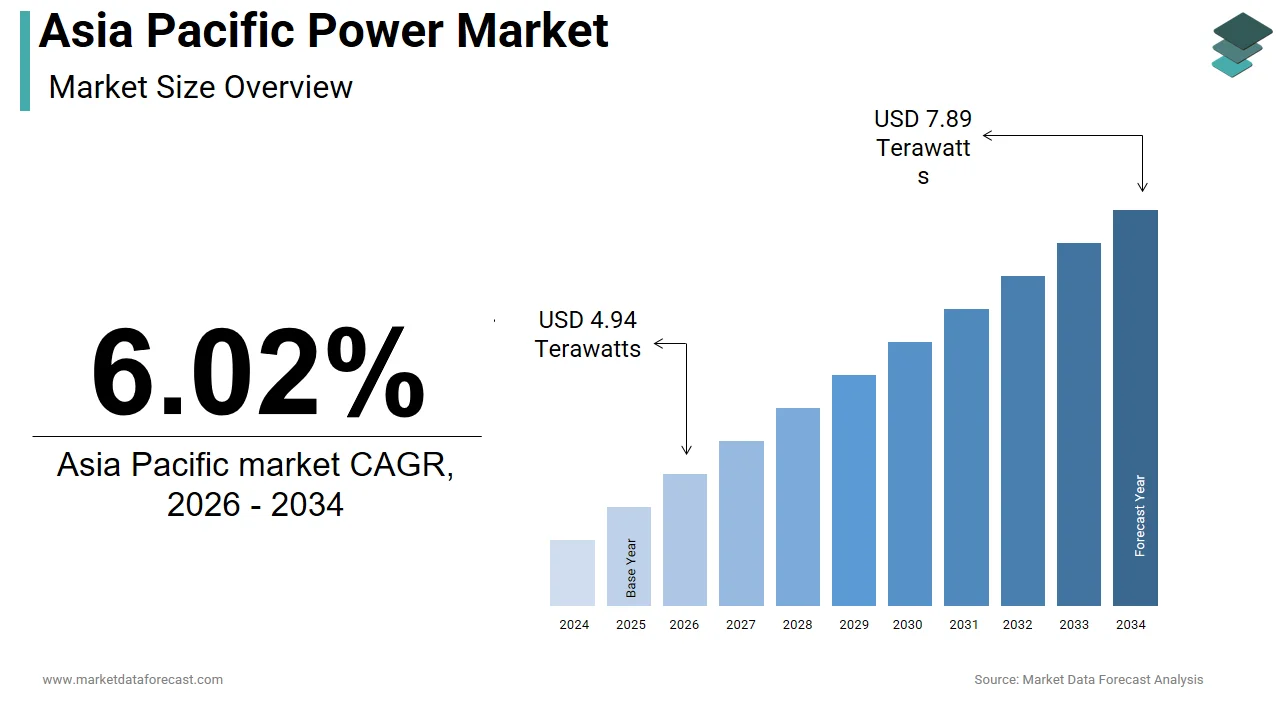
The Asia Pacific power market was valued at 4.66 terawatts in 2025, is estimated to reach 4.94 terawatts in 2026, and is projected to reach 7.89 terawatts by 2034, growing at a CAGR of 6.02% from 2026 to 2034. Rapid urbanization, industrial expansion, government-led electrification programs, and an accelerating shift toward renewable energy are key growth factors.
Key Market Trends & Insights
- China led the Asia Pacific power market in 2025.
- India, Japan, South Korea, and Australia are expected to showcase strong growth throughout the forecast period.
- Based on power generation source, the thermal power was the leading segment in 2025.
- Based on growth potential, the renewables segment is projected to be the fastest-growing.
Market Size & Forecast
- 2025 Market Size: 4.66 Terawatts
- 2026 Market Size: 4.94 Terawatts
- 2034 Projected Market Size: 7.89 Terawatts
- CAGR (2026 to 2034): 6.02%
- China: Largest market in 2025
- India, Japan, South Korea, Australia: Strong growth regions
Asia Pacific Power Market Size
The size of the Asia Pacific power market was worth 4.66 terawatts in 2025. The regional market is anticipated to grow at a CAGR of 6.02% from 2026 to 2034 and be worth 7.89 terawatts by 2034 from 4.94 terawatts in 2026.
Power refers to the electrical energy. It includes a complex interplay of conventional power sources, coal, natural gas, and hydro, and an accelerating shift toward renewable energy, driven by rising demand, urbanization, and climate commitments. This demographic weight underpins an expanding energy footprint. The region hosts some of the world’s largest power systems. China alone operates a grid with over 2.8 terawatts of installed capacity, while also including nations where electrification remains incomplete. In Papua New Guinea, for example, only 12.3% of the rural population had access to electricity as of 2022, as per the World Bank. Simultaneously, countries like Australia and Japan are advancing smart grid technologies and distributed energy resources. The region’s power infrastructure is further shaped by geopolitical dynamics, resource availability, and national energy security strategies, making it one of the most dynamic and heterogeneous energy landscapes globally.
MARKET DRIVERS
Rapid Urbanization and Industrial Expansion in Emerging Economies
Urbanization across South and Southeast Asia is fundamentally reshaping electricity demand patterns, necessitating large-scale power infrastructure development. This shift is particularly pronounced in India, Indonesia, and Vietnam, where cities are expanding at unprecedented rates. In India, urban dwellers are projected to reach 600 million by 2030, up from 480 million in 2021, placing immense pressure on existing power networks. These industries require an uninterrupted, high-quality power supply, prompting governments to fast-track grid upgrades and new generation projects. Urban infrastructure such as metro systems, commercial complexes, and data centers further intensifies load requirements. For instance, Singapore’s data centers, which consume 7% of the nation’s total electricity, are expanding due to regional digitalization. As urban and industrial ecosystems grow, so does the imperative for reliable, scalable power systems, making urbanization a core driver of market expansion.
Government-Led Electrification and Energy Access Initiatives
Expanding electricity access to underserved populations remains a critical policy objective across the region, directly fueling investment in power infrastructure. In addition, governments are implementing large-scale electrification programs. India’s Saubhagya scheme successfully connected over 28 million households to the grid by 2022, as per the Ministry of Power, significantly increasing last-mile distribution infrastructure. These initiatives not only expand grid reach but also stimulate demand for generation and distribution assets. Moreover, off-grid solutions such as solar mini-grids are being deployed in archipelagic and mountainous regions. These efforts reflect a broader commitment to energy equity, ensuring that economic development is accompanied by inclusive power access, thereby expanding the market’s foundational consumer base.
MARKET RESTRAINTS
Aging and Inadequate Grid Infrastructure in Developed and Developing Nations
Despite growing demand, significant portions of the Asia Pacific power grid suffer from obsolescence, inefficiency, and insufficient capacity, limiting reliable electricity delivery. In developing economies, the issue is compounded by rapid load growth outpacing infrastructure development. The lack of smart monitoring systems further hampers fault detection and response. These systemic weaknesses result in reduced grid reliability, higher operational costs, and constrained integration of renewable energy, ultimately impeding the market’s ability to meet modern demand patterns efficiently and sustainably.
Geopolitical and Supply Chain Vulnerabilities in Fuel Procurement
Several Asia Pacific nations remain heavily dependent on imported fossil fuels, exposing their power sectors to geopolitical instability and supply disruptions. Any disruption in shipping lanes or supplier relations can lead to price volatility and supply shortages. Maritime chokepoints like the Strait of Malacca are potential flashpoints for disruption. Besides, China’s dominance in critical mineral supply chains creates dependency risks for renewable energy expansion. These vulnerabilities constrain long-term energy security and complicate power planning across the region.
MARKET OPPORTUNITIES
Expansion of Cross-Border Power Interconnections and Regional Grid Integration
The development of transnational electricity networks presents a transformative opportunity for optimizing power supply and enhancing energy security across the Asia Pacific. The ASEAN Power Grid initiative, aimed at interconnecting ten member states, has already established 17 cross-border transmission links, with a combined capacity of 5.6 gigawatts as of 2023, according to the ASEAN Centre for Energy. These connections enable surplus hydropower from Laos to be exported to Thailand, Vietnam, and Cambodia, balancing regional supply and demand. In Northeast Asia, studies by the Asian Development Bank indicate that a unified grid linking China, South Korea, Japan, and Mongolia could reduce generation costs by up to 18% by enabling large-scale renewable integration. China has already constructed ultra-high-voltage (UHV) lines to transmit wind and solar power from Xinjiang and Gansu to coastal cities. These interconnections not only improve grid stability but also allow countries to diversify energy sources, reduce reliance on domestic fossil fuels, and lower carbon emissions through shared renewable resources, creating a foundation for a more resilient and sustainable regional power market.
Decentralized Energy Systems and Microgrid Deployment in Remote Areas
The proliferation of decentralized power solutions is unlocking new pathways for electrification and energy resilience, particularly in geographically fragmented and underserved regions. These systems serve remote communities and critical facilities such as health centers and schools, improving both access and reliability. Australia is advancing microgrid technology in mining and remote indigenous communities. Decentralized systems reduce transmission losses, enhance local energy sovereignty, and support climate goals by displacing diesel generators. As technology costs decline and policy support strengthens, microgrids are evolving from stopgap solutions to strategic components of national energy frameworks, offering scalable, sustainable alternatives to traditional grid expansion.
MARKET CHALLENGES
Integrating Intermittent Renewable Energy into Legacy Grid Systems
The rapid deployment of solar and wind power across the Asia Pacific is outpacing the modernization of grid infrastructure, creating technical and operational challenges in maintaining grid stability. In Vietnam, solar capacity surged from 100 megawatts in 2018 to over 20 gigawatts by 2023, according to the Ministry of Industry and Trade, leading to grid congestion and curtailment in central and southern provinces. The inherent variability of solar and wind requires advanced grid management tools such as flexible generation, demand response, and energy storage, which are still underdeveloped in many countries. Japan’s grid operators face challenges in absorbing excess solar during midday, leading to negative pricing episodes. The lack of real-time monitoring and forecasting systems further complicates integration. While China has invested heavily in ultra-high-voltage transmission to move renewable power from the west to the east, interconnection delays persist. Without synchronized upgrades in grid flexibility, automation, and regulatory frameworks, the full potential of renewable energy cannot be realized, threatening both energy security and decarbonization goals.
Balancing Energy Affordability with Decarbonization and Infrastructure Investment
Governments across the Asia Pacific face the complex task of maintaining affordable electricity while funding the transition to low-carbon systems and upgrading aging infrastructure. Moreover, in India, a portion of distribution companies operate at a loss due to low tariff recovery and high technical losses, constraining their ability to invest in smart meters or renewable integration. In Australia, while renewable capacity has grown, household electricity prices increased between 2021 and 2023, as reported by the Australian Energy Regulator, sparking public resistance to further green levies. In Japan, the shift away from nuclear power post-Fukushima has increased reliance on imported LNG, raising generation costs and consumer bills. The Asian Development Bank estimates that the region requires USD 1.7 trillion annually in energy infrastructure investment until 2030, yet current spending covers less than half of this need. Policymakers must navigate political sensitivities around price hikes while ensuring financial sustainability for utilities. Without coherent pricing reforms, targeted subsidies, and innovative financing mechanisms, the dual objectives of energy access and climate action may remain in conflict, undermining long-term market stability.
REPORT COVERAGE
| REPORT METRIC | DETAILS |
| Market Size Available | 2025 to 2034 |
| Base Year | 2025 |
| Forecast Period | 2026 to 2034 |
| Segments Covered | By Power Generation Source and Region. |
| Various Analyses Covered | Global, Regional and Country-Level Analysis, Segment-Level Analysis, Drivers, Restraints, Opportunities, Challenges; PESTLE Analysis; Porter’s Five Forces Analysis, Competitive Landscape, Analyst Overview of Investment Opportunities |
| Countries Covered | India, China, Japan, South Korea, Australia, New Zealand, Thailand, Malaysia, Vietnam, Philippines, Indonesia, Singapore, Rest of APAC |
| Market Leaders Profiled | NTPC Limited, Tokyo Electric Power Company Holdings, State Grid Corporation of China, Korea Electric Power Corporation, Power Construction Corporation of China, and Others. |
SEGMENTAL ANALYSIS
By Power Generation Source Insights
The thermal power remains the dominant segment in the Asia Pacific power market by accounting for 66.3% of total electricity generation in 2024. This preeminence stems from the region’s reliance on coal and natural gas to meet baseload demand amid rapid industrialization and urban expansion. Several Asia Pacific nations possess significant coal reserves and have heavily invested in coal-fired power plants over the past decades, creating a self-reinforcing infrastructure dependency. These assets, often designed for 30–40 year lifespans, remain economically viable due to sunk capital and low fuel transportation costs in coal-rich regions. The inertia of existing infrastructure, coupled with financing mechanisms favoring proven technologies, ensures thermal power’s continued dominance despite environmental pressures. In nations with less mature grid networks, thermal power provides the stable, dispatchable generation essential for maintaining grid frequency and preventing blackouts. India’s northern and western grids, serving high-density industrial zones, depend on coal plants to maintain voltage stability during peak demand periods, particularly in summer months when air conditioning load surges. For countries prioritizing uninterrupted supply over decarbonization, thermal power remains the most dependable option, especially in the absence of large-scale energy storage.

The renewables segment is the fastest-growing in the Asia Pacific power market, projected to expand at a compound annual growth rate (CAGR) of 12.4% from 2023 to 2028, according to BloombergNEF. This acceleration is driven by technological advancements, policy support, and economic competitiveness. The cost of utility-scale solar photovoltaic (PV) systems in the Asia Pacific has fallen by 82% since 2010, reaching an average of USD 0.038 per kilowatt-hour in 2023, making it cheaper than new coal plants in most countries, as per the International Renewable Energy Agency. Wind power costs have followed a similar trajectory. The efficiency of solar panels has also improved. These advancements reduce land and capital requirements, enabling faster deployment. As renewables become not just sustainable but economically superior, their adoption is accelerating across both grid-scale and distributed applications. Governments across the region have institutionalized renewable expansion through binding targets, financial incentives, and regulatory reforms. China aims to install 1,200 gigawatts of wind and solar by 2030. India targets 500 gigawatts of non-fossil capacity by 2030. Japan has raised its renewable share target to 36–38% by 2030, up from 20% in 2022, as per the Ministry of Economy, Trade and Industry. Regulatory mechanisms such as renewable purchase obligations and net metering further stimulate adoption. These policy frameworks provide long-term visibility for investors, ensuring sustained growth in the renewables segment.
COUNTRY-LEVEL ANALYSIS
China Power Market Insights
China occupied the foremost position in the Asia Pacific power market by contributing 43.5% of regional electricity generation in 2024. Its dominance is anchored in the world’s largest power system, encompassing unparalleled generation capacity, transmission networks, and energy policy influence. China generated over 9,000 terawatt-hours of electricity in 2023, fueled by a diversified mix of coal, hydro, wind, and solar. The State Grid Corporation operates the most extensive ultra-high-voltage (UHV) transmission network, spanning over 40,000 kilometers, enabling long-distance power transfer from western renewable zones to coastal load centers. Despite its reliance on coal, China leads globally in renewable deployment. The country’s 14th Five-Year Plan prioritizes energy security and decarbonization, with a target of 1,200 gigawatts of wind and solar by 2030. Nuclear power is also expanding, with several reactors under construction as of 2023. China’s dominance extends to manufacturing. Its investments in smart grids, energy storage, and digital grid management are setting regional benchmarks. As both a consumer and innovator, China’s power trajectory shapes the entire Asia Pacific energy landscape.
India Power Market Insights
India is positioned as a rapidly industrializing economy. India’s power sector is undergoing a structural transformation driven by rising demand and ambitious clean energy goals. India has set a target of 500 gigawatts of non-fossil capacity by 2030. The government’s Production Linked Incentive (PLI) scheme has spurred domestic solar manufacturing, aiming to reduce import dependence. The Green Energy Corridor project, funded by the World Bank, is strengthening interstate transmission for renewable evacuation. Hence, it is positioning it as a key growth engine in the regional market.
Japan Power Market Insights
Japan holds a significant share of the Asia Pacific power market. As a technologically sophisticated economy, Japan’s power sector is navigating a post-Fukushima transition, balancing energy security with decarbonization. However, Japan has accelerated renewable adoption, with solar capacity increasing and offshore wind projects in development. The government aims for renewables to supply a notable share of electricity. Energy efficiency remains a national priority, with Japan consuming less electricity per capita than the United States. The country is investing in hydrogen and ammonia co-firing technologies to decarbonize thermal plants. Grid modernization is underway. Despite limited land and resource constraints, Japan’s focus on innovation, energy storage, and regional LNG infrastructure ensures its continued influence in shaping Asia’s energy transition.
South Korea Power Market Insights
South Korea commands a key share of the regional power market, which is driven by a highly industrialized economy and centralized energy system. However, South Korea is undergoing a strategic energy shift under its 2050 Carbon Neutrality Strategy, which mandates a reduction in emissions by 2030. Nuclear power remains a key low-carbon baseload source, with plans to extend reactor lifespans. The country is also investing in offshore wind, green hydrogen, and battery storage to enhance grid flexibility. KEPCO, the state utility, is modernizing the grid with AI-based load forecasting and demand response systems. With strong state coordination and technological capability, South Korea is transitioning from fossil dependence to a balanced, resilient power system.
Australia Power Market Insights
Australia is distinguished by its abundant natural resources and leadership in renewable energy adoption. South Australia achieved a world record 75% renewable share in 2023, as reported by the AEMO, powered by wind farms and rooftop solar. Australia is also a major LNG exporter, with millions of tons shipped in 2023, supporting its gas-fired generation. The government targets 82% renewable electricity by 2030. With vast land and high solar irradiance, Australia is well-positioned to become a green hydrogen exporter. Its decentralized National Electricity Market fosters competition and innovation, making it a model for market-driven energy transition in the region.
COMPETITIVE LANDSCAPE
The competition in the Asia Pacific power market is evolving beyond traditional utility dominance, characterized by a dynamic interplay between state-owned enterprises, private developers, and emerging technology providers. National power companies such as State Grid, TEPCO, and EnergyAustralia maintain strong control over transmission and distribution, but face increasing pressure from independent power producers and renewable energy developers. The rise of decentralized generation, particularly rooftop solar and microgrids, is reshaping customer relationships and eroding monopoly positions. In countries like Australia and India, competitive power exchanges and merchant plants are driving innovation in pricing and service delivery. Chinese firms dominate equipment manufacturing and overseas infrastructure projects, while Japanese and South Korean companies lead in hydrogen and storage technologies. Regulatory reforms in Southeast Asia are opening markets to foreign investment, intensifying competition. The race to decarbonize is accelerating mergers, joint ventures, and cross-border energy projects. Unlike mature markets with stable demand, Asia Pacific’s competition is defined by rapid capacity expansion, technological disruption, and geopolitical influences over fuel and supply chains. Success increasingly depends on agility, innovation, and alignment with national energy strategies rather than scale alone.
KEY MARKET PLAYERS
Some of the noteworthy companies in the Asia Pacific power market profiled in this report are
- NTPC Limited
- Tokyo Electric Power Company Holdings
- State Grid Corporation of China
- Korea Electric Power Corporation
- Power Construction Corporation of China
TOP LEADING PLAYERS IN THE MARKET
- State Grid Corporation of China is a pivotal force in the Asia Pacific power landscape, operating the world’s largest electricity transmission and distribution network. The company delivers power across China and has expanded its influence through cross-border interconnections with neighboring countries such as Russia, Mongolia, and Pakistan. In 2023, it completed the Qinghai–Henan ultra-high-voltage (UHV) direct current line, capable of transmitting 8 gigawatts of renewable energy over 1,500 kilometers, enhancing grid stability and enabling large-scale wind and solar integration. State Grid has also invested in smart grid technologies, deploying over 500 million smart meters nationwide. It actively participates in international standardization and has provided technical consultancy for grid modernization in Southeast Asia and South Asia. By advancing UHV transmission, digital substations, and energy internet concepts, the company is shaping regional infrastructure development and enabling long-distance renewable power transfer, reinforcing its role as a technological and operational leader in the power sector.
- Tokyo Electric Power Company (TEPCO) remains a central player in Japan’s energy transformation, serving the Greater Tokyo region and adapting to a post-nuclear energy paradigm. Following the Fukushima incident, TEPCO has diversified its generation mix, increasing investments in LNG, renewable energy, and energy storage. In 2023, it launched a 200-megawatt battery storage project in Chiba Prefecture, one of the largest in Asia, to stabilize grid fluctuations caused by solar intermittency. The company has also formed strategic alliances with Australian and Middle Eastern LNG suppliers to secure stable fuel supply. TEPCO Renewables has expanded offshore wind development in Akita and Niigata, aiming for 5 gigawatts of renewable capacity by 2030. Through digitalization initiatives, including AI-driven demand forecasting and smart meter integration, TEPCO is enhancing grid efficiency. Its focus on decarbonization includes hydrogen pilot projects and participation in Japan’s national carbon neutrality strategy. By balancing reliability, innovation, and sustainability, TEPCO continues to influence Japan’s energy transition and regional energy cooperation.
- EnergyAustralia, a leading integrated energy company in Australia, plays a crucial role in the nation’s shift toward a low-carbon power system. The company supplies electricity and gas to over 2.8 million customers and operates a diversified portfolio that includes gas-fired generation, solar farms, and battery storage. In 2023, EnergyAustralia commissioned the 300-megawatt Tallawarra B gas plant, designed to transition to 100% green hydrogen by 2030, aligning with national decarbonization goals. It also acquired the Limondale Solar Farm and is developing the 600-megawatt Silverton Wind Farm expansion. The company is investing in grid-scale batteries, including a 250-megawatt facility in Haigh Park, to support renewable integration. EnergyAustralia has committed to retiring its coal-fired Liddell Power Station by 2023 and replacing it with clean energy infrastructure. Through partnerships with technology providers and participation in the National Electricity Market’s modernization, the company is advancing grid resilience and customer-centric energy solutions, positioning itself at the forefront of Australia’s energy evolution.
TOP STRATEGIES USED BY THE KEY MARKET PARTICIPANTS
Key players in the Asia Pacific power market are adopting multifaceted strategies to navigate the energy transition and maintain competitiveness. Companies are investing heavily in renewable energy portfolios, including solar, wind, and green hydrogen, to align with national decarbonization targets. Grid modernization through ultra-high-voltage transmission, smart meters, and digital control systems is a priority to enhance reliability and integrate variable generation. Strategic diversification into energy storage and battery technologies enables better load management and grid stability. Firms are forming international partnerships to secure fuel supply and share technological expertise, particularly in LNG and hydrogen. Mergers and acquisitions are being leveraged to expand renewable capacity and retire aging thermal assets. Utilities are also engaging in demand-side management and offering energy-as-a-service models to retain customers. Regulatory compliance, cybersecurity enhancement, and workforce reskilling are integral to long-term operational resilience. These strategies collectively reflect a shift from centralized fossil-based generation to flexible, sustainable, and digitally enabled power systems.
RECENT MARKET DEVELOPMENTS
- In September 2023, State Grid Corporation of China completed the Qinghai–Henan ultra-high-voltage direct current transmission line, enabling the transfer of 8 gigawatts of renewable energy across 1,500 kilometers and enhancing grid integration of wind and solar power.
- In July 2023, Tokyo Electric Power Company launched a 200-megawatt battery storage facility in Chiba Prefecture, one of the largest in Japan, to stabilize grid fluctuations caused by solar intermittency and support renewable integration.
- In April 2023, EnergyAustralia retired the 735-megawatt Liddell coal-fired power station in New South Wales, marking a strategic shift toward clean energy and paving the way for a new 850-megawatt solar and battery complex.
- In January 2024, KEPCO signed a joint development agreement with Macquarie Group to build 2 gigawatts of offshore wind capacity in South Korea, strengthening its renewable portfolio and international collaboration.
- In November 2023, CLP Group commissioned the 1,320-megawatt Ha Tsuen gas-fired power plant in Hong Kong, enhancing energy security and reducing carbon emissions by replacing older coal units.
MARKET SEGMENTATION
This Asia Pacific power market research report is segmented and sub-segmented into the following categories.
By Power Generation Source
- Thermal
- Hydro
- Renewables
- Others
By Country
- India
- China
- Japan
- South Korea
- Rest Of Asia Pacific