- Product Description Description
- Table of Contents TOC
- List of Table & Figure LOT
- Get Free Sample PDF Sample PDF
Market Size, 2025
$0.35 BnMarket Estimate, 2026
$0.38 BnMarket Forecast, 2034
$0.67 BnCAGR, 2026–2034
7.52%Asia Pacific Surgical Table Market Summary
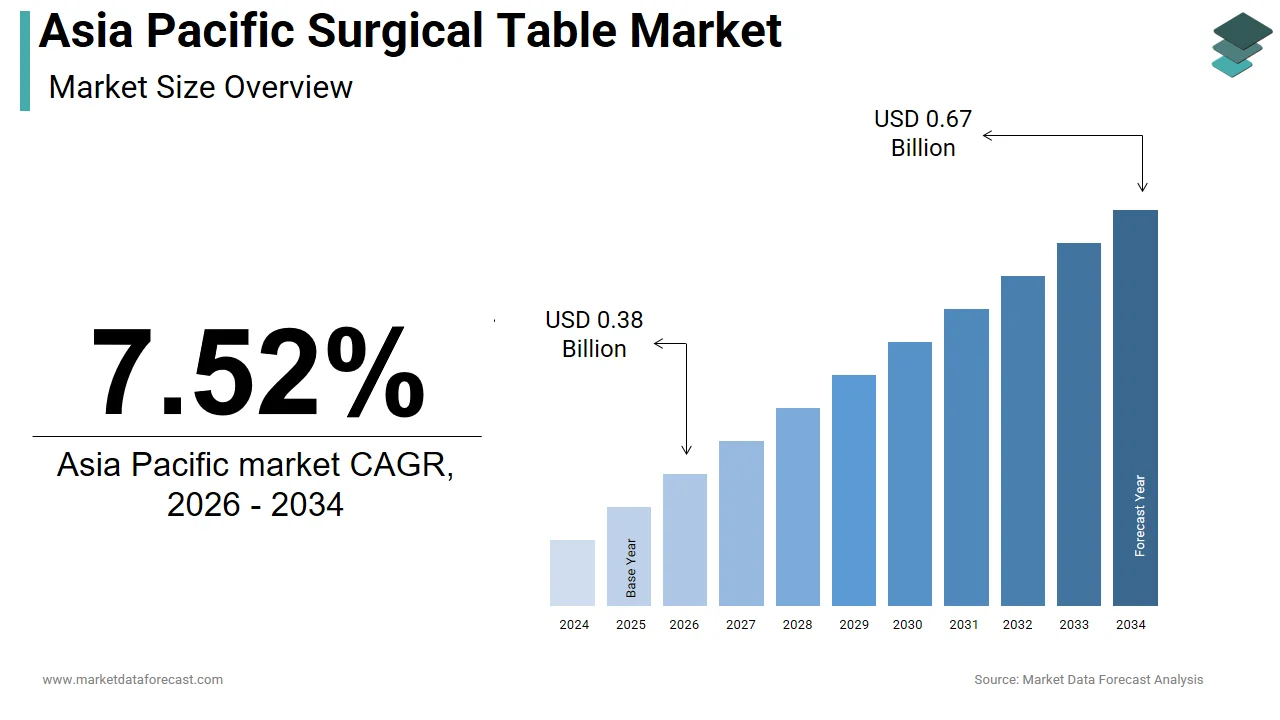
The Asia Pacific surgical table market size was USD 0.35 billion in 2025, is anticipated to be USD 0.38 billion in 2026, and is projected to reach USD 0.67 billion by 2033, registering a CAGR of 7.52% from 2026 to 2034. The surgical tables are advanced medical devices designed to support a wide array of surgical interventions, ranging from minimally invasive procedures to complex orthopedic and neurosurgical operations. The demand for surgical tables in the region is driven by expansion and modernization of healthcare infrastructure, rising prevalence of lifestyle-related diseases, and increasing surgical volumes.
Key Market Trends & Insights
- China led the Asia Pacific surgical table market in 2025.
- India and Japan are expected to showcase strong growth throughout the forecast period.
- Based on type of surgery, the general surgery tables segment was the leading segment in 2025.
- Based on material, the metal-based segment held the dominant market share in 2025.
- Based on end-user, the hospitals remained the top segment in 2025.
Market Size & Forecast
- 2025 Market Size: USD 0.35 Billion
- 2026 Market Size: USD 0.38 Billion
- 2034 Projected Market Size: USD 0.67 Billion
- CAGR 2026 to 2034): 7.52%
- China: Largest market in 2025
- India and Japan: Strong growth regions
 Download Free Sample Report
Asia Pacific Surgical Table Market Size
The size of the Asia Pacific surgical table market was worth USD 0.35 billion in 2025. The regional market is anticipated to grow at a CAGR of 7.52% from 2026 to 2034 and be worth USD 0.67 billion by 2034 from USD 0.38 billion in 2026.
The surgical table is are advanced medical device designed to support a wide array of surgical interventions, ranging from minimally invasive procedures to complex orthopedic and neurosurgical operations. The demand for surgical tables in the region is intrinsically linked to the expansion and modernization of healthcare infrastructure, particularly in emerging economies such as India, Indonesia, and Vietnam. Moreover, the increasing prevalence of lifestyle-related diseases, cardiovascular conditions, cancer, and diabetes has amplified the volume of surgical procedures. According to the International Agency for Research on Cancer, over 8.1 million new cancer cases were reported in Asia in 2022, necessitating advanced surgical interventions.
MARKET DRIVERS
Rising Volume of Surgical Procedures Due to Burgeoning Chronic Disease Burden
The escalating prevalence of chronic diseases across the Asia Pacific region is a primary factor propelling the growth of the Asia Pacific surgical table market. Cardiovascular diseases, cancer, and orthopedic conditions requiring surgical intervention have seen a marked increase due to aging populations and shifting lifestyle patterns. According to the World Health Organization, non-communicable diseases account for nearly 67% of all deaths in the Western Pacific region, with cardiovascular diseases alone responsible for over 5 million deaths annually. In China, an estimated 330 million individuals suffer from cardiovascular diseases, many of whom require surgical management. Similarly, India recorded over 1.5 million new cancer cases in 2022, as reported by the International Agency for Research on Cancer, necessitating a surge in oncological surgeries. The increasing adoption of minimally invasive and image-guided surgeries further demands advanced surgical tables with compatibility for C-arms and robotic systems.
Expansion and Modernization of Healthcare Infrastructure in Emerging Economies
The structural transformation of healthcare systems is also propelling the growth of the Asia Pacific surgical table market. Countries such as Indonesia, Vietnam, and the Philippines are investing heavily in hospital construction and medical equipment upgrades to meet growing healthcare demands. India’s Pradhan Mantri Ayushman Bharat Health Infrastructure Mission aims to establish 11,024 urban health and wellness centers and upgrade 3,000 district-level facilities, many of which will include operating theaters equipped with modern surgical tables. The shift toward accredited tertiary care centers is evident in Thailand, where the number of Joint Commission International-accredited hospitals has risen to 25, reflecting a commitment to international surgical standards. Furthermore, public-private partnerships in Australia and Malaysia are facilitating the deployment of smart operating rooms, integrating IoT-enabled surgical tables with anesthesia and monitoring systems.
MARKET RESTRAINTS
High Procurement and Maintenance Costs Limiting Adoption in Low-Income Regions
The high capital and operational costs associated with advanced surgical tables is restraining the growth of the Asia Pacific surgical table market. In countries like Cambodia and Laos, where total health expenditure per capita remains below USD 100 annually as per the World Bank, such investments are often unfeasible without external funding. Even in larger economies such as India, public hospitals in tier-2 and tier-3 cities frequently rely on outdated or manually operated tables due to budget constraints. Maintenance of motorized and digital tables further exacerbates costs, requiring specialized technicians and imported spare parts. Additionally, training surgeons and operating room staff to use advanced tables adds to the total cost of ownership.
Regulatory Fragmentation and Lengthy Approval Processes Across Regional Markets
The Asia Pacific region’s diverse regulatory landscapes present a significant factor hampering the growth of the Asia Pacific surgical table market. Each country maintains distinct medical device approval frameworks, which are leading to prolonged market entry timelines and increased compliance costs for manufacturers. As per the Global Regulatory Intelligence Report published by the Regulatory Affairs Professionals Society, 68% of medtech firms operating in the Asia Pacific cite regulatory divergence as a top operational challenge. Countries like Indonesia and Thailand have recently strengthened their regulatory oversight, requiring conformity assessments and post-market surveillance, further complicating the approval pathway. Smaller manufacturers often lack the resources to navigate these complex systems, limiting competition and innovation. This regulatory asymmetry discourages multinational companies from launching cutting-edge models in smaller markets, resulting in delayed technology diffusion.
MARKET OPPORTUNITIES
Integration of Smart Technologies and IoT in Surgical Tables
The convergence of digital health technologies with surgical equipment presents a transformative opportunity for the Asia Pacific surgical table market. Leading healthcare systems in South Korea, Japan, and Australia are increasingly adopting smart operating rooms where surgical tables are integrated with IoT platforms, enabling real-time data exchange with anesthesia machines, imaging systems, and electronic health records. For instance, South Korea’s Samsung Medical Center has deployed AI-enabled surgical tables that adjust positioning based on intraoperative imaging feedback by reducing manual intervention and improving procedural accuracy. The integration of sensors for pressure mapping, weight distribution, and positional stability enhances patient safety during prolonged surgeries. In Japan, where robotic-assisted surgeries grew by 35% between 2020 and 2023, as per the Japan Robot Association, demand for tables compatible with da Vinci and Hinotori systems is surging. Companies like Maquet and Stryker are launching next-generation tables with embedded connectivity and remote diagnostics by allowing predictive maintenance and reduced downtime.
Growing Medical Tourism Driving Demand for Premium Surgical Infrastructure
Asia Pacific has emerged as a global hub for medical tourism, with countries like Thailand, India, and Malaysia attracting millions of international patients annually, which is posing new opportunities for the growth of the Asia Pacific surgical table market. Bumrungrad International Hospital in Bangkok and Apollo Hospitals in India have installed multi-functional, radiolucent tables from German and Swiss manufacturers to meet international accreditation standards and enhance patient trust. As per the Medical Tourism Association, over 70% of medical tourists cite technology and facility quality as key decision factors. This competitive environment compels hospitals to differentiate through superior infrastructure, directly boosting demand for high-end surgical tables.
MARKET CHALLENGES
Shortage of Skilled Biomedical Engineers and Technical Support Personnel
The shortage of trained biomedical engineers and technical support staff capable of operating and maintaining sophisticated equipment is inhibiting the growth of the Asia Pacific surgical table market. However, according to the World Health Organization, the density of healthcare workers, including biomedical technicians, in Southeast Asia averages just 18 per 10,000 population, far below the recommended 25 per 10,000. In Indonesia, only 30% of public hospitals have dedicated biomedical engineering units, as reported by the Ministry of Health in 2023, leading to prolonged equipment downtime. This skills gap is exacerbated by limited academic programs in clinical engineering; India has fewer than 50 universities offering biomedical engineering specializations relevant to surgical equipment. Training programs provided by manufacturers like Getinge and Trumpf Medical are often restricted to urban centers, leaving rural facilities underserved. Moreover, the rapid pace of technological innovation outstrips the current training infrastructure, which is resulting in underutilization of advanced table functionalities.
Inconsistent Reimbursement Policies for Advanced Surgical Procedures
The absence of standardized and comprehensive reimbursement frameworks for advanced surgical procedures across the Asia Pacific creates financial disincentives for hospitals to invest in high-end surgical tables. As per the Asia Pacific Economic Cooperation’s 2023 Health Working Group report, only 12 of the 21 APEC economies have established medical device reimbursement pathways linked to clinical outcomes. Furthermore, the lack of outcome-based reimbursement models prevents hospitals from justifying capital expenditures on tables that improve surgical precision and reduce complications.
REPORT COVERAGE
| REPORT METRIC | DETAILS |
| Market Size Available | 2025 to 2034 |
| Base Year | 2025 |
| Forecast Period | 2026 to 2034 |
| Segments Covered | By Type of Surgery, Material, End User, and Region. |
| Various Analyses Covered | Global, Regional and Country-Level Analysis, Segment-Level Analysis, Drivers, Restraints, Opportunities, Challenges; PESTLE Analysis; Porter’s Five Forces Analysis, Competitive Landscape, Analyst Overview of Investment Opportunities |
| Countries Covered | India, China, Japan, South Korea, Australia, New Zealand, Thailand, Malaysia, Vietnam, Philippines, Indonesia, Singapore, Rest of APAC |
| Market Leaders Profiled | Steris Plc, Skytron LLC, Stryker Corporation, Mizuho OSI, and Getinge AB. |
SEGMENTAL ANALYSIS
By Type of Surgery Insights
The general surgery tables segment was the largest and held 58.2% of the Asia Pacific surgical table market share in 2024, owing to the high volume of general surgical procedures performed across both public and private healthcare facilities. As per the Lancet Commission on Global Surgery, over 90% of emergency surgical procedures in low- and middle-income Asia Pacific nations fall under the general surgery category, reinforcing the need for versatile, durable, and cost-effective tables. These tables are designed for multi-positioning and compatibility with laparoscopic systems, making them indispensable in high-throughput operating rooms. The emphasis on affordability and operational flexibility ensures that general surgery tables remain the default choice for most new operating theaters in rural and semi-urban centers where specialized surgical volumes remain low.
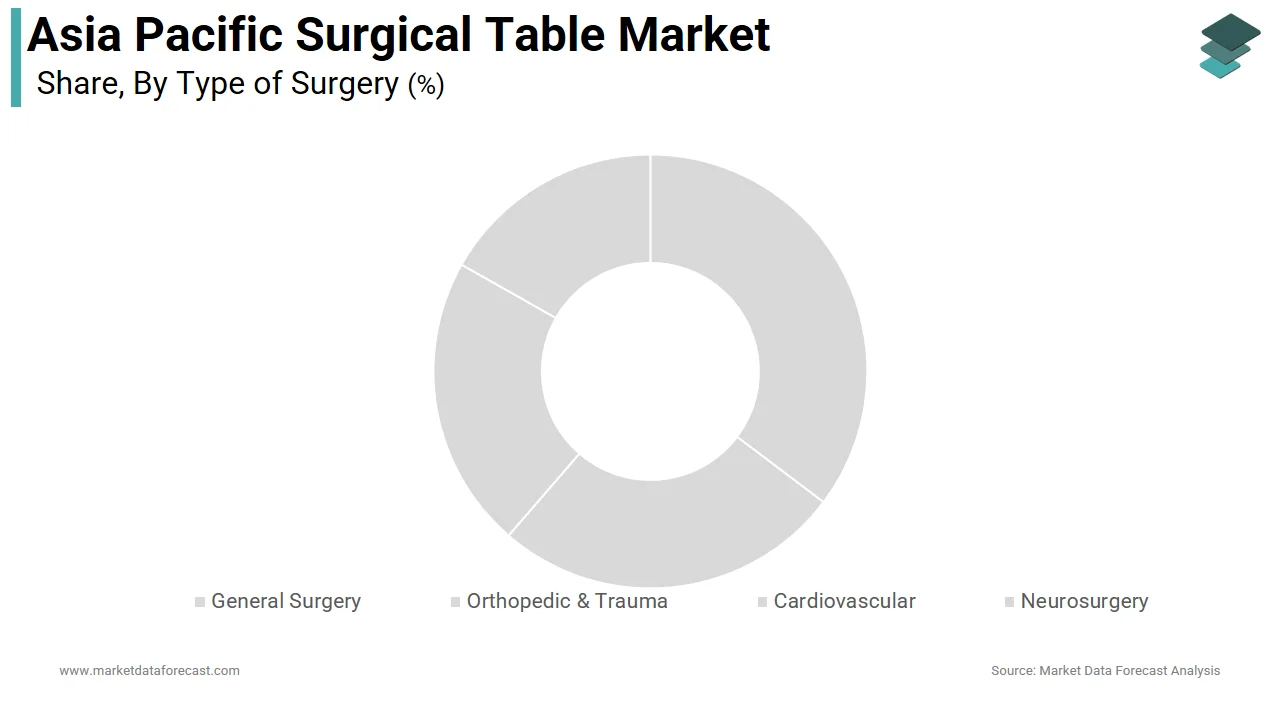
The specialty segment is projected to grow with a CAGR of 8.7% from 2026 to 2034, owing to the rising complexity of surgical interventions and the increasing adoption of minimally invasive and image-guided techniques. In Japan, over 450,000 joint replacement surgeries were performed in 2023, a 6.2% year-on-year increase as reported by the Japanese Orthopaedic Association, fueling demand for orthopedic-specific tables with fluoroscopic compatibility. The proliferation of dedicated surgical centers such as neurosurgery units in Singapore’s National Neuroscience Institute further amplifies the need for purpose-built tables. Additionally, government initiatives like Australia’s Medical Technology Strategy 2030 are incentivizing hospitals to adopt specialty equipment that improves surgical precision and reduces recovery times.
By Material Insights
The metal-based segment held a prominent share of the Asia Pacific surgical table market in 2025, with the superior structural integrity, load-bearing capacity, and resistance to sterilization-induced wear by making them ideal for high-volume surgical environments. In public hospitals across India, China, and Vietnam, where operating rooms conduct 15–20 procedures daily, the durability of metal tables ensures longevity despite frequent autoclaving and mechanical stress. According to the World Health Organization, over 60% of surgical facilities in Southeast Asia prioritize equipment resilience over advanced features due to resource constraints. Moreover, metal tables are inherently compatible with existing hospital infrastructure, including C-arm imaging systems and grounding mechanisms, reducing integration challenges. Additionally, the cost of metal tables is 30–40% lower than composite alternatives, as per a 2023 benchmarking study by the Asian Hospital Equipment Association, enabling broader adoption in budget-constrained settings.
The composite surgical tables segment is anticipated to grow with an expected CAGR of 9.3% from 2026 to 2034, with the increasing demand for radiolucent tables that facilitate real-time imaging during complex procedures. Carbon fiber tables allow unimpeded passage of X-rays, CT, and fluoroscopy, eliminating the need for patient repositioning and reducing surgical time. In neurosurgery, where precision is paramount, over 75% of leading hospitals in Australia and South Korea now use composite tables, as reported by the Australasian Neuroscience Society. The National Cancer Institute of Singapore performed over 1,200 image-guided spinal surgeries in 2023, all utilizing radiolucent composite tables to ensure accurate tumor resection. Their non-magnetic properties also make them compatible with intraoperative MRI, a growing modality in brain and spinal surgeries.
By End User Insights
The hospitals segment wad the largest by holding a prominent share of the Asia Pacific surgical table market in 2025, with the sheer scale of surgical operations conducted within hospital settings, particularly in multi-specialty and tertiary care institutions. In China, over 80 million surgical procedures were performed in hospitals in 2022, according to the National Health Commission, necessitating large fleets of both general and specialty tables. Public hospitals in India, supported by central funding under the Pradhan Mantri Ayushman Bharat Health Infrastructure Mission, have added more than 1,200 new operating theaters since 2021, each requiring at least one primary surgical table. Moreover, hospitals are the primary recipients of government and donor-funded medical equipment upgrades.
The Ambulatory Surgical Centers (ASCs) segment is gaining traction with an expected CAGR of 10.2% from 2025 to 203,3, owing to the regional shift toward outpatient care, cost containment, and the rising volume of minimally invasive procedures. ASCs prioritize compact, lightweight, and rapidly reconfigurable surgical tables to maximize room turnover. In Singapore, private ASCs like The Surgery Group have adopted modular tables that can be switched between general and specialty modes within minutes, enhancing operational efficiency. Regulatory support is also accelerating growth in India’s 2022 National Telemedicine and Outpatient Care Guidelines encourage the development of certified ASCs to decongest hospitals.
COUNTRY-LEVEL ANALYSIS
China Surgical Table Market Insights
China was the top performer of the Asia Pacific surgical table market by accounting for 28.3% of share in 2024. As the region’s most populous nation and a leader in healthcare infrastructure investment, China is undergoing a systemic upgrade of its surgical capabilities. The National Health Commission reports that the country added over 500,000 new hospital beds between 2020 and 2023, with a focus on county-level hospitals under the “Healthy China 2030” initiative. This expansion has driven massive procurement of surgical tables, particularly in tier-2 and tier-3 cities.
Japan Surgical Table Market Insights
Japan surgical table market is likely to grow with its aging population and advanced healthcare ecosystem. In 2023, the country performed over 320,000 hip and knee replacements, a figure that has grown by 5.8% annually over the past five years, according to the Japanese Orthopaedic Association. The country’s regulatory environment, though stringent, supports innovation through fast-track approvals for domestically developed devices. Additionally, Japan leads in hybrid OR adoption, with over 180 such suites operational as of 2023, as documented by the Japan Society for Medical Imaging.
India Surgical Table Market Insights
India surgical table market growth is growing, with emerging as a high-growth hub due to large-scale government healthcare initiatives and rising private sector participation, as per the Federation of Indian Chambers of Commerce and Industry’s 2023 healthcare report. The Pradhan Mantri Ayushman Bharat Health Infrastructure Mission aims to upgrade 736 medical colleges and establish 11,024 urban health centers, many of which include new operating rooms. As of 2023, over 450 district hospitals have been equipped with modern surgical suites, according to the Ministry of Health and Family Welfare. India’s surgical burden is immense over 50 million procedures performed annually, including a growing number of oncological and cardiac surgeries. The National Cancer Registry Programme reports a 12% year-on-year increase in cancer surgeries, necessitating advanced tables with radiolucent features. Additionally, the rise of corporate hospital chains like Apollo and Fortis has led to the adoption of premium tables from global brands.
Australia Surgical Table Market Insights
Australia surgical table market is expected to grow with its high healthcare expenditure and early adoption of advanced surgical technologies, as noted by the Australian Institute of Health and Welfare. The country spends over 10% of its GDP on healthcare, one of the highest ratios in the Asia Pacific, enabling widespread deployment of smart operating rooms. In 2023, Australia performed over 3.2 million surgical procedures, with a 7% increase in robotic surgeries compared to the previous year, as reported by the Australian Digital Health Agency. Leading hospitals like Royal Melbourne and Royal Brisbane are integrating IoT-enabled surgical tables that sync with electronic medical records and imaging systems.
South Korea Surgical Table Market Insights
South Korea surgical table market growth is likely to grow with its technologically advanced healthcare system and strong emphasis on digital surgery, as per the Korea Health Industry Development Institute. The country has one of the highest densities of robotic surgery systems per capita, with over 1,200 da Vinci units installed as of 2023, according to the Korean Society for Medical Robotics. This proliferation necessitates compatible surgical tables with precise positioning and load distribution. Seoul National University Hospital and Asan Medical Center have pioneered the use of AI-integrated tables that auto-adjust based on real-time imaging feedback. Additionally, South Korea’s National Health Insurance Service covers a broad range of minimally invasive procedures, encouraging ASCs and hospitals to invest in efficient, multi-functional tables. The Ministry of Food and Drug Safety has also expedited approvals for smart medical devices by reducing time-to-market.
COMPETITIVE LANDSCAPE
The competition in the Asia Pacific surgical table market is intensifying as global leaders and regional manufacturers vie for dominance in a rapidly evolving landscape. Multinational corporations such as Getinge, Stryker, and Trumpf Medical leverage technological superiority, brand reputation, and integrated surgical ecosystems to maintain in high-income markets like Japan, Australia, and South Korea. At the same time, domestic players in China, India, and South Korea are gaining ground by offering cost-effective alternatives tailored to local infrastructure and budget constraints. This dual-market dynamic creates a fragmented yet highly competitive environment. Companies are differentiating through service excellence, localized distribution, and partnerships with public health systems. Regulatory agility and rapid product customization are becoming decisive advantages. The rise of ambulatory surgical centers and smart hospitals is reshaping procurement priorities, favoring modular, interoperable, and future-ready tables. Competitive pressure is further amplified by increasing private equity investment in healthcare infrastructure and medical tourism.
KEY MARKET PLAYERS
Some of the noteworthy companies in the Asia Pacific surgical table market profiled in this report are
- Steris Plc
- Skytron LLC
- Stryker Corporation
- Mizuho OSI
- Getinge AB
TOP LEADING PLAYERS IN THE MARKET
- Getinge has established a dominant presence in the Asia Pacific surgical table market through its focus on innovation and clinical integration. The company’s Maquet brand offers advanced surgical tables designed for multi-specialty applications, including hybrid operating rooms and robotic surgery. In recent years, Getinge has intensified its collaboration with hospitals in Japan, South Korea, and Australia to co-develop tables compatible with intraoperative imaging and anesthesia systems. It launched the Flow 2 OR table in 2023, featuring enhanced ergonomics and IoT connectivity, specifically tailored for high-throughput surgical centers in India and Southeast Asia. Getinge has also expanded its local service networks in Singapore and Shanghai, ensuring rapid technical support and training for biomedical staff.
- Stryker is one of the top key players in the Asia Pacific surgical table market by integrating surgical tables with its broader ecosystem of surgical navigation and robotic systems. The company’s 6-series and 7-series surgical tables are widely adopted in neurosurgical and orthopedic centers across Australia, Japan, and South Korea due to their compatibility with the Mako robotic arm and C-arm imaging. In 2023, Stryker launched the Power900 OR table in India, engineered for durability and radiolucency, targeting high-volume public and private hospitals. The company has increased its direct sales force in Indonesia and Vietnam while partnering with local distributors to enhance market penetration. Stryker also invested in clinical training centers in Seoul and Sydney to educate surgeons and OR teams on optimal table utilization. Its strategic emphasis on integrated surgical workflows and digital interoperability has positioned Stryker as a preferred provider for next-generation operating rooms across the region.
- Trumpf Medical has gained significant traction in the Asia Pacific market by delivering high-performance surgical tables tailored for intensive care and complex surgical environments. Known for its ergonomic design and precision engineering, the company’s TruSystem 7500 and 5500 series are widely deployed in tertiary hospitals in China, Japan, and Malaysia. In 2022, Trumpf introduced a compact, radiolucent table specifically for space-constrained operating rooms in urban Indian hospitals, addressing an infrastructure gap. The company has strengthened its regional presence through partnerships with local engineering firms in Thailand and the Philippines to ensure faster installation and maintenance. Trumpf also collaborated with the National University Hospital in Singapore to test AI-assisted positioning algorithms integrated into its tables.
TOP STRATEGIES USED BY THE KEY MARKET PARTICIPANTS
The major strategies employed by key players in the Asia Pacific surgical table market revolve around product innovation, regional expansion, strategic partnerships, and integration with digital ecosystems. Companies are increasingly developing tables compatible with robotic surgery and intraoperative imaging to meet the rising demand for precision and efficiency. Firms like Getinge and Stryker are investing in clinical training programs to enhance user adoption and maximize equipment utilization. Mergers and acquisitions are being leveraged to strengthen technological portfolios, particularly in IoT and AI-driven positioning systems. Additionally, collaborations with government health programs and hospital networks enable faster regulatory approvals and procurement access. Emphasis is also placed on sustainable design, with lightweight composite materials reducing energy consumption in motorized systems. These strategies collectively enhance competitiveness and ensure alignment with evolving surgical workflows across diverse healthcare settings in the region.
RECENT MARKET DEVELOPMENTS
- In March 2023, Stryker launched its Power900 OR surgical table in India, specifically engineered for high-volume hospitals, featuring enhanced radiolucency and durability to meet the demands of over 20 daily procedures in public and private operating rooms.
- In June 2023, Getinge inaugurated a new regional service and training hub in Singapore, aimed at supporting hospitals across Southeast Asia with technical maintenance, staff training, and remote diagnostics for its Maquet surgical tables.
- In September 2022, Trumpf Medical partnered with the National University Hospital in Singapore to pilot AI-driven positioning software integrated into its TruSystem 7500 table by enhancing precision in spinal and neurosurgical procedures.
- In January 2024, Stryker acquired Gauss Surgical, a developer of AI-powered blood loss monitoring systems, to integrate real-time analytics into its surgical tables, which is improving intraoperative decision-making in Asia Pacific hospitals.
- In April 2023, Getinge collaborated with Shanghai Huashan Hospital to co-develop a hybrid OR table compatible with 3T MRI and robotic systems by targeting advanced neurosurgical centers in China and neighboring markets.
MARKET SEGMENTATION
This Asia Pacific surgical table market research report is segmented and sub-segmented into the following categories.
By Type of Surgery
- General Surgery
- Orthopedic & Trauma
- Cardiovascular
- Neurosurgery
- Others
By Material
- Metal
- Carbon-fiber Composite
By End User
- Hospitals
- Ambulatory Surgical Centers
- Specialty Clinics
By Country
- India
- China
- Japan
- South Korea
- Rest Of Asia Pacific