- Product Description Description
- Table of Contents TOC
- List of Table & Figure LOT
- Get Free Sample PDF Sample PDF
Market Size, 2025
$2.85 BnMarket Estimate, 2026
$3.21 BnMarket Forecast, 2034
$8.48 BnCAGR, 2026–2034
12.9%Global Automotive Digital Key Market Report Summary
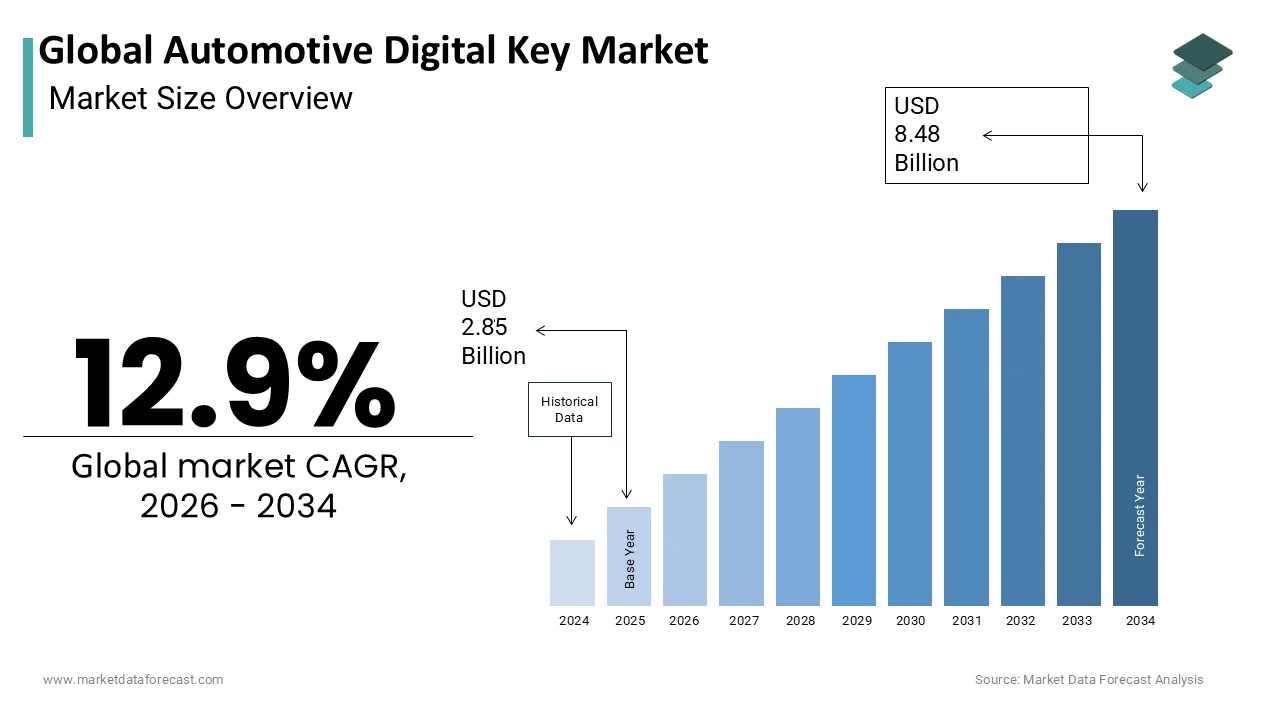
The Global Automotive Digital Key Market was valued at USD 2.85 billion in 2025 and is projected to reach USD 8.48 billion by 2034, growing from USD 3.21 billion in 2026 at a CAGR of 12.9% during the forecast period. Growth is driven by rising consumer expectations for seamless smartphone-vehicle integration, expansion of shared mobility and fleet management solutions, and growing adoption of Ultra-Wideband technology. Cybersecurity risks and fragmented technical standards are shaping market dynamics.
Key Market Trends
- Rising adoption of Ultra-Wideband technology for centimeter-level security precision
- Growing integration of digital keys with smart home and IoT ecosystems
- Increasing use of digital keys in peer-to-peer and corporate fleet sharing
- Rising consumer demand for passive entry and personalized welcome sequences
- Growing focus on multi-factor authentication to mitigate relay attack risks
Segmental Insights
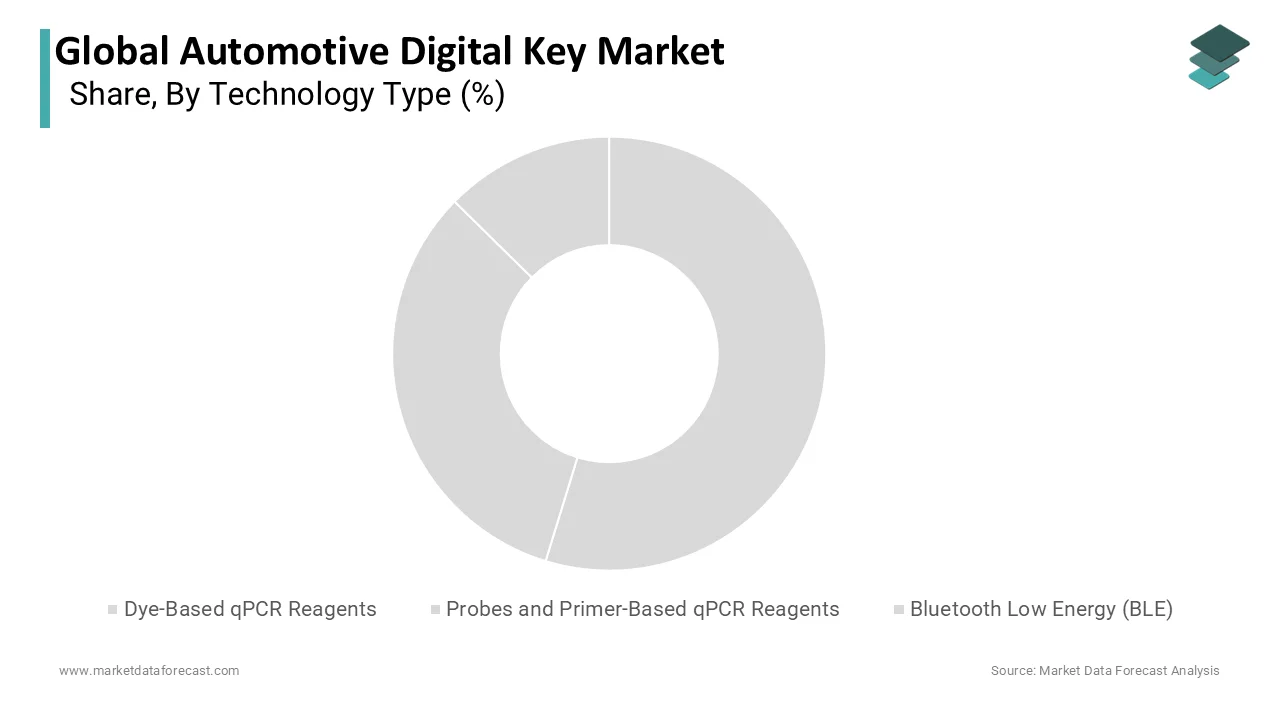
- Based on technology type, Bluetooth Low Energy held the largest share in 2025 at 55.4%, driven by its low cost, wide smartphone compatibility, and passive entry support.
- Based on sales channel, primary digital key led the market in 2025 by capturing 33.5% of the market share, driven by the shift from physical to digital ownership experiences.
- Based on application, vehicle lock and unlock held the largest share in 2025, as the foundational and most frequently used digital key function.
Regional Insights
- North America led the market in 2025 by holding 35.3% of the global market share, supported by high smartphone penetration and early connected car adoption.
- Europe holds a significant share at 21.2%, driven by GDPR-influenced data handling standards and high luxury car sales.
- Asia Pacific is a prominent market supported by China's smartphone usage and rapid electric vehicle adoption.
- Ultra-Wideband is the fastest-growing technology segment, projected at a CAGR of 32.5%, driven by superior relay-attack security and growing flagship smartphone support.
Competitive Landscape
The market is highly competitive, with technology giants, semiconductor manufacturers, and automotive suppliers all competing on cybersecurity robustness and interoperability. Companies are investing in Ultra-Wideband adoption and industry consortium participation to standardize digital key protocols.
Prominent players in the market include Robert Bosch GmbH, Continental AG, Denso Corporation, Valeo SA, HELLA GmbH & Co. KGaA, Hyundai Mobis Co. Ltd., ZF Friedrichshafen AG, NXP Semiconductors N.V., STMicroelectronics N.V., Samsung Electronics Co. Ltd., Apple Inc., and Google LLC.
 Download Free Sample Report
Global Automotive Digital Key Market Size
The Global Automotive Digital Key Market is projected to grow from USD 2.85 billion in 2025 to USD 3.21 billion in 2026 and reach USD 8.48 billion by 2034, registering a CAGR of 12.9% during the forecast period from 2026 to 2034.
The automotive digital key is a transformative shift in vehicle access technology, replacing traditional physical keys with secure digital credentials stored on smartphones, smartwatches,s or other connected devices. This adoption reflects a broader industry movement toward software-defined vehicles, where user experience and connectivity are paramount. As per Eurostat, approximately 90% of households in the European Union have access to high-speed internet, facilitating the cloud-based management of digital identities. Consumers increasingly expect their vehicles to integrate seamlessly with their digital lives, allowing for remote access,s grants, and personalized settings without physical handovers. Regulatory frameworks, such as the General Cloud-Based Regulation,n influence how manufacturers handle sensitive biometric and location data associated with these keys. The technology supports emerging mobility models like car sharing by enabling temporary secure access. This transition enables granular control over vehicle permissions for family members, service providers, or rental customers, creating a more flexible and secure ownership experience.
MARKET DRIVERS
Rising Consumer Expectation for Seamless Digital Integration
The escalating demand for seamless digital integration, as consumers increasingly view their smartphones, is fuelling the growth of the automotive digital key market. Modern drivers expect their vehicles to interact intuitively with their personal devices, es mirroring the connectivity they experience with smart home appliances and wearables. The initial quality studies indicate that connectivity features are among the top three factors influencing customer satisfaction, with nearly 70% of buyers expecting their phone to serve. Digital keys eliminate the inconvenience of carrying separate physical, fobs allowing users to u,nlock start, and share their vehicles using devices they already possess and keep charged. This convenience is particularly valued by younger demographics who prioritize minimalism and digital efficiency in their lifestyle choices. The ability to grant temporary access to valets, family members, or friends via smartphone apps enhances flexibility and reduces logistical friction in daily routines. Remote unlocking capabilities also facilitate practical use cases such as package delivery into the vehicle trunk,k adding tangible utility beyond simple entry. As vehicles become extensions of the smart home ecosystem, em the digital key acts as the authentication layer that enables personalized settings, such as seat position, climate control, and entertainment preferences to load automatically upon approach. This level of personalization creates a sticky user experience that encourages brand retention.
Expansion of Shared Mobility and Fleet Management Solutions
The rapid growth of car sharing, peer-to-peer rental,t taxi, and corporate fleet management solutions drives significant demand for automotive digital key technology due to its ability to facilitate secure remote access without physical interaction. The expansion of shared mobility and fleet management solutions is additionally boosting the growth of the automotive digital key market. Traditional physical keys are impractical for shared mobility operations where vehicles must be accessed face-to-face throughout the day without face-to-face handovers or key exchange logistics. Digital keys enable operators to grant time-limited, cloud-based credentials to renters via cloud-based platforms, ensuring accountability and reducing operational overhead. Major automakers like BMW and Mercedes-Benz have integrated digital key functionality into their shared mobility fleets, allowing users to unlock vehicles directly through rental apps,s which streamlines the user journey. This capability significantly reduces costs associated with key management, cleaning coordination, and maintenance scheduling. The technology also supports peer-to-peer car sharing models where private owners can rent out their vehicles securely to trusted individuals. Digital logs provide transparent records of access times and user identity, which is crucial for insurance claims and liability purposes in case of accidents or damage. The scalability of digital key systems allows mobility providers to expand their fleets without proportional increases in administrative staff.
MARKET RESTRAINTS
Cybersecurity Vulnerabilities and Relay Attack Risks
The significant concerns regarding cybersecurity vulnerabilities and the potential for relay attacks on the widespread consumer trust and the end adoption of automotive digital keys are hindering the growth of the automotive digital key market. These systems rely on wireless communication protocols that can be susceptible to interception, jamming, or spoofing if not implemented with rigorous security standards. Consumers are hesitant to fully rely on digital keys due to fears that hackers could gain unauthorized access to their vehicles or steal personal data stored in the associated applications. High-profile incidents where security researchers demonstrated the ability to clone digital signals or exploit Bluetooth weaknesses have eroded public confidence in the technology. The European General Data Protection Regulation imposes strict requirements on the handling of user data, including location history and access logs,ogs which adds complexity and cost to compliance for manufacturers. Manufacturers invest heavily in multi-factor authentication and secure element hardware to mitigate these risks, but the lack of universal security standards across different smartphone operating systems creates fragmentation. Insurance companies often charge higher premiums for vehicles with known digital vulnerabilities, further discouraging adoption among cos,t conscious buyers.
Fragmentation of Technical Standards and Interoperability Issues
The lack of unified technical standards and interoperability between different smartphone manufacturers and automotive brands is additionally hampering the growth of the automotive digital key market. Currently, multiple competing standards exist, including Near Field Communication, Bluetooth Low Energy, and Ultra-Wideband,eband each with varying levels of adoption compatibility, type, and performance characteristics. While efforts are underway to harmonize these protocols,ocols many vehicles only support specific technologies, limiting the range of compatible devices for consumers. Apple, Google, and Samsung have developed proprietary implementations that do not always work seamlessly with all vehicle models, creating confusion and frustration for users who switch phone brands. This fragmentation forces automakers to support multiple protocols,s increasing development costs, testing complexity, and bill of materials. It also hinders the ability of users to share access easily if the recipient uses a different type of device. The absence of a single global standard slows down the rollout of digital keys in mass vehicles, where cost sensitivity is high, and simplicity is valued. Manufacturers hesitate to commit to one technology, fearing it may become obsolete or unsupported by major phone makers.
MARKET OPPORTUNITIES
Integration with Smart Home and Internet of Things Ecosystems
The emergence of automotive digital keys with smart home and Internet of Things ecosystems for enhancing user convenience and creating new recexpected urring revenue streams for manufacturers is to elevate the growth of the automotive digital key market. Digital keys can serve as secure authentication tokens that link vehicle status with home automation systems, enabling seamless transitions between living and driving environments. As per research, over 50 million smart homes globally are equipped with connected devices that can interact with vehicle data, creating a cohesive digital lifestyle. For instance, a digital key can trigger home security systems to disarm when the vehicle approaches or adjust lighting and temperature based on driver preferences detected by the car. Automakers like Volvo and Ford are exploring partnerships with smart home platforms to create integrated experiences where the car acts as a mobile node in the IoT network. This integration allows for predictive maintenance alerts to be sent directly to home assistants and enables remote vehicle monitoring from within the home interface. The ability to share digital keys with service providers for home deliveries or maintenance visits adds further utility and security. As 5G networks expand, the latency and reliability of real-time connections will improve,e enabling real-time synchronization between devices. This ecosystem approach creates stickiness as users become invested in a cohesive digital environment that spans their home and vehicle.
Adoption of Ultra Wideband Technology for Enhanced Precision
The emerging adoption of Ultra-Wideband technology,y by providing superior spatial awareness and security compared to existing Bluetooth or Near Field Communication protocols, ls is another factor to enhance the growth of the automotive digital key market. Unlike older technologies, Ultra-Wideband measures the time of flight of radio signals to determine the precise distance and direction, centimeter-level relative to the vehicle, with centimeter-level accuracy. This precision prevents relay attacks where signal extenders are used to trick the car into thinking the key is nearby, thereby addressing one of the primary consumer security concerns. Major smartphone manufacturers, including Apple and Samsung,g have begun integrating Ultra Wideband chips into their flagship devices,s creating a growing installed base of compatible hardware for automakers to leverage. Automakers such as hands-free Hyundai are incorporating Ultra Wideband receivers in new models to enable hands-free passive entry that works reliably even in crowded parking lots with many other signals present. The technology also enables personalized welcome sequences where the vehicle adjusts settings before the driver touches the door handle, enhancing the premium experience. This technological leap positions early adopters as leaders in security and convenience. The precision of Ultra-Wideband also opens possibilities for interior sensing, such as detecting if a child or pet is left in the back seat.
MARKET CHALLENGES
Standardization Challenges Across Device Manufacturers
The difficulty in achieving consistent standardization across diverse smartphone manufacturers and operating systems, which leads to a fragmented user experience, is a key challenge for the growth of the automotive digital key market. While the Car Connectivity Consortium has established specifications for digital keys, implementation varies significantly between Apple iOS, Android, and other platforms due to differing background process management and optimization strategies. These differences affect the reliability of the digital key connectivity, as some smartphones aggressively suspend background apps to save power, causing delays or failures in unlocking the vehicle. Automakers must develop complex software workarounds to ensure compatibility, which increases testing and validation costs significantly. The rapid release cycles of mobile operating systems introduce new variables that can break existing digital key functionality,s requiring constant updates and patches from both car and phone makers. This lack of stability frustrates users and damages brand reputation as consumers blame the car manufacturer for issues that may stem from the phone. Additionally, the fragmentation of Android devices with varying hardware capabilities makes it difficult to guarantee a uniform experience across all models. Security patches rolled out by phone manufacturers may inadvertently disrupt digital key protocols. The absence of a mandatory certification process for digital key compatibility means that some combinations of phones and cars perform poorly.
Dependency on Smartphone Battery Life and Connectivity
The reliance on smartphone battery life and continuous connectivity, as it introduces a single point of failure that traditional keys do not have, is also slowing down the growth of the automotive digital key market. If a user’s phone battery dies or loses signal, they may be locked out of their vehicle,e creating a critical and stressful situation. The roadside assistance data dead batteries are among the top reasons for service calls, and digital keys exacerbate this issue if no robust backup method is available. While some systems offer low power modes that allow limited functionality when the phone is off,ff these features are not universally supported across all device models and car brands. Users in areas with poor cellular coverage may struggle to download or refresh digital credentials, especially when traveling internationally or in remote locations. The dependency on cloud servers for key management means that server outages can prevent access to vehicles even if the local connection is working properly. Automakers must design robust fallback mechanisms such as physical key cards or emergency override codes, des but these add complexity and cost to the vehicle design. Consumer anxiety about being stranded due to technical glitches remains a psychological barrier to full adoption.
REPORT COVERAGE
| REPORT METRIC | DETAILS |
| Market Size Available | 2025 to 2034 |
| Base Year | 2025 |
| Forecast Period | 2026 to 2034 |
| Segments Covered | By Technology Type, Sales Channel, Application, and Region |
| Various Analyses Covered | Global, Regional and Country-Level Analysis, Segment-Level Analysis, Drivers, Restraints, Opportunities, Challenges; PESTLE Analysis; Porter’s Five Forces Analysis, Competitive Landscape, Analyst Overview of Investment Opportunities |
| Countries Covered | North America, Europe, Asia Pacific, Latin America, Middle East & Africa |
| Market Leaders Profiled | Robert Bosch GmbH, Continental AG, Denso Corporation, Valeo SA, HELLA GmbH & Co. KGaA, Hyundai Mobis Co., Ltd., ZF Friedrichshafen AG, NXP Semiconductors N.V., STMicroelectronics N.V., Samsung Electronics Co., Ltd., Apple Inc., Google LLC. |
SEGMENTAL ANALYSIS
By Technology Type Insights
The Bluetooth low energy segment was the largest by holding 55.4% of the automotive digital key market share in 2025, with its widespread availability in smartphones and its balance between range,ge power consumption,n and cost. Unlike Near Field Communication, which requires proximity, Bluetooth Low Energy allows for passive entry where the vehicle detects the phone as the user approaches. The technology enables features, such as welcome lighting and automatic climate control activation before the driver enters the vehicle, enhancing the user experience. Automakers prefer Blue, too, to Low Energy because it does not require specialized hardware found in the smartphone,n unlike Ultra-Wideband, a nd which is currently limited to flagship models. The lower implementation cost compared to Ultra-Wideband makes it viable for mass market vehicles. Tesla and Ford have extensively used Bluetooth Low Energy for their mobile key functions, demonstrating its reliability and scalability. The ability to maintain a connection over distances of up to 100 meters facilitates remote commands, such as locking, unlocking, and checking vehicle status.
The Ultra-Wideband segment is likely to register the fastest CAGR of 32.5% from 2026 to 2034, owing to the superior security and precision offered by Ultra-Wideband technology, which mitigates the risk of relay attacks. Unlike Bluetooth, which measures signal strength, Ultra-Wideband calculates the time of flight and determines distance with centimeter-level accuracy. Major smartphone manufacturer,s including Apple, Samsung, and Google, have integrated Ultra-Wideband chips into their flagship device,s creating a mass of compatible hardware. Automakers are increasingly adopting Ultra-Wideband to meet higher security standards required for insurance and regulatory compliance. BMW was the first to introduce Ultra Wideband digital keys in the iX model, el setting a precedent for the industry. As product volumes increase, the mid-range cost of UltraWideband-rangents decreases, making it accessible to mid-range vehicles.
By Sales Channel Insights
The pfor, for, mary digital key segment was accounted in holding 33.5% of the automotive digital key market share in 202,5 owing to the fundamental shift from physical to digital ownership experiences, where the smartphone becomes the default key. Automakers prioritize the primary key experience to ensure high customer satisfaction and brand loyalty. It serves as the anchor for the digital ecosystem, enabling the owner to manage secondary keys and share access. The ease of setup during vehicle delivery and integration with manufacturer apps drives high adoption rates. Tesla and Rivian have built their entire ownership model around the primary digital key, eliminating physical keys in some models. This approach reduces manufacturing costs and simplifies the user journey. The primary key also facilitates over-the-air updates and service scheduling, and continuous relations between the driver and the manufacturer.
The shared segment is likely to exhibit the fastest CAGR of 28.0% during the forecast period, with the increasing popularity of peer-to-peer car sharing, family vehicle sharing, and temporary access grants. Unlike the primary key, which is permanent shared keys are temporary and a can be revoked easily. Families use shared keys to grant access to teenagers or spouses without needing to hand over physical fobs. The ability to set time limits and restrictions on speed or geographic area enhances safety and control. Automakers are integrating social sharing features into their apps, making it easy to send keys via text or mail. This convenience drives adoption among users who frequently lend their vehicles. The rise of gig economy drivers who use personal vehicles for work also contributes to growth, as the drivers share access with passengers or co-drivers.
By Application Insights
The vehicle lock and unlock segment was the largest by holding a significant share of the automotive digital key market in 2025. This basic function is the foundation of the digital key experience and the most frequently used feature. The elimination of physical key handling reduces wear and tear on mechanical locks and improves hygiene. The immediacy of response via Bluetooth Low Energy ensures a seamless experience comparable to traditional keys. Automakers prioritize optimizing this function to ensure reliability under various conditions, such as poor weather or interference. The lock unlock feature also serves as a security indicator, providing visual or auditory confirmation of vehicle status. It is the entry point for other advanced features such as remote start or climate control. The simplicity and high frequency of use make it the most valuable application for consumers.
The fleet and shared mobility access segment is estimated to grow at the fastest CAGR of 30.5% from 2026 to 2034, owing to the rapid expansion of corporate fleet-sharing services and ride-hailing operations that require efficient remote management. The ability to grant and revoke access instantly improves security and operational efficiency. Fleet managers can monitor vehicle usage in real time and assign keys to specific drivers for specific shifts. Ride-hailing control reduces the risk of unauthorized use and theft. The integration with fleet management software, all ride-hailing, reporting, and billing. Ride-hailing drivers benefit from faster passenger verification and vehicle handovers. The scalability of digital keys supports large fleets with thousands of vehicles.
COUNTRY LEVEL ANALYSIS
North America Automotive Digital Key Market Analysis
North America was the largest contributor to the global automotive digital key market by capturing 35.3% of the market share in 2025. The high smartphone penetration, early adoption of connected car technologies, and strong presence of key technology providers. The United States automotive digital key market growth is driven by the consumer preference for convenience and advanced features. Major automakers like Tes, Ford, and GM have pioneered digital key implementations, creating a mature ecosystem. Canada follows with similar adoption trends supported by a robust telecommunications infrastructure. The region benefits from favorable regulatory environments that encourage innovation in connected vehicles. High disposable income allows consumers to upgrade to vehicles with premium digital features. The presence of tech giants like Apple and Google drives standardization and interoperability efforts. Insurance companies in North America are beginning to offer discounts to vehicles with securdigital keysey,s security features.
Europe Automotive Digital Key Market Analysis
Europe automotive digital key market was ranked second by holding 21.2% of the share in 2025, with the stringent safety regulations and advanced automotive manufacturing. The European Union General Data Protection Regulation influences how digital keys handle user data, ensuring high privacy standards. Germany, France, and the United Kingdom lead in adoption due to high luxury car sales. The region focuses on security and interoperability with the Car Connectivity Consortium, based in Europe, for driving standardization. Consumers value the environmental benefits of digital keys,s reducing plastic waste from physical fobs. The dense urban environment favors shared mobility solutions that rely on digital keys. Regulatory mandates for cybersecurity in vehicles accelerate the adoption of secure technologies like Ultra Wideband. Local telecom providers support robust network coverage, enabling reliable cloud-based key management.
Asia Pacific Automotive Digital Key Market Analysis
Asia Pacific automotive digital thetheey market growth is expected to grow at a China'sChina'sst CAGR during the forecast period. China's automotive digital key market growth is likely to grow with the massive smartphone usage and rapid electric vehicle adoption. Local brands like BYD Ni, o, and Xpeng integrate advanced digital key features as standard equipment. Japan and South Korea lead in technology innovation, with Samsung and Sony contributing to low-cost supplies.T Theegion benefits from low-cost manufacturing of digital key modules. Government initiatives in smart cities support infrastructure for cotech-savvy vehicles. Young demographics are tech-savvy and eager to adopt new mobility solutions. The rise of super apps in Southeast Asia integrates vehicle access with daily services. Local partnerships between automakers and tech firms accelerate development.
Latin America Automotive Digital Key Market Analysis
Latin America's automotive digital key market growth is emerging steadily in the coming years. Brazil and Mexico are the largest contributors, driven by increasing vehicle sales and smartphone adoption. The digital payment adoption is rising, which correlates with digital key readiness. Security concerns drive high crime for secure access solutions in high-crime areas. Limited infrastructure in rural areas slows widespread adoption, but urban centers show strong interest. Local assembly of vehicles with digital key features is cost-effective to reduce costs. Economic volatility affects purchasing power favorride-hailingride-hailingective solutions. The rise of ride-hailing services creates demand for shared digital keys. International automakers are introducing digital keys in locally produced models. Consumer awareness of connected features is growing through marketing efforts.
Middle East and Africa Automotive Digital Key Market Analysis
The Middle East and Africa automotive experience digital key market growth is likely to experience steady growth in the coming years. Gulf Cooperation Council countries lead adoption due to high income levels and luxury vehicle prevalence. Saudi Arabia and the UAE invest in smart city projects that integrate vehicle telemetry. High temperatures require robust hardware for digital key components. Africa remains nascent, with South Africa leading in fleet management and security tracking. Vehicle theft concerns drive aftermarket adoption of secure digital keys. Limited network coverage in remote regions restricts usage to urban areas. Government vision plans in the Middle East promote digital transformation, supporting market growth. The luxury car market drives demand for premium connected services. Logistics companies in ports and mining sectors use digital keys for asset tracking.
COMPETITIVE LANDSCAPE
The competition in the automotive digital key market is characterized by intense rivalry among technology giants,s semiconductmanufacturer sure, rs and traditional automotive suppliers. Smartphone makers like Apple and Samsung leverage their massive user bases and operating system control to dictate user experience standards, while semiconductor firms such as Qualcomm, NXP, a nd Qualcomm provide the essential hardware infrastructure. Automakers are increasingly developing proprietary solutions to maintain brand differentiation but face pressure to adopt universal standards for interoperability. Cybersecurity remains a battleground, as companies compete to offer the most robust protection against hacking and relay attacks. Patent disputes over communication protocols and encryption methods are common,mmon reflecting the high stakes involved. Collaboration through industry alliances is essential, yet competitive tensions persist regarding intellectual property rights. Price competition for components is fierce, driving continuous innovation in cost-effective solutions. Customer loyalty is driven by ease of use, reliability, and seamless integration with existing digital ecosystems.
KEY MARKET PLAYERS
Some of the companies that are playing a dominating role in the Global Automotive Digital Key Market include
- Robert Bosch GmbH
- Continental AG
- Denso Corporation
- Valeo SA
- HELLA GmbH & Co. KGaA
- Hyundai Mobis Co., Ltd.
- ZF Friedrichshafen AG
- NXP Semiconductors N.V.
- STMicroelectronics N.V.
- Samsung Electronics Co., Ltd.
- Apple Inc.
- Google LLC
TOP LEADING PLAYERS IN THE MARKET
- Apple Inc significantly influences the automotive digital key market through its CarKey feature integrated into iOS and watchOS. The company collaborates with major automakers to enable iPhone and Apple Watch users to unlock star, t, and share vehicles seamlessly. Recent actions include expanding support for Ultra Wideband technology, which enhances security and precision for passive entry. Apple actively participates in the Car Connectivity Consortium to standardize digital key protocols across the industry. The company continues to refine user experience by allowing key sharing via iMessage and integrating vehicle status widgets.
- Samsung Electronics Co Ltd contributes to the automotive digital key market by providing comprehensive hardware and software solutions,s including Secure Element chips and mobile wallet integration. The company partners with automotive manufacturers to embed digital key capabilities into Galaxy smartphones and wearables. Recent initiatives involve advancing Ultra Wideband technology support to improve location accuracy and prevent relay attacks. Samsung actively collaborates with industry alliances to promote interoperability and standardization of digital key formats. The company also develops cloud-based platforms for managing digital credentials securely. These strategic moves enhance its value proposition for both consumers and automakers seeking reliable and secure access technologies.
- NXP Semiconductors NV is a leading provider of secure connectivity solutions in the automotive digital key market. The company supplies critical components such as Near Field Communication controllers and Ultra Wideband transceivers to major automakers and tier one suppliers. Recent actions include launching next-generation secure elements that meet the highest automotive cybersecurity standards. NXP actively supports the Car Connectivity Consortium specifications to ensure compatibility across different vehicle brands. The company invests in research and development to enhance signal processing and power efficiency for digital key modules.
TOP STRATEGIES USED BY KEY MARKET PARTICIPANTS
Key players in the automotive digital key market primarily focus on establishing and adhering to global standards through active participation in industry consortia like the Car Connectivity Consortium to ensure interoperability. Companies invest heavily in advanced security technologies, such as Ultra Wideband and secure element hardware, to mitigate cyber threats and build consumer trust. Strategic partnerships with smartphone manufacturers and telecom providers facilitate seamless integration and broad device compatibility. Developers prioritize user experience by enabling features like passive entry and remote key sharing to enhance convenience. Expansion of cloud-based credential management systems allows for scalable fleet and shared mobility solutions. Continuous innovation in low-power consumption technologies extends battery life for both vehicles and mobile devices.
MARKET SEGMENTATION
This research report on the Global automotive digital key market is segmented and sub-segmented into the following categories.
By Technology Type
- Bluetooth Low Energy (BLE)
- Ultra-W,ideband (UWB)
- Near Field Communication (NFC)
By Sales Channel
- Primary Digital Key
- Shared Digital Key
By Application
- Vehicle Lock and Unlock
- Remote Start and Climate Control
- Fleet and Shared Mobility Access
- Vehicle Monitoring and Management
By Country
- North America
- Europe
- Asia Pacific
- Latin America
- Middle East & Africa