- Product Description Description
- Table of Contents TOC
- List of Table & Figure LOT
- Get Free Sample PDF Sample PDF
Market Size, 2025
$242.35 BnMarket Estimate, 2026
$251.61 BnMarket Forecast, 2034
$339.61 BnCAGR, 2026–2034
3.82%Executive Summary: Global Bread Market
- Market Scope: Comprehensive global and regional analysis tracking leavened and unleavened/flat breads, ingredient types, conventional and free-from nature categories, and distribution channels across major world markets.
- Market Valuation: Valued at USD 242.35 billion in 2025, reaching USD 251.61 billion in 2026, and projected to expand to USD 339.61 billion by 2034, growing at a steady CAGR of 3.82% during the forecast period (2026–2034).
- Primary Growth Drivers: Rapid urbanization and changing lifestyle patterns driving convenience food demand, government-funded subsidy programs and food security initiatives (such as Egypt's baladi bread subsidy), and expansion of fortified, functional, and artisanal bread variants. Key restraints include rising gluten sensitivity and low-carb/keto dietary shifts, and volatility in wheat supply and climate-induced agricultural disruptions.
Key Market Segment Metrics (2026–2034)
| Category | Leading Segment (2025 Position) | Fastest-Growing Segment |
|---|---|---|
| By Product Type | Leavened Bread (dominated the market in 2025 due to widespread integration into daily diets in Western and urban societies) | Unleavened / Flat Bread (predicted to witness the highest CAGR of 7.3% from 2026 to 2034 driven by interest in ethnic cuisines) |
| By Ingredient | Wheat Bread (led global market share in 2025 due to superior functional properties and established milling infrastructure) | Rye Bread (predicted to witness the highest CAGR of 6.8% owing to rising interest in high-fiber, low-glycemic-index foods) |
| By Nature | Conventional Bread (dominated with 79.1% market share in 2025 due to affordability and mass industrial production) | Free-From Bread (estimated to register the fastest CAGR of 9.6% from 2026 to 2034 due to celiac and gluten-sensitivity diagnoses) |
| By Region | Europe (top performer accounting for 31.5% of global market share in 2025 backed by high per capita consumption and traditions) | Asia-Pacific (28.3% share) and Middle East & Africa / Latin America (steady growth driven by urbanization and staple diets) |
Major Market Players & Market Structure
Market Structure: Highly competitive landscape balancing multinational industrial baking giants, artisanal craft bakeries, private-label supermarket brands, and health-conscious food startups.
Key Companies: Grupo Bimbo, Yamazaki Baking, Mondelēz International, Flowers Foods, Associated British Foods, Campbell Soup Company (Pepperidge Farm), Britannia Industries, George Weston, Warburtons, Harry-Brot, Barilla Holding, Fuji Baking Group, and Lantmännen Unibake.
Global Bread Market Size
The global bread market size was calculated to be USD 242.35 billion in 2025 and is anticipated to be worth USD 339.61 billion by 2034 from USD 251.61 billion In 2026, growing at a CAGR of 3.82% during the forecast period.
Bread refers to the baked flour-based products consumed globally as a dietary staple. Bread is primarily derived from wheat, rye, barley, or alternative grains, serves as a fundamental component of daily nutrition across cultures. As per the study, a portion of the world’s population relies on cereals as a primary source of caloric intake, with bread being a dominant form of cereal consumption in Europe, North America, the Middle East, and parts of Africa and Latin America. In addition, global wheat production reached significant million metric tons, emphasizing the agricultural backbone of the bread market. Urbanization and changing meal patterns have shifted consumption toward packaged and fortified bread, particularly in emerging economies.
MARKET DRIVERS
Urbanization and Changing Lifestyle Patterns Driving Convenience Food Demand
The rising demand for conventional food due to changing lifestyle patterns and rapid urbanization is driving the growth of the bread market. Rapid urbanization has greatly altered dietary habits by increasing reliance on ready-to-eat and time-saving food products with packaged bread emerging as a key beneficiary. According to the study, a portion of the global population resided in urban areas, a figure projected to rise by 2030. In densely populated cities across India, Indonesia, and Nigeria, where commutes are long and home cooking time is limited, sliced and fortified bread has become a breakfast and snack staple. Major bakeries such as Britannia and Bimbo have expanded production facilities near metropolitan hubs to meet just-in-time delivery demands. The integration of bread into sandwiches, toast, and quick meals further strengthens its role in fast-paced lifestyles which makes it an important component of the evolving urban food ecosystem.
Government-Funded Subsidy Programs and Food Security Initiatives
The government subsidies in many countries are aimed at ensuring food affordability and stability is surging the growth of bread market. As per the study, Egypt has allocated approximately $2.65 billion for its baladi bread subsidy in the 2025/2026 budget. Since June 2025, the government increased the price of subsidized baladi bread by 300% to EGP 0.20 per loaf (around $0.004 USD), which still provides citizens with up to five loaves per person per day at a deeply discounted rate. This program supports millions of beneficiaries and accounts for a notable share of bread consumption in the country. Similarly, Turkey’s government procures wheat at guaranteed prices and distributes subsidized bread through state bakeries, producing millions of loaves daily, according to the reseacrh. These initiatives not only sustain demand but also stabilize the supply chain by encouraging large-scale commercial baking and infrastructure development and thereby strengthening the structural importance of bread in national food systems.
MARKET RESTRAINTS
Rising Incidence of Gluten Sensitivity and Shift Toward Low-Carb Diets
The growing awareness of gluten-related disorders and metabolic health is restricting the growth of bread market. This has led to a decline in bread consumption among health-conscious demographics in developed markets. According to the U.S. National Institutes of Health (NIH), celiac disease affects approximately 1 in 141 Americans or about 1% of the population. This has fueled a shift toward gluten-free alternatives, which occupy a portion of shelf space in major U.S. supermarkets. Apart from these, low-carbohydrate and ketogenic diets have gained traction, with a study revealing that a portion of American consumers actively limit refined grains. These dietary shifts constrain traditional bread sales, particularly in Western Europe and North America, are forcing manufacturers to reformulate or diversify product lines.
Volatility in Wheat Supply and Climate-Induced Agricultural Disruptions
The high vulnerability of wheat towards climate variability directly affects the input cost and production stability, which also restrains the growth of bread market. In addition, heatwaves in India led to a portion drop in wheat output, prompting the government to ban exports to safeguard domestic supply, as per the study. Similarly, droughts in Argentina and Australia have disrupted harvests, contributing to global price fluctuations. These instabilities increase production costs for bakeries, particularly small and medium enterprises lacking hedging mechanisms, and can lead to reduced product availability or higher retail prices, which are affecting consumer demand in price-sensitive markets.
MARKET OPPORTUNITIES
Expansion of Fortified and Functional Bread Variants Targeting Nutritional Gaps
The growing emphasis on preventive healthcare has created a strong demand for nutrient-enriched bread that helps address micronutrient deficiencies provides growth opportunity for the global bread market. As per the World Health Organization (WHO), a substantial number of people globally suffer from iron deficiency anemia, prompting governments and food manufacturers to adopt food fortification as a public health strategy. These developments position functional bread as a scalable solution for malnutrition are providing high-impact commercial and social avenues.
Growth of Artisanal and Locally Sourced Bread in Premium Segments
The rising demand of authentic, transparent and high quality has led to the resurgence in artisanal baking, which also provides opportunity for the bread market. According to the study, sales of artisanal bakery products in the U.S. grew, outpacing mass-market bread. Consumers are increasingly willing to pay a premium for sourdough, stone-ground, and heritage grain breads made with organic, locally milled flour. In France, traditional bakeries produce baguettes using time-intensive fermentation methods, with the country consuming baguettes daily, as per the study. In Japan, bakeries have elevated bread to a gourmet experience, incorporating matcha, red bean, and miso into innovative formulations. This trend is supported by farm-to-table movements and clean-label preferences which enables small producers and specialty chains to capture value in an otherwise commoditized market.
MARKET CHALLENGES
Intense Price Competition and Marginalization of Small-Scale Bakeries
Fierce price competition in regions dominated by large industrial bakeries capable of economies of scale, is challenging the growth of bread market. According to the European Commission, industrial producers account for a portion of of bread sold in supermarkets across Germany, France, and the UK, often pricing products below artisanal alternatives. Small bakeries, which rely on higher-cost ingredients and labor-intensive methods, struggle to compete on price. Supermarkets frequently use bread as a loss leader by selling it below cost to drive foot traffic which further squeezing margins. This dynamic threatens the survival of independent producers and reduces product diversity. Apart from these, rising energy and labor costs exacerbate the challenge by limiting reinvestment and innovation in the small-bakery segment despite strong consumer sentiment toward local craftsmanship.
Short Shelf Life and High Waste Generation in Fresh Bread Production
The limited shelf life of fresh bread leading to significant post-production waste is a challenge for the bread market. A portion of all baked goods produced globally are discarded before consumption, with bread being the most wasted food item in households across the UK and Australia. This waste is due to overproduction, unpredictable demand, and consumer preferences for freshness. Retailers often reject deliveries nearing expiration, while bakeries discard unsold stock at day-end. Though some companies have introduced frozen par-baked products to extend usability, the cultural preference for warm, fresh bread in many markets limits adoption. Reducing waste requires investment in predictive analytics, dynamic pricing, and redistribution partnerships which is posing operational and financial challenges for producers.
REPORT COVERAGE
| REPORT METRIC | DETAILS |
| Market Size Available | 2025 to 2034 |
| Base Year | 2025 |
| Forecast Period | 2026 to 2034 |
| CAGR | 3.82% |
| Segments Covered | By Product, Ingredient, Nature, and Region |
| Various Analyses Covered | Global, Regional & Country Level Analysis; Segment-Level Analysis; DROC, PESTLE Analysis; Porter’s Five Forces Analysis; Competitive Landscape; Analyst Overview of Investment Opportunities |
| Regions Covered | North America, Europe, APAC, Latin America, Middle East & Africa |
| Market Leaders Profiled | Grupo Bimbo, Yamazaki Baking, Mondelēz International, Flowers Foods, Associated British Foods, Campbell Soup Company (Pepperidge Farm), Britannia Industries, George Weston, Warburtons, Harry-Brot, Barilla Holding, Fuji Baking Group, Lantmännen Unibake |
SEGMENTAL ANALYSIS
By Product Type Insights
The leavened bread segment dominated the bread market by capturing a significant share in 2025. The growth of the leavened bread segment is driven by its widespread integration into daily diets across Western and urbanized societies. The convenience of sliced, packaged leavened bread for breakfast and lunch applications has cemented its role in modern meal patterns. Apart from these, industrial-scale production by major bakeries like Grupo Bimbo and Aryzta ensures consistent availability and affordability. In emerging markets such as India and Indonesia, urban consumers are increasingly adopting Western-style leavened bread for toast and sandwiches which accelerates its penetration beyond traditional flatbread consumption zones.
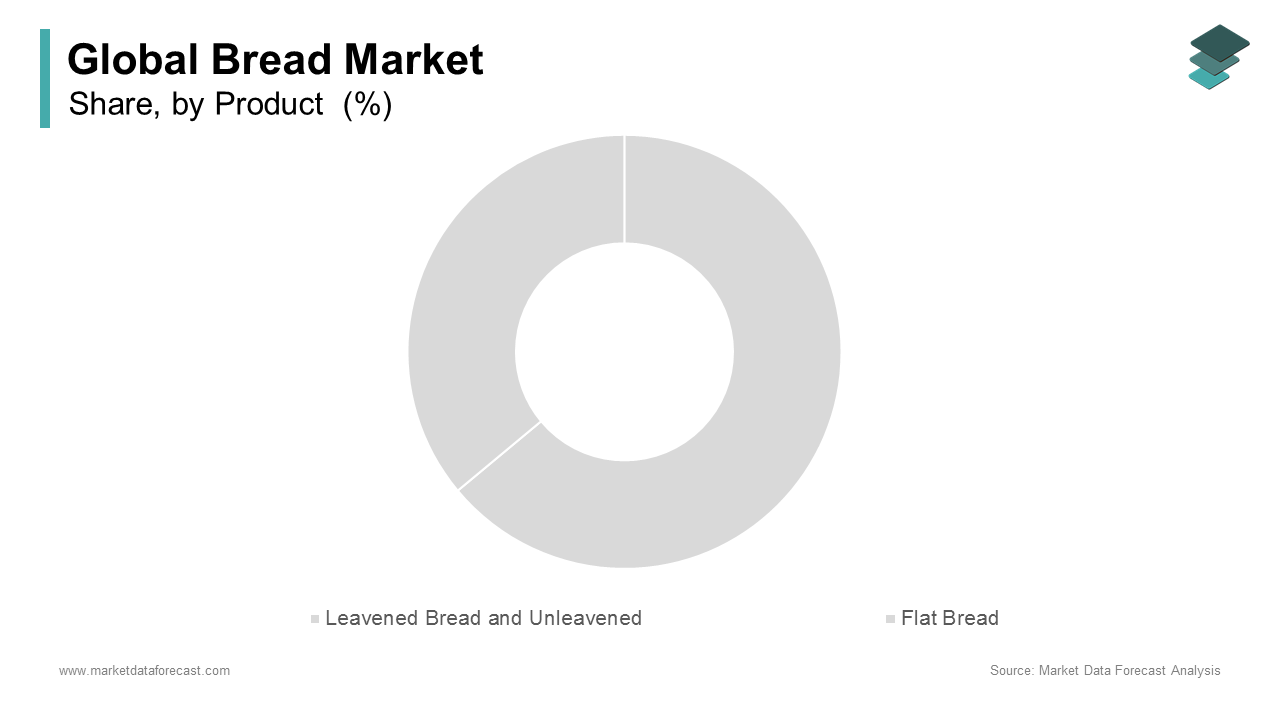
The unleavened or flat bread segment is predicted to witness the highest CAGR of 7.3% from 2026 to 2034. The rapid growth of unleavened or flat bread segment can be attibuyed to rising global interest in ethnic cuisines and traditional diets. Flatbreads such as roti, tortillas, naan, and lavash are central to daily meals in South Asia, the Middle East, and Latin America, where population growth and cultural continuity sustain demand. The versatility of flatbreads in wraps and street food has also driven adoption in Western markets. Innovations in shelf-stable, ready-to-cook formats and the expansion of ethnic foodservice chains further amplify this segment’s momentum by positioning it as a key growth engine in the global bread landscape.
By Ingredient Insights
The wheat bread segment led the global bread market share in 2025 with the wheat’s superior functional properties, including gluten formation, enables texture and volume in leavened products. Global wheat production reached significant million metric tons in 2023, with a portion directed toward bread-making, according to the study. Countries such as China, India, and Russia rely heavily on wheat-based bread as a dietary staple, with China consuming millions of metric tons of wheat for bread and related products annually, as per study. The extensive infrastructure for wheat milling and baking, coupled with consumer familiarity and affordability, supports its entrenched position. Moreover, fortified wheat bread is widely used in public nutrition programs which further strengthens its institutional and commercial relevance.
The rye bread segment is predicted to witness the highest CAGR of 6.8% over the forecast period owing to the rising consumer interest in high-fiber, low-glycemic-index foods associated with digestive and metabolic health. Rye bread contains a portion dietary fiber, significantly higher than wheat bread, and has been linked to improved satiety and blood sugar control, as per research. In Northern and Eastern Europe, countries like Germany, Poland, and Finland have long-standing rye bread traditions, with Germans consuming kilograms per capita annually, according to study. The product’s dense texture and sour flavor profile are increasingly appreciated in health-focused markets. Apart from these, artisanal bakeries in the U.S. and Canada are reviving traditional rye sourdough methods, supported by clean-label and heritage grain trends, which is further expanding its appeal beyond regional boundaries.
By Nature Insights
The conventional bread segment dominated the bread market by capturing 79.1% of the global market share in 2025. The growth of the conventional bread segment is driven by its affordability, wide availability, and deep-rooted role in everyday diets across both developed and developing nations. In regions such as Sub-Saharan Africa and South Asia, conventional wheat or maize-based breads like chapati, injera, and pita are dietary staples consumed multiple times daily. In the U.S., many households purchase conventional sliced bread regularly, according to the study. Mass production by industrial bakeries ensures consistent supply and low prices which makes it accessible to low- and middle-income populations. Despite growing health awareness, the lack of cost-effective alternatives and limited distribution of specialty breads in rural areas continue to strengthen the entrenched position of conventional bread in global consumption patterns.
The free-from bread segment is estimated to register the fastest CAGR of 9.6% from 2026 to 2034. The growth of free-from bread segment can be attributed to the increasing diagnoses of celiac disease, gluten sensitivity, and food allergies. As per the U.S. Centers for Disease Control and Prevention (CDC), the prevalence of celiac disease in the U.S. has risen, with millions more self-diagnosing gluten intolerance. In Europe, a portion of consumers actively avoid gluten, fueling demand for certified free-from products. Retail penetration has expanded significantly. Like, in the UK, free-from bread accounts for a portion of all bread sales. Innovations in texture and taste, using ingredients like tapioca, rice, and chickpea flour, have improved consumer acceptance. Apart from these, rising insurance coverage for dietary conditions and clearer labeling regulations are accelerating mainstream adoption by transforming free-from bread from a niche to a high-growth mainstream segment.
REGIONAL ANALYSIS
Europe Bread Market Insights
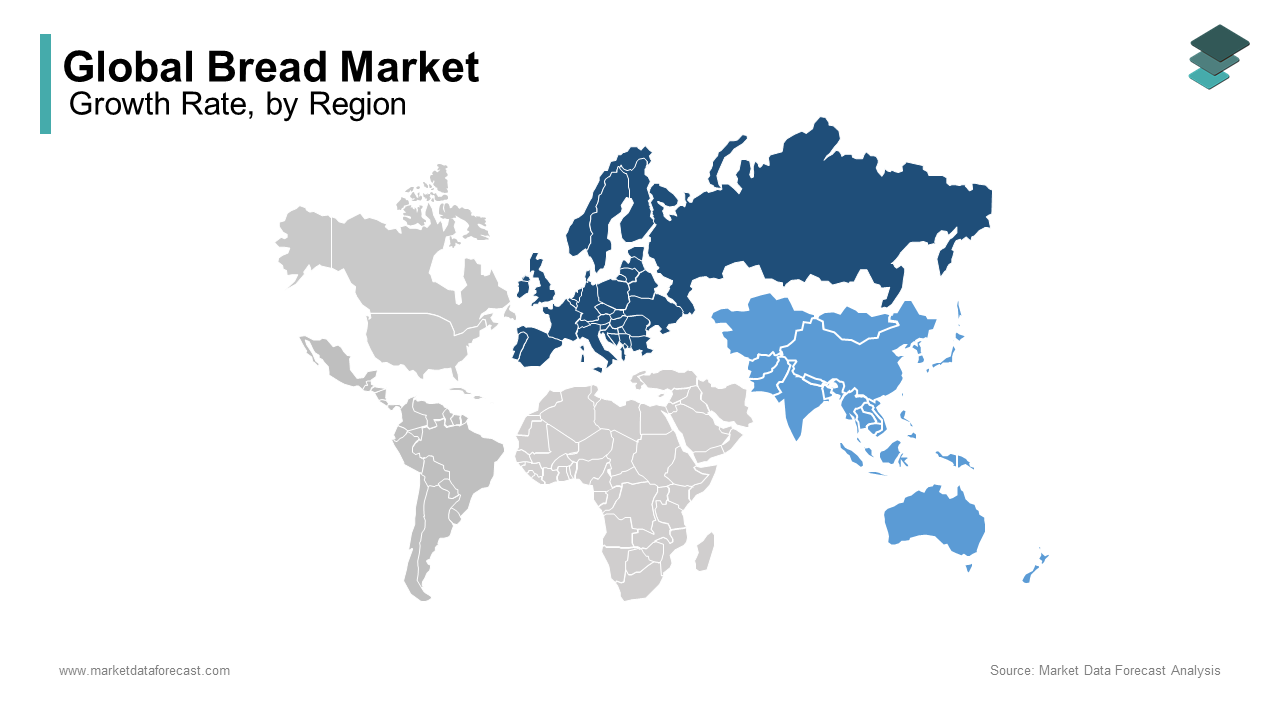
Europe was the top performer in the bread market in 2025 and accounted for 31.5% of the global market share in 2025. The domination of Europe in the global market is primarily driven by the deep-rooted baking traditions and high per capita consumption, particularly in countries like Germany, France, and Russia. Germans consume notable kilograms of bread annually, the highest in the world, according to study. Artisanal bakeries remain prevalent, with France home to many registered boulangeries producing baguettes and sourdoughs using traditional methods. The EU’s strict labeling regulations and support for geographical indications, strengthen product authenticity. Simultaneously, innovation in fortified and whole-grain breads aligns with public health initiatives, ensuring the sector remains both culturally significant and commercially dynamic.
Asia Pacific Bread Market Insights
Asia Pacific accounted for 28.3% of the global bread market share in 2025 with the traditional flatbreads which dominate rural diets, while urban centers embrace Western-style leavened and sandwich breads. In China, bread consumption has grown annually over the past years, driven by younger consumers adopting bakery-centric breakfasts, as per the study. India’s packaged bread buisness is expanding, with brands like Britannia and Modern expanding into tier-2 and tier-3 cities. The rise of café culture in Japan, South Korea, and Australia has also elevated demand for premium and flavored breads.
North America Bread Market Insights
North America grew steadily in the the global bread market with the United States serving as the primary consumption hub. While overall per capita bread consumption has declined due to low-carb diet trends, the market remains highly diversified and innovative. Americans consumed notable kilograms of bread per capita, with whole grain and organic variants gaining traction, as per reserch. The rise of plant-based and protein-enriched breads reflects evolving health priorities. Supermarkets and e-grocers are expanding private-label offerings, increasing competition. Despite challenges, the U.S. commercial baking industry generated billions in shipments.
Middle East and Africa Bread Market Insights
Middle East & Africa grew steadily in the global bread market, with the Middle East driving premiumization and North Africa sustaining volume demand. In Egypt, bread is a socio-political cornerstone, with the government distributing subsidized baladi loaves daily, as per research. The region’s reliance on wheat imports makes it vulnerable to price shocks, yet demand remains inelastic due to cultural necessity. Gulf countries like the UAE and Saudi Arabia are witnessing growth in premium and imported breads, fueled by expatriate populations and luxury retail expansion. In Sub-Saharan Africa, urbanization is shifting consumption from homemade to packaged bread, with Nigeria’s bakery sector growing annually, according to the study.
Latin America Bread Market Insights
Latin America is likely to grow in the global bread market during the forecast period with Brazil and Mexico as dominant players. Brazilians consume notable kilograms of bread per year, primarily in the form of French bread (pão francês), which is eaten daily in households and bakeries, as per the study. Mexico’s tortilla-based diet ensures consistent demand for corn and wheat flatbreads, with millions of tons consumed annually, according to study. Artisanal panaderías remain culturally significant. Rising health awareness is prompting reformulation to reduce sodium and sugar. Latin America remains a resilient and culturally rich segment of the global bread ecosystem due to strong culinary traditions and growing urban populations.
COMPETITIVE LANDSCAPE
KEY MARKET PLAYERS
Some of the companies that are playing a dominating role in the global bread market include
- Grupo Bimbo
- Yamazaki Baking
- Mondelēz International
- Flowers Foods
- Associated British Foods
- Campbell Soup Company (Pepperidge Farm)
- Britannia Industries
- George Weston
- Warburtons
- Harry-Brot
- Barilla Holding
- Fuji Baking Group
- Lantmännen Unibake
Top Strategies Used By Key Market Participants
Key players in the bread market are deploying a multifaceted strategic approach to sustain relevance amid shifting consumer dynamics. Product innovation is central, with companies launching fortified, high-fiber, and free-from variants to align with health trends. Major firms are investing in clean-label formulations, eliminating artificial preservatives and additives to meet transparency demands. Geographic expansion, particularly into high-growth Asian and African markets, is being pursued through localized production and culturally adapted recipes. Strategic acquisitions and joint ventures enable rapid entry into new segments, such as artisanal or frozen bakery products. Digital transformation is enhancing supply chain efficiency, with AI-driven inventory management reducing spoilage. Apart from these, sustainability initiatives, including eco-friendly packaging and energy-efficient bakeries, are strengthening brand equity. E-commerce integration and direct-to-consumer models are also being scaled to capture evolving retail behaviors.
COMPETITION OVERVIEW
Competition in the bread market is intensifying as traditional manufacturers face pressure from artisanal bakeries, private-label brands, and health-focused startups. Incumbents must balance affordability with innovation, navigating declining consumption in mature markets while capitalizing on growth in emerging economies. Large multinational bakeries leverage scale and distribution to dominate retail shelves, yet they are challenged by niche players offering organic, sourdough, and gluten-free alternatives with superior perceived quality. In Asia Pacific, local brands hold strong cultural resonance, forcing global players to adopt glocalization strategies. Price sensitivity remains acute in developing regions, where subsidized bread programs limit premiumization. Meanwhile, sustainability and nutritional fortification are becoming key differentiators.
LEADING PLAYERS IN THE BREAD MARKET
Grupo Bimbo
Grupo Bimbo, headquartered in Mexico, maintains a formidable presence across the Asia Pacific bread market through strategic acquisitions and localized product development. The company operates many production facilities in the region, including key hubs in China, India, and Malaysia, enabling rapid distribution and market responsiveness. The company leverages advanced cold-chain logistics and partnerships with e-grocers such as Alibaba and BigBasket to enhance last-mile delivery. Bimbo’s investment in R&D centers in Singapore focuses on clean-label ingredients and shelf-life extension which strengthens its innovation prowess in the region’s evolving bakery landscape.
Nestlé S.A.
Nestlé plays a transformative role in the Asia Pacific bread market by integrating nutrition science with mass-market bakery products. While traditionally known for dairy and confectionery, Nestlé has intensified its focus on functional bread through its breakfast and culinary divisions. These products are distributed through school nutrition programs and retail chains, enhancing accessibility. The company also utilizes its extensive distribution network, including door-to-door sales in rural areas, to penetrate underserved markets. Its emphasis on fortified, science-backed formulations positions Nestlé as a key player in bridging bread consumption with public health outcomes in the region.
Britannia Industries Limited
Britannia Industries is a cornerstone of India’s organized bread sector and a pivotal force in shaping modern bakery consumption across South Asia. The company’s bread lines have redefined product expectations by incorporating multigrains, oats, and fiber to meet rising health demands. The company has also invested in automation and AI-driven demand forecasting to minimize waste and optimize supply. Britannia’s marketing campaigns emphasize nutrition and family wellness, strengthening brand loyalty.
MARKET SEGMENTATION
This research report on the global bread market has been segmented and sub-segmented based on product, Ingredient, nature and region.
By Product
- Leavened Bread and Unleavened
- Flat Bread
By Ingredient
- Wheat Bread
- Rye Bread
- Others
By Nature
- Conventional Bread
- Free-From Bread
By Region
- North America
- Europe
- Asia-Pacific
- Latin America
- Middle East and Africa