- Product Description Description
- Table of Contents TOC
- List of Table & Figure LOT
- Get Free Sample PDF Sample PDF
Market Size, 2025
$10.73 BnMarket Estimate, 2026
$11.29 BnMarket Forecast, 2034
$16.93 BnCAGR, 2026–2034
5.20%Global Compressor Oil Market Summary
The global compressor oil market was valued at USD 10.73 billion in 2025, is estimated to reach USD 11.29 billion in 2026, and is projected to reach USD 16.93 billion by 2034, growing at a CAGR of 5.20% from 2026 to 2034. The growth of the global compressor oil market is driven by rising industrialization, growing demand for efficient lubrication in manufacturing and automotive sectors, and the need for extending compressor life and reducing maintenance costs. Additionally, the adoption of advanced synthetic lubricants for energy-efficient systems further supports market expansion.
Key Market Trends
- Increasing demand for energy-efficient compressors in manufacturing and processing industries.
- Growing adoption of synthetic and semi-synthetic compressor oils for longer drain intervals.
- Rising investments in industrial automation and manufacturing expansion worldwide.
- Expansion of compressor applications in oil & gas, power generation, and mining sectors.
- Focus on eco-friendly lubricants with lower environmental impact.
Segmental Insights
- Based on base oil, the mineral-based compressor oils segment dominated the market in 2024, owing to their cost-effectiveness and widespread usage in multiple industries.
- Based on end-use industry, the manufacturing segment held the largest share of 42.5% in 2024, supported by high demand for compressors in industrial operations.
Regional Insights
- Asia-Pacific was the top performer in the global compressor oil market in 2024, accounting for 40.1% of the market share, driven by rapid industrialization in China, India, and Southeast Asia.
- North America showed steady growth, supported by advanced manufacturing facilities and growing adoption of synthetic oils.
- Europe remained a key market, emphasizing energy-efficient lubrication solutions in compliance with strict environmental standards.
- Latin America experienced moderate growth, with expanding manufacturing and oil & gas industries.
- Middle East & Africa are emerging markets, driven by oil & gas exploration and infrastructure development.
Competitive Landscape
Key players dominating the global compressor oil market include Royal Dutch Shell plc (The Netherlands), Chevron Corporation (U.S.), Exxon Mobil Corporation (U.S.), Repsol (Spain), FUCHS (Germany), Indian Oil Corporation Ltd (India), Total SA (France), CASTROL LIMITED (U.K.), HP Lubricants (India), Klüber Lubrication (Germany), Atlas Copco AB (Sweden), Morris Lubricants (U.K.), and Penrite Oil (Australia). These companies are focusing on product innovation, expansion into emerging markets, and offering sustainable lubrication solutions to maintain a competitive edge.
Global Compressor Oil Market Size
The global compressor oil market was valued at USD 10.73 billion in 2025, is estimated to reach USD 11.29 billion in 2026, and is projected to reach USD 16.93 billion by 2034, growing at a CAGR of 5.20% from 2026 to 2034.
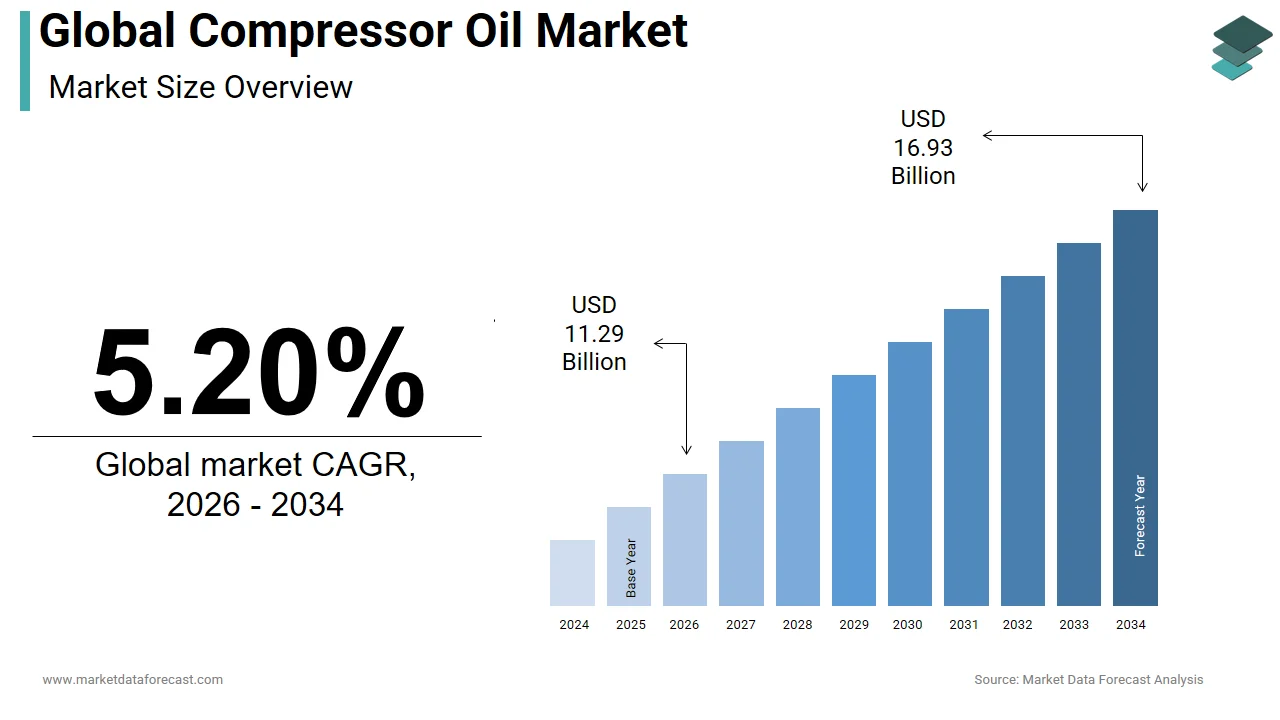
Compressor oils serve important functions, including reducing friction, dissipating heat, preventing corrosion, and maintaining seal integrity in reciprocating, rotary screw, and centrifugal compressors. As per the study, industrial machinery accounts for a portion of global final energy consumption in the manufacturing sector, emphasizing the operational reliance on reliable lubrication systems. According to research, compressed air systems alone consume significant terawatt-hours annually in Europe, reflecting extensive dependence on compressor functionality. Compressor oils are indispensable for mechanical longevity and energy efficiency. They are formulated with synthetic or mineral bases and advanced additives. This is especially crucial in extreme temperature and pressure environments within sectors such as oil and gas, food processin,g and pharmaceuticals.
MARKET DRIVERS
Growth Fueled by Industrial Automation and Manufacturing Expansion
Increasing industrial automation and expansion of manufacturing infrastructure are pivotal in amplifying the growth of the compressor oil market. As per the International Federation of Robotics, over 500,000 industrial robots were installed worldwide in 2022, a 5% increase from the previous year, which signals a surge in automated production lines that rely heavily on pneumatic systems powered by air compressors. These systems necessitate consistent and high-grade lubrication to maintain operational efficiency and minimize downtime. According to a study, global manufacturing grew, with significant growth observed in emerging economies such as India and Vietnam, where new industrial zones are being developed with state-of-the-art machinery. According to the International Energy Agency, compressed air systems constitute nearly 10% of total industrial electricity usage, and their reliability directly correlates with lubricant performance. Automation intensifies wear and thermal stress on compressors.
Rising Adoption of Oil-Free Compressors in Sensitive Industries
Rising deployment of oil-free compressors in sensitive industries is among the primary drivers of the compressor oil market. The contamination from lubricants in compressed air systems poses an important risk in food and beverage production, which has prompted a shift toward oil-free compressors in a portion of new installations in this sector across North America. Similarly, Europe promotes zero oil carryover in pharmaceutical manufacturing environments, which accelerates the adoption of oil-free technologies. According to a study, oil-free rotary screw compressors accounted for a portion of new compressor sales in the healthcare and electronics industries in 2023, up from that in 2018. These compressors eliminate the need for direct lubrication. They still require specialized maintenance and ancillary lubricants for gears and bearings, which limits but reshapes the market.
MARKET RESTRAINTS
Impact of Stringent Environmental Regulations on Compressor Oil Production
Stringent environmental regulations on petroleum-based lubricants are imposing significant restraints on the compressor oil market. The European Union’s REACH regulation restricts the use of certain mineral oil-based substances due to their poor biodegradability and potential ecotoxicity. As per research, only a portion of industrial lubricants in the EU were biodegradable, which falls short of the target set under the EU Green Deal for 2030. Apart from these, the U.S. Environmental Protection Agency enforces strict guidelines on volatile organic compound (VOC) emissions from industrial lubricants. This affects formulation choices. According to a study, a percentage of compressor oil producers in Western Europe have reformulated a share of their product lines to comply with environmental standards, incurring R&D cost increases. These regulatory burdens elevate production complexity and cost, particularly for small and mid-sized lubricant manufacturers lacking the infrastructure for rapid innovation.
MARKET OPPORTUNITIES
Rising Demand for Synthetic and Bio-Based Compressor Oils
Growing demand for synthetic and bio-based compressor oils provides a potential opportunity for the compressor oil market. The synthetic lubricants can extend compressor life and improve energy efficiency compared to mineral oils, making them increasingly attractive in energy-intensive industries. The global synthetic lubricants market, which includes compressor oils, is projected to grow in the coming years, driven by performance demands in extreme environments. Furthermore, bio-based compressor oils derived from renewable feedstocks are gaining traction. According to the study, bio-lubricants exhibit a percentage of biodegradability within days, which aligns with corporate sustainability goals. Companies have launched fully synthetic compressor oils certified standards by capturing premium segments in Europe and North America. Industrial decarbonization commitments are rising.
MARKET CHALLENGES
Volatility in Base Oil Supply and Raw Material Prices
Volatility in base oil supply and raw material pricing continues to slow down the growth of the compressor oil market. Group II and III base oils, essential for high-performance compressor lubricants, saw price hikes due to constrained refining capacity and geopolitical disruptions in key producing regions such as the Middle East and Asia. According to research, crude oil price fluctuations in 2022–2023 impacted a portion of lubricant manufacturers’ procurement strategies. Besides, the shift toward low-sulfur base oils under regulations has increased refining complexity and costs. According to a study, a portion of European lubricant producers faced margin compression in 2023 due to input cost volatility.
Technological Obsolescence and Lack of Standardization in Compressor Oils
Technological obsolescence and lack of standardization in lubricant performance testing pose challenges to the expansion of the compressor oil market. Unlike engine oils, which adhere to globally recognized standards such as API or ACEA, compressor oils lack a unified certification framework. This leads to inconsistent performance claims. As per the study, fewer industrial compressor lubricants undergo full-scale field testing under protocols that evaluate thermal stability, demulsibility, and oxidation resistance. According to research, a portion of compressor failures in manufacturing plants were linked to lubricant incompatibility or misapplication, often due to ambiguous product labeling. Furthermore, legacy compressors operating beyond their intended lifecycle, a portion of industrial compressors in the U.S. are older than 15 years, according to a study, require customized lubricants that may not align with modern formulations.
REPORT COVERAGE
| REPORT METRIC | DETAILS |
| Market Size Available | 2025 to 2034 |
| Base Year | 2025 |
| Forecast Period | 2026 to 2034 |
| Segments Covered | By Base Oil, End-use Industry, and Region. |
| Various Analyses Covered | Global, Regional and Country-Level Analysis, Segment-Level Analysis, Drivers, Restraints, Opportunities, Challenges; PESTLE Analysis; Porter’s Five Forces Analysis, Competitive Landscape, Analyst Overview of Investment Opportunities |
| Regions Covered | North America, Europe, Asia-Pacific, Latin America, Middle East and Africa |
| Market Leaders Profiled | U.S. Cold Storage, AmeriCold Logistics LLC, LINEAGE LOGISTICS HOLDING, LLC, VersaCold Logistics Services, NICHIREI LOGISTICS GROUP INC., CONGEBEC LOGISTICS INC., Burris Logistics, CONESTOGA COLD STORAGE, Kloosterboer, COLD BOX EXPRESS, INC, and others. |
SEGMENTAL ANALYSIS
By Base Oil Insights
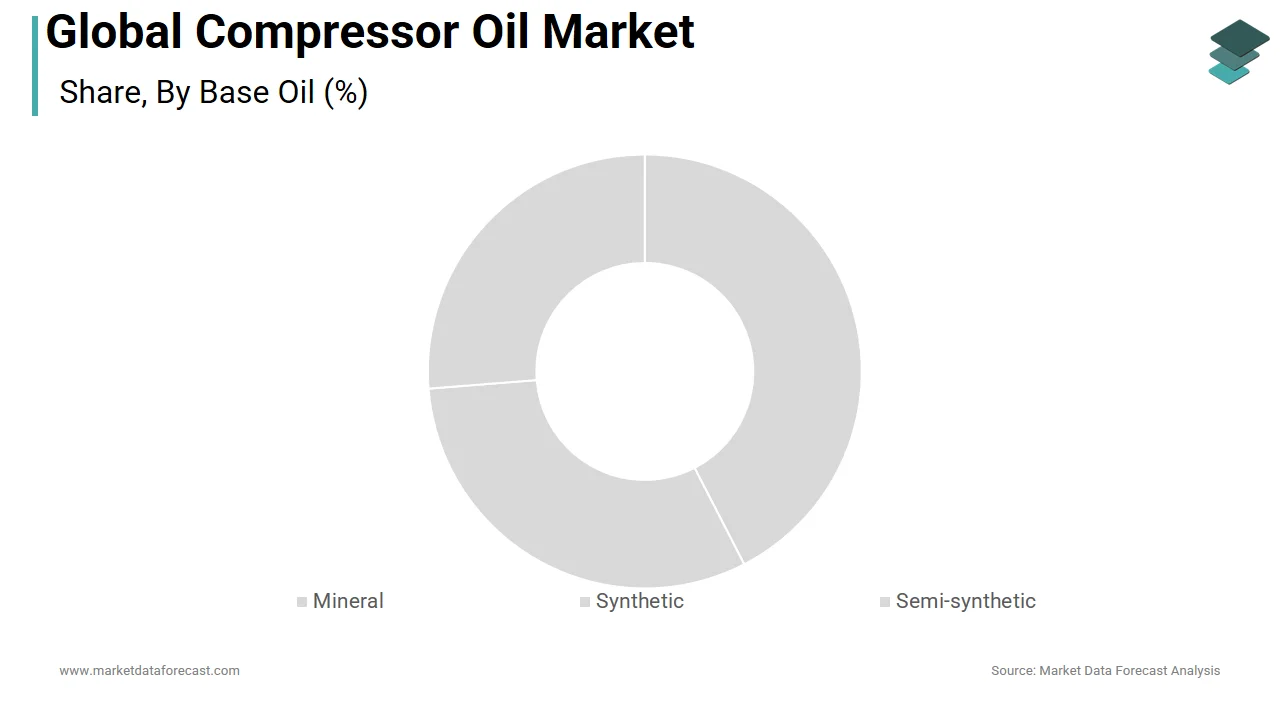
The mineral-based compressor oils segment was the dominant segment in the compressor oil market by capturing a substantial share in 2025. Its widespread adoption in general industrial applications, particularly in developing economies where cost sensitivity is an important factor in procurement decisions, is primarily driving the growth of the mineral-based compressor oil segment in the global market. Mineral oils are derived from conventional refining of crude oil, which makes them significantly more affordable than synthetic alternatives. Their lower production cost translates into attractive pricing for end-users in industries such as manufacturing and power generation, where large volumes of compressor oil are required. According to a study, a portion of industrial air compressors globally still operate using mineral oil-based lubricants, primarily due to compatibility with legacy equipment. Furthermore, according to research in regions like South Asia and Africa, where industrial infrastructure relies heavily on older compressor models, mineral oils remain the default choice due to their availability and established supply chains. The continued operation of aging industrial plants in countries such as India and Indonesia further entrenches mineral oil demand.
The synthetic-based compressor oils segment is predicted to witness the highest CAGR of 5.8% from 2025 to 2033 due to increasing demand for energy-efficient and long-lasting lubricants in high-performance applications. Synthetic oils, formulated from chemically engineered base stocks such as polyalphaolefins (PAO) and esters, offer superior thermal stability, oxidation resistance, and extended drain intervals. These properties are particularly valuable in extreme operating environments such as gas processing plants and offshore platforms.
By End-Use Industry Insights
The manufacturing segment held the largest share of 42.5% of the global compressor oil market in 2024. The prominence of the manufacturing segment is due to the pervasive use of pneumatic systems, automated machinery, and compressed air networks across diverse sub-sectors such as food & beverage, pharmaceuticals, textiles, and heavy engineering. Compressed air is often referred to as the fourth utility in manufacturing plants, second only to electricity, water, and gas. According to the U.S. Department of Energy, compressed air systems consume nearly 10% of all electricity used in industrial facilities in the United States, which emphasizes the scale of compressor deployment. Each of these systems requires regular lubrication, creating sustained demand for compressor oils. The global expansion of manufacturing capacity, particularly in Asia, further propels the expansion of the manufacturing segment.
The power generation segment is projected to experience the highest CAGR of 6.3% over the forecast period, owing to the increasing reliance on gas turbine-based power plants and the integration of compressed air energy storage (CAES) systems in renewable energy infrastructure. Natural gas, which accounted for a portion of global electricity generation, as per a study, requires extensive use of compressors for gas boosting, pipeline transmission, and turbine inlet air cooling, all of which depend on high-performance lubricants. Gas turbines operate under extreme temperatures and pressures, necessitating synthetic compressor oils that resist thermal breakdown. The global push toward grid stability amid rising renewable energy penetration also drives the growth of the power generation segment.
REGIONAL ANALYSIS
Asia-Pacific Compressor Oil Market Insights
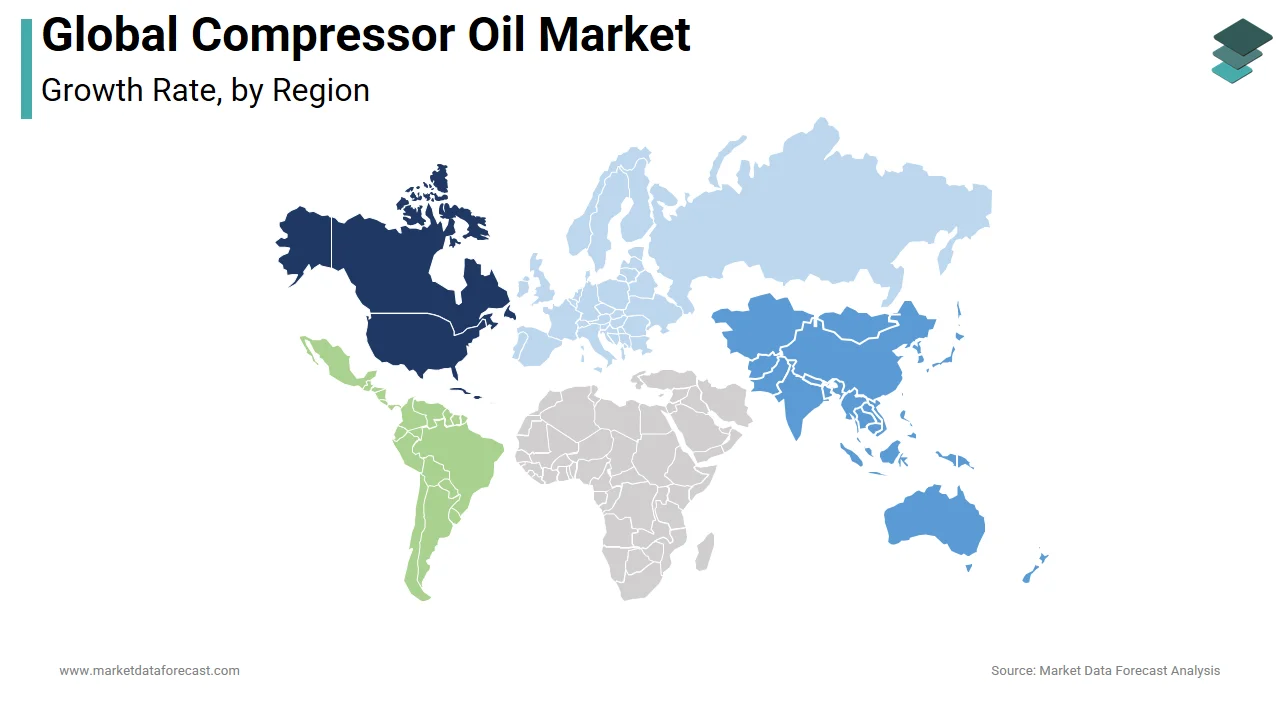
Asia-Pacific was the top performer in the compressor oil market in 2024 and accounted for 40.1% of the global market share in 2024. The dominance of Asia Pacific in the global market is primarily accelerated by its status as the world’s manufacturing hub, with China, India, and Southeast Asian nations driving industrial expansion. China alone accounts for more than half of the region’s demand, supported by its vast network of factories, steel plants, and chemical facilities. According to a study, industrial output grew year-on-year, signaling sustained demand for industrial lubricants. India is also accelerating its industrialization under initiatives like “Make in India,”. Moreover, rapid urbanization and infrastructure development are increasing the deployment of HVAC systems, construction equipment, and process compressors.
North America Compressor Oil Market Insights
North America captures the second spot in the compressor oil market with a 22.7% share in 2024. A highly developed industrial base and stringent environmental regulations are the factors propelling the growth of North America in the global market. The United States is the dominant player, with the U.S. industrial sector energy consumption reaching quadrillion BTUs, supporting extensive compressor use. The region is known for a shift toward synthetic and biodegradable lubricants, influenced by EPA regulations and corporate sustainability goals. According to research, a portion of new compressors in the U.S. are now specified for synthetic oils, reflecting performance and compliance demands.
Europe Compressor Oil Market Insights
Europe has shown a consistent growth in the compressor oil market, with Germany, Italy, and France leading consumption. According to a study, industry accounts for 25% of the EU’s final energy use, much of it powered by compressed air systems. However, the region is undergoing a structural shift driven by the European Green Deal, which aims for carbon neutrality by 2050. This has accelerated the adoption of synthetic and bio-based compressor oils. According to Eurostat, a portion of industrial enterprises in the EU have implemented energy management systems, increasing demand for efficient lubricants. The decline of heavy industry in Western Europe is offset by growth in precision manufacturing and renewable energy. Eastern Europe, particularly Poland and Romania, is seeing industrial modernization.
Middle East & Africa Compressor Oil Market Insights
The Middle East & Africa are likely to grow in the global compressor oil market, with the Gulf Cooperation Council (GCC) countries driving most of the demand. Saudi Arabia and the UAE are central, as their economies are deeply tied to oil & gas production. Saudi Arabia’s upstream sector operates numerous compressors, used in gas reinjection, LNG processing, and petrochemical plants. The African market is smaller but growing, particularly in Nigeria, Angola, and South Africa. According to a study, only a portion of Africa’s population has access to electricity, prompting investments in power generation. Gas-to-power projects require extensive compressor networks. Furthermore, mining operations in South Africa and the Democratic Republic of Congo use large volumes of compressed air for drilling and ventilation.
Latin America Compressor Oil Market Insights
Latin America is gradually expanding in the compressor oil market, with Brazil and Mexico as the primary contributors. Brazil saw oil production reach millions of barrels per day, largely from offshore pre-salt fields that require advanced compression systems. Mexico's industrial sector experienced targeted growth in certain areas, particularly manufacturing tied to nearshoring trends from U.S. companies. Chile and Peru are expanding mining activities. Apart from these, Argentina is developing its Vaca Muerta shale formation, which the U.S. Energy Information Administration estimates holds barrels of recoverable oil, requiring extensive compressor deployment.
COMPETITIVE LANDSCAPE
The competition in the compressor oil market is intense, driven by technological advancements, evolving industrial standards, and rising demand for energy-efficient lubricants. Major players differentiate themselves through product innovation, sustainability initiatives, and strong OEM partnerships. The Asia Pacific region has become a focal point due to rapid industrialization and infrastructure development. Companies are investing in R&D to develop high-performance synthetic oils with extended service life and better thermal stability. Customer support, technical expertise, and digital monitoring solutions are increasingly used as competitive levers. Regional and local players are also emerging, intensifying competition. Strategic expansions, localized production, and tailored product offerings are important for gaining an edge. Environmental regulations are tightening, so companies focusing on eco-friendly formulations are gaining favor.
KEY MARKET PLAYERS
Some of the companies that are playing a dominating role in the global compressor oil market include
- Royal Dutch Shell plc (The Netherlands)
- Chevron Corporation (U.S.)
- Exxon Mobil Corporation (U.S.)
- Repsol (Spain)
- FUCHS (Germany)
- Indian Oil Corporation Ltd (India)
- Total SA (France)
- CASTROL LIMITED (U.K.)
- HP Lubricants (India)
- Klüber Lubrication (Germany)
- Atlas Copco AB (Sweden)
- Morris Lubricants (U.K.)
- Penrite Oil (Australia)
Top Strategies Used by the Key Market Participants
Key players in the compressor oil market employ several strategic initiatives to maintain and expand their market presence. Product innovation is a primary focus, with companies developing advanced synthetic and eco-friendly formulations to meet stringent performance and environmental standards. Strategic collaborations with compressor original equipment manufacturers (OEMs) ensure compatibility and endorsement, which enhances customer trust. Geographic expansion, particularly in high-growth Asia Pacific countries like India, Vietnam, and Indonesia, allows companies to tap into industrialization-driven demand. Capacity expansion and localization of production facilities reduce costs and improve supply chain efficiency. Besides, companies invest in technical service teams and digital tools for condition monitoring and predictive maintenance, adding value for industrial clients. Marketing through industry-specific solutions and sustainability messaging strengthens brand positioning. These strategies collectively enable key participants to differentiate their offerings, improve customer retention, and respond effectively to evolving technological and regulatory landscapes in the compressor oil sector.
Top Players in the Compressor Oil Market
Shell Lubricants
Shell Lubricants is a leading player in the compressor oil market, known for its innovative and high-performance lubricant solutions tailored for industrial and commercial applications. In the Asia Pacific region, Shell has strengthened its presence through strategic partnerships with OEMs and distributors, focusing on delivering energy-efficient and long-lasting compressor oils. The company invests heavily in R&D to develop synthetic and semi-synthetic formulations that meet evolving equipment standards. Its technical support network and digital tools like LubEagle help customers optimize lubricant performance.
ExxonMobil
ExxonMobil plays a pivotal role in the compressor oil market across the Asia Pacific through its Mobil-branded lubricants, particularly the Mobil SHC and Mobil Rarus series designed for severe-duty compressor operations. The company emphasizes product innovation and equipment compatibility, working closely with compressor manufacturers to ensure optimal performance. In recent years, ExxonMobil has expanded its technical service teams in countries like India, China, and Indonesia to support industrial customers with on-site assessments and oil analysis programs. These efforts align with regional demands for energy efficiency and reduced downtime. ExxonMobil continues to enhance its value proposition and strengthen its position in the fast-growing Asia Pacific market by integrating digital monitoring tools and sustainability-focused formulations.
BP (Castrol Limited)
BP, through its Castrol brand, is a major contributor to the compressor oil market in the Asia Pacific region, offering a wide range of lubricants under the Castrol Iloform and Castrol Rotor series. These products are engineered to deliver exceptional protection in high-pressure and high-temperature environments typical of industrial compressors. The company has strengthened its market position by collaborating with key compressor OEMs and launching training programs for maintenance engineers across Southeast Asia.
MARKET SEGMENTATION
This research report on the global compressor oil market has been segmented and sub-segmented into the following categories.
By Base Oil
- Mineral
- Synthetic
- Semi-synthetic
By End-use Industry
- Manufacturing
- Oil & Gas
- Power Generation
- Automotive
- Others
By Region
- North America
- Europe
- Asia Pacific
- Latin America
- The Middle East and Africa