- Product Description Description
- Table of Contents TOC
- List of Table & Figure LOT
- Get Free Sample PDF Sample PDF
Global Contrast Media Market Size
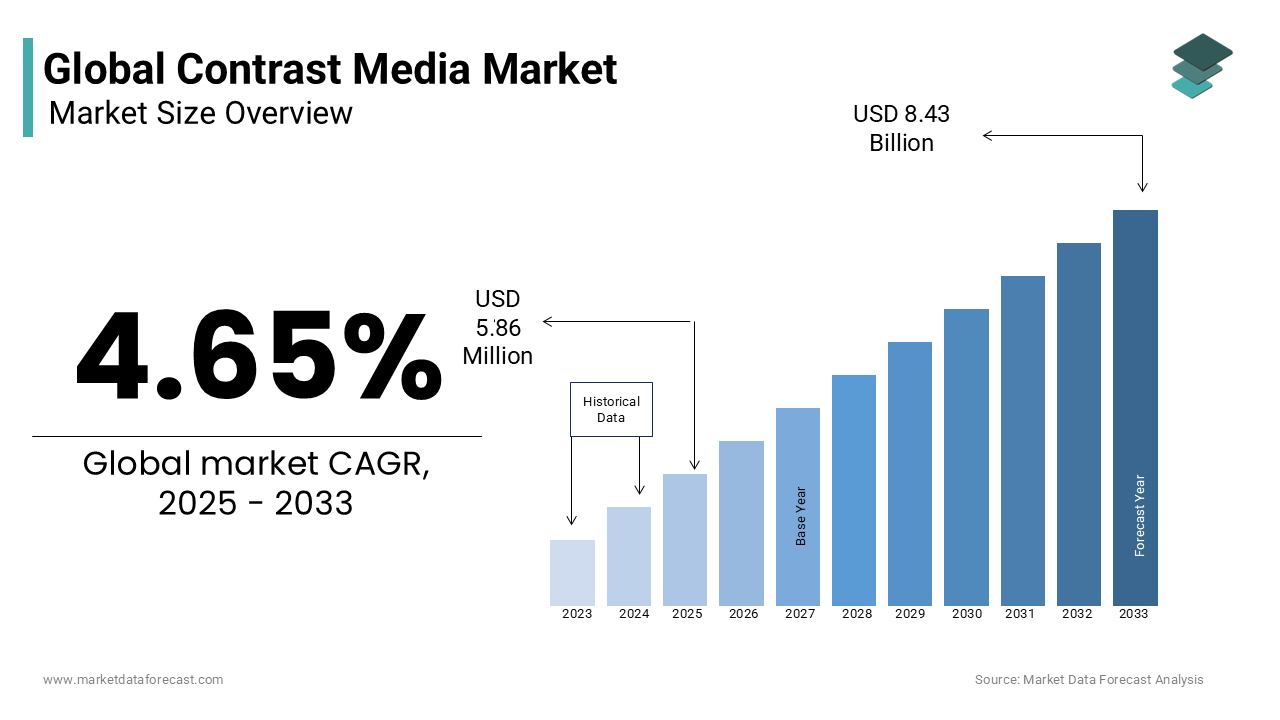
The global contrast media market size was valued at USD 5.60 billion in 2024. The contrast media market size is predicted to be worth USD 8.43 billion by 2033 and USD 5.86 billion in 2025, growing at a CAGR of 4.65% during the forecast period. Thus, the global contrast media market is developing at a rapid pace.
The contrast media are designed to enhance the visibility of internal anatomical structures and pathological conditions during medical imaging procedures such as magnetic resonance imaging (MRI), computed tomography (CT), and ultrasound. These agents function by altering signal intensity or X-ray absorption, enabling clinicians to differentiate between tissues with greater precision.
MARKET DRIVERS
Rising Prevalence of Chronic Diseases
The increasing prevalence of chronic diseases requiring advanced diagnostic imaging is propelling the growth of the contrast media market. As per the World Health Organization, cardiovascular diseases account for an estimated 17.9 million deaths annually, while cancer causes nearly 10 million deaths each year. These conditions often require repeated imaging using contrast-enhanced modalities to monitor progression and therapeutic response. Similarly, the European Society of Cardiology notes that more than 50% of cardiac MRI procedures involve contrast media to assess myocardial viability. The growing geriatric population is highly susceptible to such chronic ailments which further amplifies demand.
Enhanced Diagnostic Accuracy and Safety Requirements
Technological advancements in medical imaging modalities are significantly amplifying the growth of contrast media market. Innovations in MRI and CT imaging, including higher field strengths and spectral CT, have heightened the need for agents that offer superior tissue differentiation and safety profiles. For example, the adoption of 3 Tesla MRI systems has doubled in major healthcare systems across Europe and North America over the past decade, as noted by the International Society for Magnetic Resonance in Medicine, increasing sensitivity and thus reliance on contrast media for accurate diagnostics. Furthermore, the emergence of dual-energy CT scanners, which can differentiate materials based on atomic number, has expanded the utility of iodinated contrast media. According to the American College of Radiology, over 60% of new CT installations in the U.S. in 2023 were spectral or dual-energy systems.
MARKET RESTRAINTS
Stringent Regulatory Scrutiny and Evolving Approval Pathways
Safety concerns associated with nephrogenic systemic fibrosis (NSF) and gadolinium deposition are restraining the growth of the contrast media market. As per the U.S. Food and Drug Administration, over 400 cases of NSF were reported between 1997 and 2017, predominantly linked to non-ionic linear agents. Although macrocyclic agents exhibit greater stability, residual fears persist among clinicians and patients. Moreover, studies published in Radiology, the journal of the Radiological Society of North America, have demonstrated that trace amounts of gadolinium can deposit in the brain and bones even in individuals with normal renal function. In one multicenter study, repeated administration of linear agents was associated with detectable brain retention in 95% of subjects after six doses.
Limited Investment in Innovation by Smaller Biotech Firms
Stringent regulatory scrutiny and evolving approval pathways is impeding the growth of the contrast media market. Furthermore, the European Medicines Agency has intensified its review of gadolinium-based agents, which is led to the suspension of several linear formulations from the European market in 2017. Regulatory divergence between regions complicates global launch strategies. This regulatory bottleneck discourages investment in innovation among smaller biotech firms lacking the resources for prolonged clinical trials, which is ultimately limits the diversity and availability of advanced contrast media.
MARKET OPPORTUNITIES
Development of Targeted and Theranostic Contrast Media
The development of targeted and theranostic contrast media is solely prompting the growth of the contrast media market. These agents are engineered to bind specific biomarkers associated with diseases, enabling molecular-level visualization. Additionally, theranostic platforms that combining diagnostic imaging and therapeutic delivery are gaining traction. Researchers at the National Institutes of Health are exploring iron oxide nanoparticles functionalized with antibodies for simultaneous tumor imaging and localized hyperthermia treatment. According to a 2023 review in Nature Biomedical Engineering, over 35 investigational targeted contrast media are in clinical trials, with oncology and neurodegenerative diseases as primary focus areas.
Regulatory Approvals Supporting Contrast-Enhanced Portable Imaging
Expansion of point-of-care and portable imaging systems in emerging economies is additionally to fuel the growth of the contrast media market. The proliferation of handheld ultrasound devices and compact MRI units in rural and underserved regions is increasing access to advanced diagnostics. Portable ultrasound systems, such as Butterfly iQ+, are now being used in remote clinics across India and Southeast Asia, with contrast-enhanced applications gaining regulatory approval. Additionally, Brazil’s Ministry of Health integrated contrast-enhanced ultrasound into its national cancer screening program in 2021.
MARKET CHALLENGES
Lack of Standardization in Contrast Administration Protocols
Standardization of contrast administration protocols across healthcare systems is a challenge for the growth of the contrast media market. Variability in dosing, injection techniques, and imaging timing can significantly affect diagnostic accuracy and patient safety. In the U.S., the American College of Radiology, only 58% of imaging centers adhered to standardized protocols for gadolinium administration in MRI. This fragmentation increases the risk of adverse events and reduces the reliability of imaging outcomes. Moreover, training disparities among radiologic technologists exacerbate inconsistencies. The International Society of Radiology emphasizes that protocol heterogeneity hampers multi-center research and limits the comparability of longitudinal studies.
Sustainability Concerns in Wastewater Management
Environmental impact and sustainability are other factors challenging the growth of the contrast media market. As per a comprehensive study by the German Federal Institute of Hydrology, anthropogenic gadolinium concentrations in European surface waters have risen sharply, with levels in the Rhine River exceeding natural background by up to 100-fold. Additionally, iodinated agents contribute to the organic load in wastewater, complicating treatment processes
REPORT COVERAGE
| REPORT METRIC | DETAILS |
| Market Size Available | 2024 to 2033 |
| Base Year | 2025 |
| Forecast Period | 2025 to 2033 |
| Segments Covered | By Medical Procedure, Route of Administration, Type, Indications, Application, and Region |
| Various Analyses Covered | Global, Regional & Country Level Analysis, Segment-Level Analysis, Drivers, Restraints, Opportunities, Challenges; PESTLE Analysis; Porter’s Five Forces Analysis, Competitive Landscape, Analyst Overview of Investment Opportunities |
| Regions Covered | North America, Europe, Asia Pacific, Latin America, the Middle East, and Africa |
| Market Leaders Profiled | CMC Contrast AB (Sweden), Daiichi Sankyo (Japan), Bayer HealthCare (Germany), GE Healthcare (U.S.), Guerbet Group (France), Bracco Imaging S.p.A. (Italy) |
SEGMENTAL ANALYSIS
By Medical Procedure Insights
The ultrasound segment is likely to have the highest CAGR during the given forecast period based on medical procedures. The development of microbubble contrast media for ultrasound and a large number of approvals for ultrasound contrast media in the U.S., Europe, and Japan are some of the major factors driving the growth of this segment.
By Type Insights
Based on type, the iodinated contrast media segment is expected to register the most significant share in the global contrast media market during the forecast period. Furthermore, it is likely to continue the trend over the forecast period due to the rise in CT scanning.
By Indications Insights
Based on indications, the cardiovascular disorders segment is likely to hold the lion's share and witness the highest growth rate during the forecast period. Growing enhancements in cardiac MRI procedures, favorable government reimbursement policies for contrast media in cardiovascular diagnosis, and robust infrastructure in developed countries' healthcare are factors driving this segment’s growth.
By Application Insights
Based on the application, the interventional cardiology segment is predicted to dominate the global contrast media market. It is likely to grow at a high CAGR owing to the rise in the prevalence of cardiovascular diseases and the increasing adoption rate of minimally invasive surgical techniques.
The Radiology segment is another significant market division and contributes substantially to the contrast media market.
REGIONAL ANALYSIS
North America Contrast Media Market Analysis
North America was the top performer in the global contrast media market by holding 34.2% of the share in 2024 with its advanced diagnostic infrastructure, high healthcare expenditure, and early adoption of cutting-edge imaging technologies. As per the Centers for Disease Control and Prevention, 60% of U.S. adults have at least one chronic condition with regular imaging surveillance. Regulatory clarity from the FDA and robust reimbursement mechanisms under Medicare and private insurers further support sustained market growth, which is making North America a benchmark for diagnostic imaging standards worldwide.
Europe Contrast Media Market Analysis
Europe market growth is likely to grow with a well-established network of public and private imaging centers, coupled with universal healthcare access across most member states. Germany, France, and the United Kingdom lead in per capita imaging utilization, with over 50 million contrast-enhanced MRI and CT scans conducted annually, according to Eurostat.
Asia Pacific Contrast Media Market Analysis
The Asia Pacific region is anticipated to grow with significant CAGR in next coming years. Rising disposable incomes, expanding insurance coverage, and government-led healthcare modernization are accelerating diagnostic imaging adoption. In China, the National Health Commission reports that the number of installed CT and MRI units grew by 67% between 2018 and 2023, reaching over 25,000 CT and 18,000 MRI systems.
Latin America Contrast Media Market Analysis
Latin America market growth with Brazil and Mexico leading regional adoption. Brazil’s Ministry of Health integrated contrast-enhanced ultrasound into its national liver disease program, targeting early detection of hepatocellular carcinoma in high-risk populations. The country performs over 4 million contrast-enhanced imaging studies annually, with CT utilization rising by 3.5% per year, according to the Brazilian College of Radiology. Mexico has expanded its oncology imaging capacity, with IMSS and ISSSTE hospitals increasing MRI usage by 22% between 2019 and 2023.
Middle East and Africa Contrast Media Market Analysis
The Middle East and Africa market growth is likely to grow with Gulf Cooperation Council (GCC) nations outpacing sub-Saharan Africa in diagnostic infrastructure development, as noted by the World Health Organization’s Eastern Mediterranean Regional Office. Countries like Saudi Arabia and the UAE are investing heavily in smart hospitals and AI-integrated imaging platforms. The Saudi Vision 2030 healthcare modernization plan includes a $30 billion investment in medical technology, including over 1,000 new CT and MRI units.
COMPETITIVE LANDSCAPE
The competitive landscape of the contrast media market is characterized by technological differentiation, regulatory agility, and strategic geographic expansion. While a few multinational corporations dominate with comprehensive portfolios, mid-tier players are carving niches through specialized formulations and regional focus. Innovation is concentrated in safety-enhanced agents, particularly macrocyclic gadolinium compounds and iso-osmolar iodinated media, to mitigate adverse events and regulatory scrutiny. Companies are increasingly aligning with value-based healthcare models by integrating digital tools that optimize contrast use and improve diagnostic accuracy.
KEY MARKET PLAYERS
A few of the major companies in the contrast media market include
-
CMC Contrast AB (Sweden)
-
Daiichi Sankyo (Japan)
-
Bayer HealthCare (Germany)
-
GE Healthcare (U.S.)
-
Guerbet Group (France)
-
Bracco Imaging S.p.A. (Italy)
-
Lantheus Medical Imaging (U.S.)
-
nanoPet Pharma GmbH (Germany)
-
Subhra Pharma Private Limited (India)
Top Players in the Contrast Media Market
Bayer AG has established a formidable presence in the Asia Pacific contrast media market through strategic collaborations and product innovations tailored to regional healthcare needs. The company’s flagship iodinated agent, iopromide (Ultravist), is widely used in CT imaging across major hospitals in China, Japan, and India. Bayer has intensified its engagement with local regulatory bodies to expedite approvals and expand indications for its agents. In 2023, the company launched a digital diagnostic support platform in partnership with AI-driven imaging firms in South Korea by enhancing protocol optimization for contrast use.
GE HealthCare plays a pivotal role in shaping the contrast media landscape in Asia Pacific by integrating imaging hardware with intelligent contrast delivery systems. The company’s Optivantage line of iodinated contrast media is seamlessly compatible with its Revolution CT scanners, enabling precision dosing and reduced waste. In 2022, GE launched the DoseIQ platform in India and Australia, an AI-powered tool that personalizes contrast administration based on patient physiology and scan type, improving safety and efficacy. The company has also deepened collaborations with academic hospitals in Japan and China to develop imaging protocols for early cancer detection using dual-energy CT.
Guerbet has emerged as a key innovator in the Asia Pacific contrast media market by prioritizing safety, sustainability, and clinical precision. The company’s gadoteric acid (Dotarem), a macrocyclic MRI contrast agent, is widely adopted in neurological and oncological imaging across Australia, South Korea, and Singapore due to its favorable safety profile. Guerbet has actively pursued regulatory expansions, securing approval for Dotarem in pediatric MRI in Japan in 2023, a milestone that broadened its clinical utility. The company also introduced ContrastCare, a digital platform launched in 2024 across select Indian and Thai hospitals, designed to standardize contrast workflows and monitor patient safety metrics.
Top Strategies Used by Key Market Participants
Key players in the contrast media market are deploying multifaceted strategies to consolidate their competitive edge. Strategic mergers and acquisitions are enabling vertical integration, particularly in delivery systems and imaging software. Companies are increasingly investing in AI-driven dose optimization platforms to enhance patient safety and reduce contrast waste. Expansion into emerging markets is being accelerated through localized manufacturing and partnerships with regional distributors. Regulatory diversification is another factor with firms pursuing approvals for new indications and pediatric use to extend product lifecycles. Collaborations with academic institutions and hospitals are fostering clinical evidence generation, supporting reimbursement and adoption.
RECENT MARKET DEVELOPMENTS
- In 2019, Researchers at Massachusetts General Hospital developed a novel, safer, and adequate contrast media based on manganese-enhanced). The researcher used the novel manganese-based contrast media to enhance tumor contrast without interacting with tofflers and tissues. In addition, the researchers concluded that the new contrast media offers better efficiency than the gadolinium-based contrast media, potentially making MRIs much safer.
- In 2017, GE Healthcare's product called visipaque received approval to expand the FDA's indication. With this approval, the injection can be adopted in CCTA to diagnose patients with coronary artery disease. In addition, with the expansion of the Visiquick label, physicians can practice non-invasive imaging of coronary arteries. It is the first iodinated contrast media approved by the FDA as an application in CCTA, and the recovery of patients is much faster due to its non-invasive nature.
MARKET SEGMENTATION
The global contrast media market report has been segmented based on procedure, application, route of administration, indication, type, and region.
By Medical Procedure
- X-Ray/CT
- MRI
- Ultrasound
By Route of Administration
- Injectable Contrasts Media
- Oral Contrasts Media
- Rectal Contrasts Media
- Urethral Contrasts Media
By Type
- Iodinated Contrasts Media
- Gadolinium-Based Contrasts Media
- Microbubble Contrasts Media
- Barium-Based Contrasts Media
By Indications
- Cardiovascular Disorders
- Oncology
- Neurological Disorders
- Gastrointestinal Disorders
- Nephrological Disorders
- Musculoskeletal Disorders