- Product Description Description
- Table of Contents TOC
- List of Table & Figure LOT
- Get Free Sample PDF Sample PDF
Market Size, 2025
$28.44 BnMarket Estimate, 2026
$33.63 BnMarket Forecast, 2034
$128.47 BnCAGR, 2026–2034
18.24%Executive Summary: Global Crowdfunding Market
- Market Scope: Comprehensive global crowdfunding market analysis covering model types, end-user demographics, application verticals, regional country frameworks, and alternative financing trends.
- Market Valuation: Valued at USD 28.44 billion (2025), estimated at USD 33.63 billion (2026), and projected to reach USD 128.47 billion by 2034, registering a robust CAGR of 18.24% (2026–2034).
- Primary Growth Drivers: Expansion of digital financial infrastructure enabling broader financial inclusion, proliferation of the gig and creator economy, increasing entrepreneurial activity worldwide, and climate finance integration.
Key Market Segment Metrics (2026–2034)
| Category | Leading Segment (2025 Position) | Fastest-Growing Segment |
|---|---|---|
| By Model Type | Donation-based crowdfunding (captured 37.2% of global share) | Blockchain-based crowdfunding (projected to grow at the highest CAGR of 28.4%) |
| By End User & Application | Individuals (42.3% share) and Social causes application sector (35.4% share) | Creative professionals (24.7% CAGR) and Technology sector (CAGR of 26.1%) |
| By Region | North America (led regionally with 41.2% of global share), followed by Europe (27.1%) | Asia-Pacific (positioned as the fastest-growing region driven by mobile penetration) |
Major Market Players & Market Structure
Market Structure: Highly competitive alternative finance and digital platform landscape characterized by strategic initiatives, including creator compliance programs, real-time crisis response integrations, AI-assisted content tools, and blockchain-based milestone verification.
Key Companies: Kickstarter, AngelList, Indiegogo, Fundable, Crowdcube, GoFundMe, Crowdfunder, GoGetFunding, CircleUp, Patreon, Campfire, Crowdo, Milaap, RocketHub, FundRazr, Crowdfunder UK, Modian, Companisto, DonorsChoose, CrowdHousa, and Suning.
Global Crowdfunding Market Size
The global crowdfunding market was valued at USD 28.44 billion in 2025. The global market size is further expected to progress at a CAGR of 18.24% from 2026 to 2034 and be worth USD 128.47 billion by 2034, from USD 33.63 billion in 2026.
Crowdfunding enables individuals, startups, and organizations to raise capital directly from a broad base of contributors, typically via digital platforms, without relying on traditional banking or venture funding. This model has evolved beyond a niche alternative into a mainstream mechanism for innovation financing, social mobilization, and creative expression. As of 2023, over 3.2 billion people globally have internet access by enabling unprecedented connectivity between project initiators and potential backers, as reported by the International Telecommunication Union. The World Bank estimates that more than 1,500 crowdfunding platforms operate across 100 countries, reflecting its institutionalization as a legitimate financial channel. Moreover, the proliferation of mobile payment systems and digital identity verification has enhanced transaction security and cross-border participation.
MARKET DRIVERS
Expansion of Financial Inclusion Through Digital Banking and Mobile Penetration
The rapid expansion of digital financial infrastructure in emerging economies, where traditional banking services remain inaccessible to large segments of the population, is fuelling the growth of the crowdfunding market. This digital financial ecosystem lowers entry barriers for both fundraisers and contributors, which allows individuals in rural or underserved areas to participate in capital formation. Furthermore, integration with e-wallets and instant payment rails reduces transaction friction by enhancing donor confidence and participation rates.
Rising Entrepreneurial Activity in the Gig and Creator Economy
The proliferation of the gig and creator economy is accelerating the growth of the crowdfunding market. According to the International Labour Organization, over 700 million people engaged in non-traditional work arrangements globally in 2023, including freelancers, content creators, and solo founders who lack access to institutional credit. Platforms like Patreon, Kickstarter, and GoFundMe have become essential tools for these individuals to monetize ideas, launch products, and sustain creative projects without relying on venture capital or bank loans. The rise of social media has further accelerated this trend, enabling creators to build loyal audiences who are emotionally invested in their success. In Nigeria, the National Youth Council found that 42% of young entrepreneurs used crowdfunding to launch startups in 2022, particularly in fashion, tech, and agriculture.
MARKET RESTRAINTS
Regulatory Fragmentation and Legal Uncertainty Across Jurisdictions
The absence of harmonized regulatory frameworks, resulting in legal ambiguity and compliance complexity across regions, is restraining the growth of the crowdfunding market. According to the Financial Stability Board, only 38 of 130 countries have established comprehensive regulations for equity and debt-based crowdfunding, leaving vast markets in a legal gray zone. The countries like India and Indonesia lack dedicated crowdfunding legislation, forcing platforms to operate under general securities or banking laws that are ill-suited to peer-to-peer financing models. Furthermore, cross-border fundraising is hindered by conflicting investor protection rules and capital controls.
High Project Failure Rates and Donor Skepticism
The high incidence of project failure and the resulting erosion of donor trust, which undermines long-term engagement and capital flow, is limiting the growth of the crowdfunding market. This inconsistency breeds donor fatigue and skepticism, particularly as anecdotal cases of misuse or misrepresentation surface. The U.S. Federal Trade Commission received over 1,200 consumer complaints related to fraudulent crowdfunding campaigns in 2022, including cases where funds were diverted for personal expenses. In India, the Ministry of Consumer Affairs noted a 37% year-on-year increase in disputes over unfulfilled rewards, prompting calls for greater platform accountability. Moreover, the emotional nature of donation-based campaigns often tied to health crises or personal tragedies, can lead to impulsive giving without due diligence, increasing vulnerability to exploitation. While some platforms have introduced verification mechanisms and milestone reporting, enforcement remains inconsistent.
MARKET OPPORTUNITIES
Integration of Crowdfunding into Climate Finance and Green Innovation
The integration of crowdfunding into climate finance where it can mobilize public capital for renewable energy, sustainable agriculture, and environmental conservation projects. Crowdfunding platforms are increasingly being used to finance community solar installations, reforestation initiatives, and clean tech startups, particularly in regions with limited access to green banking. Similarly, in Kenya, the Climate Investor One initiative partnered with local platforms to crowdfund mini-grid projects, reaching over 200,000 off-grid households, as documented by the International Renewable Energy Agency. Furthermore, the rise of blockchain-based green bonds and tokenized carbon credits enables transparent, traceable contributions, enhancing donor trust.
Emergence of Decentralized Finance (DeFi) and Blockchain-Based Crowdfunding
The crowdfunding with decentralized finance (DeFi) and blockchain technology presents a groundbreaking opportunity to enhance transparency, reduce intermediation, and expand global participation. According to the Cambridge Centre for Alternative Finance, blockchain-enabled crowdfunding platforms facilitated over $3.2 billion in transactions in 2022, with Ethereum-based projects dominating the space. Platforms like Mirror and DAOstack enable creators to issue digital tokens representing ownership or governance rights by aligning contributors with long-term project success. In emerging markets, blockchain circumvents restrictive financial systems; a 2023 case in Venezuela showed that artists used cryptocurrency crowdfunding to bypass capital controls and receive international support. Moreover, non-fungible tokens (NFTs) have redefined reward-based models, allowing backers to own unique digital assets tied to creative projects. The immutability of distributed ledgers ensures transparent tracking of fund flows, addressing donor skepticism.
MARKET CHALLENGES
Platform Concentration and Market Dominance by a Few Players
The increasing concentration of power among a small number of dominant platforms, which threatens competition, innovation, and equitable access, is also restricting the growth of the crowdfunding market. Similarly, GoFundMe’s proprietary search algorithms prioritize campaigns with early momentum, often disadvantaging those from underrepresented communities. In Africa and South Asia, local platforms struggle to compete with global giants that benefit from superior marketing, investor networks, and technological infrastructure. This imbalance limits diversity in funded projects and reduces platform accountability. Furthermore, data ownership becomes a concern, as dominant platforms accumulate vast behavioral and financial datasets without transparent governance.
Vulnerability to Cybersecurity Threats and Data Misuse
The digital nature of crowdfunding makes it inherently susceptible to cybersecurity breaches, financial fraud, and personal data exploitation, posing a significant challenge to user trust and system integrity. According to the International Cyber Security Protection Alliance, crowdfunding platforms experienced a 43% increase in cyberattacks between 2021 and 2023, including phishing schemes, account takeovers, and ransomware targeting donor databases. In India, the Data Security Council noted that 62% of crowdfunding platforms lacked end-to-end encryption, leaving transaction data vulnerable during transmission. Moreover, the integration of third-party payment processors and social media logins expands the attack surface.
REPORT COVERAGE
| REPORT METRIC | DETAILS |
| Market Size Available | 2025 to 2034 |
| Base Year | 2025 |
| Forecast Period | 2026 to 2034 |
| CAGR | 18.24% |
| Segments Covered | By Product, End User, Application, and Region |
|
Various Analyses Covered | Global, Regional & Country Level Analysis, Segment-Level Analysis, DROC, PESTLE Analysis, Porter’s Five Forces Analysis, Competitive Landscape, Analyst Overview on Investment Opportunities |
| Regions Covered | North America, Europe, APAC, Latin America, Middle East & Africa |
|
Market Leaders Profiled | Kickstarter, AngelList, Indiegogo, Fundable, Crowdcube, GoFundMe, Crowdfunder, GoGetFunding, CircleUp, Patreon, Campfire, Crowdo, Milaap, RocketHub, FundRazr, Crowdfunder UK, Modian, Companisto, DonorsChoose, CrowdHousa Suning, and Others. |
SEGMENTAL ANALYSIS
By Product Insights
The donation-based segment accounted in holding 37.2% of the global crowdfunding market share in 2025, owing to the widespread use of donation-based platforms for emergency relief, medical expenses, and humanitarian causes in regions with limited social safety nets. According to the World Health Organization, out-of-pocket health expenditures constitute over 50% of total health spending in low- and middle-income countries, compelling millions to turn to platforms like GoFundMe and Ketto for survival. Similarly, in sub-Saharan Africa, the African Union reported that donation-based crowdfunding supported over 450,000 families affected by disease, natural disasters, or conflict in 2023. The emotional resonance of these campaigns, amplified by social media virality, drives high engagement and rapid fund mobilization. Furthermore, tax incentives in countries like the United States and the United Kingdom encourage charitable giving through verified platforms.
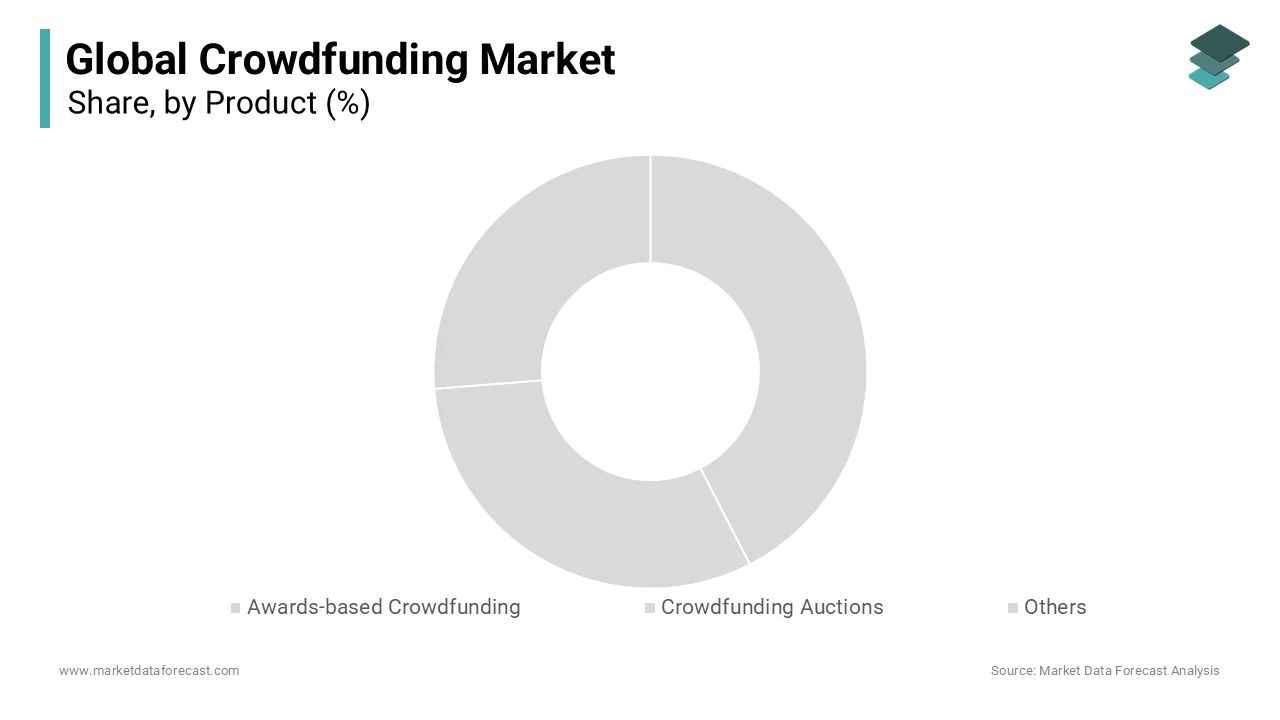
The blockchain-based segment is estimated to grow with a CAGR of 28.4% from 2025 to 2033, with the increasing adoption of decentralized technologies that enhance transparency, reduce intermediation, and enable global participation without reliance on traditional financial gatekeepers. Unlike conventional models, blockchain-based crowdfunding utilizes smart contracts to automate fund release upon predefined milestones, minimizing fraud and increasing donor confidence. The integration of non-fungible tokens (NFTs) has further expanded the model’s appeal; in 2022, the digital art platform Foundation raised over $150 million through NFT-backed crowdfunding, as reported by Chainalysis. Additionally, decentralized autonomous organizations (DAOs) are leveraging blockchain to democratize investment decisions, with ConstitutionDAO raising $47 million in just days to bid on a historic U.S. document. The European Investment Bank has recognized blockchain crowdfunding as a tool for financial inclusion, particularly in regions with underdeveloped banking infrastructure.
By End-user Insights
The individuals segment dominated the crowdfunding market by capturing 42.3% of the share in 2025, owing to the growing reliance of private citizens on crowdfunding to address urgent personal needs, particularly in healthcare, education, and crisis recovery. The accessibility of social media amplifies visibility, enabling personal stories to gain rapid traction. Platforms like GoFundMe and Milaap have optimized their interfaces for individual storytellers, offering templates, sharing tools, and verification badges to enhance credibility.
The creative professionals segment is lucratively to grow with a prominent CAGR of 24.7% during the forecast perio,d with the transformation of creative industries into self-sustaining entrepreneurial ecosystems, where artists, musicians, filmmakers, and writers bypass traditional gatekeepers to fund their work directly through audience support. The rise of digital distribution platforms such as Netflix, Spotify, and Etsy has further incentivized creators to retain ownership while using crowdfunding for upfront costs. Additionally, reward-based models allow backers to receive exclusive content, early access, or co-creation opportunities, deepening engagement.
By Application Insights
The social causes segment was the largest and held 35.4% of the crowdfunding market share in 2025, with the increasing frequency and severity of climate-related disasters, which have displaced millions and overwhelmed traditional aid mechanisms. In Ukraine, the National Bank reported that over $500 million was raised internationally through crowdfunding to support civilians, medical services, and reconstruction during the conflict, with platforms like Come Back Alive and United24 playing central roles. Domestically, grassroots campaigns for racial justice, gender equality, and refugee support have gained momentum; in the United States, the Movement for Black Lives raised over $90 million through digital platforms between 2020 and 2022, as documented by the Ford Foundation. The transparency and immediacy of crowdfunding enable donors to see direct impact, enhancing trust and participation. Furthermore, religious and cultural communities use these platforms to rebuild places of worship and support vulnerable members.
The technology segment is growing with an estimated CAGR of 26.1% from 2025 to 2033, owing to the increasing reliance of hardware startups and deep-tech innovators on crowdfunding to validate ideas, secure early capital, and build customer communities before mass production. According to the U.S. Patent and Trademark Office, over 1,200 tech products launched via crowdfunding in 2022 received utility patents, indicating high innovation potential. The success of products like the Oculus Rift and Pebble Watch demonstrated the model’s ability to transition from prototype to commercialization. The integration of video demonstrations, 3D renders, and real-time updates enhances investor confidence, while reward tiers allow early adopters to own limited editions.
REGIONAL ANALYSIS
North America Crowdfunding Market Insights
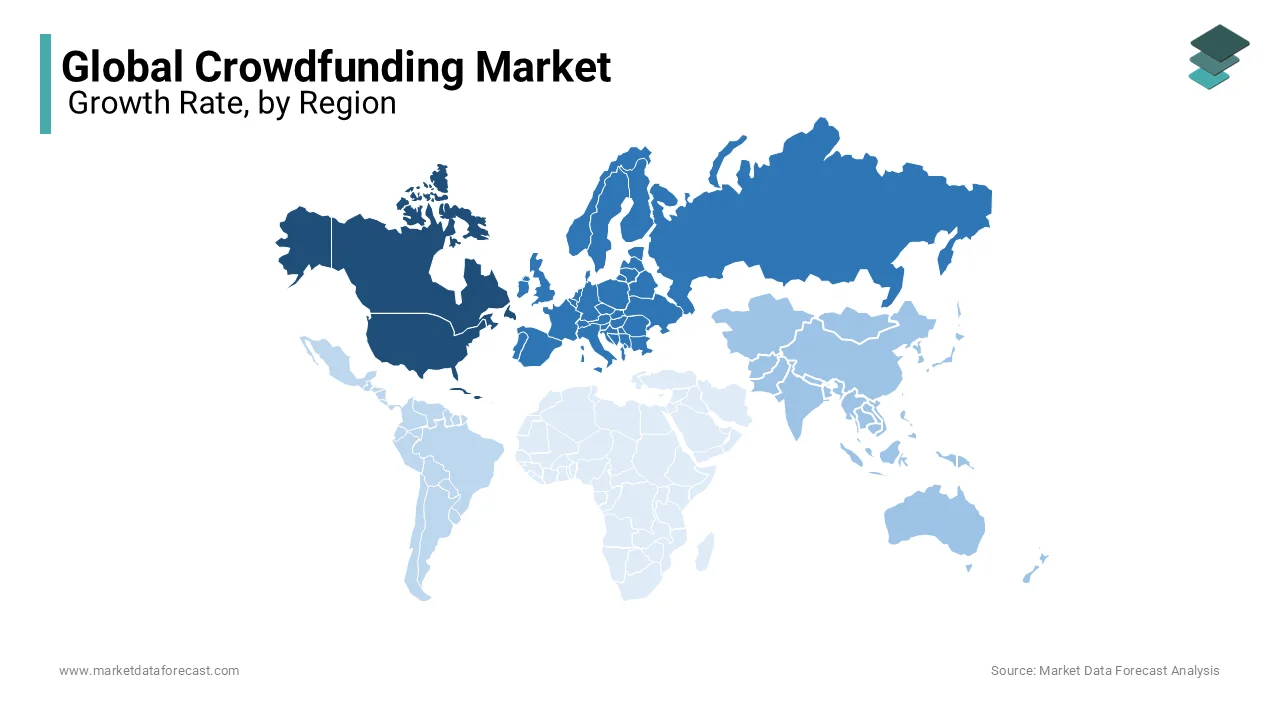
North America was the top performer of the global crowdfunding market with 41.2% of the share in 2025. The United States serves as the epicenter of innovation and transaction volume, hosting the world’s largest platforms such as GoFundMe, Kickstarter, and Indiegogo. The country’s robust digital infrastructure, high internet penetration, and culture of entrepreneurial risk-taking have fostered a thriving ecosystem for both donation-based and equity crowdfunding. According to the Federal Reserve, over 60 million Americans have contributed to a crowdfunding campaign, with medical and creative projects being the most prevalent. Canada complements this landscape with a strong regulatory framework for peer-to-peer lending and a growing number of homegrown platforms supporting Indigenous entrepreneurs and social enterprises. The presence of venture capital networks and angel investor communities has also enabled hybrid models where crowdfunding serves as a validation tool before institutional funding.
Europe Crowdfunding Market Insights
Europe was positioned second by holding 27.1% of the crowdfunding market share in 2025. The region’s strength lies in its regulatory coherence, financial literacy, and strong tradition of cooperative and community-based finance. The European Union’s Crowdfunding Service Providers Regulation (ECSP) has created a harmonized legal framework for cross-border platforms, enabling seamless operations across 27 member states.
Asia-Pacific Crowdfunding Market Insights
The Asia-Pacific region is swiftly emerging with a significant CAGR during the forecast period. China, India, and South Korea are leading the transformation, each adapting the model to local economic and cultural contexts. South Korea has embraced creative crowdfunding, with the Ministry of Science and ICT noting that 65% of indie game developers used public financing to launch titles in 2023. The region benefits from high mobile penetration, youthful populations, and rising digital literacy, creating fertile ground for innovation. Governments are increasingly supporting crowdfunding as a tool for financial inclusion and SME growth, which is positioning Asia-Pacific as the next frontier for scalable, culturally adaptive crowdfunding models.
Latin America Crowdfunding Market Insights
Latin America crowdfunding market is potentially to have prominent growth opportunities in the coming years. Brazil led the region, with platforms like Catarse and Benfeitoria financing thousands of cultural, social, and entrepreneurial projects annually. As per the Brazilian Association of Crowdfunding, over 1.2 million people participated in campaigns in 2022, with creative and educational initiatives dominating. Mexico has seen a surge in medical and disaster relief crowdfunding, particularly in underserved communities where public services are limited. The National Council of Science and Technology noted a 55% increase in tech-related campaigns between 2020 and 2023. Colombia and Chile are developing regulatory frameworks to support equity crowdfunding, aiming to unlock capital for startups outside traditional banking.
Middle East and Africa Crowdfunding Market Insights
The Middle East and Africa crowdfunding market is likely to grow steadily in the future. In Nigeria, the Central Bank reported that crowdfunding platforms raised over $120 million in 2022, primarily for SMEs, agriculture, and education, with platforms like Thrill and Flutterwave leading the charge. South Africa’s National Crowdfunding Association noted increasing use of donation-based models for medical and student debt relief. In the UAE, the Dubai Future Foundation has launched blockchain-based crowdfunding initiatives to support innovation in AI and clean energy. Egypt and Kenya are witnessing growth in agricultural crowdfunding, where farmers raise capital for seeds and equipment through mobile platforms. While regulatory frameworks remain nascent, the region’s young, tech-savvy population and urgent need for financial inclusion are catalyzing innovative, mobile-first solutions.
COMPETITIVE LANDSCAPE
The competitive dynamics of the crowdfunding market are defined by a tension between specialization and scalability, where dominant platforms vie for user loyalty in a space shaped by trust, storytelling, and technological agility. Established players like Kickstarter, GoFundMe, and Indiegogo maintain strong brand equity through years of operational consistency, user experience refinement, and cultural visibility. Competition is not solely driven by transaction volume but by emotional resonance, community engagement, and post-campaign support. Platforms that excel are those that foster a sense of belonging, enable meaningful participation, and ensure accountability beyond the fundraising phase. The rise of decentralized alternatives powered by blockchain and smart contracts introduces a new dimension, threatening the centralized gatekeeper model with promises of transparency and ownership redistribution.
KEY MARKET PLAYERS
Companies dominating the global crowdfunding market include
- Kickstarter
- AngelList
- Indiegogo
- Fundable
- Crowdcube
- GoFundMe
- Crowdfunder
- GoGetFunding
- CircleUp
- Patreon
- Campfire
- Crowdo
- Milaap
- RocketHub
- FundRazr
- Crowdfunder UK
- Modian
- Companisto
- DonorsChoose
- CrowdHousa
- Suning
TOP LEADING PLAYERS IN THE MARKET
Kickstarter
Kickstarter has redefined the landscape of creative financing by establishing a global platform where innovators, artists, and designers can bring original ideas to life through community-backed funding. Since its inception, the platform has cultivated a culture of transparency, accountability, and storytelling, emphasizing project authenticity over speculative investment. It has played a pivotal role in launching groundbreaking hardware, films, games, and design products that later achieved mainstream success. By focusing exclusively on reward-based crowdfunding, Kickstarter has maintained a distinct identity centered on creativity and public engagement. Its all-or-nothing funding model incentivizes realistic goal-setting and campaign rigor, fostering trust among backers. The platform’s influence extends beyond capital raising, serving as a validation mechanism for market demand and product feasibility.
GoFundMe
GoFundMe stands as the leading platform for personal and charitable fundraising, transforming how individuals mobilize financial support during crises, medical emergencies, and life transitions. Its intuitive interface and deep integration with social media have made it the go-to channel for urgent, emotionally driven campaigns across North America and Europe. The company has institutionalized compassion-driven giving by enabling seamless donation flows, real-time updates, and verification tools that enhance donor confidence. GoFundMe’s model prioritizes accessibility, allowing anyone to launch a campaign with minimal barriers, while its partnerships with hospitals, nonprofits, and disaster relief organizations have expanded its reach into formal healthcare and humanitarian systems. The platform has also introduced features like donor protections and fund withdrawal safeguards to improve accountability.
Indiegogo
Indiegogo has emerged as a versatile and innovation-focused crowdfunding leader, bridging the gap between early-stage tech development and market readiness. Unlike platforms limited to creative or charitable causes, Indiegogo supports a broad spectrum of ventures, including deep-tech hardware, medical devices, and sustainable consumer products. It pioneered flexible funding options, allowing creators to retain raised funds even if goals are unmet, which appeals to startups navigating uncertain development paths. The platform’s InDemand program enables post-campaign sales, turning crowdfunding into a continuous revenue channel. Indiegogo has also integrated enterprise services such as payment processing, logistics, and investor matching, positioning itself as a full-cycle launch partner. Its global reach and support for early adopter communities have made it a preferred choice for hardware entrepreneurs seeking validation, pre-orders, and manufacturing capital.
TOP STRATEGIES USED BY KEY MARKET PARTICIPANTS
- One of the most impactful strategies employed by leading crowdfunding platforms is ecosystem integration, where companies expand beyond fundraising to offer end-to-end support services such as payment processing, marketing tools, fulfillment logistics, and investor matching. This approach enhances user retention and creates additional revenue streams while reducing reliance on third-party providers. By embedding value-added services directly into the platform, firms streamline the campaign lifecycle and improve success rates.
- Another key strategy is brand trust engineering, where platforms implement verification systems, fund withdrawal safeguards, milestone reporting, and fraud detection algorithms to enhance transparency and donor confidence. Given the emotional and financial stakes involved, establishing credibility is essential for sustained engagement, particularly in donation- and equity-based models.
- Also, geographic localization and cultural adaptation, where platforms tailor user interfaces, payment methods, language, and campaign templates to regional preferences is also a new strategy for the market key players. This enables deeper penetration into emerging markets where trust in global brands must be balanced with local relevance.
Global Crowdfunding Market News
- In February 2023, Kickstarter launched a new creator compliance program requiring all hardware campaigns to submit third-party manufacturing verification before launch. This initiative is designed to reduce project failures and enhance backer trust by ensuring realistic production timelines and supply chain readiness.
- In June 2023, GoFundMe partnered with a global humanitarian network to integrate real-time crisis response alerts into its platform, enabling automatic campaign creation for disaster-affected communities. This move strengthens its role in emergency aid and improves speed-to-funding during humanitarian crises.
- In October 2023, Indiegogo introduced a blockchain-based milestone verification system for high-value tech campaigns by allowing backers to track development progress through immutable smart contracts. This innovation enhances transparency and reduces the risk of misused funds.
- In March 2024, Kickstarter acquired a storytelling and video production startup to provide creators with AI-assisted campaign content tools by improving narrative quality and engagement potential for new projects.
- In July 2024, GoFundMe implemented a new donor protection protocol that enables partial refunds if campaign updates cease for over 90 days, which is reinforcing accountability and strengthening long-term donor confidence in personal fundraising.
MARKET SEGMENTATION
This research report on the global crowdfunding market is segmented and sub-segmneted into the following categories.
By Product
- Equity-based Crowdfunding
- Debt-based Crowdfunding
- Reward-based Crowdfunding
- Donation-based Crowdfunding
- Blockchain-based Crowdfunding
- Hybrid Models
- Others
By End User
- Startups & Entrepreneurs
- NGOs & Non-profits
- Individuals
- Small & Medium Enterprises (SMEs)
- Creative Professionals (Artists, Musicians, etc.)
By Application
- Technology
- Healthcare
- Real Estate
- Food & Beverage
- Media & Entertainment
- Education
- Social Causes
- Others
By Region
- North America
- Europe
- Asia-Pacific
- Latin America
- Middle East and Africa