- Product Description Description
- Table of Contents TOC
- List of Table & Figure LOT
- Get Free Sample PDF Sample PDF
Market Size, 2025
$21.3 BnMarket Estimate, 2026
$23.30 BnMarket Forecast, 2034
$47.81 BnCAGR, 2026–2034
9.4%Executive Summary: Global Digital Biomanufacturing Market
- Market Scope: Comprehensive analysis of the global digital biomanufacturing sector, covering technological solutions, process automation, bioprocess optimization, and regional adoption trends across North America, Europe, Asia-Pacific, Latin America, and the Middle East & Africa.
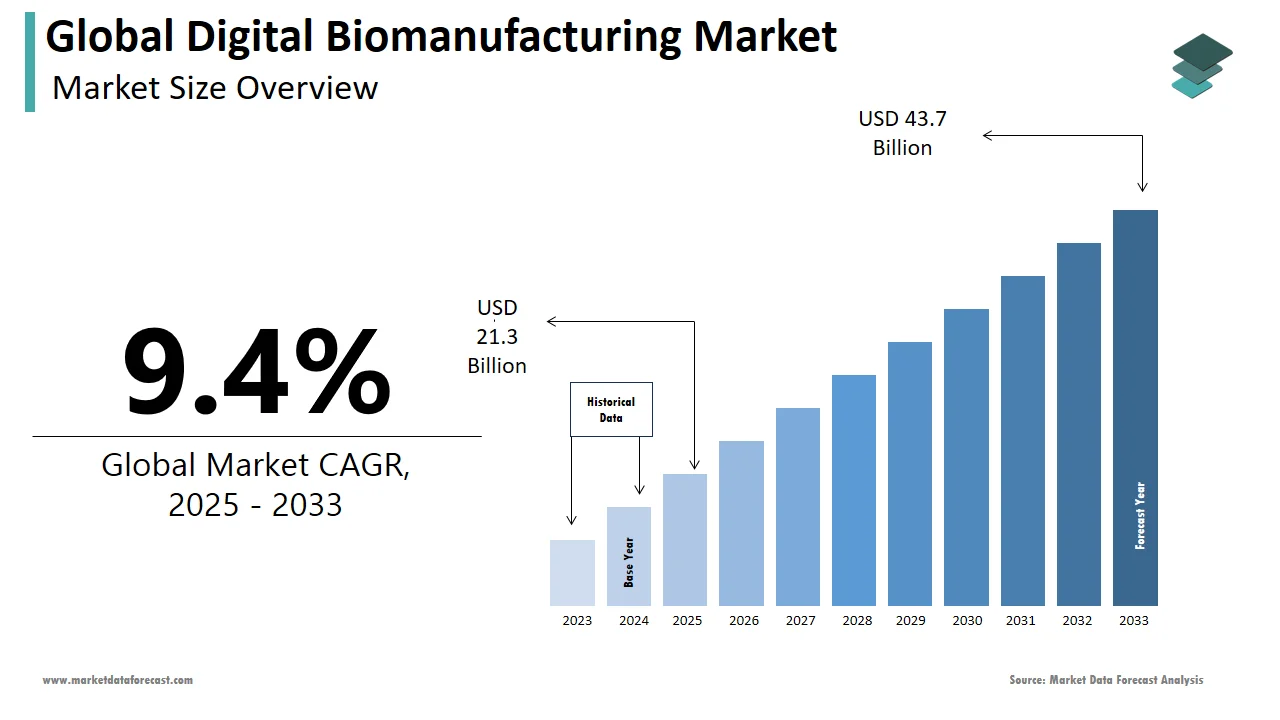
- Market Valuation: Valued at USD 21.30 billion in 2025, reaching USD 23.30 billion in 2026, and projected to expand to USD 47.81 billion by 2034, growing at a robust CAGR of 9.40% from 2026 to 2034.
- Primary Growth Drivers: Growing adoption of digital tools, advancements in AI, automation, and robotics, rising demand for biopharmaceuticals (monoclonal antibodies, vaccines, and gene therapies), and the implementation of smart manufacturing in the bio-based sector.
Key Market Segment Metrics
| Category | Leading Segment (Base Position) | Fastest-Growing / High-Growth Segment |
|---|---|---|
| By Type | Manufacturing Technologies (accounted for the major share in 2025, driven by rising demand for scalable biopharmaceutical production) | Analytical and Process Control Technologies (lucrative segment driven by real-time monitoring and consistent product quality assurance) |
| By Application | Biomanufacturing Process Automation and Control (captured a substantial market share in 2025, minimizing human error and standardizing compliance) | Bioprocess Optimization (growing at a healthy CAGR, fueled by sophisticated modeling, simulation, and cost-efficiency) |
| By Region | North America (largest regional market share in 2025, backed by a well-established biopharmaceutical industry and early adoption of digital tech) | Asia-Pacific (witnessing a promising CAGR driven by supportive government policies, R&D investments, and growing healthcare expenditure) |
Major Market Players & Industry Landscape
Market Structure: Competitive technology-driven environment characterized by strategic implementations of automation, AI-driven analytics, and IoT integration by leading life sciences and engineering corporations.
Key Companies: 3M, ABB, Cytiva, Siemens, immersciobio, Sanofi, BIOMÉRIEUX, Agilent Technologies, Inc., GE Healthcare, and Culture Biosciences.
 Download Free Sample Report
Global Digital Biomanufacturing Market Size
The global digital biomanufacturing market was worth US$ 21.3 billion in 2025 and is anticipated to reach a valuation of US$ 47.81 billion by 2034 from US$ 23.30 billion in 2026, and it is predicted to register a CAGR of 9.4% during the forecast period 2026 to 2034.
MARKET DRIVERS
The growing adoption of digital biomanufacturing majorly drives market growth. The digital biomanufacturing process aids in understanding and addressing the relevant aspects of biological activities.
The advancements in digital technologies such as AI, automation and robotics are changing the concept of manufacturing in general from product development and factory operations to material supply. Likewise, the emerging implementation of smart manufacturing in the bio-based sector supports the digital biomanufacturing market growth. The rapid expansion of digital biomanufacturing plants further fuels the growth rate of the digital biomanufacturing market. Technological advancements and rapid adoption of digital tools have been significantly helping the key market participants to accelerate their focus on expanding the manufacturing process with innovative technologies to improve the production process with R&D and for improved commercialization of vital, innovative medicine for patients. The expansion of digital biomanufacturing plants allows for higher production capacities, improving efficiency and productivity in the manufacturing process. Digital biomanufacturing plants are more flexible and adaptable to changing demands and product requirements from the market. The ability to quickly adjust the production process helps companies to respond effectively to fluctuations in demand, which favors market growth.
Technological advancements promote the digital biomanufacturing market growth.
The continuous innovation and improvement of digital technologies have a significant impact on the biomanufacturing sector. Innovation in automation and robotics systems helps handle repetitive tasks precisely and consistently. The technological developments in digital biomanufacturing have been helping companies to increase production efficiency further and reduce the risk of human errors. On the other hand, technological advancements such as data analytics and AI play a crucial role in analyzing the vast amount of data generated during the production process. The algorithm of AI help to identify a pattern, optimize production parameter and predict potential issues leading to improved process control and enhanced product quality. The IoT devices help in real-time monitoring of critical parameters such as temperature, PH levels, and nutrient concentration; this helps in ensuring process stability and early detection of deviation. The trend of technological advancements is likely to continue and support the market’s growth rate further throughout the forecast period. Factors such as digital innovation, regulatory support, flexibility and availability, growing government initiatives, available funding, and rising demand for biopharmaceuticals further fuel the growth rate of the digital biomanufacturing market.
MARKET RESTRAINT
Regulatory complexities and tackling technological challenges majorly limit the growth of the market. Lack of high technological infrastructure, skilled expertise and poor awareness regarding the technologically advanced services in emerging countries further hampers the global market growth. Emerging countries have limited access to information about biomanufacturing technological advancements. This could be due to inadequate dissemination of knowledge, limited internet penetration, and lack of resources; the successful implementation of digital biomanufacturing technologies often requires a skilled workforce. The regulatory challenges, such as compliance with evolving regulations and standards, can be complex and it may create barriers for the implementation of digital biomanufacturing solutions and is expected to hinder the market growth in the upcoming years.
REPORT COVERAGE
| REPORT METRIC | DETAILS |
| Market Size Available | 2025 to 2034 |
| Base Year | 2025 |
| Forecast Period | 2026 to 2034 |
| Segments Covered | By Type, Application, and Region. |
| Various Analyses Covered | Global, Regional, and Country-Level Analysis, Segment-Level Analysis, Drivers, Restraints, Opportunities, Challenges; PESTLE Analysis; Porter’s Five Forces Analysis, Competitive Landscape, Analyst Overview of Investment Opportunities |
| Regions Covered | North America, Europe, Asia Pacific, Latin America, Middle East & Africa |
| Market Leaders Profiled | 3M, ABB, Cytiva, Siemens, immersciobio, Sanofi, BIOMÉRIEUX, Agilent Technologies, Inc., GE Healthcare and Culture Biosciences, and Others. |
SEGMENTAL ANALYSIS
By Type Insights
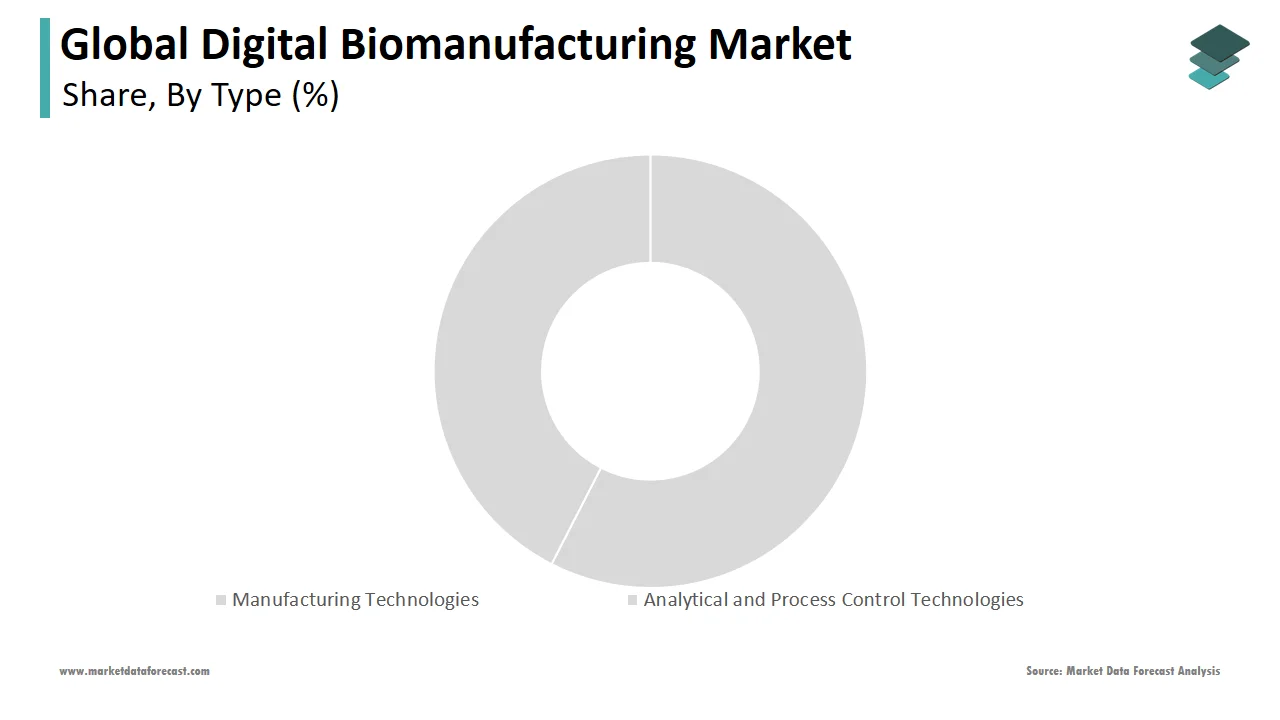
Based on type, the manufacturing technologies segment is anticipated to account for the major share of the global market during the forecast period. The emerging demand for biopharmaceutical products such as monoclonal antibodies, vaccines, and gene therapies is a key driver propelling the growth of the manufacturing technologies segment in the global market. As the demand for these advanced therapies rises, there is a need for a more efficient and scalable manufacturing process that can be achieved through the adoption of digital technologies, which is expected to drive segmental growth during the forecast period.The analytical and process control technologies segment is another lucrative segment and is estimated to account for a considerable share of the global market in the coming years. As analytical tools provide real-time data on parameters such as temperature, pH level and nutrient concentration, the manufacturers can ensure consistent product quality and avoid deviation by monitoring these parameters continuously. It also facilitates process optimization and increased productivity.
By Application Insights
Based on application, the biomanufacturing process automation and control segment is anticipated to capture a substantial share of the worldwide market during the forecast period. The growth of the segment is majorly driven by the capabilities of biomanufacturing process automation and control, such as reducing manual intervention and minimizing the risk of human errors. Automated systems help to perform repetitive tasks with precision and consistency, leading to a rise in process efficiency and higher productivity. It also ensured that the critical process parameter was consistently maintained within defined ranges and achieved product quality and minimized variability, meeting regulatory requirements and ensuring patient safety. Such advantages associated with the biomanufacturing process automation and control further result in increased adoption and propelling segmental growth.The bioprocess optimization segment is anticipated to grow at a healthy CAGR during the forecast period. Bioprocess optimization aims to maximize product yield and quality while minimizing resource consumption and production costs. The continuous advancements in bioprocess optimization tools and algorithms have enabled more sophisticated process modeling, simulation and data analysis. These technologies help biomanufacturers to identify critical process parameters and optimize production conditions for improved performance. The cost-effectiveness of bioprocess optimization is one of the major factors propelling the growth of the bioprocess optimization segment in the global market.
REGIONAL ANALYSIS
North America Digital Biomanufacturing Market Analysis
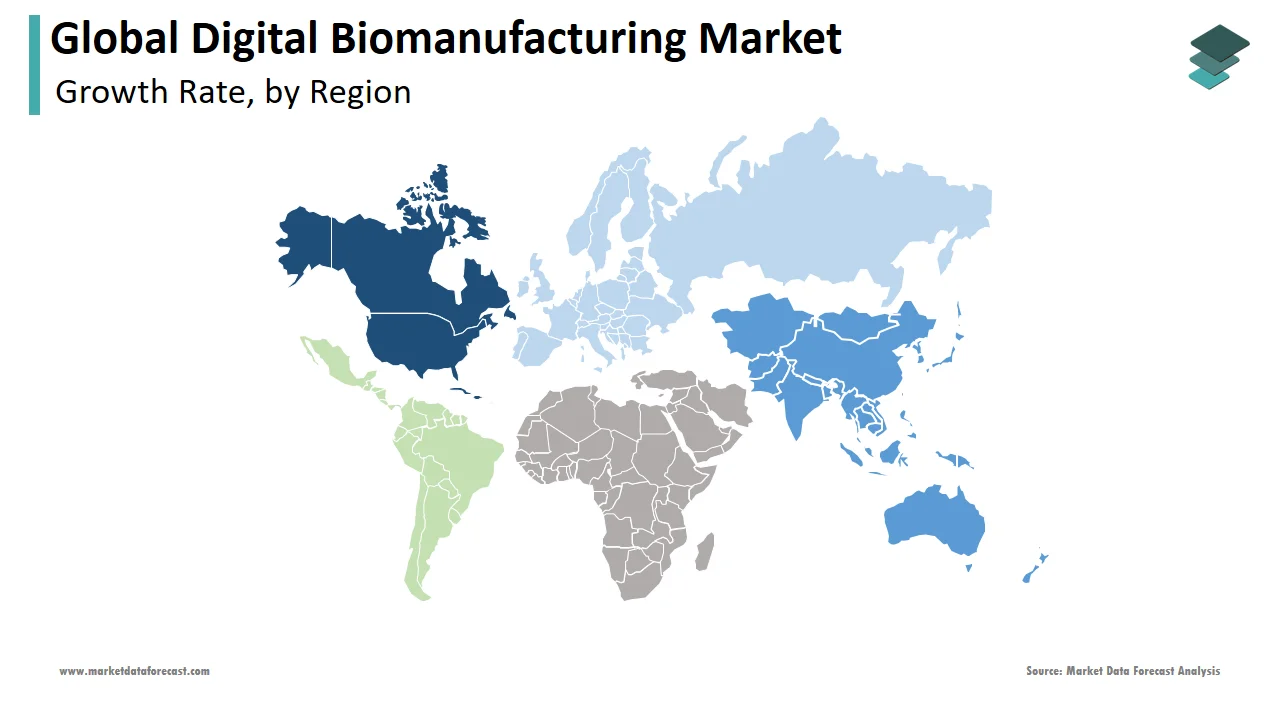
The North American region is anticipated to account for the largest share of the global market during the forecast period. The presence of a well-established biopharmaceutical industry in North America primarily drives the growth of the North American market. The growing adoption of digital biomanufacturing technologies by the market participants of the biopharmaceutical industry to enhance their manufacturing process and maintain a competitive edge contributes to the regional market growth. Technological advancements and innovation in the biopharmaceutical sector fuel the growth rate of the North American market. The U.S. is expected to account for the leading share of the North American market during the forecast period.
Asia-Pacific Digital Biomanufacturing Market Analysis
The Asia-Pacific market was the second-largest regional market in the worldwide digital biomanufacturing market in 2024 and is predicted to witness a promising CAGR during the forecast period. Countries of the APAC region have implemented supportive policies, incentives, and funding initiatives to encourage the growth of the biotechnology and biopharmaceutical sectors, favoring the APAC market growth. The growing healthcare expenditure, rapidly increasing investments in R&D and rising focus on personalized medicine further fuel the growth rate of the APAC market.
Europe Digital Biomanufacturing Market Analysis
Europe is anticipated to hold a considerable share of the global market during the forecast period. Factors such as the well-established biopharmaceutical industry, favorable regulatory environment, growing funding from the governments of European countries, and rapid adoption of technological advancements drive the growth of the European market.
Latin America Digital Biomanufacturing Market Analysis
The Latin American region is expected to progress at a healthy CAGR during the forecast period. The Middle East and Africa is predicted to grow steadily in the coming years.
KEY MARKET PLAYERS
The leading companies operating in the global digital biomanufacturing market include:
- 3M
- ABB
- Cytiva
- Siemens
- immersciobio
- Sanofi
- BIOMÉRIEUX
- Agilent Technologies, Inc.
- GE Healthcare
- Culture Biosciences
MARKET SEGMENTATION
This research report on the global digital biomanufacturing market has been segmented and sub-segmented based on type, application, and region.
By Type
- Manufacturing Technologies
- Analytical and Process Control Technologies
- Others
By Application
- Bioprocess Optimization
- Biomanufacturing Process Automation and Control
- Others
By Region
- North America
- Europe
- Asia-Pacific
- Latin America
- Middle East and Africa