- Product Description Description
- Table of Contents TOC
- List of Table & Figure LOT
- Get Free Sample PDF Sample PDF
Market Size, 2025
$424.55 BnMarket Estimate, 2026
$523.89 BnMarket Forecast, 2034
$2,817 BnCAGR, 2026–2034
23.4%Executive Summary: Global Dropshipping Market
- Market Scope: Comprehensive global dropshipping market analysis covering product segment verticals, regional country frameworks, decentralized logistics trends, and digital entrepreneurial drivers.
- Market Valuation: Valued at USD 424.55 billion (2025), estimated at USD 523.89 billion (2026), and projected to reach USD 2,817 billion by 2034, registering an exponential CAGR of 23.4% (2026–2034).
- Primary Growth Drivers: Democratization of e-commerce platforms, rising cross-border consumer demand, expansion of digital financial infrastructure, AI integration for product curation, and social media marketing adoption.
Key Market Segment Metrics (2026–2034)
| Category | Leading Segment (2025 Position) | Fastest-Growing Segment |
|---|---|---|
| By Product Segment | Fashion Segment (dominated by capturing 34.3% of market share) | Electronics & Media Segment (expected to grow at a CAGR of 15.8%) |
| By Region | North America (top-performing region accounting for 31.3% of market share) | Asia-Pacific (positioned as the fastest-growing market driven by high mobile penetration) |
Major Market Players & Market Structure
Market Structure: Highly competitive decentralized e-commerce and logistics landscape characterized by strategic developments, including international compliance automation, faster shipping program introductions, localized fulfillment networks, and AI-powered content generation tools.
Key Companies: AliDropship, SaleHoo Group Limited, Doba Inc., Oberlo, Shopify Inc., GoFundMe, Indiegogo, Patreon, Spocket, and CJ Dropshipping.
 Download Free Sample Report
Global Dropshipping Market Size
The global dropshipping market size was valued at USD 424.55 billion in 2025 and is expected to be worth USD 2,817 billion by 2034, from USD 523.89 billion in 2026, growing at a whopping 23.4% CAGR from 2026 to 2034.
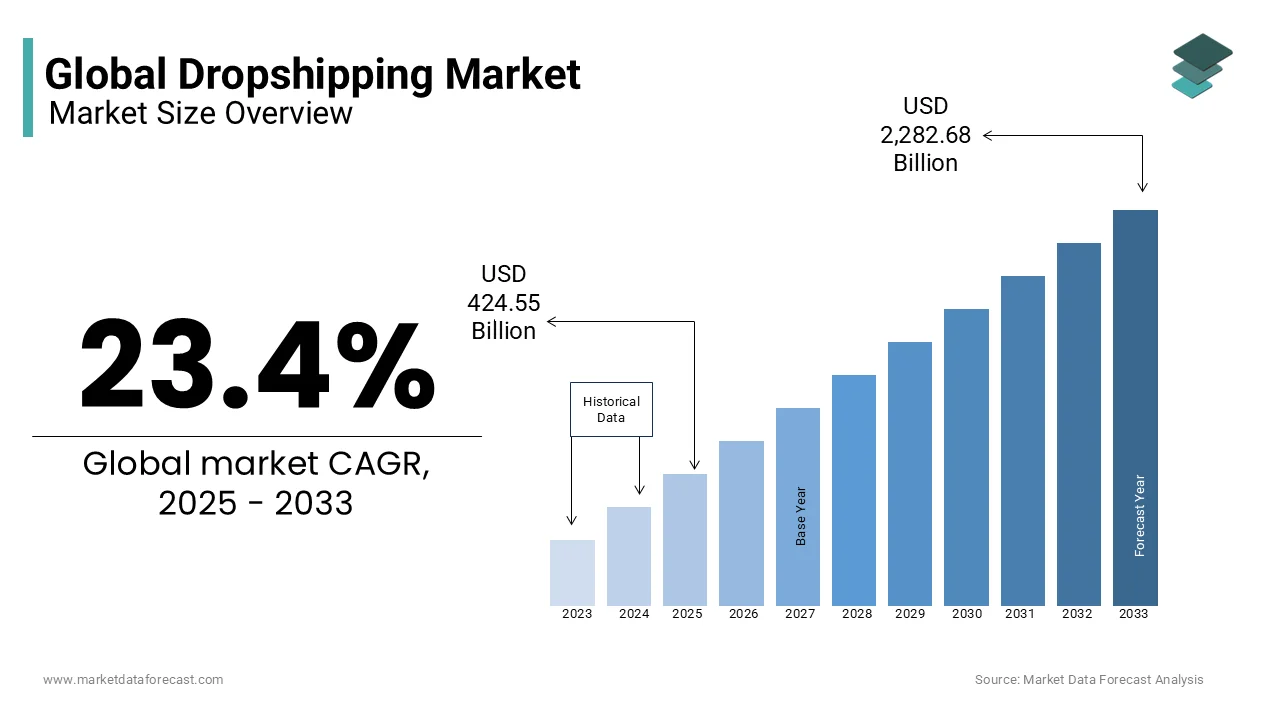
The dropshipping decentralized logistics framework eliminates the need for warehousing, reduces upfront capital investment, and enables rapid scalability by making it particularly appealing to digital entrepreneurs and e-commerce startups. Unlike traditional retail or even standard e-commerce operations, dropshipping decouples product ownership from sales by allowing sellers to operate lean, agile businesses often from remote environments. The model has gained structural relevance amid the digitization of global commerce, especially in regions where access to capital, logistics infrastructure, or supply chain networks is limited.
MARKET DRIVERS
Democratization of E-Commerce Platforms and Accessibility of Digital Tools
The widespread availability and affordability of e-commerce enabling technologies have lowered entry barriers for non-technical entrepreneurs. Platforms such as Shopify, WooCommerce, and BigCommerce offer intuitive, template-based store creation with built-in integrations to dropshipping suppliers, payment processors, and marketing tools, allowing individuals to launch an online business within hours. According to the International Telecommunication Union, global internet penetration reached 67% in 2023, with over 5.3 billion people connected, creating a vast pool of potential merchants and consumers. UNESCO’s 2022 Digital Entrepreneurship Survey revealed that 61% of first-time online sellers in Latin America and South Asia chose dropshipping due to the absence of inventory risk and minimal startup costs. The integration of AI-driven customer service bots and multilingual translation tools has further empowered micro-entrepreneurs to serve international markets without localized infrastructure.
Growth of Cross-Border Consumer Demand and Globalized Shopping Behavior
The increasing willingness of consumers to purchase goods directly from international vendors, a shift that aligns perfectly with the advanced model’s transnational supply chain structure, is escalating the growth of the dropshipping market. The appeal lies in product variety, perceived authenticity, and competitive pricing, especially for niche or culturally specific items. Moreover, social media platforms like Instagram and TikTok have become discovery engines for global products, with influencers in one country promoting goods fulfilled from suppliers in another. The World Customs Organization reported that in 2022, over 1.2 billion low-value parcels were shipped internationally under de minimis thresholds, many originating from dropshipped orders.
MARKET RESTRAINTS
Quality Control and Brand Reputation Risks Due to Decentralized Fulfillment
The inherent difficulty in maintaining consistent product quality and customer experience to the lack of direct oversight over inventory and shipping processes is inhibiting the growth of the dropshipping market. According to the International Consumer Protection Network, 43% of complaints related to cross-border e-commerce in 2022 involved discrepancies in product quality, including counterfeit items, incorrect specifications, or damaged goods, many of which originated from dropshipped orders. The inability to inspect merchandise before dispatch exposes sellers to reputational damage, especially when customer service is expected to resolve issues they cannot directly control. A 2023 audit by the European Digital Commerce Association found that 58% of consumers who had a negative experience with an online store cited poor product quality as the primary reason for not returning, with dropshipped items overrepresented in such cases. Furthermore, the absence of standardized quality certifications across supplier networks complicates assurance efforts.
Regulatory Fragmentation and Customs Compliance Complexity
The evolving and inconsistent regulatory frameworks governing cross-border e-commerce about customs, taxation, and consumer protection is additionally restraining the growth of the dropshipping market. According to the World Trade Organization, as of 2023, 76 countries had implemented or updated digital services taxes, import thresholds, or e-commerce regulations, often with minimal harmonization. For example, while the European Union enforces strict CE marking and REACH chemical compliance for imported goods, similar requirements in Latin America vary significantly between nations like Brazil, which mandates INMETRO certification, and Argentina, which applies Mercosur-wide standards. The International Chamber of Commerce warns that non-compliance risks are escalating as governments tighten enforcement to protect domestic industries and ensure tax collection.
MARKET OPPORTUNITIES
Integration of Artificial Intelligence in Product Curation and Customer Engagement
The application of artificial intelligence to enhance product discovery, personalize customer interactions, and optimize supply chain responsiveness is to create new opportunities for the growth of the dropshipping market. AI-powered tools can analyze vast datasets from social media, search trends, and consumer behavior to identify emerging product demands before they reach mass markets, enabling dropshippers to list trending items ahead of competitors. According to the MIT Initiative on the Digital Economy, AI-driven demand forecasting models have improved inventory anticipation accuracy by up to 65% in e-commerce environments, a capability increasingly accessible to small merchants via SaaS platforms. Chatbots equipped with natural language processing now handle up to 80% of initial customer inquiries, as reported by the IEEE Global AI in Retail Survey 2023, reducing operational load and improving response times. Additionally, generative AI is being used to create product descriptions, marketing content, and even virtual try-on experiences, lowering content creation barriers for non-technical sellers. Platforms like Synthesia and Jasper have reported a 300% increase in usage by dropshipping entrepreneurs since 2021. Furthermore, AI can assess supplier reliability by aggregating shipping times, return rates, and customer feedback, helping merchants select trustworthy partners.
Expansion of Sustainable and Ethical Dropshipping Models
The development of environmentally and socially responsible dropshipping networks, which respond to growing consumer demand for transparency and sustainability in global commerce, is also escalating the growth of the dropshipping market. Traditionally criticized for contributing to overconsumption and carbon-intensive shipping, the model is being reimagined through partnerships with eco-conscious suppliers, carbon-neutral logistics providers, and circular economy platforms. According to the United Nations Environment Programme, 52% of global consumers in 2023 considered sustainability a key factor in online purchases, prompting a shift in merchant behavior. A growing number of dropshipping platforms, such as EcoCart and Sendle-integrated suppliers, now offer carbon offset options at checkout, with over 15,000 stores adopting such features by 2023, as per the documentation by the Sustainable E-commerce Alliance.
MARKET CHALLENGES
Logistical Delays and Inconsistent Delivery Performance
The unpredictability of delivery timelines in cross-border transactions where packages traverse multiple carriers and customs checkpoints substantially hinders the growth of the dropshipping market. According to the Universal Postal Union, the average delivery time for international e-commerce parcels in 2022 was 18.7 days, with 23% of shipments experiencing delays beyond 25 days. These inconsistencies erode customer satisfaction and increase the likelihood of order cancellations or negative reviews. A 2023 survey by the Global Consumer Insights Forum found that 69% of online shoppers expected delivery within 10 days, and 41% would abandon a purchase if the estimated shipping time exceeded two weeks. The lack of real-time tracking integration between suppliers and merchants further compounds the issue, leaving sellers unable to provide accurate updates. In regions with underdeveloped last-mile infrastructure, such as parts of Africa and South America, delivery failures are common, with return rates as high as 30% due to undeliverable addresses.
Intensifying Competition and Market Saturation in Niche Verticals
The low barrier to entry that enables widespread participation in dropshipping has also led to severe market saturation, particularly in popular product categories such as fashion accessories, phone cases, and home décor. According to the Digital Commerce Observatory, over 78% of new Shopify stores launched in 2022 were dropshipping-based, with 60% selling products from the same top five supplier platforms, resulting in homogenized storefronts. This commoditization makes customer acquisition costly, as search engine and social media advertising spaces become oversaturated. A 2023 analysis by the Harvard Business School Digital Marketplace Project found that average cost-per-click for dropshipping ads on Meta and Google increased by 142% between 2020 and 2023, driven by bidding wars among identical product sellers.
REPORT COVERAGE
| REPORT METRIC | DETAILS |
| Market Size Available | 2025 to 2034 |
| Base Year | 2025 |
| Forecast Period | 2026 to 2034 |
| CAGR | 23.4% |
| Segments Covered | By Product and Region |
|
Various Analyses Covered | Global, Regional & Country Level Analysis, Segment-Level Analysis, DROC, PESTLE Analysis, Porter’s Five Forces Analysis, Competitive Landscape, Analyst Overview on Investment Opportunities |
| Regions Covered | North America, Europe, APAC, Latin America, Middle East & Africa |
|
Market Leaders Profiled | AliDropship, SaleHoo Group Limited, Doba, Inc., Oberlo and Shopify Inc. |
SEGMENTAL ANALYSIS
By Product Insights
The Fashion segment dominated the global dropshipping market by capturing 34.3% of share in 2025, with consumer behavior, digital retail trends, and supply chain accessibility. According to the United Nations Forum on Sustainable Fashion, over 60% of online fashion transactions in 2023 involved garments produced and shipped within 14 days of design finalization, a timeline that dropshipping networks can support through on-demand production in hubs like Guangzhou and Dhaka. Additionally, platforms such as TikTok and Instagram have transformed visual content into direct sales channels by enabling micro-influencers to launch branded storefronts overnight. A 2023 study by the Digital Marketing Institute found that 72% of fashion-focused dropshippers sourced products directly from integrated supplier marketplaces like CJ Dropshipping and AliExpress, which offer real-time catalog syncing and automated fulfillment.
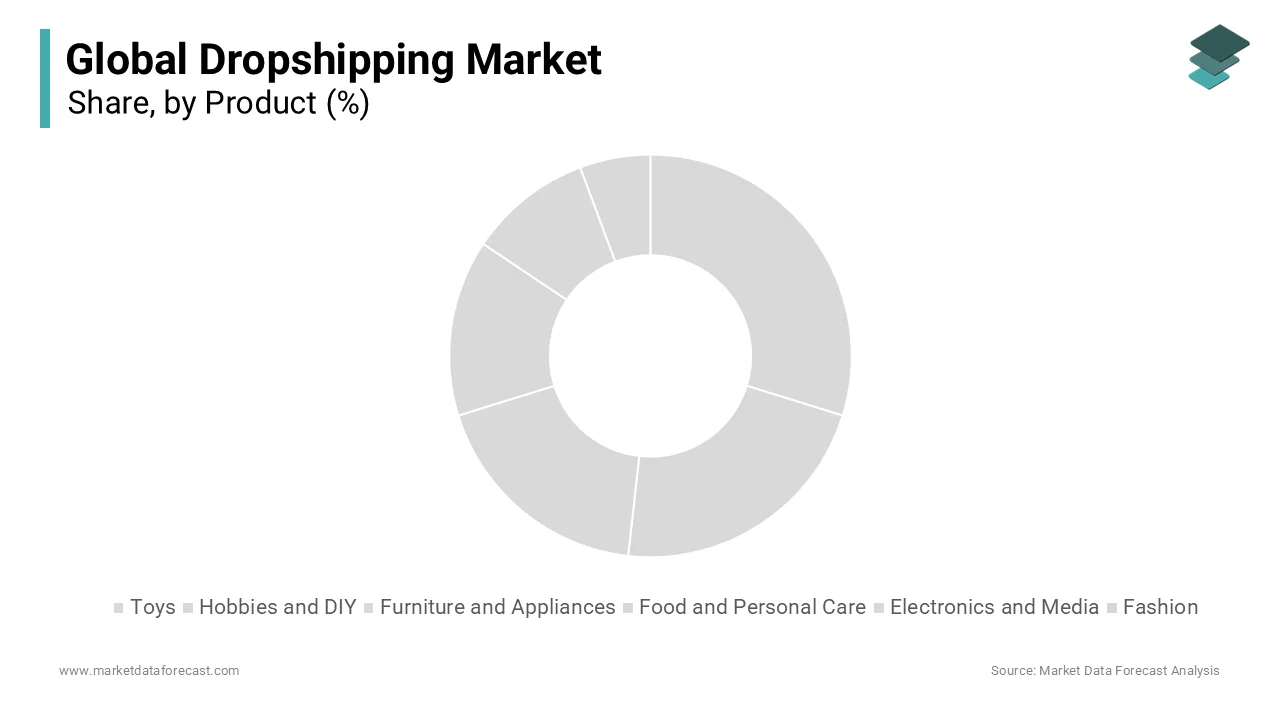
The Electronics & Media segment is expected to grow with a CAGR of 15.8% from 2025 to 2033, owing to the increasing global demand for affordable tech accessories and digital lifestyle products, particularly in emerging markets. A key factor is the rising penetration of smartphones and home entertainment systems, which fuels demand for complementary goods such as charging cables, phone cases, smart home devices, and streaming peripherals. Dropshipping enables access to these products without the capital burden of bulk purchasing, making it ideal for niche tech resellers.
REGIONAL ANALYSIS
North America Dropshipping Market Insights
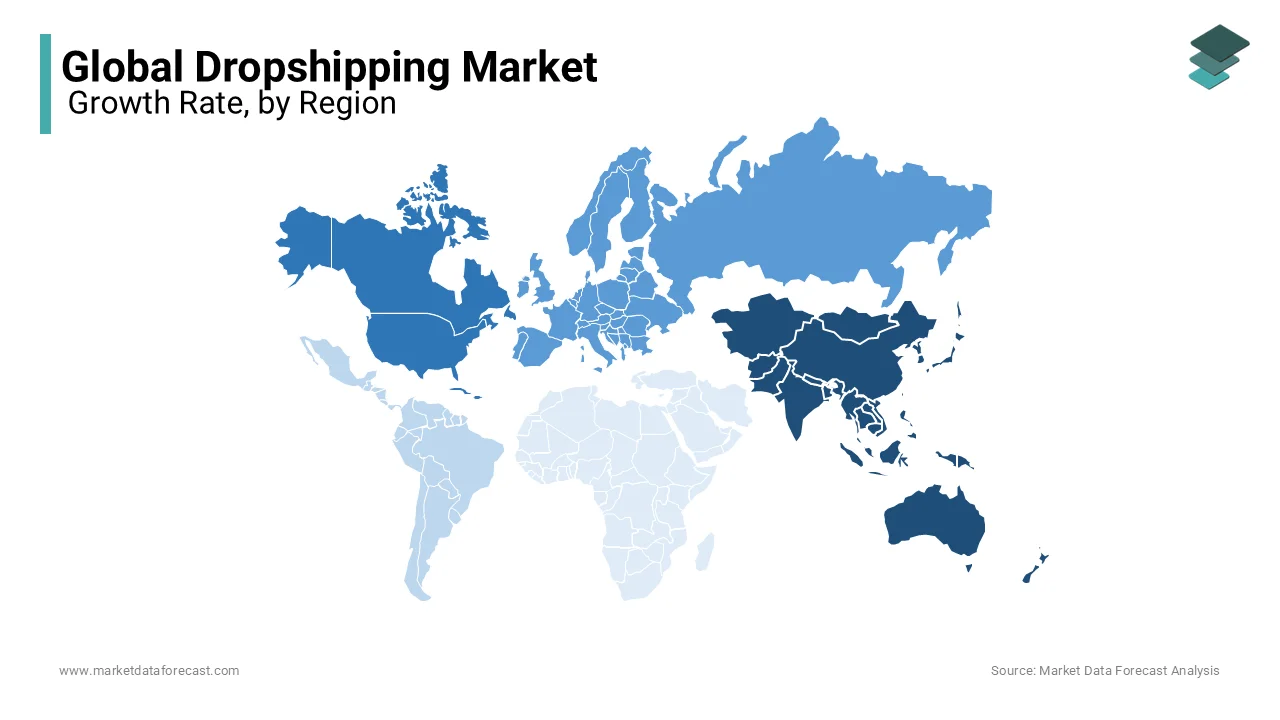
North America was the top performer of the global dropshipping market by accounting for 31.3% of the market share in 2025. The United States, in particular, serves as a central hub for dropshipping innovation by hosting major platforms such as Shopify, WooCommerce, and BigCommerce, which collectively support over 1.2 million active dropshipping stores. Consumer trust in international shipping is reinforced by the U.S. de minimis threshold of $800, allowing duty-free entry for most low-value parcels, a policy that facilitates seamless cross-border transactions. According to the U.S. International Trade Commission, over 900 million de minimis shipments entered the country in 2022, many originating from dropshipped goods. Additionally, the Federal Trade Commission’s clear guidelines on online advertising and consumer rights have created a stable regulatory environment for digital sellers.
Europe Dropshipping Market Insights
Europe dropshipping market was positioned second with 12.3% of the share in 2025. The European Union has implemented comprehensive e-commerce directives that standardize digital contracts, data privacy, and return policies, fostering trust in online transactions.
Asia Pacific Dropshipping Market Insights
Asia Pacific dropshipping market growth is anticipated to have a lucrative CAGR during the forecast period, with a rapidly expanding consumer base. China, India, and Southeast Asian nations serve as manufacturing and logistics epicenters by hosting the majority of global dropshipping suppliers on platforms like Alibaba, 1688.com, and Shopee. According to the United Nations Economic and Social Commission for Asia and the Pacific, over 70% of low-value parcels shipped globally in 2023 originated from Chinese export hubs. Local platforms such as Meesho and Flipkart have integrated dropshipping features for small vendors, enabling rural entrepreneurs to participate in digital commerce. In Indonesia, 4.2 million micro-merchants operate on Tokopedia using dropshipping models, according to the Indonesian E-commerce Association.
Latin America Dropshipping Market Insights
Latin America dropshipping market growth is expected to be steady during the forecast period, owing to the rising internet access and a young, tech-savvy population. Brazil, Mexico, and Colombia are the leading markets, with increasing adoption of e-commerce platforms and mobile payment systems. According to the Economic Commission for Latin America and the Caribbean, internet penetration reached 81% in 2023, enabling broader participation in global digital marketplaces. Platforms like Mercado Libre and Linio have introduced dropshipping integrations, allowing local sellers to access international suppliers without inventory risk. A 2023 survey by the Brazilian Association of E-commerce found that 38% of new online stores in São Paulo and Mexico City were dropshipping-based.
Middle East & Africa Dropshipping Market Insights
Middle East & Africa dropshipping market is rapidly growing with the rapid digital adoption and an underdeveloped traditional retail infrastructure, which is creating fertile ground for e-commerce innovation. In Africa, mobile money platforms like M-Pesa and PalmPay have enabled secure online payments in areas with limited banking access. However, customs inefficiencies, inconsistent postal services, and low consumer protection frameworks remain challenges. The International Finance Corporation reports that only 30% of African countries have comprehensive e-commerce laws.
KEY MARKET PLAYERS
AliDropship, SaleHoo Group Limited, Doba, Inc., Oberlo, and Shopify Inc. are some of the major players in the global dropshipping market.
TOP LEADING PLAYERS IN THE MARKET
Shopify
Shopify stands as a foundational force in the global dropshipping ecosystem by empowering entrepreneurs with an intuitive, scalable platform that seamlessly integrates storefront creation, payment processing, and supplier connectivity. Its role extends beyond infrastructure. Shopify fosters education through its merchant academy, supports marketing automation, and facilitates cross-border sales, effectively serving as the operational backbone for countless independent dropshipping businesses. The company’s developer-friendly environment has spurred innovation, allowing third-party tools to enhance functionality and customization.
AliExpress
AliExpress is a subsidiary of Alibaba Group, and functions as one of the most influential supply-side engines of the dropshipping market by linking millions of global sellers with manufacturers and wholesalers primarily based in China and Southeast Asia. Renowned for its vast product catalog, competitive pricing, and increasingly reliable shipping options, AliExpress has become the go-to sourcing platform for dropshippers seeking low-cost, high-variety inventory without minimum order commitments. The platform has evolved beyond a simple marketplace by introducing fulfillment services, buyer protection policies, and logistics partnerships that reduce delivery times and improve customer trust. Its integration with major e-commerce platforms enables real-time inventory syncing and automated order routing, streamlining operations for merchants worldwide.
Spocket
Spocket has emerged as a pivotal intermediary in the dropshipping landscape by curating a network of premium suppliers from the United States and the European Union, addressing long-standing concerns about shipping duration and product quality. Unlike generic sourcing platforms, Spocket emphasizes faster delivery times, branded invoicing, and high-caliber goods, allowing merchants to position their stores as premium retailers. The platform’s focus on vetted suppliers and seamless integration with Shopify and WooCommerce enhances reliability and operational efficiency. Spocket also provides localized pricing, currency support, and marketing assets, enabling sellers to maintain brand consistency and professionalism.
TOP STRATEGIES USED BY KEY MARKET PARTICIPANTS
One major strategy employed by leading players is the vertical integration of supply chain services, where platforms consolidate sourcing, logistics, branding, and fulfillment under a single ecosystem. This approach enhances reliability, reduces operational friction, and allows merchants to offer a more professional customer experience.
Another key strategy is the development of AI-powered product and market intelligence tools that enable merchants to identify trending items, optimize pricing, and automate marketing campaigns. These tools analyze real-time consumer behavior, social media signals, and search trends to provide actionable insights, giving sellers a competitive edge in fast-moving niches. Predictive analytics help minimize risk and improve conversion rates, transforming dropshipping from a trial-and-error model into a data-driven enterprise.
COMPETITION OVERVIEW
The competitive landscape of the dropshipping market is not defined by traditional corporate rivalry but by a decentralized, platform-driven ecosystem where technological enablers and supplier networks hold strategic dominance. Unlike conventional retail, where competition revolves around brand, pricing, and distribution, the dropshipping arena is shaped by access to tools, supplier reliability, and digital agility. Shopify, AliExpress, and Spocket do not compete directly with individual merchants but instead empower them, functioning as infrastructure providers in a vast, fragmented marketplace.
RECENT MARKET DEVELOPMENTS
- In February 2023, Shopify launched Shopify Markets Pro, enabling merchants to automate international pricing, taxes, and compliance, thereby simplifying cross-border dropshipping operations and improving scalability.
- In May 2023, AliExpress introduced its "Choice" program, highlighting products with faster shipping and higher customer ratings by enhancing buyer confidence and optimizing the dropshipping experience for global sellers.
- In September 2023, Spocket partnered with EU-based suppliers to launch a "Local Fulfillment Network," which is significantly reducing delivery times for European and North American customers.
- In January 2024, Shopify integrated AI-powered product description and ad copy generation through its Sidekick assistant that empowers dropshippers to create professional content without technical expertise.
- In March 2024, AliExpress expanded its fulfillment centers in Poland and Mexico to support quicker regional delivery, which is strengthening its position in key dropshipping markets.
MARKET SEGMENTATION
This research report on the global dropshipping market is segmented and sub-segmented into the following categories.
By Product
- Toys
- Hobbies and DIY
- Furniture and Appliances
- Food and Personal Care
- Electronics and Media
- Fashion
By Region
- North America
- Europe
- Asia-Pacific
- Latin America
- Middle East and Africa