- Product Description Description
- Table of Contents TOC
- List of Table & Figure LOT
- Get Free Sample PDF Sample PDF
Market Size, 2025
$9.26 BnMarket Estimate, 2026
$10.76 BnMarket Forecast, 2034
$35.77 BnCAGR, 2026–2034
16.20%Global E-Invoicing Market Report Summary
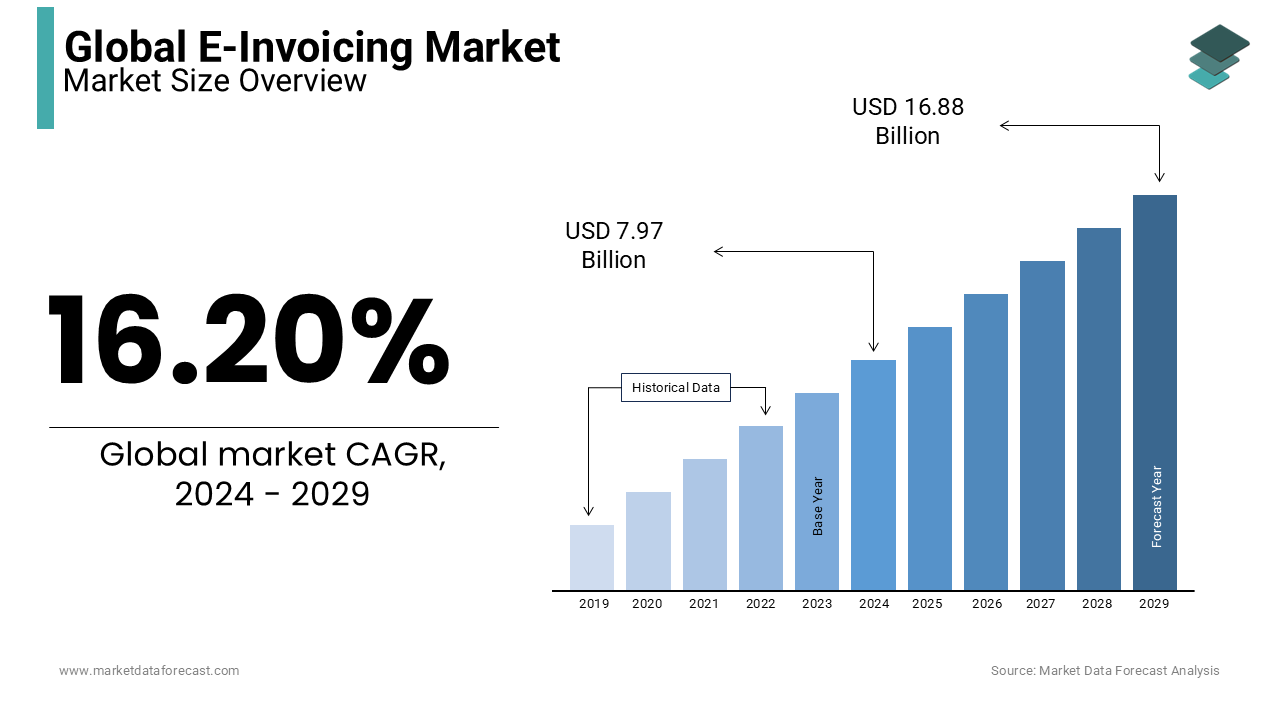
The global e-invoicing market was valued at USD 9.26 billion in 2025 and is projected to grow from USD 10.76 billion in 2026 to USD 35.77 billion by 2034, registering a CAGR of 16.20% from 2026 to 2034. Market growth is driven by increasing digital transformation initiatives, growing adoption of automated financial workflows, and rising government mandates for electronic invoicing and tax compliance. Organizations across industries are increasingly implementing e-invoicing solutions to improve operational efficiency, reduce processing costs, enhance transparency, and streamline accounts payable and receivable functions. The expansion of cloud-based platforms, real-time tax reporting requirements, and cross-border digital trade is further accelerating global market growth.
Key Market Trends
- Rising adoption of cloud-based invoicing and financial automation platforms.
- Increasing government mandates for electronic invoicing and digital tax compliance.
- Growing demand for real-time invoice processing and transaction transparency.
- Expansion of business process automation and digital procurement systems.
- Increasing integration of artificial intelligence and analytics in financial workflows.
Segmental Insights
- Based on deployment model, the cloud segment dominated the global e-invoicing market in 2025 by accounting for 66.4% market share, driven by scalability, cost efficiency, ease of deployment, and remote accessibility.
- Based on business function, the business-to-business (B2B) segment led the market by capturing 71.4% share in 2025, supported by increasing digitalization of procurement, supplier management, and enterprise financial operations.
Regional Insights
The global e-invoicing market is witnessing rapid expansion across major regions, supported by digital governance initiatives, automation adoption, and evolving regulatory frameworks.
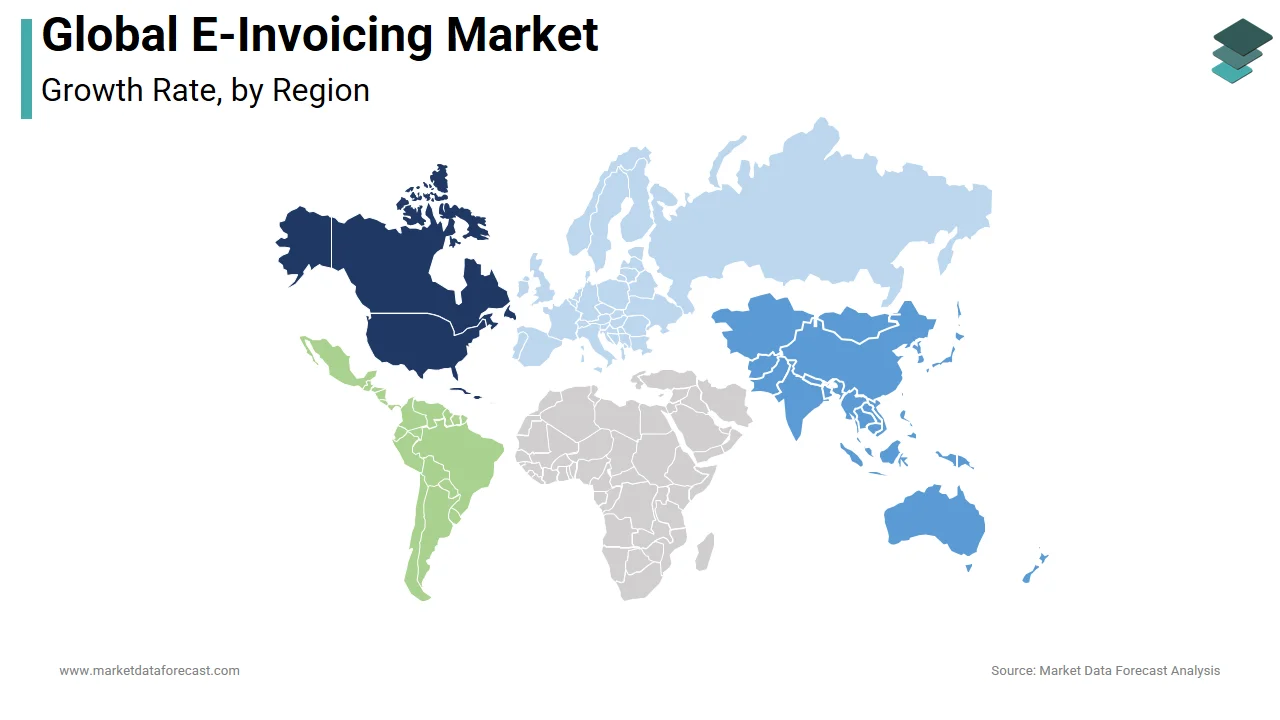
- Europe dominated the global market in 2025 with 34.3% share, driven by its pioneering role in digital tax administration, mandatory e-invoicing regulations, and strong government support for financial digitization.
- North America held a significant position in the global market and is expected to maintain strong growth throughout the forecast period, supported by high levels of private-sector adoption, enterprise digital transformation initiatives, and growing demand for automated financial management solutions.
- Asia-Pacific is emerging as a high-growth region due to increasing digitalization, expanding e-commerce activities, and growing government efforts to modernize tax administration and business reporting systems.
Competitive Landscape
The global e-invoicing market is characterized by intense competition among enterprise software providers, financial technology companies, and cloud-based business automation vendors focusing on compliance, workflow automation, and digital transaction management. Market participants are emphasizing cloud innovation, integration capabilities, AI-powered financial analytics, and regulatory compliance features to strengthen market positioning. Strategic partnerships, acquisitions, and investments in digital finance technologies are shaping competitive dynamics across the market.
Prominent companies operating in the global e-invoicing market include Basware Corporation, Cegedim SA, Comarch SA, Coupa Software Inc., IBM Corporation, Nipendo Ltd., SAP SE, Oracle Corporation, Thomson, The Sage Group Plc, Tradeshift, and Transcepta LLC.
Global E-Invoicing Market Size
The global E-invoicing market was worth USD 9.26 billion in 2025. The global market is predicted to reach USD 10.76 billion in 2026 and USD 35.77 billion by 2034, growing at a CAGR of 16.20% from 2026 to 3034.
E-invoicing represents the digital exchange of billing documents between a supplier and a customer in a structured electronic format that allows for automatic and seamless processing. Unlike traditional paper invoices or unstructured digital formats like portable document format files, this system ensures that data is fully machine-readable from end to end. The transition toward digital billing is fundamentally reshaping global tax administration and corporate financial operations. According to the European Commission, the implementation of mandatory digital billing frameworks across member states has significantly reduced the value-added tax gap, recovering billions of euros in previously lost tax revenues annually. Furthermore, as per the World Bank, digital tax administration initiatives globally have decreased compliance costs for businesses by up to 15% while simultaneously increasing government revenue collection efficiency. The operational scenario indicates a massive shift in how enterprises manage their financial ecosystems. Small and medium enterprises are increasingly adopting these digital frameworks to integrate with larger corporate supply chains. According to the Organisation for Economic Cooperation and Development, digitalizing public procurement and tax compliance processes saves governments approximately 30% in administrative overhead costs. This structural transformation is not merely a technological upgrade but a fundamental regulatory mandate aimed at eliminating tax evasion, accelerating payment cycles, and fostering a completely transparent financial environment across international borders.
MARKET DRIVERS
Government Mandates to Eliminate Tax Evasion
Government mandates to eliminate tax evasion are compelling widespread adoption of digital billing systems, which is a key factor driving the expansion of the global e-invoicing market. Tax authorities worldwide are increasingly enforcing continuous transaction controls to monitor business activities in real time, thereby shrinking the shadow economy. According to the European Commission, the value-added tax gap across European Union member states was estimated at an alarming 93 billion euros in 2020, prompting aggressive regulatory interventions. To combat this massive revenue leakage, governments are mandating that all business-to-government and business-to-business transactions utilize standardized digital formats. As per the International Monetary Fund, countries that have implemented continuous transaction controls alongside mandatory digital billing have witnessed their tax collection efficiency improve by up to 20% within the initial two years of deployment. This regulatory pressure creates an immediate and non-negotiable demand for E-invoicing solutions. Enterprises must procure compliant software to avoid severe financial penalties and operational disruptions. The demand is further amplified by the expansion of these mandates from large multinational corporations down to small and medium enterprises, ensuring that the entire commercial ecosystem operates within a transparent, digitally auditable framework that leaves no room for fraudulent reporting or tax avoidance.
Corporate Pursuit of Operational Efficiency
Corporate pursuit of operational efficiency and cost reduction is accelerating the transition to automated billing, which is further boosting the expansion of the e-invoicing market. Organizations are actively seeking ways to streamline their procure-to-pay processes, eliminate manual data entry errors, and accelerate cash flow cycles. The financial burden of managing paper-based billing is substantial, encompassing printing, postage, physical storage, and manual handling costs. According to the Association of Chartered Certified Accountants, the average administrative cost of processing a traditional paper invoice is approximately 30 dollars, whereas processing a fully automated electronic invoice costs merely 5 dollars. This drastic reduction in operational expenditure serves as a powerful catalyst for enterprise adoption. Furthermore, as per the Aberdeen Group, companies that deploy automated digital billing solutions reduce their invoice processing cycle time by up to 75%, allowing for earlier payments and better working capital management. The demand for these systems is also driven by the need for enhanced accuracy. Manual transcription inevitably leads to discrepancies that delay approvals and strain supplier relationships. By integrating digital billing directly into enterprise resource planning systems, businesses achieve seamless data synchronization, ensuring that financial operations are both highly efficient and exceptionally accurate, and thereby driving sustained organizational profitability.
MARKET RESTRAINTS
Substantial Initial Capital Expenditure
Substantial initial capital expenditure for software integration is hampering the global market expansion. Transitioning from legacy paper-based systems or rudimentary digital formats to fully compliant E-invoicing requires significant financial investment. Organizations must procure specialized software, upgrade their existing enterprise resource planning infrastructure, and ensure seamless interoperability with their trading partners and government tax portals. According to the International Data Corporation, nearly 40% of small and medium enterprises cite high upfront technology costs as the primary obstacle to undertaking comprehensive digital transformation initiatives. The financial burden is not limited to software licensing; it also encompasses extensive employee training, system testing, and ongoing technical support. As per the G20 Global Forum on Transparency and Exchange of Information for Tax Purposes, the average initial setup cost for establishing a robust digital billing infrastructure can exceed 50000 dollars for mid-sized corporations, a figure that is entirely prohibitive for smaller entities. Furthermore, the complexity of integrating these new systems with diverse legacy applications often leads to unforeseen expenses and project delays. This steep financial requirement forces many organizations, particularly those operating on thin profit margins, to postpone their digital billing adoption, thereby restricting the overall velocity of market expansion and leaving a substantial portion of the commercial sector reliant on outdated manual processes.
Fragmented Global Regulatory Standards
Fragmented global regulatory standards and interoperability hurdles severely complicate cross-border billing operations, which further hinder the growth of the global e-invoicing market. Unlike a unified global protocol, E-invoicing standards vary drastically from one jurisdiction to another, with countries mandating distinct data models, transmission protocols, and authentication mechanisms. For instance, while the Pan European Public Procurement Online network is widely adopted in Europe, other regions utilize entirely different frameworks, such as the Facturae system in Spain or the ZUGFeRD format in Germany. According to the United Nations Conference on Trade and Development, this severe fragmentation of digital trade and tax regulations costs the global economy over 100 billion dollars annually in sheer compliance inefficiencies and administrative redundancies. Corporate frameworks are forced to maintain multiple disparate software solutions to satisfy the unique legal requirements of every country in which they operate. As per the World Customs Organization, large international enterprises spend up to 25% of their total information technology budgets merely on maintaining compliance with these highly divergent regional billing formats. This lack of standardization creates immense operational friction, increases the likelihood of technical errors during cross-border transactions, and discourages smaller businesses from engaging in international trade, thereby acting as a formidable restraint on the seamless global expansion of digital billing networks.
MARKET OPPORTUNITIES
The Convergence of Advanced Technologies
The convergence of artificial intelligence and blockchain technology presents unprecedented avenues for enhancing billing security and automation, which is a prominent opportunity for the e-invoicing market. Integrating these advanced technologies into E-invoicing platforms can revolutionize how financial data is validated, stored, and reconciled. Artificial intelligence algorithms can automatically extract complex data points from unstructured documents, perform real-time anomaly detection to prevent fraud, and predict cash flow trends with remarkable precision. According to Deloitte, applying intelligent document processing in automated workflows can achieve up to 98% extraction accuracy while cutting average document handling times by 75%. Concurrently, blockchain technology offers a decentralized, immutable ledger that guarantees the absolute authenticity and non-repudiation of every billing transaction. According to the World Economic Forum, the integration of blockchain-based smart contracts in supply chain finance could reduce global transaction costs by 15% by automating payments the moment predefined billing conditions are met. These technological enhancements transform digital billing from a mere compliance tool into a strategic financial asset. Vendors who develop platforms embedding these intelligent capabilities will capture significant market share, as enterprises increasingly demand sophisticated, secure, and highly automated financial ecosystems that go far beyond basic regulatory compliance.
Rapid Digitalization in Emerging Economies
The rapid digitalization of tax administrations in emerging economies offers a massive untapped landscape for solution providers, which is another promising opportunity for the e-invoicing market. While mature markets in Europe and North America have established comprehensive digital billing frameworks, developing regions in Latin America, Asia, and Africa are currently undergoing aggressive digital transformation to formalize their economies and boost tax revenues. Governments in these regions are leapfrogging legacy systems and directly implementing continuous transaction controls and mandatory electronic billing. According to the Inter American Development Bank, the widespread adoption of digital billing in Latin America has already been instrumental in formalizing over 20% of the previously informal economy by creating an undeniable digital trail for commercial transactions. Similarly, as per the Asian Development Bank, aggressive digital tax initiatives across Southeast Asian nations are projected to increase domestic revenue mobilization by 12% over the next decade. This massive geographical expansion presents a highly lucrative opportunity for technology vendors to deploy scalable, cloud-based billing solutions tailored to the specific infrastructural constraints of developing nations. By providing affordable, mobile-friendly, and easily integrable digital billing platforms, solution providers can capture immense market share in these rapidly evolving economies, driving global market growth far beyond traditional Western boundaries.
MARKET CHALLENGES
Escalating Cyber Threats
Escalating cyber threats and stringent data privacy regulations create profound vulnerabilities for centralized billing networks, which is a major challenge to the expansion of the global e-invoicing market. E-invoicing platforms inherently process and store highly sensitive financial data, including bank account details, tax identification numbers, and confidential pricing structures, making them highly attractive targets for sophisticated cybercriminals. A successful breach can lead to catastrophic financial losses, severe reputational damage, and crippling legal penalties. According to the Ponemon Institute, the average cost of a data breach within the financial sector reached an alarming 5.9 million dollars in recent annual studies, highlighting the immense financial risk associated with securing digital financial data. Furthermore, as per the European Union Agency for Cybersecurity, ransomware attacks targeting enterprise financial and billing systems increased by a staggering 150% over the last three years. Securing these platforms against such advanced persistent threats requires continuous, resource-intensive investment in encryption, multi-factor authentication, and intrusion detection systems. Additionally, organizations must navigate a complex web of data sovereignty laws and privacy regulations, such as the General Data Protection Regulation, which dictate exactly how and where billing data can be stored and processed. Balancing the need for seamless, real-time data exchange with the imperative of maintaining absolute cybersecurity and regulatory compliance remains a formidable and ongoing operational challenge for all market participants.
Deep-Rooted Organizational Resistance
Deep-rooted organizational resistance and inadequate digital literacy severely hinder the widespread adoption of automated billing, which is another significant challenge to the growth of the global market. Despite the clear long-term financial benefits of E-invoicing, many organizations, particularly small and medium enterprises, exhibit a profound reluctance to abandon familiar paper-based workflows. This resistance is often fueled by a fear of technological disruption, a lack of understanding regarding the strategic advantages of digital billing, and an inherent discomfort with altering established operational routines. According to the European Union Statistics Office, approximately 45% of small and medium enterprises lack the internal digital skills required to successfully implement and manage advanced financial technologies. This skills deficit makes the transition highly intimidating for business owners who are already stretched thin managing daily operations. Furthermore, as per the Small Business Administration, nearly 60% of small business owners explicitly cite a lack of technical knowledge as the primary reason for delaying their digital transformation initiatives. Overcoming this cultural and educational barrier requires solution providers to develop exceptionally intuitive, user-friendly interfaces and invest heavily in comprehensive customer education and onboarding programs. Without targeted efforts to demystify the technology and demonstrate its immediate practical value, a significant segment of the market will remain stubbornly anchored to obsolete manual billing practices.
REPORT COVERAGE
| REPORT METRIC | DETAILS |
| Market Size Available | 2025 to 2034 |
| Base Year | 2025 |
| Forecast Period | 2026 to 2034 |
| Segments Covered | By Deployment Mode, Business Function, and Region. |
| Various Analyses Covered | Global, Regional, and Country-Level Analysis, Segment-Level Analysis, Drivers, Restraints, Opportunities, Challenges; PESTLE Analysis; Porter’s Five Forces Analysis, Competitive Landscape, Analyst Overview of Investment Opportunities |
| Regions Covered | North America, Europe, Asia Pacific, Latin America, Middle East & Africa |
| Market Leaders Profiled | Basware Corporation, Cegedim SA, Comarch SA, Coupa Software Inc., IBM Corporation, Nipendo Ltd., SAP SE, Oracle Corporation, Thomson, The Sage Group Plc, Tradeshift, Transcepta LLC, and Others. |
SEGMENTAL ANALYSIS
By Deployment Model Insights
The cloud segment dominated the market by accounting for 66.4% of the global market share in 2025 due to its inherent scalability and cost efficiency. The significantly lower total cost of ownership associated with cloud-based solutions compared to on-premises infrastructure is further boosting the dominance of the cloud segment in the global market. According to the International Data Corporation, organizations that migrate their financial billing systems to the cloud reduce their operational expenditure by approximately 30% within the first two years of implementation. This financial advantage is particularly compelling for small and medium enterprises that lack the capital reserves required for extensive hardware investments. Furthermore, as per Gartner, cloud platforms offer automatic software updates and seamless integration capabilities, which eliminate the burden of manual maintenance and ensure continuous compliance with evolving tax regulations. The ability to access billing data from any location also supports the growing trend of remote work and global supply chain management, making cloud deployment the preferred choice for modern enterprises seeking agility and operational resilience in their financial processes.
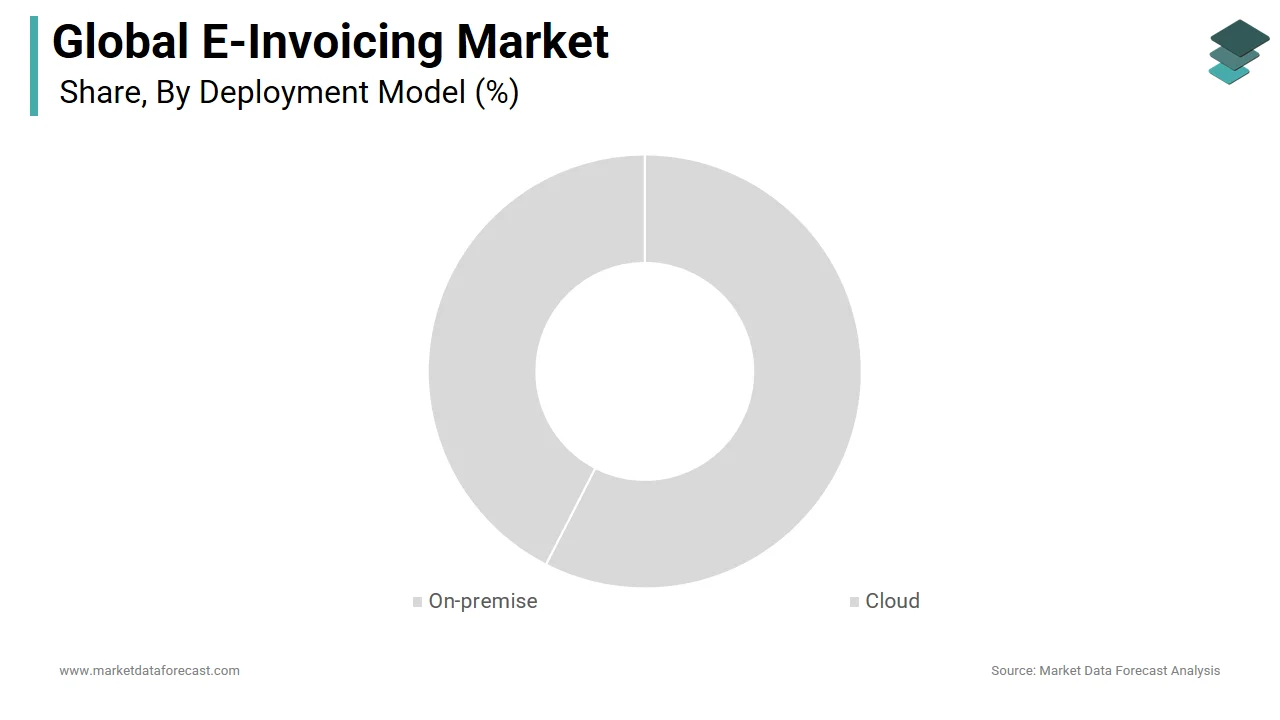
The on-premises segment, while holding a smaller market share, remains critical for highly regulated industries and large multinational corporations requiring absolute data sovereignty. The driving factor for this segment is the stringent need for complete control over sensitive financial information and adherence to specific national data residency laws. According to the Ponemon Institute, nearly 40% of financial institutions and government entities prefer on-premises solutions to mitigate the perceived security risks associated with third-party cloud providers. This preference is reinforced by the fact that on-premises deployments allow organizations to customize their security protocols and encryption standards to meet unique internal compliance requirements. As per the European Union Agency for Cybersecurity, certain sectors such as defense and healthcare are mandated by local regulations to keep critical financial data within physical borders, thereby sustaining demand for localized server infrastructure. Additionally, large enterprises with existing robust information technology infrastructure find it more economical to leverage their current assets rather than incur recurring subscription fees for cloud services, ensuring the continued relevance of on-premises deployments in specific high-security contexts.
By Business Function Insights
The business-to-business segment led the market by holding 71.4% of the global market share in 2025 due to the high frequency and complexity of corporate transactions. The domination of this segment is driven by the extensive supply chain networks that require automated reconciliation and efficient working capital management. According to the Association of Chartered Certified Accountants, large corporations process an average of 50000 invoices annually, making manual handling economically unviable and prone to errors. E-invoicing eliminates these inefficiencies by enabling straight-through processing, which reduces the invoice approval cycle from weeks to days. As per the Hackett Group, companies that implement automated business-to-business billing solutions achieve a 60% reduction in processing costs and a 40% improvement in early payment discount capture. This substantial financial benefit compels multinational corporations to mandate digital billing for all their suppliers, creating a ripple effect throughout the entire supply chain. The need for transparency and auditability in corporate procurement further reinforces the dominance of this segment as businesses seek to maintain strict compliance with internal controls and external regulatory frameworks.
The business-to-consumer segment, while smaller in volume, is experiencing significant evolution as retailers seek to enhance customer experience and reduce administrative overhead. The driving factor here is the increasing consumer expectation for instant digital receipts and seamless return processes. According to Nielsen, nearly 80% of consumers prefer receiving digital receipts via email or mobile applications due to environmental concerns and convenience. This shift allows retailers to reduce paper consumption and printing costs significantly. As per the National Retail Federation, implementing digital receipt systems can save retailers up to 5 dollars per transaction in material and labor costs. Furthermore, digital billing enables retailers to engage in targeted marketing by analyzing purchase patterns and offering personalized promotions directly through the invoice channel. This transformation of the invoice from a static document into an interactive customer engagement tool is driving adoption in the retail, hospitality, and telecommunications sectors. The integration of business-to-consumer billing with loyalty programs and mobile wallets further enhances its appeal, creating a closed-loop ecosystem that benefits both merchants and shoppers.
REGIONAL ANALYSIS
Europe E-Invoicing Market Analysis
Europe held the leading position in the global market in 2025 with 34.3% of the global market share due to its pioneering role in digital tax administration. The region is characterized by a complex patchwork of national mandates that are gradually converging toward a unified European standard. According to the European Commission, the implementation of the ViDA initiative aims to harmonize value-added tax rules across all member states by 2028, requiring real-time digital reporting for all cross-border transactions. This legislative framework is driving widespread adoption as businesses strive to comply with diverse national requirements such as the Facturae system in Spain and the ZUGFeRD format in Germany. As per Eurostat, the digitalization of public procurement in Europe has saved governments over 5 billion euros annually in administrative costs. The strong emphasis on environmental sustainability also contributes to market growth as corporations seek to eliminate paper waste. The presence of major technology providers and a highly skilled workforce further supports the advanced state of the market in this region, making it a benchmark for global best practices in digital billing.
North America E-Invoicing Market Analysis
North America played a promising role in the global market in 2025 and is estimated to continue holding a promising share of the global market throughout the forecast period, owing to a high degree of private sector-led adoption rather than strict government mandates. The United States and Canada are seeing rapid growth driven by the need for operational efficiency and integration with advanced enterprise resource planning systems. According to the Small Business Administration, over 60% of American small businesses have adopted some form of digital billing to streamline their accounts receivable processes. The market is heavily influenced by the dominance of large cloud-based financial software providers who offer seamless invoicing modules as part of their broader suites. As per the Canadian Revenue Agency, the voluntary adoption of electronic filing and billing has increased by 15% year over year due to incentives and improved user interfaces. The focus in this region is on enhancing customer experience and accelerating cash flow through automated payment reminders and online payment gateways. The lack of a federal mandate allows for greater innovation and flexibility in solution design, fostering a competitive landscape where vendors compete on features and usability rather than mere compliance.
Asia Pacific E-invoicing Market Analysis
The Asia Pacific is likely to witness widespread deployment of mobile-first compliance systems and deep electronic infrastructure rollouts over the next few years, driven by rapid economic expansion and aggressive digitalization initiatives in emerging economies. Countries like China, India, and South Korea are leading the charge with mandatory E-invoicing frameworks aimed at formalizing the economy and boosting tax revenues. According to the Asian Development Bank, the implementation of digital tax systems in Southeast Asia has increased domestic revenue collection by 12% in the past three years. In China, the widespread adoption of mobile payment platforms has seamlessly integrated E-invoicing into everyday consumer transactions. As per the Ministry of Finance in India, the Goods and Services Tax Network has processed over 1 billion electronic invoices monthly, demonstrating the massive scale of adoption. The region benefits from a young, tech-savvy population and high smartphone penetration, which facilitates the uptake of mobile-first billing solutions. Government support through subsidies and training programs further accelerates adoption among small and medium enterprises, making the Asia Pacific a critical growth engine for the global market.
Latin America E-invoicing Market Analysis
Latin America is likely to experience stricter pre-approval parameters and broader adoption of real-time fiscal reporting structures over the next few years, and be recognized as a pioneer in continuous transaction controls and real-time tax reporting. Countries such as Brazil, Mexico, and Chile have implemented some of the most stringent E-invoicing mandates globally, requiring pre-approval of invoices by tax authorities before they can be issued. According to the Inter-American Development Bank, these rigorous systems have helped reduce the tax gap by up to 20% in several Latin American nations. The market is characterized by high compliance complexity, which drives demand for specialized local software providers who understand the intricate regulatory nuances. As per the Brazilian Federal Revenue Service, over 95% of all business-to-business transactions in Brazil are now conducted electronically. The success of these early adopters is influencing neighboring countries to implement similar frameworks. The region presents unique challenges regarding infrastructure connectivity in rural areas, but the overall trend is strongly positive as businesses recognize the operational benefits of automated compliance and faster payment cycles despite the initial implementation hurdles.
The respective countries across the Middle East and Africa are likely to implement mandatory rollouts for mid-and small-tier taxpayers alongside heavy digital funding over the next few years, but are witnessing significant momentum due to recent regulatory reforms and infrastructure investments. Saudi Arabia and the United Arab Emirates have recently introduced mandatory E-invoicing phases as part of their broader economic diversification strategies. According to the Zakat Tax and Customs Authority in Saudi Arabia, the first phase of e-invoicing implementation achieved a 90% compliance rate among large taxpayers within the first six months. This rapid adoption is supported by substantial government investment in digital infrastructure and cybersecurity. As per the African Union, the development of pan-African digital trade frameworks is expected to boost electronic billing adoption across the continent by facilitating cross-border commerce. South Africa and Nigeria are also making strides in digital tax administration, although progress is uneven due to varying levels of technological readiness. The region offers substantial untapped potential as governments seek to broaden their tax bases and improve fiscal transparency, driving steady growth in the coming years.
COMPETITIVE LANDSCAPE
The competition in the E-invoicing market is intense and characterized by a mix of global technology giants and specialized regional providers. Large enterprise software vendors leverage their existing customer relationships and broad product portfolios to offer integrated billing solutions. Meanwhile, niche players compete on deep regulatory expertise and localized compliance capabilities. The barrier to entry is moderate due to the complexity of varying national tax laws, but high due to the need for robust security and scalability. Innovation in artificial intelligence and automation is becoming a key differentiator as customers seek greater efficiency. Price competition is prevalent in the small business segment, while large enterprises prioritize functionality and support. Strategic alliances with financial institutions and government bodies are crucial for success. The market is consolidating as larger firms acquire smaller innovators to fill technology gaps. Overall, the competitive landscape is dynamic with continuous pressure to adapt to changing regulatory requirements and technological advancements.
KEY MARKET PARTICIPANTS
The major companies operating in the global e-invoicing market include
- Basware Corporation
- Cegedim SA
- Comarch SA
- Coupa Software Inc.
- IBM Corporation
- Nipendo Ltd.
- SAP SE
- Oracle Corporation
- Thomson
- The Sage Group Plc
- Tradeshift
- Transcepta LLC
TOP PLAYERS IN THE MARKET
- SAP SE is a global leader in enterprise software, providing comprehensive E-invoicing solutions integrated within its widely used enterprise resource planning platforms. The company leverages its extensive customer base to drive adoption of its Ariba network, which connects millions of buyers and suppliers globally. SAP recently enhanced its artificial intelligence capabilities to automate invoice matching and anomaly detection, significantly reducing manual intervention. By focusing on end-to-end process automation, SAP helps large multinational corporations streamline their procure-to-pay cycles. The company continues to invest heavily in cloud infrastructure and partnerships with local tax authorities to ensure global compliance. Its strategic acquisitions of niche fintech firms have further strengthened its portfolio, allowing it to offer tailored solutions for diverse regulatory environments. SAP's commitment to innovation and its robust ecosystem make it a pivotal player in shaping the future of digital billing and financial supply chain management worldwide.
- Oracle Corporation offers a powerful suite of cloud-based financial applications that include advanced E-invoicing functionalities designed for scalability and security. The company focuses on providing a unified platform that integrates billing with treasury and risk management modules. Oracle has recently expanded its global tax engine to support real-time reporting requirements in key markets such as Europe and Latin America. Its machine learning algorithms predict cash flow trends and optimize working capital for enterprise clients. Oracle actively collaborates with government agencies to align its solutions with evolving statutory mandates. The company emphasizes data integrity and cybersecurity, ensuring that sensitive financial information is protected against emerging threats. Through continuous product enhancements and strategic alliances with system integrators, Oracle maintains a strong competitive position. Its ability to handle complex multi-currency and multi-language transactions makes it a preferred choice for global enterprises seeking robust and compliant billing infrastructure.
- Thomson Reuters is a prominent provider of tax and compliance solutions offering specialized E-invoicing services through its ONESOURCE platform. The company excels in navigating complex regulatory landscapes, providing accurate and up-to-date tax content embedded within its billing solutions. Thomson Reuters recently upgraded its digital verification tools to support continuous transaction controls in multiple jurisdictions. Its focus on regulatory intelligence ensures that clients remain compliant with changing laws without manual oversight. The company serves a wide range of industries, including financial services, manufacturing, and retail. By combining deep tax expertise with advanced technology, Thomson Reuters helps businesses mitigate compliance risks and avoid penalties. Its global reach and local knowledge enable it to deliver customized solutions that address specific regional requirements. Thomson Reuters continues to innovate by integrating blockchain technology for enhanced audit trails and transparency, reinforcing its reputation as a trusted partner in digital tax and billing compliance.
TOP STRATEGIES USED BY KEY MARKET PARTICIPANTS
Key players in the E-invoicing market primarily employ strategic partnerships and acquisitions to expand their geographic footprint and enhance technological capabilities. Companies frequently collaborate with local tax authorities and system integrators to ensure seamless compliance with regional mandates. Product innovation through the integration of artificial intelligence and blockchain technology is another critical strategy used to differentiate offerings and improve automation. Vendors also focus on developing user-friendly interfaces to accelerate adoption among small and medium enterprises. Additionally, many firms are transitioning to subscription-based cloud models to generate recurring revenue and improve customer retention. Investing in cybersecurity measures is paramount to building trust and protecting sensitive financial data. These combined strategies enable market leaders to maintain a competitive advantage and drive sustained growth in a rapidly evolving regulatory landscape.
MARKET SEGMENTATION
This research report on the global e-invoicing market has been segmented and sub-segmented based on the deployment model, business function, and region.
By Deployment Model
- On-premise
- Cloud
By Business Function
- B2B
- B2C
- Others
By Region
- North America
- Europe
- Asia-Pacific
- Latin America
- Middle East and Africa