- Product Description Description
- Table of Contents TOC
- List of Table & Figure LOT
- Get Free Sample PDF Sample PDF
Market Size, 2025
$871.5 MnMarket Estimate, 2026
$925.5 MnMarket Forecast, 2034
$1.49 BnCAGR, 2026–2034
6.2%Executive Summary: Global Edible Packaging Market
- Market Scope: Comprehensive global evaluation of consumable films, coatings, and containers derived from polysaccharides, proteins, or lipids that replace conventional plastic wrappings to address food waste and single-use plastic disposal.
- Market Valuation: Valued at USD 871.50 million in 2025, reaching USD 925.53 million in 2026, and projected to expand to USD 1.49 billion by 2034, registering a compound annual growth rate (CAGR) of 6.20% from 2026 to 2034.
- Primary Growth Drivers: Intense global regulatory pressure and bans against single-use plastics (e.g., EU Single-Use Plastics Directive), consumer shifts toward sustainability, and urban-driven demand for single-serve and on-the-go food formats.
Key Market Segment Metrics (2026–2034)
| Category | Leading Segment / Core Focus | Fastest-Growing / Key Segments |
|---|---|---|
| By Material | Polysaccharides (held the largest share of 47.5% in 2025 driven by structural versatility, low feedstock costs, and GRAS status of starch, cellulose, and alginate) | Protein-Based Films (projected to witness the fastest CAGR of 18.3% fueled by breakthroughs in whey, soy, and zein protein isolation for superior tensile strength) |
| By End-User | Food & Beverages (dominated in 2025 by replacing plastic waste in single-serve snacks, condiment sachets, coffee pod liners, and zero-waste formats) | Pharmaceuticals (estimated to register the fastest CAGR of 21.6% due to innovations in dissolvable protein capsules, mucoadhesive strips, and ODTs) |
| By Region | North America (top regional performer holding 34.4% of the global share in 2025 supported by biobased mandates and high retail adoption) | Europe & Asia-Pacific (Europe second at 29.1% driven by circular economy laws; APAC expanding rapidly via high demographic density and policy urgency) |
Major Market Players & Industry Landscape
Competitive Structure: Dynamic, non-linear market landscape where material science startups (e.g., Notpla, Evoware) rival global food conglomerates (e.g., Mondelez) through material breakthroughs, hyper-local sourcing, and open-source platforms.
Key Companies Profiled: Monosol, WikiCell Designs, Tipa Corp, Tate and Lyle Plc, BluWrap, Watson, Inc., Safetraces Inc., Coolhaus, Tomorrow Machine, JRF Technology, Ecoactive, EnviGreen Biotech Private Ltd, Devro Plc, Mondelez International, Notpla Ltd., and Evoware.
 Download Free Sample Report
Global Edible Packaging Market Size
The global edible packaging market size was expected to be worth USD 871.50 million in 2025 and is anticipated to be worth USD 1.49 billion by 2034, from USD 925.53 million in 2026, growing at a CAGR of 6.20% during the forecast period.
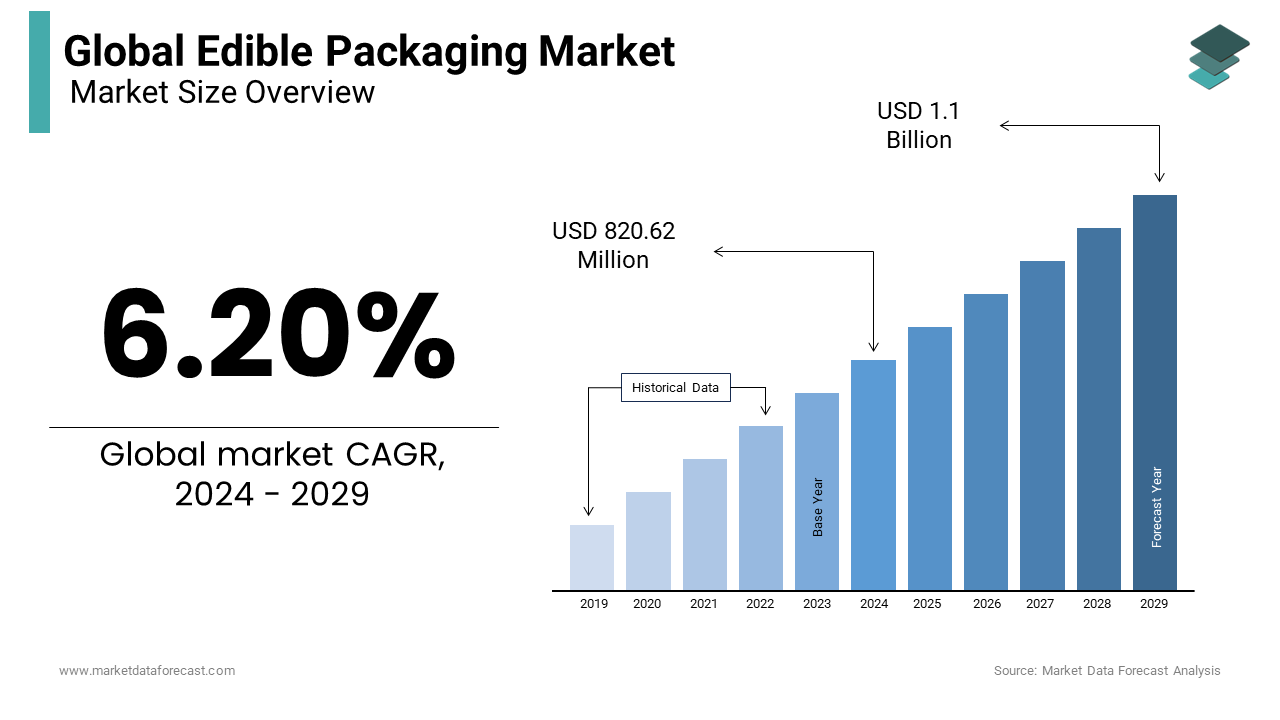
Edible packaging is consumable films, coatings, and containers derived from polysaccharides, proteins, or lipids that replace conventional plastic wrappings. This domain intersects food technology, circular economy principles, and waste mitigation imperatives. As per the United Nations Environment Programme, global food systems generate 931 million tonnes of waste annually, of which packaging contributes significantly to the landfill burden. Simultaneously, the Food and Agriculture Organization confirms that 14% of food produced is lost between harvest and retail, often due to inadequate or non-biodegradable packaging. Edible packaging offers dual utility, that is, containment and consumption by eliminating post-use disposal.
MARKET DRIVERS
Regulatory Push Toward Biodegradable Alternatives Driving Edible Packaging Market
The intensifying global regulatory burden against single-use plastics is compelling manufacturers to pivot toward biodegradable alternatives, which is amplifying the growth of the edible packaging market. The European Union’s Single-Use Plastics Directive, effective since July 3, 2021, bans specific single-use plastic products for which affordable, sustainable alternatives exist. These include plastic cutlery, plates, and food containers made of expanded polystyrene. As per the study, millions of metric tonnes of plastic waste were generated globally, with a lesser share effectively recycled. This regulatory tailwind is further amplified by consumer sentiment. Like, according to a study, a portion of global consumers would alter purchasing habits to reduce environmental impact.
Urbanization and On-the-Go Lifestyles Fueling Demand for Edible Packaging
The expansion of single-serve and on-the-go food formats within urban centers where convenience intersects with sustainability accelerates the growth rate of the edible packaging market. By 2050, roughly two-thirds of the global population is projected to live in urban areas, according to the United Nations. This shift to urban centers, along with increasingly busy, on-the-go lifestyles, is linked to a heightened demand for convenient and portable snacks. A growing number of consumers also seek portion-controlled foods to help manage their health and diets. Edible packaging satisfies this by eliminating secondary waste. For instance, WikiFoods’ edible skin for yogurt spheres and Notpla’s seaweed-based capsules for condiments have reduced packaging mass compared to conventional equivalents.
MARKET RESTRAINTS
Regulatory Ambiguity and Food Safety Concerns Hindering Market Growth
The absence of universally accepted food safety and labeling protocols for edible packaging materials across jurisdictions is a key factor constraining the expansion of the edible packaging market. The Codex Alimentarius Commission, which establishes international food standards, has yet to codify compositional or allergen declaration norms specific to edible films, creating regulatory ambiguity. As per the study, mislabeling or undeclared allergens in novel food formats contribute to millions of annual cases of foodborne illness globally. This regulatory lag stifles cross-border commercialization. For example, an edible rice-paper wrapper deemed safe in Thailand may lack approval in the European Food Safety Authority’s Novel Food Catalogue, which delays market entry several months. Lack of harmonized standards causes manufacturers to face prohibitive compliance costs and liability exposure, deterring scalability despite their technological readiness.
Barrier Performance Limitations Restricting Shelf-Life and Market Adoption
The intrinsic limitation in barrier performance against moisture, oxygen, and microbial ingress, which compromises shelf-life for moisture-sensitive or perishable goods, restricts the expansion of the edible packaging market. As per research, a percentage of edible film prototypes fail accelerated shelf-life testing beyond several days under ambient conditions, which renders them unsuitable for ambient distribution chains. For context, the ready-to-eat meals must maintain microbial safety for a minimum of 3-4 days. Current lipid-protein composite films exhibit water vapor transmission rates exceeding 15 g/m²/day, nearly triple the 5 g/m²/day threshold required for dry snack preservation, as per the study. Edible packaging remains confined to niche and short-shelf-life applications, which constrains market penetration until material science breakthroughs achieve parity with synthetic polymers in barrier efficacy.
MARKET OPPORTUNITIES
Nutrient-Infused Edible Films Creating Functional Food Opportunities
The integration of functional ingredients, such as vitamins, probiotics, or antimicrobials, directly into the packaging matrix by transforming passive wrappers into active nutrient delivery systems opens new opportunities for the edible packaging market. According to a study, a large number of people suffer from micronutrient deficiencies, while the World Health Organization attributes a significant number of child deaths to vitamin A deficiency alone. Edible films infused with encapsulated retinol or iron chelates can serve as covert fortification vectors without altering core product taste. Startups have demonstrated bioavailability retention of embedded nutrients post-ingestion. Regulatory agencies, including Health Canada, classify such nutrient-infused films as food contact materials with nutritional function. This opens pathways for dual health claims and expanded reimbursement eligibility in institutional feeding programs.
Biotechnology Advancements Driving Next-Generation Edible Packaging
The convergence of edible films and coatings with precision fermentation and cellular agriculture that enables animal-free protein films with superior mechanical as well as barrier properties is likely to give potential opportunities for the expansion of the edible packaging market. As per research, investment in fermentation-derived biomaterials surged, with a percentage allocated to structural food-grade polymers. Mycelium- and casein-alternative films produced via microbial synthesis exhibit tensile strengths exceeding 40 MPa, comparable to low-density polyethylene, while remaining fully digestible. These materials also sidestep allergenicity concerns tied to dairy or gluten. This technological synergy enhances performance and also aligns with ESG mandates of major foodservice chains by unlocking B2B contracts previously inaccessible to plant-based films.
MARKET CHALLENGES
Consumer Perception and Psychological Barriers Limiting Adoption
Consumer psychological resistance to consuming packaging, which is rooted in deeply ingrained hygiene perceptions and cultural taboos surrounding eating the wrapper, impacts the growth of the edible packaging market. As per the study, a portion of respondents in G7 nations expressed discomfort with the concept of ingesting packaging materials, even when assured of safety. This aversion is amplified in regions with high food safety incident histories. China recorded a large number of consumer complaints related to foreign material in food, despite none involving edible films. Overcoming this requires not only sensory optimization but also behavioral re-education through experiential marketing, yet current pilot programs show only a portion repeat purchase rates post-initial trial, as per research. Market adoption remains contingent on novelty rather than habit without dismantling this perceptual barrier.
High Production Costs and Lack of Industrial-Scale Infrastructure
The lack of industrial-scale manufacturing infrastructure capable of producing consumable films at competitive cost and throughput impedes the rise of the edible packaging market. As per the study, current rotary molding and solvent casting lines for edible polymers operate at a lower speed than conventional blown-film extrusion lines for polyethylene. This throughput deficit translates to production high costs per square meter for seaweed-based films, compared to those for LDPE, as per the research. Furthermore, a small share of global flexible packaging converters possess cleanroom-certified zones required for food-grade film lamination, according to a study. Edible packaging remains a premium-tier solution inaccessible to mass-market FMCG brands until capital expenditure aligns with economies of scale.
REPORT COVERAGE
| REPORT METRIC | DETAILS |
| Market Size Available | 2025 to 2034 |
| Base Year | 2025 |
| Forecast Period | 2026 to 2034 |
| CAGR | 6.20% |
| Segments Covered | By Material, End-User & Region |
| Various Analyses Covered | Global, Regional, and Country-Level Analysis; Segment-Level Analysis; DROC; PESTLE Analysis; Porter’s Five Forces Analysis; Competitive Landscape; Analyst Overview of Investment Opportunities |
| Regions Covered | North America, Europe, APAC, Latin America, Middle East & Africa |
| Market Leaders Profiled | Monosol, WikiCell Designs, Tipa Corp, Tate and Lyle Plc, BluWrap, Watson, Inc, Safetraces Inc, Coolhaus, Tomorrow Machine, JRF Technology, Ecoactive, EnviGreen Biotech Private Ltd, Devro Plc, and Others. |
SEGMENTAL ANALYSIS
By Material Insights
The polysaccharides segment held the largest share of 47.5% of the edible packaging market in 2025. The dominance of the polysaccharides segment in the global market is primarily driven by the structural versatility and broad regulatory acceptance of starch, cellulose, alginate, and chitosan derivatives. Starch-based films alone account for a portion of all polysaccharide applications, primarily due to their compatibility with existing extrusion technologies. According to the research, global starch production exceeded significant millions of metric tonnes, which ensures abundant and low-cost feedstock. Furthermore, cellulose films derived from wood pulp or bacterial synthesis demonstrate oxygen transmission rates below 5 cc/m²/day, which is important for preserving dry snacks, as per the study. This material class also benefits from GRAS status under the U.S. FDA, which accelerates commercial deployment without novel food petition delays.
The protein-based films segment is anticipated to witness the fastest CAGR of 18.3% from 2026 to 2034. The rapid acceleration of the protein-based films segment is fuelled by breakthroughs in whey, soy, and zein protein isolation that enhance tensile strength beyond 35 MPa while retaining water solubility under controlled humidity. According to research, dairy co-products, particularly acid whey from Greek yogurt production, which totals 2.1 million metric tonnes annually in the U.S. alone, are being repurposed into film-forming isolates, turning waste streams into value. Simultaneously, plant-based protein films derived from pea and fava bean isolates have demonstrated biodegradation within a number of days in industrial composting environments, as per the study.
By End-User Insights
In 2025, the Food & Beverages segment dominated the edible packaging market by occupying a substantial share 2025. The urgent need to decouple single-serve convenience from plastic waste is contributing to the growth of the food & beverages segment in the global market. According to the study, a percentage of global food packaging waste originates from snack, beverage, and condiment formats. Edible films are uniquely suited for applications such as coffee pod liners, sauce sachets, and candy wrappers, categories where post-consumption disposal is most problematic. Both Nestlé and Unilever are actively working to reduce packaging and innovate with more sustainable materials. Consumer acceptance is further validated by a study, which found that a portion of millennial shoppers actively seek zero-waste snack formats, which creates commercial pull unmatched by other sectors.
The Pharmaceuticals segment is estimated to register the fastest CAGR of 21.6% over the forecast period, owing to factors such as innovations in dissolvable protein capsules and mucoadhesive polysaccharide strips that deliver precise dosages without synthetic polymers. The demand for ODTs has grown significantly, especially for pediatric and geriatric patients and those with swallowing difficulties (dysphagia). The pharmaceutical industry continues to develop new technologies for ODT formulation to improve taste-masking, bioavailability, and overall patient compliance. Regulatory tailwinds are equally potent. According to research, chitosan-alginate edible shells increase the bioavailability of poorly soluble APIs, which creates therapeutic incentives beyond environmental compliance.
REGIONAL ANALYSIS
North America Market Analysis
North America outperformed other regions in the edible packaging market by capturing 34.4% of the global market share in 2025. The prominence of North America in the global market is largely propelled by technological advancements, synchronized policy, venture funding, and consumer behavior. The USDA's BioPreferred Program mandates federal agencies and contractors to purchase biobased products from designated categories. Simultaneously, Health Canada has approved new edible files, the highest national approval rate globally. Retail penetration is accelerating: Walmart reports that a portion of its new product launches in 2023 incorporated edible wraps, with repeat purchase rates higher than conventional plastic-packaged equivalents.
Europe Market Analysis
Europe was positioned second in the edible packaging market by accounting for 29.1% in 2025. The growth of Europe in the global market is driven by regulatory architecture and circular economy integration. The EU’s Farm to Fork Strategy explicitly funds edible packaging pilots under Horizon Europe, allocating a substantial amount to cross-border consortia developing seaweed- and mycoprotein-based films. Germany has established the edible packaging allergen labeling protocol, which has been adopted by many member states. France’s Anti-Waste Law compels food service providers to eliminate single-use plastics, which creates statutory demand. Retail compliance is visible. Europe’s strength lies in codifying norms that convert innovation into enforceable market practice.
Asia Pacific Market Analysis
Asia-Pacific is seen as the region with substantial growth potential in the edible packaging market due to demographic density and policy urgency. India’s Food Safety and Standards Authority has fast-tracked approvals for rice bran and tapioca starch films, recognizing their alignment with traditional food practices. A portion of Indian households already consume banana leaf or rice paper wraps culturally. China included edible packaging in its Five-Year Plan for Plastic Pollution Control, which targets a percentage of substitution in convenience food channels. Japan subsidizes SME adoption of edible films, with numerous manufacturers receiving grants. Urbanization intensifies demand. Jakarta, Manila, and Mumbai collectively generate notable tonnes of daily food packaging waste, as per a study. This creates visceral strain on edible alternatives in street food and delivery ecosystems.
Latin America Market Analysis
Latin America grew steadily in the edible packaging market with a notable per capita pilot adoption rate in Brazil and Mexico. Brazil's National Health Surveillance Agency (Anvisa) has established a regulatory framework for novel foods and ingredients. In recent years, Anvisa has modernized its regulations for novel foods and ingredients. Mexico City's zero-waste initiatives include a ban on single-use plastic items for businesses, including street vendors. The regulation requires the use of compostable materials. The law's impact on micro-enterprises has been acknowledged, with vendors exploring alternatives such as compostable plastic, paper, and natural materials.
Middle East and Africa Market Analysis
The Middle East and Africa are expected to expand in the edible packaging market over the forecast period. Also, it exhibits the most accelerated institutional adoption curve, particularly in the Gulf Cooperation Council states and South Africa. Saudi Arabia’s Vision 2030 Circular Economy Initiative allocates millions to edible packaging infrastructure, targeting a reduction in municipal solid waste from food service by 2030. South Africa funds seaweed cultivation specifically for alginate film production by leveraging kilometres of coastline. As per the study, a share of halal-certified food exporters in the region require edible or dissolvable primary packaging to meet Gulf Standardization Organization criteria.
COMPETITIVE OVERVIEW
The Edible packaging market exhibits a dynamic, non-linear competitive landscape where technological agility outweighs scale. Unlike mature sectors dominated by incumbents, here, startups like Notpla and Evoware rival multinationals through material breakthroughs and hyper-local deployment. Mondelez competes not by volume but by embedding edible films into global product architecture. Consumer trials, not price wars, define traction; repeat purchase rates determine survival. Regulatory first-movers gain disproportionate advantage, as seen in Europe and Indonesia. No single player controls the value chain.
KEY MARKET PLAYERS
A few of the dominating players in the global edible packaging market include
- Monosol
- WikiCell Designs
- Tipa Corp
- Tate and Lyle Plc
- BluWrap
- Watson, Inc
- Safetraces Inc
- Coolhaus
- Tomorrow Machine
- JRF Technology
- Ecoactive
- EnviGreen Biotech Private Ltd
- Devro Plc
- Others
Top Strategies Used by Key Market Participants
Key players deploy four core strategies: co-development with material scientists to overcome technical barriers, regionalized feedstock sourcing to ensure cost and cultural alignment, patent clustering around film formulations and production methods to secure IP moats, and experiential consumer trials to dismantle psychological resistance. These approaches are not siloed but integrated. Mondelez’s Singapore incubator exemplifies R&D-commercialization fusion, while Notpla’s open-source platform turns competitors into collaborators. Evoware’s farmer-integrated supply chain embeds social impact into scalability.
LEADING PLAYERS IN THE EDIBLE PACKAGING MARKET
Mondelez
Mondelez International has emerged as a pivotal force in edible packaging innovation, which is leveraging its global snack portfolio to pilot seaweed- and starch-based wrappers for single-serve confections. Mondelez also partnered with material science startups to co-develop flavor-neutral, humidity-resistant coatings, filing three new patents. Its R&D hub in Singapore now hosts a dedicated edible packaging incubator, accelerating prototyping cycles. These initiatives reflect a strategic pivot from passive adoption to active material co-creation, which embeds sustainability into product architecture rather than treating it as an add-on.
Notpla Ltd.
Notpla Ltd. has redefined scalability in bio-based edible films through its proprietary seaweed-extraction and molding technology, enabling mass production of liquid-containing capsules and flexible wraps. Collaborations with major beverage brands now focus on integrating edible liners into paperboard cartons. Notpla’s open-source material database invites third-party developers to innovate atop its platform by fostering an ecosystem rather than a proprietary silo. This accelerates category-wide adoption while strengthening its technological prowess.
Evoware
Evoware, headquartered in Jakarta, leverages Indonesia’s marine biodiversity to produce halal-certified, carrageenan-based edible films tailored for Southeast Asian Street food and condiment markets. The company introduced customizable flavor-infused wraps, which embed turmeric and lemongrass extracts to enhance consumer appeal. Evoware’s initiative directly sources seaweed from coastal farmers, which ensures traceability and rural economic uplift. Strategic alliances with regional quick-service restaurants have led to deployment across outlets, which replaces single-use sachets. Evoware’s culturally attuned and community-embedded model demonstrates how localized material sourcing and sensory design can drive grassroots commercialization unmatched by global giants.
SEGMENTAL ANALYSIS
This research report on the global edible packaging market has been segmented and sub-segmented based on material, end-user, and region.
By Material
- Lipids
- Polysaccharides
- Proteins
- Surfactants
By End-User
- Pharmaceuticals
- Food and Beverages
By Region
- North America
- Europe
- The Asia Pacific
- Latin America
- The Middle East and Africa