Global Eco-Friendly Food Packaging Market Size, Share, Trends & Growth Forecast Report Segmented By Material (Plastic, Aluminum, Paper), Application (Food &Beverages, Dairy Products, Meat & Related Products, Fruits And Vegetables), Packaging Type (Recycled Content, Reusable, Degradable), And Region (North America, Europe, APAC, Latin America, Middle East And Africa) – Industry Analysis From 2026 To 2034
Market Size, 2025
$107.3 BnMarket Estimate, 2026
$113.8 BnMarket Forecast, 2034
$181.3 BnCAGR, 2026–2034
6%Global Eco-friendly Food Packaging Market Size
The global eco-friendly food packaging market size was worth USD 107.35 billion in 2025 and is anticipated to be worth USD 181.36 billion by 2034 from USD 113.79 billion in 2026, growing at a CAGR of 6% during the forecast period. Eco-friendly food packaging produced using sustainable assets diminishes reliance on oil and lessens the amount of waste material while still yielding a product that provides benefits like conventional plastics.
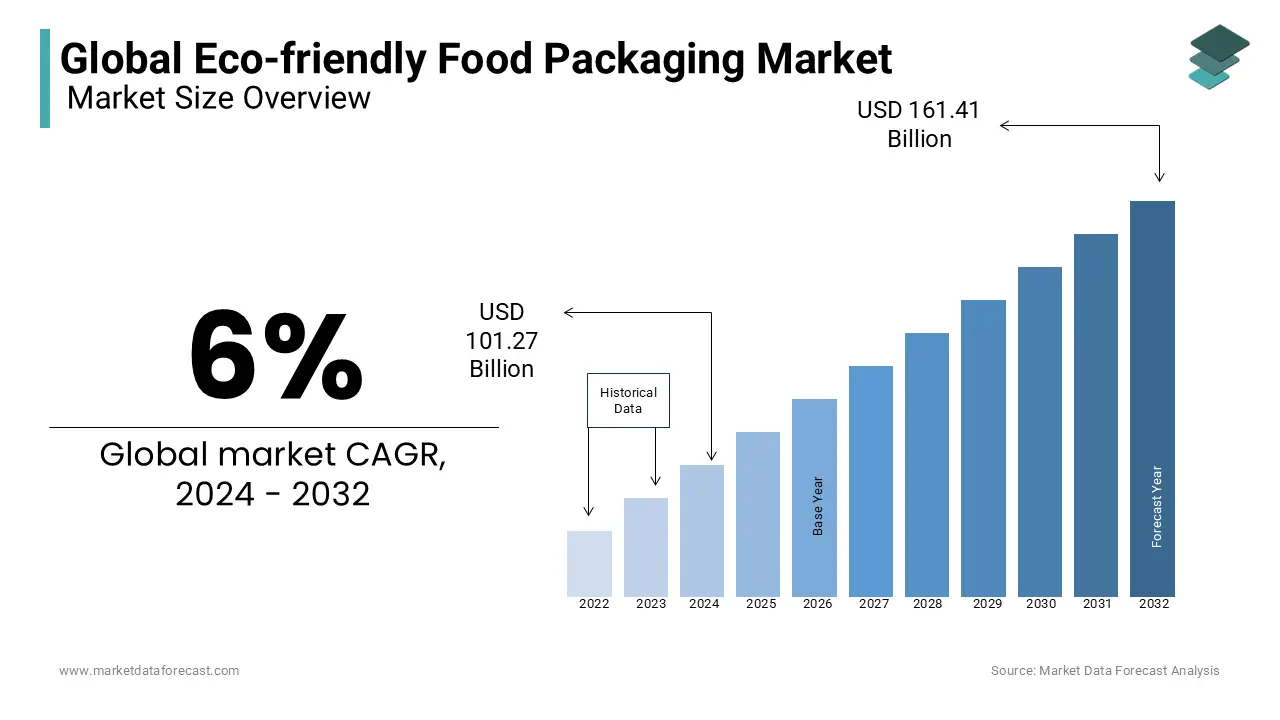
Rising shopper mindfulness in regard to the natural effect of packaging items and an eagerness to supplant packaging materials with choices with a lower carbon impression (or produced using inexhaustible assets) are the principal drivers for the turn of events and the utilization of these materials. Recyclability is required to be the best test, as an ever-increasing number of organizations that use packaging items are concentrating on recyclable and reusable packaging.
Current Scenario of the Global Eco-friendly Food Packaging Market
The global eco-friendly food packaging market has witnessed steady growth over the past few years and is expected to continue thriving during the forecast period. Eco-friendly food packaging has been gaining popularity worldwide and businesses and consumers have been increasingly considering using eco-friendly food packaging. The benefits of using eco-friendly food packaging, such as reduced environmental impact, resource conservation, and improved brand image for food companies, have been motivating the companies to shift their packaging solution to eco-friendly. In recent years, people’s awareness of environmental sustainability and the need to reduce plastic pollution have grown substantially and resulted in the adoption of eco-friendly food packaging. These factors will continue to have their impact in the coming years and propel the global market growth. The United States, Germany, France, the United Kingdom, China, and Japan are some of the early adopters of eco-friendly packaging and play a key role in the global market. The growing awareness of environmental issues among people and businesses, stringent regulations that promote sustainable practices, and changing preferences from consumers towards eco-friendly products are anticipated to have a favorable impact on the global eco-friendly food packaging market and contribute to the global market expansion.
MARKET DRIVERS
The growing awareness among consumers of environmental issues is contributing to the global eco-friendly food packaging market growth.
More and more people worldwide are becoming concerned about environmental issues. In a global study conducted by Neilsen in 2019, 81% of the participants reported that companies should take part in improving the health of the environment. This indicates that people worldwide are being cautious about the harmful impact they are having on the environment and are taking measures to minimize it. As part of that, people are increasingly using products packaged in materials that are less harmful to the environment. As per a consumer research company called GlobalWebIndex (GWI), 58% of consumers have no problem paying more for eco-friendly products. Noting this trend, several companies have been adopting eco-friendly packaging solutions to address the demands of consumers who are concerned about the environment.
Stringent government regulations on single-use plastics are another key factor propelling the growth of the eco-friendly food packaging market.
Several governments have been implementing regulations to minimize the usage of single-use plastics and promote sustainable packaging alternatives. For instance, the European Union banned the usage of single-use plastic items such as plastic plates, cutlery, straws, balloon sticks, and cotton buds with the intention of reducing the usage of these items as early as possible. Many other countries have also introduced extended producer responsibility (EPR) laws to ensure the recycling and disposal of their
Packaging materials. Such regulations have been making the companies adopt eco-friendly packaging solutions to comply with the laws and avoid penalties. An increasing number of corporate sustainability initiatives are aiding the global eco-friendly food packaging market growth.
Several companies across the world have been trying to make sustainability the core part of their business and taking measures to reduce their impact on the environment, which includes their packaging choices. The growing awareness among consumers of eco-friendly packaging is influencing several companies to adopt eco-friendly packaging as part of their CSR initiatives. In recent years, some multinational companies have announced that they will use completely recyclable materials in packaging very soon. For instance, Amazon, a giant e-commerce platform took a pledge to turn recyclable packaging by the end of 2026. Such initiatives and commitments from large-sized companies have been driving innovation in the global market and supporting global market growth.
Furthermore, factors such as Y-o-Y demand for sustainable and biodegradable packaging materials, innovations in eco-friendly packaging materials, and the growing influence of social media campaigns that promote eco-friendly practices are promoting the growth of the global eco-friendly food packaging market. The growing adoption of compostable and recyclable packaging solutions, increasing emphasis on reducing carbon footprint across supply chains, and the expansion of refill and reuse programs are favoring the growth rate of the global market.
MARKET RESTRAINTS
Higher production costs of eco-friendly food packaging compared to conventional packaging is one of the major restraints to the growth of the global market.
The availability issues of eco-friendly packaging materials, lack of standardized regulations, challenges in maintaining product freshness and shelf life, and resistance to change from traditional packaging methods are further limiting the growth rate of the global market. Insufficient infrastructure in some countries for composting and recycling, complexities in sourcing sustainable packaging materials, concerns about food safety and contamination risks, and limited consumer awareness and education about eco-friendly options are hindering the growth of the global market.
MARKET TRENDS
Beverage Packaging to be one of the Most Significant Applications
An expected number of 700,000 containers are being littered each day in the United Kingdom alone, as indicated by the Environmental Audit Committee. Such insights show the genuine requirement for Eco-friendly packaging answers for beverages. Organizations in the beverages market, like PepsiCo, have been utilizing recyclable PET jugs for their refreshments. PepsiCo's recyclable PET containers represent 30% of packaging volume in North America and 7% internationally. In any case, high assembling costs are probably going to control the act of utilizing recyclable PET for refreshment packaging across developing regions, similar to India.
Because of the developing interest for eco-friendly packaging in the beverage business across Europe, US-based Crown Holdings Inc. has opened another office in Jakarta, Indonesia. Thinking about the nation's powerful monetary development and sizable populace, such eco-friendly activities offer the noteworthy potential for Eco-friendly beverage packaging.
MARKET DYNAMICS
The global Eco-friendly food packaging market is fundamentally determined by expanding interest in eco-friendly packaging arrangements among different end-use ventures, particularly among food and beverages.
Likewise, expanding utilization of in-a-hurry food among the working populace is a factor expected to help income development of the worldwide market. In addition, rigid guidelines set by government specialists to control the use of non-recyclable materials for packaging is another factor foreseen to support the objective market development over the conjecture time frame. Notwithstanding, the unpredictable expense of crude materials and accessibility of financially savvy and interchange arrangements may hamper the development of the global eco-friendly food packaging market.
REPORT COVERAGE
| REPORT METRIC | DETAILS |
| Market Size Available | 2025 to 2034 |
| Base Year | 2025 |
| Forecast Period | 2026 to 2034 |
| CAGR | 6% |
| Segments Covered | By Material, Packaging Type, Application, And Region |
| Various Analyses Covered | Global, Regional and Country Level Analysis; Segment-Level Analysis; DROC; PESTLE Analysis; Porter’s Five Forces Analysis; Competitive Landscape; Analyst Overview of Investment Opportunities |
| Regions Covered | North America, Europe, APAC, Latin America, Middle East & Africa |
| Market Leaders Profiled | Universal Paper Company, Tetra Pak International SA, Smurfit Kappa Group PLC, Amcor Limited, and Mondi PLC |
SEGMENTAL ANALYSIS
Global Eco-friendly Food Packaging Market Analysis By Material
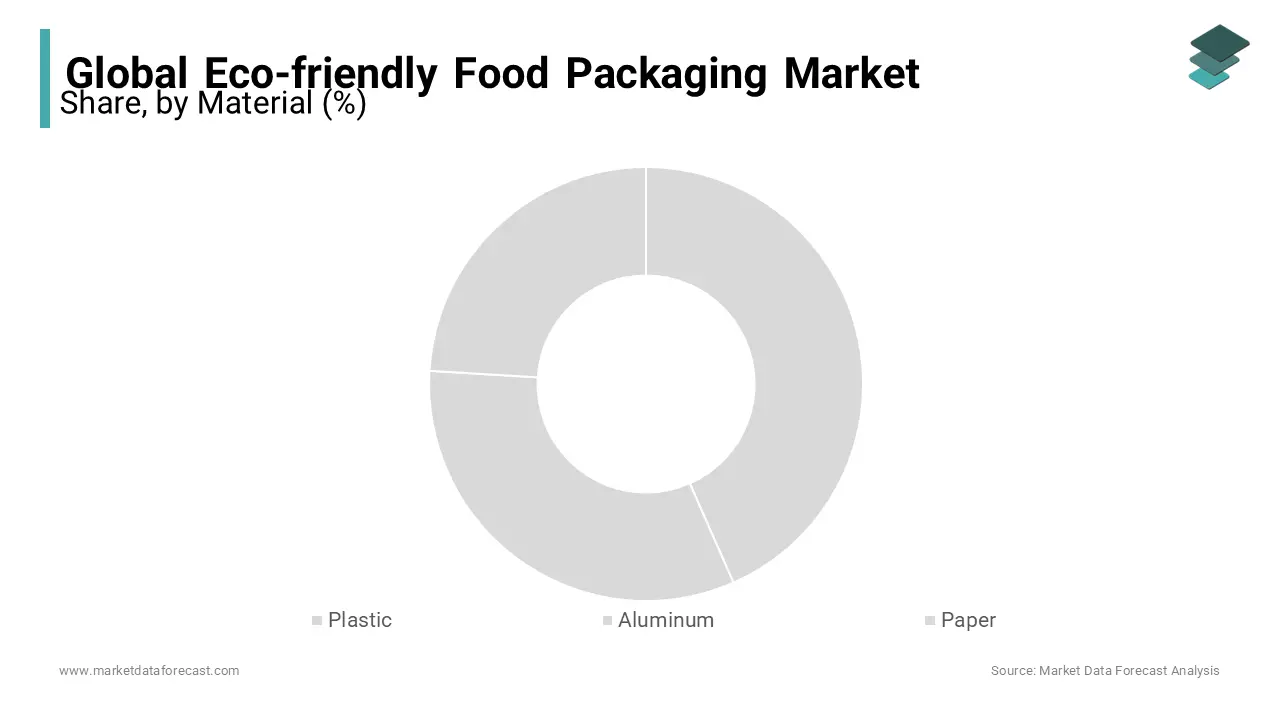
Among the material portions, the plastic fragment is anticipated to represent huge income in the worldwide market, attributable to its different properties and advantages, including solidness and lower cost.
Global Eco-friendly Food Packaging Market Analysis By Packaging Type
Based on packaging type, the industry can be divided into reused content, reusable, degradable, and other packaging arrangements. The reused content packaging portion held around 57.5% of the worldwide market in 2018. The fragment saw gigantic development in the course of recent years attributable to expanding requests from the food and beverages segment. Developing the noticeable quality of the food administration industry, inferable from mushrooming eateries, coffee shops, and so forth, is probably going to additionally support the portion over the estimated time frame.
Global Eco-friendly Food Packaging Market Analysis By Application
In 2018, the food and beverage part commanded the business and held around 58.6% of the worldwide market. Eco-friendly packaging arrangements are broadly utilized in the food administration industry. The rising noticeable quality of this industry, supported by an expanding number of burger joints, cafés, and so on, are probably going to be key sources driving interest over the expected time frame.
REGIONAL ANALYSIS
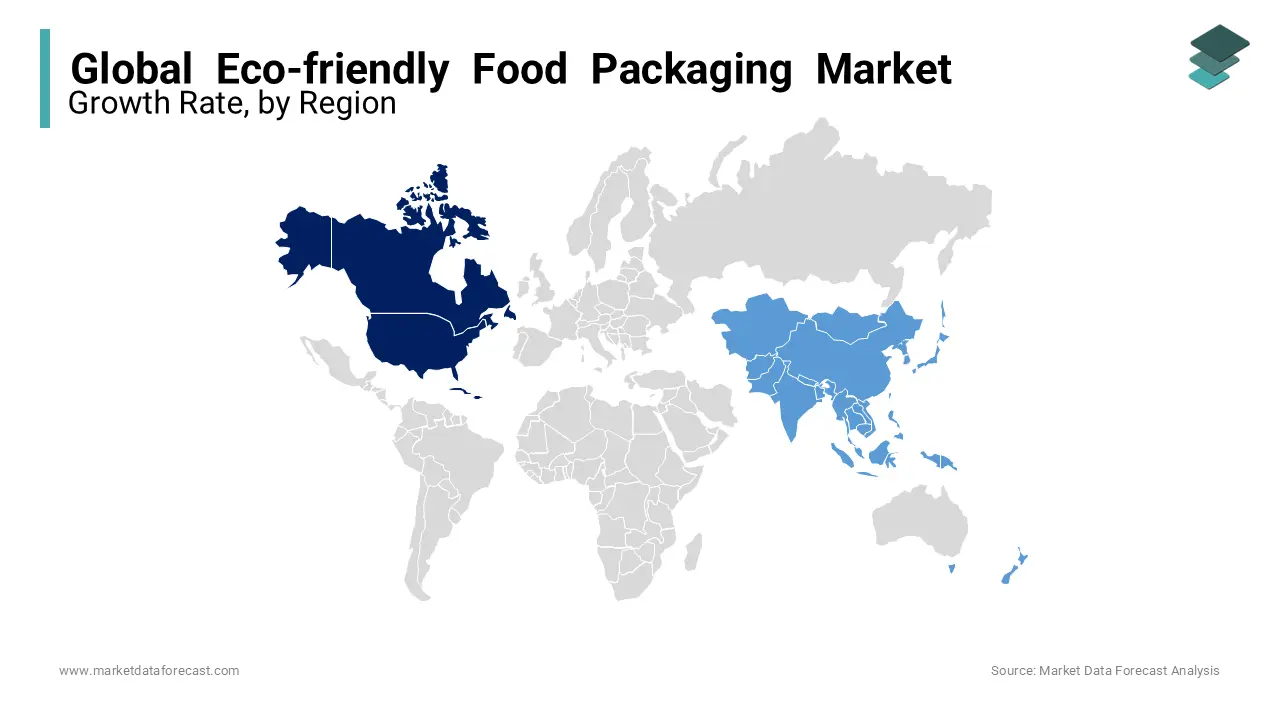
North America Eco-friendly food packaging market contributes a generous income offer to the objective market. This is credited with developing the utilization of pre-bundled food among the young populace. Likewise, a developing base of working populace combined with high discretionary cash flow is a factor supposed to help income development of the objective market in this locale. The USA is likely to account for the largest share in North America.
In the United States, the rising mindfulness among purchasers and positive guidelines from the administration are required to drive the interest in Eco-friendly packaging over the figure time frame. Strikingly, food wastage in the nation is one of the essential explanations behind expanding client mindfulness. For example, The New York Times expressed that around 60 million metric tons of food are squandered in the United States each year, which not only negatively affects the earth but also adds to the monetary weight.
Due to the previously mentioned factors, the shoppers are monitoring food wastage, inferable from which they are pushing toward durable food, which remains new for quite a while.
Markets in Europe, the Middle East and Africa, and Latin America are presumed to enlist moderate development during the forecast time. The Asia Pacific is anticipated to observe the quickest development in the global eco-friendly food packaging market during the conjecture time frame. The central point driving the eco-friendly packaging market in this area is the developing worry among buyers in regard to ecological issues. Shoppers in this locale know about the significance of eco-friendly and sustainable packaging.
KEY PLAYERS IN THE GLOBAL ECO-FRIENDLY FOOD PACKAGING MARKET
Major Key Players in the Global Eco-friendly Food Packaging Market are Universal Paper Company, Tetra Pak International SA, Smurfit Kappa Group PLC, Amcor Limited, and Mondi PLC
RECENT HAPPENINGS IN THE MARKET
- Tetra Pak propelled a set-up of new packaging materials, known as Tetra Pak Artistry, to support food and beverage makers revive the look and feel of its items.
- Amcor reported the launch of two supportable packaging advancements that help productivity and improve buyer comfort. While Polymer overlays convey an enormous sparing in material use and vitality utilization, AluFix Retort Extra's anything-but-difficult-to-peel can-end has a low ecological effect. Amcor intends to gain Bemis Co. Inc. to have a worldwide adaptable packaging impression across geologies. It will likewise expand the presentation to alluring end-market sections, including protein and social insurance packaging and innovations in boundary movies and foils.
- The US-based Kroger Co. (which arranges around 6 billion packs every year and is one of the biggest basic food item chains in the nation) declared in 2018 that it will go plastic-sack-free at all of its almost 2,800 stores by 2026.
DETAILED SEGMENTATION OF THE GLOBAL ECO-FRIENDLY FOOD PACKAGING MARKET INCLUDED IN THIS REPORT
This research report on the global eco-friendly food packaging market has been segmented and sub-segmented based on material, packaging type, application, & region.
By Material
- Plastic
- Aluminum
- Paper
By Packaging Type
- Recycled Content
- Reusable
- Degradable
By Application
- Food &Beverages
- Dairy Products
- Meat and Related Products
- Fruits and Vegetables
By Region
- North America
- Europe
- Asia Pacific
- Latin America
- Middle East and Africa
Frequently Asked Questions
1. What are the future trends in eco-friendly food packaging?
Future trends include the development of advanced materials with improved functionality, such as barrier properties and heat resistance. Additionally, there is growing interest in innovative packaging solutions, such as edible or dissolvable packaging, as well as initiatives to reduce single-use packaging through reuse and refill systems. Collaboration across sectors and investment in research and development will continue to drive innovation in this space.
2. How does eco-friendly packaging affect food preservation and safety?
Eco-friendly packaging options are designed to maintain food quality and safety throughout the supply chain. Proper selection and design ensure that packaging materials protect against moisture, oxygen, and microbial contamination, just like conventional packaging. In some cases, eco-friendly materials may even enhance food preservation due to their breathable or antimicrobial properties.
3. What are some common materials used in eco-friendly food packaging?
Common materials include biodegradable plastics (e.g., PLA, PHA), compostable materials (e.g., bagasse, cornstarch), recycled paper and cardboard, bamboo, palm leaves, and other plant-based fibers. Some innovative options also include edible packaging made from seaweed or other food-grade materials.
4. What is driving the growth of the eco-friendly food packaging market?
Growth is driven by increasing environmental awareness, government regulations on plastic use, and rising demand for sustainable packaging solutions.
5. What materials are used in eco-friendly food packaging?
Common materials include paper, cardboard, bioplastics, plant-based materials, glass, and metal.
6. What are the benefits of eco-friendly packaging?
It reduces environmental impact, supports sustainability goals, and enhances brand image among eco-conscious consumers.
7. What are biodegradable and compostable packaging?
Biodegradable packaging breaks down naturally over time, while compostable packaging decomposes into non-toxic components under composting conditions.
8. What challenges does the eco-friendly food packaging market face?
Higher costs, limited availability of materials, and performance limitations compared to traditional plastics.
9. What trends are shaping the eco-friendly packaging market?
Plant-based materials, minimal packaging, and circular economy models are key trends.
10. What is the future outlook for the eco-friendly food packaging market?
The market is expected to grow rapidly due to increasing regulations, consumer awareness, and innovation in sustainable materials.
Related Reports
Access the study in MULTIPLE FORMATS
Purchase options starting from
$ 2500
Didn’t find what you’re looking for?
TALK TO OUR ANALYST TEAM
Need something within your budget?
NO WORRIES! WE GOT YOU COVERED!
Call us on: +1 888 702 9696 (U.S Toll Free)
Write to us: sales@marketdataforecast.com