- Product Description Description
- Table of Contents TOC
- List of Table & Figure LOT
- Get Free Sample PDF Sample PDF
Market Size, 2025
$14.12 BnMarket Estimate, 2026
$17.16 BnMarket Forecast, 2034
$81.47 BnCAGR, 2026–2034
21.5%Executive Summary: Global Education and Learning Analytics Market
- Market Scope: Comprehensive global analysis of data-driven educational tools, covering software/services, deployment models, applications, and end-user segments.
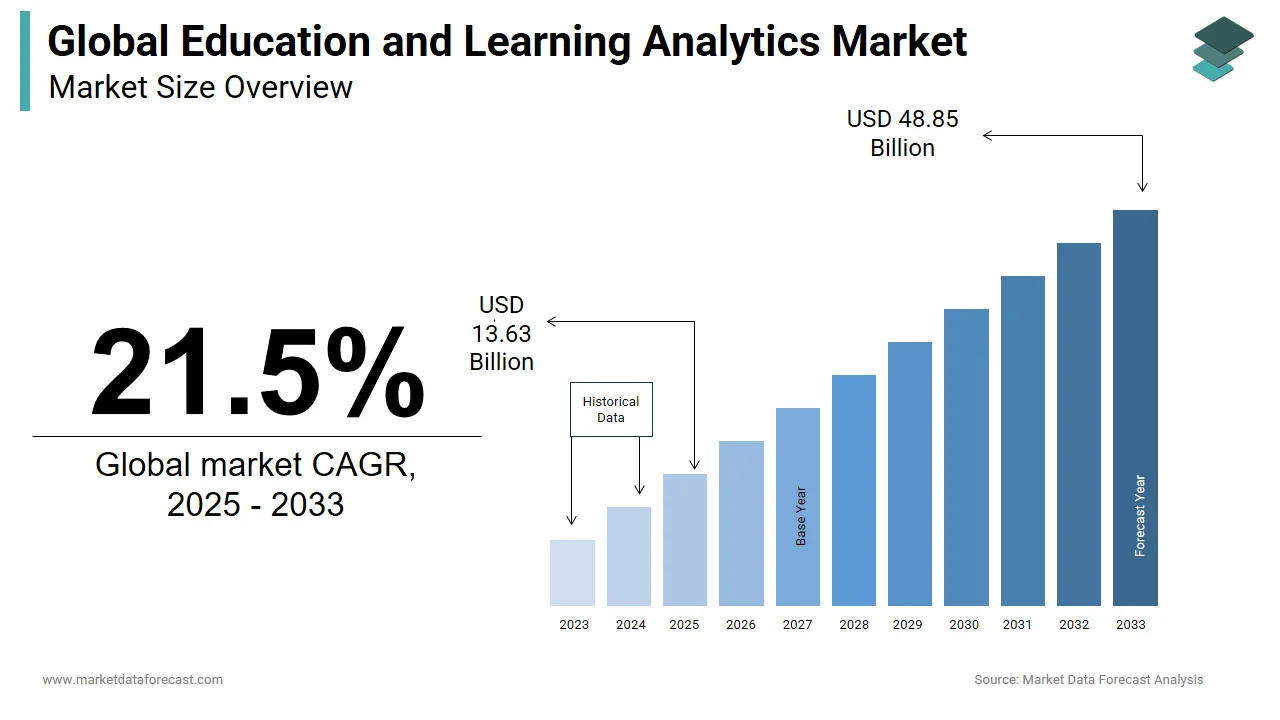
- Market Valuation: Valued at USD 14.12 billion in 2025, estimated at USD 17.16 billion in 2026, and projected to reach USD 81.47 billion by 2034, growing at a robust CAGR of 21.5%.
- Primary Growth Drivers: Massive integration of AI and Big Data in educational platforms, increasing need for real-time performance monitoring/predictive modeling to improve student retention, and expansion of corporate training/upskilling initiatives.
Key Market Segment Metrics (2026–2034)
| Category | Leading Segment Focus | Growth Focus |
|---|---|---|
| By Component | Software (Dominant; embedded dashboards in LMS) | Services (CAGR 14.2% for technical consulting/integration) |
| By Deployment | Cloud-Based (43.2% share; high remote scalability) | On-Premises (CAGR 9.1% for strict security compliance) |
| By Application | Performance Management (38.4% share) | People Acquisition & Retention (CAGR 17.5%) |
| By End-User | Higher Education (42.3% share) | Enterprises/Business (CAGR 16.3%) |
Strategic Market Context
Market Structure: High competition between established EdTech giants (Blackboard, Pearson, D2L) and agile AI-focused startups. Innovation is centered on machine learning for personalized learning paths and adaptive assessment.
Key Players: IBM, Microsoft, Oracle, SAP, SAS Institute, Blackboard Inc., Pearson PLC, D2L Corporation, Instructure Inc., and many others.
Regional Insights: North America leads with widespread adoption, while Asia-Pacific is set for the most rapid growth due to large-scale government digital education initiatives in India and China. Europe remains the leader in ethical analytics frameworks and stringent data privacy compliance.
Global Education and Learning Analytics Market Size
The global education and learning analytics market was valued at USD 14.12 billion in 2025. The market is estimated at USD 17.16 billion in 2026 and is projected to reach USD 81.47 billion by 2034, growing at a CAGR of 21.5% from 2026 to 2034.
Education and Learning Analytics is the systematic collection, analysis, and application of data generated through learning processes to enhance educational outcomes and improve institutional efficiency. These analytics tools help educators identify at-risk students, personalize instruction, and optimize curriculum design by leveraging real-time insights from student engagement, performance metrics, and behavioral patterns. According to UNESCO, over 1.6 billion learners were affected by school closures during the pandemic, accelerating the adoption of digital education platforms and increasing reliance on data-driven decision-making. Learning analytics offers a scalable solution by enabling early identification of learning gaps and facilitating targeted support strategies. Additionally, governments and private stakeholders are investing heavily in EdTech infrastructure, with McKinsey & Company reporting record levels of investment post-2020. Institutions are increasingly adopting artificial intelligence-powered platforms that use predictive modeling to forecast academic success and recommend customized learning paths.
MARKET DRIVERS
Integration of AI and Big Data in Educational Platforms
The integration of artificial intelligence (AI) and big data technologies into educational platforms is fuelling the growth of the Education and Learning Analytics Market. These technologies enable institutions to process vast amounts of learner-generated data, identifying trends, predicting outcomes, and personalizing instruction based on individual needs. According to the Massachusetts Institute of Technology (MIT), AI-enhanced learning analytics can predict student dropout risks with over 80% accuracy by allowing for timely interventions that improve retention rates.
Moreover, leading EdTech companies such as Coursera, Udacity, and Byju’s have incorporated machine learning algorithms to analyze user interactions and tailor course recommendations accordingly. The rise of intelligent tutoring systems such as Carnegie Learning’s MATHia and Squirrel AI is further amplifying demand for analytics-driven solutions. According to the Brookings Institution, AI-integrated learning platforms have shown up to a 30% improvement in knowledge retention compared to traditional instructional methods.
Demand for Real-Time Performance Monitoring and Assessment
The growing emphasis on real-time performance monitoring and assessment is another key factor propelling the Education and Learning Analytics Market forward. Traditional end-of-term assessments are being supplemented with continuous evaluation techniques that rely on data analytics to track student progress dynamically. Educational institutions are increasingly adopting learning management systems (LMS) equipped with embedded analytics dashboards. Platforms like Moodle, Blackboard, and Canvas now offer features that allow instructors to monitor quiz responses, video views, discussion participation, and assignment submissions in real time. Furthermore, organizations like Khan Academy and Duolingo use analytics to assess user behavior and adjust content difficulty levels dynamically. As per LinkedIn’s Workplace Learning Report, over 60% of enterprise learning leaders now rely on real-time analytics to evaluate employee skill development and training efficacy.
MARKET RESTRAINTS
Concerns Over Student Data Privacy and Ethical Use
The increasing concern regarding student data privacy and ethical usage of collected information is hindering the growth of the Education and Learning Analytics Market. Educational institutions and online learning platforms gather extensive data on learners, including academic records, behavioral patterns, and even biometric indicators in some cases. According to the United Nations Children's Fund (UNICEF), more than 80% of parents surveyed in Europe expressed concerns about how their children’s educational data is stored, accessed, and protected. Regulatory frameworks such as the General Data Protection Regulation (GDPR) in Europe and the Family Educational Rights and Privacy Act (FERPA) in the United States impose strict limitations on data collection and processing, often complicating the deployment of comprehensive analytics solutions. Additionally, ethical dilemmas surrounding algorithmic bias and automated decision-making are gaining attention.
Limited Infrastructure and Digital Literacy in Developing Regions
The lack of adequate technological infrastructure and digital literacy in many developing regions is also restraining the growth of the Education and Learning Analytics Market. According to the World Bank, less than 30% of schools in Sub-Saharan Africa and South Asia have reliable internet access, hindering the deployment of cloud-based analytics tools. Even in developed nations, many public schools face outdated hardware, inconsistent bandwidth, and fragmented software ecosystems.
Digital literacy among educators also remains a barrier to widespread adoption. A survey conducted by the National Education Association (NEA) found that nearly 40% of U.S. teachers lacked confidence in using data analytics tools effectively. In emerging markets, this gap is even wider, with only 25% of school administrators in low-income regions feeling adequately prepared to implement data-driven learning strategies, as per the International Society for Educational Technology (ISTE).
Moreover, financial constraints limit the ability of underfunded institutions to invest in robust analytics platforms. As per the Organisation for Economic Co-operation and Development (OECD), many schools in Latin America and Southeast Asia struggle to maintain even basic digital infrastructure, let alone advanced analytics capabilities.
MARKET OPPORTUNITIES
Expansion into Corporate Training and Lifelong Learning Programs
The expansion of corporate training and lifelong learning initiatives shall pose new growth opportunities for the growth of the Education and Learning Analytics Market. Businesses are increasingly investing in workforce development programs that leverage analytics to measure employee performance, identify skill gaps, and deliver personalized learning experiences with rapid digital transformation and evolving job requirements. According to the Association for Talent Development (ATD), companies that utilize learning analytics report a 20% increase in employee productivity and training efficiency. Organizations such as IBM, Accenture, and Amazon have implemented internal learning analytics platforms to support continuous upskilling and talent development. Additionally, microlearning platforms and mobile-based training applications are integrating analytics to offer customized learning journeys.
Adoption of Predictive Analytics in Higher Education Admissions and Retention Strategies
Higher education institutions are increasingly turning to predictive analytics to improve admissions decisions, student retention, and academic advising. The universities can develop proactive strategies to support student success by analyzing historical and real-time data on student performance, demographics, and behavioral indicators. According to the American Association of Collegiate Registrars and Admissions Officers (AACRAO), predictive models have improved graduation rates by up to 15% in several U.S. universities by identifying at-risk students early and deploying targeted interventions. Institutions like Georgia State University and Arizona State University have successfully deployed analytics platforms to monitor student engagement and alert advisors when intervention is needed. As reported by the Chronicle of Higher Education, Georgia State’s predictive analytics system helped boost graduation rates by 22% over a decade.
MARKET CHALLENGES
Ethical and Legal Complexities in Algorithmic Decision-Making
The ethical and legal complexities associated with algorithmic decision-making is likely to restrict the growth of the Education and Learning Analytics Market. While analytics tools provide valuable insights into student performance and learning behaviors, there are growing concerns about transparency, fairness, and accountability in how these insights influence academic outcomes. According to the Berkman Klein Center for Internet & Society at Harvard University, predictive analytics used in student evaluations can inadvertently reinforce biases related to socioeconomic status, gender, and learning disabilities. Legal frameworks governing the use of AI and data analytics in education vary widely across jurisdictions, creating compliance uncertainties for vendors and institutions alike. Moreover, the use of algorithm-driven assessments and recommendations has sparked debate among educators and policymakers. These ethical and legal concerns necessitate the development of standardized guidelines for responsible data handling and algorithmic fairness.
Institutional Resistance to Technological Integration
Resistance to technological integration within educational institutions represents a significant obstacle to the adoption of learning analytics. Many schools, particularly those in rural or under-resourced areas, remain hesitant to embrace data-driven methodologies due to entrenched teaching practices and administrative inertia. According to the RAND Corporation, nearly 50% of educators in the U.S. expressed reservations about the practicality and relevance of learning analytics in classroom settings. Cultural resistance is further exacerbated by concerns over job displacement and reduced autonomy for educators. As per the Organisation for Economic Co-operation and Development (OECD), some teachers fear that analytics-driven evaluations may be used for performance-linked assessments rather than supportive interventions. Additionally, the complexity of analytics tools and the need for specialized training create implementation hurdles. As per the International Society for Educational Technology (ISTE), only 35% of school administrators feel confident in managing and interpreting learning analytics data effectively.
REPORT COVERAGE
| REPORT METRIC | DETAILS |
| Market Size Available | 2025 to 2034 |
| Base Year | 2025 |
| Forecast Period | 2026 to 2034 |
| Segments Covered | By Component, Type, Deployment Model, Application, End-User, and Region. |
| Various Analyses Covered | Global, Regional and Country-Level Analysis, Segment-Level Analysis, Drivers, Restraints, Opportunities, Challenges; PESTLE Analysis; Porter’s Five Forces Analysis, Competitive Landscape, Analyst Overview of Investment Opportunities |
| Regions Covered | North America, Europe, Asia Pacific, Latin America, the Middle East, and Africa |
| Market Leaders Profiled | IBM Corporation, SAS Institute, Microsoft Corporation, SAP SE, Oracle Corporation, Tableau Software, Blackboard Inc., MicroStrategy Incorporated, TIBCO Software Inc., Alteryx, Qlik and Others. |
SEGMENTAL ANALYSIS
By Application Insights
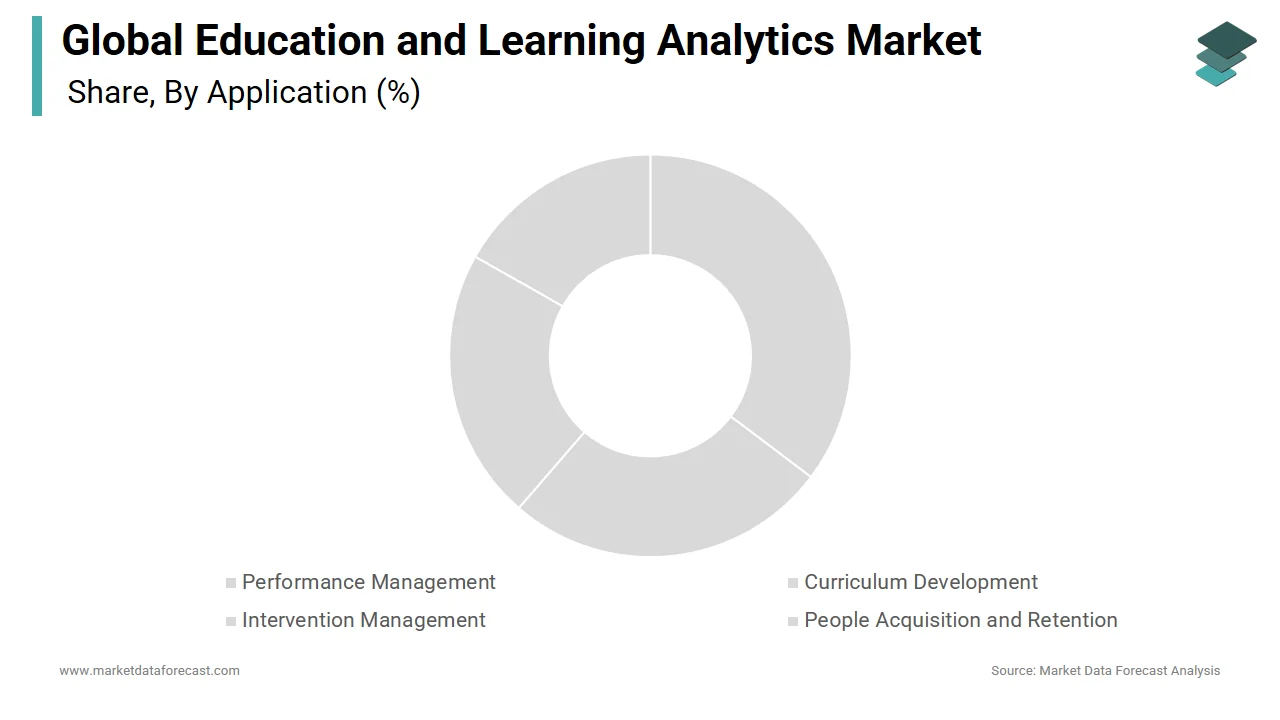
The Performance management segment accounted in holding 38.4% of the Education and Learning Analytics Market share in 2025 due to its widespread use in tracking student progress, evaluating learning outcomes, and measuring institutional effectiveness across K-12, higher education, and corporate training environments. Additionally, higher education institutions are leveraging predictive analytics to assess student success rates and graduation probabilities. As reported by Georgia State University, their predictive analytics system has contributed to a 22% increase in graduation rates over the past decade by identifying at-risk students early and deploying targeted support mechanisms. Moreover, in the corporate sector, performance management analytics are being used to evaluate employee learning progress and optimize training programs.
The People acquisition and retention segment is lucratively to register a CAGR of 17.5% in the coming years owing to the increasing reliance on data analytics in recruitment, talent development, and employee retention strategies within both educational institutions and corporations. A major contributing factor is the growing use of analytics in higher education admissions to identify high-potential applicants and predict student success based on historical and behavioral data. According to the American Association of Collegiate Registrars and Admissions Officers (AACRAO), over 50% of graduate programs in North America have integrated analytics into admission decision-making by enhancing selection accuracy and diversity. In the corporate sector, companies such as IBM, Accenture, and Microsoft are using learning analytics to track employee skill development, assess job readiness, and personalize professional development pathways. Furthermore, microlearning platforms and mobile-based training applications are integrating analytics to offer customized learning journeys. As per LinkedIn’s Workplace Learning Report, over 75% of HR leaders consider learning analytics essential for measuring employee readiness and career progression.
By Component Insights
The software segment dominated the Education and Learning Analytics market share in 2025, owing to the integration of advanced analytics features directly into educational software solutions. Platforms such as Moodle, Blackboard, and Canvas now include real-time dashboards that allow educators to track learner engagement, quiz responses, video interactions, and assignment submissions. Additionally, corporate training platforms such as Coursera, Pluralsight, and LinkedIn Learning are embedding analytics modules to enhance personalized learning paths. As per LinkedIn’s Workplace Learning Report, over 60% of enterprise learning leaders now use data analytics to evaluate training ROI and optimize employee upskilling. Moreover, governments and private stakeholders are investing heavily in proprietary and open-source analytics software tailored for educational use. As reported by UNESCO, more than 150 million learners worldwide now access digital learning platforms with built-in performance monitoring capabilities.
The services segment is anticipated to grow with a CAGR of 14.2% during the forecast period, with the need for technical assistance in deploying analytics tools effectively, particularly in public education systems and developing economies where internal IT expertise is limited. Moreover, universities and enterprises are increasingly engaging third-party consultants to customize analytics frameworks, integrate them with existing LMS, and ensure compliance with data privacy regulations. Additionally, the rise of outsourced analytics-as-a-service models is accelerating adoption among small and mid-sized institutions. As per Gartner, cloud-based analytics services are expected to account for over 40% of new deployments by 2025, offering scalable solutions without requiring substantial upfront investment.
By Deployment Model Insights
The cloud-based deployment segment was the largest and held 43.2% of the Education and Learning Analytics Market share in 2025 with the growing adoption of cloud-hosted learning management systems (LMS) across K-12 and higher education institutions. According to the World Bank, cloud-based LMS usage in education increased by over 60% since 2020, driven by the need for remote learning continuity and real-time data accessibility. Additionally, cloud deployment allows for centralized data storage, reducing the burden of maintaining on-site servers and IT infrastructure. As reported by the International Society for Educational Technology (ISTE), over 70% of U.S. school districts prefer cloud-based analytics tools for their ease of integration and automatic updates.
Moreover, multinational corporations and global e-learning providers favor cloud-based analytics to manage distributed workforces and ensure consistent training outcomes. As per LinkedIn’s Workplace Learning Report, over 60% of enterprise learning leaders now use cloud-hosted analytics to evaluate training ROI and personalize professional development paths.
The on-premises deployment mode is anticipated to register a CAGR of 9.1% in the coming years. This growth is primarily fueled by increasing demand from institutions seeking greater control over data security in sectors with stringent compliance requirements. According to the European Union Agency for Cybersecurity (ENISA), over 40% of European universities prefer on-premises analytics solutions to comply with GDPR and local data protection laws. These institutions value the ability to host sensitive student data locally, minimizing exposure to external breaches. Furthermore, research-intensive universities and defense-related academies are opting for on-premises analytics to safeguard proprietary educational datasets. In addition, government-run education systems in countries like China, Russia, and Saudi Arabia are prioritizing localized data management to align with national cybersecurity and digital education strategies.
By End-User Insights
The higher education segment was the largest by capturing 42.3% of the Education and Learning Analytics Market share in 2025, with the rising adoption of predictive analytics in admissions and student support services. According to the American Association of Collegiate Registrars and Admissions Officers (AACRAO), over 50% of graduate programs in North America now integrate learning analytics into admission decision-making by enhancing equity and precision in candidate selection. Additionally, universities such as Georgia State and Arizona State have implemented AI-driven analytics systems to monitor student engagement and proactively intervene when performance declines. Moreover, government-backed digital education initiatives in countries like India and Brazil are encouraging higher education institutions to incorporate analytics for quality assurance and accreditation purposes.
The business segment is projected to grow with a CAGR of 16.3% in the coming years, owing to the growing use of analytics to assess employee learning progress and optimize training effectiveness. As per the Association for Talent Development (ATD), companies utilizing learning analytics have reported a 20% increase in employee productivity and training efficiency. Moreover, microlearning platforms and mobile-based training applications are leveraging analytics to offer personalized learning pathways.
REGIONAL ANALYSIS
North America Education and Learning Analytics Market Insights
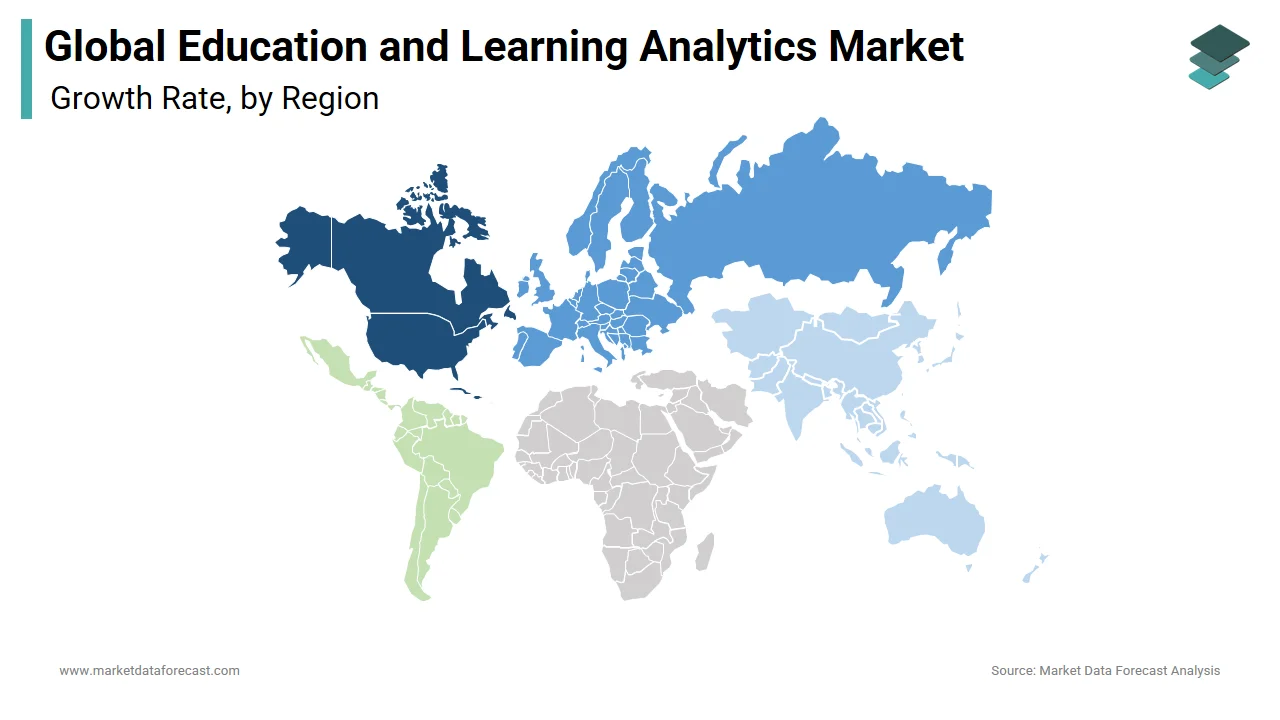
North America was the top performer in the global Education and Learning Analytics Market, with 35.4% of the share in 2025, with the widespread integration of analytics into K-12 and higher education institutions to track student progress and inform instructional strategies. According to the U.S. Department of Education, over 70% of K-12 districts now use learning analytics to personalize instruction and support at-risk learners. Additionally, corporate training programs are leveraging analytics to optimize workforce development.
Europe Education and Learning Analytics Market Insights
Europe Education and Learning Analytics Market growth is driven by progressive digital education policies and a well-established regulatory environment. The implementation of the European Education Area strategy, which promotes digital learning and data-driven teaching methods, is also expected to escalate the growth of the market in Europe. According to the European Commission, over 50% of European universities have integrated learning analytics into student support systems to improve retention and academic guidance. Moreover, concerns around data privacy and algorithmic transparency have prompted stricter oversight, influencing the development of ethical analytics frameworks. Additionally, corporate learning in countries like Sweden and the Netherlands is leveraging analytics to support workforce re-skilling programs aligned with Industry 4.0 transformations. As per the European Training Foundation, over 65% of EU vocational training centers now use analytics to assess skill development and training effectiveness.
Asia Pacific Education and Learning Analytics Market Insights
Asia Pacific Education and Learning Analytics Market growth is likely to have a significant CAGR in the coming years, with China, India, and Japan leading the way in adoption. India’s National Education Policy 2020 emphasizes technology-enabled learning, prompting large-scale deployment of analytics-driven platforms. As reported by the Indian Ministry of Education, over 250 million students now engage with digital learning systems, which is generating vast datasets that require sophisticated analytics tools. China, on the other hand, is leveraging AI and big data analytics to power its Smart Education initiatives. According to the Chinese Ministry of Education, over 80% of higher education institutions have integrated analytics into student performance monitoring and faculty development programs. Japan’s Ministry of Education has mandated the use of learning analytics in higher education to improve student outcomes and institutional efficiency.
Latin America Education and Learning Analytics Market Insights
Latin America Education and Learning Analytics Market growth is likely to grow, with Brazil and Mexico leading the way in adoption. A key contributor to market expansion is the Brazilian Ministry of Education’s Future-se program, which integrates analytics into K-12 and vocational training. In Mexico, the Secretaría de Educación Pública (SEP) has introduced national learning analytics frameworks to support remote education and improve assessment accuracy. Moreover, regional startups like Knewton and Empower Education Online are offering localized analytics solutions tailored to Latin American educational needs.
Middle East and Africa Education and Learning Analytics Market Insights
The Middle East and Africa Education and Learning Analytics Market is expected to have a steady pace from 2026 to 2034. Saudi Arabia’s Vision 2030 includes substantial investments in smart education, with the Ministry of Education mandating the use of analytics in higher education institutions. As per King Saud University’s e-learning division, over 40% of undergraduate programs now integrate learning analytics for student performance tracking and academic advising. South Africa is also advancing in the space, with the Department of Basic Education piloting analytics-based interventions to improve retention and learning outcomes in underperforming schools. Additionally, EdTech startups in Kenya and Nigeria are introducing affordable analytics solutions tailored to African educational contexts.
KEY MARKET PLAYERS
Some of the notable companies dominating the global education and learning analytics market profiled in this report are IBM, Microsoft, Oracle, SAP, SAS Institute, TIBCO, Tableau Software, MicroStrategy, Alteryx, Qlik, Blackboard Inc., Pearson PLC, D2L Corporation (Brightspace), Instructure Inc. (Canvas), Civitas Learning, Hobsons (Naviance), Domoscio, Unicon Inc., Watershed Systems, BrightBytes, Certica Solutions, Ellucian, Google LLC (Education), PowerSchool Holdings, Turnitin, and Knewton.
TOP LEADING PLAYERS IN THE MARKET
Blackboard Inc.
Blackboard plays a pivotal role in the Education and Learning Analytics Market through its widely used learning management system (LMS) that integrates advanced analytics tools for student engagement and performance tracking. The company supports institutions by providing real-time insights into learner behavior, allowing educators to identify at-risk students and personalize instruction. Blackboard contributes to the global market by continuously enhancing its analytics capabilities by ensuring compatibility with emerging AI and adaptive learning technologies.
Pearson PLC
Pearson is a leading provider of education and learning analytics solutions, particularly in digital assessment and personalized learning. The company leverages data analytics to refine its AI-driven tutoring systems, supporting both K-12 and higher education institutions. Pearson contributes to the global market by developing scalable analytics tools that help educators assess student progress and adjust curricula accordingly, thereby improving learning outcomes across multiple geographies.
D2L Corporation (Desire2Learn)
D2L is a key player known for its Brightspace platform, which incorporates comprehensive learning analytics to support educators in delivering personalized and data-driven instruction. The company contributes to the global market by equipping institutions with predictive analytics tools that help identify learning gaps and optimize instructional strategies. D2L works closely with governments and educational bodies to ensure that analytics tools align with evolving pedagogical standards and digital learning priorities.
TOP STRATEGIES USED BY KEY MARKET PARTICIPANTS
One of the primary strategies employed by leading players in the Education and Learning Analytics Market is product innovation and AI integration. Companies are continuously enhancing their analytics tools with machine learning capabilities to offer more accurate predictions, personalized learning paths, and adaptive assessments. These innovations help institutions improve student engagement and retention while staying ahead of competitors in a rapidly evolving landscape.
Major vendors are forming alliances with universities, K-12 school districts, and government agencies to co-develop analytics solutions that meet specific institutional needs. These collaborations facilitate better integration with existing learning systems and promote long-term adoption across diverse educational settings.
Companies are featuring stheir analytics offerings to suit the needs of fast-growing economies in Asia Pacific, Latin America, and Africa. Additionally, they are extending their reach into corporate learning environments, where demand for skills-based analytics is rising. These expansion strategies ensure broader market penetration and sustained growth.
COMPETITION OVERVIEW
The competition in the Education and Learning Analytics Market is characterized by a mix of established EdTech firms, emerging startups, and traditional education publishers transitioning into digital analytics. Large players such as Blackboard, Pearson, and D2L dominate due to their deep integration with learning management systems and extensive client networks. Their ability to offer comprehensive, AI-enhanced analytics solutions gives them a competitive edge in scaling operations and maintaining customer relationships.
However, the market is seeing disruption from agile startups and AI-driven platforms focusing on niche applications such as microlearning, gamification, and workforce training analytics. Companies like Knewton, Coursera, and Pluralsight are leveraging machine learning to deliver highly personalized learning experiences, challenging traditional vendors in both K-12 and corporate education sectors.
Regulatory considerations around data privacy and algorithmic fairness further shape the competitive landscape. As governments introduce stricter data governance policies, vendors must continuously adapt their analytics frameworks to ensure compliance and build trust among educators and learners.
Ultimately, competition is intensifying as market participants differentiate themselves through product customization, domain expertise, and strategic acquisitions. The future of the industry will depend on how effectively vendors balance innovation with ethical responsibility and regulatory alignment.
RECENT MARKET DEVELOPMENTS
- In February 2024, Blackboard announced a strategic partnership with an AI research institute to enhance its analytics engine with adaptive learning capabilities, which is aiming to improve student engagement and course completion rates across higher education institutions in North America and Europe.
- In May 2024, Pearson expanded its digital assessment portfolio by acquiring a predictive analytics startup specializing in K-12 performance tracking by reinforcing its commitment to personalized learning and data-driven instruction.
- In September 2024, D2L Corporation launched a new analytics dashboard specifically designed for corporate training programs by enabling enterprises to track employee learning progress and optimize upskilling initiatives in real time.
- In November 2024, a major EdTech firm introduced a localized learning analytics platform in India, aligned with the country’s National Education Policy 2020, which is supporting millions of students transitioning to digital learning ecosystems.
- In January 2025, a prominent AI-driven learning platform partnered with the European Commission to pilot an ethics-compliant analytics framework across selected universities by addressing concerns related to data privacy and algorithmic fairness in academic assessments.
MARKET SEGMENTATION
This research report on the global education and learning analysis market can be segmented by component, type, deployment model, application, end-user and region.
By Component
- Software
- Services
- Managed Services
- Professional Services
- Consulting
- Support & Maintenance
- Integration & Implementation
By Type
- Descriptive Analytics
- Predictive Analytics
- Prescriptive Analytics
By Deployment Model
- Cloud-Based
- On-Premises
By Application
- Performance Management
- Curriculum Development & Intervention Management
- People Acquisition & Retention
- Student Engagement Analytics
- Budget & Finance Management
- Operations Management
- Others
By End-User
- Academic Institutions
- K-12 Education
- Higher Education
- Enterprises
- Small and Medium-sized Enterprises (SMEs)
- Large Enterprises
- Government and Non-Profit Organizations
- Other Educational Institutions
By Region
- North America
- Europe
- Asia-Pacific
- Latin America
- Middle East and Africa