- Product Description Description
- Table of Contents TOC
- List of Table & Figure LOT
- Get Free Sample PDF Sample PDF
Market Size, 2025
$13.52 BnMarket Estimate, 2026
$14.1 BnMarket Forecast, 2034
$19.74 BnCAGR, 2026–2034
4.3%Global Electronic Logging Device (ELD) Market Size, Growth, Trends & Forecast (2026–2034)
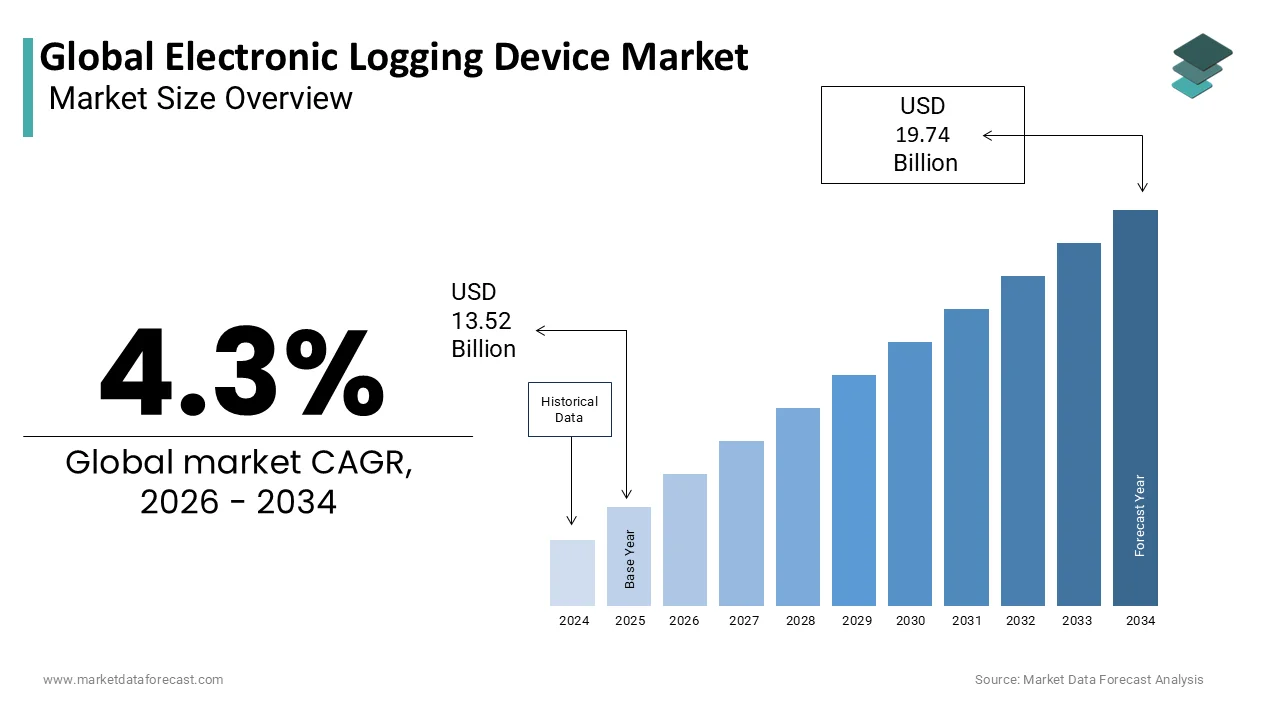
The global electronic logging device market size was valued at USD 13.52 billion in 2025, is estimated to reach USD 14.10 billion in 2026, and is projected to scale up to USD 19.74 billion by 2034, registering a compound annual growth rate (CAGR) of 4.3% during the forecast period from 2026 to 2034. Propelled by strict federal hours-of-service mandates across North America, Europe, and emerging global corridors, alongside the evolution of ELDs from simple compliance tools into intelligent fleet telematics nerve centers, the global market continues to expand steadily.
Key Executive Metrics (At-a-Glance)
- 2025 Base Valuation: USD 13.52 Billion
- 2026 Current Valuation: USD 14.10 Billion
- 2034 Forecast Valuation: USD 19.74 Billion
- Compound Annual Growth Rate (CAGR): 4.3% (2026–2034)
- Dominant Vehicle Type Segment: Trucks
- Fastest-Growing Vehicle Type Segment: Light Commercial Vehicles (LCVs, 22.6% CAGR)
- Dominant Component Type: Telematics Unit (62.6% share)
- Fastest-Growing Component Type: Display (18.9% CAGR)
- Dominant Form Factor Segment: Embedded
- Fastest-Growing Form Factor Segment: Integrated (24.3% CAGR)
- Dominant Deployment Segment: Vehicle-Based (59.2% share)
- Fastest-Growing Deployment Segment: Cloud-Based (27.1% CAGR)
- Dominant Regional Market: North America
Core Market Drivers
- Mandatory Regulatory Enforcement: Federal transport requirements across North America, Europe, and Asia-Pacific forcing commercial fleets to transition from paper logs to certified hardware.
- Operational Efficiency & Telematics Integration: Integration with fleet management systems reducing empty miles, optimizing fuel consumption, and lowering maintenance costs.
- AI & Predictive Compliance: Convergence with machine learning algorithms to anticipate fatigue violations and dynamically adjust insurance premiums based on safety scores.
Primary Market Restraints & Challenges
- High Implementation Costs for Small Fleets: Steep upfront hardware, subscription, and training investments deterring owner-operators and micro-fleets.
- Data Fragmentation & Interoperability Gaps: Absence of universal data standards across multiple vendor devices causing synchronization friction and administrative overhead.
- Legacy Fleet & Cybersecurity Hurdles: Difficulties retrofitting older engine platforms lacking standard diagnostic ports, compounded by cloud security and data privacy vulnerabilities.
Global Electronic Logging Device Market Classification Breakdown
| Segment Category | Largest (Dominant) Segment | Fastest-Growing Segment |
|---|---|---|
| By Vehicle Type | Trucks | Light Commercial Vehicles (LCVs) |
| By Component Type | Telematics Unit | Display |
| By Form Factor | Embedded | Integrated |
| By Deployment | Vehicle-Based | Cloud-Based |
| By Region | North America | Latin America |
Major Industry Players Profiled
Key enterprises shaping the competitive global electronic logging device market include Omnitracs LLC, Samsara Inc., KeepTruckin (Motive), HOS247 LLC, Assure Tracking, AT&T Fleet Complete, Geotab, Garmin International, Continental Automotive Systems Inc., EROAD, and Reckitt Benckiser / Fleetmatics FleetUp, among others.
Global Electronic Logging Device Market Size
The global electronic logging device market was valued at USD 13.52 billion in 2025, is estimated to reach USD 14.10 billion in 2026, and is projected to reach USD 19.74 billion by 2034, growing at a CAGR of 4.3% from 2026 to 2034.
An electronic logging device is a federally mandated onboard hardware system that automatically records a commercial motor vehicle’s engine hours, miles driven, location, and driver duty status to ensure compliance with hours of service regulations. These devices interface directly with the vehicle’s engine control module to capture real-time operational data, eliminating manual logbook inaccuracies and enhancing enforcement transparency. According to the Federal Motor Carrier Safety Administration, over three point five million commercial trucks operating in the United States were required to transition from paper logs to certified electronic logging devices by December seventeen. As per the American Transportation Research Institute, nearly ninety eight percent of long haul carriers had fully adopted compliant systems by mid two thousand and nineteen. Beyond regulatory compliance, these devices now serve as foundational telematics platforms by enabling fleet optimization, predictive maintenance, and driver behavior analytics. As per the Canadian Council of Motor Transport Administrators, over eight hundred thousand commercial vehicles in Canada completed their electronic logging device mandate transition by June twenty one. Globally similar regulatory frameworks are emerging. This regulatory convergence is transforming electronic logging devices from compliance tools into intelligent operational nerve centers for modern freight ecosystems.
MARKET DRIVERS
Mandatory Regulatory Compliance is Forcing Universal Adoption Across Commercial Fleets
The non-negotiable regulatory requirement imposed by federal transportation authorities across North America, compelling every qualifying commercial carrier to deploy certified hardware, is among the key drivers of the growth of the electronic logging device market. According to the Federal Motor Carrier Safety Administration, failure to install a registered electronic logging device results in out-of-service orders, fines exceeding eleven thousand dollars per violation, and potential loss of operating authority. The agency conducted over sixty-five thousand roadside inspections in 2020, twenty specifically targeting logging compliance. Ninety-three percent of inspected vehicles were found in adherence, as per its annual enforcement summary. Transport Canada began enforcing the ELD mandate for federally regulated carriers in June 2021. Insurance providers are also strengthening adoption. This regulatory and financial burden leaves no viable alternative to adoption.
Integration with Fleet Management Systems is Unlocking Operational Efficiency Beyond Compliance
These devices are increasingly valued for regulatory adherence as well as their role as data acquisition gateways that feed broader fleet intelligence platforms by enabling real-time decision making and cost reduction, which bolsters the expansion of the electronic logging device market. According to the American Transportation Research Institute, fleets that fully integrate logging data with dispatch, maintenance, and fuel management systems report an average reduction of twelve point seven percent in empty miles and a nine point three percent improvement in asset utilization. Real-time engine diagnostics transmitted through logging interfaces have also proven transformative. As per the U S Department of Transportation’s Volpe Center, integrated logging telematics reduced fuel consumption by up to eight percent through idling alerts and route deviation monitoring. Insurance underwriters, including Progressive Commerce, are now using data-driven driving behavior metrics to adjust premiums dynamically, rewarding safe acceleration, braking, and hour management. This evolution from compliance recorder to operational intelligence hub is redefining the value proposition and accelerating voluntary adoption even among exempt vehicle classes.
MARKET RESTRAINTS
High Initial Implementation Costs Deter Small Carrier Adoption and Delay Market Saturation
The high upfront investment for electronic logging systems remains a significant barrier for owner-operators and small fleets with fewer than ten vehicles, es, despite existing regulatory mandates, which impedes the growth of the electronic logging device market. For fleets operating on thin margins, this represents a material capital outlay with no immediate revenue offset. Training complexity compounds the issue,e, as a portion of small fleet managers require weeks to achieve operational proficiency, as per sources. Device malfunction and repair costs further strain budgets. Third-party leasing and subscription models have emerged, but often lock users into long-term contracts with hidden fees. Adoption among micro fleets will remain fragmented and vulnerable to non-compliance. This is until cost structures are rationalized and financing mechanisms standardized.
Interoperability and Data Fragmentation Affect Systemic Value Realization
The absence of universal data standards and cross-platform compatibility among electronic logging device manufacturers also restricts the expansion of the electronic logging device market. This creates operational friction that diminishes the technology’s potential to deliver seamless fleet-wide intelligence. According to studies, a share of fleets operating several vehicles use devices from multiple vendors, which leads to inconsistent data formats by reporting delays, and manual reconciliation efforts. Device firmware updates often trigger compatibility failures. In addition, enforcement agencies also face challenges. Cloud-based data silos further complicate matters, with carriers unable to easily migrate historical logs between providers. This fragmentation not only increases administrative burden but also erodes trust in system reliability, which discourages deeper investment in analytics and automation layers that depend on unified data streams.
MARKET OPPORTUNITIES
Expansion into International and Non-Trucking Verticals Offers Untapped Growth Avenues
The foundational architecture of electronic logging devices is increasingly adaptable to regulatory and operational environments beyond North American long-haul trucking, opening new markets in global freight maritime logistics and specialized transport sectors, and thereby creating new opportunities for the growth of the electronic logging device market. According to research, many countries are actively drafting or piloting hours of service digitization mandates. Specialized transport, including hazardous materials and oversized load carriers, is also adopting logging systems. Rail freight operators are testing locomotive-mounted logging systems to monitor engineer duty cycles and rest compliance. This geographic and modal diversification is transforming the market from a regional compliance tool into a global operational standard.
Artificial Intelligence-Driven Predictive Compliance is Redefining Risk Mitigation Strategies
Its convergence with machine learning algorithms is another major factor providing major opportunities for the electronic logging device market. As a result, this enables proactive compliance management that anticipates violations before they occur, transforming regulatory adherence from reactive enforcement to predictive governance. Startups have integrated fatigue prediction models that correlate driving duration with microsleep indicators derived from in-cabin cameras and steering patterns. Insurance providers offer dynamic premium adjustments based on AI-scored compliance risk. This shift from post hoc penalty to pre-emptive correction is not only reducing violations but fundamentally altering how carriers perceive and manage regulatory exposure.
MARKET CHALLENGES
Legacy Fleet Integration Remains a Persistent Technical and Operational Hurdle
Legacy fleet integration remains a persistent technical and operational hurdle, which slows down the growth of the electronic logging device market. A significant portion of the commercial vehicle population, particularly in owner-operator and vocational areas, operates on thousand engine platforms that lack standardized diagnostic ports or electronic control modules, complicating electronic logging device installation and data fidelity. According to sources, a large number of trucks were manufactured that require aftermarket engine sensors and bypass modules to enable logging compliance. These retrofits often introduce data latency and calibration drift. Vocational fleets such as dump trucks and concrete mixers face additional challenges due to non-standard duty cycles and frequent engine-off operations, which disrupt automatic status detection. Training gaps exacerbate the issue. Legacy fleets will remain vulnerable to compliance gaps and operational inefficiencies despite hardware installation until universal adapter standards and simplified calibration protocols are established.
Data Privacy and Cybersecurity Vulnerabilities Erode Stakeholder Trust and Regulatory Confidence
The increasing connectivity and cloud dependency of modern electronic logging devices have exposed fleets to cybersecurity threats and data privacy breaches that weaken regulatory credibility and operational security; as a result, this exposure impedes the expansion of the electronic logging device market. Device manufacturers themselves are not immune. Regulatory agencies are responding cautiously, ly, with Transport Canada delaying its cloud-based audit initiative until data sovereignty and encryption standards are formalized. Drivers also resist constant surveillance. Adoption will remain transactional rather than transformative without robust end-to-end encryption, standardized access controls, and transparent data governance frameworks.
REPORT COVERAGE
| REPORT METRIC | DETAILS |
| Market Size Available | 2025 to 2034 |
| Base Year | 2025 |
| Forecast Period | 2026 to 2034 |
| Segments Covered | By Vehicle Type, Component Type, Form factor, Deployment, and Region. |
| Various Analyses Covered | Global, Regional, and Country-Level Analysis, Segment-Level Analysis, Drivers, Restraints, Opportunities, Challenges; PESTLE Analysis; Porter’s Five Forces Analysis, Competitive Landscape, Analyst Overview of Investment Opportunities |
| Countries Covered | North America, Europe, APAC, Latin America, Middle East & Africa |
| Market Leaders Profiled | HOS247 LLC, Assure Tracking, AT&T Fleet Complete, ATS Fleet Management Solutions, BigRoad, Blue Ink Technology, Blue Tree Systems, CarrierWeb, Continental Automotive Systems Inc., Coretex, Dispatching Solutions, Drive Inc., DRIVERTECH, Eclipse Software Systems, E-Log Plus, ELD Solutions, EROAD, Fleetmatics FleetUp, Forward Thinking Systems, Garmin International, GeoSpace Labs, Geotab, and Others. |
SEGMENTAL ANALYSIS
By Vehicle Type Insights
The trucks segment remained the prominent segment in the electronic logging device market by accounting for a substantial share in 2025. The dominance of the trucks segment is driven by the regulatory scope, which mandates electronic logging for all commercial motor vehicles exceeding ten thousand pounds gross vehicle weight engaged in interstate commerce. According to sources, a large number of Class eight trucks and medium-duty freight carriers in the United States were required to adopt certified logging devices. Enforcement rigor further entrenches adoption. Freight economics also play a role. Insurance incentives support compliance. The trucking segment’s scale, regulatory exposure, and operational complexity make it the anchor of market demand.
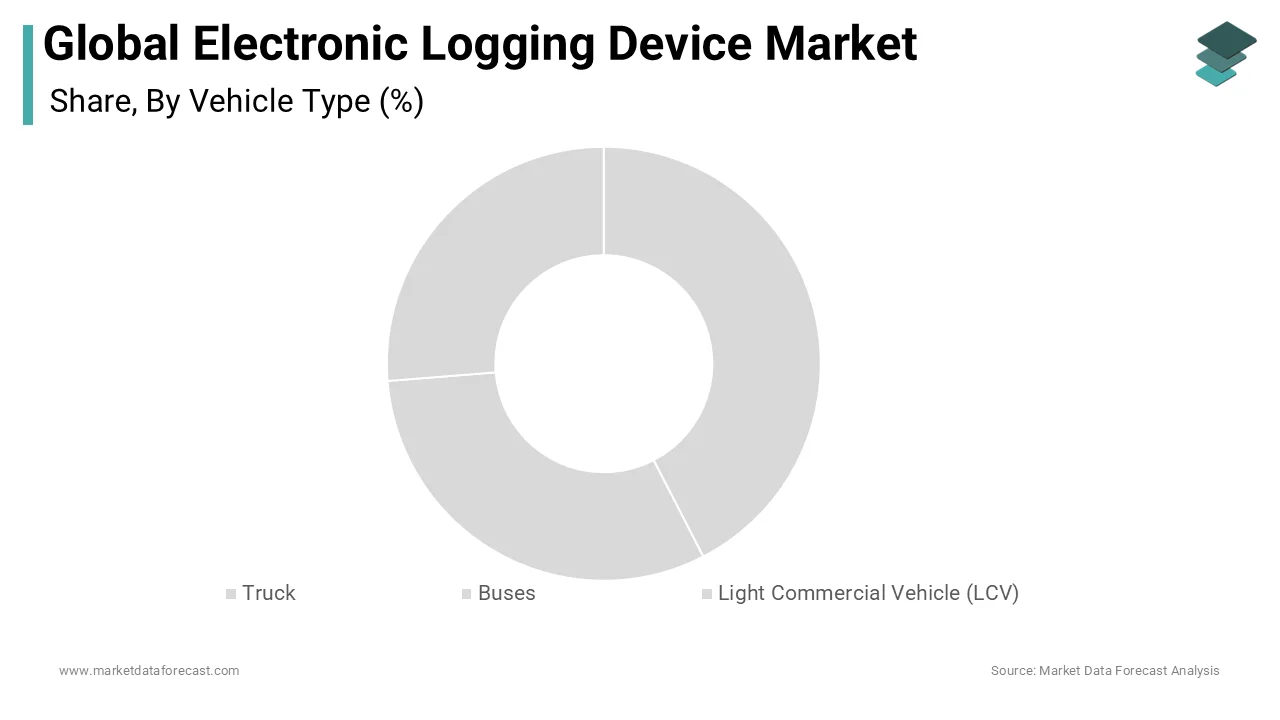
The light commercial vehicles segment is predicted to witness the highest CAGR of 22.6% from 2025 to 2033 due to regulatory expansion in last-mile and urban delivery fleets previously exempt under grandfather clauses. Municipal enforcement is also intensifying. In Canada, Transport Canada extended its mandate to all federally regulated vehicles over four thousand five hundred kilograms effective January 2025. The explosive growth of same-day delivery. This regulatory and operational convergence is rapidly transforming light commercial vehicles from peripheral to core market participants.
By Component Type Insights
The telematics unit segment maintained the leading share of 62.6% of the electronic logging device market in 2025. Its role as the central data acquisition and transmission module that interfaces directly with the vehicle’s engine control unit and global positioning system to generate legally binding records of duty status has significantly contributed to the expansion of the telematics unit segment. According to the Federal Motor Carrier Safety Administration, all certified devices must include a tamper-resistant telematics module capable of recording engine power status, vehicle motion, and miles driven time-stamped geolocation. Device manufacturers have invested heavily in ruggedized telematics hardware with IP sixty-seven ingress protection and extended temperature tolerance, as per studies. Insurance underwriters also tie premium structures to telematics-derived metrics with Zurich North America, requiring continuous telematics uptime for eligibility in its safe driver discount program. The telematics unit’s non-negotiable regulatory function and integration depth with vehicle systems strengthen its position as the highest value and most strategically important component.
The display segment is estimated to register the fastest CAGR of 18.9% during the forecast period. The rapid growth of the display segment is because of the industry’s shift toward multifunction driver interfaces that consolidate compliance logging with navigation fleet messaging and vehicle diagnostics. Driver usability is also a key factor. Regulatory evolution is further driving display innovation. Aftermarket display upgrades are surging as well. The convergence of compliance utility driver experience and regulatory specificity is transforming displays from passive output terminals into interactive operational hubs.
By Form Factor Insights
The embedded electronic logging devices segment dominated the electronic logging device market by occupying a significant share in 2025. Factors like regulatory preference for tamper-resistant hardware that is permanently installed and directly wired to the vehicle’s engine control module to ensure data integrity are largely fuelling the growth of the embedded electronic logging devices segment. Fleet operators favor embedded systems for their reliability. Warranty and service integration also drive adoption as major truck OEMs offer factory-installed embedded logging systems with full vehicle warranty coverage. Insurance providers strengthen this preference by offering lower premiums only to fleets using OEM-embedded or certified aftermarket-embedded devices. The embedded form factor’s physical integration, mechanical durability, and regulatory alignment make it the default choice for fcomcompliance-drivcompliance-driveng-haul and heavy-duty segments.
The integrated electronic logging devices segment is anticipated to witness the fastest CAGR of 24.3% from 2025 to 2033, owing to the rise of software-defined compliance platforms that merge logging functionality with broader fleet management, enterprise resource planning, and driver productivity applications. Regulatory agencies are also adapting. Small and medium fleets are leading adoption. This shift from hardware-centric compliance to software-embedded intelligence is redefining value delivery and accelerating market transformation.
By Deployment Insights
The vehicle-based deployment segment led the electronic logging device market and accounted for a 59.2% share in 2025. The prevalence of the vehicle-based deployment segment is attributed to the mandate by regulation, which requires all electronic logging devices to maintain local data storage capable of retaining at least a few days of logs without cloud connectivity. According to sources, a portion of roadside inspections relied on locally stored data due to inconsistent cellular coverage at weigh stations and border crossings. Fleet operators also prioritize vehicle-based systems for data sovereignty. Hardware reliability is another factor, with embedded vehicle-based units demonstrating notable uptime. Even cloud native providers include mandatory local storage modules in all certified devices to meet federal audit requirements. The non-negotiable need for offline data resilience and regulatory auditability ensures vehicle-based deployment remains the operational backbone of the market.
The cloud-based deployment segment is likely to experience the fastest CAGR of 27.1% from 2025 to 2033 due to the demand for real-time fleet visibility, predictive compliance, and centralized data analytics that transcend individual vehicle boundaries. Regulatory agencies are also embracing cloud integration. Insurance innovation is supporting adoption. Small fleets are leading the shift. The convergence of regulatory digitization, on insurance innovation and operational intelligence, is transforming cloud deployment from an ancillary feature to the strategic core of next-generation compliance ecosystems.
REGIONAL ANALYSIS
North America Electronic Logging Device Market Analysis
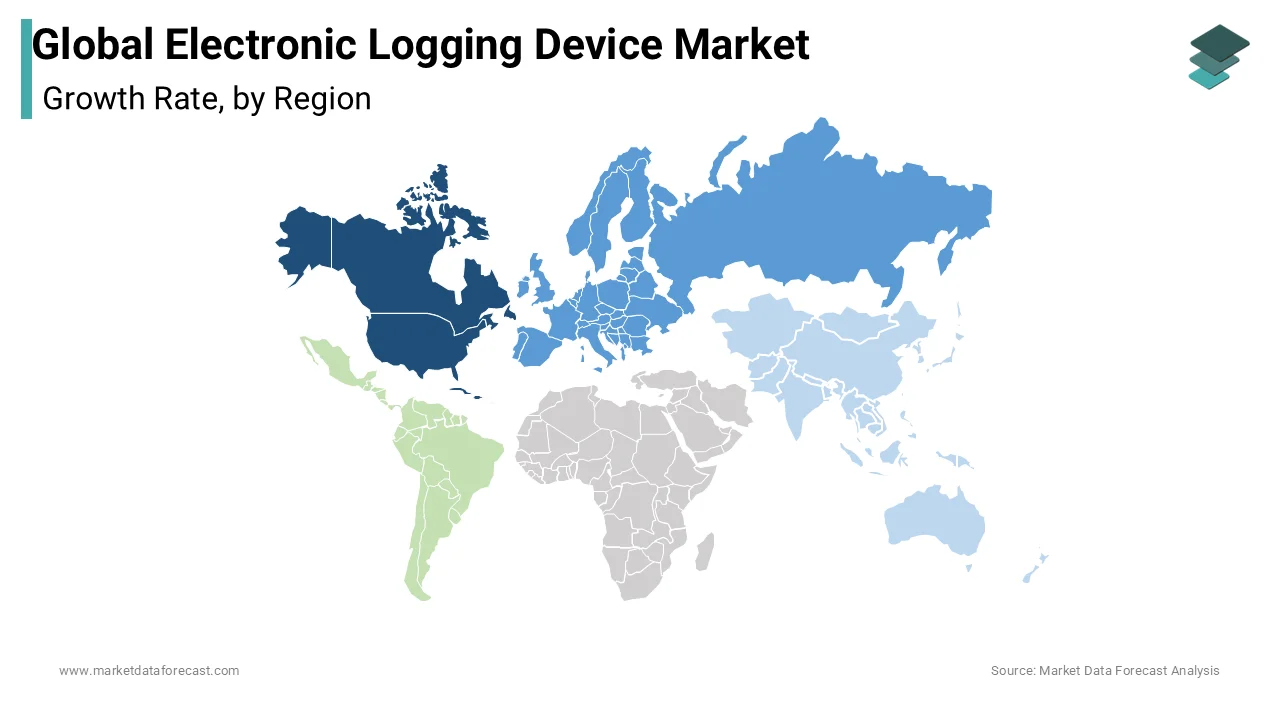
North America was the top performer in the global electronic logging device market by capturing a substantial share in 2025. The domination of North America in the global market is mainly driven by the earliest and most rigorously enforced federal mandates, which transformed electronic logging from an optional efficiency tool to a legal requirement for nearly all commercial carriers. The United States alone accounts for over three point five million registered devices with the American Trucking Associations pointing out that ninety eight percent of long haul fleets achieved full compliance by mid two thousand and nineteen. Canada followed with its own mandate enforced from June thousand twenty one covering over eight hundred thousand federally regulated vehicles. Regulatory harmonization across the United States, Mexico Canada Agreement has further streamlined adoption. Insurance incentives, data-driven enforcement, and mature vendor ecosystems support the region’s uncontested dominance.
Europe Electronic Logging Device Market Analysis
Europe is another significant region in the electronic logging device market by occupyinga 9.4% share in 2025. The European Parliament's Transport Committee proposed draft legislation in November 2023 requiring electronic duty logs for all international transport vehicles over 3.5 tons by 2026, despite no current EU mandate. Major logistics providers, including DB Schenker and DHL, have preemptively deployed logging systems across their European fleets to align with anticipated regulations and gain operational efficiencies. Europe’s growth is regulatory adjacent rather than regulatory compelled.
Latin America Electronic Logging Device Market Analysis
Latin America expanded steadily in the electronic logging device market. According to sources, Brazil has introduced electronic logging requirements for heavy interstate commercial vehicles to enhance transportation oversight. As per studies, thousands of carriers have already adopted the mandated systems following the rollout phase. Argentina and Colombia are preparing similar frameworks,,k s with draft regulations published. Regional trade agreements are accelerating harmonization, with Mercosur nations agreeing in principle to mutual recognition of electronic logging certifications. The steady market expansion is driven by the region’s regulatory momentum and freight modernization agenda despite uneven enforcement.
Asia Pacific Electronic Logging Device Market Analysis
Asia Pacific grew gradually in the electronic logging device market, with adoption concentrated in Australia, New Zealand, and pilot zones in India. According to Australia’s National Heavy Vehicle Regulator, electronic work diaries became mandatory for fatigue-regulated vehicles in all states by January thousand twenty covering over two hundred and fifty thousand commercial units. New Zealand’s Transport Agency reported a twenty seven percent drop in driver hour violations after nationwide rollout in mid two thousand and twenty two. Japan and South Korea maintain voluntary adoption focused on large logistics providers, with Nippon Express and CJ Logistics deploying internal logging systems for operational efficiency rather than compliance. The absence of pan-regional mandates and fragmented vehicle age profiles constrain growth, but regulatory pilots and private sector prominence are laying the foundational adoption.
Middle East and Africa Electronic Logging Device Market Analysis
The Middle East and Africa region is likely to grow in the electronic logging device market, with activity centered in South Africa, the United Arab Emirates, and Saudi Arabia. According to the South African Road Traffic Management Corporation, electronic logbooks became mandatory for all goods vehicles over three and a half tons in January thousand twenty four following a two-year pilot. The UAE’s Ministry of Energy and Infrastructure mandated electronic logging for all commercial vehicles operating in Dubai and Abu Dhabi as of July 23 to align with smart city initiatives. Infrastructure and enforcement capacity remain limited. However, strategic regulatory alignment and public-private partnerships are positioning the region for accelerated adoption in the medium term.
COMPETITIVE LANDSCAPE
The electronic logging device market is defined by a strategic duality between legacy hardware-centric providers and agile cloud native platforms, each vying to redefine compliance from a regulatory checkbox into an operational advantage. Incumbents leverage decades of fleet relationships and certified tamper-proof hardware to maintain trust among large carriers and enforcement agencies. New entrants counter with software-driven intelligence, predictive workflows, and frictionless user experiences that appeal to small fleets and tech-forward logistics providers. Competition is no longer about device certification alone, but about who can best synthesize engine data, driver behavior, or external variables in real-time decision support. Vendor differentiation hinges on integration depth with enterprise systems, predictive violation avoidance, and driver usability. Regulatory agencies themselves are becoming active participants by opening application programming interfaces that reward platform interoperability. Insurance underwriters are reshaping incentives by tying premiums to electronically derived safety scores. The most successful players are those who treat compliance not as an endpoint but as a data layer feeding broader operational optimization. Innovation cycles have accelerated with quarterly feature releases replacing annual hardware refreshes. Talent wars focus on data scientists, regulatory specialists, and user experience designers. The market rewards those who master complexity, not just connectivity.
KEY MARKET PLAYERS
Some of the companies that are playing a dominating role in the global electronic logging device market include
- HOS247 LLC
- Assure Tracking
- AT&T Fleet Complete
- ATS Fleet Management Solutions
- BigRoad
- Blue Ink Technology,
- Blue Tree Systems,
- CarrierWeb,
- Continental Automotive Systems Inc,
- Coretex,
- Dispatching Solutions,
- Drive Inc.,
- DRIVERTECH,
- Eclipse Software Systems,
- E-Log Plus,
- ELD Solutions,
- EROAD,
- Fleetmatics FleetUp,
- Forward Thinking Systems,
- Garmin International,
- GeoSpace Labs,
- Geotab.
TOP LEADING PLAYERS IN THE MARKET
- Omnitracs LLC remains a foundational force in the electronic logging device ecosystem by delivering deeply integrated compliance and fleet intelligence platforms trusted by long-haul and heavy-duty carriers across North America. The company recently upgraded its Intelligence Platform to include predictive hours of service violation alerts powered by machine learning algorithms. In early thousand twenty Omnitracs partnered with Cummins to embed its logging engine directly into next-generation powertrain control modules, enhancing data accuracy and reducing installation complexity. It also launched a bilingual interface compliant with the Canadian federal mandate, strengthening its cross-border relevance.
- Samsara Inc. has rapidly ascended as a cloud native disruptor by unifying electronic logging with real-time visibility across vehicle health, driver behavior, and cargo security. The company introduced its Dynamic Compliance Engine in mid two thousand and twenty four which auto-adjusts log recommendations based on traffic, weather, er and appointment delays. Samsara also integrated its platform with major transportation management systems, including Oracle and Blue Yonder, to enable seamless dispatch, payroll, and audit workflows. Its API first architecture now supports over twelve thousand enterprise customers seeking scalable compliance without hardware dependency.
- KeepTruckinInc. Carved its niche by prioritizing driver-centric design and mobile-first accessibility, making compliance intuitive for owner-operators and small fleets. In late thousand twenty KeepTruckin unveiled its Smart Load Board, which syncs available freight with driver duty status to maximize legal drive time. The company also launched an AI-powered fatigue detection feature using in-cabin camera feeds correlated with engine data. KeepTruckin expanded its repair network to over eight hundred certified service centers, ensuring rapid device support and minimizing compliance downtime for independent operators.
TOP STRATEGIES USED BY KEY MARKET PARTICIPANTS
Leading players prioritize regulatory alignment by embedding compliance engineers within federal and state transportation working groups to anticipate rule changes and influence technical standards. They invest in predictive analytics that transform raw log data into actionable intelligence, reducing violations before they occur. Strategic partnerships with original equipment manufacturers ensure factory-level integration, minimizing aftermarket installation failures. Cloud native architectures enable rapid feature deployment and seamless scalability for fleets of all sizes. Mobile-first interfaces lower training barriers and increase driver adoption, particularly among independent operators. Subscription-based pricing models reduce upfront costs and lock in long-term customer relationships. Interoperability layers allow data exchange across legacy transportation management systems, preserving existing IT investments. Cybersecurity certifications, end-to-end encryption, and building trust with carriers handling sensitive operational data. Bilingual and region-specific interface customization ensures compliance across cross-border corridors. Real-time audit preparation tools automate log reconciliation and inspection readiness, reducing administrative burden and enforcement risk.
GLOBAL ELECTRONIC LOGGING DEVICE MARKET NEWS
- HOS247 is an ELD company accredited by FMCSA that serves the U.S., Mexico, and Canada. The company's all-in-one trucking technology stage provides E-logcompliancee GPS tracking, driver-vehicle examine reports (DVIR), fleet management, vehicle diagnostics, reporting of IFTA miles, and fleet maintenance alerts.
- With the time running out for truckers in the USA to upgrade to electronic logging devices that track their time on the street, data from drivers who've made the switch appears to the point that the uncertain systems are working as intended to make trucking safer.
- GPS Insight's Hours of Service (HOS) solution leverages the field-proven power of Innovative Software Engineering's (ISE) eFleetSuite application and, therefore, the ELD-2000, a new GPS Insight-powered Android tablet, to deliver best-in-class GPS fleet tracking, real-time electronic driver logs, Driver Vehicle examine Reports (DVIR), and navigation for FMCSA compliance and superior fleet intelligence.
- Fleet Complete, a worldwide leader in mission-critical fleet, asset, and mobile workforce tracking and management solutions, recently introduced the launch of its latest Hours of Service (HoS) mobile app available through Fleet Complete's distribution partners within the U.S. and Canada.
MARKET SEGMENTATION
This research report on the global electronic logging device market has been segmented & sub-segmented into the following categories.
By Vehicle Type
- Truck
- Buses
- Light Commercial Vehicle (LCV)
By Component Type
- Display
- Telematics Unit
- Others
By Form-factor
- Embedded
- Integrate
By Deployment
- Vehicle-based
- Cloud-based
By Region
- North America
- Europe
- Asia Pacific
- Latin America
- Middle East and Africa