- Product Description Description
- Table of Contents TOC
- List of Table & Figure LOT
- Get Free Sample PDF Sample PDF
Market Size, 2025
$71.56 BnMarket Estimate, 2026
$74.84 BnMarket Forecast, 2034
$107.08 BnCAGR, 2026–2034
4.58%Executive Summary: Global Ethanol Market
- Market Scope: Comprehensive global and regional analysis tracking type (synthetic vs. bioethanol), raw material feedstocks (1st generation vs. 2nd generation), application segments, and geographical deployments across major world markets.
- Market Valuation: Valued at USD 71.56 billion in 2025, reaching USD 74.84 billion in 2026, and projected to expand to USD 107.08 billion by 2034, growing at a steady CAGR of 4.58% during the forecast period (2026–2034).
- Primary Growth Drivers: Government mandates and renewable fuel policies requiring fixed biofuel blending percentages, and the proliferation of flexible-fuel vehicles (FFVs) alongside ethanol-ready infrastructure. Key restraints include feedstock price volatility and agricultural constraints, as well as limited infrastructure for high-level ethanol blends like E85.
Key Market Segment Metrics (2026–2034)
| Category | Leading Segment (2025 Position) | Fastest-Growing Segment |
|---|---|---|
| By Type | Bioethanol (held a dominant share in 2025 due to its vital role as a renewable, carbon-mitigating fuel in transportation) | Synthetic Segment (projected to expand at a CAGR of 5.8% driven by industrial and specialty chemical/medical applications) |
| By Raw Material | 1st Generation Feedstocks (held a dominant share in 2025 supported by established agricultural and industrial infrastructure) | 2nd Generation Feedstocks (growing at a CAGR of 10.3% driven by the need to overcome food-versus-fuel conflicts and carbon targets) |
| By Application | Transportation (largest and dominant share in 2025 as a widespread gasoline additive and alternative fuel) | Chemical Application (growing at a CAGR of 7.1% as a solvent/feedstock in pharmaceuticals, cosmetics, and specialty chemicals) |
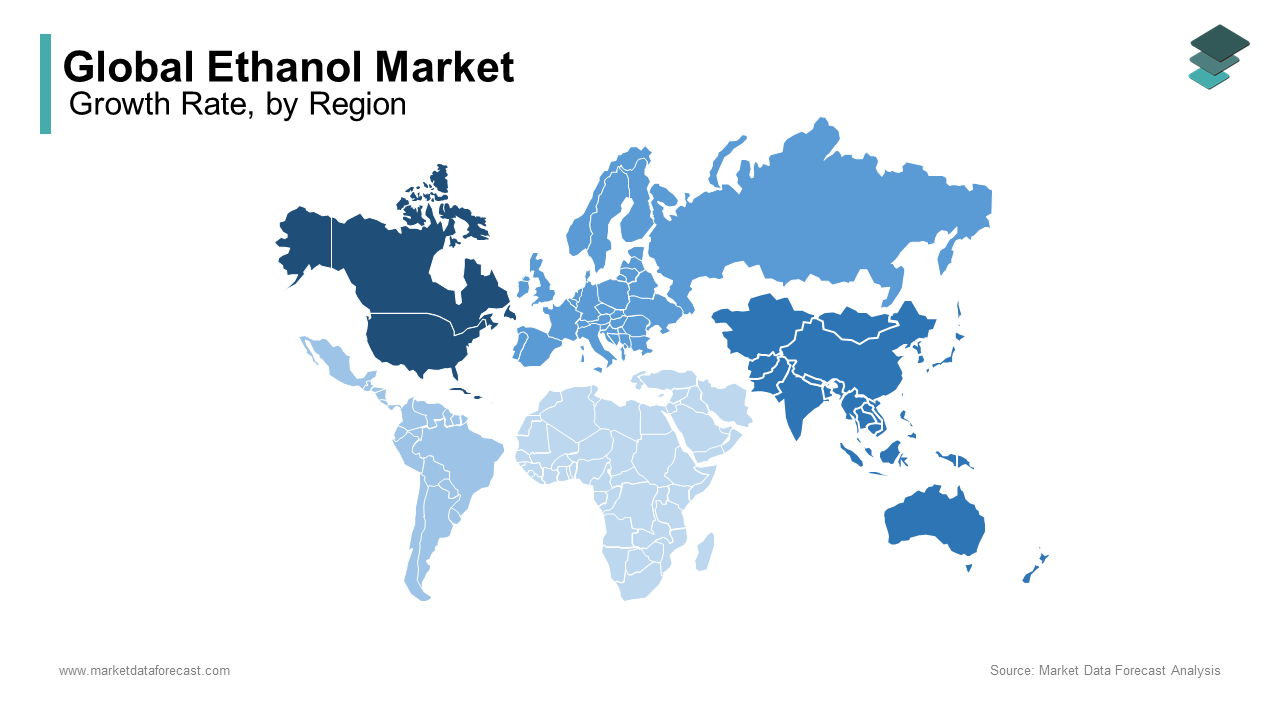
| By Region | North America (largest with 32.3% share in 2025, anchored by the U.S. corn-based ethanol industry and RFS) | Latin America (Brazil as a sugarcane leader), Asia Pacific (India & China blending programs), and Europe (sustainability-driven) |
Major Market Players & Market Structure
Market Structure: Complex interplay between large agro-industrial producers, national oil companies, and technology-driven biorefineries, with competition shaped by policy alignment, feedstock access, and carbon performance.
Key Companies: Archer Daniels Midland Company, POET LLC, Green Plains Inc., Valero Energy Corporation, Flint Hills Resources, The Andersons Inc., Pacific Ethanol Inc., Raízen Energia S.A., Cargill Incorporated, Royal Dutch Shell plc, BP plc, Petrobras, CropEnergies AG, Tereos S.A., and Alcogroup S.A.
Global Ethanol Market Size
The global ethanol market size was valued at USD 71.56 billion in 2025 and is anticipated to reach USD 74.84 billion in 2026 and USD 107.08 billion by 2034, growing at a CAGR of 4.58% during the forecast period from 2026 to 2034.
The ethanol is derived from biomass feedstocks such as corn, sugarcane, and cellulosic materials, serving dual roles as a renewable fuel additive and an industrial chemical. Ethanol is most widely used as a biofuel, blended with gasoline to reduce greenhouse gas emissions and enhance octane levels. According to the International Energy Agency, transportation accounts for nearly 24% of global CO₂ emissions from fuel combustion, which is making low-carbon alternatives like ethanol critical in decarbonizing mobility.
MARKET DRIVERS
Government Mandates and Renewable Fuel Policies
Mandatory biofuel blending regulations are driving the growth of the ethanol market. Countries have implemented policies requiring a fixed percentage of ethanol in gasoline to reduce fossil fuel dependence and lower transportation emissions. Brazil, the second-largest producer, operates a long-standing blending program requiring 27% anhydrous ethanol in gasoline (E27), as regulated by the National Agency of Petroleum, Natural Gas and Biofuels (ANP). These policies provide stable demand signals for producers and incentivize investment in production capacity and supply infrastructure, making regulatory support the cornerstone of ethanol market expansion in both developed and emerging economies.
Expansion of Flexible-Fuel Vehicles and Ethanol-Ready Infrastructure
The proliferation of flexible-fuel vehicles (FFVs) is significantly boosting the ethanol market. The country’s fueling infrastructure includes over 37,000 service stations offering ethanol, according to ANP, ensuring consumer accessibility. In the United States, the Department of Energy notes that nearly 27 million FFVs were on the road in 2023, though utilization of E85 remains limited due to sparse refueling stations. The initiatives, like the Biden administration’s Clean Fuels and Vehicles Program, are encouraging investments in ethanol-compatible pumps. Additionally, India and China are piloting E100 two-wheelers and public transport fleets in select cities.
MARKET RESTRAINTS
Feedstock Price Volatility and Agricultural Constraints
Ethanol production is highly dependent on agricultural commodities such as corn, sugarcane, and cassava, which makes it vulnerable to fluctuations in crop yields, weather patterns, and global food prices. According to the U.S. Department of Agriculture, corn prices rose by 32% in 2022 due to drought conditions and export disruptions, directly increasing ethanol production costs. In India, erratic monsoon patterns have affected sugarcane output, with the Indian Sugar Mills Association reporting a 14% drop in production in 2023 compared to the previous year. These constraints limit the scalability of first-generation ethanol and create financial instability for producers in regions without diversified feedstock sources or price stabilization mechanisms.
Limited Infrastructure for High-Level Ethanol Blends
The absence of widespread infrastructure for dispensing high-concentration ethanol blends like E85 or E100 is limiting the growth of the ethanol market. In the United States, despite 27 million flexible-fuel vehicles on the road, the Department of Energy reports that fewer than 3,000 retail stations offer E85, representing less than 3% of all fueling points. In Europe, ethanol blending is largely capped at E10 due to material compatibility concerns in older vehicles and fuel systems. India, though advancing its E20 program, faces challenges in ensuring ethanol availability at retail outlets, particularly in rural areas. The lack of consumer awareness and perceived risks related to engine compatibility further dampen demand.
MARKET OPPORTUNITIES
Growth of Cellulosic and Advanced Biofuels
The development of cellulosic ethanol produced from non-food biomass such as agricultural residues, wood chips, and municipal waste is escalating the growth of the ethanol market. According to the U.S. Department of Energy, cellulosic ethanol can reduce lifecycle greenhouse gas emissions by up to 86% compared to gasoline, far exceeding the 20–30% reduction from corn ethanol. In 2023, POET-DSM’s Project Liberty in Iowa produced over 15 million gallons of cellulosic ethanol, utilizing corn stover as feedstock. Companies like LanzaJet are commercializing alcohol-to-jet (ATJ) pathways using ethanol.
Integration of Ethanol in Decarbonizing Heavy Transport and Aviation
Ethanol is emerging as a viable low-carbon fuel for hard-to-abate transport sectors, including aviation, marine, and freight logistics, which is additionally escalating the growth of the Europe cookies market. Through chemical conversion, ethanol can be transformed into sustainable aviation fuel (SAF) via alcohol-to-jet (ATJ) processes. According to the International Air Transport Association, SAF could contribute up to 65% of the aviation industry’s carbon reduction by 2050, with ethanol-based pathways playing a crucial role. Additionally, Brazil has launched ethanol-powered buses in São Paulo, which is demonstrating feasibility in urban transit.
MARKET CHALLENGES
Carbon Intensity and Lifecycle Emissions of First-Generation Ethanol
While ethanol is marketed as a low-carbon fuel, the lifecycle greenhouse gas (GHG) emissions of first-generation (food-based) ethanol are under increasing scrutiny. According to a 2023 study by the International Council on Clean Transportation, corn ethanol in the U.S. offers only a 20–30% GHG reduction compared to gasoline when indirect land-use change (ILUC) is factored in, significantly less than previously estimated. The expansion of cropland for ethanol feedstocks can lead to deforestation and soil carbon loss, particularly in tropical regions.
Trade Barriers and Policy Inconsistencies Across Regions
The global supply chain integration and investment stability across countries are expected to degrade the growth of the ethanol market. The European Union imposes a safeguard duty of up to €250 per cubic meter on U.S. ethanol imports, limiting transatlantic trade despite surplus production in North America. India, though promoting domestic blending, restricts ethanol imports to protect local sugar producers, as stated by the Ministry of Commerce and Industry. Meanwhile, Brazil’s ethanol exports face logistical bottlenecks at ports and fluctuating tax regimes across states.
REPORT COVERAGE
| REPORT METRIC | DETAILS |
| Market Size Available | 2025 to 2034 |
| Base Year | 2025 |
| Forecast Period | 2026 to 2034 |
| CAGR | 4.58% |
| Segments Covered | By Type, Raw Material, Application, and Region |
| Various Analyses Covered | Global, Regional, and Country Level Analysis; Segment-Level Analysis; DROC; PESTLE Analysis; Porter’s Five Forces Analysis; Competitive Landscape; Analyst Overview of Investment Opportunities |
| Regions Covered | North America, Europe, APAC, Latin America, Middle East & Africa |
| Market Leaders Profiled | Archer Daniels Midland Company, POET LLC, Green Plains Inc., Valero Energy Corporation, Flint Hills Resources, The Andersons Inc., Pacific Ethanol Inc., Raízen Energia S.A., Cargill Incorporated, Royal Dutch Shell plc, BP plc, Petrobras, CropEnergies AG, Tereos S.A., Alcogroup S.A. |
SEGMENTAL ANALYSIS
By Type Insights
The bioethanol segment held a dominant share of the global ethanol market in 2025, with its role as a renewable, carbon-mitigating fuel in the transportation sector. Unlike synthetic ethanol, which is derived from fossil-based ethylene, bioethanol is produced from biomass feedstocks such as corn, sugarcane, and wheat, qualifying it for inclusion in renewable fuel mandates.
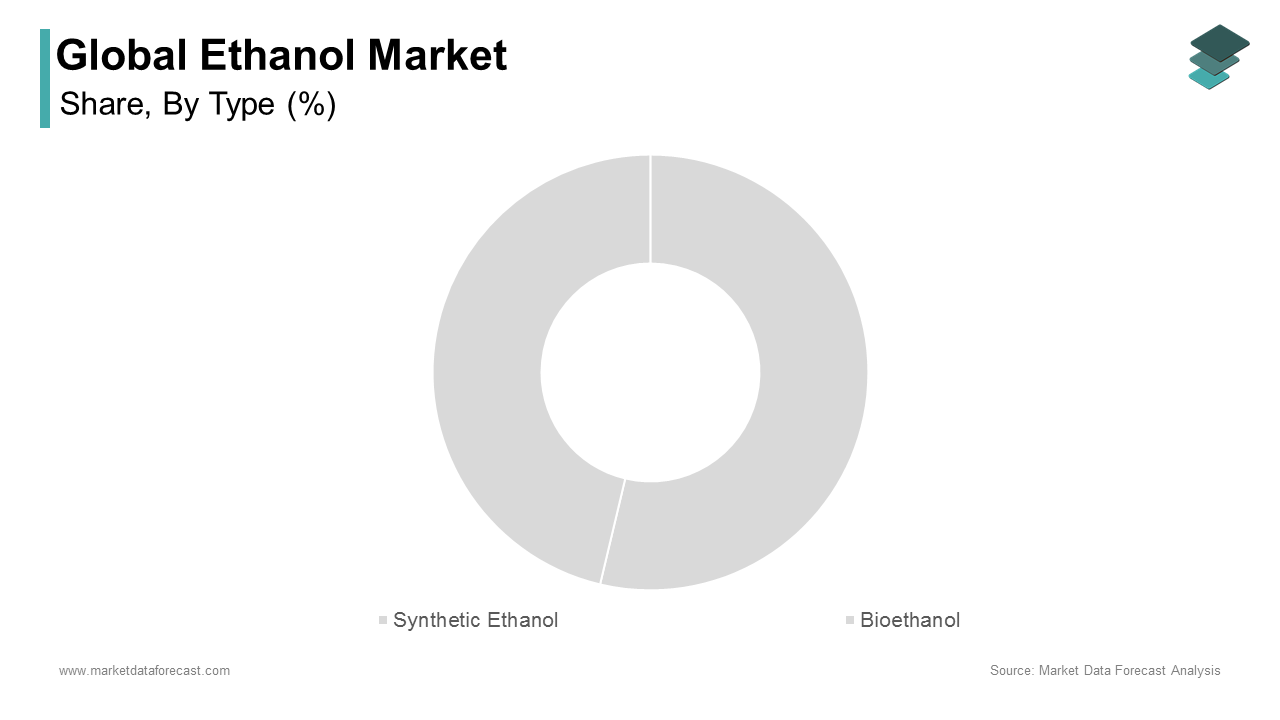
The synthetic segment is projected to expand at a CAGR of 5.8% during the forecast period, with the rising demand in industrial and specialty chemical applications. According to the American Chemical Society, over 80% of ethanol used in medical sterilization and diagnostic reagents in North America is synthetically derived, due to stringent regulatory requirements for contaminant-free solvents.
By Raw Material Insights
The first-generation feedstocks segment held a dominant share of the ethanol market in 2025. These crops are well-established, easily fermentable, and supported by decades of agricultural and industrial infrastructure. Brazil is the world’s largest sugarcane ethanol producer, harvesting 630 million metric tons of sugarcane in 2023, with over 50% directed to ethanol, as per the Brazilian Sugarcane Industry Association (UNICA).
The second-generation feedstocks segment is likely to grow with an expected CAGR of 10.3% during the forecast period, with the need to overcome food-versus-fuel conflicts and meet stricter carbon reduction targets. Cellulosic ethanol, produced from corn stover, bagasse, and switchgrass, can reduce lifecycle greenhouse gas emissions by up to 86% compared to gasoline, according to the U.S. Department of Energy. The European Union’s Renewable Energy Directive II (RED II) mandates that 14% of transport energy come from renewable sources by 2030, with double credit given for advanced biofuels, incentivizing investment. Additionally, companies like Clariant and LanzaTech are commercializing waste-to-ethanol technologies using municipal solid waste and industrial off-gases.
By Application Insights
The transportation sector was the largest and held a dominant share of the ethanol market in 2025 due to its widespread use as a gasoline additive and alternative fuel. According to the World Biofuel Statistics published by F.O. Licht, global ethanol fuel consumption reached 1.4 million barrels per day in 2023, with the U.S. and Brazil accounting for 85% of demand.
The chemical application segment is growing at a CAGR of 7.1% from 2026 to 20,33 with a solvent and feedstock in pharmaceuticals, cosmetics, and specialty chemicals. High-purity ethanol is essential in the production of hand sanitizers, disinfectants, fragrances, and active pharmaceutical ingredients (APIs). Additionally, ethanol is used in the synthesis of ethyl acetate, glycol ethers, and acetaldehyde. Ethanol-derived intermediates are gaining preference over petroleum-based alternatives in regulated markets like Europe and Japan, where sustainability certifications are increasingly required.
REGIONAL ANALYSIS
North America Market Analysis
North America was the largest with 32.3% of the global ethanol market share in 2025, with the United States as the world’s largest producer and consumer. The region’s dominance is anchored in its robust corn-based ethanol industry, supported by the Renewable Fuel Standard (RFS), which mandated 15.25 billion gallons of biofuel use in 2023, according to the U.S. Environmental Protection Agency. The U.S. operates over 200 ethanol plants in the Midwest, producing 15.5 billion gallons annually, as per the Renewable Fuels Association. According to the Department of Energy, 27 million flexible-fuel vehicles are on American roads, though E85 utilization remains limited.
Latin America Market Analysis
Latin America is growing in ethanol, with Brazil as the undisputed leader in sugarcane-based production. Brazil produces over 32 billion liters of ethanol annually, according to UNICA, making it the second-largest producer after the U.S. and the largest exporter. Flexible-fuel vehicles represent over 80% of new light-duty vehicle sales, as reported by ANFAVEA, which is creating a self-sustaining domestic market.
Asia Pacific Market Analysis
Asia Pacific is likely to grow in the ethanol market, with India and China driving growth through national blending and industrialization programs. The country plans to reach E20 by 2026, supported by expanded distillery capacity and surplus sugar production. China, though primarily focused on synthetic ethanol for chemicals, is piloting bioethanol programs in Heilongjiang and Henan provinces using corn and cassava.
Europe Market Analysis The
Europe ethanol market with a strong emphasis on sustainability and compliance with renewable energy directives. The European Union’s Renewable Energy Directive II (RED II) mandates that 14% of transport energy come from renewables by 2030, with advanced biofuels receiving double counting. France and Germany are the largest consumers, blending ethanol at E10 levels, with over 90% of gasoline in France containing ethanol, as reported by COPRA. Most European ethanol is produced from wheat and sugar beets, with Norden, Cristalco, and Tereos as major producers. However, the EU restricts first-generation biofuels to prevent indirect land-use change (ILUC), accelerating investment in cellulosic and waste-based ethanol.
Middle East & Africa Market Analysis
The Middle East & Africa ethanol market growth is producing ethanol from sugarcane and molasses, with over 400 million liters produced annually. The country has piloted E10 blending in Gauteng province to reduce emissions and support rural economies. Saudi Arabia, under Vision 2030, is investing in bio-based chemicals, including ethanol for industrial use, as part of its economic diversification.
COMPETITIVE LANDSCAPE
KEY MARKET PLAYERS
A few of the dominating players in the global ethanol market include
- Archer Daniels Midland Company
- POET LLC
- Green Plains Inc
- Valero Energy Corporation
- Flint Hills Resources
- The Andersons Inc
- Pacific Ethanol Inc
- Raízen Energia S.A
- , Cargill Incorporated
- Royal Dutch Shell plc
- BP plc
- Petrobras
- CropEnergies AG
- Tereos S.A
- Alcogroup S.A
Top Strategies Used By Key Market Participants
Key players in the ethanol market are focusing on feedstock diversification, carbon intensity reduction, and technological innovation to strengthen competitiveness. Companies are investing in cellulosic and waste-based ethanol to overcome food-versus-fuel concerns and meet low-carbon fuel standards. Expansion into high-growth regions like the Asia Pacific is achieved through export partnerships, licensing, and sustainability certifications. Carbon capture and storage (CCS) technologies are being adopted to lower lifecycle emissions and qualify for incentives under programs like California’s LCFS. Strategic collaborations with governments and research institutions are accelerating the development of advanced biofuels.
COMPETITION OVERVIEW
The ethanol market is characterized by a complex interplay between large agro-industrial producers, national oil companies, and technology-driven bio-refineries, with competition shaped by policy alignment, feedstock access, and carbon performance. While traditional players dominate through scale and agricultural integration, new entrants are leveraging advanced feedstocks and low-carbon technologies to gain regulatory and environmental advantages. Geographic disparities in feedstock availability and policy frameworks create fragmented but dynamic regional markets. In the Asia Pacific, domestic producers like Shree Renuka are gaining prominence under government blending mandates, while Brazilian exporters like Raízen leverage superior carbon profiles to access premium markets. Competition is no longer solely about volume and cost but increasingly revolves around sustainability credentials, supply chain transparency, and technological innovation.
LEADING PLAYERS IN THE ETHANOL MARKET
POET LLC
POET is a leading biofuel producer with growing strategic interest in the Asia Pacific region, particularly in advancing next-generation ethanol technologies and sustainability partnerships. While primarily operating in the U.S., POET has strengthened its global influence by licensing its proprietary BioChem and E30 technologies to international partners, including Indian distilleries seeking to upgrade production efficiency. In 2023, POET collaborated with Indian sugar mills in Maharashtra and Uttar Pradesh to optimize corn stover and sugarcane bagasse utilization, supporting India’s E20 blending target. The company also launched a carbon capture initiative at its South Dakota facilities, which it is promoting as a replicable model for low-carbon ethanol in Asia. POET’s involvement in global forums such as the Global Bioenergy Partnership has elevated its advisory role in shaping biofuel policy in emerging markets.
Raízen Energia S.A.
Raízen, a joint venture between Cosan and Shell, is a global leader in sugarcane-based ethanol and has expanded its footprint in the Asia Pacific market through strategic exports and sustainability-driven branding. The company supplies hydrous and anhydrous ethanol to Japan, South Korea, and India, where demand for low-carbon fuel additives is rising. In 2023, Raízen signed long-term supply agreements with Japanese petroleum refiners to meet tightening biofuel mandates, exporting over 500 million liters of certified low-carbon ethanol. It also achieved International Sustainability and Carbon Certification (ISCC) for its entire ethanol portfolio, enhancing market access in Europe and Asia. In 2025, Raízen launched a blockchain-based traceability system to verify carbon savings across its supply chain, appealing to ESG-focused importers.
Shree Renuka Sugars Limited
Shree Renuka Sugars is one of India’s largest integrated sugar and ethanol producers, playing a pivotal role in the country’s ethanol blending program and regional energy security. The company operates multiple distilleries across Maharashtra, Karnataka, and Telangana, producing over 500 million liters of ethanol annually from sugarcane juice and molasses. In 2023, Renuka expanded its fermentation capacity by 30% to meet rising demand from the Oil Marketing Companies (OMCs) under India’s E12-to-E20 transition plan.
MARKET SEGMENTATION
This research report on the global ethanol market is segmented and sub-segmented into the following categories.
By Type
- Synthetic Ethanol
- Bioethanol
By Raw Material
- 1st Generation Feedstock
- 2nd Generation Feedstock
- Others
By Application
- Transportation
- Energy
- Chemical
- Others
By Region
- North America
- Europe
- Latin America
- Asia Pacific
- Middle East & Africa