Europe Aerospace Foam Market Size, Share, Trends & Growth Forecast Report, Segmented By Type, By Application, And By Country (UK, France, Spain, Germany, Italy, Russia, Sweden, Denmark, Switzerland, Netherlands, Turkey, Czech Republic and Rest of Europe), Industry Analysis From 2026 to 2034
Market Size, 2025
$2.33 BnMarket Estimate, 2026
$2.46 BnMarket Forecast, 2034
$3.79 BnCAGR, 2026–2034
5.54%Executive Summary: Europe Aerospace Foam Market
- Market Scope: Comprehensive European aerospace foam industry analysis covering material foam types, application sectors, regional leadership shares, emissions and lightweighting metrics, and aviation R&D funding frameworks.
- Market Valuation: Valued at USD 2.21 billion (2024), estimated at USD 2.33 billion (2025), and projected to reach USD 3.48 billion by 2033, registering a steady CAGR of 5.54% (2025–2033).
- Primary Growth Drivers: Escalating demand for structural lightweighting, cabin interior comfort, advanced thermal insulation, and acoustic damping to meet strict environmental standards. Key aviation and sustainability benchmarks include aviation accounting for ~13.9% of transport-related CO₂ emissions, narrow-body aircraft saving up to 250 kg through interior weight reduction (translating into ~100,000 liters of annual fuel savings per aircraft), a 10% reduction in interior mass cutting fuel burn by 1.5% per flight, European commercial aircraft deliveries reaching 612 units in 2023 (with each aircraft utilizing ~300–500 kg of specialized foam), and the Clean Aviation Joint Undertaking committing €500 million in 2024 toward next-generation sustainable aircraft interiors and technologies.
Key Market Segment Metrics (2025–2033)
| Category | Leading Segment (2024 Position) | Fastest-Growing Segment |
|---|---|---|
| By Foam Type | Polyurethane foam (dominated with 55.8% of the regional market in 2024 due to mechanical strength, thermal insulation, and acoustic performance) | Melamine foam (projected as the fastest-growing type with a CAGR of 8.88%) |
| By Application Sector | Commercial aviation (held the largest market share in 2024, supported by hundreds of annual commercial aircraft deliveries) | Military aviation and advanced regional air mobility sectors |
| By End-Use Area | Cabin interiors, seating, thermal insulation, and acoustic damping | Lightweight structural core materials and fire-retardant wall panels |
| By Country / Region | Germany (led Europe with a 24.4% market share in 2024, with France ranking second) | Major European aerospace manufacturing hubs advancing sustainable aircraft development |
Major Market Players & Market Structure
Market Structure: Highly specialized and competitive European aerospace foam ecosystem featuring leading chemical corporations and advanced material manufacturers competing intensely on EASA and REACH compliance, halogen-free fire retardants, ultra-lightweight formulations, and sustainable eco-friendly aerospace foam technologies.
Key Companies: BASF SE, Evonik Industries, Rogers Corporation, Zotefoams, Solvay, Boyd Corporation, UFP Technologies, DuPont, SABIC, Armacell, ERG Aerospace Corp., and FoamPartner.
Europe Aerospace Foam Market Size
The Europe aerospace foam market was valued at USD 2.33 billion in 2025 and is anticipated to reach a valuation of USD 2.46 billion in 2026 and USD 3.79 billion by 2034, growing at a CAGR of 5.54% from 2026 to 2034.
Aerospace foam is a specialized segment of advanced polymer materials engineered to meet stringent performance criteria in both commercial and defense aviation platforms. These foams are integral to cabin interiors, thermal insulation, acoustic damping, and structural lightweighting applications. Their formulation adheres to rigorous fire, smoke, and toxicity standards such as those outlined in the European Aviation Safety Agency’s CS 25.853 regulations. In 2023, civil aerospace production in the European Union reflected sustained manufacturing activity that directly influences material consumption trajectories. Furthermore, as per the European Commission, aviation contributes around 13.9% of transport-related carbon dioxide emissions, which is placing mounting pressure on manufacturers to adopt lightweight components that enhance fuel efficiency. Aerospace foams play a critical role in this decarbonization agenda by reducing airframe mass without compromising safety or comfort. The unique regulatory and operational environment in Europe, which is characterized by a strong presence of Original Equipment Manufacturers such as Airbus, coupled with dense air traffic across the Schengen Area, shapes distinct material qualification protocols and supply chain dynamics that differentiate this regional market from its global counterparts.
MARKET DRIVERS
Demand for Lightweight Cabin Interiors Drives Foam Adoption
The relentless pursuit of fuel efficiency in commercial aviation has intensified demand for lightweight cabin components, where aerospace foams serve as foundational materials, which is one of the key factors propelling the growth of the European aerospace foam market. A typical narrow-body aircraft can save up to 250 kilograms through interior weight reductions, as estimated by the International Council on Clean Transportation. This translates into annual fuel savings of approximately 100,000 liters per aircraft, according to Airbus. In response, European airlines, including Lufthansa and Air France, have accelerated cabin retrofitting programs with a focus on replacing legacy components with advanced polymer-based alternatives. Polyurethane foams with densities below 30 kilograms per cubic meter are increasingly specified for seat cushions, headrests, and sidewall panels due to their high strength-to-weight ratios and compliance with fire retardancy norms. The European Union Aviation Safety Agency mandates that all materials used in cabin interiors must exhibit limited flame propagation and low smoke emission under its certification protocols, which has spurred the development of halogen-free flame-retardant foam formulations. Many new aircraft deliveries in Europe since 2020 include redesigned interiors aimed at weight reduction. This structural shift in cabin architecture has established a durable demand corridor for high-performance aerospace foams that balance regulatory compliance with mass efficiency.
Stringent Environmental Regulations Promote Sustainable Foam Innovation
The regulatory leadership of Europe in environmental sustainability has catalyzed material innovation in the aerospace foam sector, particularly in reducing volatile organic compound emissions and enhancing end-of-life recyclability, which is further boosting the regional market expansion. The Registration, Evaluation, Authorisation and Restriction of Chemicals framework enforced by the European Chemicals Agency has restricted the use of several traditional blowing agents and flame retardants, including certain brominated compounds, which were once prevalent in aerospace foam manufacturing. As a consequence, European foam producers have pivoted toward bio-based polyols and water-blown systems. According to the European Environment Agency, the aviation sector’s non-carbon climate impacts contribute significantly to its overall radiative forcing, which requires holistic material strategies. In 2025, the Clean Aviation Joint Undertaking committed 500 million euros to develop next-generation aircraft technologies, with lightweight, sustainable interiors being a core component. This funding has accelerated trials of polylactic acid–derived foams and chemically recyclable thermosets. Solvay and Covestro have already introduced commercial-grade foams incorporating renewable content that meet EASA flammability standards. These regulatory and innovation synergies are transforming aerospace foam from a passive insulator into an active enabler of Europe’s aviation decarbonization roadmap.
MARKET RESTRAINTS
High Cost of Certification and Qualification Processes Restrains Market Entry
The extensive certification requirements imposed by European aviation authorities constitute a formidable barrier to market entry and material substitution in the aerospace foam sector, which is primarily impeding the aerospace foam market growth in Europe. Every foam formulation intended for cabin or structural use must undergo a battery of tests under EASA Part 25, including vertical burn, smoke density,y nd toxicity assessments, which can take 18 to 24 months and involve high costs per material grade. These costs are prohibitive for small and medium-sized chemical enterprises, which account for a large share of Europe’s specialty polymer manufacturers. Furthermore, OEMs such as Airbus maintain proprietary material approval lists that require repeat testing even when minor formulation changes are introduced. This inflexibility discourages rapid iteration and limits the adoption of novel foam chemistries. For instance, only a limited number of new foam grades received full qualification between 2019 and 2023, despite many experimental formulations being developed. Additionally, the lack of harmonized testing protocols across EU member states introduces procedural redundancies that further inflate timelines. As a result, the market remains concentrated among a handful of incumbent suppliers like Rogers Corporation and Armacell, who possess established qualification dossiers. This structural inertia suppresses competitive innovation and slows the integration of cost-effective or environmentally superior alternatives into the supply chain.
Volatility in Feedstock Prices Impacts Production Economics
Fluctuations in petrochemical feedstock prices have introduced significant cost uncertainty into the production of conventional aerospace foams that rely heavily on isocyanates, polyols, and specialty additives is further hindering the growth of the European market. Between January 2021 and June 2022, the European average price of toluene diisocyanate rose significantly, which is creating margin pressure for foam fabricators operating on fixed aerospace contracts. Although prices moderated in 2023, they remain well above pre-pandemic levels. Unlike automotive or construction sectors, aerospace foam suppliers cannot easily pass through cost increases due to long-term pricing agreements with OEMs that include indexation caps. According to the European Central Bank’s Harmonised Index of Consumer Prices, industrial input costs for polymer manufacturing rose by 12.3% year-on-year in 2023, exacerbating this squeeze. Furthermore, Europe’s dependency on imported benzene and propylene, with a majority sourced from non-EU countries, amplifies exposure to geopolitical disruptions. The 2022 energy crisis further destabilized production with natural gas shortages forcing temporary shutdowns at several German and Belgian polymer plants. These compounding volatilities hinder investment in capacity expansion and discourage the development of lower-volume specialty foam grades required for emerging aerospace applications.
MARKET OPPORTUNITIES
Urban Air Mobility Creates New Foam Application Frontiers
The emergence of urban air mobility platforms presents a high-growth application domain for aerospace foams tailored to electric vertical takeoff and landing aircraft, which is a promising opportunity for the European market. Over 30 urban air mobility developers are based in Europe, including Volocopter, Lilium, and Vertical Aerospace, which collectively attracted billions of euros in private and public funding between 2020 and 2025. These aircraft prioritize extreme weight minimization due to limited battery energy density, with targets as low as 800 kilograms for four-passenger models. In such contexts, lightweight acoustic and thermal foams are critical not only for passenger comfort but also for battery compartment insulation and motor housing damping. Unlike conventional aviation, eVTOL cabins lack pressurization, which enables the use of lower-density foam structures that reduce mass compared to traditional aerospace grades. The European Aviation Safety Agency published Special Condition VTOL 01 in 2023, which establishes unique material safety criteria for these platforms, including electrical insulation and thermal runaway containment requirements that demand novel foam chemistries. Companies such as Zotefoams and Sekisui have already developed cross-linked polyolefin foams meeting these parameters. With numerous planned vertiport locations across European cities by 2030, this nascent market is poised to redefine performance benchmarks for aerospace foam systems.
Defense Modernization Programs Fuel Demand for Advanced Foam Composites
The ongoing military aviation modernization initiatives of Europe are generating robust demand for high-performance foam cores used in radar-absorbing structures and sandwich composites, which is another potential opportunity for the European aerospace foam market. According to the European Defence Agency, member states allocated billions of euros to air platform upgrades in 2025, including the Eurofighter Typhoon mid-life enhancements and procurement of next-generation systems like the Future Combat Air System. These programs emphasize low observability and electromagnetic compatibility, requiring lightweight dielectric materials that can be integrated into leading edges and engine nacelles. Polymethacrylimide foams such as Rohacell exhibit exceptional mechanical stability at elevated temperatures and tailored permittivity values, which makes them ideal for such applications. Each Eurofighter retrofit incorporates radar-transparent foam panels. Furthermore, NATO’s 2023 Defence Investment Pledge has prompted countries like Poland, Romania, nd Finland to accelerate fighter fleet renewals, which is creating spillover demand for qualified foam suppliers. The French Ministry of Armed Forces specified in its 2025 procurement guidelines that all new aerial platforms must integrate composite content by weight, which is a threshold that requires expanded use of structural foam cores. This defense-driven impetus provides a stable, high-margin segment for European foam manufacturers, insulated from commercial aviation cycles and aligned with strategic sovereignty objectives.
MARKET CHALLENGES
Supply Chain Fragmentation Undermines Material Traceability
The fragmented nature of Europe’s aerospace foam supply chain poses significant challenges in ensuring material traceability and compliance with evolving sustainability mandates. Foam production typically involves multiple specialized entities, including raw material suppliers, polymer compounders, foam converters, and tier-one integrators, yet participation in unified digital traceability systems remains limited. This opacity impedes verification of recycled content, chemical origins, and end-of-life recyclability data increasingly required under the EU’s Corporate Sustainability Reporting Directive. For instance, a single aircraft seat may contain foam derived from polyols sourced in Italy, isocyanates from Belgium, and flame retardants from Sweden, but without blockchain-enabled documentation, OEMs cannot validate environmental claims. As per the European Commission’s 2025 Circular Economy Action Plan, aerospace is a priority sector for material passport implementation, yet adoption among foam fabricators remains low. This traceability deficit not only risks regulatory non-compliance but also complicates warranty and maintenance protocols, particularly as airlines seek to increase component reuse. Until the foam supply ecosystem adopts interoperable digital tracking standards, material circularity will remain aspirational rather than operational.
Technical Limitations in High-Temperature Foam Performance Constrain Engine Applications
The inability of most commercial aerospace foams to maintain structural integrity above 250 degrees Celsius restricts their deployment in critical propulsion and exhaust zones of next-generation aircraft, which further challenges the expansion of the European market. While polyimide and bismaleimide foams can withstand high temperatures, their cost, brittleness, and complex processing requirements limit widespread adoption. Current thermal barrier systems in nacelles rely on heavy ceramic coatings rather than lightweight foams due to insufficient thermal shock resistance in polymer alternatives. The European Clean Aviation initiative has set a target to reduce engine weight by 15% by 2035 to support hybrid-electric propulsion architectures, yet foam-based solutions remain excluded from hot-section designs. Testing has shown that even advanced phenolic foams lose significant compressive strength after extended exposure to elevated temperatures, rendering them unsuitable for sustained high-heat applications. Moreover, the lack of standardized testing methodologies for foam performance under combined thermal and vibrational loads discourages OEM qualification efforts. Until breakthroughs in inorganic polymer foams or nano-reinforced architectures deliver reliable performance above 300 degrees Celsius, the application of aerospace foams will remain confined to cooler cabin and airframe segments, thereby capping their contribution to deep decarbonization strategies in aviation.
REPORT COVERAGE
| REPORT METRIC | DETAILS |
| Market Size Available | 2025 to 2034 |
| Base Year | 2025 |
| Forecast Period | 2026 to 2034 |
| CAGR | 5.54% |
| Segments Covered | By Type, Application, and By Country |
| Various Analyses Covered | Global, Regional & Country Level Analysis, Segment-Level Analysis, DROC, PESTLE Analysis, Porter’s Five Forces Analysis, Competitive Landscape, Analyst Overview on Investment Opportunities |
| Regions Covered | UK, France, Spain, Germany, Italy, Russia, Sweden, Denmark, Switzerland, Netherlands, Turkey, the Czech Republic, and the Rest of Europe |
| Market Leaders Profiled | BASF SE (Germany), Evonik Industries AG (Germany), Solvay (Belgium), Boyd Corporation (U.S.), UFP Technologies (U.S.), DuPont (U.S.), SABIC (Saudi Arabia), Armacell (Luxembourg), ERG Aerospace Corp. (U.S.), FoamPartner (Switzerland) |
SEGMENTAL ANALYSIS
By Type Insights
The polyurethane foam segment occupied 55.8% of the regional market share in 2025. The dominance of the polyurethane foam segment in the European market is primarily due to its exceptional balance of mechanical strength, thermal insulation, and acoustic damping properties. This segment’s dominance is further driven by its widespread integration into aircraft seating, sidewall panels, and insulation systems across both commercial and defense platforms. Polyurethane foam is specified in a majority of interior components for the Airbus A320 and A350 families. The foam’s compatibility with stringent European Aviation Safety Agency fire safety standards further solidifies its position. Additionally, European regulatory pressure to reduce cabin weight has accelerated the adoption of low-density polyurethane formulations. According to the estimations of the International Council on Clean Transportation, a 10% reduction in interior mass yields a 1.5% reduction in fuel burn per flight, making lightweight polyurethane foams indispensable. Leading chemical producers such as Covestro and BASF have invested significantly since 2021 in sustainable polyurethane lines using bio-based polyols that retain performance while lowering carbon footprints as per their corporate sustainability disclosures.
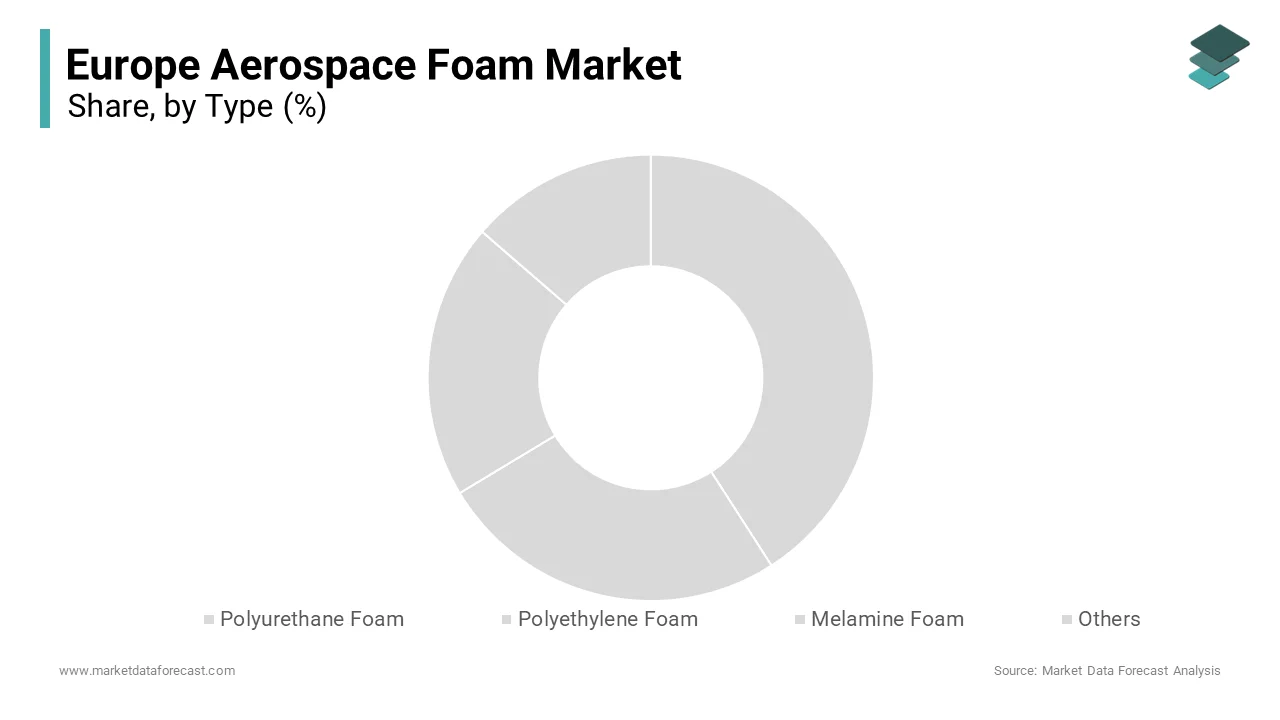
The melamine foam segment is emerging as the fastest growing segment in the Europe aerospace foam market and is predicted to record a CAGR of 8.88% over the forecast period, owing to its superior fire resistance, ultra-low smoke emission,, and acoustic absorption capabilities, and tightening cabin safety regulations under EASA CS 25.856,, which mandates near zero toxic gas release during fire events. Melamine foam emits less smoke density than conventional polyurethane when tested per ISO 5659-2, which is a critical advantage for evacuation scenarios. European airlines are retrofitting older fleets with melamine-based ceiling and sidewall panels to meet the European Union’s 2025 Aviation Safety Enhancement Directive, which requires all aircraft operated in EU airspace to comply with updated flammability benchmarks. Melamine’s open-cell structure delivers strong sound absorption across 500 to 4000 Hz frequencies, making it ideal for next-generation quieter cabins as emphasized in Airbus’s 2025 Comfort Innovation Roadmap.
By Application Insights
The commercial aviation segment accounted for the largest share of the European aerospace foam market in 2025 due to high aircraft production volumes, dense intra-European air traffic, and persistent cabin modernization initiatives. In 2023, European commercial aircraft deliveries totaled 612 units. Each aircraft requires between 300 and 500 kilograms of specialized foam for seating, acoustic lining, and thermal barriers, translating into consistent material demand. European carriers such as Ryanair and easyJet operate over 700 aircraft combined and have launched aggressive interior refresh cycles to improve fuel efficiency and passenger experience. The European Commission’s Destination 2050 sustainability roadmap calls for a 45% net reduction in CO2 per passenger-kilometer by 2030, which has pushed airlines to adopt lightweight foams that reduce tare weight without compromising comfort. Europe recorded over a billion air passengers in 2023, which is driving replacement and maintenance demand. Furthermore, the European Union Aviation Safety Agency’s updated cabin material standards, effective 2025, have accelerated the shift toward certified foam systems that meet integrated safety and environmental benchmarks.
The military & defense application segment is growing at the fastest pace and is likely to expand at a CAGR of 8.84% over the forecast period, owing to Europe’s strategic rearmament and next-generation combat aircraft programs. According to the European Defence Agency, in early 2025 that member states collectively allocated billions of euros to military aviation modernization in 2025, the highest level in decades. This includes upgrades to Eurofighter fleets, procurement of F-35s by Germany and Finland, and the Future Combat Air System, which is a tri-national UK, Italy, and France initiative targeting maiden flight by 2035. These platforms demand advanced foam cores for radar absorbing structures, thermal management in avionics bays, and lightweight crew compartment insulation. Each modern fighter integrates specialty foam composites, primarily polymethacrylimide and polyimide types. NATO’s 2023 Defence Investment Pledge, requiring members to spend 2% of GDP on defense, has directly boosted procurement, with Poland signing a multi-billion euro deal for FA-50 and F-35 aircraft. The Swedish Defence Materiel Administration confirmed in 2025 that Gripen E upgrades include new foam-based electromagnetic shielding modules. This surge in defense spending, combined with material performance requirements, is creating a high-margin niche for aerospace foam suppliers aligned with sovereign supply chain objectives.
COUNTRY ANALYSIS
Germany Aerospace Foam Market Analysis
Germany led the aerospace foam market in Europe in 2025 by occupying a share of 24.4% owing to its robust industrial base, strong defense sspendingand central role in Airbus production. As the headquarters of Airbus Defence and Space and home to major suppliers like Diehl Aviation and BASF, Germany serves as a critical hub for cabin system integration and advanced material development. Germany’s aerospace sector contributes significantly to the national GDP. The country’s commitment to the Future Combat Air System and its decision to purchase 35 F-35A fighters have intensified demand for high-performance foams used in stealth and thermal management applications. Furthermore, the German government has supported lightweight material innovation through its Luftfahrtforschungsprogramm, including recyclable foam architectures. The presence of the German Aerospace Center, which operates Europe’s largest materials testing infrastructure and enables the rapid qualification of novel foam formulations. With over 120 aerospace material suppliers clustered in Bavaria and Baden-Württemberg, Germany maintains unmatched vertical integration in foam development, manufacturing, and certification.
France Aerospace Foam Market Analysis
France ranked as the second-largest aerospace foam market in Europe in 2025. The growth of the French market is attributed to its leadership in commercial aircraft manufacturing, defense autonomy, and strategic material policy. As the birthplace of Airbus and host to Safran, a global leader in aircraft interiors, France integrates advanced foams across nearly every major European aviation program. Over 200 new commercial aircraft were assembled at Toulouse in 2025, which is leveraging foam systems for insulation and comfort. France’s military budget, the highest in Europe, has accelerated procurement of Rafale fighters and development of the Next Generation Fighter under the FCAS program, which mandates composite content including foam core sandwich structures. The French Ministry of Ecological Transition introduced in 2025 a regulatory framework requiring all aerospace materials to disclose full lifecycle carbon footprints by 2026, which is prompting Arkema and other domestic chemical firms to launch bio-sourced melamine and polyurethane foam lines. With over 2000 aerospace material researchers employed in state and private labs, France maintains a technological edge in fire-safe, sustainable foam innovation.
United Kingdom Aerospace Foam Market Analysis
The United Kingdom remains a pivotal player in the European aerospace foam market due to its legacy in defense aerospace, advanced R&D infrastructure, and leadership in urban air mobility. Despite post-Brexit trade adjustments, the UK retained its status as a core partner in the Airbus supply chain and leads the Future Combat Air System program alongside Italy. The UK aerospace sector generated significant turnover in 2023, with a large share derived from military platforms that rely heavily on specialty foams for radar cross-section reduction and crew protection. The UK’s 2025 Integrated Defence Review allocated billions of pounds to next-generation air systems, directly benefiting foam suppliers such as Morgan Advanced Materials. Moreover, the UK is home to over 15 eVTOL developers, including Vertical Aerospa, which selected lightweight polyethylene and melamine foams for its VA-X aircraft. The Aerospace Technology Institute invested heavily in 2025 in material circularity projects, including chemical recycling of aerospace foams. This dual focus on sovereign defense capabilities and future mobility cements the UK’s strategic relevance.
Italy Aerospace Foam Market Analysis
Italy occupied a prominent position in the European aerospace foam market in 2025. The participation of Italy in multinational defense programs, growing commercial MRO activity, and domestic manufacturing capabilities are propelling the aerospace foam market growth in Italy. Leo, Nardonardo, a major Italian defense contractor, integrates advanced foam composites into its AW family of helicopters and collaborates with Airbus on Eurofighter and FCAS components. In 2025, Italy’s defense ministry signed a multi-billion euro contract to modernize its Tornado and NH90 fleets, requiring extensive foam-based acoustic and thermal retrofits as detailed in its National Armament Directive. Italian carriers operated hundreds of commercial aircraft in 2025, which is driving steady demand for cabin foam replacements. Italy’s National Recovery and Resilience Plan allocated significant funding to aerospace innovation, including the development of flame-retardant biobiofoams at the Polytechnic University of Milan. Companies like Italmatic and FoamPartner maintain specialized production lines certified under EASA Part 21G. With geographic proximity to North African and Eastern European markets, Italy also serves as a logistics and service hub, amplifying its material consumption beyond domestic production needs.
Spain Aerospace Foam Market Analysis
Spain is predicted to hold a notable share of the European market over the forecast period owing to its expanding role in Airbus manufacturing, defense modernization, io nd strategic geographic positioning. Airbus’s Puerto Real and Illescas facilities produce major structural sections for the A350 and A400M programs, incorporating foam-based insulation and damping systems. According to the Spanish Association of Airlines, over 250 million passengers utilized Spanish airports in 2025, he second highest in Europe, creating robust demand for cabin refurbishment. Spain’s 2025 defense budget of 13.6 billion euros included funding for 25 H160M helicopters and upgrades to its EF 18 fleet, both requiring advanced acoustic foams for crew comfort and operational stealth. The Centre for Industrial Technological Development invested 90 million euros in 2023 in lightweight material projects, including hybrid polyurethane melamine foams with enhanced recyclability. Spanish foam converter Recticel Iberica supplies certified materials to both Airbus and ITP Aero, reinforcing domestic vertical integration. With plans to host two urban air mobility test corridors by 2026, Spain is also positioning itself as a launchpad for next-generation foam applications in emerging aviation segments.
COMPETITIVE LANDSCAPE
The Europe aerospace foam market features a concentrated yet dynamic competitive landscape dominated by technologically advanced material specialists who maintain deep integration with aircraft OEMs and tier one suppliers. Competition is less price-driven and more centered on certification readiness, regulatory compliance, performance, consistency, and sustainability credentials. Incumbents leverage decades of qualification data to defend their positions, while newer entrants focus on niche applications such as urban air mobility or defense stealth systems. The high barrier to entry created by EASA certification timelines and costs limits disruptive competition but encourages collaborative innovation through public-private partnerships like Clean Sky and Horizon Europe. Geographic proximity to Airbus and defense primes in France, Germany, and the UK provides significant logistical and developmental advantages to local foam converters. As a result, the market rewards players who combine material science expertise with agile regulatory navigation and strategic alignment with Europe’s decarbonization and sovereignty agendas.
KEY MARKET PLAYERS
- BASF SE (Germany)
- Evonik Industries AG (Germany)
- Rogers Corporation
- Zotefoams
- Solvay (Belgium)
- Boyd Corporation (U.S.)
- UFP Technologies (U.S.)
- Dupont (U.S.)
- SABIC (Saudi Arabia)
- Armacell (Luxembourg)
- ERG Aerospace Corp. (U.S.)
- FoamPartner (Switzerland)
Top Players In The Market
- Armacell is a leading global manufacturer of flexible foam solutions with a strong foothold in the European aerospace foam market. The company specializes in cross-linked polyethylene and polyolefin foams that meet stringent aviation fire safety and acoustic performance standards. Armacell supplies cabin insulation and ducting systems to major European aircraft integrators and has invested significantly in sustainable material development. In 2025, the company expanded its R&D collaboration with the German Aerospace Center to advance low-smoke, low-toxicity foam formulations compatible with electric aircraft architectures. Its production facility in Germany remains a key hub for certified aerospace foam output, serving both commercial and defense segments across the continent.
- Rogers Corporation is a pivotal player in the European aerospace foam sector through its PORON and ARLON product lines, which are widely used in aircraft seating comfort layers and gasketing applications. Headquartered in the United States, the company maintains advanced manufacturing and qualification capabilities in Belgium and Germany, enabling n rapid response to European OEM demands. Rogers has intensified its focus on lightweight high-resilience polyurethane formulations that support fuel efficiency goals. In early 2025, the company launched a new generation of halogen-free flame-retardant materials validated under EASA CS 25.853 and integrated into next-generation narrow-body cabin programs. Its commitment to regulatory alignment and performance consistency reinforces its strategic relevance in Europe.
- Zotefoams is a UK-based specialty foam producer renowned for its nitrogen-expanded cross-linked polyolefin foams marketed under the ZOTEK brand. These materials serve critical roles in aerospace applications, including thermal insulation, battery protection in eVTO, Ls, and structural cores for lightweight panels. Zotefoams maintains EASA and FAA material approvals and works closely with European urban air mobility developers and defense contractors. In 2,0, the company enhanced its Farnborough facility to increase capacity for aerospace-gradeeoam extrusion and implemented digital traceability protocols aligned with EU sustainability mandates. Its innovation in chemically inert high high-temperature, stable foams has positioned it as the preferred next-generation material for applications requiring extreme reliability and compliance.
Top Strategies Used by the Key Market Participants
Key players in the Europe aerospace foam market prioritize strategic alignment with evolving regulatory frameworks by developing halogen-free fire retardant formulations that meet EASA and REACH standards. They invest heavily in research and development to engineer lightweight foams with enhanced thermal and acoustic performance tailored for next-generation aircraft, including electric and hybrid platforms. Companies establish long-term supply agreements with tier one aerospace integrators to secure volume commitments and co-develop customized material solutions. Vertical integration is pursued through in-house compounding and foam conversion capabilities to ensure quality control and reduce lead times. Additionally, firms increasingly adopt digital traceability systems and circular economy initiatives such as chemical recycling to comply with the European Union’s Corporate Sustainability Reporting Directive and strengthen their environmental credentials.
MARKET SEGMENTATION
This research report on the Europe aerospace foam market is segmented and sub-segmented into the following categories.
By Type
- Polyurethane Foam
- Polyethylene Foam
- Melamine Foam
- Others
By Application
- Commercial Aviation
- Military & Defense
- General Aviation
By Country
- UK
- France
- Spain
- Germany
- Italy
- Russia
- Sweden
- Denmark
- Switzerland
- Netherlands
- Turkey
- Czech Republic
- Rest of Europe
Frequently Asked Questions
What role do foams play in aerospace applications?
Aerospace foams—such as polyurethane, polyimide, and phenolic variants—are critical for thermal insulation, acoustic damping, fire resistance, lightweight structural cores (e.g., sandwich panels), and vibration absorption in both cabin and airframe systems.
Which aircraft segments drive foam demand in Europe?
Commercial aviation (led by Airbus programs like A320neo and A350) dominates, while business jets, military aircraft (e.g., Eurofighter, FCAS), and emerging urban air mobility (eVTOL) platforms are fast-growing niches requiring advanced foam solutions.
How do stringent safety regulations shape foam development?
EASA and EU fire-safety standards (e.g., FAR 25.853/CS-25) mandate low smoke toxicity, flame retardancy, and thermal stability—pushing manufacturers toward halogen-free, intumescent, and ceramic-enhanced foam formulations.
Are sustainability initiatives influencing material choices?
Yes—OEMs and Tier-1s are prioritizing bio-based, recyclable, and low-VOC foams to meet Airbus’ “Zero-Waste” goals and EU Green Deal requirements, though performance and certification hurdles remain.
Which countries host key aerospace foam manufacturing?
Germany, France, the UK, and Italy lead—home to Airbus, Safran, GKN Aerospace, and specialized material suppliers like Rogers Corporation (via acquisitions), Zotefoams, and Recticel Engineered Foams.
Who are the major foam suppliers in Europe?
Key players include Zotefoams (UK, known for ZOTEK® high-performance foams), Rogers Corporation (PORON®), Recticel, Armacell, and BASF—offering certified, aerospace-grade materials with full traceability and outgassing compliance.
How is lightweighting impacting foam innovation?
Demand for fuel-efficient aircraft is driving ultra-low-density, high-strength foams—especially microcellular and nano-reinforced variants—that maintain mechanical integrity while reducing mass in interior and structural applications.
What challenges does the market face?
Long qualification cycles (often 2–5 years), volatile raw material prices (e.g., isocyanates), and supply chain fragility post-pandemic require close OEM-supplier collaboration and strategic stockpiling.
Are composites and foams increasingly integrated?
Absolutely—foam cores are essential in composite sandwich structures for wings, fairings, and floor panels. Advances in co-curing and adhesive bonding ensure seamless integration with carbon-fiber skins.
What’s the market outlook for 2025–2030?
The Europe aerospace foam market is expected to grow steadily, fueled by aircraft backlog recovery (especially single-aisle fleets), next-gen programs (e.g., ZEROe hydrogen aircraft), and rising demand for quieter, safer, and lighter cabin and structural systems.
Related Reports
Access the study in MULTIPLE FORMATS
Purchase options starting from
$ 2000
Didn’t find what you’re looking for?
TALK TO OUR ANALYST TEAM
Need something within your budget?
NO WORRIES! WE GOT YOU COVERED!
Call us on: +1 888 702 9696 (U.S Toll Free)
Write to us: sales@marketdataforecast.com