- Product Description Description
- Table of Contents TOC
- List of Table & Figure LOT
- Get Free Sample PDF Sample PDF
Market Size, 2025
$394.59 MnMarket Estimate, 2026
$425.76 MnMarket Forecast, 2034
$782.24 MnCAGR, 2026–2034
7.9%Europe Air Fryer Market Size
The Europe air fryer market was valued at USD 394.59 million in 2025, is estimated to reach USD 425.76 million in 2026, and is projected to reach USD 782.24 million by 2034, growing at a CAGR of 7.9% from 2026 to 2034.
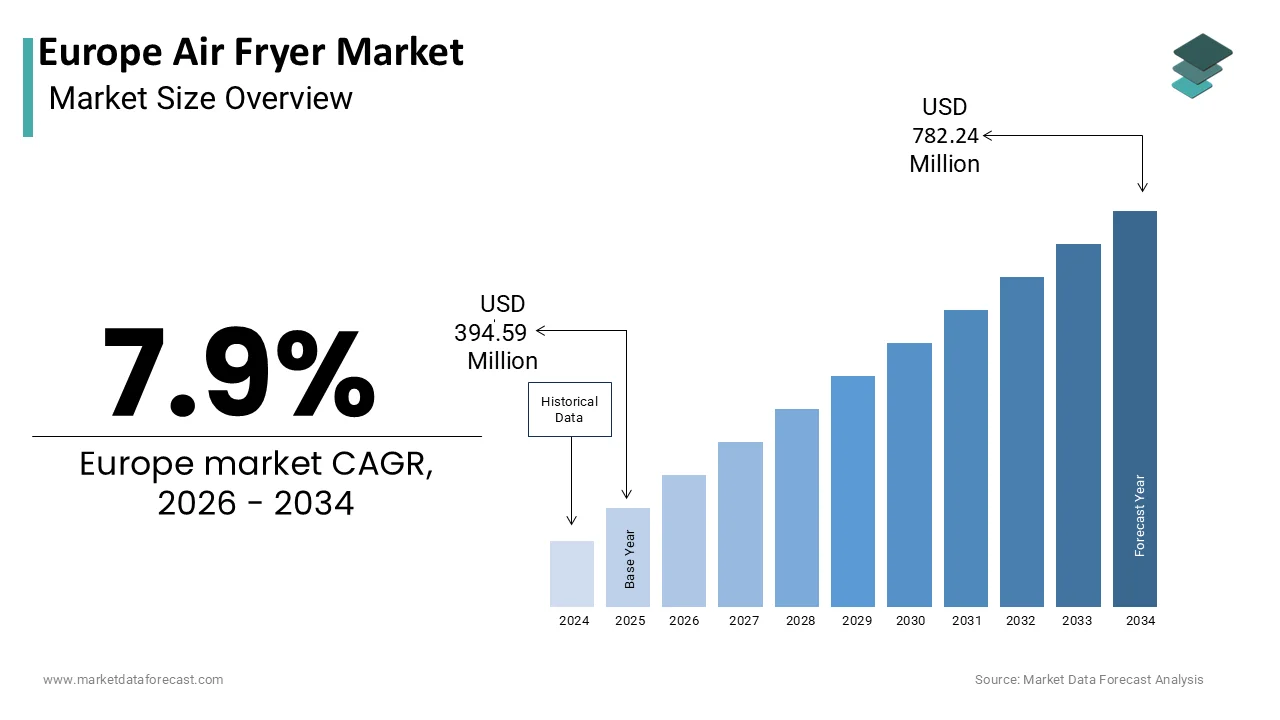
The air fryer is a small kitchen appliance that cooks food by circulating hot air at high speeds to achieve a crispy texture with minimal oil. This technology has transitioned from a niche novelty to a household staple across the continent, driven by a cultural shift toward healthier eating habits and energy efficiency. The region exhibits a unique consumption pattern where compact living spaces in urban centers like Paris and London favor versatile, space-saving appliances over traditional large ovens. According to Eurostat, household electricity prices in the European Union surged by an average of 15% in 2024, prompting consumers to seek appliances with lower energy consumption profiles for daily cooking tasks. Furthermore, the European Food Safety Authority notes that public awareness regarding the reduction of acrylamide, a potentially harmful chemical formed during high-temperature frying, has reached record levels, with 68% of consumers actively modifying cooking methods to mitigate health risks. The prevalence of single-person households, which accounted for 35% of all households in the EU in 2024 as per data from the European Commission, further accelerates the adoption of these devices due to their suitability for preparing smaller portions quickly. This convergence of economic pressure, health consciousness, and demographic changes defines the current operational landscape of the air fryer sector in Europe.
MARKET DRIVERS
Escalating Consumer Focus on Health Consciousness and Dietary Modification
The profound shift in consumer behavior toward health-conscious dietary choices and the reduction of fat intake is driving the growth of Europe air fryer market. European populations are increasingly aware of the link between excessive oil consumption and chronic diseases such as obesity and cardiovascular issues,y leading to a widespread adoption of cooking methods that require little to no added fat. As per the European Heart Network, cardiovascular diseases remain the leading cause of death in Europe, accounting for 36% of all deaths in 2024, which has spurred government and non-governmental organizations to launch aggressive public health campaigns promoting low-fat diets. Data from the European Consumer Organisation indicates that 72% of shoppers in Western Europe now read nutritional labels and seek cooking appliances that support healthier lifestyle choices. This demand is particularly strong among millennials and Gen Z consumers who prioritize wellness and are willing to invest in technology that facilitates their dietary goals. The ability of these devices to cook a wide variety of foods, from vegetables to lean proteins, without compromising taste, aligns perfectly with the Mediterranean and Nordic diet trends popular across the region. Consequently, the health narrative serves as a powerful and sustained driver for market penetration.
Surge in Energy Costs and Demand for Efficient Cooking Solutions
The rise in energy costs has fundamentally altered consumer purchasing decisions by making energy-efficient appliances like air fryers a financial necessity rather than a luxury, which is propelling the growth of Europe air fryer market. Households are actively seeking ways to reduce their electricity bills by replacing energy-intensive conventional ovens with smaller, faster, and more efficient countertop devices. According to Eurostat, the average price of electricity for households in the Euro area increased significantly in 2024, forcing families to reevaluate their daily energy usage patterns. Air fryers typically consume between 1.4 and 1.7 kilowatt hours per hour of operation, whereas traditional electric ovens can draw between 2.0 and 5.0 kilowatt hours, offering substantial savings over time. The European Commission's energy labeling framework has further educated consumers on the efficiency ratings of appliances, with many users specifically targeting A-rated devices to minimize operational costs. Data from the International Energy Agency suggests that shifting just one meal a day from a conventional oven to an air fryer could reduce a household's cooking-related energy consumption by up to 40%. This economic imperative is compounded by the shorter preheating and cooking times of air fryers, which further reduce total energy expenditure.
MARKET RESTRAINTS
Market Saturation and Extended Replacement Cycles Restraining Growth in the Europe Air Fryer Market
The rapid saturation of household ownership, combined with the inherent durability of the products, which leads to extended replacement cycles, is hampering the growth of Europe air fryer market. The market experienced an unprecedented boom during the pandemic years, resulting in a situation where a vast majority of interested households already own at least one unit. Unlike consumable goods or rapidly evolving electronics like smartphones, air fryers are mechanical devices with few moving parts that rarely fail within the first several years of use. Data from GfK indicates that the average replacement cycle for small kitchen appliances in Europe has stretched to 7 years, as consumers see little incentive to upgrade unless their current device breaks or lacks a specific new feature. This longevity creates a lull in demand where manufacturers struggle to convince existing owners to purchase newer models. The lack of compelling technological breakthroughs that offer transformative benefits over previous generations further exacerbates this issue. Consequently, companies face the challenge of stimulating demand in a mature market where organic growth through new adoptions has slowed considerably.
Concerns Regarding Material Safety and Chemical Leaching
The growing consumer apprehension regarding the safety of materials used in air fryer coatings and their potential to leach harmful chemicals into food is hindering the growth of Europe air fryer market. Despite regulatory standards, a segment of the European population remains skeptical about the long-term health implications of non-stick coatings, particularly when exposed to high temperatures over extended periods. As per the European Food Safety Authority, ongoing research into the migration of per- and polyfluoroalkyl substances from cookware into food has heightened public sensitivity, with 45% of consumers expressing concern about the safety of non-stick surfaces in a 2024 survey conducted by the European Consumer Organisation. This awareness is fueled by occasional media reports and social media discussions highlighting potential risks, which can deter risk-averse buyers from purchasing air fryers or lead them to stick with traditional cooking methods like stainless steel pans. Manufacturers face the difficult task of educating the public and proving the compliance of their products with strict EU regulations, yet the perception of risk persists. The demand for ceramic or alternative coating options is rising, but these often come at a higher price point or with perceived performance trade-offs, limiting their mass appeal.
MARKET OPPORTUNITIES
Integration of Smart Connectivity and IoT Ecosystems
The integration of smart connectivity and Internet of Things capabilities for manufacturers to revitalize and attract tech-savvy consumers is gaining traction over the growth of Europe air fryer market. By embedding Wi-Fi and Bluetooth modules, companies can offer features such as remote monitoring, voice control via virtual assistants, and access to extensive cloud-based recipe libraries that automatically adjust cooking parameters. Smart air fryers can notify users when food is ready, preheat remotely, and even order ingredients through integrated e-commerce platforms, creating a seamless cooking experience. Data from the European Technology Platform on Smart Systems Integration indicates that 60% of millennials prefer appliances that can be controlled via smartphone apps, viewing them as essential components of a modern smart home. This technological evolution allows manufacturers to differentiate their products in a crowded market and justify premium pricing. Furthermore, the data generated by these connected devices provides valuable insights into consumer cooking habits, enabling companies to develop targeted marketing strategies and personalized content. Embracing smart technology transforms the air fryer from a simple heating element into an intelligent culinary assistant, opening new revenue streams and fostering brand loyalty.
Expansion into Commercial and Food Service Sectors
The expansion of air fryer technology into the commercial food service and hospitality sectors is expected to leverage the growth of Europe air fryer market. Restaurants, fast-food chains, and institutional cafeterias are increasingly under pressure to offer healthier menu options while managing rising energy costs and adhering to strict environmental regulations. As per the European Hospitality Industry, over 40% of restaurants in major European cities plan to update their kitchen equipment to energy-efficient models by 2026 to reduce their carbon footprint and operational expenses. Commercial-grade air fryers offer the ability to produce consistent, high-quality fried foods with significantly less oil, aligning with the growing consumer demand for healthy dining out. These industrial units also feature larger capacities and faster recovery times, making them suitable for high-volume operations. Data from the European Fast Food Association shows that sales of "healthy" menu items have increased by 18% in 2024, prompting chains to adopt cooking technologies that support this trend without sacrificing speed or taste. By developing robust, heavy-duty models tailored for professional kitchens, manufacturers can tap into a B2B market segment that offers higher transaction values and recurring service contracts. This diversification reduces reliance on the saturated consumer market and positions air fryers as a standard tool in the modern professional kitchen.
MARKET CHALLENGES
Intense Price Competition and Proliferation of Low-Quality Imports
The intense price competition driven by an influx of low-cost, low-quality imports from non-European manufacturers is one of the challenges for the growth of Europe air fryer market. This saturation of budget-friendly options erodes profit margins for established brands and creates a race to the bottom in terms of pricing, often at the expense of product quality and safety. These counterfeit or substandard products often fail to meet rigorous European safety and energy efficiency standards, posing risks to consumers and damaging the overall reputation of the product category. Legitimate manufacturers struggle to compete on price while maintaining compliance with strict EU regulations regarding materials, electrical safety, and waste disposal. As per the European Committee for Standardization, inconsistent enforcement across member states allows some inferior products to slip through cracks, undercutting reputable brands. Consumers attracted by low prices may end up with devices that have shorter lifespans or poor performance, leading to dissatisfaction and hesitation in future purchases. Navigating this fragmented landscape requires significant investment in brand building, consumer education, and lobbying for stricter border controls, which strains resources and complicates market strategies for key players.
Complexity of Regulatory Compliance and Waste Management Directives
The complex web of European regulatory compliance and waste management directives additionally inhibits the growth of Europe air fryer market. The European Union enforces stringent regulations such as the Ecodesign for Sustainable Products Regulation and the Waste Electrical and Electronic Equipment Directive, which mandate rigorous standards for energy efficiency, reparability, and recycling. As per the European Environment Agency, manufacturers must now provide digital product passports detailing the lifecycle impact of every component, requiring extensive supply chain transparency and documentation. Compliance with these evolving rules necessitates substantial investment in research and development to redesign products for easier disassembly and the use of recycled materials. Data from the European Commission indicates that failure to meet these new sustainability criteria can result in severe penalties and market exclusion. Additionally, the varying interpretations and implementation timelines of these directives across different member states create a fragmented regulatory environment that complicates logistics and distribution. Small and medium-sized enterprises often lack the resources to manage this administrative burden, limiting their ability to innovate or expand.
REPORT COVERAGE
| REPORT METRIC | DETAILS |
| Market Size Available | 2025 to 2034 |
| Base Year | 2025 |
| Forecast Period | 2026 to 2034 |
| Segments Covered | By Size, Material, End User, and Region. |
| Various Analyses Covered | Global, Regional, and Country-Level Analysis, Segment-Level Analysis, Drivers, Restraints, Opportunities, Challenges; PESTLE Analysis; Porter’s Five Forces Analysis, Competitive Landscape, Analyst Overview of Investment Opportunities |
| Countries Covered | UK, France, Spain, Germany, Italy, Russia, Sweden, Denmark, Switzerland, Netherlands, Turkey, Czech Republic, Rest of Europe |
| Market Leaders Profiled | Koninklijke Philips N.V., Groupe SEB, De'Longhi Appliances S.r.l, Stanley Black & Decker, Inc., Breville Group Limited, Newell Brands, Inc., SharkNinja Operating LLC, Spectrum Brands Holdings, Inc., Havells India Ltd., Wonderchef Home Appliances Pvt. Ltd., NuWave LLC, Cosori |
SEGMENTAL ANALYSIS
By Size Insights
The large XL Size segment accounted in holding 42.3% of the Europe air fryer market share in 2025, with its precise fit with the demographic structure of modern European households, which increasingly consist of small families or multi-generational living arrangements requiring substantial cooking capacity. As per Eurostat, the average household size in the European Union stabilized at 2.3 persons in 2024, a figure that renders mini or small air fryers insufficient for preparing complete dinners without multiple batches. Consumers in this demographic prioritize appliances that can accommodate a whole chicken or enough fries for three to four people, a capability inherent to the 5.0 to 8.5 liter range. The ability to cook diverse components of a meal simultaneously using divider accessories, which are standard in XL models, further enhances their appeal.
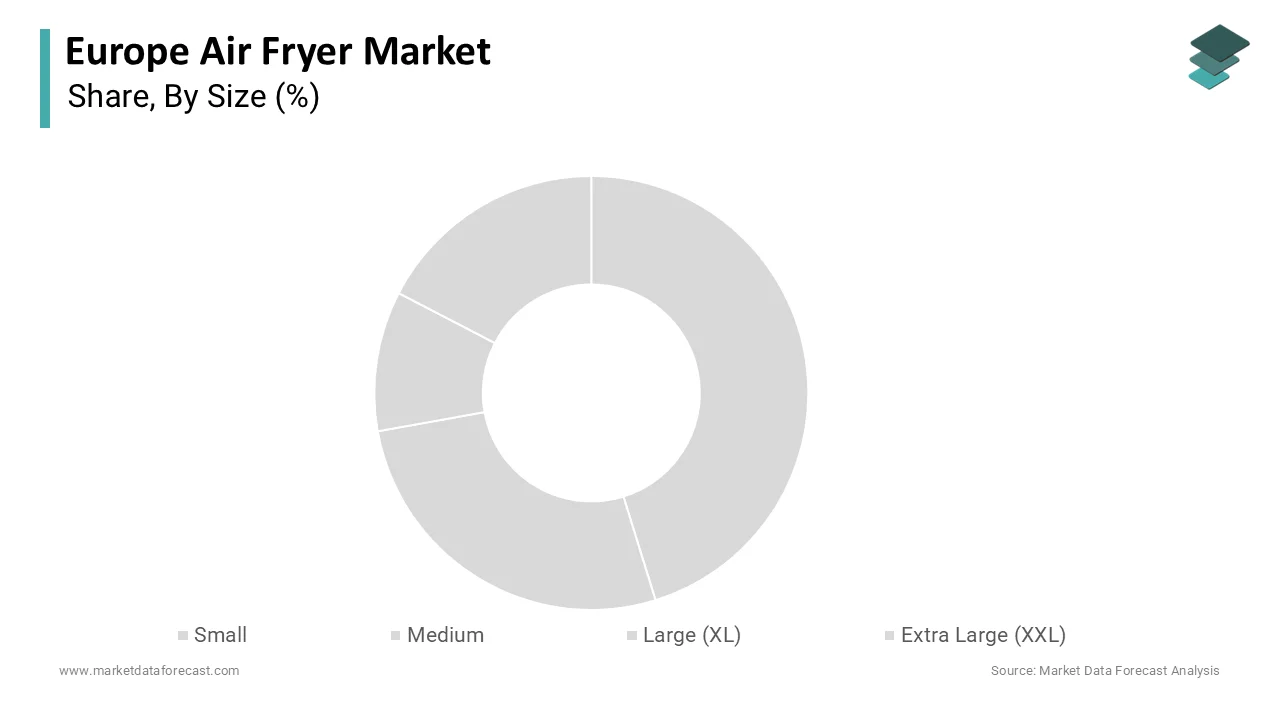
The Extra Large XXL segment is likely to witness the fastest CAGR of 18.5% from 2026 to 2034. As consumers seek to optimize their time and manage food costs amidst economic uncertainty, the practice of preparing large quantities of food in one session for consumption throughout the week has become mainstream. As per the European Institute of Innovation and Technology, participation in meal prepping activities among European adults increased by 35% in 2024, driven by the need for convenience and dietary control. XXL air fryers are uniquely positioned to support this lifestyle, offering the volume necessary to cook kilograms of protein or vegetables in a single cycle, a task impossible for smaller models. The capacity to freeze prepared meals in portioned containers directly after cooking aligns perfectly with the workflows of busy professionals and families. This shift in culinary habits transforms the air fryer from a quick-cook device into a strategic tool for household management, driving unprecedented demand for the largest available capacities and propelling the XXL segment to the forefront of market growth.
By Material Insights
The plastic segment was the largest by holding 58.4% of the Europe air fryer market share in 2025, owing to the significant cost advantage it offers in manufacturing, which translates to lower retail prices and broader accessibility for European consumers. Plastic housing and components are substantially cheaper to produce than metal alternatives, enabling brands to offer entry-level and mid-range air fryers at price points that fit within the tight budgets of many households facing inflationary pressures. As per the European Commission's consumer price index data, the average retail price of plastic-bodied air fryers remained 30% lower than metal equivalents in 2024, making them the preferred choice for first-time buyers. The ability to injection mold plastic into complex shapes also reduces assembly time and labor costs, further enhancing profit margins for manufacturers while keeping prices competitive. This economic dynamic ensures that plastic remains the material of choice for the vast majority of consumers, securing its overwhelming market share through sheer volume of sales across all distribution channels.
The metal segment is anticipated to grow at the fastest CAGR of 12.8% from 2026 to 203,4 owing to the rising consumer preference for durable, long-lasting appliances with a premium feel, which is the primary engine for the rapid growth of the metal segment. As per the European Consumer Organisation, surveys conducted in 2024 revealed that 48% of consumers associate metal construction with superior longevity and resistance to wear and tear, leading to a shift in purchasing behavior toward these models. The tactile experience of metal, combined with its resistance to scratching and discoloration over time, appeals to users seeking investment-grade appliances. This trend is particularly strong in markets like Germany and Switzerland, where engineering quality and durability are paramount decision factors. The perception of metal as a hygienic and non-porous material further enhances its appeal among health-conscious consumers.
By End User Insights
The residential segment accounted for a prominent share of the Europe air fryer market in 2025. Families are increasingly prioritizing low-fat cooking methods to combat rising obesity rates and improve overall well-being, making the air fryer a staple in modern kitchens. Air fryers allow residents to enjoy crispy textures with up to 80% less oil, directly addressing these health concerns without sacrificing taste. Data from the European Heart Network indicates that 60% of European families have modified their diet to reduce fat intake, with the air fryer cited as the primary tool for this transition. The device's ability to cook vegetables, lean meats, and fish quickly and healthily aligns perfectly with the Mediterranean and Nordic dietary recommendations popular in the region. This deep integration into daily health routines ensures consistent usage and high penetration rates, making the residential sector the undisputed leader in market volume and value.
The commercial segment is expected to grow at the fastest CAGR of 16.2% from 2026 to 2034. The strategic pivot of major fast-food chains and quick-service restaurants toward healthier menu offerings is the primary catalyst for the rapid growth of the commercial air fryer segment. Operators are under immense pressure to reduce the trans-fat and calorie content of their foods while maintaining the texture and taste customers expect, a balance that air frying technology achieves effectively. As per the European Fast Food Association, 45% of major QSR brands in Europe introduced new "light" or "healthy" fried items in 2024, relying heavily on commercial air fryers for production. These high-capacity industrial units allow kitchens to produce consistent, high-quality fried foods with minimal oil, aligning with public health guidelines and consumer preferences. Data from McDonald's Europe and other major chains indicates that the rollout of air-fried menu items has led to a 15% increase in sales among health-conscious demographics. The operational benefits, including reduced oil disposal costs and improved kitchen air quality, further incentivize adoption. As more chains commit to nutritional transparency and healthier formulations, the demand for robust commercial air fryers will surge, driving the segment's exceptional growth rate across the hospitality industry.
By Distribution Channel Insights
The e-commerce segment was the largest by holding 46.4% of the Europe air fryer market share in 2025. The unparalleled convenience of online shopping and the ability to effortlessly compare a vast array of models, features, and prices are driving up the growth of the segment. European consumers increasingly prefer the comfort of browsing and purchasing appliances from home, where they can access detailed specifications, user manuals, and thousands of verified customer reviews that are not available in physical stores. As per Eurostat, 74% of individuals in the EU aged 16 to 74 made online purchases in 2024, with home and garden appliances being a top category. The digital marketplace allows shoppers to filter results by capacity, material, and price, ensuring they find the perfect match for their specific needs without the time pressure of a retail environment. The availability of exclusive online deals, flash sales, and bundle offers further incentivizes digital purchasing. This informational empowerment and logistical ease make e-commerce the preferred channel for the majority of consumers, securing its dominant market position.
The supermarkets segment is anticipated to grow at the fastest CAGR of 14.5% from 2026 to 2034. Retailers have recognized the synergy between selling the appliance and the ingredients used in it, placing units near frozen foods, oils, and fresh produce to trigger impulse purchases. As per the European Retail Roundtable, 55% of supermarket shoppers made unplanned purchases of small appliances in 2024 when exposed to attractive in-store displays and live cooking demonstrations. This "shop-the-look" approach allows consumers to visualize the immediate utility of the device, bridging the gap between intention and action. The tactile experience of seeing the product physically, combined with the convenience of picking it up during a weekly grocery run, appeals to time-poor consumers who prefer one-stop shopping. This integration of appliance retail into the daily grocery routine is driving a surge in footfall-driven sales, making supermarkets the fastest-growing channel.
COUNTRY LEVEL ANALYSIS
United Kingdom Air Fryer Market Analysis
The United Kingdom was the top performer in the Europe air fryer market by holding 22.3% of the market share in 2025, with an exceptionally high penetration rate, where the air fryer has transcended novelty to become a quintessential kitchen appliance found in nearly half of all homes. This dominance is driven by the country's acute sensitivity to energy price hikes, which have been among the highest in Europe, compelling households to adopt energy-efficient cooking solutions urgently. The strong culture of food television and celebrity chef endorsements has further normalized the device, with major broadcasters dedicating prime-time slots to air fryer recipes. Data from YouGov indicates that 52% of UK adults owned an air fryer in 2024, the highest rate on the continent. The robust presence of major retailers like Tesco and Argos, coupled with a vibrant e-commerce sector, ensures widespread availability and competitive pricing. The emergence of economic necessity, cultural endorsement, and retail accessibility cements the UK's position as the largest and most mature market for air fryers in Europe.
Germany Air Fryer Market Analysis
Germany was ranked second by holding 18.5% of the Europe air fryer market share in 2025, with the consumer base that prioritizes engineering quality, energy efficiency ratings, and durability. The German "Energiewende" or energy transition policy, which has heightened public awareness of energy consumption and encouraged the adoption of A-rated appliances. German consumers are also highly influenced by independent testing organizations like Stiftung Warentest, whose positive ratings can make or break a product's success. Data from GfK shows that the average selling price of air fryers in Germany is 20% higher than the European average, reflecting the willingness to pay for quality and longevity. The strong domestic manufacturing base and a culture of precision cooking further support the demand for advanced features like smart connectivity and dual zones.
France Air Fryer Market Analysis
The French air fryer market was positioned second by holding 14.6% of the market share in 2025, with a unique blend of culinary tradition and modern health consciousness that is reshaping domestic cooking habits. The market status is robust, driven by a growing rejection of deep-fried foods in favor of healthier alternatives that do not compromise on the sensory experience of French cuisine. The domination of the French market is fueled by government-led public health initiatives aimed at reducing obesity and promoting the "Nutri-Score" labeling system, which encourages healthier cooking methods. The device is increasingly seen as a tool for modernizing traditional recipes, allowing families to enjoy classics like fries and croquettes with less guilt. Data from INSEE indicates that sales of small kitchen appliances in France grew by 12% in 2024, with air fryers leading the category. The strong presence of hypermarkets like Carrefour and Auchan provides excellent distribution reach, while a burgeoning community of French food bloggers promotes creative air fryer usage.
Italy Air Fryer Market Analysis
Italy's air fryer market growth is anticipated to have significant growth opportunities in the coming years, with its deep-rooted food culture and the increasing adaptation of traditional dishes to healthier cooking methods. The modification of iconic fried dishes such as arancini, frittelle, and polenta to be lighter and healthier is a trend gaining traction among younger generations, which is additionally promoting the growth of the market. According to the Italian National Institute of Statistics, the prevalence of overweight individuals in Italy reached 46% in 2024, prompting a national dialogue on diet and lifestyle changes that favor air frying. The device is also valued for its speed, fitting well into the busy lives of modern Italian families who still wish to serve home-cooked meals. The ability to reconcile health goals with culinary heritage positions Italy as a key growth market with distinct consumption patterns.
Spain Air Fryer Market Analysis
Spain's air fryer market growth is likely to grow with its warm climate, outdoor lifestyle, and the growing popularity of tapas culture adapted for air frying. The high summer temperatures discourage the use of large ovens that heat the kitchen by making the cool-running air fryer an attractive alternative year-round. The trend of "vermut" and tapas at home has evolved to include air-fried varieties, expanding the appliance's utility beyond main courses. The proliferation of affordable models in major retailers like El Corte Inglés and Mercadona ensures broad accessibility. This alignment with lifestyle, climate, and social dining traditions ensures Spain's steady ascent in the regional market hierarchy.
COMPETITIVE LANDSCAPE
The competition in the Europe air fryer market is intensely fierce,e characterized by a crowded landscape of established appliance giants and agile new entrants vying for consumer attention. Market leaders constantly battle to differentiate their offerings through technological advancements such as dual basket systems and smart sensors that optimize cooking times and energy usage. Price competition remains a critical factor as brands strive to balance premium features with affordability to appeal to cost-conscious households facing economic pressures. The struggle for shelf space in both physical retail stores and top positions on e-commerce platforms drives aggressive marketing campaigns and promotional discounts throughout the year. Brand loyalty is increasingly tied to ecosystem integration, where companies offer companion apps and recipe communities to retain users beyond the initial hardware purchase. Regulatory compliance regarding energy efficiency and material safety adds another layer of complexity,ity forcing all participants to invest heavily in research and development.
KEY MARKET PLAYERS
Some of the companies that are playing a dominating role in the global Europe Air Fryer Market include
- Koninklijke Philips N.V.
- Groupe SEB (Tefal)
- De'Longhi Appliances S.r.l
- Stanley Black & Decker, Inc.
- Breville Group Limited
- Newell Brands, Inc.
- SharkNinja Operating LLC
- Spectrum Brands Holdings, Inc.
- Havells India Ltd.
- Wonderchef Home Appliances Pvt. Ltd.
- NuWave LLC
- Cosori
TOP LEADING PLAYERS IN THE MARKET
- Philips Electronics NV stands as a pioneering force in the Europe air fryer market by originally inventing the Rapid Air technology that defines the category. The company contributes significantly to the global market by setting industry standards for health-focused cooking appliances and holding extensive patents related to fat reduction technologies. Recent actions to strengthen its position include the launch of the Premium XXL Connected series featuring smart sensing capabilities and recipe guidance via mobile applications. Philips has actively expanded its sustainability initiatives by introducing models made with recycled plastics and energy-efficient components to align with European Green Deal objectives. The firm collaborates with nutritionists and chefs across the continent to develop healthy recipe ecosystems that enhance user engagement. By focusing on premium innovation and health leadership, Philips continues to reinforce its brand authority and drive adoption among health-conscious consumers throughout the region and worldwide.
- Groupe SEB SA operates as a dominant entity in the Europe air fryer landscape through its portfolio of beloved brands,s including Tefal and Mouli,n each of which caters to diverse consumer segments. The company impacts the global market by leveraging its massive manufacturing scale to deliver high-quality yet affordable air frying solutions to millions of households. Recent strategic moves involve the introduction of the Easy Fry Precision range, which combines air frying with steaming functions to offer versatile cooking options for European families. SEB has strengthened its market presence by investing heavily in circular economy programs that offer repair services and spare parts to extend product lifecycles. The firm actively partners with retail giants to create exclusive in-store experiences and demonstration zones that educate consumers on healthy cooking benefits.
- Ninja Kitchen has rapidly emerged as a disruptive leader in the Europe air fryer market by introducing multi-functional devices that combine air frying with pressure cooking and grilling capabilities. The company contributes to the global sector by popularizing the concept of all-in-one cooking systems that save counter space and simplify meal preparation for modern households. Recent efforts to solidify its standing include the rollout of the Foodi Dual Zone technology, which allows users to cook two different foods at separate temperatures simultaneously. Ninja has intensified its marketing campaigns across European digital platforms and collaborated with popular social media influencers to showcase rapid and versatile cooking demonstrations. The firm focuses on aggressive product innovation cycles that introduce unique features like smart finish and match cook to address specific consumer pain points.
TOP STRATEGIES USED BY KEY MARKET PARTICIPANTS
Key players in the Europe air fryer market primarily focus on continuous product innovation to introduce multi-functional appliances that combine air frying with steaming or grilling capabilities. Companies actively develop smart connectivity features allowing users to control devices via mobile applications and access cloud-based recipe libraries for enhanced convenience. Another major strategy involves emphasizing sustainability by manufacturing units with recycled materials and ensuring energy efficiency to comply with strict European environmental regulations. Brands frequently engage in strategic partnerships with health organizations and celebrity chefs to promote healthy lifestyle benefits and build consumer trust. Manufacturers also expand their distribution networks by strengthening relationships with both online marketplaces and physical retail chains to ensure maximum product visibility. Additionally, firms invest in extended warranty programs and repair services to address consumer concerns about durability and support circular economy goals within the region.
MARKET SEGMENTATION
This research report on the europe air fryer market is segmented and sub-segmented into the following categories.
By Size
- Small
- Medium
- Large (XL)
- Extra Large (XXL)
By Material
- Plastic
- Metal
By End User
- Residential
- Commercial
By Distribution Channel
- E-commerce
- Supermarkets/Hypermarkets
- Specialty Stores
- Others
By Country
- United Kingdom
- Germany
- France
- Italy
- Spain
- Rest of Europe