- Product Description Description
- Table of Contents TOC
- List of Table & Figure LOT
- Get Free Sample PDF Sample PDF
Market Size, 2025
$30.9 BnMarket Estimate, 2026
$32.88 BnMarket Forecast, 2034
$54 BnCAGR, 2026–2034
6.4%Europe Aluminum Market Report Summary
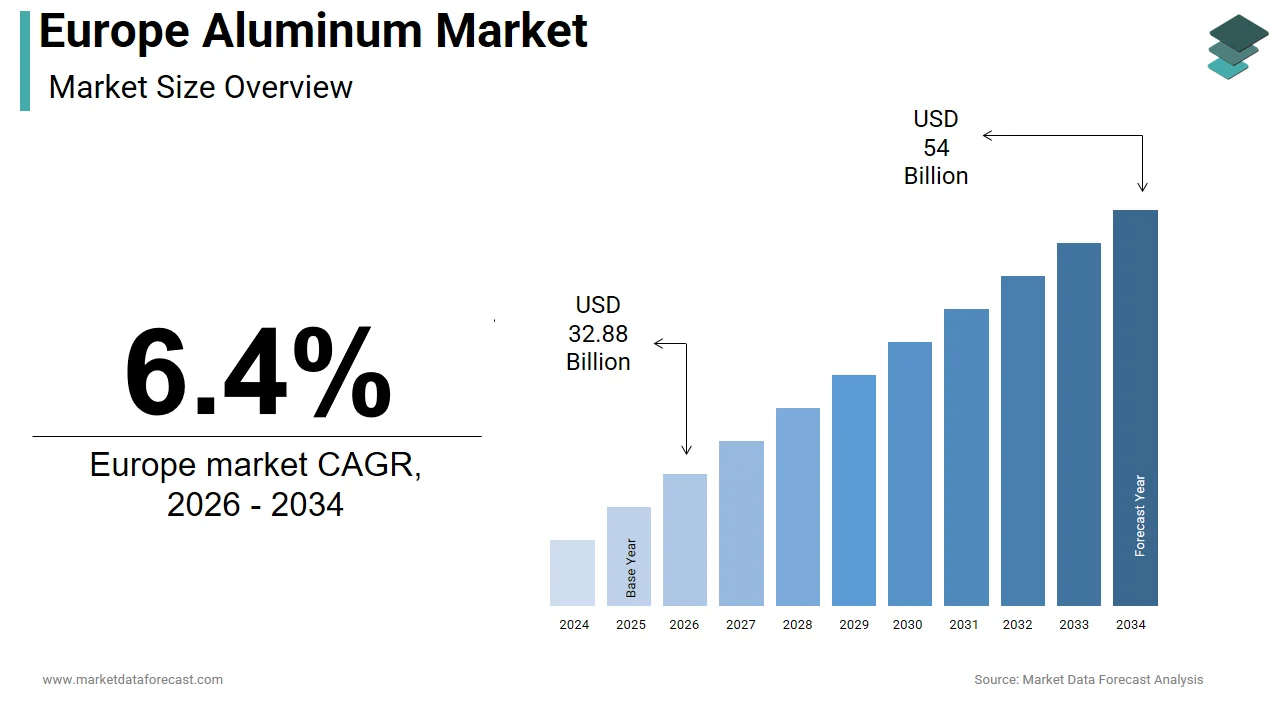
The Europe aluminum market was valued at USD 30.9 billion in 2025, is estimated to reach USD 32.88 billion in 2026, and is projected to reach USD 54 billion by 2034, growing at a CAGR of 6.4% from 2026 to 2034. Market growth is driven by increasing demand for lightweight and durable materials across industries such as transportation, construction, and packaging. Aluminum is widely used due to its corrosion resistance, recyclability, and high strength-to-weight ratio, making it essential for automotive manufacturing, aerospace applications, and sustainable construction. Rising investments in electric vehicles, expansion of renewable energy infrastructure, and increasing emphasis on recyclable materials are further supporting market growth across Europe.
Key Market Trends
- Increasing demand for lightweight materials in automotive and transportation industries.
- Rising adoption of recyclable and sustainable aluminum products.
- Growing use of aluminum in electric vehicle manufacturing and battery components.
- Expansion of renewable energy infrastructure and construction projects.
- Increasing technological advancements in aluminum alloy processing and manufacturing.
Segmental Insights
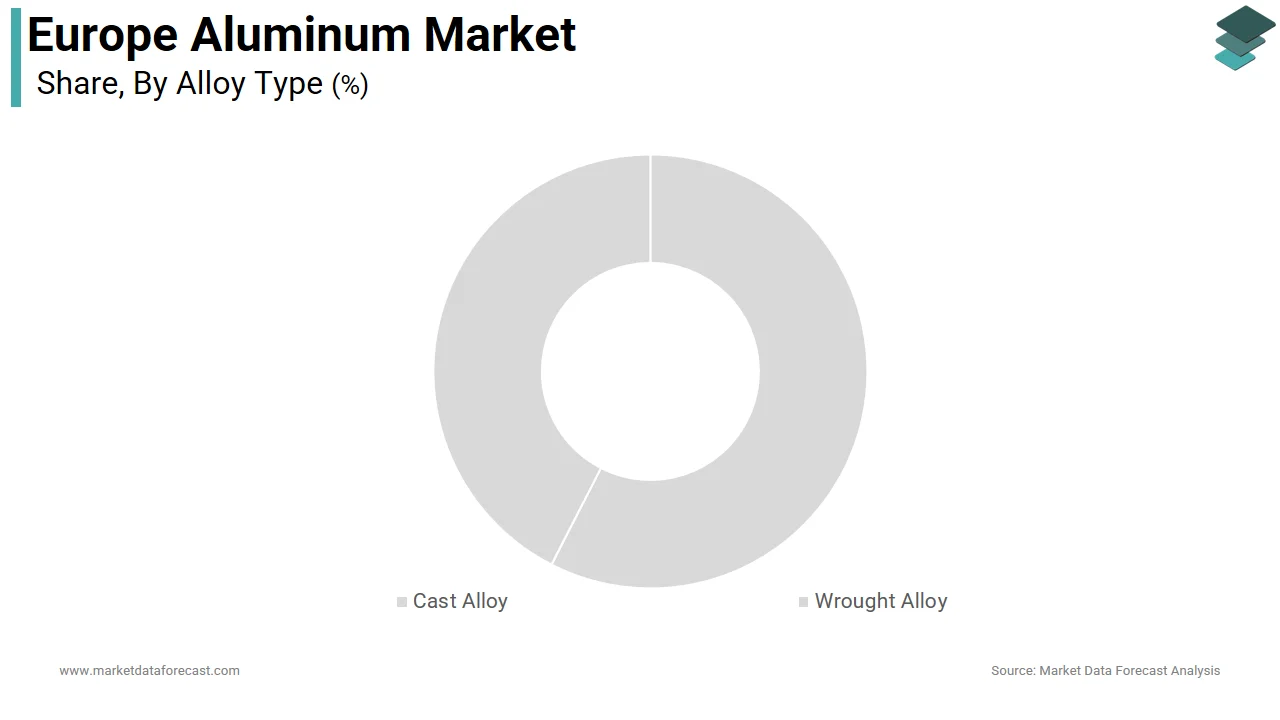
- Based on alloy type, the wrought alloy segment dominated the Europe aluminum market in 2025 by holding the largest share, supported by its widespread use in structural applications, automotive components, and aerospace manufacturing.
- Based on end use, the transportation segment led the market by capturing 35.7% share in 2025, driven by increasing demand for lightweight vehicle components and growing adoption of aluminum in electric vehicle production.
Regional Insights
The Europe aluminum market is witnessing steady growth across major countries due to strong manufacturing capabilities, growing automotive production, and increasing demand for sustainable materials.
- Germany dominated the regional market in 2025 with 24.1% share, supported by its strong automotive industry and advanced manufacturing sector.
- Italy ranked second with 15.2% share in 2025, driven by a well-established aluminum processing industry and strong industrial demand.
- France also holds a significant position in the market, leveraging its strong aerospace industry and growing investments in renewable energy infrastructure.
Competitive Landscape
The Europe aluminum market is characterized by strong competition among global aluminum producers and regional metal processing companies. Market participants are focusing on improving production efficiency, expanding recycling capabilities, and developing advanced aluminum alloys for industrial applications. Strategic partnerships, investments in sustainable manufacturing, and expansion of production capacities are shaping competitive dynamics across the region.
Prominent companies operating in the Europe aluminum market include Alcoa Corporation, Rio Tinto Group, Rusal, China Hongqiao Group Limited, Norsk Hydro ASA, South32 Limited, Constellium SE, Kaiser Aluminum Corporation, and Novelis Inc.
Europe Aluminum Market Size
The Europe aluminum market was valued at USD 30.9 billion in 2025, is estimated to reach USD 32.88 billion in 2026, and is projected to reach USD 54 billion by 2034, growing at a CAGR of 6.4% from 2026 to 2034.
Aluminum (symbol Al, atomic number 13) is a silvery-white, lightweight metal that is the most abundant metallic element in the Earth's crust. Domestic primary production has dwindled to approximately 950,000 metric tons annually, meeting less than 7% of regional demand, while total apparent consumption exceeds 13.5 million metric tons, according to EUROSTAT data from 2024. This deficit renders Europe heavily import-dependent, sourcing over 6.5 million tons of raw and semi-finished aluminum from global suppliers. Unlike commodity-driven markets elsewhere, Europe’s aluminum ecosystem is increasingly governed by regulatory frameworks such as the Circular Economy Action Plan and the Carbon Border Adjustment Mechanism. Recycling now forms the backbone of supply security, with secondary aluminum offering up to 95% lower CO₂ emissions compared to primary metal, as documented by the European Commission. Consequently, the market functions as a strategic interface between industrial policy, climate ambition, and material sovereignty rather than a conventional trading arena.
MARKET DRIVERS
Lightweighting Imperatives in Automotive and Aerospace Drive Structural Demand
The relentless pursuit of vehicle lightweighting across the region’s automotive and aerospace sectors remains a cornerstone driver of the Europe aluminum market. In the automotive domain, the shift toward electric mobility has intensified material substitution, as manufacturers seek to offset the weight of heavy battery packs. Every 10% reduction in vehicle mass can improve energy efficiency by 6% to 8%, a metric that directly influences range anxiety and regulatory compliance under the EU’s CO₂ fleet targets. According to sources, automakers are systematically replacing steel components with aluminum in chassis, body panels, and powertrain systems to achieve these gains. The European Automobile Manufacturers’ Association notes that the average aluminum content per passenger car rose from 160 kilograms in 2015 to over 210 kilograms in 2025, with electric vehicles often exceeding 250 kilograms due to battery enclosures and motor housings. In aerospace, Airbus and other European OEMs utilize high-strength aluminum-lithium alloys in up to 20% of airframe structures for models like the A350, where weight savings translate directly into fuel economy and emissions reductions over the aircraft’s lifecycle. The aerospace sector's demand for aluminum is decoupled from general economic downturns, driven instead by long-term manufacturing cycles and a mandatory industry-wide push for higher fuel efficiency.
Construction Sector Modernization Fuels Long-Term Aluminum Adoption
The region’s built environment is undergoing a profound transformation driven by energy performance directives and urban densification, both of which amplify demand for architectural aluminum systems, and thereby propel the expansion of the Europe aluminum market. The revised Energy Performance of Buildings Directive mandates that all new public buildings achieve nearly zero-energy status, a benchmark that favors materials enabling thermal efficiency, durability, and design flexibility. Aluminum remains the preferred material for modern commercial architecture in Europe, driven by its durability and the aesthetic requirements of contemporary high-performance building envelopes. These systems integrate thermal breaks and multi-chamber profiles that reduce heat transfer coefficients to below 1.0 W/m²K, aligning with Passive House standards. Moreover, European climate policy is acting as a massive structural driver for aluminum demand, as the continent-wide effort to decarbonize the building stock requires high volumes of recyclable, energy-efficient building materials. Urban infrastructure projects further bolster demand: high-speed rail expansions in Spain and Italy, metro upgrades in Berlin and Warsaw, and modular housing programs in the Netherlands all specify aluminum for roofing, cladding, and structural elements due to its corrosion resistance and 100% recyclability. Unlike cyclical construction booms, this demand is policy-anchored and long-duration, creating a stable undercurrent even during economic slowdowns.
MARKET RESTRAINTS
Energy Intensity and Volatility Undermine Primary Production Viability
Extreme energy dependence and volatile electricity pricing are critically constraining the European aluminum market. As a result, its capacity to sustain primary smelting operations is at risk. Producing one metric ton of primary aluminum requires approximately 13,500 to 15,000 kilowatt-hours of electricity, rendering smelters acutely sensitive to power costs. During the 2022 energy crisis, natural gas-driven electricity prices in Germany and France surged beyond 400 euros per megawatt-hour, forcing producers like Alcoa and Norsk Hydro to curtail or permanently shutter capacity totaling over 1.1 million metric tons annually. Although prices have moderated, structural risks persist. As of late 2025, European industrial power tariffs remain two to three times higher than those in the Gulf Cooperation Council countries and North America, according to the International Energy Agency. This cost disparity has eroded Europe’s competitiveness, with primary production now accounting for less than 7% of regional supply needs. Compounding the issue, the intermittent nature of renewable-dominated grids complicates the stable baseload supply required for electrolytic reduction cells. Without access to long-term, fixed-price clean power contracts or state-backed energy hedges, new investments in primary capacity remain economically unviable. Consequently, Europe’s strategic autonomy in aluminum is increasingly compromised, as the region cedes control over foundational metal supply to external producers operating in lower-cost jurisdictions.
Carbon Border Adjustment Mechanism Imposes Unintended Competitive Distortions
The Carbon Border Adjustment Mechanism (CBAM) introduces complex distortions that inadvertently penalize domestic aluminum producers and hinder the expansion of the Europe aluminum market. At the same time, it creates loopholes for foreign competitors. Effective from 2026, CBAM imposes a carbon cost on imported aluminum based on embedded emissions, projected to add between 20 and 50 US dollars per metric ton to import prices. However, the regulation assigns zero emissions to imported aluminum scrap, enabling non-EU producers to remelt high-carbon primary metal into secondary billet outside Europe and re-export it as a “low-carbon” product without full lifecycle accounting. This loophole allows Chinese and Turkish exporters to circumvent CBAM levies while undercutting EU-based recyclers who operate under stringent environmental permits and higher labor costs. Simultaneously, domestic producers face double regulation: they remain subject to the EU Emissions Trading System (ETS), which already prices their direct emissions, while also competing against artificially cheap imports. Leading European aluminum producers are warning that current regulatory loopholes in carbon accounting could inadvertently favor imported re-melted scrap over cleaner, primary EU-produced metal, potentially undermining domestic low-carbon investments. Rather than shielding green industry, CBAM’s current design risks fragmenting the internal market and accelerating offshoring of value-added fabrication, thereby undermining the very decarbonization goals it seeks to advance.
MARKET OPPORTUNITIES
Circular Economy Transition Unlocks High-Value Recycling Potential
The formalization of Europe’s circular aluminum economy offers a transformative opportunity to reconcile industrial demand with climate neutrality, which is likely to promote the growth of the Europe aluminum market. Europe is sitting on a massive and rapidly growing reservoir of dormant aluminum in its infrastructure and vehicles, which is becoming a primary strategic asset for achieving industrial autonomy. By the end of this decade, Europe's scrap recovery systems are expected to provide a majority of the raw material needed for local manufacturing, provided that export leakages are curtailed. Critically, recycled aluminum requires only 5% of the energy needed for primary production, a differential that becomes economically decisive under rising carbon pricing. The industry is investing hundreds of millions in automated sorting and sensor-based separation to transform mixed post-consumer scrap into high-purity alloys that can replace carbon-intensive primary metal. Companies such as Constellium and Novelis are already investing in closed-loop partnerships with automotive OEMs, where used car body sheets are returned, re-melted, and re-supplied as certified low-carbon sheet within 90 days. This model not only secures feedstock but also qualifies for green procurement preferences under the EU Green Public Procurement criteria. Circularity is shifting from aspiration to operational reality. Europe can convert its import dependency into a strategic advantage by becoming the global hub for high-integrity recycled metal.
Green Hydrogen Integration Offers Pathway to Decarbonized Primary Production
The region retains a unique opportunity to pioneer fossil-free primary aluminum through green hydrogen integration, which is predicted to boost the expansion of the Europe aluminum market. This is despite the decline in conventional smelting. Ancillary processes, such as anode baking and casting, traditionally rely on natural gas. Consequently, these processes contribute to the smelter’s Scope 1 emissions, even while electrolysis remains electricity-intensive. The European Commission’s Innovation Fund has identified green hydrogen as a viable substitute for these thermal applications, with pilot projects in Norway and Iceland demonstrating feasibility using offshore wind-powered electrolyzers. Leading aluminum producers are reaching record-low emission levels by combining ultra-efficient electrolysis technology with renewable energy grids, while testing hydrogen as a future replacement for natural gas in thermal processes. Scaling this model across the EU could unlock residual primary capacity in regions with abundant renewables. Global industrial roadmaps are identifying green hydrogen as a primary tool for decarbonizing high-heat processes in the aluminum value chain, particularly in refining, to complement the broader shift toward renewable electricity in smelting. Moreover, such low-carbon metal commands premium pricing in sectors like electronics and premium automotive, where brands like Apple and BMW have committed to sourcing only aluminum with verified emissions below 4 metric tons CO₂ per ton. Europe can leverage its renewable energy assets and engineering expertise to reposition primary production. This moves the sector from a cost center to a premium, climate-aligned industrial capability.
MARKET CHALLENGES
Geopolitical Fragmentation Exacerbates Raw Material Supply Vulnerability
The region’s aluminum supply chain is increasingly exposed to geopolitical instability stemming from concentrated import dependencies and shifting trade alliances, which hampers the growth of the Europe aluminum market. Despite efforts to diversify, the region imported over 6.5 million metric tons of primary aluminum and semi-finished products in 2024, with significant volumes originating from Russia, China, and the Middle East. The European aluminum market is undergoing a geopolitical shift in its supply chain, gradually reducing its exposure to Russian material while facing an influx of competitively priced semi-finished goods from Asian markets. This creates a strategic vulnerability. China’s state-subsidized aluminum sector, powered by coal-intensive electricity, can flood markets during downturns, depressing prices and undercutting EU producers attempting to commercialize green aluminum. Simultaneously, the United States’ imposition of Section 232 tariffs and potential new duties under the Biden administration disrupt traditional arbitrage flows, trapping European fabricators between expensive domestic metal and restricted third-country sources. The situation is further complicated by Russia’s redirection of its surplus aluminum to Southeast Asia, where it is reprocessed and re-exported as “non-Russian” origin, obscuring true supply provenance. Europe’s aluminum security will remain hostage to great-power competition and opaque supply chains. This will continue unless the EU adopts a coordinated raw materials strategy that includes strategic stockpiling, reciprocal trade agreements with low-carbon producers, and investment in alternative feedstocks.
Scrap Quality Degradation Threatens Closed-Loop Recycling Integrity
Rising dependency on recycled aluminum in Europe is hampered by the inconsistent nature of post-consumer feedstock, which creates systemic risks for premium and closed-loop applications, and impedes the expansion of the European aluminum market. The proliferation of multi-material packaging, composite building products, and mixed-alloy automotive components has increased contamination levels in municipal and industrial scrap streams. The presence of unwanted metallic impurities in recycled materials remains the primary technical barrier preventing the "closed-loop" recycling of old vehicles into high-performance automotive and aerospace components. This degradation forces recyclers to either downcycle material into lower-grade castings or invest heavily in costly refining technologies like fractional crystallization or salt-free melt purification. Compounding the issue, the EU’s scrap export ban proposals have tightened domestic supply but not improved quality, as collection systems remain fragmented across 27 member states with varying sorting standards. Manufacturers are increasingly struggling with the quality and consistency of the scrap supply, leading to a greater emphasis on rigorous chemical testing and the adoption of advanced sensor-based sorting technologies. The circular economy vision risks stalling at the input stage without harmonized design-for-recycling regulations. These regulations include mandatory alloy labeling or restrictions on incompatible material combinations. The consequence is a bifurcated market: premium applications continue to depend on virgin or near-virgin metal, while secondary flows are confined to construction and general engineering, thereby limiting both economic value and emission reduction potential.
REPORT COVERAGE
| REPORT METRIC | DETAILS |
| Market Size Available | 2025 to 2034 |
| Base Year | 2025 |
| Forecast Period | 2026 to 2034 |
| Segments Covered | By Alloy Type, End-User, Type, Product Type, and Country. |
| Various Analyses Covered | Global, Regional, and Country-Level Analysis, Segment-Level Analysis, Drivers, Restraints, Opportunities, Challenges; PESTLE Analysis; Porter’s Five Forces Analysis, Competitive Landscape, Analyst Overview of Investment Opportunities |
| Countries Covered | UK, France, Spain, Germany, Italy, Russia, Sweden, Denmark, Switzerland, Netherlands, Turkey, Czech Republic, and the Rest of Europe. |
| Market Leaders Profiled | Alcoa Corporation, Rio Tinto Group, Rusal, China Hongqiao Group Limited, Norsk Hydro ASA, South32 Limited, Constellium SE, Kaiser Aluminum Corporation, Novelis Inc. |
SEGMENTAL ANALYSIS
By Alloy Type Insights
The wrought alloy segment held the majority share of the Europe aluminum market in 2025. This supremacy of the segment is primarily driven by the extensive demand from the transportation and construction sectors, which require materials with high strength-to-weight ratios and excellent ductility. A leading driving factor is the automotive industry's aggressive shift toward vehicle lightweighting to meet stringent European Union carbon emission standards. This growth is also due to its superior mechanical properties and versatility in forming complex shapes. These alloys can be rolled, extruded, or forged, allowing manufacturers to design intricate safety cages that absorb impact energy efficiently while reducing overall vehicle mass. A further driver is the robust construction sector, which utilizes wrought aluminum extrusions for facades, window frames, and structural supports due to their corrosion resistance and aesthetic flexibility. Research indicates that the construction industry remains the largest consumer of non-ferrous metals in the EU, with wrought alloys preferred for their ability to be anodized and painted without losing structural integrity. The continuous innovation in heat-treatable wrought series, such as the 6000 and 7000 series, further cements their market leadership by enabling thinner gauges and higher load-bearing capacities essential for modern sustainable infrastructure and mobility solutions.
The cast alloy segment is estimated to register the fastest CAGR of 6.8% over the forecast period, owing to the rising adoption of high-pressure die casting technologies in the production of electric vehicle components and complex industrial machinery parts. The main reason behind this expansion is the cost-effectiveness and design freedom offered by casting processes, which allow for the creation of near-net shape parts with minimal secondary machining. As per insights from the International Aluminium Institute, the production of large-scale die-cast components for electric vehicle battery housings and motor mounts is surging, with some new EV platforms utilizing single-piece castings that replace dozens of stamped and welded steel parts. This consolidation reduces assembly time and weight significantly, making cast alloys highly attractive to automakers racing to optimize production lines. Another critical driver is the expansion of the recycling infrastructure, which favors cast alloys due to their tolerance for higher levels of impurities found in post consumer scrap. The European Union's Circular Economy Action Plan encourages the use of recycled content, and cast alloys can incorporate up to 90% recycled aluminum without compromising performance. This alignment with sustainability goals lowers raw material costs and carbon footprints. Foundries across Germany and Italy are investing heavily in vacuum-assisted casting technologies to produce high-integrity parts for aerospace and premium automotive applications, further propelling the segment's rapid expansion.
By End-use Insights
The transportation segment was the largest segment in the Europe Aluminum Market and captured a 35.7% share in 2025 because of the imperative to decarbonize mobility and enhance fuel efficiency. This prominence is also supported by the comprehensive regulatory framework established by the European Union, which mandates drastic reductions in fleet average carbon dioxide emissions for both passenger cars and commercial vehicles. Among these, a key driving factor is the widespread substitution of steel with aluminum in vehicle structures to achieve weight reduction targets without sacrificing safety. As per the European Automobile Manufacturers Association, replacing conventional steel bodies with aluminum equivalents can reduce vehicle weight, directly translating to lower energy consumption and extended range for electric vehicles. A further reason for this growth is the booming electric vehicle market, which relies heavily on aluminum for battery enclosures, cooling systems, and chassis components to offset the weight of battery packs. Data from BloombergNEF indicates that electric vehicle sales in Europe surpassed three million units in recent years, each containing significantly more aluminum than internal combustion engine counterparts. Furthermore, the aerospace and rail sectors contribute substantially to this dominance, utilizing high-strength aluminum alloys for airframes and train carriages to improve payload capacity and energy efficiency. The European Green Deal reinforces this trend by promoting sustainable transport modes, ensuring that aluminum remains the material of choice for next-generation mobility solutions across the continent.
The packaging segment is anticipated to witness the fastest CAGR of 7.2% during the forecast period due to the intensifying global focus on sustainability and the urgent need to replace single-use plastics with infinitely recyclable alternatives. A primary driving factor is the legislative pressure exerted by the European Union's Single Use Plastics Directive, which bans certain plastic items and mandates higher recycled content in packaging, prompting brands to switch to aluminum cans, foil, and closures. As per data from Metal Packaging Europe, aluminum beverage cans already boast a recycling rate of over 76% in Europe, the highest of any packaging material, making them the preferred choice for environmentally conscious consumers and regulators alike. A further reason for this growth is the shifting consumer preference towards premium and convenient packaging formats in the food and beverage industry. Aluminum offers superior barrier properties against light, oxygen, and moisture, extending shelf life without the need for preservatives. The rise of craft beverages and ready-to-drink coffee segments has further amplified demand for sleek, portable aluminum containers. Additionally, advancements in coating technologies have enabled aluminum packaging to withstand diverse contents, including acidic foods and carbonated drinks, without corrosion. The circular economy model strongly favors aluminum due to its ability to be recycled repeatedly without loss of quality, creating a virtuous cycle of demand that outpaces other traditional end-use sectors.
COUNTRY-LEVEL ANALYSIS
Germany Aluminum Market Analysis
Germany dominated the Europe Aluminum Market and accounted for a 24.1% share in 2025. The dominance of the German market is attributed to its massive industrial base and leadership in automotive manufacturing. The market status in Germany shows a sophisticated ecosystem of primary producers, recyclers, and downstream processors that serve as the backbone of the continent's supply chain. A pivotal driving factor is the country's position as the largest automobile producer in Europe, with giants like Volkswagen, BMW, and Mercedes-Benz increasingly integrating aluminum into their vehicle architectures to meet emission norms. A further crucial aspect is the robust machinery and equipment industry, which utilizes aluminum for lightweight components to enhance energy efficiency and portability. The German government's strong commitment to the Energiewende or energy transition has also spurred demand in the renewable energy sector, where aluminum is essential for solar panel frames and wind turbine components. Furthermore, Germany leads Europe in aluminum recycling rates, with a significant portion of post-consumer scrap recovered and reprocessed, aligning with national sustainability targets. The presence of advanced research institutions focusing on new alloy development ensures that German manufacturers remain at the forefront of technological innovation, securing the nation's dominant market position.
Italy Aluminum Market Analysis
Italy was the second largest country in the Europe aluminum market and held a share of 15.2% share in 2025. The growth of the Italian market is driven by its world-class extrusion and fabrication industries that cater to diverse sectors ranging from construction to luxury automotive. The market status in Italy is defined by a dense network of small and medium-sized enterprises that specialize in high-value-added aluminum products known for their design excellence and precision engineering. A major driving factor is the thriving construction and architectural sector, which extensively employs aluminum extrusions for windows, doors, and curtain walls in both residential and commercial projects. In addition, this area is supported by the prestigious automotive and design industry, where Italian manufacturers supply lightweight components and bespoke alloy solutions to supercar makers and luxury brands globally. The country's strategic location in the Mediterranean also supports a strong marine industry that utilizes corrosion-resistant aluminum alloys for yacht building. Additionally, Italy has made significant strides in circular economy practices, with a highly efficient scrap collection system that feeds secondary smelters. The combination of artisanal craftsmanship, industrial scale capability, and a strong export orientation sustains Italy's vital role in the European aluminum landscape.
France Aluminum Market Analysis
France is another key player in the Europe Aluminum Market by leveraging its strong aerospace heritage and ambitious green energy initiatives to drive demand. Moreover, France has a balanced mix of primary production capabilities and advanced downstream processing facilities that serve high technology industries. A key driving factor is the presence of Airbus and a dense cluster of aerospace suppliers who rely heavily on high-performance aluminum lithium and other advanced alloys for aircraft structures. As per research, the aerospace sector remains a top consumer of specialized aluminum grades, with demand projected to grow alongside the ramp-up of commercial aircraft production rates. Also, this region is boosted by the national push for electrification and renewable energy, which necessitates vast quantities of aluminum for electric vehicle components, charging infrastructure, and solar installations. The French government's France 2030 investment plan allocates substantial funds to decarbonize industry and promote electric mobility, directly boosting aluminum consumption. Furthermore, the packaging industry in France is rapidly transitioning away from plastics, increasing the uptake of aluminum cans and flexible packaging. The country's commitment to nuclear energy also supports stable electricity prices, which are critical for energy-intensive primary aluminum production. These strategic industrial policies and sectoral strengths ensure France remains a cornerstone of the European aluminum economy.
Spain Aluminum Market Analysis
Spain grew steadily in the European market due to a dynamic construction sector and a growing automotive manufacturing hub that fuels aluminum demand. The market status in Spain is defined by its resilience and adaptability, with a strong focus on exporting finished aluminum products to the rest of Europe and North Africa. A major factor that aids this market is the rebound and modernization of the construction industry, which utilizes aluminum extensively for sustainable building envelopes and infrastructure projects supported by European recovery funds. One more point that adds strength is the automotive industry, where Spain serves as the second largest car manufacturer in Europe, hosting plants for major global brands that are increasingly producing electric models requiring lightweight aluminum bodies and battery trays. The government's strategic plan for the recovery and economic transformation includes specific measures to support the electric vehicle value chain, attracting investments in aluminum processing facilities. Additionally, Spain's abundant solar resources have triggered a boom in photovoltaic installations, creating steady demand for aluminum framing systems. The country's competitive energy costs relative to other Western European nations also support the viability of its aluminum processing sector, fostering continued growth.
Turkey Aluminum Market Analysis
Turkey is anticipated to expand in the European market over the forecast period, with its robust production capacity and export-oriented strategy. The market status in Turkey is marked by rapid industrialization and a heavy reliance on secondary aluminum production, making it a leader in recycling within the region. The core reason for this rise is the expansive construction and infrastructure development agenda, which drives massive consumption of aluminum profiles for urban projects and residential complexes. Added support for this market comes from the burgeoning automotive and white goods industries, where Turkish manufacturers supply lightweight components and durable parts to global brands. The country's customs union agreement with the EU facilitates seamless trade, encouraging European companies to source aluminum semi-finished products from Turkish mills. Furthermore, Turkey's aggressive investment in recycling infrastructure allows it to process large volumes of scrap efficiently, aligning with global sustainability trends and reducing dependency on primary metal imports. The government's support for industrial zones and export incentives continues to attract foreign direct investment, solidifying Turkey's position as a pivotal player in the European aluminum market dynamics.
COMPETITIVE LANDSCAPE
The Europe aluminum market features intense competition characterized by a strategic shift from volume-based commodity production to value driven low carbon and circular material solutions. Traditional smelters have largely exited due to energy costs, leaving downstream processors and recyclers to dominate the landscape. Competition now centers on technological capability, alloy certification, carbon footprint verification, and proximity to high-growth sectors like electric mobility and renewable energy infrastructure. Global players such as Novelis and Hydro compete alongside specialized European producers like AMAG and Gränges for premium contracts requiring audited sustainability credentials. Barriers to entry remain high due to capital intensity, regulatory compliance, and the need for established scrap collection networks. Differentiation occurs through proprietary alloy development, closed-loop partnerships, and integration with digital traceability systems that satisfy both OEM specifications and EU green procurement rules. As carbon pricing mechanisms mature, competition increasingly favors those who can credibly demonstrate fossil-free production and near-net shape manufacturing efficiency.
KEY MARKET PLAYERS
The leading companies operating in the Europe aluminum market include:
- Alcoa Corporation
- Rio Tinto Group
- Rusal
- China Hongqiao Group Limited
- Norsk Hydro ASA
- South32 Limited
- Constellium SE
- Kaiser Aluminum Corporation
- Novelis Inc.
TOP PLAYERS IN THE MARKET
- Hydro ASA is a vertically integrated Norwegian aluminum company with extensive operations across Europe spanning bauxite mining, alumina refining, primary smelting, and downstream rolling, extrusion, and recycling. The company has positioned itself as a leader in low-carbon aluminum by leveraging hydropower for its smelters and investing in inert anode technology through its Elysis joint venture. In recent years, Hydro has expanded its recycling capacity at plants in Germany and France to meet automotive demand for certified circular aluminum and launched its Hydro CIRCAL brand. These initiatives reinforce its strategic focus on sustainability and premium product differentiation in high-value European markets.
- Constellium is a Franco-Dutch specialty aluminum producer renowned for advanced alloys used in automotive, aerospace, and packaging applications. Constellium has deepened partnerships with major automakers like BMW and Stellantis to co-develop lightweight solutions for electric vehicles and recently commissioned a new aerospace plate line in Issoire to serve Airbus and defense clients. Its commitment to innovation is further demonstrated through participation in EU-funded research programs focused on hydrogen-compatible alloys and digital twin process optimization.
- Novelis Inc, a subsidiary of India’s Aditya Birla Group, maintains a formidable presence in Europe through recycling-driven flat rolled production. With major plants in the United Kingdom, Germany, and Switzerland, Novelis supplies beverage can sheet, automotive body panels, and specialty foil to leading brands. Novelis also signed long-term supply agreements with Polestar and Ford to provide low-carbon aluminum for electric vehicle platforms, underscoring its strategy to anchor growth in circularity and decarbonized manufacturing aligned with European regulatory trends.
TOP STRATEGIES USED BY THE KEY MARKET PARTICIPANTS
Key players in the Europe aluminum market are prioritizing decarbonization through renewable energy integration and green hydrogen adoption to align with stringent EU climate regulations. They are expanding closed-loop recycling infrastructure to secure high-quality scrap and meet corporate sustainability commitments from automotive and packaging customers. Strategic partnerships with original equipment manufacturers enable co-development of lightweight alloys tailored for electric vehicles and aerospace applications. Investment in digital technologies such as artificial intelligence for melt shop optimization and blockchain for material traceability enhances operational efficiency and product certification. Additionally, companies are diversifying feedstock sources and relocating value-added fabrication closer to end markets to mitigate geopolitical risks and reduce logistics emissions while strengthening regional supply chain resilience.
MARKET SEGMENTATION
This research report on the Europe aluminum market has been segmented and sub-segmented into the following categories.
By Alloy Type
- Cast Alloy
- Wrought Alloy
By End-User
- Transportation
- Building and Construction
- Electrical Engineering
- Consumer Goods
- Foil and Packaging
- Machinery and Equipment
- Others
By Type
- Primary
- Secondary
By Product Type
- Flat Rolled
- Castings
- Extrusion
- Rod & Bar
- Forgings
- Others
By Country
- United Kingdom
- France
- Spain
- Germany
- Italy
- Russia
- Sweden
- Denmark
- Switzerland
- Netherlands
- Rest of Europe