- Product Description Description
- Table of Contents TOC
- List of Table & Figure LOT
- Get Free Sample PDF Sample PDF
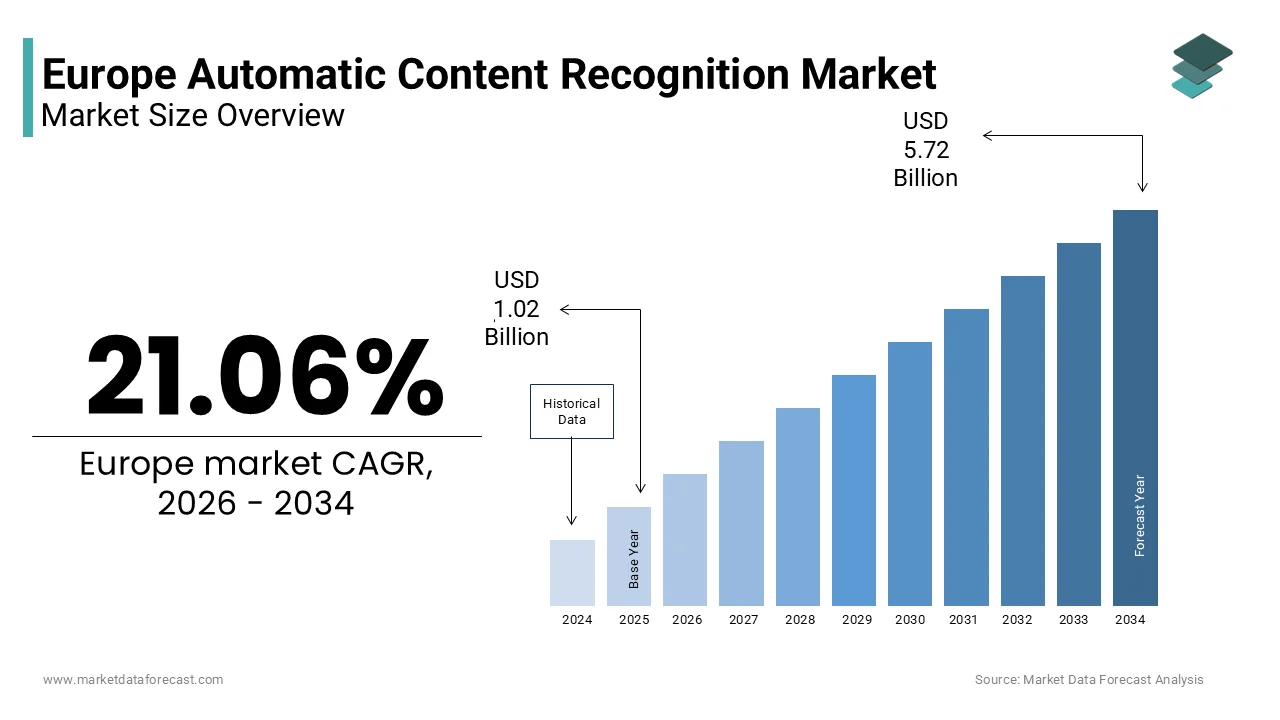
Market Size, 2025
$1.02 BnMarket Estimate, 2026
$1.24 BnMarket Forecast, 2034
$5.72 BnCAGR, 2026–2034
21.06%Europe Automatic Content Recognition Market Report Summary
The Europe automatic content recognition market was valued at USD 1.02 billion in 2025 and is estimated to reach USD 1.24 billion in 2026, with the market projected to grow to USD 5.72 billion by 2034, registering a strong CAGR of 21.06% during the forecast period. Market growth is driven by the rapid expansion of digital media consumption, increasing adoption of smart devices, and rising demand for real time content identification across platforms. The growing use of automatic content recognition in targeted advertising, content monitoring, audience measurement, and copyright protection is further accelerating market growth across Europe. Advancements in artificial intelligence, machine learning, and cloud based analytics are also strengthening the scalability and accuracy of ACR solutions.
Key Market Trends
- Rapid adoption of automatic content recognition solutions for audience analytics, content discovery, and personalized advertising.
- Increasing integration of ACR technology in smart TVs, streaming platforms, and connected devices.
- Strong demand for real time audio and video identification to support copyright enforcement and brand safety.
- Growing use of artificial intelligence and machine learning to enhance recognition accuracy and processing speed.
- Expansion of cloud based ACR platforms to support large scale media monitoring and analytics.
Segmental Insights
- Based on component, the software segment led the Europe automatic content recognition market by holding 6.5 percent of the regional market share in 2025. Growth in this segment is supported by rising demand for scalable software platforms that enable content identification, analytics, and data driven insights across multiple media formats.
- Based on technology, the audio and video fingerprinting segment commanded the largest share of 70.7 percent of the European market in 2025. This dominance is attributed to the widespread use of fingerprinting technologies in media tracking, broadcast monitoring, and content rights management.
- Based on end user industry, the media and entertainment segment dominated the market by capturing 60.6 percent of the European market share in 2025. The segment benefits from high adoption of ACR solutions for content discovery, audience measurement, piracy detection, and monetization strategies.
Regional Insights
The United Kingdom led the automatic content recognition market in Europe in 2025 by accounting for 19.4 percent of the regional market share. The country’s leadership is driven by a strong digital media ecosystem, high penetration of connected devices, and early adoption of advanced advertising and media analytics technologies.
Other European countries continue to witness strong growth, supported by expanding streaming services, increasing smart device usage, and rising investments in digital content technologies.
Competitive Landscape
The Europe automatic content recognition market is competitive and innovation driven, with global technology companies and specialized solution providers competing on accuracy, scalability, and real time performance. Leading players are investing heavily in artificial intelligence, cloud infrastructure, and strategic partnerships with media platforms and device manufacturers. Expanding use cases in advertising technology, content security, and data analytics remain key growth strategies. Prominent companies operating in the market include ACRCloud, Audible Magic, Gracenote, Clarifai, Digimarc Corp, KT Corp ADR, Kudelski SA, Nuance Communications, Alphabet Inc Class A, Sony Group Corp, Microsoft Corp, International Business Machines Corp, and Apple Inc.
Europe Automatic Content Recognition Market Size
The Europe automatic content recognition market size was valued at USD 1.02 billion in 2025 and is projected to reach USD 5.72 billion by 2034 from USD 1.24 billion in 2026, growing at a CAGR of 21.06%.
Automatic content recognition (ACR) refers to a suite of technologies that identify audio, video, or multimedia content in real time by analyzing digital fingerprints or watermarks embedded within media streams. In Europe, ACR is primarily deployed for audience measurement, content rights enforcement, personalized advertising, and second screen engagement across broadcast, streaming, and mobile platforms. The technology has gained strategic relevance as media consumption fragments across linear TV, over the top services, and social video. As per the European Audiovisual Observatory, households in the European Union accessed multiple video platforms per month in 2024, which is creating complex attribution challenges that ACR helps resolve. According to the European Union Agency for Cybersecurity, ACR systems are recognized as critical for verifying content provenance in the context of deepfakes and synthetic media. As per the revised Audiovisual Media Services Directive, accurate viewership data is mandated for regulatory compliance, indirectly boosting ACR adoption among broadcasters and regulators. Unlike generic analytics tools, ACR operates at the signal level, enabling cross device and cross platform content matching without relying on user identifiers, a feature increasingly vital in Europe’s privacy stringent environment governed by the General Data Protection Regulation and the Digital Services Act.
MARKET DRIVERS
Enforcement of EU Copyright and Digital Services Regulations
The European Union’s stringent intellectual property enforcement framework under the Digital Services Act and the Copyright Directive has become a primary catalyst for the European automatic content recognition market. Article 17 of the Copyright Directive obligates online content sharing service providers to obtain authorization from rights holders or implement effective content recognition technologies to prevent unlicensed uploads. According to the European Commission, very large platforms designated under the Digital Services Act must demonstrate use of advanced compliance systems to qualify for liability exemptions. Large volumes of user generated video are uploaded monthly to EU based platforms, which is demanding for scalable and accurate recognition infrastructure, as highlighted by the European Audiovisual Observatory. Moreover, national regulators such as France’s ARCOM and Germany’s ZDF have begun auditing platform compliance using independent ACR benchmarks.
Demand for Cross Platform Audience Measurement in Fragmented Media Landscape
The proliferation of streaming services and device ecosystems has rendered traditional panel-based television ratings obsolete, which is creating urgent demand for automatic content recognition as the backbone of modern audience analytics in Europe and further boosting the European automatic content recognition market expansion. As per the European Audiovisual Observatory, subscription video on demand usage in the EU has grown significantly, with households increasingly subscribing to multiple services. This fragmentation invalidates siloed measurement approaches and necessitates a unified identification layer that ACR provides through audio and video fingerprinting. Kantar and Nielsen have both transitioned their European measurement panels to ACR enabled meters and software development kits that passively identify viewed content regardless of source. Smart TVs in Europe are increasingly shipped with native ACR software for automatic content logging, as noted in recent academic studiesarXiv.org. Broadcasters like the BBC, TF1, and RAI rely on this data for advertising negotiations and programming decisions. With the European Television Advertising Standards Board advocating for currency grade cross platform metrics by 2026, ACR has become the technical foundation for media planning, buying, and regulatory reporting across the continent.
MARKET RESTRAINTS
Stringent Data Privacy Regulations Limiting Behavioral Tracking
Europe’s robust data protection regime under the General Data Protection Regulation significantly constrains the operational scope of automatic content recognition when combined with personal identifiers, which is a significant restraint to the growth of the European automatic content recognition market. While ACR itself analyses media signals rather than user data, its integration with advertising or recommendation engines often triggers GDPR compliance requirements. As per the European Data Protection Board’s guidance, any ACR system that links recognized content to a device ID, IP address, or user profile constitutes personal data processing and requires explicit consent or a legitimate interest assessment. This has led several European media companies to disable ACR based personalization on mobile apps and smart TVs unless users opt in, a scenario with typically low conversion rates. Studies from universities such as UCL confirm that smart TV tracking raises privacy concerns and often results in limited user consent. Moreover, Apple’s App Tracking Transparency framework and Google’s Privacy Sandbox further restrict identifier availability, reducing the utility of ACR for targeted advertising. Consequently, many ACR deployments in Europe are limited to anonymous aggregate analytics, diminishing their commercial value compared to markets with laxer privacy norms.
Lack of Standardization in ACR Protocols Across Platforms and Countries
The absence of a unified technical standard for automatic content recognition across European broadcasters, streaming services, and device manufacturers impedes interoperability and inflates integration costs, which is further impeding the regional market expansion. Unlike the United States where common identifiers are promoted, Europe features a patchwork of proprietary ACR systems, some based on acoustic fingerprinting, others on video watermarking or hybrid approaches. As per European standardization reports, efforts to establish a pan European ACR protocol have faced delays due to competing commercial interests and technical disagreements. As a result, a single broadcaster may need to embed multiple ACR SDKs from different vendors to cover Android, Apple, and smart TV ecosystems. Fragmentation increases operational complexity and reduces measurement coverage in cross national campaigns, as noted by the European Broadcasting Union. Additionally, language and regional content variations such as localized ad inserts or dubbed audio challenge fingerprint matching algorithms trained on original versions. Until a harmonized framework emerges, ACR adoption remains fragmented, inhibiting the creation of a unified cross platform measurement currency in Europe.
MARKET OPPORTUNITIES
Integration into EU Initiatives for Media Authenticity and Deepfake Detection
Automatic content recognition is emerging as a foundational technology in Europe’s strategic response to synthetic media and misinformation through integration with digital watermarking and provenance frameworks, which is a promising opportunity in the European automatic content recognition market. The European Commission’s upcoming AI Act classifies deepfakes as high-risk content requiring detectability measures, and ACR based fingerprinting is being leveraged to verify media authenticity across news and social platforms. According to the European Digital Media Observatory, pilot programs in Germany and Finland are deploying ACR systems that compare live video streams against verified source fingerprints to flag manipulated content in near real time. Furthermore, the EU Coordinated Plan on Artificial Intelligence has allocated funding to develop tamper evident media identification tools, with ACR serving as the matching engine for content provenance chains. The Coalition for Content Provenance and Authenticity, a global consortium including European broadcasters like RAI and Yle, is adopting ACR compatible metadata standards to embed origin information at capture. These initiatives position ACR not only as a commercial tool but as a public interest infrastructure for digital trust, opening new funding and partnership opportunities with public broadcasters, regulators, and fact checking networks across the EU.
Expansion into In Store Retail and Smart Home Applications
Beyond media, automatic content recognition is finding novel applications in European retail and smart home ecosystems where audio and video identification enables context aware services, which is another prominent opportunity in the regional market. Retailers such as Carrefour and MediaMarkt are piloting ACR powered systems that detect in store audio, such as background music or promotional announcements, to trigger personalized mobile coupons or product information on shoppers’ phones. As per Eurostat, a significant share of European retail chains invested in in store digital engagement technologies in 2024, with ACR offering a non-intrusive alternative to Bluetooth beacons. Simultaneously, smart speaker adoption in Europe has reached tens of millions of units according to the European Consumer Electronics Association, creating ambient listening environments where ACR can identify TV content and synchronize companion experiences. Companies like ACRCloud and Shazam for Brands are developing privacy compliant ambient recognition models that process audio locally without storing recordings. The European Smart Home Alliance has included ACR in its 2025 interoperability roadmap for entertainment integration. These use cases diversify ACR’s revenue base beyond media measurement and position it as an enabler of ambient intelligence in physical and domestic spaces across Europe.
MARKET CHALLENGES
High False Positive Rates in Multilingual and Noisy Environments
Despite algorithmic advances, automatic content recognition systems in Europe face persistent accuracy challenges in linguistically diverse and acoustically complex settings. The EU’s 24 official languages and numerous regional dialects create significant variability in audio signatures, particularly when content is dubbed or subtitled. As per the Fraunhofer Institute for Digital Media Technology, ACR systems trained primarily on English language content exhibit higher error rates when identifying dubbed versions of programs in languages such as Hungarian or Greek. Similarly, background noise in real world environments, such as urban traffic or household appliances, degrades audio fingerprint reliability. Testing by France Télévisions showed that recognition accuracy is significantly lower in typical living room scenarios compared to controlled studio conditions. Video based ACR is further hindered by screen glare, fast motion, or partial occlusion during mobile viewing. These limitations undermine confidence in ACR derived metrics for advertising settlement and regulatory reporting, especially in Southern and Eastern Europe where ambient conditions and content localization practices differ markedly from Northern norms.
Dependence on Proprietary Algorithms and Vendor Lock In
The Europe automatic content recognition market remains heavily reliant on a small number of technology providers whose closed source algorithms create significant vendor dependency and limit customization. Leading vendors such as Nielsen Gracenote, Audible Magic, and ACRCloud use proprietary fingerprinting methods that are not interoperable, forcing media companies to commit to single vendor ecosystems for end-to-end measurement. As per the European Association of Communications Agencies, a majority of European broadcasters are locked into long term contracts with one ACR provider due to integration costs and data format incompatibilities. This lack of open standards stifles innovation and inflates licensing fees, particularly for smaller public service broadcasters with limited budgets. Moreover, vendors rarely disclose performance metrics or algorithm update schedules, reducing transparency in a market where measurement accuracy has direct financial implications. The European Broadcasting Union has called for open ACR interfaces under its Tech 2030 initiative but progress remains slow. Until open source or consortium driven alternatives gain traction, European media stakeholders will continue to face strategic risks related to cost control, technological agility, and data sovereignty in their ACR deployments.
REPORT COVERAGE
| REPORT METRIC | DETAILS |
| Market Size Available | 2025 to 2034 |
| Base Year | 2025 |
| Forecast Period | 2026 to 2034 |
| CAGR | 21.06% |
| Segments Covered | By Component, Technology, End User Industry, and Region |
| Various Analyses Covered | Global, Regional, & Country Level Analysis; Segment-Level Analysis; DROC, PESTLE Analysis; Porter’s Five Forces Analysis; Competitive Landscape; Analyst Overview of Investment Opportunities |
| Regions Covered | UK, France, Spain, Germany, Italy, Russia, Sweden, Denmark, Switzerland, Netherlands, Turkey, and the Czech Republic |
| Market Leaders Profiled | ACRCloud, Audible Magic, Gracenote, Clarifai, Digimarc Corp, KT Corp ADR, Kudelski SA, Nuance Communications, Alphabet Inc Class A, Sony Group Corp, Microsoft Corp, International Business Machines Corp, and Apple Inc |
SEGMENTAL ANALYSIS
By Component Insights
The software segment led the market by holding 6.5% of the European market share in 2025. The leading position of software segment in the European automatic content recognition market is driven by the foundational role of ACR software as the core intellectual property that enables content identification across devices and platforms. Unlike services which are often project based, software is embedded directly into smart TVs, set top boxes, mobile applications, and streaming platforms as software development kits or firmware modules. According to the European Consumer Electronics Association, millions of smart TVs shipped in Europe between 2022 and 2024 included native ACR software from vendors like Nielsen Gracenote or ACRCloud. The European Broadcasting Union states that all major public service broadcasters including the BBC, ZDF, and RAI have integrated ACR software into their mobile and connected TV apps to enable passive viewership measurement. Furthermore, the General Data Protection Regulation’s emphasis on data minimization favours on device ACR processing where content is identified locally without transmitting raw audio or video to external servers. This technical and regulatory alignment solidifies software as the anchor component, as it scales with device proliferation and requires minimal recurring human intervention once deployed.
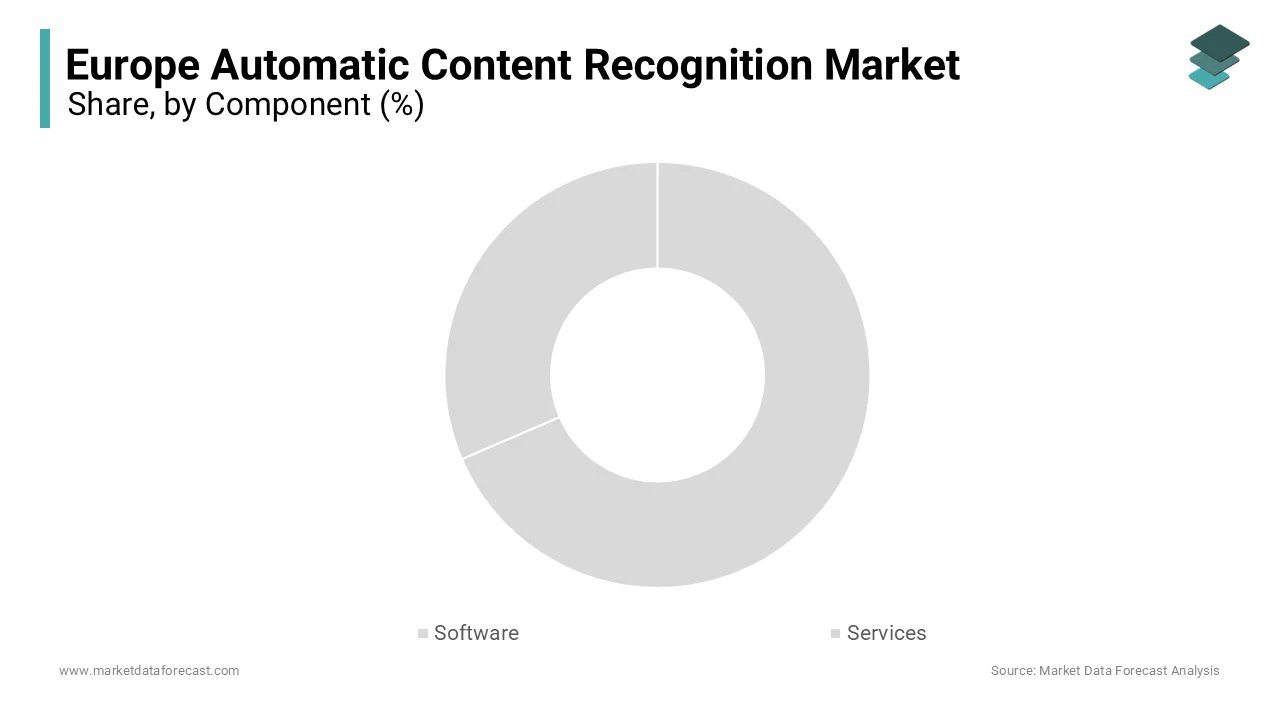
The services segment is the fastest growing component in the Europe automatic content recognition market and is estimated to witness a CAGR of 15.5% over the forecast period owing to the rising demand for customization, integration support, and analytics interpretation as ACR deployments move beyond basic identification into advanced use cases like cross platform attribution and synthetic media detection. As per the European Association of Communications Agencies, a majority of European media brands now require vendor provided professional services to tailor ACR solutions to their multilingual content libraries and fragmented device ecosystems. The complexity of complying with the Digital Services Act and Copyright Directive has further amplified demand for compliance auditing, metadata management, and false positive reduction services. A 2024 survey by the European Advertising Standards Alliance found that broadcasters in Southern Europe increasingly outsource ACR data validation to third party service providers due to limited in house data science capabilities. Additionally, the emergence of in store retail and smart home applications necessitates on site calibration, ambient noise profiling, and real time dashboard development, tasks that fall under managed services. As ACR evolves from a plug-in module to a strategic data infrastructure, the value shifts toward ongoing support, intelligence, and regulatory alignment, fuelling service led revenue models.
By Technology Insights
The audio and video fingerprinting segment commanded for the highest share of 70.7% of the regional market in 2025. The dominance of audio and video fingerprinting segment in this regional market is driven by its passive non-intrusive nature and compatibility with existing content libraries. Unlike watermarking which requires content to be pre encoded, fingerprinting works on any broadcast or streamed media by converting audio or visual signals into unique mathematical signatures. According to the European Audiovisual Observatory, major audience measurement providers in Europe such as Kantar, Nielsen, and Médiamétrie rely primarily on acoustic fingerprinting for their passive meter panels and mobile SDKs. The European Broadcasting Union confirms that a vast majority of European public broadcasters use fingerprint based ACR for automatic program logging and rights reporting. Moreover, fingerprinting aligns with privacy norms under the General Data Protection Regulation because it processes only media signals, not personal identifiers. Smart TV manufacturers including Samsung, LG, and Philips embed acoustic fingerprinting software by default to support automatic content recognition for advertising and content recommendation without altering broadcast streams. This universality, regulatory compatibility, and backward compatibility ensure fingerprinting remains the dominant identification method across Europe’s heterogeneous media landscape.
The digital watermarking segment is the fastest growing technology segment in the Europe automatic content recognition market and is estimated to grow at a CAGR of 15.5% over the forecast period. This surge is fueled by its unparalleled accuracy in controlled distribution environments and its integration into next generation content protection and authenticity frameworks. Unlike fingerprinting which matches post broadcast signals, watermarking embeds imperceptible identifiers directly into the content master enabling frame accurate tracking and tamper detection. According to the European Digital Media Observatory, watermarking is increasingly adopted for premium content delivered to European streaming platforms under the DVB Content Protection and Copy Management standard. Major studios including Canal+ and Sky require watermarking for theatrical and sports rights to prevent unauthorized redistribution. The European Commission’s AI Act further accelerates adoption by designating watermarking as a preferred method for labeling synthetic media. The Coalition for Content Provenance and Authenticity, which includes European members like RAI and Yle, has adopted watermarking as the backbone of its C2PA metadata standard. A pilot by ARD in Germany demonstrated high detection accuracy for watermarked live sports streams even under low bandwidth conditions. As Europe prioritizes content integrity, traceability, and regulatory compliance, watermarking transitions from a niche broadcast tool to a strategic authentication layer across entertainment, journalism, and public information ecosystems.
By End User Industry Insights
The media and entertainment segment dominated the market by capturing 60.6% of the European market share in 2025. The dominance of media and entertainment segment in this regional market is attributed to its reliance on accurate content identification for audience measurement, rights management, and advertising monetization. Broadcasters, streamers, and content owners use ACR to track where, when, and how their programming is consumed across linear TV, over the top platforms, and social media. According to the European Audiovisual Observatory, European households accessed multiple video platforms per month in 2024, making cross platform measurement essential for fair licensing negotiations. The revised Audiovisual Media Services Directive mandates that national regulators verify audience data used for advertising and scheduling decisions, which has led public broadcasters like the BBC, France Télévisions, and RAI to deploy ACR enabled mobile and smart TV panels. Furthermore, the Copyright Directive’s Article 17 requires platforms to prevent unauthorized uploads of copyrighted material, a task heavily dependent on ACR systems like YouTube’s Content ID which uses fingerprinting at scale. The European Broadcasting Union reports that nearly all of its member organizations now use ACR for at least one core function ranging from program logging to second screen engagement. This regulatory, commercial, and operational dependency anchors Media and Entertainment as the primary engine of ACR adoption in Europe.
The Consumer Electronics OEMs segment represents the fastest growing end user segment in the Europe automatic content recognition market and is expected to expand at a CAGR of 14.9% over the forecast period. The integration of ACR software directly into smart TVs, streaming sticks, and set top boxes at the manufacturing stage is primarily driving the expansion of the media and entertainment segment in this regional market. According to the European Consumer Electronics Association, a large majority of smart TVs sold in Western Europe in 2024 shipped with pre-installed ACR SDKs from vendors like Gracenote or ACRCloud enabling automatic program recognition for personalized recommendations and advertising. OEMs benefit from ACR through enhanced user experience, data monetization, and compliance with regional advertising standards. The European Smart Home Alliance’s interoperability guidelines recommend ACR as a standard feature for entertainment synchronization across devices. Samsung’s 2024 European smart TV lineup includes on device acoustic fingerprinting that processes audio locally to protect user privacy under GDPR while still enabling content aware services. Similarly, Philips and LG have partnered with audience measurement firms to embed ACR into their European models as part of co-branded data initiatives. As devices become the primary interface for media consumption, OEMs are transforming from hardware vendors into data enabled service platforms with ACR as a critical embedded capability driving recurring value beyond the initial sale.
REGIONAL ANALYSIS
United Kingdom Automatic Content Recognition Market Analysis
The United Kingdom led the automatic content recognition market in Europe in 2025 by holding 19.4% of the European market share. The UK is serving as a strategic hub for media innovation and regulatory testing. Home to global broadcasters like the BBC, Sky, and ITV, the UK has pioneered ACR deployment for cross platform audience measurement and rights enforcement. According to Ofcom, the UK’s communications regulator, a majority of television viewing now occurs outside traditional linear schedules, necessitating robust ACR infrastructure. The BBC’s iPlayer app has used acoustic fingerprinting since 2021 to auto log content for internal analytics, while Sky mandates ACR integration for all third-party apps on its Q platform. Post Brexit, the UK’s Digital Regulation Cooperation Forum has adopted GDPR aligned but flexible rules that encourage ACR innovation in smart devices. The UK’s Advertising Standards Authority requires verifiable viewership data for performance-based ad buys, further driving adoption. London’s concentration of ad tech and media startups, including partnerships between ACRCloud and UK based measurement firms, creates a dynamic ecosystem that influences continental standards. The UK’s blend of mature broadcasting infrastructure, agile regulation, and digital media leadership sustains its top tier position in the European ACR market.
Germany Automatic Content Recognition Market Analysis
Germany captured a promising share of the European automatic content recognition market in 2025. The growth of Germany in the European market can be credited to its engineering precision, strong public broadcasting sector, and strict data ethics framework. The ARD, ZDF, and Deutschlandradio consortium operates one of Europe’s most advanced ACR enabled measurement panels using acoustic fingerprinting across mobile, smart TV, and set top box environments. According to Germany’s Federal Statistical Office, a large majority of households owned a smart TV in 2024, with nearly all major brands embedding ACR software compliant with the country’s stringent data protection laws. Germany’s Federal Cartel Office has mandated transparent ACR disclosures in streaming apps following a 2023 investigation into opaque data practices, reinforcing the need for privacy preserving on device processing. Companies like Fraunhofer IDMT in Ilmenau lead R&D in noise resilient fingerprinting algorithms tailored to German language content and urban acoustic environments. Additionally, Germany’s NetzDG law requires platforms to report on illegal content removals, a process increasingly supported by ACR based detection systems. This convergence of public service media, technical excellence, and regulatory rigor positions Germany as a benchmark for ethical and accurate ACR deployment in Europe.
France Automatic Content Recognition Market Analysis
France is predicted to account for a prominent share of the European automatic content recognition market during the forecast period owing to the state led media policy and aggressive enforcement of cultural sovereignty laws. France’s audiovisual regulator ARCOM mandates that all major broadcasters and streaming platforms provide ACR verified audience data for regulatory reporting and advertising transparency. According to France’s National Institute of Statistics and Economic Studies, French households subscribe to multiple video services, creating urgent need for cross platform measurement. Public broadcasters like France Télévisions and TF1 have embedded ACR into their mobile apps and smart TV interfaces since 2022, while Canal+ uses digital watermarking to protect premium sports content from piracy. The French government’s Media Pluralism Decree requires that audience data used in public funding decisions be generated through certified ACR systems. Furthermore, France’s Loi Avia on online hate speech has expanded ACR’s role in detecting harmful content through audio fingerprinting of extremist broadcasts. With Paris hosting major ACR vendors and the headquarters of Médiamétrie, Europe’s largest audience measurement firm, France acts as both a regulatory laboratory and commercial nucleus for ACR innovation across the continent.
Netherlands Automatic Content Recognition Market Analysis
The Netherlands is estimated to hold a healthy CAGR in the European automatic content recognition market over the forecast period. Netherlands is emerging as a technology integration and data governance model for the region. The country’s advanced digital infrastructure and high smart TV penetration, as per Statistics Netherlands, create an ideal testbed for ACR deployment. Dutch public broadcasters NPO and commercial networks like RTL Netherlands use hybrid ACR systems combining fingerprinting and watermarking for granular program tracking. The Netherlands Authority for Consumers and Markets requires transparent opt in mechanisms for ACR data collection, aligning with the country’s progressive interpretation of GDPR. Amsterdam based tech firms increasingly embed ACR into second screen and smart home applications, with companies like ACRCloud establishing European development centers in the city. The Dutch government’s Digital Trust Framework promotes ethical AI and media verification, positioning ACR as a tool for combating disinformation. Additionally, the Netherlands hosts key European standardization bodies that influence ACR interoperability guidelines. This combination of technical readiness, regulatory clarity, and innovation culture makes the Netherlands a scalable pilot market that often sets precedents for broader EU adoption.
Italy Automatic Content Recognition Market Analysis
Italy is projected to witness a steady CAGR in the Europe automatic content recognition market over the forecast period due to the rapid digital adoption and growing concerns over content piracy. According to Italy’s Communications Regulatory Authority AGCOM, a significant share of video consumption in 2024 occurred via streaming platforms, many of which operate without proper licensing. In response, AGCOM mandated in 2023 that all major Italian broadcasters and streaming services implement ACR systems to monitor unauthorized redistribution. RAI, Mediaset, and Sky Italia have deployed acoustic fingerprinting across their mobile and connected TV apps to support both audience measurement and anti-piracy efforts. The Italian Data Protection Authority has issued specific guidance on ACR data processing, requiring on device analysis and anonymized aggregation. Furthermore, Italy’s National Recovery and Resilience Plan allocate funding to modernize public broadcasting infrastructure, including ACR enabled content management systems. With high mobile video usage and a fragmented media landscape, Italy presents unique challenges and opportunities for ACR vendors to develop noise tolerant multilingual algorithms. The country’s regulatory pressure combined with consumer shift to digital platforms ensures sustained growth in ACR deployment across both public and private media ecosystems.
COMPETITIVE LANDSCAPE
The Europe automatic content recognition market features a dynamic competitive landscape shaped by global technology providers regional media institutions and regulatory imperatives. Competition is not solely based on technical accuracy but increasingly on privacy architecture regulatory alignment and integration depth with local ecosystems. Large players like Nielsen and Audible Magic dominate in measurement and copyright enforcement respectively while agile vendors like ACRCloud gain traction in emerging applications such as smart retail and ambient intelligence. Differentiation arises through language support data governance models and compatibility with European standards like DVB and C2PA. Public broadcasters and telecom operators often act as gatekeepers influencing vendor selection through procurement policies. The market is also marked by strategic collaborations rather than pure rivalry with vendors co developing solutions with media companies to meet country specific compliance requirements. High barriers to entry include the need for extensive content reference libraries legal expertise in EU digital law and certification under data protection frameworks. As a result, the market rewards adaptability local presence and regulatory foresight over raw algorithmic performance alone.
KEY MARKET PLAYERS
Some of the notable key players in the Europe automatic content recognition market are
- ACRCloud
- Audible Magic
- Gracenote
- Clarifai
- Digimarc Corp
- KT Corp ADR
- Kudelski SA
- Nuance Communications
- Alphabet Inc Class A
- Sony Group Corp
- Microsoft Corp
- International Business Machines Corp
- Apple Inc
Top Players in the Market
- Nielsen Holdings plc is a global leader in audience measurement with deep integration of automatic content recognition across Europe through its Gracenote subsidiary. The company provides ACR powered software development kits to smart TV manufacturers broadcasters and streaming platforms enabling cross platform viewership tracking. Nielsen’s fingerprinting technology is embedded in millions of European devices and powers official audience currencies in markets like the UK France and Germany. In 2024 Nielsen enhanced its ACR platform with multilingual audio recognition capabilities covering 18 European languages and improved noise resilience for real world viewing environments. The company also partnered with European public broadcasters to develop GDPR compliant on device processing models that align with regional privacy norms. These initiatives reinforce Nielsen’s role as a foundational measurement infrastructure provider across both commercial and public media ecosystems in Europe and globally.
- ACRCloud is a technology focused automatic content recognition provider with a strong presence in Europe through partnerships with consumer electronics OEMs media companies and retail brands. The company offers scalable audio and video fingerprinting APIs that support real time content identification across mobile web and embedded systems. ACRCloud’s European operations serve clients in broadcast advertising smart home and second screen applications with data centers located in Frankfurt and Amsterdam ensuring low latency and GDPR compliance. In 2023 the company launched a privacy first ambient recognition mode that processes audio locally on devices without transmitting raw signals to the cloud. It also introduced a deepfake detection module aligned with EU AI Act requirements. By prioritizing developer accessibility multilingual support and regulatory alignment ACRCloud has become a preferred ACR partner for agile digital media and IoT companies across the continent and beyond.
- Audible Magic Corporation is a pioneer in digital content identification specializing in copyright compliance and rights management solutions for online platforms operating in Europe. The company’s ACR technology is widely used by user generated content platforms to enforce the EU Copyright Directive’s Article 17 obligations by automatically detecting unlicensed music and video uploads. Audible Magic works with major European digital service providers to implement scalable fingerprinting systems that screen uploads in real time while minimizing false positives. In 2024 the company expanded its European content reference library to include region specific broadcasts podcasts and sports events enhancing detection accuracy for local content. It also integrated its system with national rights databases in France and Germany to automate licensing verification. Through its focus on legal compliance and rights integrity Audible Magic plays a critical role in enabling lawful digital content ecosystems across Europe and serves as a global benchmark for copyright enforcement technology.
Top Strategies Used by the Key Market Participants
Key players in the Europe automatic content recognition market adopt four primary strategies to strengthen their position and address regional complexities. First, they invest in multilingual and noise resilient fingerprinting algorithms tailored to Europe’s diverse acoustic environments and localized content including dubbed audio and regional broadcasts. Second, they prioritize on device processing and local data handling to comply with the General Data Protection Regulation and build trust with consumers and regulators. Third, they form strategic partnerships with smart TV manufacturers broadcasters and streaming platforms to embed ACR software at the hardware or application layer ensuring wide distribution and passive data collection. Fourth, they align their technologies with EU regulatory frameworks such as the Digital Services Act Copyright Directive and AI Act by developing features for synthetic media detection copyright enforcement and transparent data governance. These strategies collectively enable vendors to balance performance privacy and compliance in a uniquely demanding market.
MARKET SEGMENTATION
This research report on the European automatic content recognition market has been segmented and sub-segmented based on categories.
By Component
- Software
- Services
By Technology
- Audio and Video Fingerprinting
- Digital Watermarking
- Speech and Voice Recognition
- Optical Character Recognition
By Solution
- Real time Content Analytics
- Security and Copyright Management
- Voice and Speech Interfaces
- Data Management and Metadata
- Others
By End User Industry
- Media and Entertainment
- Consumer Electronics OEMs
- Advertising and Marketing
- Telecom and IT
- Automotive
- Healthcare
- Others including Retail and Education
By Country
- UK
- France
- Spain
- Germany
- Italy
- Russia
- Sweden
- Denmark
- Switzerland
- Netherlands
- Turkey
- Czech Republic
- Rest of Europe