- Product Description Description
- Table of Contents TOC
- List of Table & Figure LOT
- Get Free Sample PDF Sample PDF
Market Size, 2025
$37.29 BnMarket Estimate, 2026
$38.86 BnMarket Forecast, 2034
$54.05 BnCAGR, 2026–2034
4.21%Europe Bedroom Furniture Market Size, Growth, Trends & Forecast (2026–2034)
The Europe bedroom furniture market size was calculated to be USD 37.29 billion in 2025, is estimated to reach USD 38.86 billion in 2026, and is anticipated to be worth USD 54.05 billion by the end of 2034, registering a compound annual growth rate (CAGR) of 4.21% during the forecast period from 2026 to 2034. Driven by urban housing densification, rising consumer emphasis on sleep health and wellness, and stringent EU circular economy and sustainability mandates, the European bedroom furniture sector is shifting toward functional minimalism, smart home integration, and transparent material traceability.
Key Executive Metrics (At-a-Glance)
- 2025 Base Valuation: USD 37.29 Billion
- 2026 Current Valuation: USD 38.86 Billion
- 2034 Forecast Valuation: USD 54.05 Billion
- Compound Annual Growth Rate (CAGR): 4.21% (2026–2034)
- Largest Product Segment: Wardrobes and Closets (32.3% share in 2025)
- Fastest-Growing Product Segment: Beds (6.22% CAGR)
- Largest End-User Segment: Residential
- Fastest-Growing End-User Segment: Commercial (8.04% CAGR)
- Largest Distribution Channel: B2C Retail
- Fastest-Growing Distribution Channel: B2B / Direct from Manufacturers (8.2% CAGR)
- Largest Regional Market: Germany (20.9% share in 2025)
Core Market Drivers
- Multifunctional Space Optimization: Shrinking dwelling sizes and urban micro-apartments driving high demand for built-in, modular storage solutions and hydraulic space-saving bed platforms.
- Sleep Quality & Wellness Focus: Rising consumer awareness of bedroom ergonomics, biophilic design, and certified low-chemical off-gassing materials to support holistic mental and physical well-being.
Primary Market Restraints & Challenges
- Complex Environmental Compliance: Fragmented national and EU-level regulations, including the Ecodesign for Sustainable Products Regulation and REACH restrictions, inflating administrative burdens and compliance costs.
- Raw Material Dependency: Persistent reliance on imported wood panels, textiles, and hardware exposing manufacturers to supply chain volatility, import tariffs, and CBAM pressures.
Europe Bedroom Furniture Market Segmentation Breakdown
| Segment Category | Dominant / Leading Segment | Fastest-Growing / High-Potential Segment |
|---|---|---|
| By Product Type | Wardrobes and Closets (32.3% share in 2025) | Beds (6.22% CAGR) |
| By End User | Residential | Commercial (8.04% CAGR) |
| By Distribution Channel | B2C Retail | B2B / Direct from Manufacturers (8.2% CAGR) |
| By Region | Germany (20.9% share in 2025) | United Kingdom, France, Sweden |
Major Industry Players Profiled
Key enterprises shaping the European bedroom furniture market include IKEA, Ashley Furniture Industries, Wayfair, Kunert Furniture, Steinhoff International, Herman Miller, Roche Bobois, Hülsta, Ligne Roset, DFS Furniture, John Lewis & Partners, Made.com, Habitat, Poltrona Frau, and B&B Italia.
Europe Bedroom Furniture Market Size
The Europe bedroom furniture market size was calculated to be USD 37.29 billion in 2025 and is anticipated to be worth USD 54.05 billion by 2034, from USD 38.86 billion in 2026, growing at a CAGR of 4.21% during the forecast period.
Bedroom furniture includes beds, wardrobes, dressers, nightstands, and integrated storage solutions designed for private residential sleeping spaces across the continent. Unlike the commoditized furniture segment, this market is defined by evolving consumer expectations around wellness, spatial efficiency, and aesthetic identity within the home environment. European households increasingly treat the bedroom as a sanctuary for rest and mental recovery rather than merely a functional space. According to Eurostat, single-person households represented 34% of all residences in the EU as of 2023. Urban densification trends further intensify demand for multifunctional and space-saving furniture, particularly in cities like Pari, Berlin, and Amsterdam, where average apartment sizes have declined to under 65 square meters, as documented by the European Environment Agency. Sustainability imperatives also shape product design with the European Commission’s Ecodesign for Sustainable Products Regulation mandating durability, reparability, and material traceability for all furniture placed on the EU market from 2027. These sociodemographic and regulatory currents position bedroom furniture at the intersection of lifestyle design, environmental compliance, and residential well-being.
MARKET DRIVERS
Rising Demand for Multifunctional and Space Optimized Solutions
Urbanization and shrinking dwelling sizes across Europe are compelling consumers to prioritize multifunctional bedroom furniture that maximizes utility within constrained footprints, which is one of the key factors propelling the European bedroom furniture market growth. According to the Organisation for Economic Co-operation and Development, the average new apartment size in major Western European cities has declined in recent years, with Paris and London averaging around 58 and 61 square meters, respectively. This spatial pressure has elevated demand for beds with integrated storage hydraulic lift mechanisms and wardrobes that double as room dividers. In Germany, many new residential developments under 70 square meters now specify built-in or modular bedroom systems. Retailers such as IKEA and Maisons du Monde have responded by expanding their space-saving collections, with IKEA’s PAX wardrobe system accounting for a significant share of its bedroom category sales in 2025. Additionally, micro apartment mandates in cities like Barcelona require developers to incorporate transformable furniture, which has spurred B2B partnerships between property firms and furniture manufacturers. This shift toward functional minimalism is not merely aesthetic but structurally driven by housing policy affordability crises and demographic densification that collectively redefine bedroom utility in contemporary European living.
The Rising Consumer Focus on Sleep Quality and Wellness Integration
European consumers are increasingly aligning bedroom furniture purchases with holistic sleep health and mental well-being objectives, which is further boosting the bedroom furniture market expansion in Europe. Nearly 30% of adults in the EU experience chronic sleep disturbances, with stress and poor bedroom ergonomics cited as primary contributors. This awareness has catalysed demand for beds with orthopedic support headboards featuring integrated acoustics and nightstands with built-in air purification or circadian lighting. The European Commission’s 2023 Consumer Safety Alert on volatile organic compound emissions from low-grade wood composites further accelerated preference for solid wood or FSC-certified furniture with low chemical off-gassing. Brands like Hästens and Tempur have expanded beyond mattresses into full bedroom ecosystems, incorporating biophilic design principles and natural textiles. In Scandinavia, many premium bedroom furniture purchases in 2025 included wellness certifications such as the Nordic Swan Ecolabel or OEKOTEX Standard 100. This convergence of health consciousness, regulatory scrutiny, and experiential design transforms bedroom furniture from passive decor into an active component of daily wellness routines.
MARKET RESTRAINTS
Stringent and Fragmented Environmental Compliance Requirements
An increasingly complex web of national and EU-level environmental regulations that raise compliance costs and delay product launches is majorly hampering the growth of the European bedroom furniture market. The European Commission’s Ecodesign for Sustainable Products Regulation, which takes full effect in 2027, mandates digital product passports detailing material composition, carbon footprint, and disassembly instructions for all furniture. Simultaneously, France’s Anti-Waste Law for a Circular Economy requires all new furniture to display a reparability index, while Germany’s Packaging Act imposes strict take-back obligations on producers. According to the European Furniture Federation, manufacturers must now navigate multiple national chemical restriction lists under REACH in addition to EU-wide formaldehyde emission limits. A single wardrobe shipped across several EU countries may require separate conformity assessments, flame-retardant, volatile organic compounds, and recycled content claims. According to Eurostat, these overlapping mandates increase administrative burden, particularly for SME, which constitute the majority of Europe’s furniture enterprises. Non-compliance penalties can reach significant levels under national enforcement actions. This regulatory fragmentation stifles innovation speed and deters cross-border e-commerce despite the single market’s theoretical harmonization.
Persistent Dependence on Imported Raw Materials and Components
The European bedroom furniture market remains heavily reliant on imported wood panels, textiles, and hardware, which exposes it to global supply chain volatility and geopolitical risk, which is further hindering the bedroom furniture market in Europe. The EU imports a significant share of its hardwood veneer from Southeast Asia and North America, while a large portion of upholstery fabrics originates from China and Turkey. The 2022 EU Timber Regulation enforcement surge blocked non-compliant timber at ports as recorded by the European Commission, which is disrupting production for dozens of mid-sized manufacturers. Simultaneously, rising shipping costs and container shortages from 2021 to 2023 inflated input expenses for furniture makers. Although the EU promotes circularity, only a limited share of bedroom furniture sold in 2025 contained substantial recycled content due to restricted domestic secondary material streams, as documented by the European Environment Agency. This external dependency not only compromises cost stability but also complicates sustainability claims, especially as the Carbon Border Adjustment Mechanism begins applying to wood and textile imports from 2026 onward, further pressuring margins and design flexibility.
MARKET OPPORTUNITIES
Integration of Smart Home Technology into Bedroom Furniture
The convergence of interior design and digital living is creating novel opportunities for the European bedroom furniture market. As per the European Smart Home Market Observatory, many EU households owned at least one smart home device in 20,24, with bedroom-centric products like smart lighting, sleep trackers, and voice-controlled blinds showing the fastest adoption. Furniture manufacturers are responding by embedding wireless charging surfaces, occupancy sensors, and app-controlled storage mechanisms directly into beds and nightstands. Italian brand Poltrona Frau launched a connected bed frame in 2023 that syncs with Philips Hue and Apple Health to adjust ambient lighting based on sleep cycles. Similarly, Swedish startup Lammhults partnered with IKEA to develop wardrobes with RFID-enabled inventory tracking for clothing care. The European Commission’s Horizon Europe program allocated funding in 2025 specifically for human-centric smart furniture prototypes that support.
REPORT COVERAGE
| REPORT METRIC | DETAILS |
| Market Size Available | 2025 to 2034 |
| Base Year | 2025 |
| Forecast Period | 2026 to 2034 |
| CAGR | 4.21% |
| Segments Covered | By Product Type, End User, Distribution Channel, and Region |
| Various Analyses Covered | Global, Regional & Country Level Analysis; Segment-Level Analysis; DROC, PESTLE Analysis; Porter’s Five Forces Analysis; Competitive Landscape; Analyst Overview of Investment Opportunities |
| Regions Covered | UK, France, Spain, Germany, Italy, Russia, Sweden, Denmark, Switzerland, Netherlands, Turkey, and the Czech Republic |
| Market Leaders Profiled | IKEA, Ashley Furniture Industries, Wayfair, Kunert Furniture, Steinhoff International, Herman Miller, Roche Bobois, Hülsta, Ligne Roset, DFS Furniture, John Lewis & Partners, Made.com, Habitat |
SEGMENTAL ANALYSIS
By Product Type Insights
The wardrobes and closets segment dominated the European bedroom furniture market in 2025 by holding 32.3% of the regional market share. The dominance of the wardrobes and closet segment in the European market is attributed to Europe’s urban housing constraints and regulatory emphasis on built-in storage efficiency. In countries like Italy and Spain, many new residential apartments under 80 square meters are legally required to include minimum wardrobe volumes as per national building codes. Additionally, consumer behaviour trends show a marked preference for integrated storage solutions that reduce visual clutter and support minimalist aesthetics. IKEA’s PAX system accounted for a significant share of wardrobe sales in Western Europe in 2023. The growth of the wardrobes and closets segment is further driven by the renovation activity, as renovations constituted a large portion of total EU residential construction output in 202,3, according to Eurostat, with wardrobe replacement being the most common upgrade due to wear and customization demands. Customization capabilities, including modular interiors, lighting, and sliding mechanisms, have elevated wardrobes from passive storage to active spatial organizers.
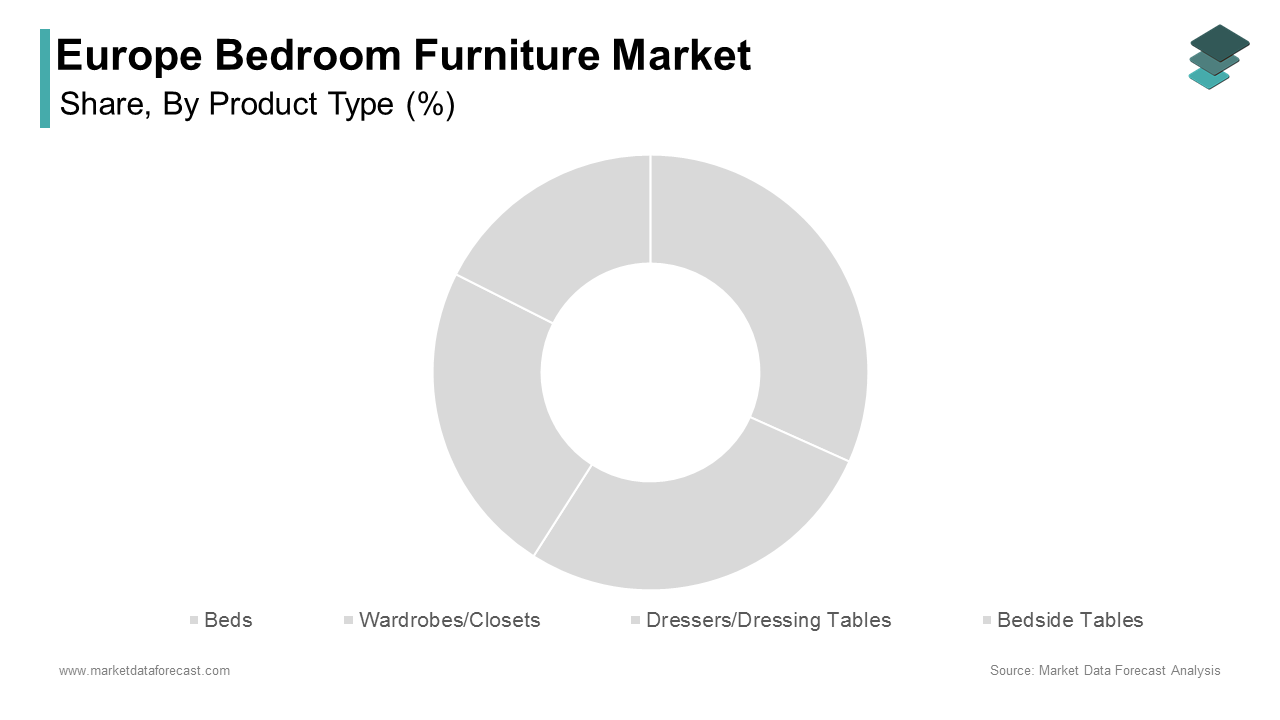
The beds segment is a promising segment and is estimated to expand at the fastest CAGR of 6.22% over the forecast period in the European market, owing to the convergence of sleep science, consumer wellness, and smart home integration. Nearly 31% of EU adults report chronic sleep dissatisfaction, which is prompting demand for orthopedic adjustable sensor-enabled beds. Premium brands like Hästens and DUX have seen growth by embedding biometric monitoring and climate control into bed frames. Simultaneously, regulatory shifts are driving upgrades as the EU’s updated REACH restrictions on flame retardants banned several legacy foam formulations in 2023, which is forcing manufacturers to redesign core support systems. Urban micro housing also spurs innovation with space-saving bed platforms featuring hydraulic lifts and fold-away mechanisms, gaining traction in cities like Berlin and Amsterdam, where many new apartments are under 60 square meters as per the European Environment Agency. This blend of health orientation, regulatory compliance, and spatial necessity positions beds as the most dynamically evolving bedroom category.
By End User Insights
The residential segment was the largest in the European bedroom furniture market in 2025. The growth of the residential segment in the European market is mainly attributed to Europe’s high rate of owner-occupied and long-term rental housing, where occupants invest in personalized, durable furnishings. A large share of EU households own their primary residence or reside in tenancies exceeding three years, which is enabling stable demand for quality bedroom sets. Renovation cycles further amplify this as many European homeowners undertook interior upgrades between 2022 and 2025, primarily in bedrooms, as per the European Commission’s Flash Eurobarometer on Home Improvement. Cultural norms also play a role in markets like Germany and Sweden, where bedroom aesthetics are closely tied to hygge and wohngesundheit wellness philosophies. Unlike commercial procurement, which prioritizes cost and durability, residential purchases emphasize emotional connection, material authenticity, and design storytelling, which is making this segment bovolume-richich and innovation-receptive.
The commercial segment is predicted to witness a CAGR of 8.04% over the forecast period in the European bedroom furniture market, owing to the expansion of mid-scale and lifestyle hotels targeting millennial and business travelers who expect residential-grade comfort. Europe welcomed a record 707 million international tourists in 2023, as per the United Nations World Tourism Organization, which is triggering a hotel construction boom with many new properties opened in 2025. Boutique hotels now allocate a notable share of room budgets to custom bedroom furniture, as documented by Hospitality Design Europe, to differentiate through authenticity and local craftsmanship. Simultaneously, the rise of aparthotels and co-living spaces such as those operated by The Collective and Saco requires multifunctional bedroom units with integrated storage and work surfaces. EU building directives now mandate that all new hospitality projects achieve minimum BREEAM or LEED certifications, which favours furniture made from FFSC-certified wood and low-VOC finishes. These converging trends transform commercial bedroom procurement from standardized bulk orders to design-led curated acquisitions.
By Distribution Channel Insights
The B2C retail segment occupied the dominating share of the European bedroom furniture market in 2025. The leading position of the B2C segment in the European market is primarily attributed to Thrope’s dense network of omnichannel furniture retailers ranging from mass market giants like IKEA and Conforama to premium boutiques in Milan and Paris. Physical showrooms remain critical as many European consumers still prefer to touch and test bedroom furniture before purchasing, according to a 2023 Pan-Europeano consumer survey. Retailers have responded by integrating augmented reality apps in-store and offering white glove delivery and assembly services, which increase conversion as per McKinsey’s European Home Furnishings Insight. The channel also benefits from seasonal promotional cycles such as Black Friday and January sales, which drive a significant share of annual revenue. Crucially, retailers act as compliance gatekeepers, which is ensuring all products meet national EPR and chemical safety standards, thereby reducing consumer risk and enhancing trust in branded channels.
The B2B segment is predicted to expand at a healthy CAGR of 8.2% over the forecast period in this regional market, owing to the rising demand for customized solutions in hospitality co co-liv, ing and high-end residential developments, where project specifications require tailored dimensions, finishes, and material sourcing. Developers like Vonovia in Germany and Nexity in France now bypass retailers to co-design bedroom systems directly with manufacturers such as Poliform and Bontempi Cas, ensuring brand alignment and cost control. The European Commission’s Green Public Procurement criteria also favor direct manufacturer engagement as public housing agencies require verifiable sustainability data that only producers can provide. Additionally, digital B2B platforms like Faire and Tundra have reduced transaction friction, which is enabling SME manufacturers to access commercial clients across borders. With many new EU residential projects exceeding 50 units as per Eurostat, bulk procurement through direct channels offers economies of scale unattainable via retail markups.
REGIONAL ANALYSIS
Germany Bedroom Furniture Market Analysis
Germany dominated the European bedroom furniture market in 2025 by holding 20.9% of the regional market share. Germany serves as both Europe’s leading producer and a high-value consumer market driven by a strong culture of quality craftsmanship and sustainability. Over 7,000 furniture companies operate in Germany, including global brands like Bulthaup, with the North Rhine-Westphalia region alone accounting for a significant share of national output. German consumers prioritize durability, with the average bedroom furniture replacement cycle exceeding 14 years per the Federal Statistical Office. The nation’s stringent Blue Angel ecolabel requirements have pushed manufacturers to adopt formaldehyde-free adhesives and water-based finishes across most new lines. Additionally, the Energiewende housing retrofit program allocated billions of euros in 2023 for interior modernization in millions of homes, directly stimulating bedroom upgrades. Germany’s dual role as innovator and discerning buyer cements its central position in the European market.
Italy Bedroom Furniture Market Analysis
Italy occupied a substantial share of the European bedroom furniture market in 2025. The prominent position of Italy in the European market is attributed to its global reputation for luxury design and artisanal excellence. The Brianza region near Milan hosts over 1,200 high-end manufacturers, including B&B Italia and Poltrona Frau, whose bedroom collections define contemporary European aesthetics. Domestic demand is reinforced by cultural emphasis on home as a reflection of identity, with many Italian households spending significantly on bedroom renovations in 2023 as per ISTAT. Italy also leads EU furniture exports, with bedroom items contributing notably to its furniture export total in 2025. The government’s Made in Italy certification program ensures authenticity, while EU carbon border rules have accelerated the option of local walnut and beech sourcing. With design weeks in Milan and Florence setting continental trends, Italy remains the aesthetic compass of the European bedroom furniture landscape.
United Kingdom Bedroom Furniture Market Analysis
The United Kingdom is predicted to register a prominent share of the European market during the forecast period owing to the advanced retail integration and urban housing dynamics. Despite post-Brexit trade friction, UK consumers remain highly active with online bedroom furniture sales continuing to grow annually since 2022, according to the Office for National Statistics. Brands like John Lewis and MADE.com pioneered augmented reality preview tools, now adopted across Europe. London’s micro flat boom fuels demand for transformable beds and wardrobes with integrated desks. The UK also leads in circular models with a notable share of bedroom retailers offering take-back schemes, as per WRAP’s 2023 Furniture Reuse Report. Though challenged by import costs, the UK’s digital retail maturity and compact living innovation sustain its position as a trend-setting and high velocity market.
France Bedroom Furniture Market Analysis
France is also a notable market for furniture in Europe. The French market is distinctly shaped by aggressive environmental legislation, including the Anti-Waste Law, which mandates reparability scoring and bans the destruction of unsold furniture. As a result, the French furniture market has seen a significant shift towards modular and customizable designs, which cater to evolving consumer preferences for space-saving and functional solutions. Parisian renovation culture also drives demand and is supported by new environmental building regulations such as RE2020, which emphasize sustainable materials and energy efficiency in residential projects. French consumers show a strong preference for locally sourced solid wood, with oak and beech widely used in furniture manufacturing. The France Relance recovery plan, with a total budget of €100 billion, is dedicated to substantial funding to support sustainable growth and business competitiveness, including measures that benefit SME furniture makers adopting circular production methods. This policy, combined with consumer and material alignment, makes France a laboratory for sustainable bedroom furniture innovation.
Sweden Bedroom Furniture Market Analysis
Sweden is expected to exhibit a healthy CAGR in the European bedroom furniture market during the forecast period due to its outsized influence through design philosophy and sustainability leadership. Sweden is home to IKEA, and premium brands like Asplund Sweden embed minimalism and biophilic design into bedroom solutions that resonate across Northern Europe. Swedish bedroom furniture production relies heavily on domestically sourced FSC-certified pine and birch, with tropical wood use being minimal due to sustainability regulations. The nation’s national wellness strategy links interior environments to mental health, which is prompting public housing agencies to specify low-VOC finishes and ergonomic bed bases in new developments. For instance, Swedish consumers increasingly prioritize “sleep quality” as a primary purchase criterion for beds. With circular design principles embedded in education and production, Sweden continues to shape Europe’s bedroom furniture evolution through ethical minimalism and human-centric functionality.
COMPETITION OVERVIEW
The Europe bedroom furniture market features a highly fragmented yet stratified competitive landscape with clear segmentation between mass market retailers, premium design houses, and regional artisans. At the high end, Italian and Scandinavian brands compete on heritage craftsmanship and sustainability credentials while leveraging architectural collaborations to maintain exclusivity. Mass market leaders like IKEA dominate through economies of scale, rapid product iteration, and omnichannel accessibility. Mid-tier players face intense pressure as consumers either trade down for affordability or trade up for authenticity. Competition is increasingly defined not by price alone but by compliance with evolving environmental regulations c,, circularity capabilities, and digital service integration. New entrants struggle due to high certification costs, long design cycles, and entrenched brand loyalty. Despite fragmentation, innovation in modular design, wellness integration, and resale models is accelerating, driven by urbanization, climate policy, and shifting consumer values around ownership and well-being.ng
KEY MARKET PLAYERS
A few major players of the Europe bedroom furniture market include
- IKEA
- Ashley Furniture Industries
- Wayfair
- Kunert Furniture
- Steinhoff International
- Herman Miller
- Roche Bobois
- Hülsta
- Ligne Roset
- DFS Furniture
- John Lewis & Partners
- Made.com
- Habitat
Top Strategies Used by the Key Market Participants
Key players in the Europe bedroom furniture market are increasingly adopting circular economy models through take-back back refurbishment, and resale programs to align with stringent EU sustainability mandates. They invest heavily in digital integration, offering augmented reality room planning tools and smart furniture with embedded technology to enhance user experience. Companies are localizing supply chains by sourcing wood and textiles within Europe to reduce carbon footprint and comply with the Carbon Border Adjustment Mechanism. Premium brands emphasize artisanal heritage and material traceability by implementing digital product passports as required under upcoming Ecodesign regulations. Mass retailers focus on space-saving multifunctional designs tailored to urban micro apartments while leveraging omnichannel distribution to blend online convenience with in-store tactile engagement.
Leading Players in the Europe Bedroom Furniture Market
IKEA
IKEA is a transformative force in the European bedroom furniture market, renowned for its flat-pack modular designs and democratic pricing. The company offers an extensive range of beds, wardrobes, and storage solutions that prioritize spatial efficiency and Scandinavian minimalism. In recent years, IKEA has intensified its sustainability commitments by transitioning to 100% FSC-certified wood and phasing out single-use plastics in packaging across all European stores. It has also expanded its smart bedroom ecosystem with integrated lighting and wireless charging surfaces in nightstands and dressers. The launch of its buy-back and resell program in 28 European countries in 2023 underscores its pivot toward circularity, aligning with EU regulatory trends and strengthening its appeal among environmentally conscious urban consumers.
Poltrona Frau
Poltrona Frau stands as a benchmark for luxury bedroom furniture in Europe, blending artisanal craftsmanship with timeless Italian design. The company specializes in high-end beds, headboards, and wardrobes featuring hand-stitched leather, solid wood frames, and bespoke finishes. To reinforce its premium positioning, Poltrona Frau opened flagship immersive showrooms in Paris, Milan, and London in 2023 that integrate digital configurators with tactile material libraries. It also partnered with sleep science institutes to develop ergonomically certified bed bases that support spinal alignment. Its commitment to traceability includes digital product passports detailing material origins and carbon footprint, a move aligned with the EU’s upcoming Ecodesign regulations and enhancing its credibility in the global luxury segment.
B&B Italia
B&B Italia is a leader in contemporary European bedroom design, known for its innovative use of materials and architect-led collaborations. The company’s bedroom collections emphasize clean lines, modularity, and technological integration, including beds with adjustable bases and hidden storage. In 2025, B&B Italia completed the renovation of its production facility in Novedrate, Italy, to achieve carbon-neutral certification and implemented closed-loop water recycling across all finishing processes. It also launched a limited edition bedroom series co-designed with renowned architects, focusing on biophilic elements and acoustic comfort. These initiatives reinforce its reputation for design excellence, sustainability, and technical sophistication, appealing to high-net-worth clients and boutique hospitality projects globally.
MARKET SEGMENTATION
This research report on the Europe bedroom furniture market has been segmented and sub-segmented based on product type, end user, distribution channel, and region.
By Product Type
- Beds
- Wardrobes/Closets
- Dressers/Dressing Tables
- Bedside Tables
By End User
- Residential
- Commercial
By Distribution Channel
- B2C/Retail
- B2B/Directly From Manufacturers
By Region
- UK
- France
- Spain
- Germany
- Italy
- Russia
- Sweden
- Denmark
- Switzerland
- Netherlands
- Turkey
- Czech Republic
- Rest of Europe