- Product Description Description
- Table of Contents TOC
- List of Table & Figure LOT
- Get Free Sample PDF Sample PDF
Market Size, 2025
$3.08 BnMarket Estimate, 2026
$3.86 BnMarket Forecast, 2034
$23.28 BnCAGR, 2026–2034
25.2%Executive Summary: Europe Buy Now Pay Later (BNPL) Market
- Market Scope: Comprehensive European Buy Now Pay Later (BNPL) market analysis covering channel types, enterprise segments, end-use verticals, country-level adoption, and consumer payment metrics.
- Market Valuation: Valued at USD 3.08 billion (2025), estimated at USD 3.86 billion (2026), and projected to reach USD 23.28 billion by 2034, registering a robust CAGR of 25.20% (2026–2034).
- Primary Growth Drivers: Cost-of-living pressures, demand for interest-free installment options, digital commerce expansion, and seamless integration into online and physical checkout environments. Key model mechanics typically divide consumer purchases into three to six structured installments.
Key Market Segment Metrics (2026–2034)
| Category | Leading Segment (2025 Position) | Fastest-Growing Segment |
|---|---|---|
| By Channel & Enterprise Size | Online Channel (leading share in 2025); Large Enterprises (65.5% market share) | Point-of-Sale (POS) BNPL (31.2% CAGR) & Small and Medium Enterprises (SMEs at 28.7% CAGR) |
| By End-Use Vertical | Retail (leading end-use segment, particularly for transaction sizes between €100 and €500) | Healthcare Services & Specialized Elective Care BNPL (forecast at 34.5% CAGR) |
| By Credit Model & Offering | Pay-in-4 / Short-Term Interest-Free Installment Plans | Longer-Term Structured Financing & Integrated Super-App Ecosystems |
| By Region / Country | United Kingdom (led regional market with a 26.1% share in 2025), followed by Germany (20.7%) | Germany (expected to record the highest country-level growth rate across Europe) |
Major Market Players & Market Structure
Market Structure: Highly competitive European fintech and digital payments landscape featuring major specialized BNPL providers, global tech giants, and banking institutions competing intensely on merchant integration, affordability assessment, regulatory compliance, responsible lending frameworks, in-store QR activation, and transparent interest-free installment options.
Key Companies: Klarna Bank, Afterpay, PayPal, Affirm, Clearpay, Zip, Splitit, Zilch, Scalapay, Riverty, Alma, Sezzle, and Revolut.
Europe Buy Now Pay Later Market Size
The Europe Buy Now Pay Later market was valued at USD 3.08 billion in 2025, is expected to reach USD 3.86 billion in 2026, and is projected to grow at a CAGR of 25.2% from 2026 to 2034 is projected to be worth USD 23.28 billion by 2034.
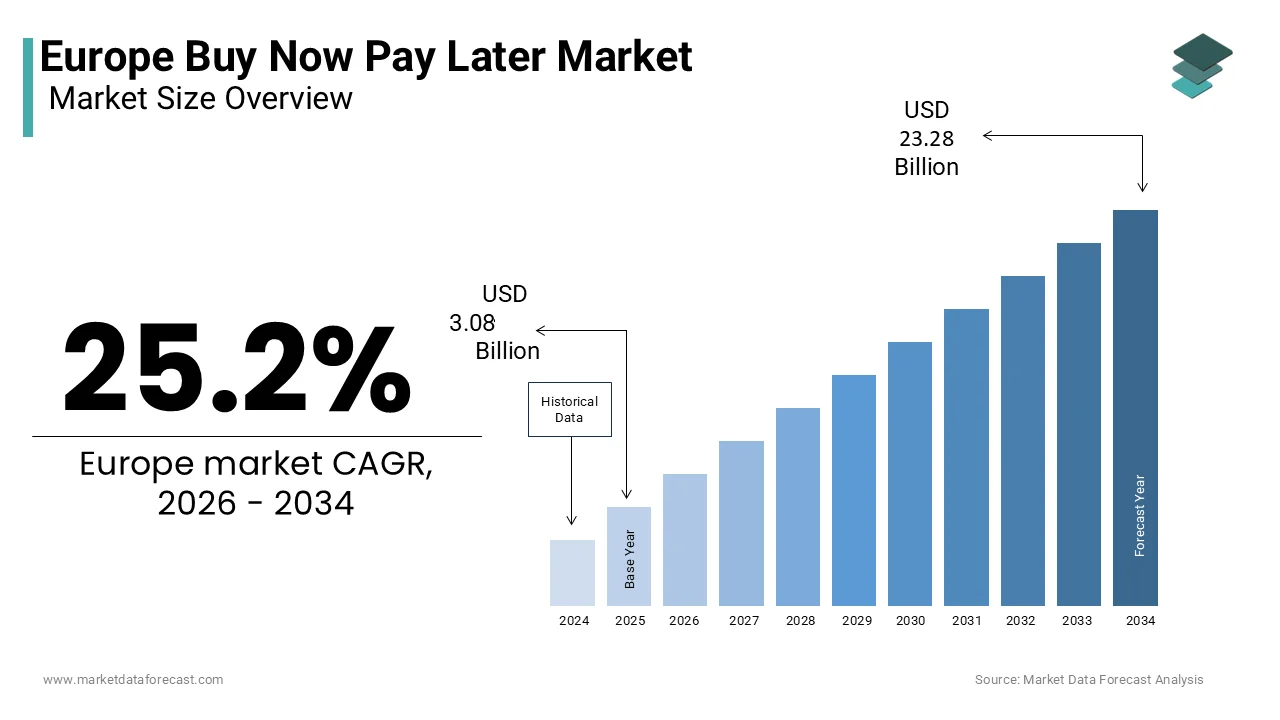
Buy Now, Pay Later (BNPL) is a short-term point of sale credit that allows consumers to split purchases into interest-free instalments without traditional credit checks or long-term debt obligations. Embedded directly into online and increasingly in-store checkout flows, BNPL offers immediate product access with deferred financial settlement, typically over three to six installments. This model aligns with shifting European consumer preferences toward financial transparency, flexible budgeting,g and aversion to revolving credit. As per the European Central Bank in 2025, BNPL products were contributing to an increase in consumer credit indebtedness in general. Also, a majority of consumers were concerned about privacy when making digital payments. The regulatory environment is also evolving, with the European Commission classifying BNPL under the upcoming Consumer Credit Directive revision,n acknowledging its distinct risk profile compared to traditional lending. Unlike markets driven purely by convenience, Europe’s BNPL adoption is increasingly shaped by macroeconomic pressures, including inflation and cost-of-living constraints, which make installment payments a pragmatic budgeting tool. This confluence of behavioral preference, economic necessity,y and regulatory recognition positions BNPL not as a fringe fintech novelty but as a structural component of Europe’s modern retail finance landscape.
MARKET DRIVERS
Cost of Living Pressures Amplify Budgeting Utility of BNPL
Rising inflation and stagnant wage growth across the region are among the factors boosting the expansion of the European buy now pay later market. This development has transformed BNPL from a convenience tool into a vital household budgeting mechanism, particularly for middle- and lower-income demographics. As per sources, across the European Union, people faced rising costs for basic needs like food, housing, and getting around, while pay increases did not keep pace with these price hikes. In this context, BNPL enables consumers to smooth irregular income flows and avoid high-interest alternatives. As per research, many consumers in Spain, Italy, and Poland are using "Buy Now, Pay Later" (BNPL) services primarily because they feel the pressure of high living costs and would otherwise have to skip buying necessary items. Importantly, BNPL’s appeal lies in its interest-free structure. For example, in Germany, individuals are choosing zero-fee BNPL options to make purchases, preferring this method over the significantly more expensive interest rates commonly associated with credit cards. This financial pragmatism is especially pronounced among young families, with nearly half of parents under forty using BNPL to handle occasional large costs, such as back-to-school shopping, without needing to use their savings. Thus, BNPL functions less as a debt enabler and more as a liquidity bridge in an era of economic uncertainty, reinforcing its embedded role in everyday financial resilience.
Seamless Integration into Native E-Commerce Checkout Flows
The frictionless embedding of BNPL options directly into merchant checkout pages also propels the growth of thEuropeanpe buy now pay later market. This integration has dramatically accelerated adoption by reducing cognitive and procedural barriers at the point of decision. Unlike traditional credit applications that require identity verification and waiting periods, BNPL completes underwriting in seconds using minimal data and presents ian nstallment option in line with the total price. As per a study, a share of major online retailers in the UK, France, and the Netherlands offer at least one BNPL provider at checkout. This integration is powered by standardized application programming interfaces that alloreal-timeme risk assessment without compromising user experience. Moreover, platforms like Shopify and Magento have baked BNPL into their core payment stacks, enabling even small merchants to deploy it with a single toggle. The psychological impact is significant. Consumers perceive total cost differently when broken into smaller units. This native embeddability transforms BNPL from an ancillary payment method into a core component of the digital shopping journey itself.
MARKET RESTRAINTS
Fragmented Regulatory Oversight Across European Jurisdictions
The absence of a unified European regulatory framework for BNPL creates significant compliance complexity and consumer protection gaps that hinder the expansion of the European buy now pay latermarket. As of 2023-2025, BNPL regulation is fragmented. Some member states, such as Sweden and Germany, have national rules that classify certain BNPL models as regulated credit requiring licensing and affordability checks, while others, like Spain and Italy, have historically treated some forms as commercial payment deferrals that fall outside existing consumer credit oversight. This inconsistency allows providers to operate under lighter regimes in some markets while facing stringent capital and reporting requirements in others. The European Consumer Protection Cooperation (CPC) Network has pointed out instances of cross-border BNPL disputes where consumers in certain countries were denied appropriate redress because the provider was licensed only in a jurisdiction with a low-regulation approach, highlighting the current challenges of a fragmented legal landscape, which CCD2 aims to address. Furthermore, the lack of standardized credit reporting means BNPL debt remains invisible to traditional credit bureaus in most countries, masking true indebtedness. The market's vulnerability to regulatory arbitrage, consumer confusion, and systemic risk will persist until harmonization is achieved, especially as usage moves beyond low-value retail into larger ticket categories.
Exclusion of BNPL Data from National Credit Reporting Systems
The widespread exclusion of BNPL repayment behaviour from national credit reference agencies distorts creditworthiness assessments, amplifies over-indebtedness risks, and is an important restraint in the European buy now pay later market. In most EU member states, BNPL transactions are not currently reported to traditional credit bureaus, showing that a consumer can accumulate multiple parallel installment obligations across different providers without immediate detection by lenders or even other BNPL providers. Research has shown a concerning pattern where a significant percentage of BNPL users simultaneously hold high-interest credit card debt, a pattern that is often invisible to underwriters due to the lack of credit reporting. This opacity is particularly concerning for young adults who constitute the largest user group. Also, most of continental Europe lags due to data privacy interpretations under GDPR and fragmented bureau infrastructure. This information asymmetry not only endangers individual financial health but also undermines the integrity of the broader credit ecosystem by creating blind spots in systemic risk monitoring and responsible lending practices.
MARKET OPPORTUNITIES
Expansion into In-Store and Offline Retail Environments
The integration of BNPL into physical retail settings gives a major growth area for the expansion of the European buy now pay later market. Providers are moving beyond e-commerce to capture the notable share of European retail still conducted in brick-and-mortar stores, according to sources. BNPL options, accessible via QR codes or card-linked tokens at checkout counters, are available across the fashion, electronics, and furniture sectors through partnerships with point-of-sale terminal providers. This expansion is accelerated by consumer demand. The integration of BNPL's digital tools with physical commerce allows providers to access higher average transaction values and build deeper merchant relationships. This shift, which also offers consumers consistent payment flexibility across channels, is turning BNPL into a universal retail payment standard.
Partnerships with Traditional Financial Institutions for Risk and Scale
Strategic alliances between BNPL fintechs and established banks or credit unions are opening new prospects for the growth of the European buy now pay later market. These collaborations leverage banks’ regulatory licenses, capital reserves, and customer trust while providing fintechs with access to sophisticated risk engines and payment rails. These alliances also facilitate product innovation, such as savings-linked BNPL, where installment funds are drawn from a user’s own time-bound deposit, reducing default risk. This convergence enhances consumer protection, improves underwriting accuracy, and positions BNPL as a responsibly embedded feature of the mainstream financial ecosystem rather than a parallel shadow credit channel.
MARKET CHALLENGES
Rising Default Rates Among Young and Low-Income Users
The interest-free appeal of BNPL has not prevented worrying delinquency trends from appearing among Europe's most financially vulnerable demographics, which ultimately obstructs the expansion of the European buy now pay latermarket. These trends are exacerbated by limited financial literacy. A share of BNPL users correctly identified late fees as a consequence of missed payments, according to studies. Unlike traditional credit w,h where arrears trigger credit score impacts, BNPL’s current invisibility to bureaus means consumers often accumulate multiple defaults across providers without immediate consequence,s leading to spiraling obligations. The BNPL segment risks normalizing short-term credit dependency, potentially leading to long-term financial instability, especially as it expands into higher-value categories like travel and electronics, unless proactive affordability checks and cross-provider data sharing are implemented.
Operational Vulnerability to Payment Infrastructure Disruptions
Operational risk further degrades the growth of the European buy now pay later market. This operational vulnerability is due to its dependence on third-party payment processors and open banking APIs that are susceptible to outages,, regulatory chang,es or cyber incidents. Most BNPL providers do not operate their own payment rails but rely on licensed partners for fund disbursement and collection, creating single points of failure. Additionally, the reliance on open banking for income verification exposes providers to API instability. Cybersecurity is another concern. These vulnerabilities not only disrupt revenue collection but also erode consumer trust, particularly when failed payments trigger late fees through no fault of the user. The model remains operationally fragile within Europe’s complex, interconnected financial ecosystem until providers either diversify their infrastructure dependencies or build their own payment capabilities.
SEGMENTAL ANALYSIS
By Channel Insights
The online segment led the European buy now pay later market and accounted for a substantial share in 2025. The native integration of BNPL into e-commerce checkout flows, where minimal friction and real-time underwriting align perfectly with digital shopping behaviour, drives the supremacy of the online segment. Unlike physical stores, which require additional hardware or staff tratrainingonline merchants can activate BNPL through simple API integrations with platforms like ShShopifyfy Magent,,o and WooCommerce. As per research, most major online retailers in Europe have begun offering BNPL as a payment option, a trend particularly strong in sectors like clothing, gadgets, and cosmetics. The psychological impact of installment pricing is also magnified online, where consumers lack tactile engagement and rely more on financial framing to justify purchases. Apart from these, the pandemic accelerated digital shopping habits. This digital-native synergy ensures online remains the primary conduit for BNPL growth.
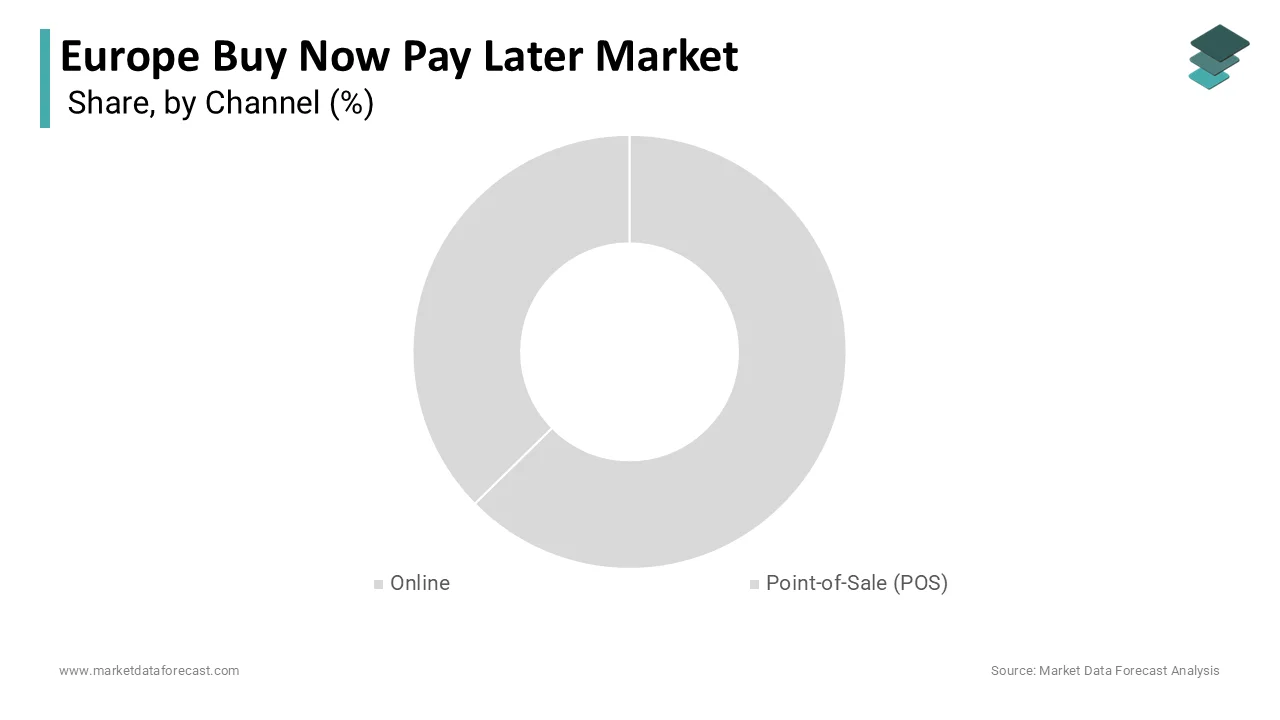
The point-of-sale segment is expected to exhibit a noteworthy CAGR of 31.2% from 2025 to 2033. The swift expansion of the point-of-sale segment is propelled by strategic partnerships between BNPL providers and payment terminal networks, enabling seamless in-store adoption without merchant retraining. BNPL options now appear as standard payment methods on checkout screens for major retail chains, thanks to integrations with Worldline, Ingenico, and SumUp. Buy Now Pay Later (BNPL) solutions are increasingly being adopted in physical retail settings across Europe, with providers integrating services to offer seamless installment options. For example, Klarna's in-store solution is live in many physical locations in Sweden, allowing consumers to approve installments via QR code or other in-store terminals. Similarly, France’s Alma partners with various retailers, including large brands, to embed BNPL options, enabling quick activation at the till. As per research, consumer preference for different payment methods varies by transaction value. This convergence of consumer demand, merchant economies, and payment infrastructure is transforming POS from a niche extension into a high-value growth engine.
By Enterprise Size Insights
The large enterprises segment dominated the European buy now pay later market by capturing a share of 65.5% in 2025. The dominance of the large enterprises segment is attributed to their ability to integrate BNPL at scale through established e-commerce platforms, robust IT iinfrastructurere and high transaction volumes that attract favourable terms from providers. Major retailers operate across multiple European countries and can negotiate customized BNPL contracts that include co-branded marketing, shared risk models, and real-time performance dashboards. Apart from these, large enterprises benefit from brand trust that reassures consumers about data security when sharing financial information at checkout. Their compliance teams also navigate evolving regulatory requirements more effectively than smaller players, ensuring continuity during transitions. This combination of scale,e technical capability, and regulatory resilience makes large enterprises the backbone of BNPL adoption across the continent.
The small and medium enterprise segment is predicted to witness the highest CAGR of 28.7% over the forecast period due to factors such as plug-and-play BNPL solutions tailored to their operational constraints. Unlike large firms, SMEs lack dedicated payment or compliance teams,, ms but benefit from simplified onboarding via e-commerce platforms that embed BNPL as a single toggle feature. Besides, national digital adoption grants subsidize up to a share of integration costs for eligible businesses, accelerating uptake. Importantly, BNPL helps SMEs overcome consumer hesitation on unfamiliar sites by offering trusted third-party payment assurance. This democratization of financial flexibility empowers smaller merchants to retain customers who might otherwise abandon carts due to full upfront payment, which positions SMEs as the next wave of BNPL-driven retail innovation.
By End Use Insights
The retail segment held the leading share of theEuropeane buy now pay later market in 2025. BNPL’s alignment with discretionary spending on fashion, eelectronicss home goods, ds and beauty, categories where impulse and affordability intersect, has mainly contributed to the growth of the retail segment. Retailers leverage BNPL to reduce purchase friction and boost conversion, particularly for mid-ticket items between 100 and 500 euros, where consumers are most price sensitive. The psychological effect of instalment pricing is well documented. Major online marketplaces have embedded multiple BNPL options, creating consumer expectation and competitive necessity. Apart from these, retail’s digital maturity enables seamless integration with minimal operational overhead. This synergy of behavioural economics, digital infrastructur,,e and category relevance ensures retail remains the core engine of BNPL adoption across Europe.
The healthcare end-use segment is estimated to register the fastest CAGR of 34.5% from 2025 to 2033. The rapid expansion of the healthcare end-use segment is driven by rising out-of-pocket costs for non-emergency and elective care, including dental, orthodontic,,s vision correction, and mental health services, which are often only partially covered by public or private insurance. According to reports such as the 2023 Germany: Country Health Profile available from the OECD, Germany has one of the lowest rates of out-of-pocket payments in the EU (12% of total health expenditure), while France is similarly low (around 9%). BNPL addresses this by enabling patients to spread payments over months without interest. Providers like Klarna and Splitit have lauhealthcare-specific integrations with clinic management software, allowing instant approval at the point of scheduling. This expansion transforms BNPL from a retail convenience into a critical access tool for essential yet underfunded health services.
COUNTRY LEVEL ANALYSIS
United Kingdom Buy Now Pay Later Market Analysis
The United Kingdom was the largest player in theEuropeane buy now pay later market and accounted for a 26.1% share in 2025. Early consumer adoption, mature fintech infrastructure, and proactive regulatory engagement all have contributed to the expansion of BNPL in the UK market. The UK established BNPL as a mainstream payment method long before continental Europe, primarily because it was the birthplace of Klarna's European operations and home to native players like Clearpay. The Financial Conduct Authority’s early sandbox approach allowed controlled experimentation. Apart from these, the UK’s high e-commerce penetration creates a fertile environment for digital payment adoption. This combination of first mover advantage, regulatory clarity,y and digital readiness ensures the UK remains the continent’s BNPL benchmark and testing ground for new models.
Germany Buy Now Pay Later Market Analysis
Germany followed closely in the Europe buy now pay later market by capturing a 20.7% share in 2025 and is expected to attain the highest growth rate from 2025 to 2033. The growth of Germany in the regional market is attributed to high consumer demand for transparent financing and strict data privacy expectations. Despite cultural aversion to debt, Germans embrace BNPL due to its interest-free structure and clear installment breakdown. The market is also shaped by strong data protection norms, with providers like Ratepay and Klarna investing heavily in GDPR compliant underwriting that uses minimal personal data. Retail adoption is robust. Apart from these, Germany’s BaFin financial regulator has implemented a licensing framework that balances innovation with consumer safeguards, encouraging responsible scaling. This unique blend of transparency, expectation,n privacy rigor, and retail integration makes Germany high-valueue and high-trust BNPL environment.
Sweden Buy Now Pay Later Market Analysis
Sweden is moving ahead steadfastly in the Europe buy now pay later market due to its cashless society, digital native population, and homegrown fintech dominance. Klarna, headquartered in Stockholm, has cultivated deep integration across both domestic and international retailers, creating a cultural norm around instalment shopping. The government’s digital ID system,m Bank ID, enables instant and secure verification, ion reducing fraud and friction. Besides, Sweden’s progressive consumer protection laws require clear disclosure of payment terms,,erms which builds trust without overregulating. This ecosystem of digital fluency, trusted infrastructure, and homegrown innovation positions Sweden as both a domestic stronghold and a global influence on BNPL design and ethics.
France Buy Now Pay Later Market Analysis
France saw moderate growth in theEuropeane buy now pay later market, with strong regulatory oversight and strategic alignment with national digital commerce goals. The French government’s Loi Pacte framework classifies BNPL as a regulated payment service requiring licensing and affordability checks, which has elevated consumer confidence. Domestic players have gained significant traction by partnering with major retailers,s embedding BNPL into loyalty ecosystems. Apart from these, France’s high mobile commerce penetration favors BNPL’mobile-optimizeded experience. The state-backed France Relance program also subsidizes BNPL integration for SMEs, accelerating adoption beyond large retailers. This fusion of regulatory discipline, retail collaboration, and digital policy support creates a balanced and sustainable BNPL ecosystem.
Netherlands Buy Now Pay Later Market Analysis
The Netherlands is a mature country in the Europe buy now pay later market with growth propelled by high e-commerce maturity, financial literacy, and cross-border retail activity. Dutch consumers are among Europe’s most digitally savvy, with most shopping online regularly and exhibiting a strong preference for transparent payment options. BNPL aligns with this ethos, offering clear installment terms without hidden interest. Major domestic banks have launched their own BNPL products while international providers partner with local payment leaders to ensure seamless integration. Besides, the Netherlands serves as a logistics and e-commerce hub for pan-European retailers, many of whom activate BNPL for Dutch consumers first due to favourable payment infrastructure and low fraud rates. This combination of digital rereadinessfinancial prudence, and strategic geographic position sustains the Netherlands as a high-quality growth market within the European BNPL landscape.
COMPETITIVE LANDSCAPE
Competition in theEuropeane buy now pay later market is intensifying as global fintechs, European spespecialistssand traditional financial institutions vie for consumer and merchant loyalty. The landscape is characterized by rapid product differentiation with players moving beyond basic installments into features like savings-linked payments, carbon footprint trtrackingg ain-storeore QR activation. Regulatory divergence across member states creates both barriers and opportunities, favoring those with localized compliance capabilities. While early movers like Klarna benefit from brand recognition, newer entrants compete on niche retail verticals, responsible lending credentials, or bank backing. Merchant economics are also shifting as providers offer co-marketing, support,t risk sharing, ng and advanced analytics to justify integration costs. As the EU moves toward unified regulation under the revised Consumer Credit Directive, live competition is increasingly defined not by speed of rollout but by sustainability of risk management,ment consumer protection, and value beyond checkout. This environment rewaadaptabilityilit,y transparency, and long-term trust over transactional convenience alone.
KEY MARKET PLAYERS
Some of the companies that are playing a dominating role in the global europe buy now pay later (BNPL) market include
- Klarna Bank AB
- Afterpay Limited (part of Block, Inc.)
- PayPal Holdings, Inc.
- Affirm Holdings, Inc.
- Clearpay Finance Ltd.
- Zip Co. Limited
- Laybuy Group Holdings Limited
- Splitit Payments Ltd.
- Zilch Technology Ltd.
- Scalapay S.R.L.
- Twisto Payments a.s.
- Riverty (formerly Arvato Financial Solutions)
- ViaBill A/S
- Alma SAS
- Sezzle Inc.
- Openpay Group Ltd.
- Amazon Pay Later (Amazon.com, Inc.)
- Revolut Ltd.
TOP LEADING PLAYERS IN THE MARKET
- Klarna Bank AB is a Swedish fintech pioneer and one of the most influential players in the European buy now pay later market. The company offers flexible installment and pay-later options across thousands of online and physical retailers, with a strong emphasis on user experience and brand trust. Klarna has strengthened its European position by investing in regulatory compliance, including early alignment with the UK’s Financial Conduct Authority and Germany’s BaFin requirements. It recently launched a unified credit reporting system across EU markets to promote responsible borrowing. Globally, Klarna exports its European operating model, combining seamless integration, transparent pricing, and robust risk management, as a benchmark for BNPL implementation in North America and Australia, influencing global standards for consumer protection and digital checkout design.
- Afterpay Limited, now part of Block Inc, established a significant footprint in the European buy now pay later market through strategic retail partnerships and a distinctive interest-free philosophy. The company integrated its installment platform with major European fashion and beauty retailers, emphasizing visual commerce and social shopping alignment. Afterpay has reinforced its presence by localizing its product for European data privacy laws and collaborating with regional payment processors to ensure smooth cross-border transactions. Its global contribution lies in popularizing the four-installment model worldwide and demonstrating how BNPL can drive merchant sales without relying on revolving credit. In Europe, it continues to differentiate through brand collaborations and sustainability-linked shopping incentives that resonate with conscious consumers.
- Clearpay, the European brand of Block Inc’s BNPL arm, operates as a tailored solution for UK and continental European markets with deep integration into local retail ecosystems. The company partners with leading fashion, beauty,y and home goods merchants, offering consumers transparent installment plans with no interest or hidden fees. Clearpay has enhanced its competitiveness by implementing real-time affordability checks compliant with emerging EU regulations and launching tools that allow consumers to manage spending through budgeting dashboards. It also supports small businesses through simplified onboarding and promotional features on social commerce platforms. Globally, Clearpay serves as Block’s regulatory and operational testbed for responsible BNPL innovation, with European learnings informing product development in other regulated markets.
TOP STRATEGIES USED BY THE KEY MARKET PARTICIPANTS
Key players in the European buy now pay later market prioritize regulatory compliance by proactively adapting to national licensing regimes and credit reporting mandates ahead of EU harmonization. They invest in seamless merchant integration through plug-and-play APIs for major e-commerce platforms and point-of-sale systems to reduce adoption barriers. Companies emphasize financial transparency by offering zero-interest installment plans and real-time affordability assessments to build consumer trust. Strategic partnerships with retailers, banks, and digital wallets enhance distribution and credibility. Additionally, they deploy consumer education tools and spending dashboards to promote responsible usage and mitigate regulatory scrutiny while differentiating through ethical branding and sustainability-aligned incentives.
MARKET SEGMENTATION
This research report on the europe buy now pay later (BNPL) Market is segmented and sub-segmented into the following categories:
By Channel
- Online
- Point-of-Sale (POS)
By Enterprise Size
- Large Enterprises
- Small & Medium Enterprises (SMEs)
By End Use
- Retail
- Healthcare
- Others
By Country
- United Kingdom
- Germany
- Sweden
- France
- Netherlands
- Rest of Europe