- Product Description Description
- Table of Contents TOC
- List of Table & Figure LOT
- Get Free Sample PDF Sample PDF
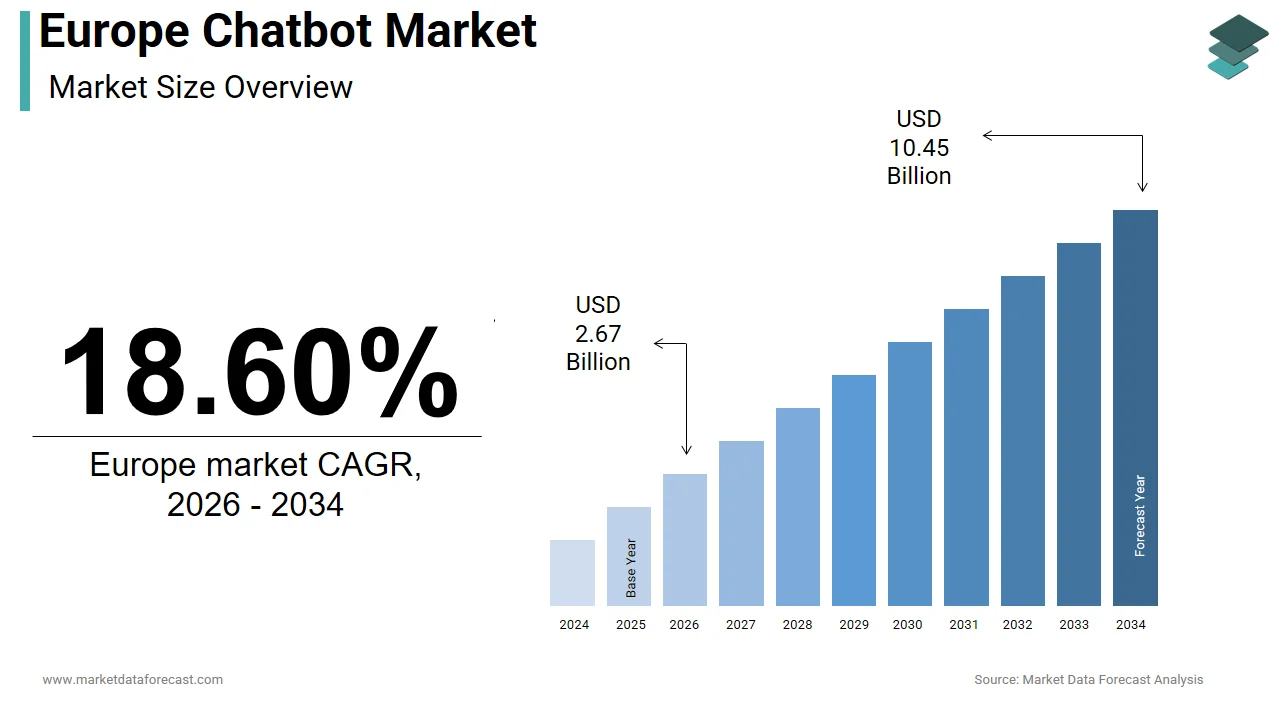
Market Size, 2025
$2.25 BnMarket Estimate, 2026
$2.67 BnMarket Forecast, 2034
$10.45 BnCAGR, 2026–2034
18.60%Europe Chatbot Market Report Summary
The Europe chatbot market was valued at USD 2.25 billion in 2025, is estimated to reach USD 2.67 billion in 2026, and is projected to reach USD 10.45 billion by 2034, growing at a strong CAGR of 18.60% from 2026 to 2034. Market growth is driven by rapid digital transformation across industries, rising adoption of AI-powered customer engagement tools, and increasing demand for automated, personalized, and round-the-clock support services. Organizations across Europe are integrating chatbots into websites, mobile applications, and messaging platforms to enhance customer experience, reduce operational costs, and improve service efficiency. The growing deployment of natural language processing (NLP), conversational AI, and multilingual chatbot solutions is further accelerating market expansion.
Key Market Trends
- Increasing adoption of AI- and NLP-powered conversational platforms for personalized customer interactions.
- Rising deployment of omnichannel chatbots across websites, mobile apps, and social media platforms.
- Growing demand for self-service automation tools in banking, retail, healthcare, and telecom sectors.
- Expansion of voice-enabled and hybrid chatbot solutions for enhanced user engagement.
- Strengthening focus on data security, privacy compliance, and ethical AI practices.
Segmental Insights
- Based on type, the web-based chatbots segment dominated the Europe chatbot market in 2024 by accounting for 48.1% market share. The segment’s dominance is attributed to easy deployment, wide compatibility with enterprise platforms, and cost-effective implementation.
- Based on product, the AI-powered chatbots segment led the market by capturing 63.7% share in 2024, driven by advancements in machine learning, natural language understanding, and predictive analytics capabilities.
- Based on application, the service-oriented chatbots segment held the leading position with 41% market share in 2024, supported by strong demand for automated customer support, appointment scheduling, and complaint resolution services.
Regional Insights
The Europe chatbot market is witnessing strong growth across major economies, supported by rising digital adoption, increasing enterprise automation initiatives, and government-led digital transformation programs.
- The United Kingdom was the top performer, accounting for 21.5% of the market share in 2024, driven by strong fintech, e-commerce, and digital services ecosystems.
- Germany ranked second with 19.4% share in 2024, supported by advanced industrial digitalization and enterprise AI adoption.
- France represents an attractive market, driven by its national strategy for digital sovereignty and public service modernization, boosting demand for conversational AI in government and public sector services.
Competitive Landscape
The Europe chatbot market is characterized by intense competition among global technology leaders and specialized conversational AI providers offering advanced, scalable, and industry-specific chatbot solutions. Market players are focusing on enhancing multilingual support, integrating generative AI capabilities, and improving contextual understanding. Strategic partnerships, platform upgrades, and continuous innovation are shaping competitive dynamics across the region.
Prominent companies operating in the Europe chatbot market include IBM Corporation, Nuance Communications, Google LLC, Microsoft Corporation, Amazon Web Services, Artificial Solutions, Inbenta Technologies, Chatfuel, AIVO, Passage AI, Kore.ai, KeyReply, SmartBots, CogniCor Technologies, and Conversica.
Europe Chatbot Market Size
The Europe chatbot market was valued at USD 2.25 billion in 2025, is estimated to reach USD 2.67 billion in 2026, and is projected to reach USD 10.45 billion by 2034, growing at a CAGR of 18.60% from 2026 to 2034.
Chatbot refers to the AI-powered conversational interfaces deployed across websites, mobile applications, and messaging platforms to automate customer service, internal support, and transactional interactions. These systems leverage natural language understanding, machine learning, and contextual memory to simulate human-like dialogue in multiple European languages while adhering to strict data privacy and transparency norms. According to Eurostat data for 2024, approximately 21% of medium-sized enterprises (50-249 employees) and 41% of large enterprises (250+ employees) in the EU used any form of AI technology, which includes a range of applications beyond just conversational interfaces (such as text mining, image recognition, machine learning, etc.). As per sources, citizen expectations for 24/7 digital public services have surged, with a notable share of Europeans preferring chat-based support over phone or in-person options for routine inquiries. Furthermore, the European Accessibility Act mandates that all public sector digital tools, including chatbots, meet WCAG 2.1 standards, ensuring inclusivity for users with disabilities. This regulatory and behavioral convergence positions chatbots not as experimental add-ons but as essential infrastructure for responsive, efficient, and compliant service delivery across the continent.
MARKET DRIVERS
Acute Labor Shortages in Service Sectors Accelerate Automation Adoption
The region faces a structural deficit in frontline service workers that is fuelling the growth of the Europe chatbot market. General labor and skills shortages are a recognised issue in the EU in specifically, often skilled trades and technical occupations. This mismatch is particularly acute in countries like Germany and the Netherlands, where aging populations shrink the available workforce. In response, banks are increasingly using AI chatbots to handle a significant percentage of routine and repetitive customer inquiries efficiently. Similarly, National tax agencies in highly digitized countries like Sweden and Estonia use advanced digital tools, including AI chatbots, to manage citizen queries and significantly reduce the burden on call centers during peak periods. These deployments are not driven by cost-cutting alone but by the impossibility of staffing service levels to meet digital demand. The EU's working-age population is projected to experience a significant decline by 2030 due to ongoing demographic shifts and an aging population, according to Eurostat.
Regulatory Push for Transparent and Accessible Digital Public Services
The European Union’s legislative framework further contributes to the expansion of the Europe chatbot market. This is actively shaping chatbot design and deployment to ensure equity, accountability, and user control. The EU AI Act is the primary legislation that requires deployers of AI systems intended to interact with natural persons to inform them that they are interacting with an AI system. The European Accessibility Act (EAA) became fully enforceable on June 28, 2025, for new products and services, and it requires relevant digital services (including e-commerce and banking, which may use chatbots) to be accessible. These regulations do not stifle innovation but channel it toward responsible design, creating a market where compliance and user trust are competitive advantages. Vendors that embed explainability, accessibility, and multilingual fairness from inception gain preferential access to high-value public sector contracts.
MARKET RESTRAINTS
Persistent Deficiencies in Multilingual and Dialectal Understanding
Most commercial chatbots still struggle with the region’s linguistic diversity, particularly regional dialects, idioms, and code switching, which restricts the growth of the Europe chatbot market. Only a few enterprise chatbot platforms demonstrated reliable performance across all 24 official EU languages, with significant accuracy drops in less-resourced tongues. Even in major languages, contextual nuances pose challenges; French sarcasm, Italian indirect requests, or German compound noun constructions often lead to misinterpretation. This forces organizations to either limit chatbot deployment to dominant languages, excluding minority populations, or invest heavily in custom language models, which inflates costs. Chatbots will offer inconsistent user experiences and remain only partially effective in Europe until foundation models achieve true parity across the continent's complete linguistic range.
Stringent Data Minimization Requirements Under GDPR Limit Personalization Depth
The General Data Protection Regulation principles of data minimization restrict how much personal information chatbots can collect, store, or use to tailor responses, and these constraints inhibit the expansion of the European chatbot market. This legal environment discourages the deep personalization common in other regions where chatbots leverage extensive user histories to anticipate needs. In Europe, a banking chatbot may not remember a customer’s past loan inquiry unless the user reconsents during each session, limiting contextual continuity. Consequently, European chatbots often operate in a state of intentional amnesia, delivering generic responses that satisfy privacy but frustrate users expecting intelligent assistance. This tension between personalization and privacy remains a fundamental constraint on functional sophistication.
MAKET OPPORTUNITIES
Integration of Chatbots into EU Digital Identity and Wallet Ecosystems
The rollout of the European Digital Identity Wallet creates a major opportunity for the growth of the Europe chatbot market. As per studies, there is an accelerating trend across Europe toward a widespread implementation and piloting of digital identity wallet services within EU member states. This enables high-trust transactions previously impossible in anonymous chat environments. For example, healthcare providers are increasingly adopting wallet-authenticated chatbots to enable patients to securely and conveniently access medical information, schedule appointments, and manage prescriptions without needing traditional passwords. Similarly, Public employment services are integrating chatbots and digital identity verification into their systems to streamline processes for job seekers applying for benefits and related services, such as automatic verification of employment history. This integration eliminates friction while maintaining GDPR compliance through user-controlled data sharing. Vendors that build wallet-ready chatbot frameworks will gain privileged access to next-generation public and financial services where security and convenience converge.
Expansion of Voice-Enabled Chatbots in Aging and Rural Populations
The region’s demographic shift gives a unique opening for voice-first chatbots that serve older adults and rural communities with limited digital literacy, and it promotes the expansion of the Europe chatbot market. According to sources, a portion of Europeans aged sixty-five and above live alone and face barriers using traditional web forms, yet are comfortable with voice interfaces. In response, some public health agencies have deployed telephone-based voice chatbots that provide medication reminders, symptom checks, and appointment scheduling in local dialects. These systems use speech recognition models fine-tuned on regional accents, achieving notable accuracy. Apart from these, some of the rural post offices use voice chatbots on public kiosks to assist citizens with pension inquiries and utility payments without requiring typing or smartphone use. EU investment in accessible AI makes voice recognition a significant, socially oriented growth sector, which connects technology directly to the demographic landscape.
MARKET CHALLENGES
Escalating Sophistication of Social Engineering Attacks via Conversational AI
Increased weaponization by malicious actors to conduct phishing scams, to impersonate officials, or to extract sensitive data through seemingly benign dialogue challenges the growth of the Europe chatbot market. These attacks exploit user trust in conversational interfaces, particularly among older populations who may not distinguish between official and fraudulent bots. Current detection systems struggle because these interactions occur within encrypted channels and mimic legitimate conversational patterns. The NIS2 Directive requires incident reporting, but it does not specify technical safeguards for conversational AI. Chatbots will remain vulnerable to digital deception until robust authentication, liveness detection, and real-time anomaly monitoring become standard practice, which consequently affects user confidence and institutional adoption.
Lack of Standardized Evaluation Frameworks for Chatbot Performance and Ethics
The region lacks a unified methodology to assess chatbot accuracy, fairness, and safety, which creates inconsistent quality and accountability gaps, and thereby inhibits the expansion of the Europe chatbot market. As per research, only a limited number of commercial chatbots underwent third-party audits for bias hallucination or harmful output despite the AI Act’s risk classification requirements. The absence of standardized benchmarks forces vendors to report performance using unique and incomparable metrics. Public sector procurement further suffers as tender evaluations focus on cost and language count rather than conversational robustness or error recovery. This measurement vacuum allows subpar systems to proliferate, particularly in SMEs and local governments with limited technical oversight. Reliability and ethical standards for conversational AI across the market will remain inconsistent until the European Standardization Organization completes its work on the ENISA-supported testing protocols.
REPORT COVERAGE
| REPORT METRIC | DETAILS |
| Market Size Available | 2025 to 2034 |
| Base Year | 2025 |
| Forecast Period | 2026 to 2034 |
| Segments Covered | By Type, Product, Application, Organization Size, Vertical, and Region. |
| Various Analyses Covered | Global, Regional and Country-Level Analysis, Segment-Level Analysis, Drivers, Restraints, Opportunities, Challenges; PESTLE Analysis; Porter’s Five Forces Analysis, Competitive Landscape, Analyst Overview of Investment Opportunities |
| Countries Covered | UK, France, Spain, Germany, Italy, Russia, Sweden, Denmark, Switzerland, Netherlands, Turkey, Czech Republic, and the Rest of Europe. |
| Market Leaders Profiled | IBM Corporation, Nuance Communications, Google LLC, Microsoft Corporation, Amazon Web Services, Artificial Solutions, Inbenta Technologies, Chatfuel, AIVO, Amazon.com, Passage AI, Kore.ai, KeyReply, SmartBots, CogniCor Technologies, and Conversica. |
SEGMENTAL ANALYSIS
By Type Insights
The web-based chatbots segment dominated the Europe chatbot market and accounted for a 48.1% share in 2024. The seamless integration into corporate websites, where the majority of customer journeys begin, drives the dominance of the web-based chatbots segment. Unlike standalone or messenger bots that require users to download apps or switch platforms, web-based interfaces offer zero-friction access directly on brand domains, critical for compliance and trust. As per sources, a notable share of European consumers prefer resolving service issues on the company’s official website rather than third-party messaging apps. This preference is reinforced by the General Data Protection Regulation, which mandates clear data controller identification, easier to establish on owned web properties. Banks and insurers embed contextual web chatbots that access session data to personalize responses without violating privacy. This convergence of user behavior, regulatory alignment, and technical control makes web-based chatbots the default deployment model across regulated and customer-facing industries.
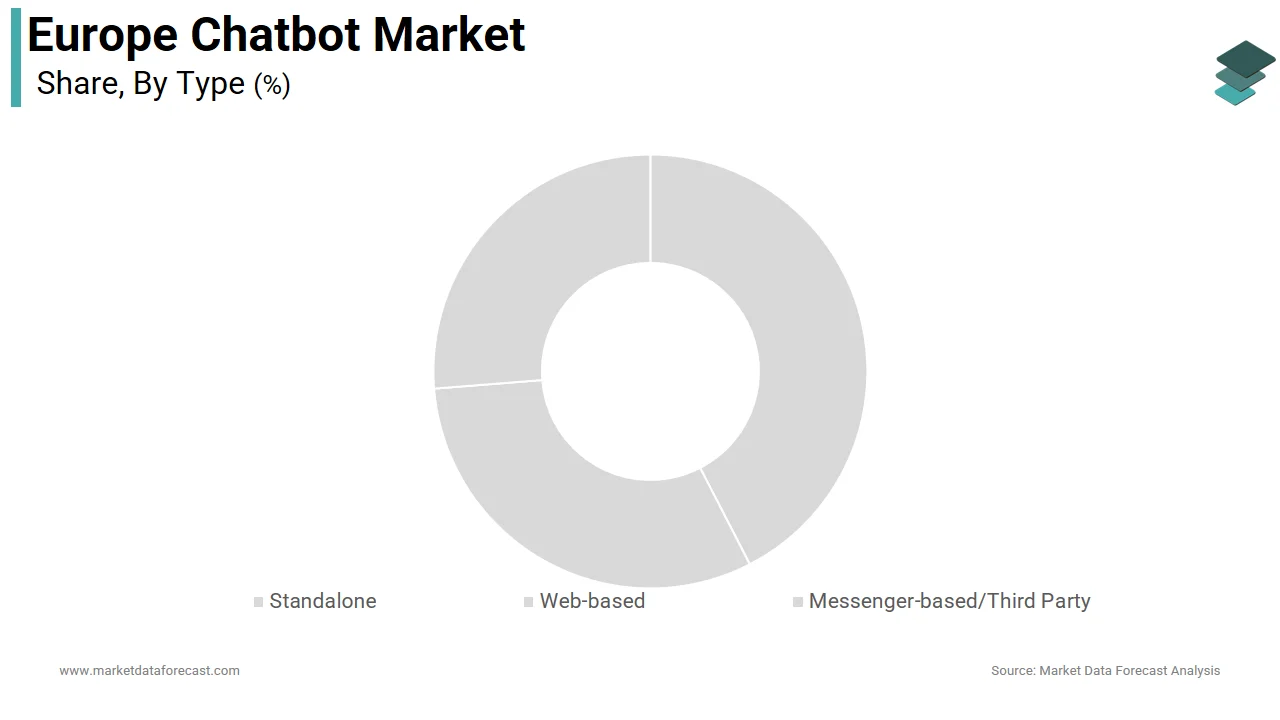
The messenger-based chatbots segment is predicted to witness the highest CAGR of 22.7% from 2025 to 2033. The rapid expansion of the messenger-based chatbots segment is fueled by the deep entrenchment of platforms like WhatsApp, Facebook Messenger, and Telegram in European daily life, particularly among younger and mobile-first users. According to research, a significant share of Europeans use WhatsApp daily for both personal and commercial interactions, creating a natural channel for conversational commerce. In response, some retailers offer order tracking, returns, and style advice directly within WhatsApp without redirecting users to websites. The European Commission’s Digital Markets Act has further leveled the playing field by requiring gatekeeper platforms to enable interoperability, allowing businesses to deploy bots across multiple messaging services via unified APIs. Besides, Meta’s launch of end-to-end encrypted business messaging with verified badges enhances trust in transactional conversations. The growing consumer preference for obtaining services within familiar social contexts, combined with a rejection of numerous single-purpose apps, is positioning messenger bots at the forefront of adaptive customer service.
By Product Insights
The AI-powered chatbots segment led the Europe chatbot market and captured a 63.7% share in 2024. The prominence of the AI-powered chatbots segment is attributed to the enterprise shift from scripted rule-based systems to adaptive conversational agents capable of handling complex multilingual queries. AI chatbots leverage transformer-based language models fine-tuned on domain-specific data to understand context, intent, and sentiment, essential in Europe’s diverse linguistic landscape. As per sources, a notable share of large European firms now use AI chatbots for customer service. Regulatory drivers also favor AI systems that can provide audit trails and explain decisions, requirements embedded in the EU AI Act for high-risk applications. Financial institutions and healthcare providers deploy AI chatbots that not only answer questions but also detect distress signals and escalate to humans when needed. This blend of autonomy, accountability, and contextual intelligence makes AI the cornerstone of modern conversational strategy across the continent.
The human intelligence chatbots segment is estimated to register the fastest CAGR of 19.4% during the forecast period, owing to rising consumer expectations for empathetic and accurate support in high-stakes scenarios. According to a study, a considerable share of Europeans abandoned a transaction after receiving an incorrect or robotic response from a chatbot, particularly in banking and healthcare. In response, companies are adopting human-in-the-loop architectures where AI pre-qualifies queries and provides agents with full conversation history and suggested responses, which reduces handle time. Public sector agencies use these hybrid bots for social benefit applications where errors can have severe consequences. The EU’s Digital Services Act further mandates human fallback for automated decisions affecting legal or financial rights, ensuring sustained demand for intelligently augmented human support.
By Application Insights
In 2024, the service-oriented chatbots segment held a leading share of 41% of the Europe chatbot market. The supremacy of the service-oriented chatbots is propelled by the universal need across industries to manage high-volume repetitive inquiries, password resets, account balances, and appointment scheduling, without human intervention. According to research, service roles face the largest staffing gaps in the EU, with a large number of vacancies in customer support. Utilities and telecom operators deploy multilingual service bots that resolve a notable portion of tier one issues instantly while maintaining GDPR compliant data handling. Unlike marketing or social media bots, which drive engagement, service bots directly reduce operational costs and compliance risk. This functional indispensability ensures their continued primacy in enterprise conversational strategies.
The chatbots for the payments and order processing segment are anticipated to witness the fastest CAGR of 25.3% from 2025 to 2033 due to factors such as the convergence of open banking, instant payments, and conversational commerce. Under the Revised Payment Services Directive, consumers can now initiate secure transactions directly within chat interfaces using Strong Customer Authentication. Moreover, food delivery platforms like Deliveroo use voice and text bots to take orders, process payments, and track deliveries in real time. The European Central Bank’s TARGET Instant Payment Settlement system enables 24/7 sub-second transfers, making chat-initiated payments technically viable across the eurozone. Consumers now expect effortless transactional capabilities within messaging platforms, a need addressed by this segment, which merges communication and commerce, uniquely shaped by the European regulatory context.
By Vertical Insights
The BFSI segment was the prominent segment in the Europe chatbot market and occupied 28.3% of the regional market in 2024. Financial institutions deploy chatbots for account management, fraud alerts, loan eligibility checks, and regulatory disclosures, tasks requiring high accuracy and auditability, which in turn boosts the expansion of the BFSI segment. Insurers use multilingual bots to guide customers through claims submission, reducing processing time from days to hours. The sector’s zero tolerance for error, combined with stringent data governance, makes it the most demanding and mature chatbot user. Moreover, the Payment Services Regulation requires clear communication of transactional rights, easily fulfilled through scripted yet intelligent conversational flows. This regulatory density and customer trust imperative cement BFSI as the anchor vertical for enterprise-grade chatbot deployment.
The healthcare segment is likely to experience the fastest CAGR of 27.5% over the forecast period. The swift growth of the healthcare segment is fuelled by workforce shortages and the operationalization of the European Health Data Space. There is growing interest and research into the use of AI-powered symptom checker chatbots in primary care settings across various countries, including parts of Europe, to potentially improve efficiency and patient flow. National health services in some countries deploy bots that schedule vaccinations, manage chronic disease follow ups and provide mental health first aid in local languages. The EU Medical Device Regulation classifies certain diagnostic chatbots as Class devices requiring clinical validation, which spurs investment in evidence-based conversational AI. The push to digitize healthcare, driven by an increasing number of older adults, has made chatbots essential for delivering care that is scalable, empathetic, and compliant with regulations.
COUNTRY LEVEL ANALYSIS
United Kingdom Chatbot Market Analysis
The United Kingdom was the top performer in the Europe chatbot market and accounted for a 21.5% share in 2024. Its world-leading fintech ecosystem and agile regulatory sandbox primarily drive the domination of the UK market. According to research, a notable share of British banks and insurers use AI chatbots with real-time compliance monitoring for Financial Conduct Authority rules. London alone hosts numerous conversational AI startups serving global clients from banking to legal services. The UK’s post-Brexit regulatory autonomy has enabled rapid testing of generative chatbots under controlled supervision, with the Information Commissioner’s Office issuing clear guidance on lawful data use in conversational systems. This blend of financial gravity, technological agility, and forward-looking governance ensures the UK remains a crucible for next-generation chatbot innovation with European and global relevance.
Germany Chatbot Market Analysis
Germany is the next most prominent region in the Europe chatbot market and captured a 19.4% share in 2024. Its engineering precision, strong data protection culture, and industrial service demands fuel the chatbot demand in Germany. According to a study, many DAX 30 companies deploy GDPR compliant chatbots for customer and partner support with strict data minimization protocols. Automotive giants use multilingual service bots to assist global customers while ensuring all data remains within EU jurisdictions. The cultural and legal context favors vendors that prioritize transparency, explainability, and on-premise deployment options. The Berlin-based GAIA-X initiative not only utilizes chatbot technology but also spearheads the effort to create the ethical and technical framework for its use throughout Europe.
France Chatbot Market Analysis
France is an attractive country in the Europe chatbot market because of its national strategy for digital sovereignty and public service modernization. The French government has a national AI strategy that encourages the adoption and experimentation of AI in public services. The country’s stance on algorithmic transparency under the Digital Republic Act requires chatbots to disclose their logic and allow user contestation. Homegrown vendors develop NLP engines trained exclusively on French corpora to avoid reliance on US-based language models. This fusion of state leadership, linguistic pride, and civic tech positions France as a unique laboratory for sovereign conversational AI aligned with republican values.
Netherlands Chatbot Market Analysis
The Netherlands holds a key position in the Europe chatbot market due to its role as the region’s e-commerce and logistics gateway. Many Dutch retailers and delivery firms use multilingual chatbots to serve customers in Dutch, English, German, and French, which reflects the country’s international trade orientation. Companies integrate WhatsApp and web chatbots for real-time order tracking, returns, and delivery rescheduling, reducing call center volume. As per the Ministry of Economic Affairs, the Netherlands leads in open banking adoption, enabling chat-initiated payments. Furthermore, Amsterdam’s status as a data hub ensures low latency and GDPR compliant hosting for conversational platforms. This pragmatic focus on seamless cross-border commerce and infrastructure maturity makes the Netherlands a critical node in Europe’s conversational economy.
Sweden Chatbot Market Analysis
Sweden is anticipated to expand in the Europe chatbot market from 2025 to 2033. It stands out for its human-centric design principles and integration of chatbots into welfare services. A notable share of municipal agencies use empathetic chatbots for citizen support in areas like housing, childcare, and elderly care, with built-in escalation to social workers. Companies lead in conversational commerce with payment bots that explain financial implications in plain language. This holistic approach, where technology serves social equity, environmental goals, and user dignity, positions Sweden as a thought leader in the next evolution of responsible conversational AI in Europe.
COMPETITIVE LANDSCAPE
The Europe chatbot market features a nuanced competitive landscape where global technology leaders coexist with specialized European vendors and open source innovators. Competition is not driven by feature count alone but by depth of regulatory alignment, linguistic precision, and ethical design. Global players leverage scale and AI research, while European firms differentiate through data sovereignty sector sector-specific compliance, and native language support. The market is highly fragmented by industry, with banking, healthcare, and public administration each demanding tailored conversational logic and security protocols. Regulatory complexity acts as both a barrier and a differentiator; vendors that proactively embed GDPR, AI Act, and Accessibility Act requirements gain institutional trust. New entrants thrive in verticals like sustainable commerce or elderly care but struggle to scale without certification and integration capabilities. Overall, the market rewards those who view chatbots not as isolated tools but as accountable components of Europe’s broader digital public infrastructure.
KEY MARKET PLAYERS
Some of the companies that are playing a dominating role in the Europe chatbot market include
- IBM Corporation
- Nuance Communications
- Google LLC
- Microsoft Corporation
- Amazon Web Services
- Artificial Solutions
- Inbenta Technologies
- Chatfuel
- AIVO
- com
- Passage AI
- Kore.ai
- KeyReply
- SmartBots
- CogniCor Technologies
- Conversica
TOP PLAYERS IN THE MARKET
- IBM is a leading force in the Europe chatbot market through its Watson Assistant platform, which emphasizes enterprise-grade security, explainability, and multilingual support. The company serves clients across banking, healthcare, and public sectors where regulatory compliance and auditability are paramount. IBM has strengthened its European footprint by integrating Watson Assistant with national digital identity frameworks in countries like Estonia and Belgium, enabling secure, authenticated conversations. These initiatives reflect IBM’s global strategy of positioning chatbots not as consumer novelties but as governed components of responsible enterprise automation aligned with Europe’s ethical AI vision.
- Google contributes significantly to the Europe chatbot ecosystem through its Dialogflow platform, which powers multilingual conversational interfaces for businesses and public agencies. The company leverages its global language models while ensuring regional compliance through EU-based data processing and transparency controls. In recent years, Google has deepened Dialogflow’s integration with Google Cloud’s secure infrastructure and European public sector APIs such as France’s API Particulier. Google ensures that organizations can implement smart, reliable chatbots across different European contexts by merging extensive language capabilities with careful adherence to regulations.
- Microsoft plays a pivotal role in the Europe chatbot market via Azure Bot Service and Copilot Studio, which embed conversational AI into enterprise workflows such as Microsoft Teams and Dynamics 365. The company prioritizes data sovereignty by hosting all European chatbot workloads in local Azure regions, including Switzerland and Sweden, ensuring full GDPR alignment. These capabilities make Microsoft a preferred partner for large enterprises and governments seeking to operationalize chatbots within Europe’s evolving legal and ethical framework while maintaining seamless integration with existing productivity ecosystems.
TOP STRATEGIES USED BY THE KEY MARKET PARTICIPANTS
Key players in the Europe chatbot market employ five core strategies to sustain dominance and address regional complexities. First, they embed strict data minimization and consent management to comply with GDPR and avoid storing unnecessary personal data. Second, they prioritize multilingual and dialect-aware natural language understanding trained on European corpora to ensure accuracy across diverse populations. Third, they integrate chatbots with national digital identity and payment systems to enable secure, authenticated transactions. Fourth, they implement mandatory human escalation and transparency disclosures as required by the Digital Services Act. Fifth, they align with public sector procurement standards by certifying bots for accessibility bias mitigation and auditability. These strategies reflect a market where technical performance must be inseparable from legal compliance and social responsibility.
MARKET SEGMENTATION
This research report on the Europe chatbot market has been segmented and sub-segmented into the following categories.
By Type
- Standalone
- Web-based
- Messenger-based/Third Party
By Product
- Artificial Intelligence
- Marketing
- Human Intelligence
By Application
- Bots for Service
- Bots for Social Media
- Bots for Payments/Order Processing
- Bots for Marketing
- Others
By Organization Size
- Small Enterprises
- Medium Enterprises
- Large Enterprises
By Vertical
- Healthcare
- Retail
- Banking, Financial Services, and Insurance
- Media and Entertainment
- Travel and Tourism
- E-Commerce
- Others
By Country
- United Kingdom
- France
- Spain
- Germany
- Italy
- Russia
- Sweden
- Denmark
- Switzerland
- Netherlands
- Rest of Europe