Europe Clay Market Size, Share, Trends, and Growth Analysis Report, Segmented by Form, Clay Type, Application, End-use Industry, Production Method, and Country – Industry Forecast From 2026 to 2034
Market Size, 2025
$8.62 BnMarket Estimate, 2026
$8.86 BnMarket Forecast, 2034
$11.04 BnCAGR, 2026–2034
2.79%Europe Clay Market Report Summary
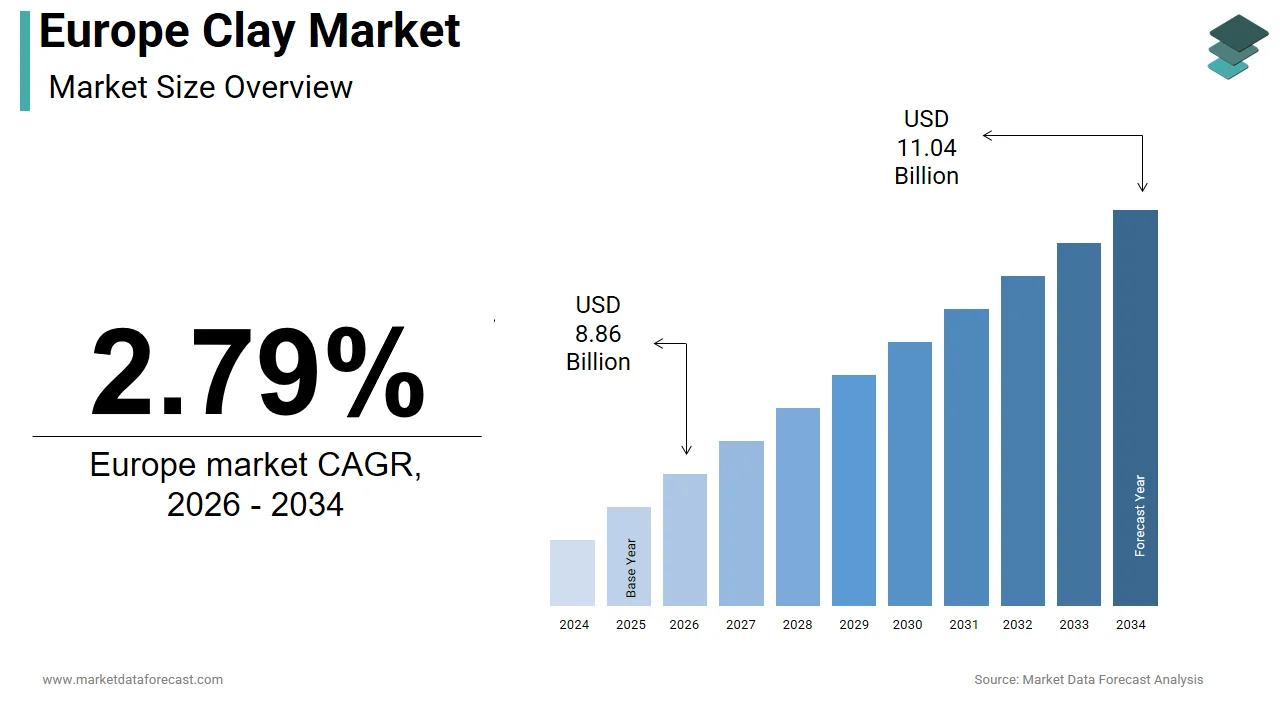
The Europe clay market was valued at USD 8.62 billion in 2025, is anticipated to reach USD 8.86 billion in 2026, and is projected to reach USD 11.04 billion by 2034, growing at a CAGR of 2.79% from 2026 to 2034. Market growth is driven by strong demand from construction, ceramics, paper, and industrial manufacturing sectors. Clay remains an essential raw material for producing tiles, sanitaryware, bricks, and specialty industrial products due to its versatility and cost efficiency. Increasing adoption of sustainable construction materials and expanding ceramic production across Europe are further supporting market expansion.
Key Market Trends
- Rising demand for clay in ceramic tile and sanitaryware manufacturing.
- Increasing adoption of kaolin in paper coating and industrial applications.
- Growing use of clay in sustainable construction materials.
- Expansion of surface mining operations for efficient clay extraction.
- Strengthening focus on eco-friendly and recyclable material solutions.
Segmental Insights
- Based on form, the powder segment dominated the market in 2025 by accounting for 60.1% share, driven by its ease of handling, storage, and suitability for industrial processing applications.
- Based on clay type, the kaolin segment held the majority share in 2025, supported by its extensive use in ceramics, paper coating, paints, and refractories.
- Based on production method, the surface mining segment led the market in 2025, driven by cost efficiency, operational scalability, and widespread availability of clay deposits suitable for surface extraction.
Regional Insights
The Europe clay market is witnessing steady growth across key industrial economies, supported by strong ceramic production and construction activity.
- Germany led the regional market in 2025 with 25.1% share, driven by its strong industrial base, advanced manufacturing sector, and high demand for clay in construction and ceramics.
- The United Kingdom followed with 18.6% share in 2025, supported by its established construction sector and specialty clay applications.
- Italy maintains a significant position, driven by its globally recognized ceramic manufacturing industry and growing use of clay in sustainable construction and architectural applications.
Competitive Landscape
The Europe clay market is characterized by the presence of global mineral processing companies and regional clay producers. Market participants are focusing on expanding mining operations, improving material processing technologies, and developing specialty clay products for industrial applications. Strategic investments in sustainable mining and supply chain optimization are shaping competitive dynamics across the region.
Prominent companies operating in the Europe clay market include Imerys S.A., KaMin LLC, Sibelco, Bentonite Performance Minerals LLC, Thiele Kaolin Company, Ashapura Minechem Limited, Quarzwerke Group, Bentonite Corporation, and EICL Limited.
Europe Clay Market Size
The size of the Europe clay market was worth USD 8.62 billion in 2025. The regional market is anticipated to grow at a CAGR of 2.79% from 2026 to 2034 and be worth USD 11.04 billion by 2034 from USD 8.86 billion in 2026.
Clay is most commonly known as a natural, fine-grained earthy material that becomes soft and plastic (malleable) when wet and permanently hardens when dried or fired. Unlike generic definitions, the European context is defined by stringent geological constraints, heritage preservation mandates, and evolving sustainability frameworks. According to research, the European Union's clay mining sector is undergoing a period of growth, with the majority of production driven by a small number of key, heavy-industrialized member states dominated by Germany and France, alongside Italy and Spain, primarily to meet construction demand. The European Ceramic Society notes that traditional pottery and brickmaking remain culturally embedded, yet modern demand is increasingly driven by high-performance applications: kaolin in pharmaceuticals and paper coating, bentonite in landfill liners and drilling muds, and fire clay in refractory linings for steel and glass furnaces. Crucially, clay is classified as a critical raw material under the EU Raw Materials Initiative due to its irreplaceable role in water purification and soil stabilization. Production occurs through open-pit mining and dredging, subject to rigorous environmental impact assessments under the EU Habitats Directive. This dual identity, as both a cultural heritage medium and an industrial enabler, positions clay as a silent yet strategic component of Europe’s material sovereignty and ecological resilience.
MARKET DRIVERS
Growth in Sustainable Construction and Energy-Efficient Building Materials
The European Green Deal and related building regulations are driving renewed demand for clay-based construction materials, which fuels the growth of the Europe clay market. This is due to its natural thermal mass, recyclability, and low embodied carbon. European Commission initiatives support that using renewable energy, such as biomass or electricity in modern kiln technologies, substantially lowers the carbon footprint of fired clay bricks and tiles compared to traditional, carbon-intensive alternatives. The Energy Performance of Buildings Directive now recognizes clay masonry for its passive cooling properties, which reduce summer overheating in urban environments, a critical factor as heatwaves intensify. The German residential construction sector is increasingly embracing sustainability, with a growing trend towards incorporating recycled, crushed clay material into new clay brick production. Similarly, France’s RE2020 environmental regulation mandates lifecycle assessments that favor natural materials like clay plasters and terracotta cladding. The European ceramic industry is steadily transforming, with a growing number of new brick plants across Western Europe adopting renewable energy sources, such as electric kilns and hydrogen, to improve environmental performance. This regulatory and climatic alignment ensures that clay remains a cornerstone of Europe’s low-carbon built environment.
Expansion of Environmental and Geotechnical Applications
Clay, particularly bentonite and kaolin, is gaining strategic importance in the region’s environmental infrastructure owing to its impermeability and adsorption capacity, which boosts the expansion of the Europe clay market. Engineered landfill liners across Europe frequently utilize sodium bentonite-based geosynthetic clay liners, chosen for their efficiency in preventing groundwater contamination from landfill leachate. Moreover, the widespread application of bentonite-based sealing systems for landfill containment creates a significant, consistent demand for bentonite clay products across Europe. Additionally, bentonite is essential in horizontal directional drilling for pipeline and cable installation, where it stabilizes boreholes and carries cuttings, critical for the EU’s hydrogen and fiber-optic backbone projects. Kaolin is increasingly used in wastewater treatment as a flocculant and in soil remediation to immobilize heavy metals. Horizon Europe is funding significant, large-scale efforts to reverse soil degradation, using clay amendments to optimize soil structure and boost water retention. This shift from traditional ceramics to environmental engineering transforms clay into a vital tool for circular economy and climate adaptation strategies.
MARKET RESTRAINTS
Stringent Land Use Regulations and Quarry Permitting Delays
Clay extraction faces significant regulatory hurdles across the region because of competing land use priorities and biodiversity protections, which impede the growth of the European clay market. Under the EU Habitats Directive and national planning laws, new quarry permits often require extensive environmental impact assessments, public consultations, and habitat compensation measures. According to European mineral industry associations, the process for obtaining permits for new extraction sites in Western Europe is marked by long, multi-year delays, with authorization rates particularly low in environmentally sensitive areas due to strict regulatory hurdles. In 2023, a proposed kaolin mine in Cornwall, UK ,was rejected after local authorities cited impacts on protected heathland species. These delays constrain supply expansion just as demand rises for sustainable building materials. Moreover, many existing quarries operate under sunset clauses, with closure mandated once reserves are depleted, limiting long-term investment. This regulatory friction increases costs, discourages exploration, and forces reliance on imported clays, undermining Europe’s raw material autonomy despite abundant geological resources.
Depletion of High-Purity Domestic Clay Deposits
The region’s accessible reserves of high-grade kaolin and ball clay are rapidly depleting, which creates supply vulnerabilities in premium ceramic and paper sectors, and thereby hinders the expansion of the Europe clay market. Studies indicate that the historic production center in South West England maintains vast sub-surface reserves capable of supporting extraction activities for many decades to come. Similarly, Germany’s high-plasticity ball clay reserves in the Westerwald region are declining, forcing potters and sanitaryware manufacturers to blend imported materials. The European market for industrial clays balances significant domestic extraction with international trade partnerships to manage supply chain stability and mitigate potential resource vulnerabilities. Unlike industrial minerals with synthetic substitutes, high-purity clays cannot be easily replicated. Their particle size distribution and rheological properties are geologically unique. This depletion threatens Europe’s renowned ceramic heritage, from Limoges porcelain to German stoneware, and increases costs for specialty applications in pharmaceuticals and cosmetics that require consistent mineralogy. The continent’s clay industry faces a structural supply crunch in the absence of discoveries or advanced beneficiation technologies.
MARKET OPPORTUNITIES
Integration of Clay in Circular Economy and Urban Mining
Innovative reuse of demolition clay waste paves the way to close material loops in the construction sector, which is likely to promote the growth of the Europe clay market. According to sources, construction and demolition activities generate the largest share of total waste, with concrete and masonry forming the majority of this material. Recent initiatives are shifting industry practices toward increased recovery and circular reuse, rather than traditional disposal methods. Traditionally landfilled, this material is now being crushed and reintegrated into new brick production at notable replacement rates without compromising strength. Companies like Wienerberger and Terreal have launched certified “circular brick” lines containing recycled clay, meeting EN 771 standards. In the Netherlands, the “Brick2Brick” initiative recovers whole bricks from demolished buildings for direct reuse in restoration projects, preserving historical texture and reducing CO₂ compared to new production. The EU Construction and Demolition Waste Management Protocol now incentivizes such practices through green public procurement. The proliferation of EPR schemes is shifting the lifecycle of clay from a linear, extraction-based model to a circular, closed-loop system, aligned with European sustainability objectives.
Development of Advanced Functional Clays for Health and Cosmetics
High-purity kaolin and bentonite are emerging as premium ingredients in the region’s natural health and personal care landscape, which provides fresh prospects for the expansion of the Europe clay market. This trend is driven by consumer demand for clean-label, mineral-based products. Driven by consumer demand for natural ingredients, the market for clay-based personal care products is experiencing sustained growth, with high-quality, regional ingredients like French green and Italian white kaolin recognized as premium components in facial care. Pharmaceutical applications are equally significant: kaolin is used as an excipient in tablets for its binding and disintegration properties, while purified bentonite serves as an anti-diarrheal agent in over-the-counter medicines. The European Pharmacopoeia sets strict limits on heavy metals and microbial content, requiring specialized processing that adds value. Companies like Imerys and Sibelco have invested in dedicated purification lines to meet these standards, targeting brands like L’Oréal and Weleda. Natural clays are gaining market traction as premium, ethically sourced alternatives to synthetic additives, directly responding to new EU sustainability policies.
MARKET CHALLENGES
Labor Shortages and Aging Workforce in Traditional Ceramics
A critical demographic crisis in its artisanal and small-scale production segments threatens cultural continuity and technical expertise, which in turn constrains the growth of the Europe clay market. The European ceramic industry, particularly in Mediterranean regions, faces a significant labor demographic shift, with a substantial portion of its skilled workforce, including potters and brickmakers, nearing retirement age. This situation is further compounded by a declining interest among young people in entering the profession through formal training programs, resulting in a shrinking recruitment pool for these traditional trades. Vocational training programs in traditional ceramics have declined across Southern Europe, as younger generations pursue digital or service-sector careers. This shortage impacts not only heritage pottery but also specialized refractory and sanitaryware production, where hand-forming and glaze chemistry require decades of tacit knowledge. In response, some workshops automate, but complex shapes and finishes still demand human skill. Europe's unique, export-worthy craft techniques, such as Raku and salt-glazing, are at risk of vanishing due to a lack of specialized immigration pathways and preservation funding for skilled artisans. This human capital gap undermines both economic resilience and intangible cultural heritage.
Energy Intensity and Decarbonization Pressure on Firing Processes
Clay processing, particularly the firing of ceramics and bricks, remains highly energy-intensive, posing a major challenge to compliance with EU climate targets and the Europe clay market. Industrial heating processes are transitioning away from traditional fossil fuels as environmental regulations tighten across major markets. Regional ceramic manufacturing represents a measurable but relatively small portion of the broader industrial carbon footprint. The manufacturing of building materials remains a primary source of emissions within the heavy clay sector. Adopting advanced emission-free heating technology involves substantial financial investment that remains a barrier for smaller manufacturers. International trade regulations currently target primary heavy industries, with plans to incorporate additional specialized sectors in the coming years. Domestic environmental levies are progressively raising the cost of production for manufacturers that continue to rely on carbon-intensive energy. Escalating regulatory burdens, combined with a lack of affordable green energy and innovative production methods (microwave/plasma), place European ceramic producers at a disadvantage against international competitors, jeopardizing their survival.
REPORT COVERAGE
| REPORT METRIC | DETAILS |
| Market Size Available | 2025 to 2034 |
| Base Year | 2025 |
| Forecast Period | 2026 to 2034 |
| Segments Covered | By Form, Clay Type, Application, End-use Industry, and Country. |
| Various Analyses Covered | Global, Regional, and Country-Level Analysis, Segment-Level Analysis, Drivers, Restraints, Opportunities, Challenges; PESTLE Analysis; Porter’s Five Forces Analysis, Competitive Landscape, Analyst Overview of Investment Opportunities |
| Countries Covered | UK, France, Spain, Germany, Italy, Russia, Sweden, Denmark, Switzerland, Netherlands, Turkey, Czech Republic, and the Rest of Europe. |
| Market Leaders Profiled | Imerys S.A., KaMin LLC, Sibelco, Bentonite Performance Minerals LLC, Thiele Kaolin Company, Ashapura Minechem Ltd., Quarzwerke Group, Bentonite Corporation, EICL Limited, and Others. |
SEGMENTAL ANALYSIS
By Form Insights
The powder segment led the Europe clay market by capturing a 60.1% share in 2025. The leading position of the power segment is credited to its versatility across industrial applications requiring precise dosing and homogeneity. Milled to micron-level fineness, powdered clay is essential in ceramics for slip casting, in paper coating for uniform gloss, and in pharmaceuticals for tablet formulation. The European industrial minerals sector continues to see high demand for clay materials, with large-scale production driven by construction needs, while high-value clays such as kaolin and bentonite remain essential for diverse industrial applications. The form’s dominance stems from compatibility with automated production lines: powder flows consistently in pneumatic conveying systems and blends uniformly with binders or pigments. In construction, powdered fire clay is used in refractory castables for steel furnaces, where particle size distribution directly affects thermal shock resistance. Strict quality control, enforced under ISO 13014 for particle analysis, ensures batch consistency, a non-negotiable requirement in regulated sectors. This technical necessity, combined with established milling infrastructure across Germany, France, and the UK, solidifies powder as the backbone of Europe’s value-added clay processing industry.
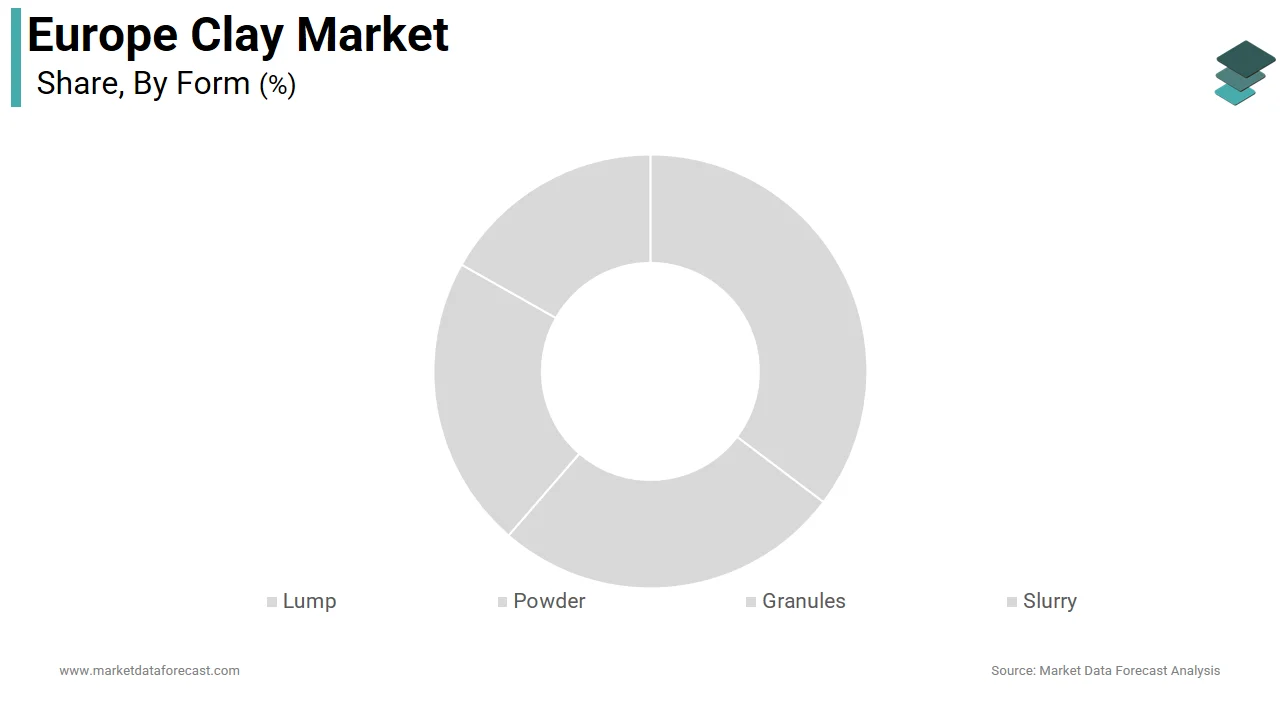
The slurry segment is estimated to register the fastest CAGR of 8.1% from 2026 to 2034. The swift expansion of the slurry is propelled by demand for ready-to-use, homogeneous dispersions in environmental and oilfield applications. In landfill construction, bentonite slurry is pumped directly into trenches to form impermeable barriers, eliminating on-site mixing and ensuring consistent viscosity. Driven by ongoing large-scale infrastructure and sustainability projects, the European construction sector has shown an increased reliance on specialized, sustainable slurry technologies for stabilization, tunneling, and environmental protection. Similarly, in horizontal directional drilling for utility corridors, pre-mixed bentonite slurries provide immediate hole stabilization, reducing project delays. Environmental regulations also favor slurries: the EU Water Framework Directive encourages closed-loop systems that minimize dust and runoff, which slurry delivery inherently supports. Companies like Imerys and Sibelco now offer certified, biocide-stabilized slurries with guaranteed solids content, meeting EN 1538 standards for geotechnical works. The increasing necessity for precision and regulatory compliance is driving the rapid adoption of slurry in engineering and remediation, favored for its safety, ease of use, and superior performance.
By Clay Type Insights
The kaolin segment captured the majority share of the Europe clay market in 2025. The supremacy of the kaolin segment is driven by its irreplaceable role in high-end ceramics, paper coating, and pharmaceuticals. Known as “china clay,” its fine particle size, high brightness, and chemical inertness make it the preferred mineral for porcelain, sanitaryware, and glossy paper finishes. The European ceramics sector remains a dominant force in mineral consumption, with high-quality tableware and sanitary fixture manufacturing relying heavily on white-firing clay bodies to maintain superior product standards across major production hubs. In the paper industry, though declining in newsprint, kaolin remains essential for high-quality packaging and label stock, where smoothness and printability are critical. In the European paper sector, specialty grades continue to utilize mineral additives as a critical component to enhance the functionality and print quality of high-performance paper products. Moreover, pharmaceutical-grade kaolin is mandated as an excipient in antidiarrheal formulations under the European Pharmacopoeia. This combination of aesthetic, functional, and regulatory demand ensures kaolin’s premium positioning and market leadership despite competition from synthetic alternatives.
The bentonite segment is predicted to witness the highest CAGR of 7.2% over the forecast period, owing to its expanding role in environmental engineering and energy infrastructure. Sodium bentonite remains a primary, highly regarded material for creating impermeable, self-healing, and secure barrier systems in modern European landfills to prevent ground contamination. Stricter European environmental regulations and the need for enhanced containment are driving high demand for engineered bentonite-based liners in landfill construction and rehabilitation. These materials are critical for ensuring low permeability and protecting groundwater. Beyond waste management, bentonite is critical in horizontal directional drilling for hydrogen pipelines and fiber-optic cables, where it stabilizes boreholes and carries cuttings. The development of the European Hydrogen Backbone involves a significant effort to convert existing gas pipelines, alongside new construction, aimed at creating a large-scale, transnational hydrogen network by the 2030s. Additionally, the EU Soil Mission promotes bentonite-amended soils for water retention in drought-prone regions like Spain and Italy. Strengthening environmental and circular economy regulations are accelerating bentonite's transition from a minor resource to a foundational, strategic material in European infrastructure development.
By Production Method Insights
The surface mining segment dominated the Europe clay market by accounting for a substantial share in 2025. The dominance of the surface mining segment is driven by the shallow geological occurrence of most clay deposits and the cost-effectiveness of open-pit operations. Unlike metallic ores that require deep shafts, clay seams, particularly kaolin and ball clay, are typically found within 10 to 30 meters of the surface, making excavation with draglines and excavators both technically feasible and economically viable. Ceramic and industrial clay extraction remains a significant surface mining activity in Europe, with substantial production volumes concentrated in established mining districts across Germany, Italy, and the United Kingdom. This method allows for high recovery rates and facilitates progressive rehabilitation of mined land, a requirement under the EU Environmental Impact Assessment Directive. Surface mining also enables selective extraction of high-purity layers, critical for ceramic and paper applications. Its dominance is further reinforced by lower capital intensity compared to underground alternatives, making it accessible to small and medium producers who form the backbone of Europe’s artisanal clay sector.
The in-situ mining segment is expected to exhibit a noteworthy CAGR of 6.8% from 2026 to 2034 due to regulatory pressure. Stricter EU biodiversity protection policies and legally binding restoration targets are increasing pressure on the extractive industry, necessitating a shift away from traditional, high-impact quarrying toward more sustainable, less-disturbing methods near sensitive, protected, and Natura 2000 sites. This emerging technique mobilizes clay-bound particles for extraction through fluid injection, bypassing the need for surface excavation and gaining popularity in regions where environmental or urban proximity is a concern. Pilot projects in Sweden and the Netherlands are testing in-situ leaching for bentonite used in geosynthetic liners, where a minimal surface footprint aligns with strict habitat conservation rules. Research conducted by the Geological Survey of Finland indicates that in-situ mining methods, such as leaching, can significantly shrink the environmental footprint of extraction by reducing land disturbance and eliminating waste rock, ultimately lowering the costs associated with post-operation site rehabilitation. Additionally, the technique shows promise for recovering clay from exhausted quarries where residual fines remain trapped in subsoil. Advancements in digital monitoring and precision injection allow in-situ mining to access stranded resources while adhering to strict European ecological standards.
COUNTRY-LEVEL ANALYSIS
Germany Clay Market Analysis
Germany was the top performer in the Europe clay market by accounting for a 25.1% share in 2025. The dominance of the German market is driven by its advanced ceramics, construction, and chemical industries. The country’s market status reflects deep integration of clay into high-value manufacturing: the Westerwald region produces significant metric tons of ball clay annually for sanitaryware giants like Villeroy & Boch. The German Federal Institute for Geosciences reports significant domestic extraction of kaolin and fire clay, which are vital raw materials for producing heat-resistant refractories in the nation’s steel and glass industries. In line with national waste management policies aimed at enhancing resource efficiency, the German construction industry is accelerating innovation in clay reprocessing to increase the proportion of secondary materials in new brick manufacturing. Major producers like Sibelco and Quarzwerke operate state-of-the-art mills supplying ultra-fine powders to automotive catalyst and pharmaceutical clients. This blend of industrial scale, regulatory rigor, and technological sophistication solidifies Germany’s position as the continent’s clay processing and innovation hub.
United Kingdom Clay Market Analysis
The United Kingdom followed closely in the European clay market by capturing a 18.6% share in 2025. The expansion of the UK market is fuelled by its historic kaolin reserves and modern environmental applications. The market status is also supported by the St Austell basin in Cornwall, which has supplied high-brightness kaolin to global paper and ceramics markets for over 200 years. The United Kingdom continues to hold its position as a major global exporter of high-quality kaolin, with a substantial portion of its production destined for international markets. Driven by environmental protection and infrastructure needs, demand for bentonite for use in landfill liners and construction projects is rising, requiring strict compliance with environmental regulations regarding material handling. Companies like Imerys UK are investing in solar-powered drying facilities to reduce their carbon footprint, aligning with national net-zero targets. Despite Brexit, the UK continues to mirror EU standards for clay purity and environmental use, ensuring seamless integration into continental supply chains. This dual identity, as both a heritage producer and a modern environmental solutions provider, sustains the UK’s resilient and diversified clay economy.
Italy Clay Market Analysis
Italy maintains a significant share of the European clay market due to its world-renowned ceramic heritage and growing use in sustainable construction. The market status reflects centuries-old traditions in Tuscany and Emilia-Romagna, where high-plasticity ball clay and kaolin feed thousands of pottery and tile workshops. Despite global market challenges, Italy maintained its position as a major exporter of ceramic products in 2024, continuing to heavily rely on international raw material sourcing for its manufacturing processes rather than solely domestic clay. The Italian Superbonus initiative has significantly increased the demand for sustainable construction materials, including traditional clay-based products, as part of energy-efficiency renovations, driving a renovation boom in the Italian housing sector. Companies like Sacmi and LB Ceramics lead in developing low-temperature firing technologies that cut energy use. Additionally, Italian research institutes are pioneering clay-based photocatalytic coatings for air purification. This fusion of artisanal excellence, policy support, and green innovation ensures Italy remains a cultural and industrial powerhouse in the European clay landscape.
France Clay Market Analysis
France witnessed a consistent expansion in the European clay market, with growth centered on kaolin for cosmetics, paper, and nuclear waste containment. The market status is shaped by the Limousin and Brittany regions, which produce high-purity kaolin prized by luxury brands like L’Oréal and Chanel for face masks and powders. The French geological agency highlights robust domestic kaolin extraction, with a significant portion of the output increasingly utilized by the personal care and cosmetic sectors for high-quality formulations. Simultaneously, France leads in nuclear safety. ANDRA, the national radioactive waste agency, uses compacted bentonite blocks in its Cigéo disposal project to isolate waste for millennia. Due to specialized nuclear waste confinement strategies, French geological and radioactive waste management authorities confirm that ongoing and future deep geological repositories rely on significant, long-term consumption of bentonite for engineered barrier systems. National regulations under the AGEC Law also promote clay-based biodegradable packaging. This unique intersection of beauty, safety, and sustainability positions France as a high-value, innovation-driven segment in the European clay market.
Spain Clay Market Analysis
Spain is anticipated to grow in the Europe clay market during the forecast period owing to its focus on construction and soil remediation in arid regions. The Spanish structural ceramics sector (fired clay bricks and tiles) is experiencing a period of sustained activity and resilience in 2024, with high production volumes meeting residential housing demand. Clay masonry remains a preferred, sustainable construction choice in southern Spain for its ability to regulate indoor temperatures, effectively decreasing the need for active air conditioning systems. Additionally, the government’s “Plan Sequía” allocates funds for bentonite-amended soils to improve water retention in agricultural lands affected by drought. The use of bentonite in the agricultural sector is increasing in Spain, driven by its properties in enhancing soil quality and water management. Local producers like Argiles du Sud specialize in granulated clays for horticulture, while major brickmakers like La Paloma adopt electric kilns to comply with EU emissions rules. This pragmatic adaptation to climate and housing needs ensures Spain’s resilient and context-specific clay economy.
COMPETITIVE LANDSCAPE
The Europe clay market features a mix of large integrated producers and regional specialists competing on purity, sustainability, and application expertise rather than price alone. Incumbents like Imerys Sibelco and Quarzwerke dominate through control of geological assets, advanced processing capabilities, and long-standing relationships with ceramics, construction, and environmental sectors. New entrants face high barriers, including capital intensity permitting delays under the EU Habitats Directive and stringent quality requirements for regulated applications. The market is bifurcated between bulk clay for bricks, where volume and logistics matter, and specialty clay for cosmetics or pharmaceuticals, where certification and consistency drive value. Competition is not characterized by aggressive pricing but by innovation in circularity, decarbonization, and functional performance. Collaboration through industry associations enables collective investment in recycling infrastructure and regulatory advocacy. This environment rewards operational excellence, environmental stewardship, and strategic alignment with Europe’s green transition over scale or marketing intensity.
KEY MARKET PLAYERS
The leading companies operating in the Europe clay market include:
- Imerys S.A.
- KaMin LLC
- Sibelco
- Bentonite Performance Minerals LLC
- Thiele Kaolin Company
- Ashapura Minechem Ltd
- Quarzwerke Group
- Bentonite Corporation
- EICL Limited
TOP PLAYERS IN THE MARKET
- Imerys S.A. is a French multinational and one of Europe’s largest industrial minerals producers, with extensive kaolin, bentonite, and specialty clay operations across the UK, Germany, and Italy. The company supplies high-purity clays for ceramics, paper, cosmetics, and environmental applications globally. Imerys contributes to the worldwide market through its advanced beneficiation technologies and sustainable mining practices. Recently, the company launched a new line of solar-dried kaolin powders at its Cornwall facility, reducing carbon emissions compared to conventional thermal drying. It also introduced certified circular clay products containing post-industrial ceramic waste for brickmakers, aligning with EU Green Deal objectives and strengthening its position as a leader in sustainable mineral solutions.
- Sibelco Europe is a major producer of industrial minerals headquartered in Belgium with significant clay operations in Germany, the Netherlands, and Spain. The company specializes in kaolin, ball clay, and bentonite for construction, foundry, and environmental markets across Europe and beyond. Sibelco contributes globally through its integrated supply chain and innovation in functional mineral solutions. The company also partnered with Dutch architects to develop low-carbon terracotta facade systems using recycled clay, reinforcing its commitment to circular construction and expanding its footprint in sustainable infrastructure.
- Quarzwerke Group is a German-based industrial minerals company with strategic clay assets in the Westerwald region, supplying high-quality ball clay and kaolin to Europe’s premium ceramics and refractory sectors. The company serves global markets through its precision processing and strict quality control aligned with ISO and EN standards. Quarzwerke contributes to international supply chains by providing tailored clay blends for sanitaryware and technical ceramics. Recently, it invested in a biomass-powered kiln system to decarbonize its drying operations, achieving a reduction in Scope 1 emissions. It also launched a digital platform for real-time clay composition tracking, enhancing transparency for customers in regulated industries like pharmaceuticals and food contact materials.
TOP STRATEGIES USED BY THE KEY MARKET PARTICIPANTS
Key players in the Europe clay market are investing in renewable energy integration, such as solar and biomass drying, to reduce carbon footprint and comply with EU climate regulations. They are developing circular clay products incorporating post-consumer and post-industrial ceramic waste to meet green public procurement criteria. Companies are expanding slurry and granule production to serve environmental engineering and horticulture markets with ready-to-use formulations. Strategic partnerships with architects and construction firms promote low-carbon clay-based building systems like terracotta facades and passive cooling bricks. Advanced beneficiation technologies ensure consistent particle size and purity for high-value applications in cosmetics and pharmaceuticals. Digital platforms for real-time quality tracking and material passports enhance traceability and support Environmental Product Declarations. Compliance with the EU Biodiversity Strategy drives the adoption of in-situ and low-impact extraction methods near protected areas. Geographic consolidation of processing facilities improves logistics efficiency and reduces transport emissions. Innovation in low-temperature firing and electric kilns supports decarbonization of ceramic manufacturing. Participation in EU-funded soil remediation projects expands demand for bentonite and kaolin in climate adaptation initiatives.
MARKET SEGMENTATION
This research report on the Europe clay market has been segmented and sub-segmented into the following categories.
By Form
- Lump
- Powder
- Granules
- Slurry
By Clay Type
- Kaolin
- Montmorillonite
- Bentonite
- Fuller's Earth
- Illite
By Application
- Ceramics and Pottery
- Construction
- Papermaking
- Refractories
- Foundry and Molding
By End-use Industry
- Automotive
- Electronics
- Oil and Gas
- Pharmaceuticals
- Cosmetics
By Production Method
- Surface Mining
- Underground Mining
- In-Situ Mining
By Country
- United Kingdom
- France
- Spain
- Germany
- Italy
- Russia
- Sweden
- Denmark
- Switzerland
- Netherlands
- Rest of Europe
Frequently Asked Questions
What is the Europe clay market?
The Europe clay market involves extraction, processing, and distribution of clays like kaolin and bentonite for construction and industry. It supports sectors across the region with raw materials.
How does the Europe clay market operate?
The Europe clay market operates via mining, refining, and trading networks supplying manufacturers. Producers focus on quality for ceramics, building, and other uses region-wide.
Who are the key players in the Europe clay market?
Key players in the Europe clay market include major extractors and processors serving construction needs. They lead in production and distribution across leading countries.
What trends shape the Europe clay market?
Trends in the Europe clay market emphasize sustainable extraction, eco-friendly applications, and advanced processing tech. Demand grows for green building materials.
What types of clay dominate the Europe clay market?
Types in the Europe clay market include kaolin, bentonite, fire clay, and common varieties for construction. Each serves specific industrial and building purposes.
How does regulation affect the Europe clay market?
Regulation in the Europe clay market enforces environmental standards for mining and waste. It promotes sustainable practices across extraction and processing sites.
What role does technology play in the Europe clay market?
Technology improves the Europe clay market through efficient mining tools, quality testing, and processing innovations. It enhances purity for end-user applications.
How does competition influence the Europe clay market?
Competition in the Europe clay market drives quality upgrades and cost efficiencies for suppliers. Firms innovate to meet demands in construction and ceramics.
What challenges face the Europe clay market?
Challenges in the Europe clay market include environmental concerns, resource scarcity, and supply chain issues. Adaptation focuses on sustainable sourcing methods.
How has the Europe clay market evolved?
The Europe clay market has evolved from basic extraction to refined processing for modern uses. Shifts align with industrial growth and sustainability goals.
Related Reports
Access the study in MULTIPLE FORMATS
Purchase options starting from
$ 2000
Didn’t find what you’re looking for?
TALK TO OUR ANALYST TEAM
Need something within your budget?
NO WORRIES! WE GOT YOU COVERED!
Call us on: +1 888 702 9696 (U.S Toll Free)
Write to us: sales@marketdataforecast.com