- Product Description Description
- Table of Contents TOC
- List of Table & Figure LOT
- Get Free Sample PDF Sample PDF
Market Size, 2025
$46.84 BnMarket Estimate, 2026
$56.70 BnMarket Forecast, 2034
$261.59 BnCAGR, 2026–2034
21.06%Europe Cloud Storage Market Report Summary
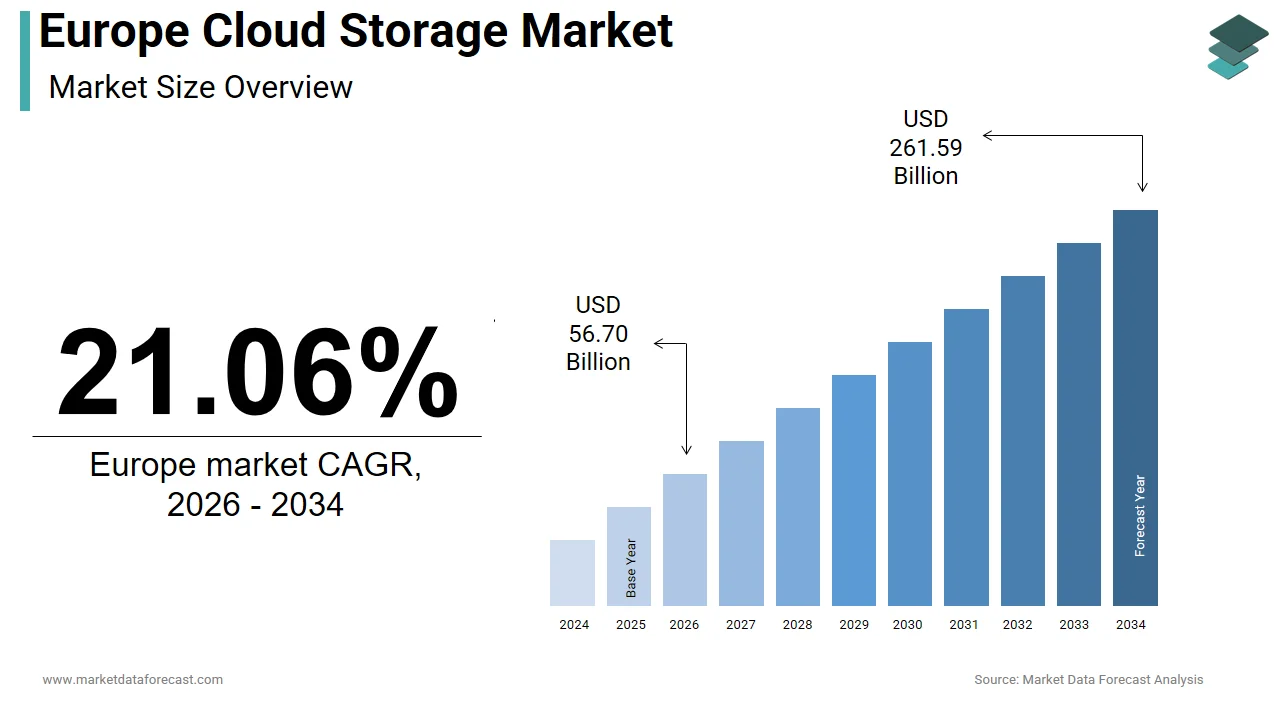
The Europe cloud storage market was valued at USD 46.84 billion in 2025, is estimated to reach USD 56.70 billion in 2026, and is projected to reach USD 261.59 billion by 2034, growing at a CAGR of 21.06% from 2026 to 2034. Market growth is driven by the exponential increase in data generation, rising adoption of cloud computing, and growing demand for scalable and cost-efficient storage solutions. Organizations across industries are increasingly shifting toward cloud-based infrastructure to enhance data accessibility, security, and operational efficiency. The expansion of digital transformation initiatives, increasing adoption of AI and big data analytics, and the growing need for disaster recovery and data backup solutions are further accelerating market growth across Europe.
Key Market Trends
- Rapid growth in data generation and cloud adoption across enterprises.
- Increasing demand for scalable and cost-effective storage solutions.
- Rising adoption of AI, big data analytics, and IoT technologies.
- Growing focus on data security, compliance, and disaster recovery.
- Expansion of hybrid and multi-cloud storage strategies.
Segmental Insights
- Based on type, the solution segment dominated the Europe cloud storage market in 2025, driven by widespread adoption of storage platforms and services.
- Based on deployment model, the public cloud segment held the largest share in 2025, supported by its scalability, flexibility, and cost advantages.
- Based on vertical, the BFSI segment led the market in 2025 due to high volumes of transactional data, strict regulatory requirements, and strong need for secure data storage.
Regional Insights
The Europe cloud storage market is witnessing strong growth across major countries due to rapid digitalization and cloud adoption.
- Germany led the regional market in 2025 with 25.5% share, supported by strong industrial digitalization and enterprise cloud adoption.
- The United Kingdom holds a significant share, driven by a mature IT ecosystem and high adoption of cloud technologies.
- France is expected to account for a prominent share during the forecast period due to strong government support for digital sovereignty and cloud infrastructure development.
Competitive Landscape
The Europe cloud storage market is highly competitive, with the presence of global technology giants and cloud service providers. Market players are focusing on enhancing storage capabilities, improving security features, and expanding cloud infrastructure. Strategic partnerships, innovation in cloud technologies, and investments in data centers are shaping competitive dynamics across the region.
Prominent companies operating in the Europe cloud storage market include IBM Corporation, Amazon.com, Inc. (Amazon Web Services), Microsoft Corporation, Google Inc., Oracle Corporation, VMware, Inc., Hewlett Packard Enterprise (HPE), Red Hat, Inc., Rackspace, and Dropbox.
Europe Cloud Storage Market Size
The Europe cloud storage market was valued at USD 46.84 billion in 2025, is estimated to reach USD 56.70 billion in 2026, and is projected to reach USD 261.59 billion by 2034, growing at a CAGR of 21.06% from 2026 to 2034.
Cloud storage represents the specialized segment of the digital ecosystem dedicated to the remote preservation management and retrieval of data across distributed server networks located within or serving the European continent. This domain transcends simple file hosting to encompass sophisticated object storage, block storage, and file storage solutions that underpin the data integrity of modern enterprises. The landscape is uniquely shaped by the stringent requirements of the General Data Protection Regulation, which mandates rigorous control over data residency and cross-border transfers. As per Eurostat, enterprises in the European Union are increasingly utilizing cloud computing services, with storage serving as the foundational layer for these operations. The market is increasingly defined by the shift toward hybrid architectures where sensitive data remains on-premises or in private clouds while less critical information resides in public repositories. According to the European Commission, the creation of data within the EU is expanding rapidly, which is driven by the Internet of Things and artificial intelligence applications.
MARKET DRIVERS
Exponential Proliferation of Unstructured Data from IoT Devices
The relentless expansion of the Internet of Things ecosystem across European industries is primarily driving the growth of the Europe cloud storage market. Manufacturing plants, smart cities, and connected vehicles generate massive volumes of unstructured data, including video feeds, sensor logs, and telemetry streams that traditional on-premise systems cannot store cost-effectively. According to the International Data Corporation, global data creation and replication are expected to grow significantly by 2025, with Europe contributing a notable portion due to its advanced industrial automation. The automotive sector exemplifies this trend, where autonomous vehicles generate vast amounts of data daily, necessitating robust cloud repositories for training machine learning models. As per the European Telecommunications Standards Institute, the number of connected devices in Europe is projected to rise substantially in the coming years, which is further accelerating data generation rates. Organizations are turning to cloud storage to leverage its durability and accessibility, allowing them to archive vast datasets for future analysis while keeping active data readily available for real time decision making.
Mandatory Long-Term Data Retention for Regulatory Compliance
Stringent regulatory frameworks mandating long term data retention for legal and compliance purposesares further contributing to the expansion of the European cloud storage market. Industries such as finance, healthcare, and pharmaceuticals are subject to rigorous laws requiring the preservation of records for extended periods to ensure auditability and legal defensibility. As per the International Association of Privacy Professionals, many European organizations cite compliance with data retention laws as a top priority, influencing their storage strategy decisions. Cloud storage providers offer features like write once, read many capabilities and immutable buckets that prevent data alteration or deletion, thereby satisfying strict regulatory requirements for data integrity. The General Data Protection Regulation also requires that personal data be stored securely and accessible for erasure requests, which cloud platforms facilitate through advanced management tools. According to the European Banking Authority, financial institutions are increasingly migrating archival data to the cloud to reduce the high costs associated with maintaining on-premises tape libraries and legacy disk arrays. The legal imperative to maintain accurate and accessible records for extended periods makes cloud storage an indispensable component of the compliance infrastructure for European enterprises.
MARKET RESTRAINTS
Persistent Latency Issues in Data Retrieval for Real-Time Applications
The inherent latency associated with retrieving data from remote cloud storage centers is impeding the growth of the European cloud storage market. While cloud storage offers immense scalability, the physical distance between the user and the data center can introduce delays that are unacceptable for high-frequency trading, autonomous vehicle navigation, and industrial control systems. According to the European Telecommunications Standards Institute, even small delays can result in critical failures or financial losses in time-sensitive operations. This limitation forces many organizations to maintain expensive on-premise storage tiers for hot data while only archiving cold data to the cloud, thereby limiting the total addressable market for pure cloud storage solutions. According to the reports from the German Federal Office for Information Security, reliance on public internet connections for data retrieval introduces unpredictability that some industries cannot tolerate. Although edge computing aims to mitigate this problem, the integration complexity and additional costs often deter smaller enterprises from adopting hybrid storage models. Until network infrastructure improves significantly and latency is reduced to negligible levels, hesitation to move performance-critical workloads to the cloud will continue to restrain market growth.
Complexity and Cost of Data Egress and Migration
The substantial costs and technical complexities associated with moving large volumes of data out of cloud storage environments are hampering the European cloud storage market growth. Cloud providers typically charge significant fees for data egress, which can accumulate rapidly when organizations need to retrieve archived data for analysis or migrate to a different provider. According to the Open Cloud Consortium, many European enterprises express concern about vendor lock-in due to prohibitive egress costs and proprietary data formats that complicate migration efforts. The technical challenge of transferring petabytes of data over limited bandwidth connections further prolongs migration timelines and increases the risk of operational disruption. As per the European Commission, small and medium-sized enterprises are particularly vulnerable to these costs as they lack the negotiating power of larger corporations to secure favorable terms. The fear of being trapped in a single ecosystem with escalating retrieval costs leads many organizations to adopt cautious strategies that limit their cloud storage usage to static archives. This restraint hinders the fluidity of the digital market and prevents organizations from optimizing their storage architectures based on changing business needs.
MARKET OPPORTUNITIES
Integration of Artificial Intelligence for Intelligent Data Tiering
The convergence of artificial intelligence with cloud storage offers a promising opportunity in the European cloud storage market. AI algorithms can analyse access patterns to automatically move frequently accessed data to high-performance storage tiers while archiving dormant data to lower-cost cold storage without human intervention. According to Gartner, organizations that implement AI-driven storage management can significantly reduce their overall storage costs while improving application performance. This capability is particularly valuable in Europe, where data volumes are expanding rapidly and managing storage efficiency is critical for maintaining profitability. Cloud providers are increasingly embedding machine learning models directly into their storage services to predict future data needs and proactively allocate resources. As per the European Artificial Intelligence Alliance, adoption of AI-optimized storage solutions is expected to grow considerably in the coming years as businesses seek to maximize return on investment. The ability to derive insights from stored data without moving it also opens new avenues for analytics and innovation. By automating the complex task of data placement, organizations can focus on core business activities while ensuring their storage infrastructure operates at peak efficiency.
Expansion of Sovereign Cloud Storage for Data Autonomy
The growing demand for data sovereignty and digital autonomy offers a substantial opportunity in the European cloud storage market. Concerns over foreign surveillance laws and data privacy have led governments and enterprises to seek storage options that are legally and technically insulated from non-European influence. As per the Gaia X initiative, there is a concerted effort to build a trusted ecosystem where data storage complies strictly with European values and regulations. This trend creates a niche for providers who can offer certified sovereign storage services that appeal to public sector entities, defense contractors, and highly regulated industries. The European Commission has identified data sovereignty as a strategic priority and is likely to introduce incentives or mandates that favor local storage solutions. According to Stiftung Neue Verantwortung, a majority of German companies prefer sovereign cloud providers for sensitive data storage. This shift towards autonomy stimulates investment in local data centers and fosters the growth of European cloud providers who can meet these specific requirements.
MARKET CHALLENGES
Escalating Cybersecurity Threats Targeting Stored Data
The increasing sophistication and frequency of cyber-attacks specifically targeting cloud storage repositories pose a formidable challenge to the regional market growth. Ransomware groups are increasingly focusing on backup and archival systems to extort organizations by encrypting or deleting their critical data reserves. According to the European Union Agency for Cybersecurity, incidents involving the compromise of cloud storage have risen in recent years, with attackers exploiting misconfigured access permissions and weak authentication protocols. The shared responsibility model often leads to confusion where customers mistakenly assume the provider handles all security aspects, leaving gaps in encryption key management and identity access controls. High-profile breaches have eroded confidence among potential adopters who fear the catastrophic loss of intellectual property and sensitive customer information. The complexity of multi-cloud storage environments further exacerbates this issue by creating fragmented security postures that are difficult to monitor and defend uniformly. Cybercriminals are using automated tools to scan for exposed storage buckets containing unencrypted data, which allows them to infiltrate systems with minimal effort. Addressing this challenge requires continuous investment in advanced threat detection, zero-trust architectures, and specialized training, yet many organizations struggle to keep pace with the evolving threat landscape.
Environmental Impact of Massive Data Center Energy Consumption
The surging energy demands of the massive data centers required to support cloud storage operations pose a significant environmental challenge to the regional market expansion. Storing and preserving exabytes of data requires continuous power for servers, cooling systems, and networking equipment, raising concerns about the sustainability of current growth trajectories. According to the European Environment Agency, the information and communication technology sector already accounts for a notable portion of total electricity consumption in the Union, with projections indicating further increases as data storage needs continue to grow. Governments and consumers are increasingly demanding verifiable proof of sustainability, forcing providers to invest heavily in renewable energy sources and innovative cooling technologies, which can be capital-intensive. The European Green Deal sets ambitious targets for climate neutrality that require data center operators to drastically improve their power usage effectiveness and transition away from fossil fuels. Failure to meet these standards could result in stricter regulations, fines, and reputational damage that deter potential customers. Balancing the exponential growth in data storage needs with the imperative to minimize ecological impact requires continuous technological breakthroughs and strategic planning. This tension between expansion and sustainability remains a persistent challenge that providers must navigate carefully to maintain compliance with evolving environmental mandates.
REPORT COVERAGE
| REPORT METRIC | DETAILS |
| Market Size Available | 2025 to 2034 |
| Base Year | 2025 |
| Forecast Period | 2026 to 2034 |
| Segments Covered | By Type, Deployment Model, Organization Size, Vertical, and Country. |
| Various Analyses Covered | Global, Regional, and Country-Level Analysis, Segment-Level Analysis, Drivers, Restraints, Opportunities, Challenges; PESTLE Analysis; Porter’s Five Forces Analysis, Competitive Landscape, Analyst Overview of Investment Opportunities |
| Countries Covered | UK, France, Spain, Germany, Italy, Russia, Sweden, Denmark, Switzerland, Netherlands, Turkey, Czech Republic, and the Rest of Europe. |
| Market Leaders Profiled | IBM Corporation, Amazon.com, Inc. (Amazon Web Services), Microsoft Corporation, Google Inc., Oracle Corporation, VMware, Inc., Hewlett Packard Enterprise (HPE) Company, Red Hat, Inc., Rackspace, Dropbox, and Others. |
SEGMENTAL ANALYSIS
By Type Insights
The solution segment dominated the market by capturing the highest share of the European cloud storage market in 2025 due to the fundamental necessity for robust software platforms and hardware infrastructure to manage exploding data volumes. The urgent requirement for scalable and flexible data architectures that can accommodate the exponential growth of unstructured data across European enterprises is further contributing to the dominance of the solution segment in the European market. Traditional on-premise storage systems often lack the elasticity needed to handle sudden spikes in data generation from sources like video surveillance, Internet of Things sensors, and digital media archives. According to the International Data Corporation, data creation in Europe is projected to grow significantly by 2025, which requires storage solutions that can expand seamlessly without physical hardware constraints. As per the European Telecommunications Standards Institute, many new storage deployments in the region are based on software-defined storage architectures that decouple software from hardware to enhance flexibility. The ability to scale storage independently of compute resources allows businesses to optimize costs while ensuring high availability and durability for their critical assets.
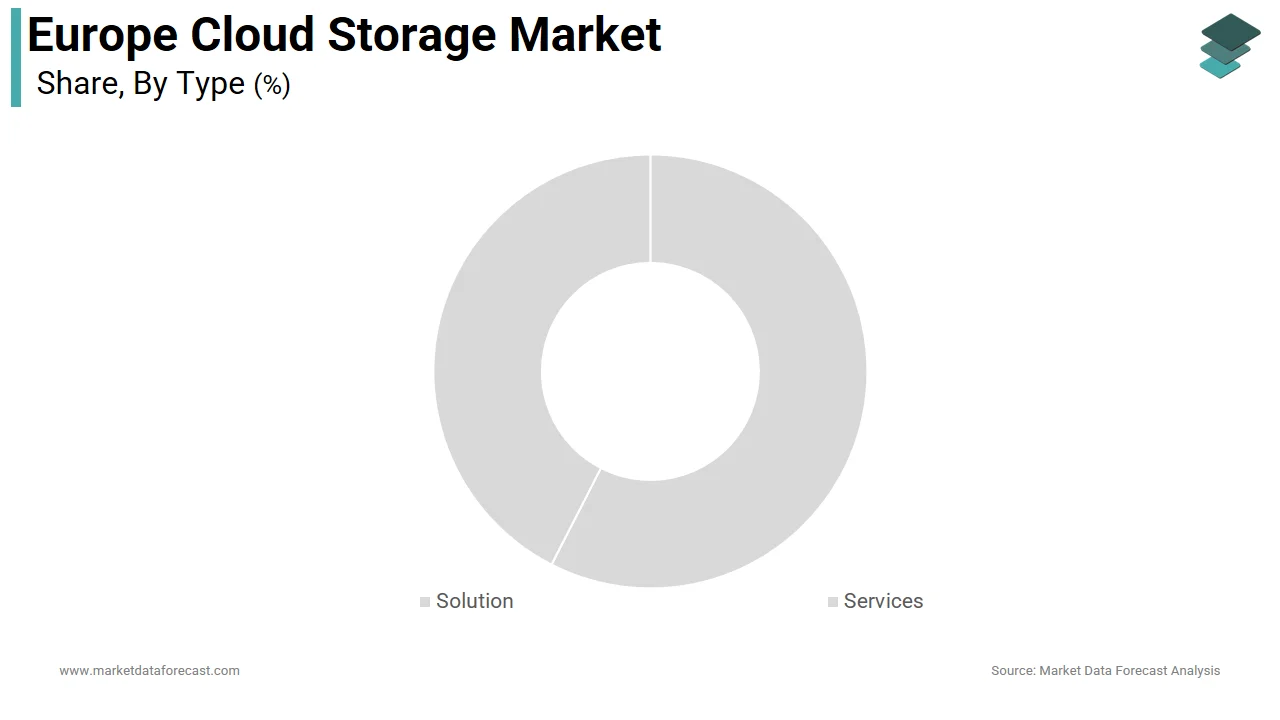
On the other hand, the services segment is emerging as the fastest-growing category in the Europe cloud storage market and is expected to witness a promising CAGR of 23.2% over the forecast period, owing to the increasing complexity of storage environments and the growing need for specialized expertise to manage, migrate, and optimize cloud storage infrastructures. The escalating demand for managed storage services and professional migration support as organizations struggle to navigate the complexities of transitioning from legacy on-premises systems to cloud environments is further propelling the growth of the services segment in the European market. According to Forrester Research, many European companies rely on third-party service providers to handle their cloud storage migration projects due to the risks of data loss and downtime associated with internal approaches. As per the European Cloud Partnership, organizations utilizing managed storage services report reductions in operational costs and improvements in system performance compared to those managing storage internally. The ability to offload routine maintenance tasks such as patching, monitoring, and capacity planning allows IT teams to focus on strategic initiatives rather than infrastructure management.
By Deployment Model Insights
The public cloud segment held the dominant position in the Europe cloud storage market in 202,y holding the largest share of the European cloud storage market. The dominance of the public cloud segment in the European market can be credited to its unparalleled scalability, cost efficiency, and ease of access for diverse organizational needs. The ability of public providers to offer enterprise-grade storage capabilities to businesses of all sizes without the burden of capital expenditure is boosting the expansion of the public cloud segment in the European market. The overwhelming preference for the public cloud storage segment is primarily driven by its compelling economic model that transforms fixed capital expenses into variable operational costs aligned with actual usage. Organizations can access vast amounts of storage capacity on a pay-per-use basis, eliminating the need for substantial upfront investments in physical hardware, data center space, and cooling infrastructure. According to Deloitte, European companies that adopt Public Cloud storage solutions achieve higher returns on investment compared to those maintaining traditional on-premise storage systems. As per the European Investment Bank, access to affordable Public Cloud storage has enabled many startups to launch and scale operations without significant initial funding barriers.
On the other side, the hybrid cloud segment is the fastest-growing deployment type in the Europe cloud storage market and is anticipated to record a CAGR of 26.7% over the forecast period, owing to the unique ability of Hybrid architectures to balance the security and control of private storage with the scalability and cost benefits of public clouds while navigating complex regulatory landscapes. The rapid ascent of Hybrid Cloud storage is fundamentally linked to stringent European data protection regulations that mandate specific handling, residency, and sovereignty of sensitive information. According to the International Data Corporation, many European enterprises are adopting Hybrid Cloud storage strategies specifically to comply with the General Data Protection Regulation and industry-specific mandates regarding data localization. Reports from the European Banking Authority indicate that financial institutions are increasingly deploying Hybrid storage architectures to meet strict oversight guidelines without sacrificing technological agility. The ability to segregate data based on sensitivity and regulatory requirements makes Hybrid Cloud the only viable option for many regulated industries.
By Vertical Insights
The BFSI segment held the largest share of the Europe cloud storage market in 2025 due to the immense volume of transactional data, the critical need for long term retention, and the stringent security requirements inherent to the financial sector. The rigorous regulatory framework mandating the long-term retention of financial records, transaction logs, and communication archives is propelling the dominance of the BFSI segment in the European market. Financial institutions must preserve this data in an immutable and auditable format to satisfy requirements from bodies like the European Central Bank and local financial authorities. According to the European Banking Federation, many major European banks have prioritized cloud storage adoption to meet these retention mandates cost-effectively while ensuring data integrity. Traditional on-premise tape libraries and disk arrays are becoming increasingly expensive and difficult to manage at the scale required by modern banking operations. As per Accenture, banks utilizing cloud-based archival solutions have reported reductions in compliance-related storage costs while improving audit readiness and data retrieval speeds. The ability to store vast amounts of historical data securely and access it instantly for regulatory inquiries makes cloud storage an indispensable asset for the financial sector.
On the other hand, the healthcare and life sciences segment is projected to be the fastest-growing segment in the Europe cloud storage market and record a CAGR of 27.7% over the forecast period, owing to the explosion of medical imaging data, genomic sequencing initiatives, and the push for collaborative research environments. The massive volume of high-resolution medical images, such as MRI, CT scans, and X-rays, along with genomic sequencing data that requires scalable and secure cloud storage capabilities, is further boosting the expansion of the healthcare and life sciences segment in the European market. The advent of precision medicine relies on analysing vast genomic datasets to tailor treatments to individual patients, a task that is computationally intensive and impractical on-premises. According to the European Molecular Biology Laboratory, genomic data produced in Europe is expanding at a rapid pace, necessitating cloud infrastructures that can expand elastically to accommodate this growth. As per the European Commission, cloud-based genomic initiatives have accelerated research timelines, which is enabling faster identification of genetic markers for diseases. The ability to store and share large medical images securely across different healthcare facilities improves diagnostic accuracy and facilitates remote consultations. As the cost of sequencing continues to drop and data volumes soar, the reliance on cloud services to manage and analyze this information will continue to surge, driving the exceptional growth of the healthcare vertical.
COUNTRY-LEVEL ANALYSIS
Germany Cloud Storage Market Analysis
Germany dominated the cloud storage market in Europe in 2025 with 25.5% of the regional market share. The country serves as the economic engine of the continent, and its robust industrial base drives immense demand for storage solutions to support manufacturing, automotive, and chemical sectors. The German market is characterized by a strong emphasis on data sovereignty and security, which has led to the proliferation of sovereign cloud storage offerings tailored to local regulatory needs. According to the German Federal Office for Information Security, the number of certified cloud storage providers in Germany has increased in recent years to meet the strict compliance requirements of local industries. The manufacturing sector, known as Industry 4.0, relies heavily on cloud storage to archive massive amounts of sensor data from smart factories and enable real-time analytics for predictive maintenance. As per Bitkom, German companies have made significant investments in cloud storage technologies, reflecting their commitment to digital leadership and operational excellence. The presence of major hyperscalers establishing dedicated regions in Frankfurt and Munich further solidifies the country's dominant position by offering low-latency and high-availability storage services. Additionally, the government's push for digital administration acts as a catalyst for public sector cloud storage adoption.
United Kingdom Cloud Storage Market Analysis
The United Kingdom held a promising share of the European cloud storage market in 2025. Despite post Brexit complexities, the UK remains a global fintech hub and a center for digital innovation, which fuels continuous demand for advanced storage capabilities across financial, media, and professional services sectors. The market status in the UK is defined by a highly mature cloud ecosystem with widespread adoption among both large enterprises and agile startups. According to Tech UK, the cloud storage sector contributes significantly to the British economy and supports a large number of jobs in technology and related fields. London’s status as a financial capital drives the consumption of secure and compliant cloud storage for trading archives, banking records, and insurance analytics. As per the Office for National Statistics, many large UK enterprises utilize cloud storage for critical business functions, indicating deep market penetration. The government’s Cloud First policy mandates that public sector bodies consider cloud storage solutions for all new IT projects, accelerating adoption in healthcare, education, and local government. Furthermore, the UK is a leader in artificial intelligence research, which requires substantial storage capacity for training large language models and deploying AI applications. The presence of numerous data centers in London, Cardiff, and Manchester ensures low latency and high availability for domestic and international clients.
France Cloud Storage Market Analysis
France is estimated to account for a prominent share of the European cloud storage market during the forecast period, owing to the strong government intervention aimed at fostering digital sovereignty and reducing dependence on non-European technology providers through national strategic initiatives. The status of the cloud storage sector in France is heavily influenced by the France 2030 investment plan, which allocates significant funds to develop independent storage capabilities and support local innovation ecosystems. According to the French Ministry of Economy and Finance, the government has partnered with major tech firms to build trusted cloud storage infrastructures that guarantee data residency within national borders. As per Syntec Numérique, French enterprises are increasingly adopting cloud storage to modernize their IT landscapes and improve competitiveness in global markets. Paris has emerged as a key data center hub in Southern Europe, attracting investments from global providers who want to serve the Francophone market and surrounding regions.
Netherlands Cloud Storage Market Analysis
The Netherlands is expected to exhibit a healthy CAGR in the European cloud storage market during the forecast period. The country serves as the primary digital gateway to Europe due to its strategic location, advanced network infrastructure, and favorable business environment, which attracts multinational corporations and cloud providers alike. The market status in the Netherlands is defined by its role as a major interconnection hub where a significant portion of European internet traffic is exchanged, facilitating efficient cloud storage connectivity for the entire region. According to the Dutch Internet Exchange, data traffic volumes in the country have reached record highs, supporting the dense concentration of data centers in Amsterdam and surrounding areas. As per the Holland Data Center Association, the country hosts facilities for all major global cloud storage providers, ensuring redundancy and low-latency access for customers across the continent. The Dutch government promotes a progressive digital agenda that encourages cloud storage adoption among startups and multinational corporations through supportive policies and incentives. Furthermore, the nation’s commitment to sustainability has led to the development of green data centers powered by renewable energy sources, aligning with the environmental goals of many European enterprises.
Sweden Cloud Storage Market Analysis
Sweden is estimated to showcase a notable CAGR in the European cloud storage market during the forecast period. The Swedish market is renowned for its advanced digital maturity, high internet penetration, and leadership in sustainable cloud storage practices that attract environmentally conscious organizations. The status of the cloud storage sector in Sweden is characterized by early and widespread adoption across all sectors, driven by a tech-savvy population, supportive government policies, and a strong tradition of innovation. According to Statistics Sweden, a large majority of the population uses the internet regularly, creating fertile ground for cloud-based consumer and enterprise services. As per the Swedish Post and Telecom Authority, Sweden leads Europe in fiber optic coverage, which provides the high-speed connectivity necessary for effective cloud storage utilization and low-latency applications. Stockholm has become a prominent hub for cloud storage innovation, particularly in sectors that require high-performance computing and real-time data processing. The Swedish government’s ambitious climate goals have spurred the development of carbon-neutral data centers that utilize excess heat for district heating systems, setting a benchmark for sustainability in the industry.
COMPETITIVE LANDSCAPE
The competition in the Europe cloud storage market is intensely fierce, characterized by a dynamic struggle between global hyperscalers and emerging regional providers vying for dominance amidst strict regulatory scrutiny and evolving customer demands. Global giants leverage their vast resource pools and extensive service catalogs to capture large enterprise contracts, while local players compete on agility, specialized compliance knowledge, and personalized support services. The battleground has shifted from mere price competition to value-added services, including artificial intelligence integration, sustainability credentials, and sovereign data handling capabilities that address specific European concerns. Regulatory frameworks like the General Data Protection Regulation act as both a barrier and a catalyst, forcing all participants to innovate rapidly to meet localization demands and maintain trust. New entrants specializing in niche verticals or green storage are challenging established norms by offering tailored solutions that resonate with specific European cultural and legal expectations. The rise of multi-cloud strategies among customers further intensifies rivalry as providers must ensure seamless interoperability to prevent churn and maintain relevance. Strategic acquisitions and partnerships have become commonplace as companies seek to fill capability gaps quickly and expand their geographical reach without the delay of organic growth. This complex ecosystem ensures that no single entity can rest on its laurels as technological advancements and shifting political tides constantly reshape the competitive hierarchy and define future success in the storage domain.
KEY MARKET PLAYERS
The leading companies operating in the Europe cloud storage market include:
- IBM Corporation
- Amazon.com, Inc. (Amazon Web Services)
- Microsoft Corporation
- Google Inc.
- Oracle Corporation
- Vmware, Inc.
- Hewlett Packard Enterprise (HPE) Company
- Red Hat, Inc.
- Rackspace
- Dropbox
TOP PLAYERS IN THE MARKET
- Amazon Web Services stands as a pivotal force in the Europe cloud storage market by offering a comprehensive suite of object block and file storage solutions that cater to diverse enterprise needs. Globally, the company sets industry standards for durability, scalability, and security through its Simple Storage Service, which stores trillions of objects for customers worldwide. Recent actions to strengthen its European position include the launch of new data center regions in Spain and Italy to ensure data residency and reduce latency for local clients. The company actively invests in renewable energy projects to power its storage facilities, aligning with European sustainability goals. Amazon Web Services also introduces advanced features like intelligent tiering and immutable backups to help organizations manage costs and protect against ransomware. These strategic expansions and continuous innovations reinforce its role as a trusted partner for European businesses seeking robust and compliant storage infrastructure.
- Microsoft Azure leverages its deep integration with enterprise software to drive widespread adoption of its cloud storage services across European corporations and public sector entities. The company contributes globally by providing seamless hybrid storage solutions that allow organizations to manage data across on-premises and cloud environments efficiently. Recent efforts involve establishing sovereign cloud regions in Germany and France to address strict data sovereignty requirements and build trust with regulated industries. Microsoft actively enhances its storage portfolio with artificial intelligence capabilities for automated data management and threat detection. The company also commits to becoming carbon negative by 2030, influencing its storage infrastructure development across Europe. By focusing on compliance, security, and sustainability, Microsoft Azure strengthens its market position as a preferred choice for enterprises requiring secure and scalable storage architectures that align with European regulatory frameworks.
- Google Cloud Platform distinguishes itself in the Europe cloud storage market through superior capabilities in data analytics, artificial intelligence, and sustainable computing practices. Globally, the company leads in offering high-performance storage solutions optimized for machine learning workloads and large-scale data lakes. Recent expansions include opening new cloud regions in Finland and the Netherlands to serve diverse customer needs with low latency and high availability. Google Cloud places a strong emphasis on helping European businesses leverage open source technologies and multi-cloud strategies to avoid vendor lock-in. The company recently announced significant investments in carbon-free energy to power its data centers, aligning with the European Green Deal objectives. By offering advanced tools for data lifecycle management and security, Google Cloud empowers organizations to derive actionable insights from their stored data. These initiatives solidify its reputation as an innovative and responsible provider in the European cloud storage landscape.
TOP STRATEGIES USED BY THE KEY MARKET PARTICIPANTS
Key players in the Europe cloud storage market primarily employ strategies centered on localized infrastructure expansion and strategic partnerships to navigate complex regulatory landscapes effectively. Companies are heavily investing in building new data centers within specific European nations to ensure data sovereignty and comply with General Data Protection Regulation mandates regarding data residency. Another prevalent strategy involves developing sovereign cloud offerings that guarantee data remains within national borders to attract government and financial sector clients who prioritize security. Major providers are also forming alliances with local telecommunications firms to enhance edge storage capabilities and reduce latency for real time applications across the continent. Sustainability initiatives serve as a critical differentiator as vendors commit to powering operations entirely with renewable energy to meet European Green Deal objectives and appeal to eco-conscious enterprises. Furthermore, organizations are focusing on industry-specific storage solutions tailored for manufacturing, finance, and healthcare to address unique sectoral requirements and deliver greater value. Acquisitions of specialized security and data management firms allow these giants to broaden their service portfolios and offer integrated ecosystems that retain customer loyalty and drive long term growth effectively.
MARKET SEGMENTATION
This Europe cloud storage market research report is segmented and sub-segmented into the following categories.
By Type
- Solution
- Primary Storage
- Disaster Recovery & Backup
- Cloud Storage Gateway
- Data Archiving
- Services
- Professional
- Managed
By Deployment Model
- Public Cloud
- Private Cloud
- Hybrid Cloud
By Organization Size
- Small & Medium Enterprises
- Large Enterprises
By Vertical
- BFSI
- IT & Telecom
- Retail
- Healthcare
- Manufacturing
- Government & Public-Sector
- Media & Entertainment
- Others
By Country
- UK
- France
- Spain
- Germany
- Italy
- Russia
- Sweden
- Denmark
- Switzerland
- Netherlands
- Turkey
- Czech Republic
- Rest of Europe