- Product Description Description
- Table of Contents TOC
- List of Table & Figure LOT
- Get Free Sample PDF Sample PDF
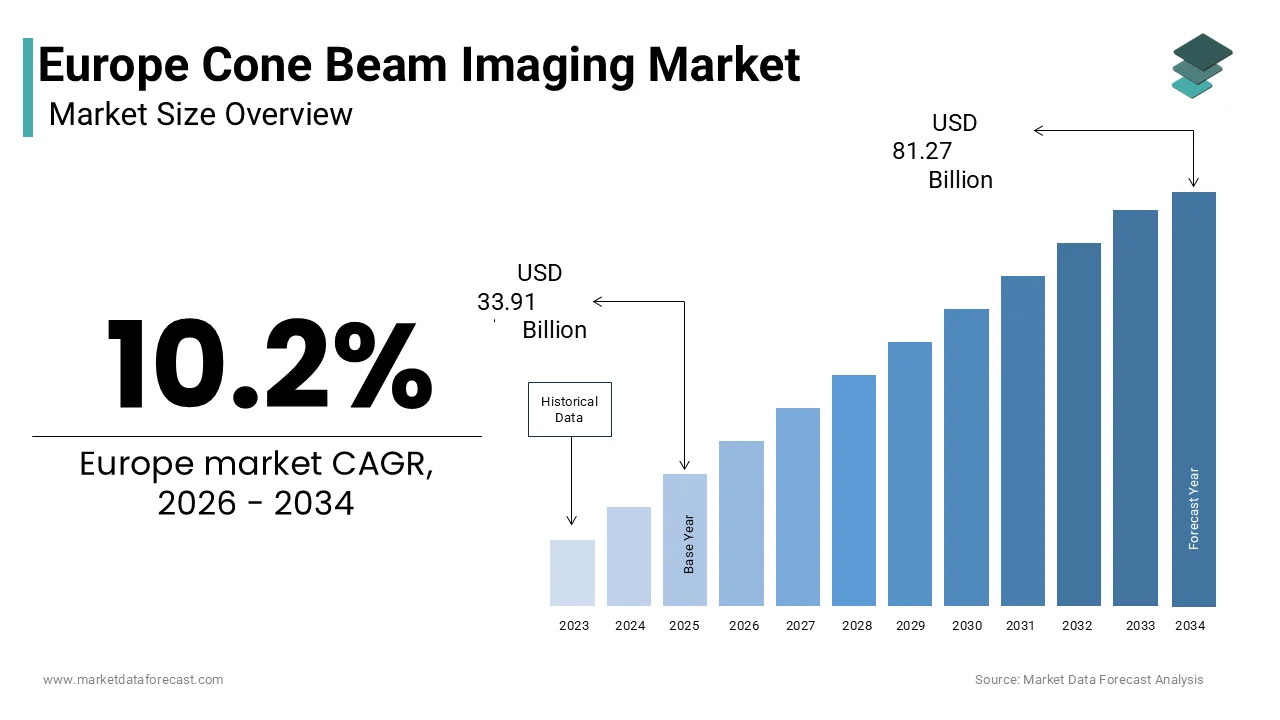
Market Size, 2025
$33.91 BnMarket Estimate, 2026
$37.37 BnMarket Forecast, 2034
$81.27 BnCAGR, 2026–2034
10.2%Europe Cone Beam Imaging Market Size
The Europe Cone Beam Imaging Market was valued at USD 33.91 billion in 2025 and increased to USD 37.37 billion in 2026. It is projected to reach USD 81.27 billion by 2034, growing at a CAGR of 10.2% from 2026 to 2034.
Cone Beam Computed Tomography (CBCT) is a specialized medical imaging technology that generates high-resolution three-dimensional images of dental, maxillofacial, and ENT structures using a conical X-ray beam and a rotating detector. Unlike conventional CT, CBCT delivers lower radiation doses and is optimized for hard tissue visualization, making it indispensable in dental implantology, orthodontics, oral surgery, and otolaryngology. In Europe, the adoption of CBCT is influenced by stringent radiation safety directives, evolving clinical guidelines, and the integration of digital workflows in outpatient care settings. According to sources, there has been a widespread and increasing adoption of CBCT technology in the dental and medical fields for various diagnostic purposes. Furthermore, the European Society of Dental Radiology (ESDR) promotes the use of CBCT in implant cases where a clinical assessment indicates its necessity for detailed anatomical information. These clinical and regulatory dynamics position CBCT not as a luxury but as a standard of care in advanced dental and craniofacial diagnostics.
MARKET DRIVERS
Integration of CBCT into Routine Dental Implant and Orthodontic Workflows
CBCT has become a non-negotiable diagnostic step in complex dental procedures due to its unparalleled ability to map bone density, nerve pathways, and sinus anatomy in three dimensions, thereby driving the growth of the European cone beam imaging market. As per sources, the use of Cone Beam Computed Tomography (CBCT) scans is an increasingly important part of dental implant treatment planning, helping clinicians visualize the alveolar ridge and identify anatomical structures to minimize surgical risks. CBCT imaging has become widely used in orthodontics and oral surgery for complex cases involving impacted canines, skeletal discrepancies, and presurgical planning, as it provides a valuable 3D perspective that can improve diagnostic accuracy and treatment outcomes. This clinical integration is reinforced by digital dentistry trends. Digital workflows in dentistry are advancing, with dental laboratories frequently receiving Standard Tessellation Language (STL) files that are superimposed with CBCT data to fabricate highly accurate guided surgery templates, as per sources. Consequently, the shift from 2D radiography to 3D diagnostics is no longer driven by technology alone but by evidence-based standards that prioritize patient safety and treatment accuracy.
Rise of Specialized Outpatient Centers and Dental Service Organizations
The decentralization of advanced dental care into private specialty clinics and corporate dental networks is accelerating the expansion of the European cone beam imaging market. This increases CBCT adoption outside hospital radiology departments. In some countries, where public dental coverage is limited, private orthodontic and oral surgery centers have invested heavily in compact CBCT systems to offer premium services. Moreover, these centers often bundle imaging with treatment packages, making CBCT economically viable through volume utilization. This structural shift transforms CBCT from a shared hospital resource into a practice-owned asset, broadening its deployment across the outpatient care continuum.
MARKET RESTRAINTS
Stringent EU Radiation Safety Regulations Limit Unnecessary Scanning
The European Union’s Basic Safety Standards Directive 2013/59/Euratom imposes rigorous justification and optimization requirements for all medical exposures to ionizing radiation, which hinders the growth of the European cone beam imaging market. As per research, dental practitioners are required to document the clinical justification for every CBCT exam, demonstrating that lower-dose alternatives, such as panoramic radiography, are insufficient. National authorities enforce these rules strictly. Warnings have been issued to dental clinics for non-compliant CBCT protocols. Furthermore, the directive mandates that only certified professionals may operate CBCT units, creating training barriers. Only a minority of dental assistants have completed the necessary radiation safety courses, according to studies. These regulatory safeguards, while essential for patient protection, reduce scan volumes and slow return on investment for smaller practices, particularly in Eastern Europe, where compliance infrastructure is underdeveloped.
High Capital Cost and Reimbursement Limitations in Public and Private Systems
The acquisition and maintenance of CBCT systems remain financially prohibitive for many dental practices due to high upfront investment and limited insurance coverage, which hampers the expansion of the European cone beam imaging market. A medical-grade CBCT unit costs a significant amount, with annual service contracts adding thousands of euros. In some countries, public dental care rarely reimburses CBCT scans except in trauma or oncology cases, which forces patients to pay out of pocket. Private insurers follow similar constraints. As per research, only a few EU countries offer partial reimbursement for diagnostic CBCT in routine implantology. Consequently, solo practitioners in lower-income regions often delay or forgo purchase, relying on referrals to imaging centers. This economic reality fragments access and slows market penetration, particularly in rural and underserved areas where advanced diagnostics are most needed.
MARKET OPPORTUNITIES
Expansion of CBCT Applications in ENT and Sleep Apnea Diagnostics
Increased adoption beyond dentistry into otolaryngology and sleep medicine for airway assessment and sinus evaluation creates new clinical and commercial avenues, thus providing fresh opportunities for the growth of the European cone beam imaging market. More significantly, the European Sleep Research Society now recommends CBCT for evaluating upper airway morphology in obstructive sleep apnea patients, with studies showing it accurately identifies retropalatal and retroglossal collapse sites. In some countries, multidisciplinary clinics routinely use CBCT to plan mandibular advancement devices, integrating dental and ENT workflows. The European Commission’s Cross-Speciality Imaging Initiative further supports this trend by funding pilot programs that validate CBCT protocols for non-dental indications. This diagnostic diversification transforms CBCT from a dental tool into a versatile craniofacial imaging platform.
Integration with Artificial Intelligence and Digital Treatment Planning Platforms
The convergence of CBCT with AI-driven analytics and cloud-based treatment ecosystems is unlocking new value through automated diagnosis and workflow efficiency, which in turn opens new prospects for the European cone beam imaging market. Companies like Dentsply Sirona and Carestream have embedded AI algorithms into their CBCT software that automatically segment nerves, detect periapical lesions, and calculate bone density, tasks that previously required manual interpretation. According to sources, AI-assisted CBCT analysis can reduce diagnostic time and improve implant placement accuracy. Furthermore, cloud platforms now enable real-time collaboration between dentists, surgeons, and labs. The European Health Data Space framework facilitates interoperability while ensuring GDPR compliance, encouraging broader adoption. This digital fusion elevates CBCT from an imaging modality to an intelligent diagnostic hub within integrated care pathways.
MARKET CHALLENGES
Shortage of Trained Professionals for CBCT Operation and Interpretation
Its effective use requires specialized training in both acquisition protocols and 3D image interpretation, a competency gap that affects diagnostic quality and regulatory compliance across the region. This degrades the growth of the European cone beam imaging market. According to research, A significant gap exists in formal CBCT interpretation training among general dentists in the EU, often resulting in incidental findings being overlooked. In Eastern Europe, the deficit is more acute. In some regions, a very low percentage of CBCT operators have certified training in both radiation protection and image analysis. This skills shortage is compounded by the lack of standardized curricula. Training requirements for CBCT certification vary widely across different countries, with some mandating specific hours of training while others have no formal requirements. Consequently, even when devices are installed, their clinical utility remains suboptimal, increasing medico-legal risks and reducing confidence in 3D diagnostics among referring clinicians.
Lack of Harmonized Cross-National Reimbursement and Coding Systems
The absence of a unified EU reimbursement framework for CBCT scans creates financial uncertainty and market fragmentation, which obstructs the expansion of the European cone beam imaging market. Each member state maintains distinct billing codes and coverage policies; for example, Germany reimburses CBCT under specific dental procedure codes while France excludes it from standard insurance unless linked to trauma or cancer. The inconsistency discourages cross-border tele radiology services and complicates investment decisions for multinational dental chains. Moreover, the lack of standardized billing impedes health technology assessments that could demonstrate CBCT’s long-term cost-effectiveness in preventing surgical complications. Access to CBCT will favor high-income regions and private patients, compromising equitable care delivery, until the EU aligns on common diagnostic imaging tariffs.
REPORT COVERAGE
| REPORT METRIC | DETAILS |
| Market Size Available | 2025 to 2034 |
| Base Year | 2025 |
| Forecast Period | 2026 to 2034 |
| Segments Covered | By Patient Position, Application, End Use, and Region. |
| Various Analyses Covered | Global, Regional, and Country-Level Analysis, Segment-Level Analysis, Drivers, Restraints, Opportunities, Challenges; PESTLE Analysis; Porter’s Five Forces Analysis, Competitive Landscape, Analyst Overview of Investment Opportunities |
| Countries Covered | UK, France, Spain, Germany, Italy, Russia, Sweden, Denmark, Switzerland, Netherlands, Turkey, Czech Republic, Rest of Europe |
| Market Leaders Profiled | Planmeca Group, Vatech Co., Ltd., Dentsply Sirona, Cefla S.C., Danaher Corporation, Carestream Health, Inc., J. Morita MFG. Corp (Japan), Asahi Roentgen IND. CO., LTD, PreXion Corporation, CurveBeam LLC. |
SEGMENTAL ANALYSIS
By Patient Position Insights
The Standing/Sitting segment dominated the European Cone Beam Imaging Market by accounting for a 65.1% share in 2025 because of its widespread use in dental and outpatient settings, where space efficiency, patient accessibility, and workflow integration are prioritized. These systems accommodate upright semi-upright positioning, aligning with natural head posture during dental examinations and reducing installation footprint compared to supine units. In addition, standing and sitting CBCT units are the default choice in private dental clinics and orthodontic centers across Europe due to their compatibility with standard dental chair workflows and minimal spatial requirements. In compact urban clinics, particularly in cities like Paris, Berlin, and Amsterdam, floor space constraints make upright systems essential. Besides, upright positioning reduces patient anxiety and improves accessibility for elderly or mobility-limited individuals, supporting broader inclusivity in diagnostic care. In addition, standing and sitting CBCT systems typically cost less than supine units and do not require structural modifications like reinforced flooring or radiation shielding rooms. This affordability enables solo practitioners and small group practices, representing a notable share of EU dental providers as per Eurostat, to adopt in-house imaging without major capital outlays. Furthermore, service and maintenance are simpler due to the modular design. These economic and operational efficiencies ensure sustained dominance of the standing/sitting segment in Europe’s decentralized dental care landscape.
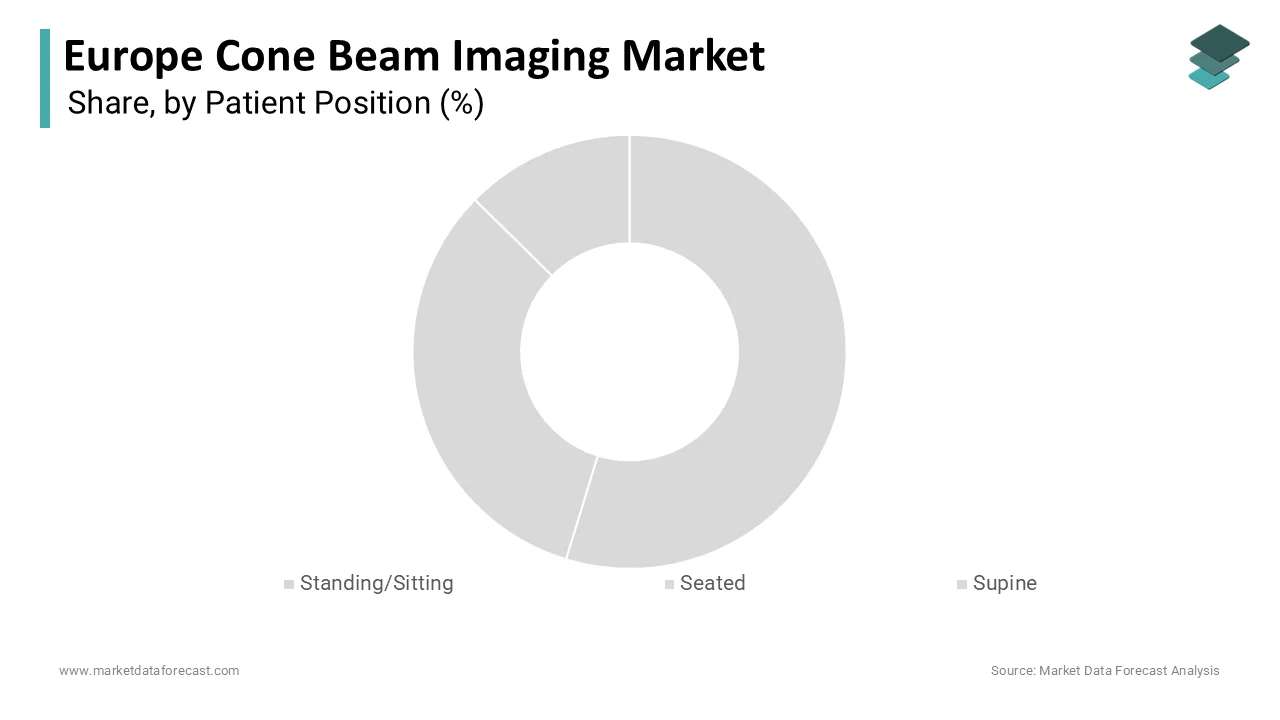
The supine patient position segment is expected to exhibit a noteworthy CAGR of 9.1% from 2025 to 2033 over the forecast period due to expanding use in hospital-based maxillofacial surgery and complex diagnostic scenarios. Supine CBCT systems are increasingly adopted in European university hospitals and trauma centers where compatibility with standard radiology workflows and patient immobilization are critical. These systems provide superior reproducibility for longitudinal studies in oncology and orthognathic surgery, where millimeter precision is non-negotiable. This clinical necessity in high acuity settings drives premium adoption despite higher costs. Moreover, supine positioning minimizes gravitational distortion of soft tissues and ensures standardized head orientation, which is essential for AI-driven segmentation and surgical guide fabrication. As per research, supine CBCT scans reduced landmark identification error compared to upright scans in orthognathic planning. This accuracy is vital for emerging applications such as virtual surgical simulation and patient-specific implant design. Furthermore, the European Commission’s Horizon Europe program funds projects that require supine CBCT data for multicenter AI validation, which further incentivizes hospital investment. These technical and research imperatives position supine systems as the gold standard for precision craniofacial diagnostics.
By Application Insights
The implantology segment captured the majority share of 28.4% of the European Cone Beam Imaging Market in 2025, as 3D imaging has become the standard of care for preoperative planning, bone assessment, and surgical guide fabrication in dental implant procedures across the continent. European clinical guidelines now universally require CBCT for dental implant placement due to its ability to visualize critical anatomical structures such as the inferior alveolar nerve and maxillary sinus. As per studies, a share of implant cases utilized CBCT data for computer-guided surgery, reducing complication rates compared to freehand techniques. Countries have incorporated CBCT into mandatory preoperative checklists enforced by dental boards. Apart from these, the rise of immediate loading protocols, where implants are placed and restored in one visit. Relies entirely on precise bone density mapping, only possible with CBCT. The European Commission’s Medical Device Coordination Group also recognizes CBCT as essential for CE certification of patient-specific surgical guides, which further institutionalizes its use. The demand for dental implants is surging across Europe due to an aging population retaining more natural teeth and seeking functional restoration. In countries, public dental programs now partially cover implants for seniors, which increases procedure volumes. Each implant case typically requires at least one CBCT scan, creating a direct and scalable demand driver. Furthermore, the growth of dental tourism in Eastern Europe, where clinics in Hungary and Croatia serve Western European patients, relies on CBCT to ensure same-day diagnostics and treatment by amplifying utilization across borders.
The Temporomandibular Joint (TMJ) Disorders application segment is predicted to witness the highest CAGR of 10.3 percent from 2025 to 2033 due to rising diagnosis rates and the unique ability of CBCT to visualize bony joint morphology in 3D. Temporomandibular disorders affect a portion of the European adult population, with symptoms including chronic pain, limited jaw movement, and joint clicking. Historically diagnosed clinically, TMJ cases now increasingly require CBCT to assess condylar degeneration, osteophyte formation, and joint space narrowing, features invisible on 2D imaging. Private insurers in some countries have also begun covering CBCT for TMJ diagnostics when linked to functional impairment, removing financial barriers. This clinical and reimbursement shift transforms TMJ imaging from a niche use into a mainstream diagnostic indication. Modern TMJ diagnosis relies on correlating joint morphology with occlusal dynamics, a workflow enabled by CBCT’s compatibility with digital bite scanners and jaw tracking devices. AI algorithms now automatically measure joint space asymmetry and condylar volume loss from CBCT datasets, which improves diagnostic objectivity. This multidisciplinary approach elevates CBCT from a structural tool to a functional diagnostic cornerstone in orofacial pain management.
By End User Insights
The private practice segment was the largest in the European Cone Beam Imaging Market and captured a 58.4% in 2025. The prominence of the private practice segment is driven by the decentralization of advanced dental care, rising patient demand for precision diagnostics, and the economic viability of in-house imaging for high-volume clinics. Private dental practices, including solo clinics, group practices, and Dental Service Organizations (DSOs), are rapidly adopting CBCT to enhance service offerings and reduce reliance on external imaging centers. In countries where public dental coverage is limited, private clinics use CBCT as a premium differentiator. The UK’s General Dental Council mandates 3D imaging for complex extractions and implants, pushing even small practices toward acquisition. Besides, compact upright CBCT systems fit seamlessly into existing operatory layouts, minimizing disruption. This trend reflects a broader move toward vertically integrated care, where diagnostics and treatment occur under one roof. CBCT enables private practices to bundle imaging with high-margin procedures like implants and clear aligner therapy, improving revenue per patient. The average payback period for a CBCT unit in a busy practice is several months. Moreover, eliminating referral fees to radiology centers preserves margin while improving workflow efficiency; patients no longer need separate appointments for scans. This economic logic, combined with leasing options and manufacturer financing, makes CBCT financially accessible even to mid-sized practices, solidifying private practice dominance.
The academic end-user segment is estimated to register the fastest CAGR of 8.7% from 2026 to 2034. The rapid growth of the academic end-user segment is propelled by research funding, curriculum modernization, and the role of universities as centers of clinical innovation. European dental schools are systematically incorporating CBCT into undergraduate and postgraduate curricula to align with evolving clinical standards. Universities operate dedicated CBCT simulation labs where students practice virtual implant placement and surgical planning. The investments ensure that future dentists are proficient in 3D diagnostics from the outset, which creates institutional demand for academic-grade CBCT systems with teaching and annotation capabilities. Academic medical centers are leading EU-funded research in AI-driven diagnostics, surgical robotics, and personalized implantology, all requiring high-fidelity CBCT datasets. These studies demand supine and high-resolution systems capable of standardized, reproducible imaging across sites. Furthermore, academic hospitals serve as validation centers for new CBCT software and devices seeking CE certification under the EU Medical Device Regulation. This dual role, as educators and innovators, positions academic institutions as critical growth engines in the European CBCT ecosystem.
COUNTRIES LEVEL ANALYSIS
Germany Cone Beam Imaging Market Analysis
Germany was the top performer in the European cone beam imaging market and accounted for a 24.3% share in 2025, which benefited from its dense network of advanced dental practices, robust medical technology industry, and strict clinical guidelines that mandate 3D imaging for complex procedures. The country hosts several registered dental practices, with a notable number equipped with CBCT units. Germany’s Federal Joint Committee requires CBCT for all dental implant cases covered by statutory health insurance when bone augmentation is anticipated. Apart from these, German manufacturers drive domestic adoption through continuous innovation in low-dose and AI-integrated systems. These regulatory, industrial, and clinical factors consolidate Germany’s position as Europe’s largest and most sophisticated CBCT market.
France Cone Beam Imaging Market Analysis
France was the second-largest country in the European cone beam imaging market and captured a 16.6% share in 2025 because of its centralized dental education system, high implant volumes, and progressive radiation safety policies that balance access with justification. France performs a substantial number of dental implants annually, with CBCT noteworthy usage in urban centers. Moreover, France’s Nuclear Safety Authority operates a national CBCT registry that tracks usage patterns and ensures compliance, fostering responsible adoption. Public universities in Paris and Lyon serve as training hubs, graduating thousands of dentists annually proficient in CBCT interpretation. This blend of clinical demand, regulatory oversight, and education sustains France’s strong market presence.
United Kingdom Cone Beam Imaging Market Analysis
The United Kingdom is another key player in the European cone beam imaging market due to its private dental care model, high patient willingness to pay for advanced diagnostics, and integration of CBCT into NHS specialist pathways. Many UK dental practices offering implants use in-house CBCT, driven by General Dental Council standards. The NHS funds CBCT scans in hospital dental departments for orthognathic surgery, trauma, and oncology, creating a dual public-private demand stream. Besides, UK dental schools pioneered CBCT training curricula now adopted across Europe. Despite Brexit, the Medicines and Healthcare products Regulatory Agency maintains alignment with EU MDR, ensuring continued device access. These structural and clinical factors ensure ongoing market relevance.
Italy Cone Beam Imaging Market Analysis
Italy grew steadily in the European cone beam imaging market owing to a high density of dental specialists, a strong tradition of aesthetic dentistry, and growing medical tourism centered on implantology. Italy has thousands of dentists, with one of the highest ratios of specialists per capita in Europe. Cities like Milan and Rome attract patients from across Europe for same-day implant procedures, all requiring immediate CBCT diagnostics. Furthermore, Italian universities lead in maxillofacial research, using CBCT for virtual surgical planning in cleft palate and orthognathic cases. This fusion of clinical excellence, tourism, and academic innovation sustains Italy’s robust position.
Spain Cone Beam Imaging Market Analysis
Spain is likely to grow in the European cone beam imaging market from 2025 to 2033 due to rapid private sector growth, cost-effective care models, and increasing adoption in both urban and provincial clinics. Spain’s dental market is highly privatized, with thousands of clinics serving domestic and international patients seeking affordable, advanced care. Furthermore, Spain benefits from EU cohesion funds that support digital health infrastructure in smaller clinics. These economic, clinical, and policy dynamics position Spain as a dynamic and expanding market within the European CBCT landscape.
COMPETITIVE LANDSCAPE
The European Cone Beam Imaging Market is characterized by intense competition among global innovators and specialized regional suppliers vying for influence through technological differentiation and regulatory agility. Established players like Dentsply Sirona and Carestream Dental leverage integrated digital ecosystems and strong brand recognition, while Asian manufacturers such as Vatech compete on cost efficiency and rapid compliance with EU standards. The enforcement of the Medical Device Regulation has raised technical and documentation barriers, favoring companies with mature quality management systems. Competition is further shaped by clinical trends, including the demand for AI integration, low-dose protocols, and cross-specialty applications in ENT and sleep medicine. Private practices prioritize compact, affordable systems, whereas hospitals and academic centers see high-end supine units with research capabilities. This bifurcated demand landscape rewards both innovation in software intelligence and flexibility in hardware deployment.
KEY MARKET PLAYERS
Prominent Companies leading the europe cone beam imaging market profiled in the report are
- Planmeca Group,
- Vatech Co., Ltd.
- Dentsply Sirona,
- Cefla S.C.,
- Danaher Corporation,
- Carestream Health, Inc.
- J. Morita MFG. Corp (Japan),
- Asahi Roentgen IND.CO., LTD,
- PreXion Corporation,
- CurveBeam LLC.
TOP LEADING PLAYERS IN THE MARKET
- Dentsply Sirona is a global leader in dental technologies with a commanding presence in the European Cone Beam Imaging Market. Headquartered in the United States but with major R&D and manufacturing hubs in Germany, the company offers a comprehensive portfolio of CBCT systems, including the ORTHOPHOS and X Glide series, tailored for dental practices, hospitals, and academic institutions across Europe. Dentsply Sirona contributes significantly to global standards in digital dentistry by integrating CBCT with CAD/CAM and implant planning software. It also expanded its cloud-based imaging ecosystem to support cross-border collaboration among European dental professionals.
- Carestream Dental is a prominent player in the European Cone Beam Imaging Market, known for its high-resolution CS 9600 and CS 8200 3D systems, widely used in private practices and specialty clinics. The company leverages its legacy in medical imaging to deliver CBCT solutions with superior contrast resolution and compact footprints suited for urban dental offices. Carestream’s global influence extends through its software platform CS Imaging, which supports multimodal integration and AI-driven diagnostics. The company also enhanced its remote support and training services across Southern and Eastern Europe to address the growing need for operator education and regulatory compliance in decentralized markets.
- Vatech is a South Korean multinational that has significantly expanded its footprint in the European Cone Beam Imaging Market through affordable yet technologically advanced systems such as the PaX Zenith and Green series. The company differentiates itself with ultra-low radiation doses and user-friendly interfaces that appeal to small and medium-sized dental practices. Vatech’s global strategy emphasizes accessibility without compromising image quality, making it a preferred choice in cost-sensitive European regions. It also partnered with dental universities in Spain and Poland to establish CBCT training centers focused on safe and effective clinical interpretation, reinforcing its long-term commitment to the European professional community.
TOP STRATEGIES USED BY THE KEY MARKET PARTICIPANTS
Key players in the European Cone Beam Imaging Market focus on regulatory compliance, clinical integration, and software innovation to maintain a competitive advantage. Companies prioritize alignment with the EU Medical Device Regulation and radiation safety directives through rigorous documentation and low-dose imaging protocols. Strategic development of AI-powered diagnostic tools enhances workflow efficiency and clinical accuracy. Partnerships with dental schools and professional associations strengthen training and adoption. Expansion of cloud-based platforms enables secure data sharing and remote collaboration across borders. Apart from these, firms tailor system designs for space-constrained private practices while offering supine configurations for hospital and academic use, ensuring broad market coverage.
MARKET SEGMENTATION
This research report on the europe cone beam imaging market has been segmented and sub-segmented into the following categories.
By Patient Position
- Standing/Sitting
- Seated
- Supine
By Application
- Dental Applications
- Implantology
- Oral
- Maxillofacial Surgery
- Orthodontics
- Endodontics
- General Dentistry
- Temporomandibular Joint (TMJ) Disorders
- Periodontics
- Forensic Dentistry
By End User
- Hospitals
- Private Practice
- Academic
- Research Institutes
By Country
- UK
- France
- Spain
- Germany
- Italy
- Russia
- Sweden
- Denmark
- Switzerland
- Netherlands
- Turkey
- Czech Republic
- Rest of Europe