- Product Description Description
- Table of Contents TOC
- List of Table & Figure LOT
- Get Free Sample PDF Sample PDF
Market Size, 2025
$51.42 BnMarket Estimate, 2026
$53.77 BnMarket Forecast, 2034
$76.81 BnCAGR, 2026–2034
4.56%Europe Contract Furniture Market Summary
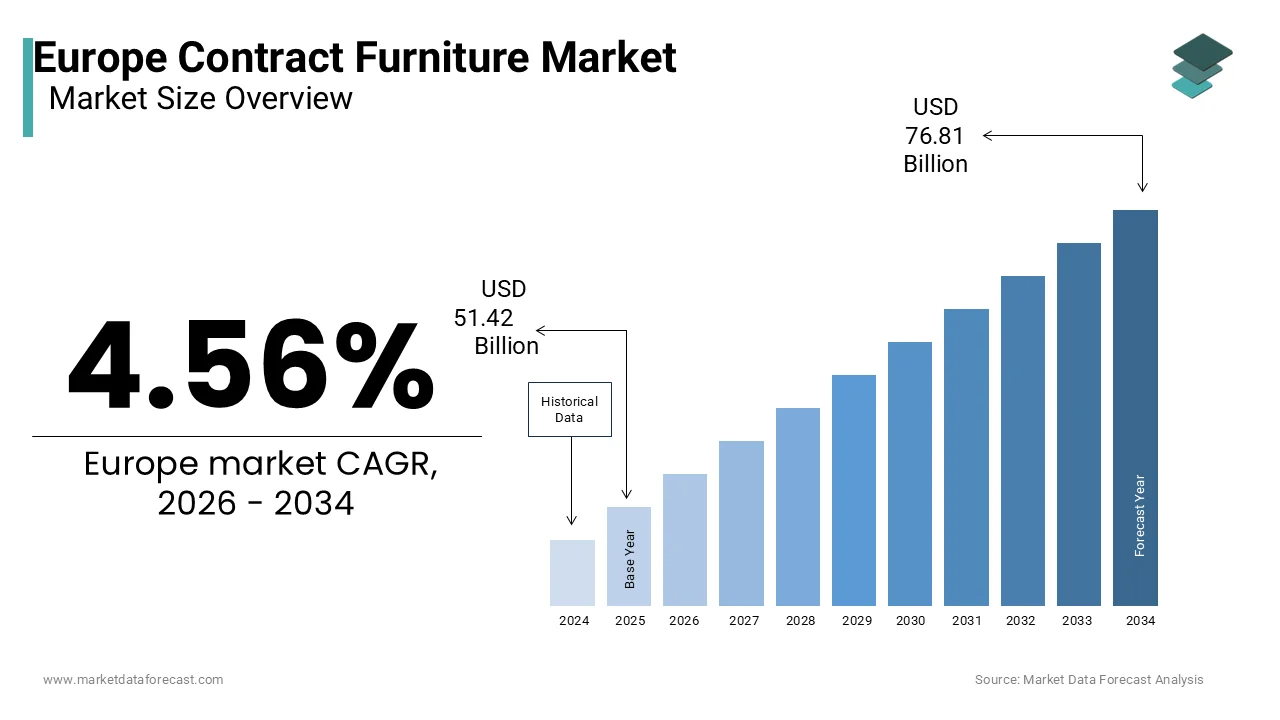
The Europe contract furniture market, valued at USD 51.42 billion in 2025, is projected to reach USD 76.81 billion by 2034, growing at a CAGR of 4.56%, driven by urban commercial expansion, hybrid work transformation, and rising demand for sustainable, modular furnishing systems.
Key Marekt Insights
- 2025 Market Size: USD 51.42 billion
- 2026 Estimate: USD 53.77 billion
- 2034 Forecast: USD 76.81 billion
- CAGR (2026–2034): 4.56%
- Base Year: 2025
- Forecast Period: 2026–2034
Quick Growth Drivers
- Expansion of urban commercial real estate and office retrofitting
- Widespread adoption of hybrid and flexible work models
- Strong growth in education, healthcare, and public infrastructure investment
- Rising demand for ergonomic, modular, and reconfigurable furniture systems
- Procurement shift toward certified sustainable and circular furniture
Principal Restraints
- Raw material price inflation (wood, steel, engineered panels)
- Persistent supply chain volatility and extended lead times
- Shortage of skilled craftsmanship in woodworking and upholstery
- Margin pressure on SMEs due to customization-heavy projects
High-Value Opportunities
- Integration of smart and IoT-enabled furniture in offices and campuses
- Growth of furniture-as-a-service (FaaS) and leasing models
- Large-scale public sector investment in education, culture, and civic buildings
- Rising adoption of universal design and accessibility-compliant furniture
- Expansion of circular procurement frameworks across EU municipalities
Key Market Challenges
- Mid-tier price sensitivity, especially among SMEs and budget hospitality
- Competition from retail-grade substitutes lacking contract certifications
- Regulatory fragmentation in fire safety, emissions, and accessibility standards
- Higher compliance costs for cross-border EU tenders
Fastest-Growing Segments
- Storage Furniture: 6.8% CAGR driven by space optimization and GDPR compliance
- Steel-Based Furniture: 7.2% CAGR modularity, recyclability, and durability
- Educational Institutions: 8.1% CAGR EU-funded school and campus upgrades
Regional Leadership & Dynamics
- Germany (18.2%) ergonomic leadership, DGNB-certified projects, skilled labor base
- France (18.2%) public infrastructure investment and sustainability mandates
- United Kingdom flexible office growth, hospitality rebound, fire safety upgrades
- Italy premium design exports, hospitality-driven demand, artisanal clusters
- Netherlands circular procurement leadership and furniture passport initiatives
What Wins Commercially
- Modular, reconfigurable systems aligned with hybrid work
- Strong sustainability certifications (EU Ecolabel, Cradle to Cradle, FSC)
- Ability to deliver customization at scale with short lead times
- Integration of digital infrastructure and smart workplace analytics
- Local manufacturing or assembly to ensure regulatory compliance and speed
Top Strategic Ask for Executives
Invest in circular product design, smart-enabled furniture systems, and service-based business models while localizing production to mitigate supply chain risk and regulatory fragmentation across Europe.
Leading Players
Some of the companies that are playing a dominating role in the Europe contract furniture market include:
- Steelcase
- Herman Miller
- Haworth
- Vitra
- Sedus Stoll AG
- Wilkhahn
- Ahrend
- Actiu
 Download Free Sample Report
Europe Contract Furniture Market Size
The europe contract furniture market was valued at USD 51.42 billion in 2025, is estimated to reach USD 53.77 billion in 2026, and is projected to reach USD 76.81 billion by 2034, growing at a CAGR of 4.56% from 2026 to 2034.
The contract furniture is the design, manufacture, and supply of purpose-built furniture solutions for commercial, institutional, and hospitality environments, including offices, hotels, educational institutions, healthcare facilities, and public infrastructure projects. In 2025, the European Union recorded approximately 25 million square meters of new office space completions, according to Eurostat, signaling renewed momentum in commercial construction. Concurrently, Eurofound reported that over 60% of European office workers now operate under hybrid work arrangements, accelerating demand for flexible, modular furnishing systems. These occupancy-driven dynamics directly shape procurement cycles and spatial planning strategies, anchoring the contract furniture market to broader economic and behavioral trends across the continent.
MARKET DRIVERS
Accelerated Urbanization and Commercial Real Estate Expansion
The urban population for new-commercial construction directly fuels procurement of contract furniture, which is propelling the growth of Europe contract furniture market. As per the United Nations Department of Economic and Social Affairs, over 78% of Europe’s population resided in urban areas in 2023, a figure projected to rise steadily through 2030. This demographic concentration has intensified the need for efficient, high-density spatial solutions in offices, schools, and healthcare facilities, all of which rely on specialized contract-grade furnishings. These developments increasingly prioritize flexible layouts, acoustic privacy, and digital integration, requirements that contract furniture is uniquely positioned to address. Flexible office space providers expanded their European footprint by 12% in 2025, according to JLL, reflecting a structural shift toward agile work environments. This trend sustains consistent demand for modular desks, stackable seating, mobile partitions, and reconfigurable storage systems, all core product categories in the contract segment. The urban-commercial nexus thus ensures a resilient, long-term demand pipeline independent of cyclical consumer sentiment.
Rising Emphasis on Sustainable and Circular Design Principles
The regulatory and cultural commitment to environmental sustainability has fundamentally reshaped product development, and procurement is additionally fuelling the growth of Europe contract furniture market. The European Environment Agency stated in 2025 that the furniture sector contributes approximately 3.5 million tonnes of waste annually to EU landfills. In response, the EU’s updated Ecodesign for Sustainable Products Regulation now mandates material traceability, repairability, and extended producer responsibility for durable goods, including commercial furnishings. Over 70% of corporate procurement officers in Europe indicated in a 2025 survey by the European Procurement Association that sustainability certifications, such as Cradle to Cradle or the EU Ecolabel, significantly influence vendor selection. This has accelerated investment in bio-based polymers, recycled aluminum, FSC-certified timber, and mono-material construction techniques that simplify disassembly and reuse. IKEA’s contract division reported that 89% of its commercial furniture range in Europe used renewable or recycled content in 2025. Furthermore, the German Sustainable Building Council noted a 30% annual increase in construction projects requiring Level(s) certification, where a sa European framework for sustainable building performance.
MARKET RESTRAINTS
Persistent Supply Chain Volatility and Raw Material Cost Inflation
The ongoing instability in global material supply chains and sustained inflation in key input costsarees solely restricting the growth of Europe contract furniture market. According to the European Central Bank, the producer price index for wood and wood products in the euro area remained 18% above pre-pandemic levels as of November 2025. Compounding this pressure, the European Forest Institute reported a 9% decline in timber harvests in 2023 across major producing countries like Sweden and Finland due to climate-related forest stress and tightened biodiversity protections. Simultaneously, the European Commission documented a 22% year-on-year increase in EU imports of upholstered furniture components from Asia in 2025, underscoring reliance on distant and geopolitically sensitive supply routes. Lead times for engineered wood panels now average 14 weeks across Western Europe, as per the European Panel Federation, more than double the 6-week benchmark of 2019. These delays directly impact project execution timelines and compress margins, especially for small and medium-sized manufacturers lacking vertical integration. Additionally, the EU’s Carbon Border Adjustment Mechanism now imposes financial levies on carbon-intensive imports, including select metal and plastic components, further escalating costs. This environment restricts pricing flexibility and forces trade-offs between quality, delivery speed, and affordability, hampering market responsiveness.
Labor Shortages and Skilled Craftsmanship Gaps
The acute shortage of skilled labor in precision woodworking, metal fabrication, and upholstery core competencies for high-quality contract furniture production is also impeding the growth of Europe contract furniture market. Eurostat reported in 2025 that the vacancy rate in the EU’s furniture manufacturing sector stood at 4.7%, markedly above the 2.8% average for all manufacturing industries. Germany’s Federal Institute for Vocational Education and Training noted a 31% decline in apprenticeship enrollments in furniture craftsmanship between 2015 and 2023, reflecting declining interest in traditional trades. This labor deficit directly impacts the capacity to fulfill complex, custom orders, which constitute over 60% of high-end contract projects, according to the European Furniture Industries Confederation. For bespoke installations in healthcare or hospitality settings, where dimensional accuracy and material integrity are important, such shortages translate into production bottlenecks and reliance on costly subcontracting. Italy’s artisanal furniture cluster in Brianza reported a 15% reduction in on-time deliveries in 2025 due to workforce constraints. Moreover, the European Trade Union Confederation highlighted that over 35% of current technicians are aged above 55, raising concerns about knowledge attrition.
MARKET OPPORTUNITIES
Integration of Smart Technologies and IoT-Enabled Furniture
The fusion of interior infrastructure with digital ecosystems is creating new opportunities for the growth of the European contract furniture market. As per the European Commission’s 2025 Digital Economy and Society Index, some of the large EU enterprises now deploy Internet of Things (IoT) solutions in physical workplaces. This shift necessitates furniture that embeds power delivery, data connectivity, occupancy sensing, and environmental feedback mechanisms. Manufacturers are responding by integrating wireless charging surfaces, USB-C hubs, modular cable management, and sensor-ready cavities into desks, lounge units, and collaborative tables. The Smart Building Alliance for Europe reported that 40% of new commercial construction projects in France and the Netherlands in 2025 included explicit specifications for connected furniture as part of integrated building automation strategies. Workplace analytics firm Leesman observed that occupant satisfaction scores increase by up to 22% in environments where furniture supports seamless digital interaction. Educational institutions are also adopting smart tables with interactive surfaces, with the European Education and Culture Executive Agency funding over 120 pilot classrooms across the EU in 2025. These developments enable premium pricing and recurring service revenue models, positioning contract furniture as an active component of the intelligent built environment.
Revival of Cultural and Civic Infrastructure Investment
The renewed public investment in cultural, educational, and civic infrastructure is expected to enhance the growth of Europe contract furniture market. According to the survey, over 18 billion euros were allocated in 2025 to renovate or construct public libraries, museums, and municipal facilities under the EU’s Cultural Recovery Plan. Simultaneously, the European Centre for the Development of Vocational Training reported that EU member states launched 210 new higher education campus projects in 2025, many financed through the Recovery and Resilience Facility. These institutions require durable, compliant, and inclusive furniture that meets stringent public procurement criteria. For example, Vienna’s 2025 central library tender mandated seating with a minimum 15-year service life and 90% material recyclability. France’s Ministry of Culture introduced a policy requiring all publicly funded furniture contracts to prioritize local manufacturers using FSC-certified timber, with a measure that boosted regional contract furniture orders by an estimated 12% in 2025, according to France Strategie. Additionally, the European Accessibility Act mandates that all public furniture installed after 2025 comply with ergonomic and mobility standards, fostering innovation in universal design. This public-sector investment cycle provides volume stability, encourages regional manufacturing, and elevates the strategic role of furniture in shaping equitable, future-ready public spaces.
MARKET CHALLENGES
Intensifying Price Sensitivity in the Mid-Tier Commercial Segment
A growing segment of European businesses, particularly small and medium enterprises (SMEs) and budget-oriented hospitality operators, is exhibiting heightened cost sensitivity, challenging the value proposition of mid-tier contract furniture. The intensifying price sensitivity in the mid-tier commercial segment is acting as a barrier for the growth of Europe contract furniture market. According to the European Central Bank’s 2025 Survey on the Access to Finance of Enterprises, nearly 68% of SMEs identified cost containment as their top operational priority amid persistent inflation and elevated borrowing costs. This pressure has led to deferred refurbishments, extended furniture lifecycles, and increased substitution with lower-cost retail-grade alternatives that lack fire resistance, ergonomic certification, or durability. The European Hotel Classification Institute observed that over 40% of three-star and below hotels in Southern and Eastern Europe opted for non-certified furniture in 2025 to manage operating expenses. Consequently, mid-tier contract suppliers face margin compression as they compete against mass-market retailers whose e-commerce platforms offer “commercial-looking” products at 30 to 50% lower price points, according to the European Retail Roundtable. This dynamic risks commoditizing the mid-segment, discouraging innovation, and undermining the enforcement of safety and quality standards, ultimately eroding the market’s integrity and long-term resilience.
Regulatory Fragmentation Across EU Member States
Despite efforts toward harmonization, significant regulatory divergence persists across EU countries in fire safety, chemical emissions, and accessibility requirements, creating operational complexity for contract furniture manufacturers. This factor is ascribed to the decline in the growth of Europe contract furniture market. According to the European Committee for Standardization, national deviations from EN 13501-1 (the EU fire classification standard) remain in place in 11 member states as of 2025, necessitating product adaptations for localized compliance. Similarly, the European Chemicals Agency documented inconsistent enforcement interpretations of over 200 REACH-restricted substances across national authorities, leading to compliance ambiguities. For instance, upholstered seating compliant with German flammability protocols may fail UK tests due to differing ignition source standards, a legacy of divergent national codes. While the European Accessibility Act establishes a common framework, implementation timelines and technical specifications vary by country, resulting in staggered adoption. These inconsistencies force manufacturers to maintain multiple product variants, increasing design validation and testing costs by an estimated 15 to 20%, as per the European Furniture Industries Confederation. Smaller firms, lacking legal and compliance resources, often avoid cross-border tenders altogether, limiting market reach and stifling competition.
REPORT COVERAGE
| REPORT METRIC | DETAILS |
| Market Size Available | 2025 to 2034 |
| Base Year | 2025 |
| Forecast Period | 2026 to 2034 |
| Segments Covered | By Product, Material, Application, and Region. |
| Various Analyses Covered | Global, Regional, and Country-Level Analysis, Segment-Level Analysis, Drivers, Restraints, Opportunities, Challenges; PESTLE Analysis; Porter’s Five Forces Analysis, Competitive Landscape, Analyst Overview of Investment Opportunities |
| Countries Covered | Mexico, Brazil, Argentina, Chile, Rest of Latin America |
| Market Leaders Profiled | Herman Miller, Inc., Steelcase Inc., HNI Corporation, Haworth, Inc., KI (Krueger International), Vitra International AG, Wilkhahn Wilkening + Hahne GmbH + Co. KG, Interface, Inc. (contract seating & surfaces), Bene AG, Sedus Stoll AG, Hrmann Collection GmbH & Co. KG, Versteel LLC, Okamura Corporation, JSI (Junk Seat International), Actiu, Ahrend, Vepa Office Furniture, Davison Highley, Orangebox (Republic of Fritz Hansen Group), BPGA (British Contract Furniture Association) |
SEGMENTAL ANALYSIS
By Product Insights
The Chairs and Stools segment was the largest by holding 32.1% of the European contract furniture market share in 2025, owing to the universal necessity of seating across all commercial and institutional applications, from office workstations and lecture halls to hospital waiting areas and hotel lobbies. The intensifying focus on ergonomic health and workplace well-being isexpectedy to further escalate the growth of the segment. Eurofound’s 2025 survey revealed that 74% of European enterprises now mandate ergonomic assessments for all workstation setups, directly increasing demand for task chairs with lumbar support, adjustable armrests, and dynamic seating mechanisms. Additionally, the rise of activity-based working has diversified seating needs requiring lounge stools for collaboration zones, height-adjustable perches for standing desks, and compact stackable chairs for flexible meeting rooms.
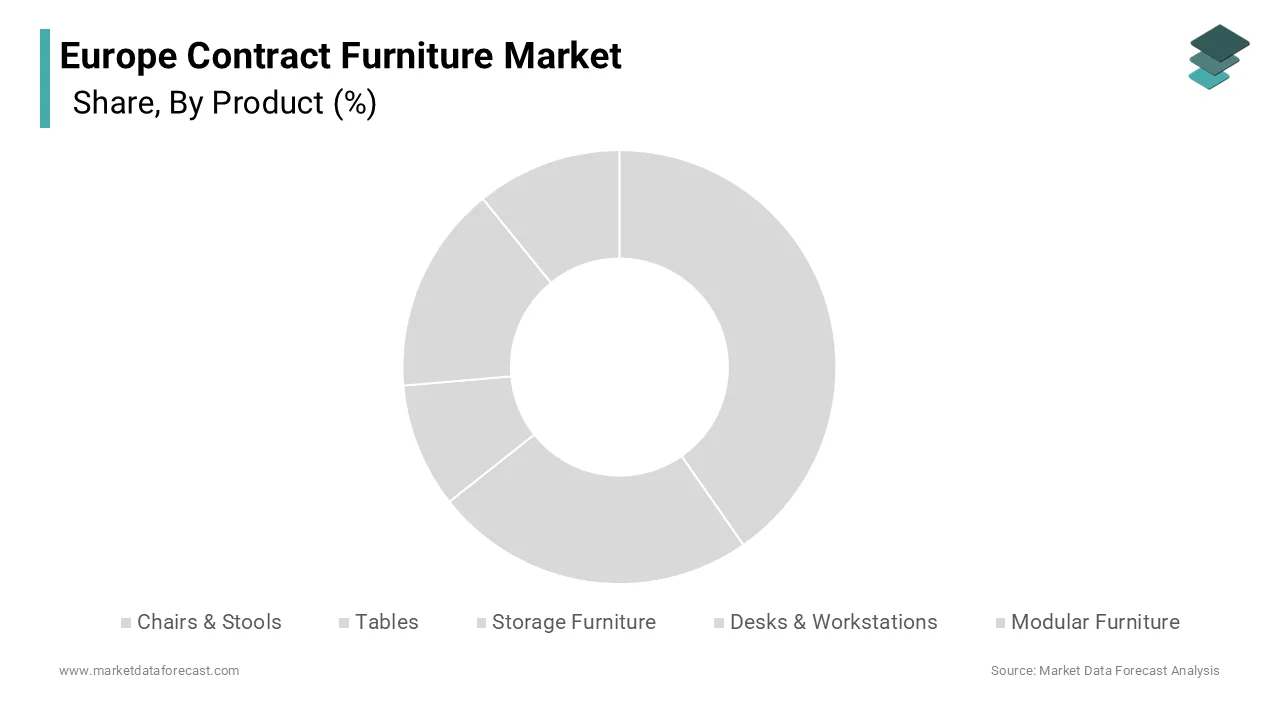
The storage furniture segment is projected to expand at a CAGR of 6.8% from 2025 to 2033. This acceleration is fueled by the convergence of hybrid work models, space optimization imperatives, and data privacy regulations requiring secure physical document handling. The architectural shift toward dense, flexible workspaces is also boosting the growth of this segment. As per the International Workplace Group, the average office density in major European cities increased by 18% between 2021 and 2025, compressing personal space and elevating demand for under-desk cabinets, mobile pedestals,s and modular storage walls that maximize vertical volume. The General Data Protection Regulation continues to mandate secure physical storage for sensitive personnel records, with the European Data Protection Board reporting that 42% of mid-sized firms upgraded filing infrastructure in 2025 to meet audit requirements.
By Material Insights
The Wood segment was the largest by accounting for 45.3% of the European contract furniture market share in 2025, owing to the deep-rooted tradition of craftsmanship, strong consumer preference for natural aesthetics, and widespread availability of sustainably managed timber sources. The European Environment Agency confirmed in 2025 that over 80% of public sector furniture tendersnow require FSC or PEFC certification, favoring responsibly sourced hardwoods and engineered wood panels. Additionally, the EU Timber Regulation has effectively curtailed illegal logging by ensuring that 96% of wood used in EU furniture production complies with legal harvesting standards, according to the European Commission. This regulatory clarity has bolstered buyer confidence and supported premium pricing for certified wood products. Moreover, innovations in cross-laminated timber and bamboo composites have enhanced durability and moisture resistance, extending wood’s applicability to high-traffic zones like schools and hospitals. These developments, combined with cultural affinity for natural materials, solidify wood’s position as the material of choice across diverse contract applications.
The steel segment is expected to grow at the fastest CAGR of 7.2%throughout the forecast period, owing to the increasing adoption ofsteel-framedd modular furniture in agile office environments. As per the European Institute of Innovation and Technology, over 55% of new co-working spaces launched in Europe in 2025 utilized steel-based desking systems due to their structural rigidity, ease of reconfiguration, and compatibility with integrated power and data conduits. Steel’s recyclability also aligns with the EU Green Deal objective.ArcelorMittal reported that 92% of steel used in European manufacturing is recovered and reused at the end of life, far exceeding recovery rates for most polymers. Furthermore, the hospitality sector’s shift toward minimalist industrial aesthetics in urban boutique hotels has elevated demand for powder-coated steel frames in seating and tables.
By Application Insights
The Office application segment accounted for a prominent share of the European contract furniture market in 2025. The structural transformation of office design paradigms is propelling the growth of the segment. As per the European Commission’s Urban Audit 2025, 71% of major European cities now incentivize office retrofits that support hybrid work through grants or tax credits, directly stimulating furniture refresh cycles. The shift from assigned desks to activity-based environments requires diverse furniture typologies, quiet pods, height-adjustable desks, and mobile whiteboards, all procured in bulk. Additionally, the EU’s revised Workplace Directive mandates minimum space and lighting standards per employee by compelling firms to upgrade outdated layouts. JLL’s 2025 European Office Fit Out Report noted that average refurbishment spend per workstation rose to 2800 euros in 2025, up from 2100 euros in 2021, driven by ergonomic and technological integration. These regulatory and behavioral forces ensure that offices remain the single largest and most consistent source of contract furniture demand despite the normalization of remote work.
The Educational Institutions segment is expanding at a CAGR of 8.1% during the forecast period,iod owing to the EU’s Recovery and Resilience Facility, which allocated over 12 billion euros in 2025 specifically for school and university upgrades across member states. This funding supported the construction or renovation of more than 3500 educational facilities in 2025 alone, each requiring complete furniture packages compliant with safety and accessibility standards. Concurrently, modern curricula emphasize group projects,ects peer instruction,uction and digital integration, demanding lightweight furniture, mobile, ht mobile and reconfigurable. Moreover, aging infrastructure in Southern and Eastern Europe is undergoing urgent replacement, where Eurostat data shows that 41% of school buildings in Italy and Romania were constructed before 1990 and lack basic ergonomic or acoustic provisions. These combined pressures create a sustained high-volume pipeline for durable, adaptable,ble adaptable and inclusive contract furniture solutions.
COUNTRY LEVEL ANALYSIS
Germany Contract Furniture Market Analysis
Germany was the top European player of the European contract furniture market by holding 18.2% of the share in 2025, owing to its robust industrial base,e strong export orientation, and dominance in ergonomic and sustainable design standards. Germany is home to globally recognized contract furniture brands, such as Wilkhahn and Sedus, whose R&D investments consistently set benchmarks for workplace innovation. The German government allocated 1.3 billion euros through its “Future of Work” initiative to modernize public sector offices and vocational schools, directly stimulating domestic furniture procurement. The Federal Institute for Research on Building Urban Affairs and Spatial Development reported that 72% of new commercial buildings certified under the DGNB sustainability scheme in 2025 specified locally manufactured contract furniture with Cradle to Cradle credentials. Additionally, Germany’s dual education system ensures a steady pipeline of skilled wood and metal craftspeople, mitigating labor shortages that constrain competitors.
France Contract Furniture Market Analysis
The French contract furniture market was ranked second with 18.2% of share in 2025, owing to the aggressive public investment in cultura,l educational, education, and municipal infrastructure, under the France Relance recovery plan. In 2025, the Ministry of Culture awarded 420 million euros in grants for library and museum renovations, directly driving demand for custom archival storage seating and display furniture. Simultaneously, the Ministry of National Education launched the “Campus du Futur” program targeting the modernization of 1200 higher education facilities by 2027, with a pipeline that generated over 800 million euros in furniture contracts in 2025 alone, according to the French Public Procurement Agency. French design philosophy emphasizing elegance, functionality, t,y and artisanal quality gives domestic manufacturers like Ligne Roset and Petite Friturea competitive edge in premium segments. The French Environment and Energy Management Agency also enforces strict material disclosure rules requiring all public furniture to declare carbon footprint and recyclability, which is accelerating the adoption of bio-composites and recycled metals.
United Kingdom Contract Furniture Market Analysis
The United Kingdom contract furniture market is likely to grow with the pent-up demand in the hospitality sector and corporate office repositioning strategies. Concurrently, London remains Europe’s largest hub for flexible office space, with IWG and WeWork adding 1.2 million square feet of new capacity in 2025, alone necessitating bulk orders for modular desking and breakout furniture. The UK’s updated Building Safety Act also mandatesfire-resistantt materials in public buildings, a requirement that has increased the specification of steel-framed and non-combustible upholstered furniture. Moreover, British designers continue to influence global trends with firms like Vitsoe and Barber & Osgerby embedding longevity and repairability into their contract offerings. These intersecting forces, tourism recovery,y workspace evolution, and regulatory tightening, sustain the UK’s position as a resilient atrend-settinging market.
Italy Contract Furniture Market Analysis
Italy's contract furniture market growth is driven by its unparalleled tradition of artisanal craftsmanship, high-end design, and the premium hospitality and luxury office segments. Clusters, such as the Brianza region near Mila,n host over 2000 specialized workshops producing bespoke contract solutions for global brands including Poltrona Frau and B&B Italia. In 2025, Italian contract furniture exports to the EU rose by 9.3% according to ICE Italian Trade Agency,cy driven by demand for design-led seating and tables in boutique hotels and flagship retail spaces across Paris, Berlin,,n and Amsterdam. The Italian Ministry of Economic Development’s “Made in Italy” certification program has further bolstered credibility, requiring traceability of materials and adherence to ethical labor practices. Additionally, Italy’s National Recovery Plan allocated 600 million euros in 2025 for university campus upgrades with a mandate to source 70% of furnishings from domestic manufacturers. This dual focus on global aesthetic leadership and domestic policy support ensures Italy remains a highly influential player despite higher production costs.
Netherlands Contract Furniture Market Analysis
The Netherlands' contract furniture market growth is propelled by the circular design principles, public procurement innovation, and agile workspace adoption. In 2025, the city of Amsterdam became the first European capital to implement a “furniture passport” system requiring material composition and reuse instructions for all municipal purchases. This regulatory foresight has nurtured firms like Ahrend and Gispen, which now offer furniture-as-a-service models with take-back guarantees.
KEY MARKET PLAYERS
Some of the companies that are playing a dominating role in the global Europe contract furniture market include
- Herman Miller, Inc.
- Steelcase Inc.
- HNI Corporation
- Haworth, Inc.
- KI (Krueger International)
- Vitra International AG
- Wilkhahn Wilkening + Hahne GmbH + Co. KG
- Interface, Inc. (contract seating & surfaces)
- Bene AG
- Sedus Stoll AG
- Hrmann Collection GmbH & Co. KG
- Versteel LLC
- Okamura Corporation
- JSI (Junk Seat International)
- Actiu
- Ahrend
- Vepa Office Furniture
- Davison Highley
- Orangebox (Republic of Fritz Hansen Group)
- BPGA (British Contract Furniture Association)
COMPETITIVE LANDSCAPE
Competition in the European contract furniture market is characterized by a blend of global design leaders, regional artisans, and agile niche specialists. While multinational corporations leverage scale,e innovation, and sustainability credentials to dominate the premium segment,s local manufacturers compete through craftsmanship,ip speed, customization, and cost efficiency in mid-tier projects. The market exhibits high product differentiation with intense focus on ergonomic performance, material transparency, and compliance with EU regulatory frameworks. Digitalization has intensified rivalry as firms embed smart technologies and data-driven services into physical products. Public procurement policies favoring circularity and local sourcing further fragment competitive dynamics. Despite moderate barriers to entry, brand reputation design, I, P, and service infrastructure remain decisive advantages. Continuous investment in R&D, sustainability certifications, and flexible business models defines the strategic posture of leading participantas they navigate evolving spatial and regulatory landscapes across diverse European economies.
TOP LEADING PLAYERS IN THE MARKET
- Vitra iSwitzerland-basedased global leader in design-oriented contract furniture, renowned for its collaborations with iconic designers and commitment to ergonomic innovation. The company plays a pivotal role in shaping workplace aesthetics across Europe through its high-end office and collaborative furniture systems. In recent years, Vitra has intensified its focus on sustainabili, ty, launching circular design initiatives, including furniture take-back programs and material transparency labeling. The company inaugurated a carbon-neutral production facility in Germany in 2025 and expanded its modular furniture offering to support hybrid work environments. These actions reinforce Vitra’s positioning as a premium provider that merges architectural integration with human-centered functionality across corporate education and cultural sectors in Europe and beyond.
- Steelcase is a US-headquartered multinational with deep penetration in the European contract furniture market through localized design centers and agile manufacturing hubs in France and the Netherlands. The company specializes in research-driven workplace solutions that integrate furniture, architecture, and digital tools. To strengthen its European footprint,t Steelcase launched its Smart furniture ecosystem in early 20,25 embedding IoT sensors into desks and partitions to support space utilization analytics. It also partnered with European universities to pilot inclusive design labs focused on neurodiversity and accessibility. By aligning its product development with EU sustainability directives and the hybrid work trend, Steelcase continues to influence commercial interior standards while expanding its service-based offering,s, such as furniture as a service, across key European economies.
- Haworth is a global contract furniture manufacturer with a strong European presence anchored in the United Kingdom,m Italy, a nd Sweden. Known for its balance of design quality and operational eefficiencycy Haworth serves diverse sectors including finance, healthcare, and education across the continent. The company accelerated its circular economy strategy by achieving Cradle to Cradle Gold certification for its entire Open Office portfolio sold in Europe. Haworth also introduced a modular reconfiguration service enabling clients to adapt existing furniture layouts without new procurement. Additionally, it expanded its Milan-based innovation studio to co-create localized solutions with European architects and interior designers. These steps underscore Haworth’s commitment to sustainable adaptability and deep regional engagement in evolving European workspaces.
TOP STRATEGIES USED BY THE KEY MARKET PARTICIPANTS
Key players in the European contract furniture market prioritize sustainability integration through certified materials circular esign, circular economy, and end-of-life take-back programs. They invest heavily in modular and reconfigurable product systems to align with hybrid work demands and space optimization trends. Strategic collaborations with architects, interdesignerssgner,s an, and technology firms enablco-creationon of integrated workplace ecosystems. Expansion of localized manufacturing and assembly hubs reduces lead times and carbon footprint while ensuring compliance with regional regulations. Companies also deploy furniture as a service model offer flexibility, lower upfront cost, and recurring revenue streams, particularly targeting SMEs and public institutions.
MARKET SEGMENTATION
This research report on the europe contract furniture market is segmented and sub-segmented into the following categories.
By Product
- Chairs & Stools
- Tables
- Storage Furniture
- Desks & Workstations
- Modular Furniture
- Others
By Material
- Wood
- Metal (Steel & Aluminum)
- Plastic
- Glass
- Composite & Sustainable Materials
By Application
- Offices
- Educational Institutions
- Hospitality
- Healthcare
- Retail
- Government & Public Buildings
By Country
- Germany
- France
- United Kingdom
- Italy
- Netherlands
- Spain
- Rest of Europe