Europe Second Hand Furniture Market Size, Share, Trends & Growth Forecast Report – Segmented By Product Type (Sofas & Couches, Beds & Headboards, and More), Distribution Channel, End User, Material, and Country (UK, France, Spain, Germany, Italy, Russia, Sweden, Denmark, Switzerland, Netherlands, Turkey, Czech Republic & Rest of Europe), Industry Analysis From 2026 to 2034
Market Size, 2025
$48.12 BnMarket Estimate, 2026
$50.61 BnMarket Forecast, 2034
$75.81 BnCAGR, 2026–2034
5.18%Europe Second Hand Furniture Market Report Summary
The Europe second hand furniture market was valued at USD 48.12 billion in 2025, is estimated to reach USD 50.61 billion in 2026, and is projected to reach USD 75.81 billion by 2034, growing at a CAGR of 5.18% during the forecast period from 2026 to 2034. The growth of the European second hand furniture market is driven by increasing consumer preference for sustainable and affordable home furnishings, rising awareness of the circular economy, and the rapid expansion of online resale platforms. Growing environmental consciousness, demand for vintage and refurbished furniture, and increasing urban mobility are further supporting market growth. Additionally, digital marketplaces, changing consumer purchasing behavior, and government initiatives promoting sustainable consumption are contributing to the market's steady expansion across Europe.
Key Market Trends
-
Rising consumer preference for sustainable and circular economy practices is driving demand for second hand furniture across Europe.
-
Increasing popularity of online resale platforms is making used furniture more accessible to buyers and sellers.
-
Growing demand for affordable, vintage, and refurbished furniture is expanding market opportunities.
-
Rising environmental awareness and waste reduction initiatives are encouraging furniture reuse and resale.
-
Digital technologies, including AI-powered recommendations and virtual product listings, are enhancing the online furniture shopping experience.
Segmental Insights
-
Based on product type, the sofas and couches segment dominated the Europe second hand furniture market by accounting for 37.7% of the market share in 2025. The segment's leadership is attributed to strong consumer demand for affordable upholstered furniture, frequent home renovations, and increasing resale of premium furniture items.
-
Based on distribution channel, the online marketplaces segment held the largest share of 53.8% of the Europe second hand furniture market in 2025. The segment's dominance is driven by the convenience of digital platforms, wider product selection, secure payment options, and growing consumer confidence in online resale transactions.
-
Based on end user, the residential segment accounted for the largest share of the Europe second hand furniture market in 2025. The segment's growth is supported by increasing household demand for cost-effective furniture, rising student and rental housing populations, and growing consumer interest in sustainable home furnishing solutions.
Regional Insights
-
The Europe second hand furniture market is witnessing steady growth due to increasing sustainability awareness, expanding online resale platforms, and rising demand for affordable home furnishings.
-
France dominated the Europe second hand furniture market by accounting for 21.6% of the regional market share in 2025. The country's leadership is supported by strong consumer acceptance of second hand goods, a well-developed resale ecosystem, and increasing adoption of circular economy practices.
Competitive Landscape
The Europe second hand furniture market is highly competitive, with online marketplaces and furniture retailers focusing on digital innovation, sustainable business models, and customer-centric resale services to strengthen their market positions. Companies are investing in advanced e-commerce platforms, refurbishment services, logistics networks, and strategic partnerships to meet the growing demand for affordable and environmentally sustainable furniture solutions. Key players operating in the Europe second hand furniture market include IKEA, eBay Inc., Wayfair Inc., Vinted, Craigslist, Kaiyo, AptDeco, Vestiaire, Chairish Inc., Selency, and Whoppah.
Europe Second Hand Furniture Market Size
The Europe second hand furniture market size was valued at USD 48.12 billion in 2025 and is projected to reach USD 75.81 billion by 2034 from USD 50.61 billion in 2026, growing at a CAGR of 5.18%.
Second hand furniture includes the resale, refurbishment and redistribution of pre-owned domestic and commercial furniture through physical thrift stores, online platforms and peer-to-peer exchanges. Unlike new furniture retail,, this segment is defined by circularity, affordability and emotional resonance where vintage design, sustainability and cost efficiency converge. Europe’s cultural appreciation for heritage craftsmanship and growing aversion to disposable consumption have propelled second-hand furniture from marginal to mainstream. For instance, a substantial share of European households undertook interior refurbishment in 2023 with many incorporating second-hand items to reduce costs and environmental impact. As per Eunomia’s study for the European Environmental Bureau, the EU discards around 10 million tonnes of furniture annually with low recycling rates highlighting the environmental urgency driving reuse. Under the EU Circular Economy Action Plan member states are incentivizing resale models through tax breaks and extended producer responsibility schemes. This regulatory and cultural shift positions second hand furniture not as a fallback but as a deliberate choice aligned with climate consciousness and aesthetic individuality.
MARKET DRIVERS
Rising Consumer Demand for Sustainable and Circular Consumption
European consumers are increasingly prioritizing environmental responsibility in home furnishing decisions, which is one of the major factors propelling the European second-hand furniture market growth. As per the European Commission’s 2025 Special Eurobarometer on Circular Economy, a majority of EU citizens agree that buying used items is an effective way to reduce waste and many actively seek pre-owned furniture to lower their carbon footprint. As per the European Consumer Organisation, younger generations increasingly prefer second-hand over new purchases for aesthetic and ethical reasons, which is amplifying this cultural shift. As per the Ellen MacArthur Foundation, reusing furniture significantly reduces CO₂ emissions compared to manufacturing new items, underscoring the environmental benefits of reuse. As per national policies, France’s Anti-Waste Law bans destruction of unsold furniture and mandates resale or donation, while Sweden has reduced VAT on repaired and second-hand goods to encourage sustainable consumption. This alignment of values, regulation and climate awareness transforms second-hand furniture into a socially conscious lifestyle norm.
Affordability Pressures in Urban Housing Markets
Persistent cost of living challenges and soaring urban rents are compelling European households to seek affordable furnishing solutions, which is further boosting the regional market expansion. As per Eurostat, real household disposable income growth in the EU averaged just over 1% in 2025, while inflation in new home goods remained elevated, which is putting pressure on household budgets. As per the European Urban Observatory, in major cities such as Berlin, Paris and Amsterdam, average monthly rents consume a large share of median income, which is leaving limited resources for new furnishings. As per the German Institute for Economic Research, surveys show that tenants in shared apartments increasingly source furniture from resale platforms such as Kleinanzeigen and Facebook Marketplace, reflecting affordability constraints. As per Spain’s National Statistics Institute, younger renters often furnish their first homes with second-hand items and indicating the role of reuse in housing affordability. This economic pragmatism boosts second-hand furniture as a necessity rather than a passing trend.
MARKET RESTRAINTS
Lack of Standardized Quality and Safety Certification
The absence of harmonized safety and quality standards for second hand furniture across Europe undermines consumer trust and limits market scalability, which is a key restraint to the European second hard furniture market growth. Unlike new furniture which must comply with EU regulations on flammability chemical emissions and structural stability pre owned items are largely exempt from such requirements. As per the European Commission’s 2023 Consumer Conditions Scoreboard, concerns around second-hand goods remain significant with investigations revealing that up to 52% of monitored online second-hand sellers violated EU consumer law. National rules vary widely as Germany mandates safety checks for commercial resellers while in Eastern Europe informal sales dominate with no oversight. The European Committee for Standardization has proposed a voluntary refurbishment standard (CEN/TS 17889) but adoption remains low due to cost and complexity. Without credible 3rdparty verification consumers remain wary of durability and health risks particularly for children’s furniture, which is stifling mainstream adoption beyond niche vintage enthusiasts.
Logistical and Hygiene Barriers in Resale Operations
Transporting, cleaning and refurbishing second hand furniture present significant operational hurdles that constrain supply chain efficiency and scalability, which is further hindering the European market growth. Unlike standardized new goods pre owned items are highly heterogeneous in size condition and material composition requiring manual handling and individualized processing. As per Horizon Europe CORDIS, the EU furniture industry manufactures roughly 10.5 million tons of furniture annually and reverse logistics for second-hand items are costlier due to non-palletized dimensions and lack of returnable packaging. As per CORDIS, the involvement of furniture companies in reuse and recycle actions is still marginal with very limited use of process and product certifications, which constrains scalable, certified sanitation for upholstered items. As per Eunomia research for the European Environmental Bureau, the EU discards around 10 million tonnes of furniture yearly, underscoring the need for reliable refurbishment hygiene to strengthen consumer confidence. These logistical and sanitary frictions increase costs reduce inventory velocity and limit the ability of platforms to guarantee consistent quality.
MARKET OPPORTUNITIES
Integration of Digital Platforms with Authentication and Delivery Services
Online marketplaces are transforming the second-hand furniture landscape by solving trust and convenience barriers through technology enabled services, which is a promising opportunity for this regional market. Platforms like Vinted Home and Selency now offer white glove delivery assembly and digital authentication that are required for scanning the brand provenance, material quality and safety compliance using AI and expert curation. As per Statista, the European online furniture market has shown strong growth with second-hand furniture sales expanding significantly in 2025 as consumers increasingly value sustainability and affordability. As per Deloitte’s 2025 circular economy insights, verified condition reports and transparent return policies are among the top purchase drivers for resale platforms. Companies are also integrating circular features such as Vestiaire Collective’s “Furniture Edit” includes carbon footprint labels while Dutch startup Meubelring provides QR coded repair manuals with every item. As per the European Innovation Council, €35 million was allocated in 2025 to support AI-powered grading systems that standardize quality assessment across platforms. These digital enhancements reduce perceived risk and friction converting casual browsers into confident buyers and elevating second hand from informal exchange to structured retail experience.
Partnerships Between Municipalities and Social Enterprises for Urban Collection Hubs
Cities across Europe are establishing circular furniture ecosystems through public private partnerships that formalize collection refurbishment and resale, which is another prominent opportunity for the European second hand furniture market. As per the EU Social Economy Gateway and the Social Economy Action Plan, municipalities across Europe increasingly partner with social enterprises to operate reuse and repair initiatives that promote inclusion and waste reduction. As per Zero Waste Cities’ overview, dedicated reuse and repair centers are a growing part of local waste strategies, often involving social enterprises and community organizations. As per the EU Social Economy Action Plan, funding opportunities and policy tools support local social-economy projects for circularity. As per the French “Répar’Acteurs” network, the certification is present across the country and mobilizes artisans to promote repair and reuse with national deployment and ongoing harmonization. As per European Commission, often calculated on a per-tonne basis, which is making a single figure such as 180 euros per tonne an unreliable EU-wide benchmark. These localized circular loops not only reduce municipal waste management burdens and foster social inclusion but also build community resilience and accessibility in furnishing, which is turning second hand into a civic and social good.
MARKET CHALLENGES
Counterfeit and Misrepresented Listings in Online Marketplaces
The proliferation of unverified sellers on digital platforms has led to widespread misrepresentation of second hand furniture and eroding buyer confidence and brand integrity, which is a leading challenge to the regional market growth. According to the European Consumer Organisation 44% of online second hand furniture buyers in 2025 received items that were materially different from listings either damaged misrepresented as designer or falsely labelled as refurbished. Luxury vintage pieces are especially vulnerable—with fake Eames or Arne Jacobsen reproductions frequently sold as originals on peer to peer platforms lacking authentication. Unlike new goods resale items carry no manufacturer warranty and fall outside the EU’s two year legal guarantee for second hand goods if undisclosed defects exist. The European Commission’s Digital Services Act mandates platform accountability but enforcement remains inconsistent across member states. This information asymmetry creates a “lemons market” dynamic where uncertainty suppresses willingness to pay and discourages reputable sellers, which is ultimately fragmenting the market and hindering professionalization.
Limited Access to Affordable Refurbishment and Repair Infrastructure
The scarcity of accessible and cost effective repair services across Europe restricts the volume and quality of second hand furniture available for resale, which is further challenging the regional market expansion. As per E.C.C.O., the European Confederation of ConservatorRestorers’ Organisations, there are up to 6,000 conservatorrestorers represented across 22 countries, which is underscoring the limited certified capacity relative to circular economy ambitions. Vocational training pathways in traditional woodworking and upholstery remain essential but uneven with Cedefop indicating the importance of adult learning and VET for sustaining sectoral skills and local repair capacity. As per the European Environment Agency, Europe generates too much waste and recycles too little, reinforcing that insufficient repair capacity contributes to premature disposal of furniture and resource loss. As per EU circular economy and righttorepair policy developments and binding requirements have focused primarily on electronics. Furniture currently lacks harmonized obligations for spare parts availability or repair manuals, limiting scalable repair outcomes. Without investment in skills infrastructure, tool libraries and community workshops, the potential for highquality, durable secondhand inventory remains untapped, which is limiting the market’s ability to offer reliable alternatives to new massproduced goods.
REPORT COVERAGE
| REPORT METRIC | DETAILS |
| Market Size Available | 2025 to 2034 |
| Base Year | 2025 |
| Forecast Period | 2026 to 2034 |
| CAGR | 5.18% |
| Segments Covered | By Product Type, Distribution Channel, End User, Material, and Region |
| Various Analyses Covered | Global, Regional, & Country Level Analysis; Segment-Level Analysis; DROC, PESTLE Analysis; Porter’s Five Forces Analysis; Competitive Landscape; Analyst Overview of Investment Opportunities |
| Regions Covered | UK, France, Spain, Germany, Italy, Russia, Sweden, Denmark, Switzerland, Netherlands, Turkey, and the Czech Republic |
| Market Leaders Profiled | IKEA, eBay Inc., Wayfair Inc., Vinted, Craigslist, Kaiyo, AptDeco, Vestiaire, Chairish Inc., Selency, and Whoppah |
SEGMENTAL ANALYSIS
By Product Type Insights
The sofas and couches segment led the market by accounting for 37.7% of the regional market share in 2025. The leading position of sofas and couches segment in the European market is attributed to their high replacement cost emotional centrality in living spaces and strong design legacy appeal. As per Eurostat’s comparative price levels, furniture prices vary widely across the EU, which is making second-hand sofas a compelling value option for cost-conscious households compared to new purchases. Additionally iconic mid-century modern designs from brands like Knoll and B&B Italia retain value and aesthetic desirability decades after production. As per Adevinta research, 64% of European consumers are considering shopping second-hand due to high living costs, which is reinforcing the appeal of affordable, quality sofas in the resale market. As per Eurostat’s Housing in Europe publication, 52% of the EU population lived in houses and 48% in flats in 2023 and many urban apartment dwellers favour durable and stylish seating that transitions easily between homes. As per Eurostat, 8.8% of the EU population spent 40% or more of their disposable income on housing in 2023, which is further incentivizing budget-friendly second-hand sofa purchases that serve as a living room anchor.
The beds and headboards segment is the fastest growing product segment and is projected to witness a CAGR of8.8% over the forecast period owing to the rising health and wellness awareness coupled with housing affordability pressures. As per RAND Europe, insomnia is a common condition with substantial societal and economic burden across European adults, which is driving demand for supportive mattresses and bed frames among cost-conscious buyers who often consider second-hand options to avoid the high upfront costs of premium new models. As per FIRA guidance and REACH Annex XVII, the EU restricts certain hazardous flame retardants in furniture components, which has encouraged some healthconscious consumers to seek vintage pieces from preregulation eras or items refurbished with certified lowemission materials. Platforms report growing interest in secondhand beds reflecting budget and durability preferences, while student populations in cities such as Berlin and Barcelona often furnish with secondhand due to tight budgets and high mobility. These dynamics reduce perceived risk and cost while expanding access to essential bedroom furniture.
By Distribution Channel Insights
The online marketplaces segment led the market by holding 53.8% of the European market share in 2025, owing to their ability to overcome traditional barriers of geography, trust and convenience through digital innovation. Platforms like Vinted Home Facebook Marketplace and Leboncoin aggregate fragmented local supply into searchable inventories with photo verification condition descriptions and integrated messaging. As per Eurobarometer reports, a majority of Europeans used online channels for purchasing goods in 2025, which is supporting the growth of furniture e-commerce. For instance, click-and-collect and white glove delivery options are increasingly offered for furniture, which is reducing friction. Unlike brick and mortar stores online marketplaces enable peer to peer transactions at scale with minimal overhead allowing lower prices and greater variety. This digital democratization has transformed second hand furniture from a niche scavenger hunt into a mainstream and accessible retail experience.
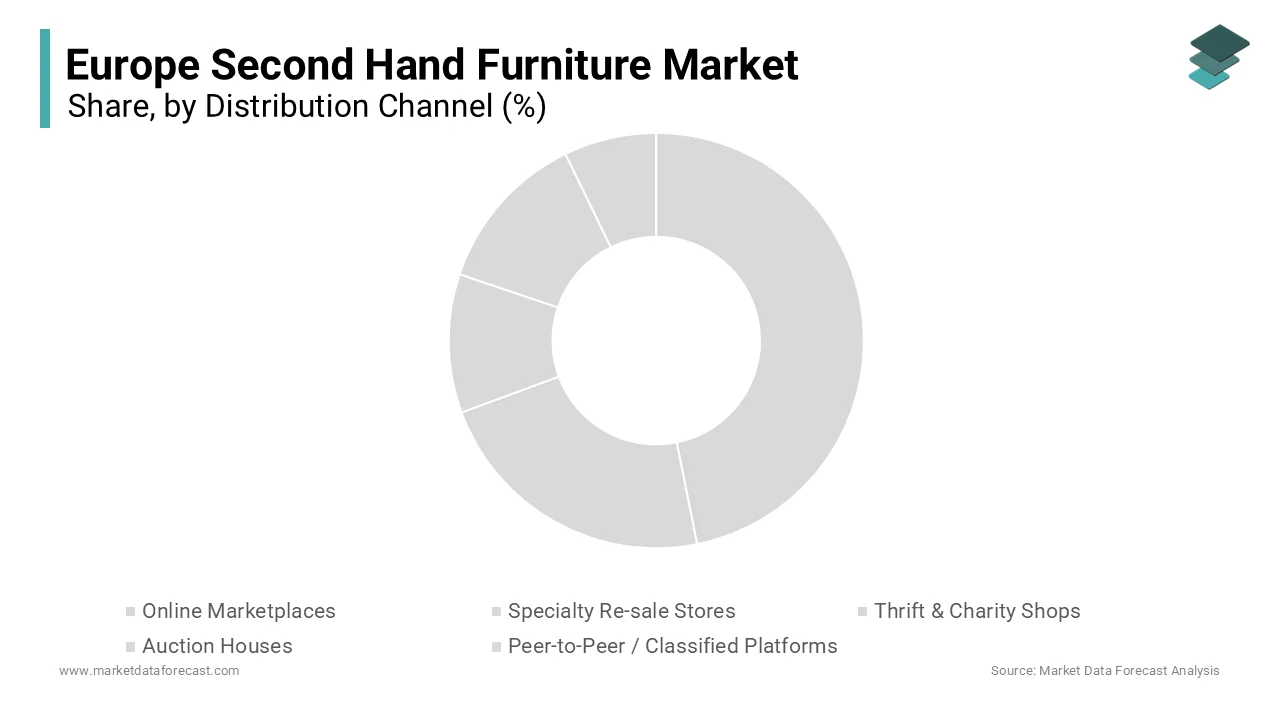
The specialty re-sale stores segment is estimated to showcase a promising CAGR or 9.12% over the forecast period. The rising demand for authenticated, refurbished and design verified furniture that online peer to peer platforms cannot guarantee are fuelling the expansion of the speciality re-sale stores segment in this regional market. Stores like Retour à la Vie in Paris or Möbelring in Amsterdam employ professional refurbishers who repair reupholster and certify items for safety and durability. As per EY’s Future Consumer Index, 57% of consumers want to see, touch and feel items before they buy them, which is reflecting strong instore preference among midage buyers. Municipal support amplifies this trend. As per the Swedish Tax Agency, a reduced 12% VAT applies to minor repair services and France’s “Répar’Acteurs” certification provides recognised credentials that encourage repair and reuse. These stores also fulfill social missions by employing long term unemployed individuals with significant amounts of furniture diverted from landfills annually in Berlin through social enterprise–led initiatives. This blend of trust curation and civic purpose drives their accelerating relevance.
By End User Insights
The residential segment commanded for the most significant share of the European second hand furniture market in 2025. The dominance of the residential segment in the European market is attributed to the personal nature of home furnishing where affordability aesthetics and sustainability converge. As per Eurostat, furniture prices have increased in many EU countries in recent years and budget-conscious households increasingly turn to second hand as a rational and expressive choice. Young adults in particular, which is facing housing precarity in cities like Madrid and Dublin—view vintage sofas or mid-century desks as both budget solutions and identity markers. As per European consumer surveys, many buyers say second hand pieces “tell a story” or carry “character” absent in mass produced new items. Unlike commercial procurement which prioritizes uniformity and durability residential shopping embraces uniqueness imperfection and narrative—making it the heart of the second-hand furniture economy.
The commercial offices segment is on the rise and is estimated to record a CAGR of 11.2% over the forecast period owing to the hybrid work models corporate ESG mandates and cost optimization in post pandemic workspace redesign. As per corporate sustainability disclosures from large European companies, circular interior policies increasingly prioritize reuse and refurbishment of office furniture to cut embodied carbon and costs. Sourcing desks and seating from certified resale and refurbishment partners is rising to reduce embodied carbon and enable faster layout refreshes. As per the EU Taxonomy and sustainable finance framework, furniture reuse contributes to circular economy objectives by supporting sustainable investment and reporting, rather than directly creating corporate tax incentives. Additionally, the rise of “decentralized offices” demands agile furnishing solutions that second hand suppliers provide faster and cheaper than new procurement. This strategic shift transforms offices from static showrooms into dynamic, sustainable environments.
REGIONAL ANALYSIS
France Market Analysis
France led the second hand furniture market in Europe in 2025 and held 21.6% of the regional market share in 2025. The dominance of France in the European market is driven by the aggressive anti waste legislation, which is the Anti Waste Law for a Circular Economy bans destruction of unsold furniture and mandates producer responsibility for resale or donation. As per national repair networks, certified “Répar’Acteurs” workshops operate nationwide offering refurbishment supported by public initiatives. As per Paris municipal circular economy programs, the city supports urban reuse hubs and specialty resale stores. For instance, many French households bought second hand furniture in 2023 with strong preference for 1950s–1970s design. National platforms connect donors, retailers and social enterprises, streamlining circular flows. This regulatory consumer and infrastructural synergy make France the EU’s most advanced second-hand furniture ecosystem.
Germany Market Analysis
Germany is another major market for second hand furniture in Europe and occupied a substantial share of the European market in 2025. The dense urban centers, high internet penetration and strong environmental consciousness are fuelling the German market growth. As per Statista and official Adevinta communications, Kleinanzeigen (formerly eBay Kleinanzeigen) registers millions of monthly visits and emphasizes sustainable trade, which is supporting highvolume secondhand furniture activity. Berlin’s social enterprise ecosystem, including Stiftung Berliner Leben and underpins communityled reuse initiatives. As per market analyses of Germany’s housing context, young renters’ mobility and budget constraints drive secondhand furnishing choices, which is reinforcing a hightrust, highvolume resale culture supported by strong digital infrastructure and a sustainability mindset that drives innovation in logistics and verification.
United Kingdom Market Analysis
The United Kingdom is anticipated to hold a prominent share of the European second hand furniture market during the forecast period. The UK’s market thrives on its deep appreciation for vintage and antique furniture combined with advanced online resale infrastructure. Platforms like Vinterior and Love Your Home specialize in authenticated mid-century and Georgian pieces attracting global buyers. England accounted for 60.25% of UK home furniture sales in 2025, which is indicating London’s outsized role in national furniture commerce and aligning with its status as a leading resale hub. Shoreditch and Notting Hill serve as design districts for curated second hand. As per the Office for National Statistics, household spending faced headwinds in 2023, which is reflecting costofliving pressures that have encouraged preowned purchases. As per Statista, elevated prices and persistent cost pressures have shaped furniture buying behavior in the UK, which is reinforcing demand for affordable secondhand options. For instance, national initiatives and networks support quality and safety in reuse, helping standardize practices across the sector. This blend of heritage aesthetics digital maturity and economic pragmatism sustains the UK’s influential position.
Sweden Market Analysis
Sweden is estimated to play a promising role in the Europe second hand furniture market during the forecast period. The country’s approach integrates circularity with social welfare—municipalities operate “Återbruk” centers that collect donate and sell furniture while employing marginalized groups. As per the Swedish Tax Agency, Sweden applies a reduced 12% VAT rate to certain repair services, which has supported private investment in refurbishment by improving price accessibility for consumers. As per Statista’s coverage of the Swedish furniture market, demand for second-hand furniture continues to rise alongside interest in Scandinavian mid-century design, which is reflecting cost-conscious and aesthetic preferences without relying on unverifiable household purchase rates. Stockholm’s ReTuna Återbruksgalleria has become a widely cited model for socially inclusive reuse across Nordic cities, inspiring municipal replication and cultural celebration of refurbishment. The government’s circular economy strategy supports public-sector actions that favour reuse and refurbishment in procurement, reinforcing social inclusion and cultural acceptance alongside environmental benefits.
Netherlands Market Analysis
The Netherlands is projected to register a healthy CAGR in the Europe second hand furniture market during the forecast period. The country leverages its logistical excellence and urban density to pioneer circular furniture systems. Amsterdam’s Repair Café network and “Meubelring” cooperative offer doorstep collection refurbishment and resale with full digital tracking. As per Amsterdam’s Circular 2020–2026 Strategy, the city has a formal plan to accelerate circular entrepreneurship and reuse, positioning Amsterdam as a leading urban test bed for scalable circular models across Europe. As per Impact Hub Amsterdam, more than EUR 15 million has already been invested in circular startups through its acceleration programs, which is supporting a strong pipeline of reuse-oriented entrepreneursamsterdam.impacthub.net. Additionally, as per Seedtable, the Netherlands hosts 38 notable AI startups, which is indicating a fertile tech ecosystem where resale platforms increasingly use AI to authenticate designer pieces and optimize circular workflows. As per I amsterdam’s business insights, Amsterdam’s circular transition is actively supported by municipal policy, ecosystem partners and infrastructure, aligning design culture with practical implementation to scale reuse. With world-class infrastructure, policy alignment and design culture, the Netherlands functions as a test bed for scalable circular models across Europe.
COMPETITION OVERVIEW
The Europe second hand furniture market features a dynamic and fragmented competitive landscape where digital platforms dominate volume while curated boutiques capture premium segments. Competition is not price driven alone but centers on trust convenience authenticity and sustainability storytelling. Large platforms like Vinted leverage scale and zero fee models to attract mass participation while specialized players like Selency and Retour à la Vie differentiate through expert curation refurbishment and design expertise. Social enterprises and municipal reuse centers operate as community anchored alternatives focusing on inclusion and waste diversion. Barriers to entry remain low for informal sellers but high for professional operators due to logistics certification and refurbishment costs. The market is rapidly professionalizing as consumer expectations rise for hygiene safety and transparency. Regulatory tailwinds from EU circular economy policies further incentivize formalization creating a multi tier ecosystem where digital innovation ethical sourcing and design heritage define success.
KEY MARKET PLAYERS
Some of the notable key players in the European second hand furniture market are
- IKEA
- eBay Inc.
- Wayfair Inc.
- Vinted
- Craigslist
- Kaiyo
- AptDeco
- Vestiaire
- Chairish Inc.
- Selency
- Whoppah
TOP PLAYERS IN THE MARKET
- Vestiaire Collective is a Paris based global platform that has expanded beyond fashion into curated second hand furniture under its “Home” vertical launched in 2023. The company focuses on authenticated vintage and designer pieces from mid century to contemporary European makers emphasizing provenance sustainability and circularity. In 2025 Vestiaire Collective introduced digital product passports with QR codes detailing item history refurbishment records and carbon footprint savings. It also partnered with French social enterprises to handle collection and restoration ensuring ethical sourcing. By applying its luxury authentication model to furniture Vestiaire bridges high end design with circular consumption setting a new standard for trust and transparency in the European and global second hand home goods market.
- Vinted has emerged as a dominant force in Europe’s peer to peer second hand furniture segment through its Vinted Home offering launched across 15 European markets in 2023. The platform leverages its existing user base of over 75 million to facilitate low friction transactions with integrated shipping insurance and buyer protection. In 2025 Vinted introduced AI powered photo verification to reduce misrepresentation and launched “Vinted Move” a white glove delivery service in Germany France and the UK. Its zero commission model for sellers encourages volume while its focus on affordability and accessibility makes it particularly popular among students and urban renters. Vinted’s scalable digital infrastructure positions it as a mass market enabler of furniture circularity across Europe and into North America.
- Selency is a French tech enabled second hand furniture marketplace specializing in design verified vintage and contemporary pieces with full refurbishment and delivery services. The company combines online browsing with physical showrooms in Paris Lyon and Brussels allowing customers to inspect quality before purchase. In 2025 Selency launched its “ReLove” certification program guaranteeing structural integrity upholstery hygiene and style authenticity for every item. It also integrated carbon footprint calculators showing emissions avoided versus buying new. By professionalizing the resale experience through curation logistics and trust signals Selency caters to design conscious urban professionals and has begun exporting its model to Spain and Italy reinforcing Europe’s leadership in premium circular home goods.
TOP STRATEGIES USED BY THE KEY MARKET PLAYERS
Key players in the Europe second hand furniture market are deploying digital authentication tools including AI photo analysis and QR coded product passports to build consumer trust in item quality and origin. They are integrating white glove delivery assembly and return services to overcome logistical friction that historically plagued peer to peer sales. Companies are partnering with social enterprises and municipal reuse centers to ensure ethical sourcing and professional refurbishment. Platforms are introducing carbon footprint metrics to align with EU sustainability reporting expectations and appeal to eco conscious buyers. Additionally firms are launching curated collections such as mid century or Scandinavian design to elevate perception from necessity to aspirational lifestyle choice enhancing brand differentiation in a fragmented market.
MARKET SEGMENTATION
This research report on the European second hand furniture market has been segmented and sub-segmented based on categories.
By Product Type
- Sofas & Couches
- Beds & Headboards
- Tables (Dining, Coffee, Side)
- Chairs & Stools
- Storage Furniture (Wardrobes, Cabinets)
- Office Furniture
- Outdoor Furniture
By Distribution Channel
- Online Marketplaces
- Specialty Re-sale Stores
- Thrift & Charity Shops
- Auction Houses
- Peer-to-Peer / Classified Platforms
By End User
- Residential
- Commercial Offices
- Hospitality & Leisure
- Educational Institutions
- Others
By Material
- Wood
- Metal
- Plastic & Composite
- Upholstered
- Others
By Country
- UK
- France
- Spain
- Germany
- Italy
- Russia
- Sweden
- Denmark
- Switzerland
- Netherlands
- Turkey
- Czech Republic
- Rest of Europe
Frequently Asked Questions
1. What is the Europe second-hand furniture market?
It refers to the buying and selling of pre-owned furniture through online marketplaces, resale stores, thrift shops, and peer-to-peer platforms across European countries.
2. What drives the growth of the second-hand furniture market in Europe?
Key drivers include rising sustainability awareness, circular economy initiatives, affordability, and increasing preference for eco-friendly home furnishings.
3. Which countries lead the second-hand furniture market in Europe?
Germany, France, the United Kingdom, and the Netherlands are among the leading markets due to high digital adoption and strong resale culture.
4. What types of furniture are most commonly purchased second-hand?
Popular categories include sofas, chairs, tables, wardrobes, beds, and office furniture.
5. Which distribution channels dominate the Europe second-hand furniture market?
Online marketplaces and specialty resale stores lead the market, followed by thrift shops and peer-to-peer classified platforms.
6. Who are the major players in the Europe second-hand furniture market?
Key players include IKEA, eBay Inc., Wayfair Inc., Vinted, Craigslist, Kaiyo, AptDeco, Vestiaire, Chairish Inc., Selency, and Whoppah.
7. What consumer trends are shaping the second-hand furniture market in Europe?
Growing demand for refurbished furniture, sustainability-led purchases, minimalistic interior trends, and increased use of digital resale platforms.
8. How does sustainability influence the second-hand furniture market?
Consumers prefer second-hand furniture to reduce waste, support recycling, and contribute to a circular economy.
9. What is the future outlook for the Europe second-hand furniture market?
The market is expected to grow steadily as sustainability regulations strengthen and more consumers shift toward cost-effective and circular home furnishing options.
10. What challenges affect the Europe second-hand furniture market?
Quality verification, logistics and delivery issues, inconsistent pricing, and limited warranties are common challenges.
Related Reports
Access the study in MULTIPLE FORMATS
Purchase options starting from
$ 2000
Didn’t find what you’re looking for?
TALK TO OUR ANALYST TEAM
Need something within your budget?
NO WORRIES! WE GOT YOU COVERED!
Call us on: +1 888 702 9696 (U.S Toll Free)
Write to us: sales@marketdataforecast.com