- Product Description Description
- Table of Contents TOC
- List of Table & Figure LOT
- Get Free Sample PDF Sample PDF
Market Size, 2025
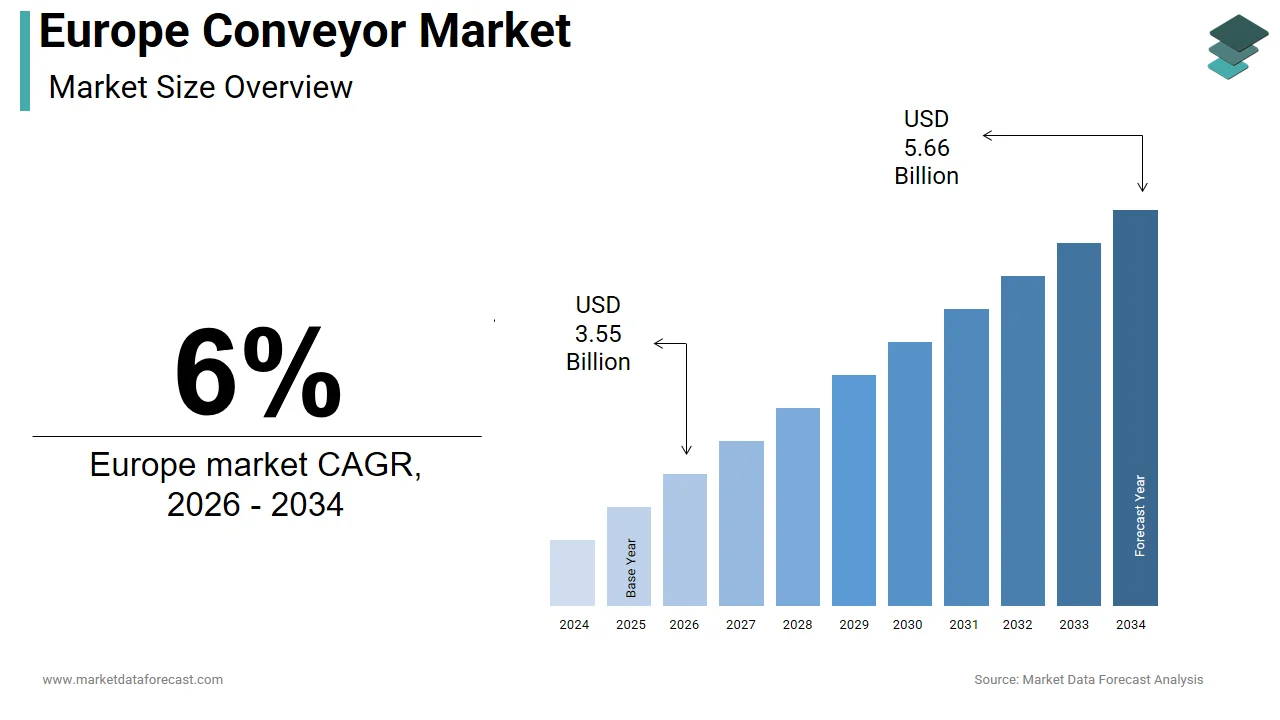
$3.35 BnMarket Estimate, 2026
$3.55 BnMarket Forecast, 2034
$5.66 BnCAGR, 2026–2034
6%Europe Conveyor Market Size
The Europe conveyor market was valued at USD 3.35 billion in 2025, is estimated to reach USD 3.55 billion in 2026, and is projected to reach USD 5.66 billion by 2034, growing at a CAGR of 6% from 2026 to 2034.
A conveyor is a mechanical handling apparatus used to automatically transport materials, goods, or people along a predetermined path. These systems are foundational to operational efficiency in sectors such as automotive assembly, food processing, e-commerce fulfillment, and pharmaceutical packaging. The Europe conveyor market is distinguished by high engineering standards, integration with Industry 4.0 technologies, and compliance with stringent safety and energy efficiency directives. As per multiple studies, manufacturing remains the largest employer in the European Union's business economy, characterized by a sustained shift toward integrating advanced robotics and automated logistics to address labor constraints and increase output efficiency. According to various sources, under the framework of the Digital Europe Programme, industrial facilities are increasingly adopting networked manufacturing platforms that utilize artificial intelligence and real-time data to optimize maintenance and operational uptime. Furthermore, the European Environment Agency reports that industrial energy consumption accounted for approximately 25% to 26% of the EU’s final energy use, driving demand for energy-optimized conveyor drives compliant with Ecodesign Regulation 2019/1781. This convergence of automation, sustainability, and digitalization defines the modern European conveyor landscape as a critical enabler of resilient and competitive industrial infrastructure.
MARKET DRIVERS
Expansion of E-Commerce Fulfillment Infrastructure Across Urban Centers
The exponential growth of online retail has triggered a continent-wide expansion of automated fulfillment and sortation centers, which is one of the major factors propelling the growth of the Europe conveyor market. This shift is directly fueling demand for high-speed, flexible conveyor systems. According to research, online retail across the European Union has maintained an upward trajectory, supported by a rising number of digital consumers and a market-wide shift toward faster fulfillment to meet heightened delivery expectations. In response, leading European e-commerce retailers are aggressively integrating advanced robotics and automated sorting systems into their logistics networks to enhance efficiency and mitigate rising labor costs. Germany continues to expand its industrial logistics footprint, with a clear focus on high-capacity sorting facilities that utilize extensive automated conveyor networks to handle growing parcel volumes. The Netherlands has solidified its position as a premier European gateway for e-commerce logistics, characterized by a high concentration of technologically advanced distribution centers near major transit hubs. These systems must handle irregularly shaped packages while minimizing jams and energy use, a challenge met through modular design and variable frequency drives. Rising pressure in last-mile logistics necessitates continued innovation in space-efficient, high-throughput conveying systems.
Mandatory Energy Efficiency Standards Under EU Ecodesign Regulations
European regulatory mandates are compelling industries to replace legacy conveyor systems with energy-optimized alternatives, which further boosts the expansion of the Europe conveyor market. These new systems reduce carbon footprints and operational costs. European energy efficiency regulations have established stricter performance benchmarks for industrial motors, leading to the widespread adoption of high-efficiency drive systems and the gradual removal of older, less efficient motor classes from the market. The implementation of advanced efficiency standards is projected to significantly lower electricity demand across the European Union, contributing to broader goals for industrial decarbonization and energy security. A substantial portion of the German manufacturing sector is actively modernizing internal logistics and drive systems to align with new regulatory requirements and internal sustainability targets. Similarly, in France, government-backed financial incentives are increasingly tied to measurable improvements in energy performance, encouraging industrial operators to invest in more efficient material handling and processing equipment. Manufacturers like Interroll and SSI SCHAEFER have responded with 48-volt DC roller conveyors that consume less power than traditional AC systems. This regulatory push transforms conveyors from passive transport tools into active contributors to corporate sustainability targets.
MARKET RESTRAINTS
Persistent Shortage of Skilled Automation Technicians and System Integrators
A critical shortage of personnel trained in mechatronics, programmable logic controllers, and industrial networking limits the growth of the Europe conveyor market. This hampers the deployment and maintenance of advanced conveyor systems. The European industrial sector is navigating a persistent shortage of specialized technical talent, with major manufacturing hubs experiencing significant difficulty in filling roles related to advanced robotics and system integration. Conveyor systems in modern warehouses integrate dozens of sensors, motor controllers, and safety circuits that require precise calibration, tasks beyond the scope of general maintenance staff. Limited availability of skilled systems integrators has become a primary constraint for the logistics industry, often extending the timelines for the deployment of complex automated handling systems. In Northern European markets, the scarcity of certified technical personnel has influenced the pace of industrial modernization, as firms must account for labor availability when planning major equipment installations. Vocational training programs have not kept pace with technological complexity. Fewer share of EU technical schools offer courses in modern conveyor diagnostics. Failure to urgently invest in training and standards will widen the chasm between automation goals and operational capability, capping market potential regardless of high demand.
Fragmented Safety Certification Requirements Across Member States
Divergent national interpretations of machinery safety directives create compliance friction for conveyor manufacturers operating across borders, which inhibits the expansion of the Europe conveyor market. The Machinery Regulation 2023/1230 establishes baseline requirements. Individual countries impose supplementary validation protocols for emergency stops, guarding, and risk assessments. Manufacturers follow unified European safety standards for machinery distances. However, regional inspection bodies continue to emphasize rigorous local compliance audits for noise and safety, reflecting long-standing national technical traditions in industrial safety management. Industrial equipment suppliers are navigating a complex landscape of evolving European regulations and administrative requirements, which can extend project timelines and increase the overall financial burden of product market entry. Post Brexit complications further compound the issue. UKCA marking now requires separate conformity assessments for British deployments. These inconsistencies discourage SMEs from exporting and delay system commissioning, particularly in multi-site rollouts for pan-European retailers. Absent a harmonized safety assessment framework, market participants will continue to bear excessive administrative and financial burdens, thereby restricting scalability and stifling innovation.
MARKET OPPORTUNITIES
Integration of Autonomous Mobile Robots with Fixed Conveyor Networks
The convergence of autonomous mobile robots and fixed conveyor systems offers key growth areas for the Europe conveyor market. This allows for the creation of hybrid material flow architectures that combine flexibility with throughput. Leading European logistics providers are deploying AMR fleets that interface seamlessly with conveyor endpoints for goods-to-person picking and pallet transport. The deployment of autonomous mobile robots across European logistics hubs has accelerated, with a growing emphasis on hardware and software compatibility to ensure seamless handovers between mobile units and fixed automated systems. Logistics leaders in the Benelux region are leveraging mobile robotic fleets to automate internal transport tasks, significantly alleviating the physical workload on warehouse staff and improving the efficiency of the induction process. Similarly, Automotive manufacturing facilities in Germany are increasingly integrating autonomous logistics platforms to orchestrate the precise delivery of components to assembly lines, ensuring high-speed production sequences are maintained without manual intervention. This synergy requires standardized communication protocols like VDA 5050 and OPC UA, which the EU’s Gaia X initiative is actively promoting. As labor costs rise and SKU complexity increases, hybrid systems offer the optimal balance of adaptability and speed, opening new revenue streams for conveyor OEMs in software middleware and interface hardware.
Adoption of Circular Economy Principles in Conveyor Design and Lifecycle Management
The region’s circular economy mandate is escalating innovation in conveyor systems designed for disassembly, reuse, and material recovery, which provides potential prospects for the Europe conveyor market. New European regulatory frameworks are increasingly mandating that physical goods meet higher standards for longevity and circularity, encouraging a shift toward product designs that simplify maintenance, component replacement, and end-of-life material recovery. Companies like DEMATIC and Vanderlande have launched conveyor platforms with bolted rather than welded joints, enabling full disassembly after 15 years of service. Adopting circular economy principles in the manufacturing process has the potential to significantly decrease the environmental footprint of industrial products while simultaneously extending their functional utility through better durability and reuse. Logistics facilities in Germany are exploring innovative service-based business models, such as equipment leasing and performance-based contracts, to align operational costs with actual usage and promote the refurbishment of industrial assets. Additionally, recycled aluminum and bio-based polymers are replacing virgin materials. Leading manufacturers of material handling components are increasing their focus on the use of sustainable and secondary materials in their product lines to meet corporate environmental targets and customer demand for circular supply chains. Corporate sustainability reporting is becoming mandatory under CSRD. Consequently, conveyors will transition from capital expenses to circular service assets.
MARKET CHALLENGES
Supply Chain Volatility for Critical Components Like Motors and Bearings
Unstable supply chains for essential components such as electric motors, bearings, and frequency inverters continue to obstruct the growth of the Europe conveyor market. Geopolitical tensions and export controls have constrained access to rare earth magnets and semiconductor chips used in high-efficiency drives. High-efficiency motor supply chains have experienced significant fluctuations in availability as manufacturers align production with strict new European energy standards, leading to a long-term trend of extended procurement windows for premium industrial drives. Similarly, Ongoing maritime instability on major trade routes from Asia has introduced persistent uncertainty into the supply of critical mechanical components, forcing European equipment integrators to adjust project timelines and inventory strategies. Small and medium system integrators, lacking inventory buffers, are particularly vulnerable. Extreme component shortages of previous years have largely subsided. However, a significant portion of the German engineering sector continues to manage operational delays caused by targeted gaps in specialized technical parts. Reshoring initiatives like the EU Chips Act aim to bolster local production. However, motor and bearing manufacturing remains concentrated outside Europe. 1. The market will contend with cost inflation, project slippage, and forced redesigns that undermine reliability and client trust. 2. This will continue until regional resilience improves.
Rising Cybersecurity Risks in Connected Conveyor Systems
Integrating conveyor systems into IIoT networks increases their vulnerability to cyberattacks, which hampers the expansion of the Europe conveyor market. This can halt production, compromise data, and cause safety issues. Modern systems feature IP-enabled motor controllers, cloud-connected condition monitoring, and remote diagnostics, all potential attack vectors. Automated logistics and industrial production environments have emerged as high-priority targets for cyber threats, as the increasing connectivity of operational technology creates new vulnerabilities within the supply chain. Cyber incidents targeting the automotive logistics sector have demonstrated the potential to disrupt critical sorting and distribution infrastructure, leading to significant operational downtime across the manufacturing value chain. Legacy systems are especially vulnerable; many still run unpatched Windows Embedded OS versions, non-compliant with EU NIS2 Directive requirements. Hardening these systems demands continuous vulnerability scanning, zero-trust architectures, and secure boot mechanisms, yet only a portion of EU conveyor operators have dedicated OT security teams. Cybersecurity must become intrinsic to conveyor design rather than an afterthought. Until then, operational continuity in smart factories remains at risk.
REPORT COVERAGE
| REPORT METRIC | DETAILS |
| Market Size Available | 2025 to 2034 |
| Base Year | 2025 |
| Forecast Period | 2026 to 2034 |
| Segments Covered | By Product Type, End-user Industry, Load Type, Automation Level, Service, and Country. |
| Various Analyses Covered | Global, Regional, and Country-Level Analysis, Segment-Level Analysis, Drivers, Restraints, Opportunities, Challenges; PESTLE Analysis; Porter’s Five Forces Analysis, Competitive Landscape, Analyst Overview of Investment Opportunities |
| Countries Covered | UK, France, Spain, Germany, Italy, Russia, Sweden, Denmark, Switzerland, Netherlands, Turkey, Czech Republic, and the Rest of Europe. |
| Market Leaders Profiled | SSI Schaefer AG, Interroll Group, Mecalux S.A., Dematic (KION Group), Beumer Group GmbH and Co. KG, KNAPP AG, Swisslog AG (KUKA AG), and Others. |
SEGMENTAL ANALYSIS
By Product Type Insights
The belt conveyor segment dominated the Europe conveyor market and accounted for a 42.8% share in 2025. The dominance of the segment is driven by its versatility, cost efficiency, and suitability for continuous transport of bulk materials and packaged goods across diverse industries. Their dominance is particularly pronounced in food processing, e-commerce fulfillment, and mining applications, where gentle handling and high throughput are essential. The vast agricultural output of the European Union continues to drive demand for automated processing infrastructure that adheres to strict food safety and contact material regulations. Automated parcel hubs across Europe increasingly rely on specialized belt-driven induction systems to maintain high throughput and accommodate a growing variety of package geometries in high-speed sorting environments. Modular conveyor solutions have become a preferred choice for German small and medium-sized enterprises seeking scalable and easily adaptable material handling infrastructure to support flexible production lines. Additionally, advancements in low-friction thermoplastic belts and energy-efficient drum motors have reduced power consumption compared to legacy systems. This combination of adaptability, regulatory compliance, and operational economy ensures belt conveyors remain the backbone of European material flow infrastructure.
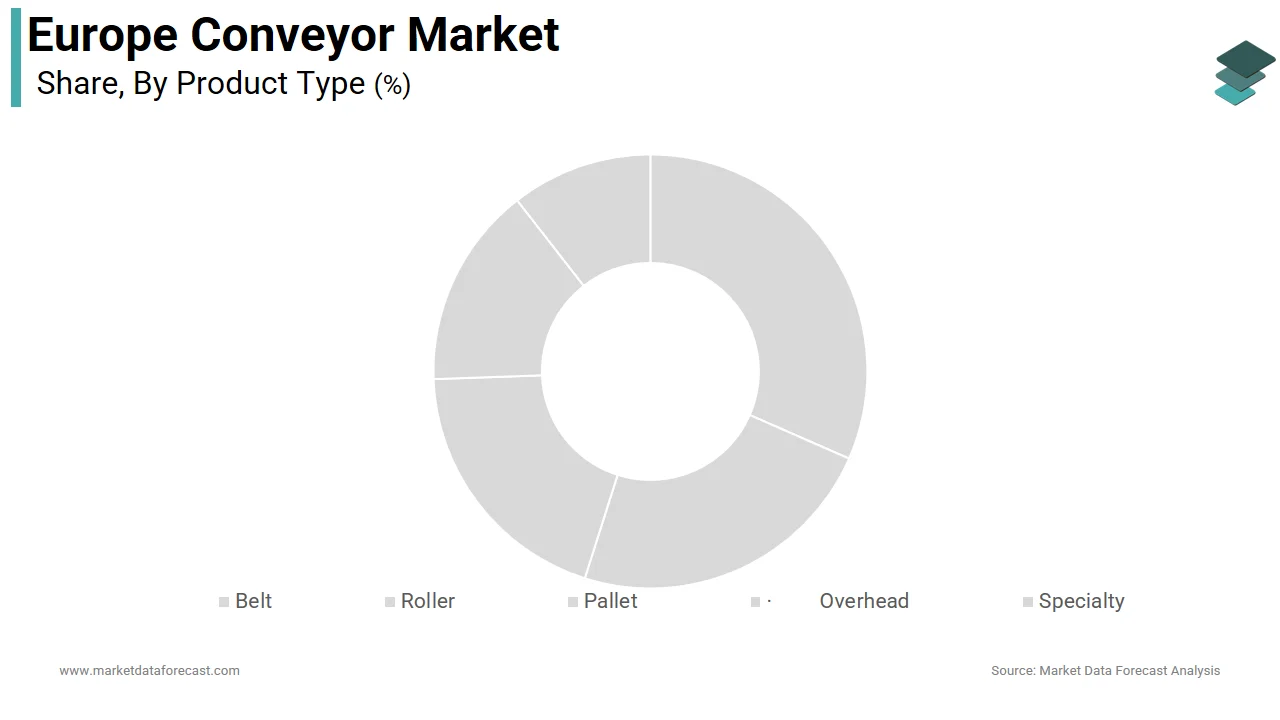
The roller conveyors segment is estimated to register the fastest CAGR of 7.8% from 2026 to 2034 due to the rise of automated e-commerce warehouses and just-in-time manufacturing, where zero-pressure accumulation and precise parcel control are critical. Unlike belt systems, roller conveyors enable individual item tracking, dynamic routing, and seamless integration with robotic picking arms. Automated distribution centers across Europe continue to rely heavily on versatile roller-based transport systems as a core component of their internal logistics architecture, often integrating them with other modular technologies to maximize throughput. Large-scale fulfillment hubs in the Dutch logistics corridor are utilizing extensive automated conveyor networks and advanced sorting technology to achieve high-volume processing and reliable operational uptime. Similarly, automotive suppliers like Bosch use accumulation roller conveyors in assembly plants to synchronize part delivery with production takt times. The shift toward 48-volt DC roller technology, championed by Interroll and Siemens, has further boosted adoption by cutting energy use and enabling plug-and-play scalability. In an era of surging online retail and rising wages, roller conveyors stand out as the primary infrastructure for next-generation distribution.
By End User Industry Insights
The e-commerce and retail segment led the Europe Conveyor market and captured a 36.8% share in 2025. The leading position of the segment is attributed to the continent’s rapid shift toward online shopping and automated fulfillment. The demand stems from the need to process millions of daily orders with speed, accuracy, and minimal human intervention. Continued growth in the European digital market has prompted significant capital expenditure in logistics infrastructure as retailers work to compress delivery timelines and meet the heightened service expectations of online consumers. Amazon has extensively expanded its physical presence across Europe, deploying high-density automated warehouses that utilize vast internal conveyor networks to orchestrate the rapid movement of millions of items. Driven by a competitive landscape and consumer demand for speed, a large majority of the German retail sector is prioritizing the modernization of its fulfillment operations through targeted technological investments. These facilities rely heavily on modular belt and roller conveyors linked to warehouse execution systems that dynamically adjust routing based on real time inventory and carrier availability. Additionally, returns processing, a growing pain point, requires dedicated conveyor loops for inspection and restocking, further amplifying demand. Urban micro-fulfillment centers are proliferating in cities like Paris and Berlin. Consequently, compact, scalable conveyor architectures have become indispensable to maintaining service levels in a hyper-competitive retail landscape.
The automotive manufacturing segment is anticipated to witness the fastest CAGR of 8.2% during the forecast period, owing to the industry’s transition to electric vehicle production, which demands highly flexible, clean, and synchronized material flow systems for battery assembly, motor integration, and final vehicle build. The European automotive industry is undergoing a structural shift toward electric mobility, prompting manufacturers to reconfigure assembly lines with heavy-duty and precision-engineered transport systems to accommodate unique component requirements. BMW’s Leipzig plant uses overhead chain conveyors with torque-controlled carriers to transport EV chassis without floor obstructions, while Volkswagen’s Zwickau facility employs pallet conveyors with RFID tracking for just-in-sequence battery module delivery. European regulatory frameworks are prioritizing the expansion of domestic clean technology manufacturing, which is accelerating the establishment of large-scale production facilities that utilize high-precision automated systems for complex battery assembly processes. Unlike traditional automotive lines, these systems must accommodate frequent product changes, spurring demand for modular, reconfigurable conveyors with digital twin-enabled validation. Europe is accelerating its mobility transformation. Consequently, conveyor systems are evolving from passive transport to active production enablers.
By Service Insights
The installation services segment held the majority share of 48.1% of the Europe conveyor market in 2025. The supremacy of the segment is credited to the complexity and customization inherent in deploying integrated material handling systems. Unlike off-the-shelf equipment, modern conveyors require precise alignment, electrical integration, safety circuit validation, and software commissioning to function within larger warehouse or factory ecosystems. European intralogistics projects frequently require tailored engineering solutions to fit existing warehouse footprints, sustaining a high demand for specialized technical teams to manage the integration of complex automated systems. Major automated distribution centers require extensive multi-month installation periods and large, multi-disciplinary technical crews to execute the mechanical assembly and complex digital synchronization of modern sorting networks. The European Machinery Directive mandates that all conveyor installations undergo risk assessment and CE marking validation, adding regulatory layers that only certified integrators can fulfill. Additionally, the rise of multi-vendor systems, combining AMRs, sorters, and AS/RS, requires deep interoperability expertise during installation. This labor and knowledge-intensive phase remains the largest service cost component, ensuring installation retains dominance despite the rise of digital maintenance models.
The predictive maintenance segment is likely to experience the fastest CAGR of 12.4% over the forecast period. The rapid growth of the segment is propelled by the integration of Industrial Internet of Things sensors, cloud analytics, and artificial intelligence to anticipate failures before they cause downtime. Modern conveyors now embed vibration sensors, temperature monitors, and current meters that stream data to centralized platforms for anomaly detection. Small and medium-sized logistics providers across Europe are increasingly prioritizing digital transformation strategies that leverage data analytics to anticipate equipment failures and minimize operational downtime. Leading intralogistics providers are expanding their digital service portfolios with cloud-integrated monitoring tools designed to optimize the reliability and performance of automated transport systems. Similarly, Dematic’s Predictive Care platform uses machine learning to forecast bearing wear in sortation rollers, scheduling replacements during planned maintenance windows. Significant European Union research and innovation funding is being channeled into the development of artificial intelligence for industrial applications, supporting the broader adoption of advanced asset management technologies. Uptime is becoming a key competitive differentiator in e-commerce and manufacturing. Therefore, predictive maintenance is transitioning from an optional add-on to a core operational strategy.
COUNTRY-LEVEL ANALYSIS
Germany Conveyor Market Analysis
Germany dominated the Europe conveyor market held a 24.7% share in 2025. Its status as the manufacturing heart of the continent, where automation is not optional but essential for survival, supports the dominance of the German market. A major force behind growth is the automotive sector, which relies heavily on sophisticated assembly line conveyors to maintain high production volumes. Major original equipment manufacturers located within German borders create a consistent demand for heavy-duty and precision conveying systems. The national push toward Industry 4.0 has accelerated the integration of smart sensors and Internet of Things capabilities into standard conveyor units. According to VDMA data, German manufacturers of material handling and intralogistics equipment experienced a decline in incoming orders during the recent full fiscal year. This growth reflects a strategic shift toward fully automated factories designed to mitigate labor shortages and enhance supply chain resilience. Government subsidies for digital transformation have further encouraged small and medium enterprises to upgrade their legacy systems. The market status remains robust with projections suggesting continued expansion as logistics networks become increasingly complex. German engineering firms continue to set global standards for reliability and efficiency, ensuring the country retains its top rank.
France Conveyor Market Analysis
France was the second largest player in the Europe conveyor market and captured a share of 15.8% share in 2025. The nation serves as a major junction for European trade, requiring advanced material handling solutions across multiple sectors. A diverse mix of aerospace, food and beverage, and pharmaceutical industries fuels the demand for specialized conveyor technologies in France. Recent government initiatives aimed at reindustrialization have triggered significant capital investment in modernizing factory floors and distribution centers. The French logistics and warehousing sector is growing rapidly due to rising e-commerce, increased manufacturing, and automation investment. Consequently, there is a surging demand for advanced technologies like conveyor systems. The rising volume of e-commerce transactions has forced retailers to adopt high-speed sorting systems to meet consumer expectations for rapid delivery. Sustainability mandates are also shaping the market as companies increasingly prefer energy-efficient electric drives over traditional hydraulic systems. Major hubs near Paris and Lyon are undergoing massive infrastructure upgrades to handle increased cargo flows from ports and airports. Analysts predict that ongoing investments in rail and intermodal transport will further boost the requirement for heavy-duty conveying infrastructure. This strategic focus ensures France remains a pivotal growth engine within the European material handling ecosystem.
United Kingdom Conveyor Market Analysis
The United Kingdom secures a noteworthy share of the Europe conveyor market owing to a powerful retail sector and one of the most advanced e-commerce landscapes in the world. Labor shortages in the warehousing sector have become a main accelerator, forcing UK businesses to accelerate automation adoption at an unprecedented pace. Retailers are investing heavily in automated storage and retrieval systems integrated with complex conveyor networks to maintain operational efficiency. According to the UK Material Handling Association, the UK material handling industry has experienced a market normalization period following a previous surge in investment, resulting in a contraction of total bookings rather than growth. The national commitment to achieving net zero emissions is influencing procurement decisions with a clear shift toward electric-driven and low-carbon footprint conveyors. London continues to act as a central node for logistics innovation, attracting substantial venture capital into supply chain technology startups. Statistical evidence suggests that online sales now account for nearly thirty percent of total retail turnover, necessitating faster order fulfillment capabilities. The urgency to reduce dependency on manual labor has made conveyor systems a critical component of business continuity strategies. These dynamics ensure the UK retains its status as a key contributor to regional market expansion even amidst broader economic uncertainties.
Italy Conveyor Market Analysis
Italy experienced a steady growth in the Europe conveyor market due to its world-renowned fashion, luxury goods, and packaging industries, to sustain steady demand for precise and gentle conveying solutions. Small and medium-sized enterprises form the backbone of the Italian economy and are increasingly upgrading their production lines to stay competitive in global markets. The need for delicate handling of high-value items such as leather goods and ceramics drives the adoption of specialized low-friction conveyor belts. According to ISTAT reports from late 2025/early 2026, Italian industrial production showed a recovery trend, with notable monthly growth in November 2025 driven by energy and capital goods. This upward movement indicates a strengthening, albeit gradual, turnaround in manufacturing activity. The geographical advantage of serving as a gateway to Southern Europe enhances its role as a distribution hub requiring extensive conveyor networks. Recent trade agreements have opened new export channels, prompting manufacturers to scale up their material handling capacities significantly. Investment in digital transformation within the manufacturing sector is expected to drive double-digit growth for smart conveyor segments in the coming years. The blend of traditional craftsmanship and modern automation defines the unique market character of Italy. Local manufacturers are also focusing on modular designs that allow for quick reconfiguration to adapt to changing product lines.
Spain Conveyor Market Analysis
Spain is likely to grow in the Europe conveyor market over the forecast period, owing to its booming tourism-related food processing and automotive sectors. The nation has emerged as a preferred location for international companies establishing distribution centers due to its strategic location. The strategic position of Spain, connecting Europe with Africa and Latin America, has led to a surge in the construction of mega warehouses equipped with state-of-the-art conveying systems. Government incentives for foreign direct investment have attracted major logistics players who require robust material handling infrastructure to manage high cargo volumes. Studies indicate that the logistics and transport sector in Spain is experiencing significant growth, driven by the strong resurgence of international travel and trade, along with high-value investments in infrastructure. The renewable energy sector is also contributing to market growth as solar panel manufacturers require specialized conveyors for their assembly lines. Urbanization trends in cities like Madrid and Barcelona are driving last-mile delivery innovations that depend on compact and flexible conveyor designs. The food and beverage industry remains a strong pillar with strict hygiene standards driving demand for stainless steel and easy-to-clean conveyor systems. Projections suggest that continued infrastructure development will propel Spain to capture a larger portion of the regional market in the near future. This growth trajectory highlights the increasing importance of Spain in the broader European supply chain network.
COMPETITIVE LANDSCAPE
The Europe conveyor market features a competitive landscape shaped by technological sophistication, regulatory compliance, and service depth rather than price alone. Global leaders like Interroll, Dematic, and SSI SCHAEFER dominate through proprietary technologies, extensive service networks, and deep integration with Industry 4.0 ecosystems. Competition centers on energy efficiency, modularity, cybersecurity, and lifecycle support. While large integrators control complex turnkey projects, specialized component manufacturers thrive by offering standardized, plug-and-play solutions for SMEs. The market sees moderate consolidation as software capabilities become critical differentiators; vendors without native warehouse execution platforms struggle to compete. Regional strengths vary: Germany excels in automotive and industrial conveyors, the Netherlands leads in e-commerce sortation, and Southern Europe focuses on food processing lines. New entrants face high barriers due to certification requirements, long qualification cycles, and the need for local technical support. However, opportunities exist in predictive maintenance, circular design, and hybrid AMR conveyor integration. Overall, the market rewards those who combine engineering excellence with digital intelligence and sustainability.
KEY MARKET PLAYERS
The leading companies operating in the Europe conveyor market include:
- SSI Schaefer AG
- Interroll Group
- Mecalux S.A.
- Dematic (KION Group)
- Beumer Group GmbH and Co. KG
- KNAPP AG
- Swisslog AG (KUKA AG)
TOP PLAYERS IN THE MARKET
- Interroll Group, headquartered in Switzerland, is a global leader in roller conveyor technology and a pivotal force in the Europe conveyor market. The company pioneered the 48-volt DC roller drive system, now an industry standard for energy-efficient parcel handling in e-commerce and logistics. Interroll supplies core components to major integrators across Europe and operates production facilities in Germany, France, and the Czech Republic. It also expanded its modular conveyor curve portfolio to support high-density sortation in urban micro fulfillment centers. These innovations reinforce Interroll’s role as an enabler of sustainable, intelligent material flow across the continent.
- Dematic, a subsidiary of Germany’s KION Group, is a leading global provider of integrated automated material handling solutions with deep roots in the European market. The company designs and deploys end-to-end conveyor systems for e-commerce giants, automotive manufacturers, and retail distribution centers. Dematic emphasizes software-driven orchestration through its SynQ warehouse execution platform, which dynamically optimizes conveyor routing in real time. The company also enhanced its modular belt conveyor line for food safety compliance, featuring seamless stainless steel frames and washdown-resistant motors, strengthening its position in regulated industries.
- SSI SCHAEFER Group, based in Austria, is a major European engineering firm specializing in customized conveyor and intralogistics systems for industrial and retail applications. The company serves clients across automotive, pharmaceuticals, and consumer goods sectors with scalable, modular conveyor architectures. SSI SCHAEFER integrates sustainability into its core design philosophy, offering systems with lower energy consumption through regenerative braking and smart zoning. The company also partnered with leading AMR providers to develop hybrid material flow solutions, positioning itself at the intersection of fixed and mobile automation.
TOP STRATEGIES USED BY THE KEY MARKET PARTICIPANTS
Key players in the Europe conveyor market prioritize energy efficiency by adopting 48-volt DC motorization and regenerative drive technologies to comply with EU Ecodesign regulations. They invest in predictive maintenance platforms using IoT sensors and artificial intelligence to minimize unplanned downtime in high-throughput environments. Companies expand modular product portfolios to enable rapid reconfiguration for e-commerce and flexible manufacturing. Strategic partnerships with autonomous mobile robot developers create hybrid material flow ecosystems. Vertical integration of software and hardware ensures seamless control through warehouse execution systems. Emphasis on food safety and hygiene drives innovation in stainless steel and washdown-compatible conveyors. Training academies and digital twins enhance customer proficiency and reduce commissioning errors. These strategies collectively address the dual imperatives of sustainability and operational resilience in modern logistics.
MARKET SEGMENTATION
This research report on the Europe conveyor market has been segmented and sub-segmented into the following categories.
By Product Type
- Belt
- Roller
- Pallet
- Overhead
- Specialty (Spiral, Climbing, Sorting)
By End-user Industry
- Airport
- E-commerce and Retail
- Automotive Manufacturing
- General Manufacturing
- Food and Beverage
- Pharmaceuticals
- Mining and Bulk Handling
By Load Type
- Unit Load
- Bulk Load
By Automation Level
- Manual
- Semi-Automated
- Fully Automated / Smart Conveyors
By Service
- Installation
- Preventive Maintenance
- Predictive / IIoT-Enabled Maintenance
By Country
- United Kingdom
- France
- Spain
- Germany
- Italy
- Russia
- Sweden
- Denmark
- Switzerland
- Netherlands
- Rest of Europe