- Product Description Description
- Table of Contents TOC
- List of Table & Figure LOT
- Get Free Sample PDF Sample PDF
Market Size, 2025
$8.17 MnMarket Estimate, 2026
$8.19 MnMarket Forecast, 2034
$11.75 MnCAGR, 2026–2034
4.12%Executive Summary: Europe Copper Market
- Market Scope: Comprehensive regional copper market analysis covering material sourcing types, application sectors, country-specific leadership frameworks, and key strategic developments.
- Market Valuation: Valued at 8.17 million tons (2025), estimated at 8.19 million tons (2026), and projected to reach 11.75 million tons by 2034, registering a robust CAGR of 4.12% (2026–2034).
- Primary Growth Drivers: Rapid electrification of transport systems (with BEVs consuming ~80 kg of copper) and aggressive renewable energy and grid modernization deployments under the EU Green Deal. Opportunities include circular economy integration and advanced recycling infrastructure, balanced against supply constraints.
Key Market Segment Metrics (2026–2034)
| Category | Leading Segment (2024/2025 Position) | Fastest-Growing Segment |
|---|---|---|
| By Source / Material | Recycling segment (held 42.3% share due to Europe’s entrenched circular economy policies and scrap collection) | Advanced scrap-recovery and sustainably sourced secondary copper technologies |
| By Application Sector | Building and construction application segment (led with 38.3% share, driven by wiring and HVAC systems) | Transportation segment (expected to register the fastest CAGR of 7.2% due to road and rail electrification) |
| By Region / Country | Germany (dominated regional market with a 22.3% share, supported by advanced manufacturing and Energiewende) | European hubs accelerating grid modernization and electric vehicle manufacturing infrastructure |
Major Market Players & Market Structure
Market Structure: Highly competitive European copper production and recycling landscape featuring major metal refiners and industrial fabricators competing intensely on advanced scrap processing, vertical integration, and green energy supply partnerships.
Key Companies: Aurubis AG, KME Group, Wieland-Werke AG, Boliden AB, Atlantic Copper, Metallo-Chimique International, KGHM Polska Miedź S.A., Luvata, and Kabelwerke Brugg AG.
Europe Copper Market Size
The europe copper market was valued at 8.17 million tons in 2025, is expected to have a 4.12% CAGR from 2026 to 2034, and is projected to reach 11.75 million tons by 2034 from 8.19 million tons in 2026.

Europe does not possess significant primary copper reserves and relies heavily on imports and recycling to meet its annual demand, which exceeds one million metric tons. The building and construction segment represents an additional twenty %. Geopolitical disruptions in global supply chains and stringent environmental regulations continue to shape procurement strategies across the region. The market’s trajectory is increasingly tied to decarbonization mandates and technological transitions rather than traditional macroeconomic cycles, reflecting a structural shift in copper’s strategic importance within Europe’s sustainable development framework.
MARKET DRIVERS
Electrification of Transport Systems Drives Copper Consumption
The rapid electrification with charging infrastructure and ancillary systems is boosting the growth of the Europe copper market. The electric vehicles require three to four times more copper than internal combustion engine vehicles, with battery electric models consuming approximately 80 kilograms per unit. This surge directly translates into heightened copper requirements, as each public charging station incorporates between five and ten kilograms of copper, depending on power capacity.
Expansion of Renewable Energy Infrastructure Fuels Copper Demand
The aggressive deployment of renewable energy systems, with copper consumption given the metal’s irreplaceable role in photovoltaic cells, wind turbine generators, and grid interconnection hardware, is propelling the growth of Europe's copper market. Onshore wind farms utilize approximately 3.6 tons of copper per megawatt, while offshore installations require nearly double that amount due to subsea cabling and transformer requirements. The European Union added 15.7 gigawatts of new wind capacity in 2023, with offshore projects accounting for 4.3 gigawatts. The solar photovoltaic installations reached 56 gigawatts in 2023. The grid investments will exceed 500 billion euros by 2030 to accommodate renewable integration and cross-border electricity flows. This infrastructure overhaul demands extensive copper-based conductors, transformers, and switchgear. The energy transition could elevate the region’s annual copper demand by over 700,000 metric tons by 2035 compared to baseline levels observed in 2020.
MARKET RESTRAINTS
Geopolitical Volatility Disrupts Copper Supply Chains
The geopolitical instability in key copper-producing and transit regions is inhibiting the growth of the European copper market. According to the study, Chilean copper production declined by 3.2 % in 2023 due to prolonged labor strikes and community blockades at major mining sites. The Red Sea shipping crisis triggered by Houthi attacks has rerouted European imports through the Cape of Good Hope, increasing freight costs by up to 30% and extending delivery lead times by 2 to 3weeks. Europe’s reliance on Russian refined copper further complicates procurement despite sanctions, as indirect imports via third countries such as Kazakhstan and Serbia persist.
Stringent Environmental Regulations Increase Operational Costs
Europe’s rigorous environmental legislation, while advancing sustainability goals that elevate compliance costs and operational complexity for copper producers and fabricators, is also hampering the growth of Europe's copper market. The best available techniques for emissions control require significant capital expenditure for pollution abatement systems. Moreover, the EU Emissions Trading System now includes upstream metal processing under its carbon pricing mechanism, with allowances trading above 80 euros per ton in 2023. This imposes direct financial burdens on energy-intensive refining operations, which consume approximately ten megawatt-hours of electricity per metric ton of cathode copper. The Water Framework Directive further restricts wastewater discharge parameters, compelling plants to implement closed-loop water recycling systems that increase both capital and maintenance outlays.
MARKET OPPORTUNITIES
Urban Mining and Secondary Copper Recovery Present Growth Avenues
The expansion of urban mining initiatives offers a compelling opportunity to bolster Europe’s copper supply through enhanced recovery from end-of-life products and industrial scrap. Europe already recycles approximately 2.1 million metric tons of copper annually, representing forty-two % of total consumption. However, significant untapped potential remains, particularly in the recovery of copper from obsolete electrical and electronic equipment, which contains up to 25% copper by weight. Advanced hydrometallurgical and electrochemical refining technologies now enable 99.99 % purity copper recovery from complex scrap streams in Germany and Belgium.
Grid Modernization Under the Green Deal Unlocks Infrastructure Demand
The European Union’s comprehensive grid modernization agenda under the Green Deal, through the deployment of smart transmission and distribution networks, is prompting new opportunities for the growth of Europe's copper market. The existing grid infrastructure requires digitalization or physical reinforcement to accommodate rising renewable penetration and bidirectional power flows. The planned investments in high-voltage direct current links and subsea interconnectors. These projects demand high-conductivity copper conductors due to efficiency requirements over long distances, with each kilometer of high-capacity cable incorporating up to ten metric tons of copper.
MARKET CHALLENGES
Price Volatility Undermines Long-Term Investment Planning
The persistent copper price volatility is an industrial consumers and fabricators by disrupting budgeting, procurement, and project economics, which is also a challenge for the growth of the European copper market. Automotive and construction firms operating on fixed-price contracts face margin compression when input costs surge unexpectedly, as copper constitutes up to 12% of total material expenses in electric vehicle production. The absence of effective hedging mechanisms for small and medium enterprises further amplifies exposure. The prolonged price uncertainty has delayed several capital expenditure decisions in the cable manufacturing and transformer assembly sectors. The stable supply chain relationships necessary for Europe’s energy transition erode competitiveness against regions with more predictable raw material pricing frameworks.
Skilled Labor Shortages Hamper Downstream Fabrication Capacity
The shortage of skilled technicians and metallurgical engineers with the ability to expand and modernize its copper downstream processing sector is degrading the growth of the European copper market. This scarcity impedes the adoption of advanced manufacturing technologies such as continuous casting and precision wire drawing, which require specialized operational expertise. The lack of personnel also delays maintenance cycles, increasing unplanned downtime and reducing overall equipment effectiveness.
REPORT COVERAGE
| REPORT METRIC | DETAILS |
| Market Size Available | 2025 to 2034 |
| Base Year | 2025 |
| Forecast Period | 2026 to 2034 |
| Segments Covered | By Source, End-Use, and Region. |
| Various Analyses Covered | Global, Regional, and Country-Level Analysis, Segment-Level Analysis, Drivers, Restraints, Opportunities, Challenges; PESTLE Analysis; Porter’s Five Forces Analysis, Competitive Landscape, Analyst Overview of Investment Opportunities |
| Countries Covered | UK, France, Spain, Germany, Italy, Russia, Sweden, Denmark, Switzerland, Netherlands, Turkey, Czech Republic, and the Rest of Europe |
| Market Leaders Profiled | Aurubis AG, KME Group, Wieland-Werke AG, Boliden AB, Atlantic Copper, Metallo-Chimique International, KGHM Polska Miedź S.A., Luvata, Kabelwerke Brugg AG |
SEGMENTAL ANALYSIS
By Source Insights
The recycling segment was the largest by occupying 42.3% of the European copper market share in 2024, with the principal source of copper supply. Europe’s entrenched circular economy policies, mature scrap collection infrastructure, and metal’s infinite recyclability without quality degradation. The recycled copper is the energy needed for primary production, translating into a 65% lower carbon footprint. The recycling rates for copper in building wiring exceed 90 % due to established take-back schemes and high residual value.
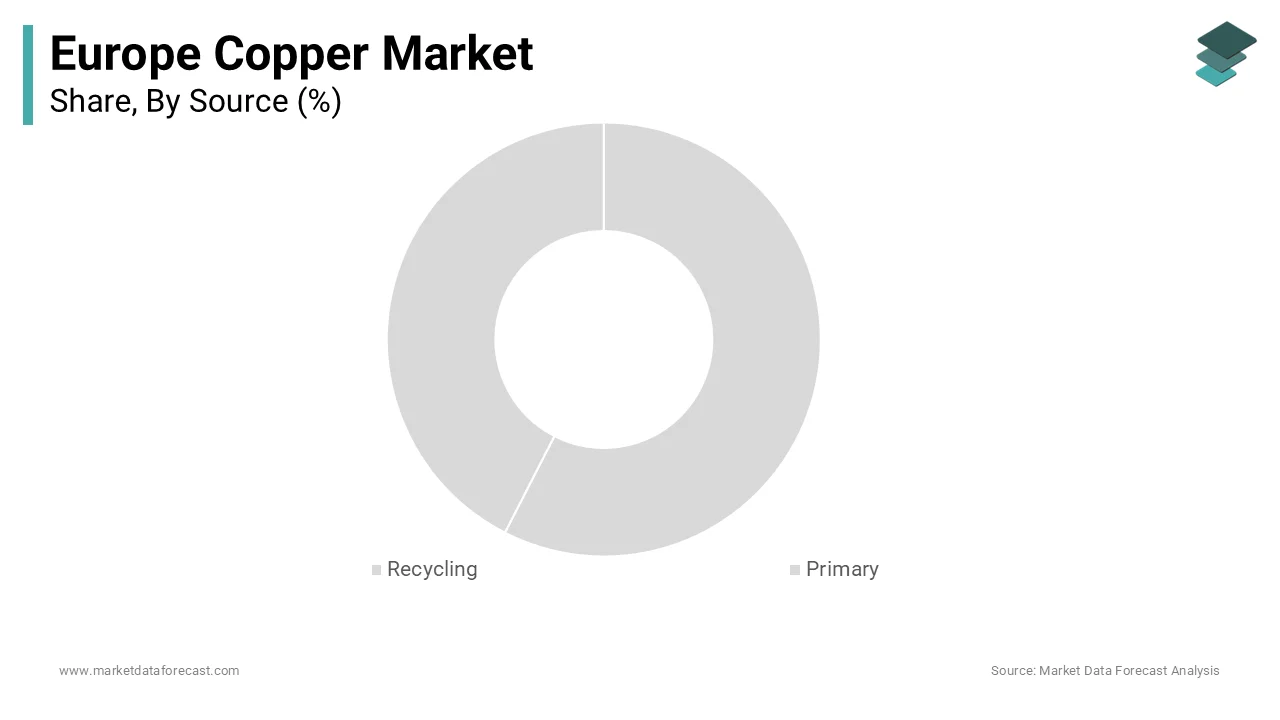
The recycling segment is growing lucratively with an anticipated CAGR of 4.8% throughout the forecast period, with the tightening supply constraints on primary copper and escalating policy pressure to decarbonize material flows. It explicitly prioritizes secondary copper in strategic stockpiling and public procurement, which is creating stable demand signals for recyclers. Additionally, the EU’s Extended Producer Responsibility framework obliges electronics manufacturers to fund collection and recycling by ensuring gaconsistent scrap supply.
By End-Use Insights
The building and construction segment was the largest by capturing 38.3% of the European copper market share in 2024, with copper’s irreplaceable role in electrical wiring, plumbing, and HVAC systems. Copper remains the standard conductor in residential and commercial buildings due to its fire resistance,e, durability, and superior conductivity compared to alternatives. Renovation activity further amplifies demand as the EU’s Energy Performance of Buildings Directive mandates deep retrofits for 3% of public buildings annually, requiring rewiring and updated heating systems. The typical single-family home contains 100 to 150 kilograms of copper, primarily in cables and pipes. Moreover, urbanization trends persist with Europeans now living in cities, increasing density-driven construction in metropolitan hubs like Berlin, Paris, and Madrid.
The transportation segment is deemed to register the fastest CAGR of 7.2 % throughout the forecast period, with almost entirely attributable to the electrification of road and rail networks. Battery electric vehicles alone consume 80 kilograms of copper per unit compared to 20 kilograms in conventional cars. The public transport is also transforming, with cities like Paris and Copenhagen committing to 100 % electric bus fleets by 2030, requiring an average of 250 kilograms of copper per bus for motors and charging systems. Rail electrification further contributes as the EU aims to double high-speed rail traffic by 2030 under the Sustainable and Smart Mobility Strategy, requiring extensive copper-based overhead lines and signaling systems.
COUNTRY LEVEL ANALYSIS
Germany Copper Market Analysis
Germany was the top performer of the European copper market by accounting for 22.3% of the share in 2024, owing to its advanced manufacturing base and energy transition policies. The country’s industrial sector, particularly automotive and machinery, consumes over 60 % of its copper demand, nd with electric vehicle production accelerating rapidly. Simultaneously, Germany’s Energiewende policy has spurred massive renewable deployment with 70 gigawatts of solar and 67 gigawatts of wind installed by the end of 2023. The government’s National Hydrogen Strategy also relies on copper-intensive electrolyzers with 10 gigawatts of capacity targeted by 2030. Urban infrastructure renewal in cities like Munich and Hamburg further sustains demand for copper plumbing and building wiring.
France Copper Market Analysis
France's copper market was ranked second by holding 18.2% of the share in 2024, with its demand anchored in nuclear energy, modernization, building renovation, and transport electrification. France’s automotive sector is also pivoting sharply toward electrification, with Stellantis and Renault expanding EV production capaHigh-speed speed rail expansion under the Grand Paris Express project alone will consume huge tons of copper for traction power and signaling. France’s strict building codes prohibit aluminum in residential wiring, reinforcing copper’s dominance in construction.
Italy Copper Market Analysis
Italy's copper market growth is likely to grow with renewable energy deployment, building refurbishment, and industrial machinery. The country added 4.2 gigawatts of solar capacity in 2023, the highest in Europe according to SolarPower Europe, leveraging its high solar irradiance and supportive Conto Energia incentives. These retrofits invariably include rewiring with copper due to national fire safety standards. Additionally, Italy’s aging water infrastructure is being replaced with copper piping in major cities like Milan and Rome under EU cohesion funds.
United Kingdom Copper Market Analysis
The United Kingdom copper market is anticipated to have a stdy growth in the coming years, with growth propelled by offshore wind expansion, electric vehicle adoption, and grid reinforcement. Offshore wind uses 6 to 8 tons of copper per megawatt, primarily in subsea export cables and platform transformers.
Spain Copper Market Analysis
Spain's copper market growth is fueled by solar energy leadership, building modernization,n and rail electrification. This solar boom translates to over 33,000 metric tons of annual copper demand for panels, inverters, and grid connections. High-speed rail expansion under the PERTE Ferroviario program aims to electrify 1,500 kilometers of track by 2027, each kilometer consuming approximately 8 tons of copper for catenary systems and signaling.
COMPETITIVE LANDSCAPE
The European copper market has intense competition among integrated producers, recyclers, and global traders vying for dominance in a supply-constrained and policy-driven environment. Domestic players leverage proximity to end users and compliance with EU sustainability standards while international firms compete on scale and logistics efficiency. The market is characterized by consolidation as companies acquire scrap processors and downstream fabricators to strengthen value chain control. Technological differentiation, particularly in high-purity and specialty copper products, is a key competitive lever. Regulatory pressures around emissions, recycling content, and responsible sourcing further raise entry barriers and favor established entities with robust environmental governance.
KEY MARKET PLAYERS
Some of the companies that are playing a dominating role in the global European copper market include
- Aurubis AG
- KME Group
- Wieland-Werke AG
- Boliden AB
- Atlantic Copper
- Metallo-Chimique International
- KGHM Polska Miedź S.A.
- Luvata
- Kabelwerke Brugg AG
TOP LEADING PLAYERS IN THE MARKET
- Aurubis AG is a leading integrated copper manufacturer headquartered in Germany with extensive operations across Europe. The company specializes in copper refining, recycling, and the production of copper products such as rods, strips, and specialty alloys. Aurubis has significantly expanded its recycling capabilities by investing in advanced scrap processing technologies that recover high-purity copper from complex waste streams. In recent years, the company has commissioned new recycling facilities in Germany and the Netherlands to meet rising demand for sustainable copper. These initiatives align with European Union circular economy goals and reinforce Aurubis’s role as a key enabler of green industrial transformation across the continent and globally.
- Glencore International AG is a major global commodity trader and mining company with substantial copper assets and logistics networks serving Europe. The company supplies refined copper and concentrates to European smelters and fabricators through long-term offtake agreements and spot market channels. Glencore has strengthened its European footprint by optimizing its rail and port logistics in the Baltic and Mediterranean regions to ensure reliable delivery. The firm also participates in responsible sourcing initiatives and has committed to reducing the carbon intensity of its copper supply chain. These efforts enhance its reputation among European industrial customers, prioritizing sustainability and supply chain transparency.
- KME Group is a prominent European producer of copper and copper alloy semi-finished products with manufacturing sites in Germany, Italy, and Spain. The company supplies high-precision rods, tubes, and profiles to the automotive, electrical engineering, and construction sectors. KME has recently modernized its casting and extrusion lines to improve energy efficiency and product quality. It has also expanded its range of low-carbon copper products certified under European environmental standards. Through strategic partnerships with electric vehicle and renewable energy equipment manufacturers, KME has positioned itself as a supplier in Europe’s electrification value chain,n contributing significantly to both regional and global downstream copper markets.
TOP STRATEGIES USED BY THE KEY MARKET PARTICIPANTS
Key players in the European copper market are prioritizing vertical integration to secure raw material access and stabilize supply chains. Companies are investing heavily in advanced recycling infrastructure to align with EU circular economy mandates and reduce reliance on primary imports. Strategic partnerships with renewable energy and electric vehicle manufacturers are being forged to anchor long-term demand. Firms are also modernizing production facilities with digital technologies to enhance energy efficiency and product precision. Additionally, participants are actively engaging in sustainability certification schemes and carbon footprint reduction programs to meet stringent European environmental regulations and maintain a competitive advantage in a decarbonizing industrial landscape.
MARKET SEGMENTATION
This research report on the europe copper market is segmented and sub-segmented into the following categories:
By Source
- Recycling
- Primary
By End-Use
- Building and Construction
- Transportation
- Electrical and Electronics
- Industrial Machinery
- Others
By Country
- Germany
- France
- Italy
- United Kingdom
- Spain
- Rest of Europe