- Product Description Description
- Table of Contents TOC
- List of Table & Figure LOT
- Get Free Sample PDF Sample PDF
Market Size, 2025
$0.25 BnMarket Estimate, 2026
$0.27 BnMarket Forecast, 2034
$0.54 BnCAGR, 2026–2034
8.68%Europe Deep Brain Stimulation Devices Market Size, Growth, Trends & Forecast (2026–2034)
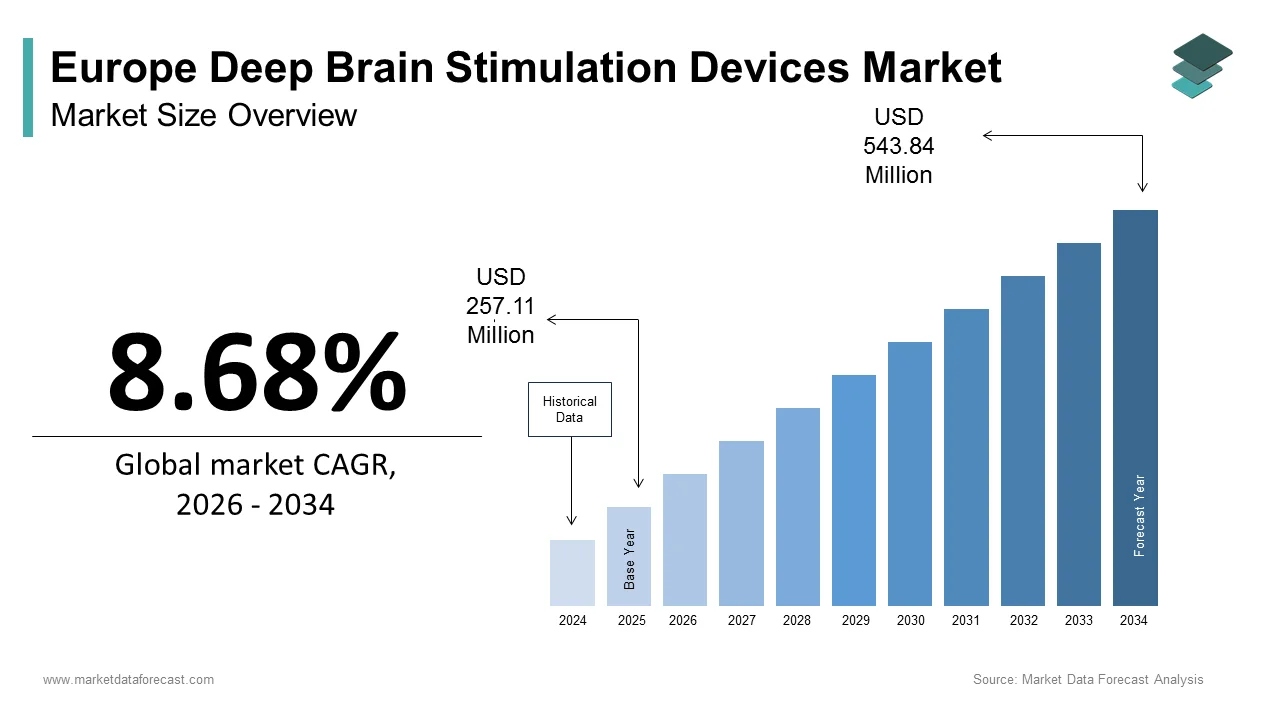
The Europe deep brain stimulation devices market size was calculated to be USD 257.11 million in 2025, is anticipated to be worth USD 279.43 million in 2026, and is projected to scale up to USD 543.84 million by 2034, registering a compound annual growth rate (CAGR) of 8.68% during the forecast period from 2026 to 2034. Driven by the expanding therapeutic indications beyond movement disorders, an aging European demographic, and technological advancements in adaptive and directional DBS platforms, the market continues to expand steadily across Europe.
Key Executive Metrics (At-a-Glance)
- 2025 Base Valuation: USD 257.11 Million
- 2026 Current Valuation: USD 279.43 Million
- 2034 Forecast Valuation: USD 543.84 Million
- Compound Annual Growth Rate (CAGR): 8.68% (2026–2034)
- Dominant Application Segment: Parkinson’s Disease (holding 64.4% of the European market share in 2025)
- Fastest-Growing Application Segment: Obsessive-Compulsive Disorder (estimated to witness the fastest CAGR of 11.4% over the forecast period)
- Dominant End User Segment: Hospital (undisputed leader accounting for 69.6% of the European market share in 2025)
- Fastest-Growing End User Segment: Ambulatory Surgical Centers (ASCs) (projected to expand at a CAGR of 11.4% over the forecast period)
- Dominant Region: Germany (led the DBS devices market in Europe in 2025 with the highest share)
Core Market Drivers
- Expanding Indications: Active exploration of new treatments for conditions like treatment-resistant depression and other neuropsychiatric disorders.
- Aging Population: Rapidly aging European demographic driving up the absolute number of patients suffering from neurodegenerative conditions like Parkinson’s disease.
- Technological Innovation: Evolution from open-loop systems to intelligent, closed-loop adaptive DBS platforms and directional leads.
Primary Market Restraints & Challenges
- Regulatory Hurdles: Stringent requirements and compliance backlogs under the European Union Medical Device Regulation (EU MDR) for Class III implantables.
- Financial Barriers: Substantial upfront procedural costs combined with inconsistent, fragmented reimbursement pathways across individual member states.
- Expertise Shortages: Scarcity of multidisciplinary surgical and specialized programming teams limiting overall procedure volumes.
Europe Deep Brain Stimulation Devices Market Segmentation Breakdown
| Segment Category | Leading Sub-Segment (2025 Base) | Fastest-Growing Sub-Segment (2026–2034) |
|---|---|---|
| By Application | Parkinson’s Disease (64.4% share in 2025) | Obsessive-Compulsive Disorder (OCD) (11.4% CAGR) |
| By End User | Hospital (69.6% share in 2025) | Ambulatory Surgical Centers (ASCs) (11.4% CAGR) |
| By Region | Germany (highest share in 2025) | France & Spain (expanding via favorable centralized policies and clinical trial participation) |
Major Industry Players Profiled
Key enterprises shaping the competitive European deep brain stimulation devices market include Medtronic plc, Abbott Laboratories, Boston Scientific Corporation, LivaNova PLC, Aleva Neurotherapeutics SA, NeuroPace Inc., SceneRay Corporation, Beijing PINS Medical Co., Ltd., Soterix Medical Inc., and Synapse Biomedical Inc.
Europe Deep Brain Stimulation Devices Market Size
The Europe deep brain stimulation devices market size was calculated to be USD 257.11 million in 2025 and is anticipated to be worth USD 543.84 million by 2034, from USD 279.43 million in 2026, growing at a CAGR of 8.68% during the forecast period.
Deep brain stimulation (DBS) is a neurosurgical procedure that involves the implantation of a pulse generator to deliver controlled electrical impulses to precisely targeted areas of the brain. This therapy is primarily used for managing motor symptoms in advanced Parkinson’s disease, essential tremor, and dystonia, with ongoing clinical investigations into its application for treatment-resistant depression and other neuropsychiatric conditions. In Europe, DBS is embedded within a highly regulated healthcare infrastructure supported by a strong tradition of neurological research and innovation. A critical non-market statistic shaping this landscape is the high prevalence of target neurological disorders. According to Neurology, Parkinson’s disease is recognized as a common condition among Europeans aged 65 and older, with prevalence increasing further in those over 80. Furthermore, as per the European Academy of Neurology, brain disorders collectively impose a substantial economic burden on European economies. The continent’s clinical capacity is reflected in the presence of neurologists across populations, though significant disparities exist between countries, influencing access to specialized care.
MARKET DRIVERS
Expanding Indications Beyond Movement Disorders Drive Market Growth
The active exploration of new therapeutic indications beyond traditional movement disorders is primarily driving the growth of the European DBS devices market. Treatment-resistant depression represents a particularly promising frontier. As per European clinical trials, DBS has shown clinically meaningful responses in patients with treatment-resistant depression, providing a foundation for regulatory submissions and clinical adoption. Given that major depressive disorder is a leading cause of disability across Europe, a successful approval for this indication would dramatically expand the eligible patient pool. This shift from a narrowly defined surgical intervention to a potential mainstream psychiatric therapy is altering the strategic priorities of device manufacturers and accelerating investment in next-generation, adaptive DBS platforms.
Aging Population Intensifies Demand for Advanced Neurological Therapies
Europe’s demographic trajectory, characterized by a rapidly aging population, serves as a powerful structural driver for the European DBS devices market. The incidence of neurodegenerative diseases such as Parkinson’s disease increases with age. As per Germany’s Robert Koch Institute, Parkinson’s disease prevalence rises significantly among older populations. With projections indicating that nearly 30% of the European Union’s population will be aged 65 or older by 2030, the absolute number of patients suffering from advanced, medication-refractory movement disorders is set to grow. As DBS is typically indicated for later stages of disease, this demographic trend ensures a sustained increase in the pool of potential candidates.
MARKET RESTRAINTS
Stringent Regulatory Framework Under EU MDR Constrains Market Entry
The enforcement of the European Union Medical Device Regulation has introduced a formidable barrier to market entry and product innovation for DBS devices, which is hindering the growth of the European DBS devices market. Classified as Class III implantables, these systems are subject to the highest level of scrutiny, requiring extensive clinical evidence and rigorous conformity assessment. The transition to this new regime has created delays and backlogs in the approval process. Manufacturers must now compile far more comprehensive technical documentation than under the previous directive, a requirement that is especially burdensome for smaller companies. While enhancing patient safety, this heightened regulatory burden has slowed the pace of technological iteration and market access for novel DBS systems.
High Upfront Costs and Fragmented Reimbursement Hinder Widespread Adoption
The substantial initial cost of a DBS procedure, coupled with inconsistent reimbursement policies across European nations, remains a primary restraint on broader adoption and hampers the growth of the European DBS devices market. As per data from the German healthcare system, DBS implantation is associated with high costs. Although countries such as France, Belgium, and England have established reimbursement mechanisms, many others lack clear funding pathways. This fragmentation creates financial uncertainty for hospitals and results in disparities in patient access. Consequently, even medically eligible patients may be denied therapy due to administrative or economic barriers. This patchwork of reimbursement policies across the single market effectively caps the procedure’s penetration rate and impedes its establishment as a standard of care.
MARKET OPPORTUNITIES
Technological Advancements in Adaptive and Directional DBS Create New Opportunities
The evolution from conventional open-loop DBS to intelligent, closed-loop systems presents a transformative opportunity for market expansion. Next-generation devices can sense local field potentials in real time and automatically adjust stimulation parameters in response to neural biomarkers. This adaptive approach promises to enhance therapeutic precision, improve symptom control, and reduce side effects by delivering stimulation only when necessary. Directional leads further allow clinicians to steer electrical current with greater accuracy, avoiding non-target brain structures. As per ongoing clinical validations and regulatory pathways, these advanced platforms are expected to establish a premium market segment and drive replacement cycles for legacy systems, which is fuelling sustained growth.
Growing Focus on Neuromodulation for Rare Neurological Disorders Opens Niche Markets
A significant opportunity exists in applying DBS to treat rare and orphan neurological conditions such as Tourette syndrome, certain forms of epilepsy, and severe obsessive-compulsive disorder. As per early clinical trials and compassionate use programs in Europe, encouraging results have been reported for these patient groups. The European Union’s Orphan Drug Regulation provides a supportive policy environment, offering incentives such as market exclusivity and scientific advice to encourage development for small populations. Europe’s dense network of academic medical centers, with expertise in neurology and functional neurosurgery, makes it an ideal region for conducting complex clinical trials. Successfully securing approval for even one rare disease would address a critical unmet medical need and create a high-value, low-competition segment for device manufacturers.
MARKET CHALLENGES
Shortage of Specialized Surgical and Programming Expertise Limits Procedure Volume
A critical bottleneck in the European DBS market is the scarcity of multidisciplinary teams with the requisite specialized skills. Effective DBS therapy requires collaboration between neurosurgeons, movement disorder neurologists, and specialized support staff. The training required to master these competencies is lengthy and not uniformly available across member states. While Europe averages neurologists across populations, the subset trained specifically in DBS management is a small fraction of this total. This shortage directly constrains the number of procedures that can be performed, leading to long waiting lists and limiting the market’s ability to scale to meet clinical need.
Long Term Data Gaps on Efficacy and Safety for Emerging Indications Pose a Strategic Risk
A major strategic challenge for the future growth of the DBS market in Europe is the lack of robust, long-term data for newer psychiatric and neurological applications. While the safety and efficacy of DBS for Parkinson’s disease are well established, the evidence base for conditions such as treatment-resistant depression is primarily derived from short-term or small-scale trials. The absence of large, decade-long follow-up studies on the durability of response, quality of life outcomes, and potential late-onset adverse effects creates uncertainty. As per health technology assessment bodies, this evidentiary gap makes clinicians cautious in recommending the procedure and delays reimbursement decisions. Until long term data is generated, adoption of DBS for these promising new indications will remain slow and fragmented, limiting the market’s potential to expand into larger patient populations.
REPORT COVERAGE
| REPORT METRIC | DETAILS |
| Market Size Available | 2025 to 2034 |
| Base Year | 2025 |
| Forecast Period | 2026 to 2034 |
| CAGR | 8.68% |
| Segments Covered | By Application, End User, And Region |
| Various Analyses Covered | Global, Regional & Country Level Analysis; Segment-Level Analysis; DROC, PESTLE Analysis; Porter’s Five Forces Analysis; Competitive Landscape; Analyst Overview of Investment Opportunities |
| Regions Covered | UK, France, Spain, Germany, Italy, Russia, Sweden, Denmark, Switzerland, Netherlands, Turkey, and the Czech Republic |
| Market Leaders Profiled | Medtronic plc, Abbott Laboratories, Boston Scientific Corporation, LivaNova PLC, Aleva Neurotherapeutics SA, NeuroPace Inc., SceneRay Corporation, Beijing PINS Medical Co. Ltd., Soterix Medical Inc., Synapse Biomedical Inc. |
SEGMENTAL ANALYSIS
By Application Insights
The Parkinson’s disease segment dominated the market by holding 64.4% of the European market share in 2025. The dominance of Parkinson’s disease segment in the European market is driven by the high prevalence of Parkinson’s disease across Europe’s aging population and the well-established clinical efficacy of DBS as a standard of care for advanced cases where pharmacological management fails or causes debilitating side effects. Decades of clinical research have consistently demonstrated that DBS can significantly improve motor function, reduce medication requirements, and enhance quality of life for patients in later stages of the disease. This strong evidence base has led to widespread acceptance and integration into national treatment guidelines across Europe, creating a stable demand stream that far outpaces other indications.
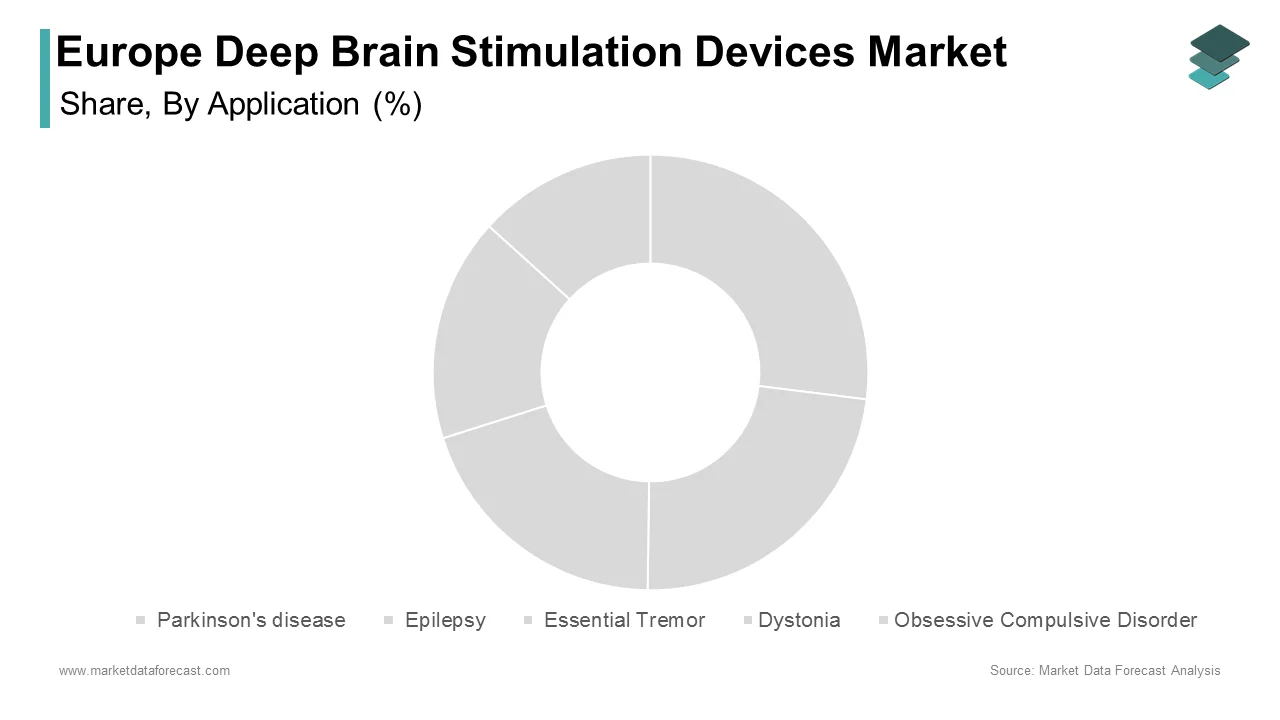
The obsessive-compulsive disorder (OCD) segment is estimated to witness the fastest CAGR of 11.4% over the forecast period, owing to the compelling clinical data from European centers of excellence. A pivotal factor is the designation of DBS for severe, treatment-refractory OCD as a Humanitarian Use Device, which has created a clearer pathway for clinical application. Combined with the profound unmet need for effective therapies in patients who have exhausted all other options, this recognition is driving investment in clinical trials and specialized treatment programs, accelerating adoption at a pace unmatched by more mature segments.
By End User Insights
The hospital segment was the undisputed leader and accounted for 69.6% of the European market share in 2025. The growth of the hospital segment in the European market can be credited to the highly complex and resource-intensive nature of DBS procedures, which require specialized personnel, advanced imaging infrastructure, and critical care support typically available only in hospital settings. Successful DBS implantation demands collaboration between neurosurgeons, neurologists, anesthesiologists, and specialized nurses, supported by intraoperative imaging and postoperative monitoring. This level of coordination is characteristic of major European university hospitals and tertiary care centers, making them the natural home for these procedures.
Conversely, the ambulatory surgical centers (ASCs) segment is the fastest-growing segment and is projected to expand at a CAGR of 11.4% over the forecast period, owing to a strategic shift toward outpatient and cost-efficient care models within European healthcare systems. As DBS techniques become more standardized and postoperative protocols refined, lower-risk follow-up procedures such as battery replacements and routine programming sessions are increasingly being migrated from hospitals to ASCs. This transition reduces the burden on acute care facilities and lowers the overall cost of long-term DBS management, a trend gaining traction in countries with robust private healthcare sectors.
REGIONAL ANALYSIS
Germany Deep Brain Stimulation Devices Market Analysis
Germany led the DBS devices market in Europe in 2025 with the highest share of the European market. Its leadership is anchored in a world-class neurosurgical and neurological research infrastructure, exemplified by institutions like Charité in Berlin and the University Hospital of Tübingen. The country’s statutory health insurance system provides broad coverage for DBS for approved indications, ensuring patient access. A critical factor shaping this market is Germany’s high density of neurologists, which directly translates into a large pool of qualified professionals capable of managing the complex DBS patient pathway from diagnosis to long-term care.
France Deep Brain Stimulation Devices Market Analysis
France holds a prominent position as a leading market, distinguished by its centralized and proactive healthcare policy. The French National Authority for Health (HAS) has issued favorable recommendations for DBS in Parkinson’s disease and essential tremor, which are fully reimbursed under the national health insurance scheme. This streamlined reimbursement environment has fostered a high volume of procedures. France is also a hub for clinical innovation, with pioneering work in adaptive DBS being conducted at centers like the Pitié Salpêtrière Hospital in Paris, which not only drives domestic adoption but also attracts international patients.
United Kingdom Deep Brain Stimulation Devices Market Analysis
The United Kingdom is a key market characterized by its publicly funded National Health Service (NHS). While access can be subject to regional commissioning decisions, the National Institute for Health and Care Excellence (NICE) has published comprehensive technology appraisals that endorse DBS for specific patient groups. The UK’s strength lies in its network of specialized neuroscience centers, such as the National Hospital for Neurology and Neurosurgery, which serve as national referral hubs. The market is further supported by the UK’s significant contribution to global neurological research, with academic institutions generating long-term outcome data that informs clinical practice across Europe.
Italy Deep Brain Stimulation Devices Market Analysis
Italy represents a significant and steadily growing market within Southern Europe. Its market status is defined by a mix of public and private healthcare provision, with leading centers of excellence concentrated in northern regions such as Milan and Turin. A key driver of the Italian market is the country’s rapidly aging population, with a high proportion of citizens aged 65 or older. This demographic pressure creates sustained demand for advanced therapeutic interventions. While reimbursement can be complex, the presence of highly skilled neurosurgical teams ensures Italy remains a vital contributor to the continental market.
Spain Deep Brain Stimulation Devices Market Analysis
Spain is an emerging market with considerable growth potential. Its position is bolstered by a strong public healthcare system that provides universal coverage, and a growing number of specialized movement disorder units in cities like Madrid and Barcelona. A critical factor for Spain’s market development is its active participation in multinational European clinical trials for novel DBS applications, which accelerates the adoption of new technologies and protocols. The Spanish Society of Neurology has been instrumental in developing national guidelines for DBS, helping to standardize patient selection and care pathways, thereby building a solid foundation for future market expansion.
COMPETITION OVERVIEW
The competitive landscape of the Europe deep brain stimulation devices market is characterized by the dominance of a few global MedTech giants who leverage their extensive resources to drive innovation and clinical adoption. The rivalry is intense yet focused on technological differentiation rather than price competition. Companies compete by introducing next-generation platforms featuring brain sensing, directional leads, and seamless connectivity. The regulatory environment under the EU MDR has raised the barrier to entry, effectively limiting competition to established players with the capital and expertise to navigate complex approval processes. Consequently, the market is not fragmented but consolidated among leaders who continuously invest in clinical evidence, physician training, and digital health ecosystems. These dynamic fosters a high standard of care but also create a challenging environment for new entrants or smaller innovators seeking to gain a foothold in this specialized and highly regulated therapeutic area.
KEY MARKET PLAYERS
A few major players of the Europe Deep brain stimulation device market include
- Medtronic plc
- Abbott Laboratories
- Boston Scientific Corporation
- LivaNova PLC
- Aleva Neurotherapeutics SA,
- NeuroPace Inc.
- SceneRay Corporation
- Beijing PINS Medical Co., Ltd
- Soterix Medical Inc
- Synapse Biomedical Inc
Top Strategies Used by the Key Market Participants
Key players in the Europe deep brain stimulation devices market employ a range of sophisticated strategies to maintain and expand their influence. A primary approach is continuous technological innovation focused on developing adaptive and directional stimulation systems that improve clinical outcomes. Companies also prioritize generating robust clinical evidence through large-scale European trials to support regulatory approvals and reimbursement decisions under the stringent EU MDR. Strategic partnerships with leading academic medical centers are common to accelerate research and training. Additionally, firms invest in comprehensive physician education programs to build a skilled user base. Expanding digital health capabilities for remote patient monitoring and programming is another critical strategy that enhances long term patient management and aligns with evolving healthcare delivery models across the continent.
Leading Players in the Market
- Medtronic is a global leader in medical technology with a profound presence in the European deep-brain stimulation devices market. The company has been instrumental in pioneering DBS therapy for Parkinson’s disease and other movement disorders. Its portfolio includes advanced systems like the Percept PC neurostimulator, which features brain-sensing capabilities for adaptive stimulation. To strengthen its position in Europe, Medtronic has invested heavily in clinical evidence generation through partnerships with leading European academic centers and has actively supported regulatory submissions for new indications under the EU MDR framework, ensuring its technologies remain at the forefront of clinical practice.
- Boston Scientific has established itself as a formidable innovator in the neuromodulation space following its acquisition of Cerenovus and its legacy work in neurostimulation. In Europe, the company focuses on delivering next-generation directional lead technology that allows for more precise targeting of brain structures. Its recent actions include expanding its clinical trial footprint across multiple European countries to validate the efficacy of its Vercise Genus system in both traditional and emerging psychiatric indications, thereby broadening its therapeutic relevance and reinforcing its commitment to the European neurological care ecosystem.
- Abbott is a key player whose entry into the European DBS market was marked by its strategic acquisition of St Jude Medical’s neuromodulation business. The company leverages its strong commercial infrastructure to promote its Infinity DBS system, known for its patient-centric design and remote programming capabilities. To solidify its European standing, Abbott has prioritized digital health integration, launching secure telehealth platforms that enable remote device management. This approach addresses post-operative care challenges and aligns with the region’s growing emphasis on connected and efficient healthcare delivery models.
MARKET SEGMENTATION
This research report on the Europe deep brain stimulation devices market has been segmented and sub-segmented based on application, end user & region.
By Application
- Parkinson's disease
- Epilepsy
- Essential Tremor
- Dystonia
- Obsessive Compulsive Disorder
- Other Applications
By End User
- Neurological Clinics
- Ambulatory Surgical Centers
- Hospital
- Others
By Region
- UK
- France
- Spain
- Germany
- Italy
- Russia
- Sweden
- Denmark
- Switzerland
- Netherlands
- Turkey
- Czech Republic
- Rest of Europe