- Product Description Description
- Table of Contents TOC
- List of Table & Figure LOT
- Get Free Sample PDF Sample PDF
Market Size, 2025
$54 BnMarket Estimate, 2026
$61.56 BnMarket Forecast, 2034
$175.61 BnCAGR, 2026–2034
14%Europe Direct Current Market Report Summary
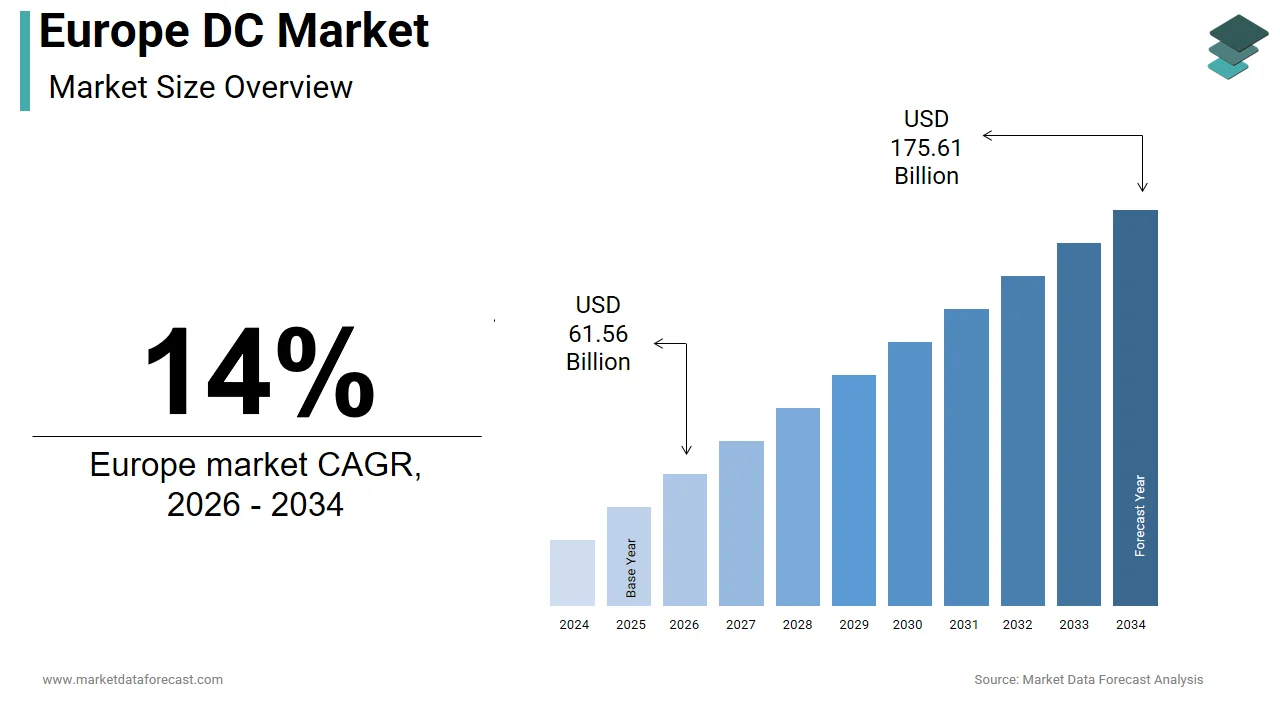
The Europe direct current (DC) market was valued at USD 54 billion in 2025, is anticipated to reach USD 61.56 billion in 2026, and is projected to reach USD 175.61 billion by 2034, growing at a strong CAGR of 14% from 2026 to 2034. Market growth is driven by the rapid expansion of data centers, increasing adoption of renewable energy systems, and the growing demand for energy-efficient power transmission infrastructure. Direct current technology plays a crucial role in integrating renewable energy sources, supporting hyperscale data centers, and enabling efficient power distribution across digital and industrial ecosystems. Rising investments in digital infrastructure, electric vehicle charging networks, and smart grids are further accelerating market expansion across Europe.
Key Market Trends
- Rapid expansion of hyperscale and mega data center infrastructure.
- Increasing adoption of high-voltage direct current (HVDC) transmission systems.
- Growing integration of renewable energy sources into power grids.
- Rising demand for energy-efficient power distribution solutions.
- Strengthening investments in digital infrastructure and electrification initiatives.
Segmental Insights
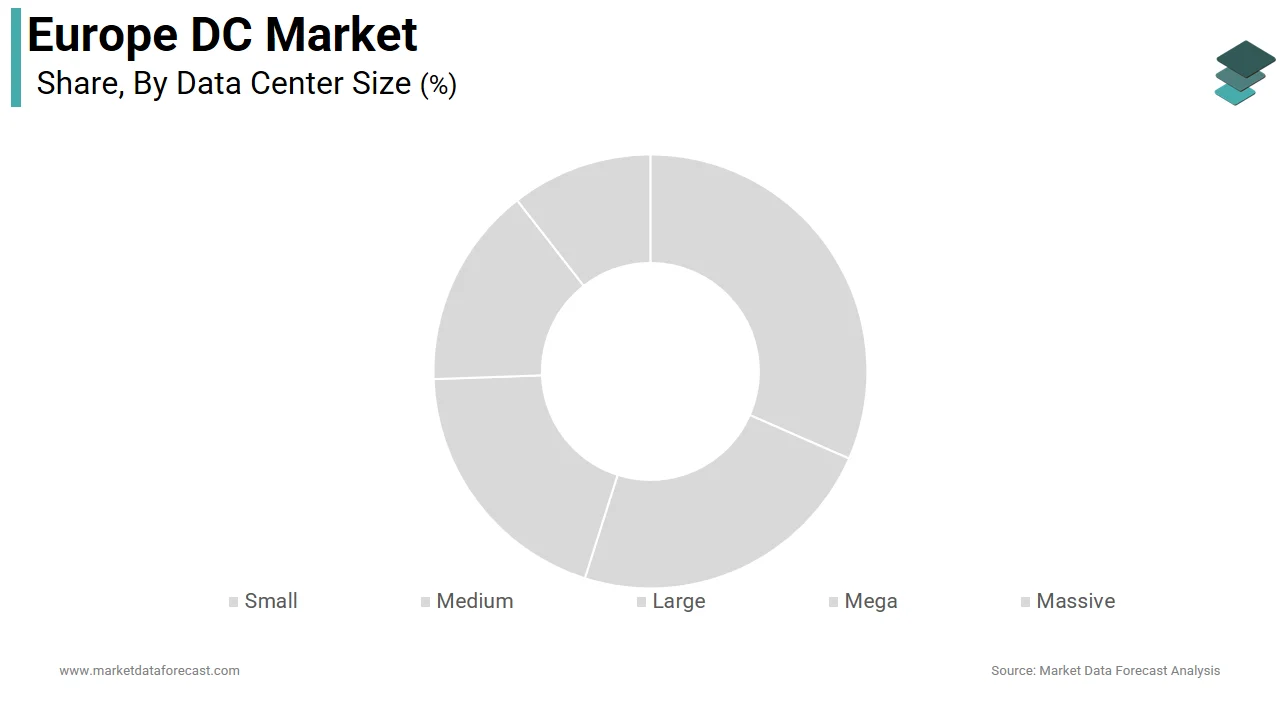
- Based on data center size, the mega data centers segment dominated the market in 2025 by capturing 55.5% share, driven by growing hyperscale cloud infrastructure and increasing digital service demand.
- Based on tier type, the tier 3 data centers segment led the market by accounting for 50.3% share in 2025, supported by their balance between reliability, redundancy, and cost efficiency.
- Based on end user, the IT and ITES segment held the majority share of 45.8% in 2025, driven by rising cloud computing, enterprise digitalization, and expanding data storage requirements.
Regional Insights
The Europe direct current market is witnessing rapid growth across major economies, supported by strong digital transformation initiatives, renewable energy integration, and data center expansion.
- Germany led the regional market in 2025 with 24.5% share, driven by its role as a digital, industrial, and financial hub with strong demand for advanced power infrastructure.
- The United Kingdom followed with 18.1% share in 2025, supported by its global financial ecosystem and concentration of hyperscale cloud facilities.
- France maintains a significant position, driven by state-backed digital sovereignty initiatives and renewable energy integration, including the Cloud Souverain program promoting Tier 3+ domestic data center infrastructure.
Competitive Landscape
The Europe direct current market is characterized by strong competition among global electrical infrastructure providers and power technology companies. Market participants are focusing on developing advanced HVDC systems, improving grid efficiency, and supporting renewable energy integration. Strategic partnerships, grid modernization projects, and investments in data center power solutions are shaping competitive dynamics across the region.
Prominent companies operating in the Europe direct current market include Hitachi Energy Ltd., Siemens AG, GE Vernova, Prysmian Group, Nexans S.A., NKT A/S, Toshiba Corporation, Mitsubishi Electric Corporation, ABB Ltd., and Schneider Electric SE.
Europe DC Market Size
The size of the Europe DC market was worth USD 54 billion in 2025. The regional market is anticipated to grow at a CAGR of 14% from 2026 to 2034 and be worth USD 175.61 billion by 2034 from USD 61.56 billion in 2026.
Direct current (DC) is a type of electrical current where the flow of electric charge is unidirectional, meaning it moves consistently in a single direction from a power source's negative terminal to its positive terminal. Unlike the historically dominant alternating current (AC) grid, the DC market is emerging as a critical enabler of Europe’s energy transition, driven by the proliferation of native DC sources and loads. There is a growing shift in European homes toward electronic devices and renewable energy systems that fundamentally function on direct current, creating a mismatch with traditional alternating current grids. European digital infrastructure is projected to significantly increase its energy demand, driving a need for more efficient power distribution architectures that minimize the energy lost during electrical conversion. Furthermore, the rise of battery energy storage systems and DC fast-charging corridors for electric vehicles creates structural demand for DC power management. For the entire European Union, the Commission and ACEA project a much higher need, ranging from 3.5 million to 8.8 million public charging points by 2030. This shift is not merely technological but systemic, positioning DC as a foundational element of Europe’s decarbonized, digitalized, and decentralized energy future.
MARKET DRIVERS
Proliferation of Native DC Energy Sources and Loads
The rapid adoption of inherently DC-based technologies is a primary driver of the Europe DC market. Solar photovoltaic systems, which generate DC electricity, achieved another record year in 2024 with 65.5 GW added, making it the fastest-growing power source in the EU and contributing to a record 47% share of renewables in the total electricity generation mix, according to Ember and SolarPower Europe. Simultaneously, end-use devices are increasingly DC-native. The European Environment Agency and various industry studies indicate that a large majority of modern household electronics (LEDs, computing, chargers) operate on DC internally. While battery electric vehicles store energy in DC, most utilize AC motors for propulsion, relying on inverters to convert DC to AC. This creates a fundamental mismatch with the AC grid, necessitating multiple AC-DC conversions that waste a portion of energy per cycle. In commercial buildings, LED lighting and variable-speed HVAC drives further amplify DC demand. The European Data Centre Association and major operators are piloting 380-volt DC microgrids to eliminate redundant AC-DC conversions, which can achieve energy savings of 12 to 18 percent in facility power usage. Europe is targeting over 600 gigawatts of total solar capacity by 2030 and millions of electric vehicles, an upgrade from earlier plans. Because of this rising volume of native DC generation and consumption, hybrid or full-DC architectures in buildings are becoming an economic imperative to reduce conversion losses.
Expansion of High-Power Electric Vehicle Charging Infrastructure
The deployment of ultra-fast DC charging networks for electric vehicles is accelerating demand for high-efficiency DC power systems across the region, which further propels the expansion of the Europe DC market. European regulations require the phased installation of high-power charging, with fast-charging stations for light vehicles installed at frequent intervals along major highways, complemented by higher-power stations for heavy-duty vehicles. Despite expanding, public fast-charging infrastructure cannot keep up with rising demand, requiring faster rollout and better grid connectivity. These stations operate most efficiently when powered by DC microgrids integrated with on-site solar and battery storage, minimizing conversion steps. Technical evaluations indicate that integrated direct-current fast-charging stations, which connect storage and generation directly to chargers, improve overall efficiency and reduce energy losses compared to traditional alternating-current systems. The adoption of 800-volt systems by manufacturers is accelerating the need for compatible high-voltage DC charging networks. This transport-driven electrification is transforming roadside service areas into high-power DC nodes, catalyzing broader adoption of DC distribution in commercial and industrial settings.
MARKET RESTRAINTS
Lack of Standardized DC Grid Codes and Interoperability Frameworks
The absence of harmonized technical standards for DC power systems acts as a major restraint on the Europe DC market. This affects market scalability in the region. Unlike AC, which benefits from over a century of standardized voltage levels, protection schemes, and grid codes, DC lacks unified specifications for safety, voltage bands, fault management, and device interoperability. The European standardization landscape for utilizing direct current in building infrastructure is still evolving, while high-power direct current applications in industry are characterized by disconnected, regional pilot initiatives rather than a unified standard. This uncertainty discourages manufacturers from investing in mass-produced DC components and deters building owners from adopting DC microgrids due to perceived integration risks. Research indicates that European facility managers view the absence of standardized protocols and frameworks as the primary obstacle to implementing direct current systems. DC grid deployment will remain limited to niche projects until the EU mandates binding codes under the Clean Energy Package.
High Upfront Costs and Immature Supply Chains
The high capital expenditure required for system redesign and the immaturity of dedicated component supply chains are causing significant economic barriers, which in turn hinder the expansion of the Europe DC market. DC circuit breakers, solid-state transformers, and bidirectional converters remain more expensive than their AC counterparts due to low production volumes and complex semiconductor requirements. According to research, the cost premium for a full-building DC distribution system is currently higher than conventional AC wiring, despite lower lifetime energy costs. Additionally, the supply chain for silicon carbide and gallium nitride power devices, essential for efficient DC conversion, is concentrated in Asia, creating import dependencies and delivery delays. The European Investment Bank emphasizes that a limited number of certified manufacturers exist within Europe for specialized DC switchgear, which restricts competitive options and slows innovation in the sector. The lack of financial incentives and localized manufacturing, combined with slow-growing economies of scale, ensures that high upfront expenses remain a major barrier to DC adoption in smaller, budget-conscious markets.
MARKET OPPORTUNITIES
Integration of DC Microgrids in Renewable Energy Communities
The EU’s Renewable Energy Directive empowers citizen-led energy communities to generate, store, and share locally produced power, which creates a fertile ground for DC microgrid deployment, and thereby provides new opportunities for the Europe DC market. These communities, often centered around solar cooperatives or apartment blocks, benefit from DC’s inherent compatibility with rooftop PV and battery storage, eliminating unnecessary AC-DC-AC conversions. According to the European Federation of Renewable Energy Cooperatives, the number of energy communities in the EU continues to grow, with new initiatives in Germany and the Netherlands demonstrating enhanced self-consumption through the implementation of local, specialized direct current distribution networks. The EU’s Clean Energy for All Europeans package mandates that member states remove regulatory barriers to local energy sharing, further enabling DC-native architectures. DC microgrids, supported by advancing P2P trading platforms, represent the most efficient and cost-effective infrastructure for active, citizen-driven energy, aligning perfectly with the European Green Deal.
Development of DC-Powered Data Centers and Digital Infrastructure
Data centersofferr great potential for the Europe DC market. This is due to their massive and growing electricity demand, coupled with native DC server loads. European digital infrastructure is expected to significantly increase its demand for electricity over the next decade as cloud and computing services expand. Since IT equipment operates on 48-volt or 380-volt DC internally, eliminating AC-DC conversion at the rack level can improve power usage effectiveness, translating to millions in annual savings per facility. Major technology providers are implementing advanced power and cooling innovations in their regional facilities to minimize waste heat and improve overall system efficiency. The EU Code of Conduct for Data Centre Energy Efficiency now recognizes DC distribution as a best practice, unlocking green financing. The intensification of compute density driven by AI and cloud computing makes DC efficiency a critical success factor, establishing data centers as the primary drivers of modern infrastructure evolution.
MARKET CHALLENGES
Grid Integration and Regulatory Misalignment with AC-Centric Policies
The region’s deeply entrenched AC regulatory and operational framework creates systemic challenges, despite its efficiency advantages, which hamper the growth of the Europe DC market. Electricity tariffs, grid connection rules, and certification requirements are all designed for AC systems, creating disincentives for DC adoption. According to the Council of European Energy Regulators, no EU member state currently offers differentiated grid fees for DC-connected prosumers, negating potential cost savings. Similarly, building codes like the EU Energy Performance of Buildings Directive still mandate AC wiring as the default, requiring costly exemptions for DC installations. The European Network of Transmission System Operators for Electricity has yet to define how DC microgrids should interact with the main AC grid during faults or islanding events, creating safety and liability uncertainties. This regulatory inertia, rooted in over a century of AC dominance, slows investment and innovation, forcing DC pioneers to navigate a labyrinth of outdated rules that fail to recognize the technology’s role in a decarbonized future.
Skilled Workforce Shortage and Lack of DC Training Programs
A shortage of engineers, electricians, and technicians trained in DC system design, installation, and maintenance constrains the expansion of the Europe DC market. Traditional electrical education across Europe remains overwhelmingly focused on AC theory, machinery, and protection schemes, leaving professionals unprepared for DC’s unique characteristics, such as constant voltage, arc persistence, and bidirectional power flow. Technical education across the European Union continues to focus heavily on traditional AC power, resulting in a shortage of university-level programs specializing in DC power system design and operation. Vocational training programs for electricians similarly lack DC certification modules, deterring contractors from bidding on DC projects. The European Commission’s Pact for Skills has yet to include DC competencies in its green jobs roadmap. Europe’s transition to a resilient, renewable power grid will be delayed, regardless of policy or technological advances, unless immediate action is taken to reform curricula and establish hands-on training centers to bridge the workforce gap.
SEGMENTAL ANALYSIS
By Data Center Size Insights
The mega data centers segment dominated the Europe DC market by accounting for a 55.5% in 2025. The dominance of the mega data centers segment is driven by economies of scale that justify investment in advanced DC power architectures, including 380-volt DC distribution and liquid-cooled server racks. These facilities, typically exceeding 40 megawatts in capacity, are operated by hyperscalers like Google, Microsoft, and Amazon to support cloud computing, artificial intelligence, and streaming services across the continent. According to sources, large-scale, modern data centers in Europe are operating with far superior energy efficiency compared to older, smaller facilities, with many newer, large-scale sites achieving exceptionally low power usage effectiveness ratios. European policy and industry pacts are driving operators to prioritize climate neutrality, pushing for the widespread deployment of sustainable, highly efficient infrastructure to meet strict energy performance goals by the end of the decade. Additionally, their proximity to renewable energy hubs in Scandinavia and Iberia enables direct DC coupling with solar and wind farms, minimizing conversion losses. This concentration of compute density, capital, and regulatory alignment ensures that mega data centers remain the primary engine of DC adoption in Europe.
The small data centers segment is predicted to witness the highest CAGR of 9.3% from 2026 to 2034 due to the rise of edge computing, which requires localized processing power for 5G networks, autonomous vehicles, and smart city applications. Unlike mega facilities, small data centers, typically under 5 megawatts, are deployed in urban and industrial settings where space and energy efficiency are critical. According to advancements in the European Telecommunications Standards Institute’s Multi-access Edge Computing (MEC) frameworks, 2024 marked a transition toward increased deployment of edge nodes to support low-latency services in industrial automation and healthcare, supported by new specifications focused on MEC federation and AI-native applications. These compact facilities increasingly adopt 48-volt DC microgrids to eliminate AC-DC conversions, reducing footprint and cooling loads. The European Commission’s Edge Computing Action Plan further funds pilot deployments in transport hubs and manufacturing zones. Tightening data localization laws and digital sovereignty demands are fueling the growth of small, DC-coupled data centers as a resilient, decentralized solution for Europe’s infrastructure.
By Tier Type Insights
The tier 3 data centers segment led the Europe DC market and captured a 50.3% share in 2025. The leading position of the tier 3 data centers segment is attributed to the EU’s General Data Protection Regulation, which mandates high availability for personal data processing, and by financial institutions requiring robust but not fault-tolerant systems. These facilities offer concurrently maintainable infrastructure with multiple active power and cooling paths, striking a balance between cost and reliability that appeals to enterprises, government agencies, and cloud service providers. As per a study, most newly constructed data centers in Western European markets are opting for the penultimate tier of certification, as this standard provides sufficient operational reliability for most enterprise needs while avoiding the prohibitive financial investment required for the highest level of fault tolerance. Tier 3 facilities are also more adaptable to DC integration; their modular design allows incremental deployment of DC power zones alongside legacy AC systems. This pragmatic blend of reliability, scalability, and cost-efficiency ensures Tier 3 remains the workhorse of Europe’s digital infrastructure, particularly in mid-sized markets like Belgium, Poland, and the Netherlands.
The tier 4 data centers segment is estimated to register the fastest CAGR of 8.7% during the forecast period, owing to mission-critical demands from financial trading platforms, national defense systems, and AI research labs that require 99.995 percent uptime and fully fault-tolerant infrastructure. According to research, high-frequency trading operations now mandate sub-millisecond latency and zero downtime, driving banks to colocate in Tier 4 facilities in Frankfurt and London. Similarly, sovereign cloud initiatives, such as France’s Cloud Souverain and Germany’s Gaia-X, require Tier 4 certification for handling classified data. These facilities are increasingly adopting 380-volt DC distribution to enhance reliability, as DC systems eliminate failure points associated with AC-DC rectifiers and inverters. The European Commission’s Cyber Resilience Act further elevates Tier 4 as the gold standard for critical infrastructure. Tier 4 is the premier solution for Europe's high-stakes digital operations, offering unmatched redundancy and emerging DC compatibility against rising geopolitical and cyber threats.
By End User Insights
The IT and ITES (Information Technology and Information Technology Enabled Services) segment held the majority share of 45.8% of the Europe DC market in 2025. The supremacy of the IT and ITES segment is credited to cloud computing, software-as-a-service platforms, and managed hosting services. Global hyperscalers and regional cloud providers operate vast server fleets that require continuous, high-efficiency power delivery. According to Eurostat, a majority of enterprises across the European Union now utilize paid cloud computing services, with a growing reliance on third-party data centers for hosting sophisticated, data-intensive applications such as enterprise resource planning (ERP) and customer relationship management (CRM) systems. The sector’s dominance is further amplified by the rise of platform economies, such as Spotify and SAP, which rely on massive, always-on infrastructure. These users prioritize power usage effectiveness and latency over upfront cost, making them early adopters of DC-native architectures that reduce energy waste. The European Cloud Partnership’s push for interoperable, secure cloud services also consolidates demand into large, efficient facilities. This structural shift toward centralized digital services ensures that IT and ITES remain the cornerstone of Europe’s DC power ecosystem.
The manufacturing segment is anticipated to witness the fastest CAGR of 10.2% from 2026 to 2034. The rapid expansion of the manufacturing segment is propelled by the Fourth Industrial Revolution, where smart factories deploy thousands of sensors, robots, and edge servers that operate natively on DC power. According to studies, a growing share of European manufacturers are implementing industrial IoT systems, which necessitates the deployment of localized, energy-efficient edge data centers to support real-time data processing and regulatory compliance. Automotive giants like BMW and Volkswagen are installing 48-volt DC microgrids in their plants to power assembly line robotics and real-time quality control systems, reducing energy losses. The EU’s Digital Product Passport initiative further mandates embedded computing in physical goods, increasing on-site data processing needs. DC-powered edge infrastructure drives both efficiency and sustainability as Industry 4.0 matures. It converts factories into active nodes within Europe’s energy network, allowing them to move beyond mere consumption to proactive energy management.
COUNTRY-LEVEL ANALYSIS
Germany DC Market Analysis
Germany was the top performer in the Europe DC market by accounting for a 24.5% share in 2025. The demand for DC in Germany is driven by its role as a digital and financial hub. The country’s market growth exhibits strong demand from hyperscalers, financial institutions, and industrial automation. Frankfurt alone hosts numerous data centers, serving as Europe’s primary interconnection point with a substantial share of transatlantic cables landing there. Data center energy consumption in Germany is rising rapidly due to expanding IT capacity and artificial intelligence demands, driving major operators like Equinix and Digital Realty to increase investments in advanced, high-density infrastructure. The nation’s Energiewende policy encourages direct renewable coupling, with pilot projects linking solar parks to DC microgrids. Additionally, Germany’s Industry 4.0 strategy mandates smart factory adoption, accelerating edge DC deployment in manufacturing. Strict data sovereignty laws further anchor local infrastructure, ensuring sustained growth in both mega and edge segments.
United Kingdom DC Market Analysis
The United Kingdom was the second largest country in the Europe DC market and captured a 18.1% share in 2025. The growth of the UK market is supported by London’s status as a global financial and digital nexus, and high-density colocation facilities in Slough and Croydon, which serve trading firms requiring sub-millisecond latency. According to UK parliamentary and government analysis, data center energy consumption is rapidly rising due to AI demand, with the majority of capacity concentrated in the Greater London area, forcing a strategic shift toward new regional hubs. The National Cyber Security Centre mandates Tier 3 or higher for government cloud workloads, driving reliability-focused investments. Post-Brexit data localization rules have intensified domestic infrastructure build-out, while the UK’s AI Strategy allocates significant funds for sovereign compute capacity. Companies like VIRTUS and Ark Data Centres are pioneering liquid-cooled, DC-coupled designs to meet sustainability targets. This fusion of finance, regulation, and innovation sustains the UK’s high-value, high-resilience DC ecosystem.
France DC Market Analysis
France maintains a significant share of the Europe DC market due to state-driven digital sovereignty and renewable integration, and the success of the Cloud Souverain initiative, which mandates that public sector data reside in Tier 3+ facilities operated by French entities like OVHcloud and Scaleway. France’s electricity system operator reports that data centers are experiencing high energy consumption, with a large majority of this demand met by low-carbon sources, primarily nuclear and hydroelectric power. The French government’s "France 2030" plan prioritizes massive investment in AI and quantum computing, specifically allocating substantial capital to create modern, optimized data center infrastructure to secure technological independence. Major developments in Gravelines and Massy leverage low-carbon power for efficient operations. Additionally, edge DC deployment is accelerating in smart cities like Lyon and Bordeaux. This blend of public policy, clean energy, and technological ambition positions France as a leader in secure, sustainable digital infrastructure.
Netherlands DC Market Analysis
The Netherlands is moving ahead steadfastly in the Europe DC market, with growth revolving around connectivity, sustainability, and logistics. This market is propelled by Amsterdam’s AMS-IX, the world’s largest internet exchange point, which drives demand for high-density, low-latency facilities. According to data from the Dutch Data Center Association and Statistics Netherlands, the nation’s commercial data center sector continues to grow, with a significant concentration of facilities, particularly around the Amsterdam region, requiring an amount of electricity comparable to a substantial portion of the country's total residential power consumption. The government’s Climate Agreement caps data center energy use, pushing operators like Interxion and Yondr toward DC-native and liquid-cooled designs. The Port of Rotterdam facilitates access to North Sea offshore wind, enabling direct renewable coupling. Additionally, the Netherlands serves as a gateway for US hyperscalers entering Europe, with major campuses in Eemshaven and Zeewolde. This combination of digital connectivity, green energy, and strategic location ensures the Netherlands remains a pivotal node in Europe’s DC landscape.
Ireland DC Market Analysis
Ireland is likely to expand notably in the Europe DC market during the forecast period, owing to the presence of Apple, Google, and Meta, which operate massive data centers in Dublin, Athlone, and Clonee, drawn by cool ambient temperatures that reduce cooling loads. Based on data from the Irish Central Statistics Office and regulatory guidance, data centres in Ireland account for a substantial and increasing portion of the nation’s metered electricity, which has led to strict, conditional, or restricted grid connection policies for new facilities, particularly in the Dublin region. However, the government’s National Development Plan prioritizes grid upgrades and renewable integration, with pilot projects testing DC microgrids powered by wind. The country’s common law system and English-speaking workforce further attract global tech investment. Despite recent constraints, Ireland’s natural advantages and digital economy focus ensure its continued prominence as a high-efficiency, high-density DC hub in Europe.
COMPETITIVE LANDSCAPE
The Europe DC market features intense competition among established power electronics giants and agile startups vying to shape the nascent infrastructure landscape. Companies like ABB, Siemens, and Schneider Electric dominate through integrated hardware and software, and service portfolios backed by decades of grid expertise. New entrants focus on niche segments such as edge DC microgrids or AI-optimized power management, but struggle with scale and certification. Competition is not price-driven but centers on efficiency, reliability, and compliance with evolving EU sustainability mandates. The absence of harmonized DC standards creates both opportunity and risk as firms race to establish de facto architectures. Hyperscalers exert significant influence by specifying DC-ready designs in their procurement contracts, pushing vendors to innovate rapidly. Collaboration is common in pilot projects, yet commercial deployment remains fragmented due to regulatory inertia and workforce gaps. This dynamic environment rewards technical excellence, strategic partnerships, and regulatory foresight over traditional market share tactics.
KEY MARKET PLAYERS
The leading companies operating in the Europe DC market include:
- Hitachi Energy Ltd.
- Siemens AG
- GE Grid Solutions / GE Vernova
- Prysmian Group
- Nexans S.A.
- NKT A/S
- Toshiba Corporation
- Mitsubishi Electric Corporation
- ABB Ltd.
- Schneider Electric SE
TOP PLAYERS IN THE MARKET
- ABB Ltd is a Swiss multinational and a global leader in power electronics and electrification solutions with significant operations across Europe. The company contributes to the worldwide DC market through its advanced HVDC (High Voltage Direct Current) transmission systems and medium-voltage DC distribution technologies for data centers and industrial applications. In Europe, ABB supplies DC switchgear, solid-state transformers, and energy management systems that enable efficient integration of renewables and battery storage. It also partnered with a major European utility to pilot a DC microgrid for an industrial park in Sweden, reinforcing its role as an enabler of Europe’s decarbonized and digitalized power infrastructure.
- Siemens AG is a German industrial giant with deep expertise in electrical engineering and digital grid solutions. The company plays a pivotal role in the global DC market through its HVDC technology and low-voltage DC systems for buildings and data centers. In Europe, Siemens provides integrated DC power architectures that combine renewable generation, battery storage, and intelligent load management. The company also collaborated with a French hyperscaler to deploy a fault-tolerant 48-volt DC system in a Tier 4 facility near Paris. These innovations position Siemens as a key partner in advancing Europe’s transition toward efficient, resilient, and native-DC power ecosystems aligned with EU Green Deal objectives.
- Schneider Electric SE is a French multinational specializing in energy management and automation, with a strong footprint in the European DC market. The company contributes globally through its EcoStruxure IT and Microgrid solutions that support DC-native data centers and industrial facilities. In Europe, Schneider offers end-to-end DC power systems, including rectifiers, distribution panels, and monitoring software, tailored for both mega and edge deployments. It also initiated a training program for electricians on DC installation safety in partnership with German vocational schools. These actions strengthen Schneider’s position as a holistic solutions provider, driving standardization and workforce readiness for Europe’s emerging DC infrastructure.
TOP STRATEGIES USED BY THE KEY MARKET PARTICIPANTS
Key players in the Europe dc market are developing standardized 380 volt and 48 volt dc power architectures to enable interoperability across data centers and industrial facilities. They are investing in silicon carbide and gallium nitride-based power electronics to improve conversion efficiency and reduce thermal losses. Companies are forming strategic partnerships with hyperscalers and utilities to pilot DC microgrids integrated with solar and battery storage. Innovation in liquid cooled dc distribution systems is accelerating to support high density ai and HPC workloads. Participation in European standardization bodies like cen and cenelec aims to establish unified safety and grid codes for DC infrastructure. Digital twin modeling and ai driven energy management platforms enhance predictive maintenance and load optimization in DC environments. Geographic expansion of manufacturing for dc switchgear and solid-state transformers reduces supply chain dependencies. Collaboration with vocational institutions addresses workforce shortages through specialized dc training programs. Integration of cybersecurity protocols ensures resilience in mission critical dc power systems. Advocacy for regulatory reforms promotes fair grid tariffs and building codes that recognize dc efficiency advantages.
MARKET SEGMENTATION
This research report on the Europe DC market has been segmented and sub-segmented into the following categories.
By Data Center Size
- Small
- Medium
- Large
- Mega
- Massive
By Tier Type
- Tier 1 and 2
- Tier 3
- Tier 4
By Data Center Type
- Hyperscale / Self-built
- Enterprise / Edge
- Colocation
- Utilized
- Retail Colocation
- Wholesale Colocation
- Non-Utilized
- Utilized
By End User
- BFSI
- IT and ITES
- E-commerce
- Government
- Manufacturing
- Media and Entertainment
- Telecom
- Other End Users
By Country
- United Kingdom
- France
- Spain
- Germany
- Italy
- Russia
- Sweden
- Denmark
- Switzerland
- Netherlands
- Rest of Europe