- Product Description Description
- Table of Contents TOC
- List of Table & Figure LOT
- Get Free Sample PDF Sample PDF
Market Size, 2025
$0.86 BnMarket Estimate, 2026
$0.95 BnMarket Forecast, 2034
$2.04 BnCAGR, 2026–2034
10.1%Executive Summary: Europe Telecom Power System Market
- Market Scope: Comprehensive European telecom power system industry analysis covering component/technology categories, power sources, country leadership frameworks, strategic corporate developments, and competitive landscapes.
- Market Valuation: Valued at USD 0.86 billion (2025), estimated at USD 0.95 billion (2026), and projected to reach USD 2.04 billion by 2034, registering a strong CAGR of 10.1% (2026–2034).
- Primary Growth Drivers: Rapid deployment of 5G infrastructure requiring high-density power solutions, integration of renewable energy sources to meet decarbonization mandates, AI-driven predictive power management, and modular architectures for edge data centers. Restraints include regulatory fragmentation across national grid standards and supply chain volatility for critical battery components.
Key Market Segment Metrics (2026–2034)
| Category | Leading Segment / Country (Position) | Fastest-Growing Segment |
|---|---|---|
| By Grid / Component | On-grid segment (accounted for dominant share in 2025 due to robust Western/Central European grid connectivity) / Rectifiers (largest component with 48.2% share) | Controllers (projected fastest-growing component segment at a CAGR of 16.2% through forecast period) |
| By Power Source | Diesel-battery hybrid configuration (held 41.3% of power source share in 2025) | Multiple-source systems (anticipated to witness fastest CAGR of 19.4%) |
| By Region / Country | Germany (largest country contributor at 22.3% share in 2025, followed by France at 16.2%) | Key European telecom clusters advancing renewable site integrations and 5G densification |
Major Market Players & Market Structure
Market Structure: Highly competitive European telecom infrastructure and power management ecosystem driven by AI-optimized 5G small cell integrations, solar hybrid rural deployments, second-life battery UPS systems, and EU Cyber Resilience Act compliance certifications.
Key Companies: Huawei Technologies Co., Ltd., Eaton Corporation plc, Delta Electronics, Inc., Vertiv Holdings Co., Cummins Inc., ABB Ltd., Schneider Electric SE, ZTE Corporation, Myers Power Products, Inc., General Electric Company, Benning Elektrotechnik und Elektronik GmbH & Co. KG, AEG Power Solutions B.V., Eltek AS, HOPPECKE Batteries GmbH & Co. KG, Ascot Industrial S.r.l., Socomec Group S.A., Alpha Technologies Ltd., UNIPOWER LLC, Statron AG, and Tesla, Inc.
Europe Telecom Power System Market Size
The europe telecom power system market was valued at USD 0.71 billion in 2023, is expected to reach USD 0.78 billion in 2025 and USD 0.86 billion in 2025, and growing at a CAGR of 10.1% from 2025 to 2033 is projected to reach USD 1.85 billion by 2033.
The telecom power system is an integrated hardware and software solution designed to ensure uninterrupted and efficient power delivery to telecommunications infrastructure, including base stations, data centers, and fiber nodes. These systems encompass rectifiers, inverters, backup batteries, power distribution units, and intelligent monitoring platforms that maintain network reliability amid growing data traffic and grid volatility. Concurrently, the European Union’s Energy Efficiency Directive mandates a 32.5% reduction in final energy consumption by 2030, pressuring telecom operators to adopt smarter, more efficient power systems. Thus, the telecom power system market in Europe is increasingly defined not by mere electricity supply but by intelligent, sustainable, and resilient energy management aligned with digital sovereignty and climate resilience goals.
MARKET DRIVERS
Expansion of 5G Infrastructure Requiring High-Density Power Solutions
The rollout of 5G networks for advanced telecom power systems due to the technology’s heightened energy demands and denser cell site configurations is driving the growth of European telecom power system market. Unlike 4G, 5G base stations consume up to three times more power per unit, with massive MIMO antennas and millimeter wave radios requiring continuous high current supply. The European Commission’s Connecting Europe Facility has earmarked 2.8 billion euros through 2027 specifically for digital backbone resilience, including power redundancy for critical telecom nodes. Furthermore, small cell densification in cities like Paris and Stockholm necessitates compact, high-efficiency rectifiers integrated into street furniture and utility poles, driving demand for distributed power architectures. These operational imperatives transform power systems from auxiliary components into mission-critical enablers of network performance, scalability, and uptime.
Integration of Renewable Energy Sources into Telecom Networks
European telecom operators are increasingly integrating solar, wind, and hybrid power systems into their infrastructure to comply with decarbonization mandates and reduce operational costs. The integration of renewable energy sources into telecom networks is additionally to leverage the growth of the European telecom power system market. As per the International Energy Agency, the information and communications technology sector accounts for approximately 3.5% of global electricity demand, prompting operators to seek cleaner alternatives. Similarly, Vodafone’s Green Networks program has deployed wind-solar hybrid power systems across 800 off-grid sites in rural Romania and Greece, thereby reducing diesel generator runtime by 75%. The European Union’s Corporate Sustainability Reporting Directive now requires large enterprises to disclose scope two emissions, accelerating the adoption of intelligent power systems with renewable integration capabilities. These systems incorporate maximum power point tracking controllers and lithium-ion storage to stabilize intermittent supply, ensuring 99.999% uptime even in low grid reliability zones. This shift redefines telecom power from grid-dependent backup to proactive energy management by aligning network operations with Europe’s net-zero trajectory.
MARKET RESTRAINTS
Regulatory Fragmentation Across European National Grid Standards
The absence of harmonized grid interconnection and backup power regulations across European Union member states complicates the deployment of standardized telecom power systems. This regulatory fragmentation is majorly restricting the growth of the European telecom power system market. While the European Committee for Electrotechnical Standardization has issued EN 50530 for photovoltaic inverters, national deviations persist in voltage tolerance, islanding protocols, and battery safety certifications. According to the sources, over 28 distinct low-voltage grid codes govern distributed energy integration in Europe, requiring telecom operators to customize power system configurations for each country. In Italy, for instance, battery storage systems must undergo additional fire safety testing under Ministerial Decree 14 January 2022, adding six to eight weeks to deployment timelines. Similarly, in Poland, uninterruptible power supply units above 10 kilovolt ampere require separate grid compatibility assessments by the Energy Regulatory Office. This regulatory heterogeneity increases engineering overhead, inventory complexity, and time to market for pan-European operators like Telefónica and Telenor.
Aging Grid Infrastructure Increasing Vulnerability to Power Fluctuations
The increasing vulnerability to power fluctuations due to aging grid infrastructure is also limiting the growth of the European telecom power system market. This aging infrastructure suffers from poor voltage regulation and frequent transient events, placing additional stress on telecom power systems that must compensate for sags, surges, and harmonic distortions. In 2023, the UK’s National Grid reported 127 grid instability incidents affecting telecom sites, leading to 3400 cumulative hours of service disruption. Grid modernization is needed by 2030, yet progress remains slow due to funding gaps and permitting delays.
MARKET OPPORTUNITIES
Deployment of Edge Data Centers Requiring Modular Power Architectures
The proliferation of edge computing nodes for compact, scalable, and energy-efficient power systems tailored to decentralized telecom infrastructure is creating new opportunities for the growth of the European telecom power system market. These edge facilities, often co-located with 5G base stations, require integrated power solutions combining lithium-ion batteries, high-frequency rectifiers, and AI-driven energy management software. Nokia’s partnership with Schneider Electric in early 2025 launched a containerized edge power system that reduces the footprint by 40% while improving energy efficiency to 96%. The European Commission’s Digital Europe Programme has allocated 1.2 billion euros to edge infrastructure through 2027, with stringent Power Usage Effectiveness targets below 1.2. Telecom operators such as TIM in Italy and Telia in Sweden are piloting liquid-cooled power distribution units that recover waste heat for district heating, turning energy loss into a revenue stream.
Adoption of Artificial Intelligence for Predictive Power Management
European telecom operators are leveraging artificial intelligence to transition from reactive to predictive power system management, optimizing energy use and preventing outages before they occur. The adoption of artificial intelligence for predictive power management is another factor to accelerate the growth of the European telecom power system market. Machine learning algorithms now analyze historical load patterns, weather forecasts, and grid health indicators to forecast battery depletion or rectifier failure up to 72 hours in advance. As per Ericsson’s 2025 Network Intelligence Report, AI-driven power management reduced unplanned outages by 42% across 15000 base stations in Germany and the Netherlands. Deutsche Telekom’s AI platform “PowerMind” dynamically shifts non-critical loads during peak tariff hours, cutting energy costs by 18% annually. The European Union’s Horizon Europe program has funded the AETHER project, a consortium of 12 companies developing self-healing power systems that reroute energy autonomously during faults.
MARKET CHALLENGES
Supply Chain Volatility for Critical Battery Components
The persistent disruption due to geopolitical instability and export controls affecting the supply of lithium, cobalt, and nickel, essential for lithium-ion backup batteries, is a challenge for the growth of the European telecom power system market. According to the European Commission’s 2025 Critical Raw Materials List, lithium is classified as a strategic material with over 70% of refined supply sourced from outside Europe, primarily Chile and China. Ericsson estimated that backup battery expenses rose by 22% in 2023 across its European deployments, squeezing capital budgets. Although the European Battery Alliance aims to establish 20 gigafactories by 2030, only three are currently operational at full scale, limiting local supply. Furthermore, the EU Battery Regulation enacted in February 2025 mandates stringent carbon footprint declarations and recycled content thresholds, forcing power system vendors to redesign supply chains overnight.
Skilled Labor Shortage in Power System Installation and Maintenance
The scaling telecom power infrastructure is the acute shortage of technicians trained in hhigh-efficiencyDC DC DC power systems, battery safety protocols, and renewable integration is also declining the growth of the European telecom power system market. According to the European Federation of Energy Traders, over 40000 specialized electrical engineering roles remained unfilled in 2023, with telecom power installation cited as a top three priority gap by national telecom regulators. In rural regions of Spain and Bulgaria, operators report delays of up to 14 weeks in site commissioning due to a lack of certified personnel for lithium-ion battery handling under IEC 62619 standards. The rapid evolution of power technology from lead acid to lithium and now toward fuel cells has outpaced vocational training curricula, which still emphasize legacy AC systems.
REPORT COVERAGE
| REPORT METRIC | DETAILS |
| Market Size Available | 2025 to 2034 |
| Base Year | 2025 |
| Forecast Period | 2026 to 2034 |
| Segments Covered | By Grid Type, Component, Power Source and Region. |
| Various Analyses Covered | Global, Regional and Country-Level Analysis, Segment-Level Analysis, Drivers, Restraints, Opportunities, Challenges; PESTLE Analysis; Porter’s Five Forces Analysis, Competitive Landscape, Analyst Overview of Investment Opportunities |
| Countries Covered | UK, France, Spain, Germany, Italy, Russia, Sweden, Denmark, Switzerland, Netherlands, Turkey, Czech Republic, Rest of Europe |
| Market Leaders Profiled | Huawei Technologies Co., Ltd., Eaton Corporation plc, Delta Electronics, Inc., Vertiv Holdings Co., Cummins Inc., ABB Ltd., Schneider Electric SE, ZTE Corporation, Myers Power Products, Inc., General Electric Company, Benning Elektrotechnik und Elektronik GmbH & Co. KG, AEG Power Solutions B.V., Eltek AS (Delta Group), HOPPECKE Batteries GmbH & Co. KG, Ascot Industrial S.r.l., Socomec Group S.A., Alpha Technologies Ltd., UNIPOWER LLC, Statron AG, Tesla, Inc. |
SEGMENTAL ANALYSIS
By Grid Type Insights
The on-grid segment accounted in holding a dominant share of the European telecom power system market in 2025, with the continent’s historically robust and widespread electrical grid infrastructure. In Western and Central Europe, over 99.8% of base stations are connected to the main utility grid, as confirmed by the European Telecommunications Network Operators’ Association. This high connectivity allows operators to rely on rectifier-based power systems with limited battery backup, reducing capital expenditure. The European Network of Transmission System Operators for Electricity reports that grid availability in countries like Germany, France, and the Netherlands exceeds 99.99% annually, minimizing the need for full off-grid solutions. Additionally, on-grid systems integrate seamlessly with smart energy management platforms that draw power during off-peak hours to charge backup batteries, optimizing operational costs. Regulatory incentives such as the EU’s Energy Efficiency Directive encourage grid-tied telecom sites to participate in demand response programs, further enhancing economic viability. The maturity of grid infrastructure, coupled with low downtime risk and supportive energy policies, ensures on-grid configurations remain the default architecture for urban and suburban telecom deployments across Europe.
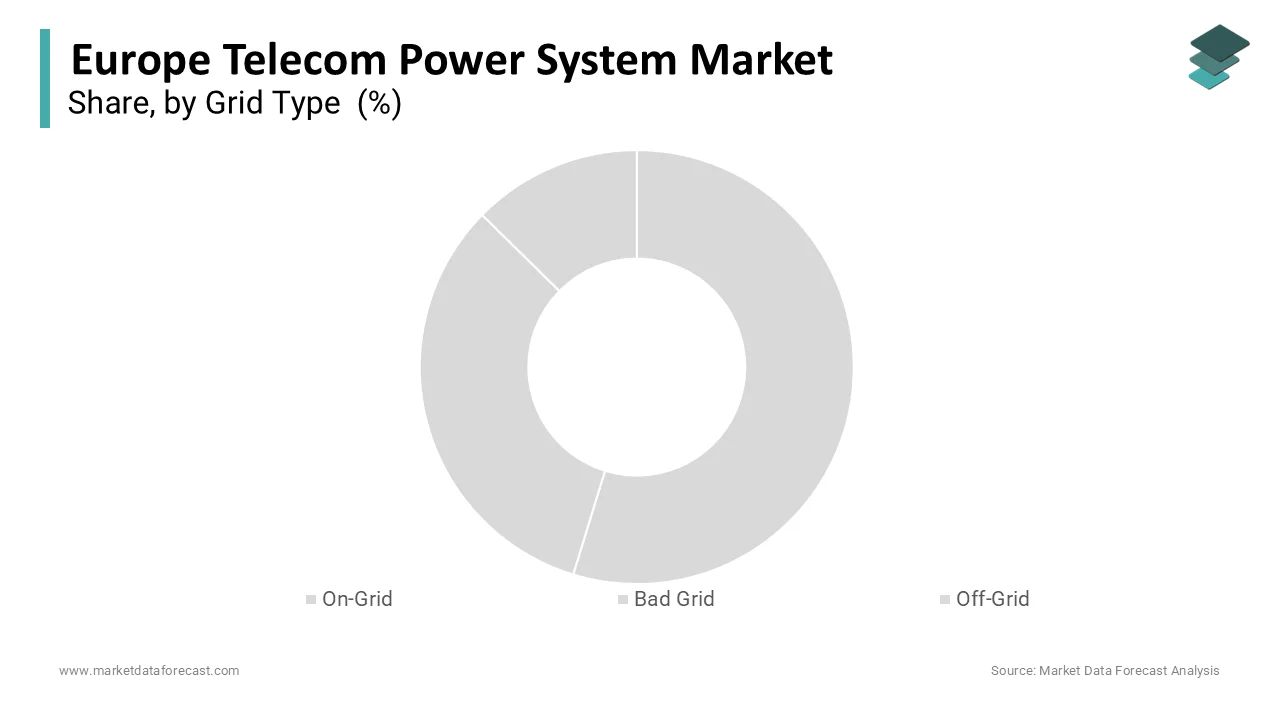
The bad grid segment is projected to expand at a CAGR of 14.8% from 2025 to 2033, increasing grid instability in parts of Eastern and Southern Europe, where aging infrastructure, extreme weather events, and underinvestment lead to frequent voltage sags, surges, and outages. According to the European Environment Agency, countries like Romania, Bulgaria, and parts of Italy experienced over 150 grid disruption events per 1000 customers in 2023, more than triple the EU average. Telecom operators in these regions are deploying hybrid power systems with wide input voltage range rectifiers and oversized lithium-ion banks to maintain uptime during erratic supply.
By Component Insights
The rectifiers segment was the largest and held 48.2% in the European telecom power system market share in 2025, owing to their fundamental role in converting alternating current from the grid into stable direct current for telecom equipment. Modern base stations require high-efficiency rectifiers capable of operating at 96 to 98% efficiency to meet the European Commission’s Ecodesign Directive for energy-related products. As per the European Power Supply Manufacturers Association, over 85% of new rectifier deployments in 2023 used high-frequency switch-mode designs that reduce energy loss and footprint. The rollout of 5G has intensified demand, as massive MIMO radios draw continuous DC loads up to 5 kilowatts per sector, necessitating modular rectifier shelves with hot swap capability. Operators like Orange and Deutsche Telekom have standardized on 48-volt DC architectures across their networks, creating uniform demand for compatible rectification units. Additionally, the integration of Power over Ethernet and remote radio heads in fiber deep architectures further embeds rectifiers into distributed access nodes.
The controllers segment is expected to grow at the fastest CAGR of 16.2% throughout the forecast period, with the shift from passive to intelligent power management, where digital controllers orchestrate energy flow between grid, batteries, and renewables in real time. According to some studies, 72% of European operators now deploy AI-enabled power controllers that predict outages and optimize battery cycling by reducing degradation by up to 30%. These controllers comply with the European Telecommunications Standards Institute’s EN 300 132 2 standard for remote monitoring by enabling centralized oversight of thousands of sites. The European Union’s Cyber Resilience Act, effective in 2025, further mandates secure firmware updates and intrusion detection in all networked power devices, which is accelerating the adoption of advanced controllers with embedded security modules. Companies like ABB and Vertiv have launched controllers with digital twin interfaces that simulate load scenarios before deployment.
By Power Source Insights
The diesel battery hybrid configuration segment held 41.3% of the European telecom power system market share in 2025. Despite Europe’s green ambitions, over 18000 telecom sites in Eastern Europe, the Balkans, and the Nordic periphery still rely on diesel generators paired with lead acid or lithium-ion banks for primary power. The persistence of this configuration stems from its operational simplicity, rapid deployment capability, and existing maintenance ecosystems. Operators like Cosmote and Telekom Romania maintain centralized fuel logistics networks that ensure 72-hour runtime during winter outages. Although carbon-intensive, diesel battery systems offer proven reliability in sub-zero conditions where solar irradiance is low and wind access is limited.
The multiple sources segment is expected to witness the fastest CAGR of 19.4% throughout the forecast period, which reflects operators’ strategic pivot toward energy diversification to mitigate fuel price volatility and meet decarbonization targets. As per the study, 65% of major operators now mandate hybrid power systems with at least three energy inputs for new rural deployments. In Sweden, Telia’s “Triple Hybrid” sites in Lapland integrate 10-kilowatt solar arrays, 5-kilowatt wind turbines, and biodiesel generators by achieving 92% renewable penetration year-round. Similarly, Orange’s pilot in the French Pyrenees uses hydrogen fuel cells as a fourth source during prolonged winter blackouts. The low-interest loans for multi-source deployments, with over 420 sites financed in 2023 alone. Advanced energy routers dynamically prioritize the cleanest and cheapest available source by reducing diesel runtime by up to 85%.
COUNTRY LEVEL ANALYSIS
Germany Telecom Power System Market Analysis
Germany was the largest contributor in the European telecom power system market by occupying 22.3% of the share in 2025 with its dense 5G rollout, industrial digitization, and stringent energy efficiency mandates. The country hosts over 85000 active base stations, with 60% upgraded to 5G as per the Federal Network Agency. This expansion demands high-capacity rectifier systems and intelligent controllers compliant with the German Energy Efficiency Act. Germany’s Energiewende policy also incentivizes on-site solar integration, with 1200 telecom towers now equipped with photovoltaic panels under the Renewable Energy Sources Act. Coupled with world-class manufacturing from companies like Rittal and Bosch, Germany’s market is defined by technological sophistication, regulatory alignment, and industrial scale.
France Telecom Power System Market Analysis
France Telecom's power system market held 16.2% of the share in 2025 with its national strategy for digital sovereignty and rural connectivity. The French government’s “Plan France Très Haut Débit” aims to connect 100% of households to fiber by 2025, requiring resilient power for over 20000 remote cabinets. As per ARCEP, France’s telecom regulator, 28% of new sites in 2023 used hybrid solar-diesel systems to comply with the Energy Climate Law mandating 40% emission cuts by 2030. Orange leads this transition, deploying lithium-ion battery banks with second-life electric vehicle cells at 1500 sites, validated by ADEME’s Circular Economy Fund. Nuclear-powered grid stability ensures on-grid dominance in cities, but mountainous regions like the Alps necessitate a bad grid-capable system with wide voltage tolerance. France’s unique blend of state-driven infrastructure policy and corporate sustainability innovation sustains its leadership in balanced, resilient telecom power deployment.
United Kingdom Telecom Power System Market Analysis
The United Kingdom telecom power system market growth is likely to grow with the rapid 5G densification and climate adaptation imperatives. Ofcom reports that 70% of UK mobile traffic now runs over 5G, with small cells proliferating in urban corridors like London and Manchester. These high-density nodes require compact, high-efficiency rectifiers with integrated battery backup due to limited space and frequent grid maintenance. The UK’s Net Zero Strategy mandates all critical infrastructure to achieve climate resilience by 2027, accelerating the adoption of multiple source systems in coastal and flood-prone areas. Additionally, the UK’s exit from the EU has spurred domestic supply chain development, with firms like Zenaji scaling local production of telecom power modules.
Italy Telecom Power System Market Analysis
Italy's telecom power system market growth is likely to grow with the geographical diversity and legacy grid challenges. Southern regions like Sicily and Calabria suffer from frequent voltage fluctuations, with Enel reporting over 200 annual grid events per 1000 customers in 2023, driving demand for bad grid-capable power systems. TIM’s 2025 infrastructure plan allocates 340 million euros to upgrade 5000 rural sites with wide input rectifiers and lithium storage. The National Recovery and Resilience Plan allocates 1.2 billion euros to digital infrastructure, with 30% earmarked for sustainable power solutions.
COMPETITIVE OVERVIEW
Competition in the European telecom power system market is defined by a mix of global technology leaders and specialized regional vendors vying for influence amid stringent regulatory and sustainability demands. Established players leverage deep integration capabilities, digital platforms, and pan-European service footprints to secure long-term contracts with major operators. Meanwhile, niche firms compete through cost-effective solutions tailored for Eastern European and Balkan markets where budget constraints prevail. Innovation centers on energy efficiency, multi-source integration, and cybersecurity compliance, with differentiation increasingly tied to software intelligence rather than hardware alone. The European Union’s push for digital sovereignty has also encouraged local partnerships and supply chain diversification to reduce reliance on non-European suppliers. Regulatory alignment with Ecodesign, Battery Regulation, and Cyber Resilience Act requirements creates high entry barriers, favoring incumbents with compliance expertise.
KEY MARKET PLAYERS
Some of the companies that are playing a dominating role in the global European telecom power system market include
- Huawei Technologies Co., Ltd.
- Eaton Corporation plc
- Delta Electronics, Inc.
- Vertiv Holdings Co.
- Cummins Inc.
- ABB Ltd.
- Schneider Electric SE
- ZTE Corporation
- Myers Power Products, Inc.
- General Electric Company
- Benning Elektrotechnik und Elektronik GmbH & Co. KG
- AEG Power Solutions B.V.
- Eltek AS (Delta Group)
- HOPPECKE Batteries GmbH & Co. KG
- Ascot Industrial S.r.l.
- Socomec Group S.A.
- Alpha Technologies Ltd.
- UNIPOWER LLC
- Statron AG
- Tesla, Inc.
TOP LEADING PLAYERS IN THE MARKET
- Vertiv Co. is a pivotal contributor to the European telecom power system market through its comprehensive portfolio of AC-DC power systems, intelligent controllers, and thermal management solutions tailored for telecom infrastructure. The company supplies advanced rectifier platforms and lithium-ion battery systems to major European operators, including Vodafone and Orange. Vertiv launched its compact Liebert Micro integrated power system designed specifically for 5G small cells in urban environments, featuring AAI-driven energy optimization and remote diagnostics. It also expanded its service network across Eastern Europe to support rural site deployments. These initiatives underscore Vertiv’s commitment to scalable, intelligent, and service-integrated power solutions that align with Europe’s digital and sustainability objectives while reinforcing its global leadership in critical infrastructure power management.
- Huawei Technologies Co Ltd plays a significant role in the European telecom power system market by offering high-density, energy-efficient power solutions for 5G base stations and fiber access nodes. Despite geopolitical headwinds, the company maintains strong relationships with operators in Central and Eastern Europe through localized support and innovative hybrid power architectures. Huawei introduced its SmartLi UPS system with second-life battery integration and advanced cell balancing algorithms that extend service life by up to 40%. It also partnered with European research institutes to validate the performance of its power systems under extreme cold conditions relevant to Nordic deployments. These efforts highlight Huawei’s focus on resilience, circularity, and localized engineering, enabling continued relevance in Europe’s evolving telecom power ecosystem.
- Schneider Electric SE significantly influences the European telecom power system market through its EcoStruxure for Telecom platform that integrates power distribution, monitoring, and predictive maintenance into a unified digital architecture. The company provides modular rectifiers, lithium-ion battery enclosures, and AI-powered energy management software to operators pursuing grid independence and carbon reduction. Schneider Electric collaborated with Deutsche Telekom to deploy solar hybrid power systems at 500 rural sites in Germany, incorporating real-time carbon intensity tracking aligned with EU taxonomy rules. It also enhanced its cybersecurity certification for all power controllers under the EU Cyber Resilience Act. These actions reflect Schneider Electric’s strategic alignment with Europe’s dual imperatives of digital sovereignty and climate neutrality, strengthening its position as a trusted enabler of sustainable telecom infrastructure globally.
TOP STRATEGIES USED BY THE KEY MARKET PARTICIPANTS
Key players in the European telecom power system market prioritize the development of intelligent and modular power solutions that support 5G densification and edge computing requirements. They actively integrate artificial intelligence for predictive maintenance and energy optimization to enhance system reliability and reduce operational costs. Strategic partnerships with telecom operators and renewable energy providers enable the deployment of hybrid power systems combining solar, wind, and battery storage. Companies are also investing in localized service networks to ensure rapid response in rural and remote areas. Furthermore, they align product design with European Union sustainability mandates, including the Ecodesign Directive and Battery Regulationton by incorporating recyclable materials and digital product passports.
MARKET SEGMENTATION
This research report on the europe telecom power system market is segmented and sub-segmented into the following categories.
By Grid Type
- On-Grid
- Bad Grid
- Off-Grid
By Component
- Rectifiers
- Controllers
- Converters
- Heat Management Systems
- Others
By Power Source
- Diesel–Battery Hybrid
- Multiple Sources (Solar, Wind, Hydrogen, Biodiesel, etc.)
- Others
By Country
- Germany
- France
- United Kingdom
- Italy
- Spain
- Rest of Europe