- Product Description Description
- Table of Contents TOC
- List of Table & Figure LOT
- Get Free Sample PDF Sample PDF
Market Size, 2025
$5.55 BnMarket Estimate, 2026
$6.86 BnMarket Forecast, 2034
$37.36 BnCAGR, 2026–2034
23.6%Executive Summary: Europe Power Bank Market
- Market Scope: Comprehensive analysis of the European power bank market covering portable energy storage solutions, battery technologies, distribution channels, and regional country dynamics.
- Market Valuation: Valued at USD 5.55 billion in 2025, reaching USD 6.86 billion in 2026, and projected to expand to USD 37.36 billion by 2034, registering a strong compound annual growth rate (CAGR) of 23.6% from 2026 to 2034.
- Primary Growth Drivers: Proliferation of high-drain smartphones with 5G connectivity and power-intensive applications, alongside the expansion of mobile-dependent sectors and the gig economy workforce across Europe.
Key Market Segment Metrics (2026–2034)
| Category | Leading Segment / Core Focus | Fastest-Growing / Key Segments |
|---|---|---|
| By Energy Type | Electric-Powered (Grid-Charged) (dominated the European market by capturing a substantial share in 2024 due to high energy efficiency, rapid recharge times, and universal grid access) | Solar-Powered (projected to grow at a CAGR of 12.6% from 2025 to 2033 fueled by eco-tourism, outdoor activities, and off-grid emergency preparedness) |
| By Distribution Channel | E-Commerce (dominated the market in 2024 driven by online convenience, extensive price comparisons, and promotional spikes via platforms like Amazon) | Brick-and-Mortar Retail (predicted to witness the highest CAGR of 6.8% anchored by experiential tech hubs, urgent travel purchases, and carrier bundling) |
| By Battery Type | Lithium-ion (Li-ion) Batteries (led the market in 2024 due to cost efficiency, high energy density, and mature manufacturing infrastructure) | Lithium-polymer (Li-polymer) Batteries (estimated to register a CAGR of 9.3% from 2025 to 2033 driven by demand for slim, lightweight, and flexible form factors) |
| By Country | Germany (top performer with a 24.6% share in 2024 driven by high smartphone penetration, rigorous safety standards, and robust e-waste recycling) | Spain & UK (Spain emerging as highly lucrative due to vibrant tourism and mobile-first populations; UK ranking second with high digital engagement) |
Major Market Players & Industry Landscape
Competitive Structure: Highly fragmented environment characterized by a blend of technological innovation, regulatory compliance, and brand trust, where major players compete on GaN integration, fast-charging capabilities, and safety certifications.
Key Companies Profiled: Anker Technology Co. (Anker Innovations), Beijing Xiaomi Technology Co., Ltd., Belkin International, Inc., Lenovo Group Ltd., Microsoft Corporation, Panasonic Corporation, Sony Corporation, AsusTek Computer Inc., ADATA Technology Co., Ltd., Intex, uNu Electronics Inc., Syska, and Portronics.
Europe Power Bank Market Size
The Europe power bank market was valued at USD 5.55 billion in 2025, is estimated to reach USD 6.86 billion in 2026, and is projected to reach USD 37.36 billion by 2034, growing at a CAGR of 23.6% from 2026 to 2034.
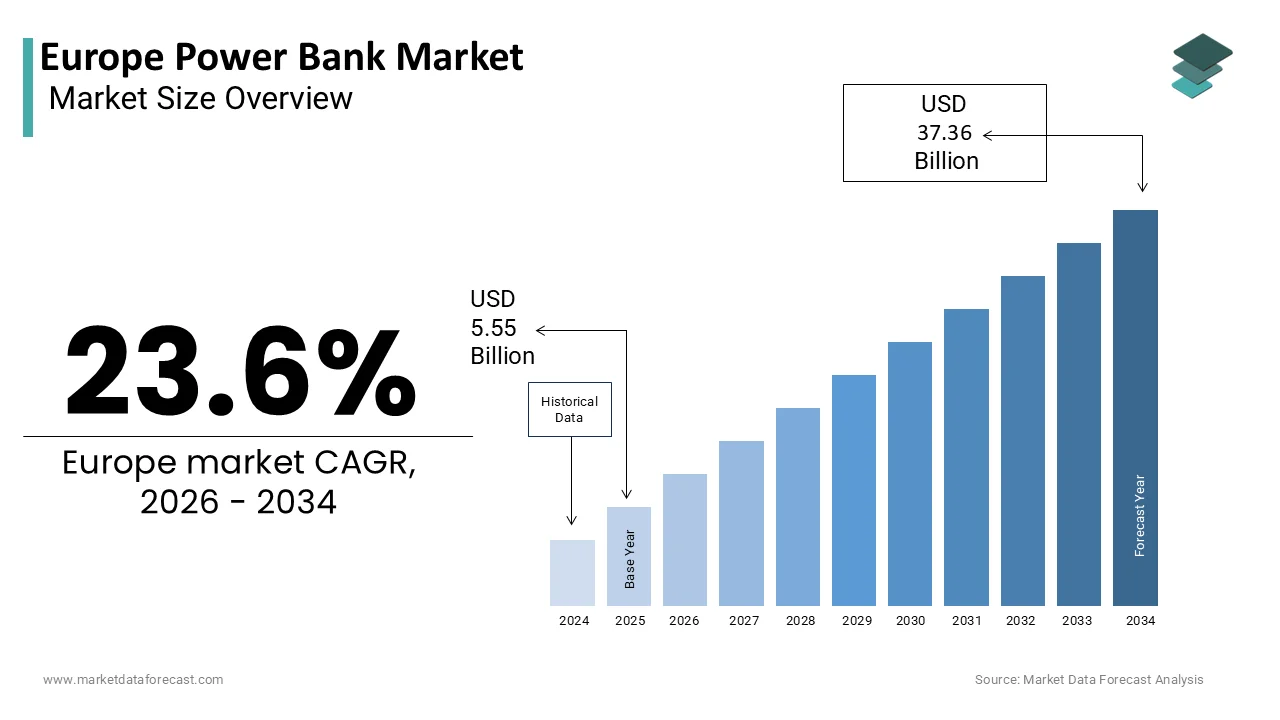
Power banks are portable energy storage devices designed to recharge electronic gadgets such as smartphones, tablets, and wearable technology via integrated lithium-ion or lithium-polymer batteries. These devices have transitioned from niche accessories to essential utilities, driven by the continent’s deep reliance on mobile connectivity and evolving digital lifestyles. According to a study, over 85% of individuals aged 16–74 in the European Union used the internet regularly in 2023, with mobile devices serving as the primary access point in many cases. As per the research, the average European has more than 2 connected personal devices, intensifying demand for on-the-go charging solutions. Furthermore, the rise of remote work, mobile banking, and contactless payments has elevated the importance of uninterrupted device functionality by embedding power banks into daily personal and professional routines across urban and rural settings alike.
MARKET DRIVERS
Proliferation of High-Drain Smartphones with Limited Battery Longevity
Modern smartphones consume power at significantly higher rates than previous generations, reducing battery endurance and increasing reliance on external charging, which is propelling the growth of the Europe power bank market. It is particularly those with 5G connectivity, high-refresh-rate displays, and advanced computational photography. According to a study, 5G-enabled devices in Europe exhibit faster battery depletion compared to their 4G counterparts under identical usage conditions. This accelerated drain is particularly evident in countries like Germany and Sweden, where average daily smartphone usage exceeds hours per user, as per the research. Consequently, consumers are increasingly adopting high-capacity power banks, those exceeding 10,000 mAh, to sustain device functionality throughout the day. Manufacturers have responded by launching ultra-fast charging models with dual USB-C ports, which aligns with the shift toward power-intensive mobile applications and supports the necessity of portable power solutions.
Expansion of Mobile-Dependent Sectors and Gig Economy Workforce
The growing integration of mobile technology in transportation, delivery, and freelance services is accelerating the growth of the Europe power bank market. It has institutionalized power banks as operational tools for Europe’s gig economy workforce. As per a study, millions of Europeans are engaged in digital platform-based employment, including ride-hailing, food delivery, and mobile-based field services, all of which require uninterrupted device functionality. Delivery couriers in cities like Paris, Amsterdam, and Milan often rely on navigation, order tracking, and customer communication apps for many hours daily, making battery longevity an important work requirement.
MARKET RESTRAINTS
Stringent Regulatory and Safety Standards Limiting Product Entry
Rigorous safety and environmental regulations governing lithium-based batteries are hindering the growth of the Europe power bank market. Under the EU Battery Directive and the revised Battery Regulation (EU) 2023/1542, all portable batteries must meet strict requirements for labeling, chemical composition, and recycling protocols. Apart from these, the CE marking process mandates compliance with the EN 62133 standard for safety in portable lithium cells, which includes thermal stability, overcharge protection, and mechanical durability testing. According to the research, a portion of non-compliant electronic products detained at EU borders were power banks due to inadequate safety certifications or substandard battery cells. These regulatory hurdles increase time-to-market and production costs, particularly for smaller brands, while also limiting the availability of low-cost imports that fail to meet EU safety benchmarks.
Rising Integration of High-Capacity Batteries in Smart Devices
Smartphone and tablet manufacturers are increasingly embedding larger internal batteries and implementing energy-efficient technologies by reducing the perceived necessity of external power banks, which hampers the growth of the Europe power bank market. Concurrently, advancements in adaptive battery management systems, such as those developed by Google and Apple, have extended device uptime under typical usage, according to a study. In markets like Finland and Denmark, where device replacement cycles exceed years, users report lower reliance on power banks due to improved built-in performance.
MARKET OPPORTUNITIES
Integration of Power Banks into Sustainable Mobility and Urban Infrastructure
The incorporation of power banks into shared urban mobility ecosystems, including e-bike stations, electric scooter hubs, and public transit networks, is setting up new opportunities for the growth of the Europe power bank market. Cities such as Vienna, Barcelona, and Copenhagen have initiated programs offering rental power banks at metro stations and bike-sharing docks by aligning with broader smart city objectives. According to the research, a large number of e-bike trips were recorded in the EU in 2024, many of which involve smartphone navigation and digital payment, increasing on-the-go power demands. This trend toward embedded charging infrastructure provides a scalable avenue for manufacturers to partner with municipal authorities and mobility providers, which transforms power banks into integral components of sustainable urban living.
Adoption of Gallium Nitride (GaN) and Fast-Charging Technologies
The commercialization of gallium nitride (GaN) semiconductors in power bank design is setting up new opportunities for the growth of the Europe power bank market. This enables faster charging, reduced heat generation, and compact form factors. According to a study, GaN-based chargers achieve greater energy efficiency than traditional silicon-based models, allowing for higher wattage output without compromising portability. Brands have introduced 65W+ dual-output GaN power banks capable of charging laptops and smartphones simultaneously, appealing to business travelers and remote workers. In Sweden and the Netherlands, where remote work constitutes a portion of full-time employment, as per research, demand for multi-device charging solutions has surged. This technological leap not only enhances user convenience but also aligns with EU energy efficiency directives, which position GaN-enabled power banks as premium, future-ready products.
MARKET CHALLENGES
Environmental Impact and End-of-Life Management of Lithium Batteries
The environmental footprint of discarded power banks is challenging the growth of the Europe power bank market. The improper disposal of lithium-ion cells contributes to electronic waste and potential soil contamination. According to the study, only a portion of e-waste in Europe was formally collected and recycled, with small batteries often excluded from dedicated take-back systems. Power banks are frequently discarded with household waste due to a lack of visible recycling labels, which contributes to this gap. The European Environment Agency estimates that millions of power banks reached end-of-life in the EU, with a smaller share being properly recycled. Moreover, the presence of cobalt and nickel in battery cells raises ethical sourcing concerns. Therefore, addressing this requires coordinated efforts in consumer education, standardized labeling, and expanded producer responsibility schemes under the EU’s Circular Economy Action Plan.
Proliferation of Substandard and Counterfeit Products in Online Marketplaces
The widespread availability of uncertified, low-quality power banks that pose safety risks and undermine consumer trust is degrading the growth of the Europe power bank market. As per a study, many batches of non-compliant power banks were withdrawn from online platforms in the EU, primarily due to risks of overheating, short-circuiting, and explosion. Also, according to research, many power banks sold on major online marketplaces lacked proper CE certification or contained mismatched battery cells. These substandard units often use recycled or ungraded lithium cells, leading to inconsistent performance and safety hazards.
REPORT COVERAGE
| REPORT METRIC | DETAILS |
| Market Size Available | 2025 to 2034 |
| Base Year | 2025 |
| Forecast Period | 2026 to 2034 |
| Segments Covered | By Energy, Distribution Channel, Battery, and Country. |
| Various Analyses Covered | Global, Regional and Country-Level Analysis, Segment-Level Analysis, Drivers, Restraints, Opportunities, Challenges; PESTLE Analysis; Porter’s Five Forces Analysis, Competitive Landscape, Analyst Overview of Investment Opportunities |
| Countries Covered | UK, Germany, Italy, France, Spain, Sweden, Denmark, Poland, Switzerland, the Netherlands, and the Rest of Europe. |
| Market Leaders Profiled | Beijing Xiaomi Technology Co., Ltd., Lenovo Group Ltd., Microsoft Corporation, Panasonic Corporation, Sony Corporation, AsusTek Computer Inc., Anker Technology Co., ADATA Technology Co., Ltd., Intex, uNu Electronics Inc., Syska, Portronics, and Others. |
SEGMENTAL ANALYSIS
By Energy Insights
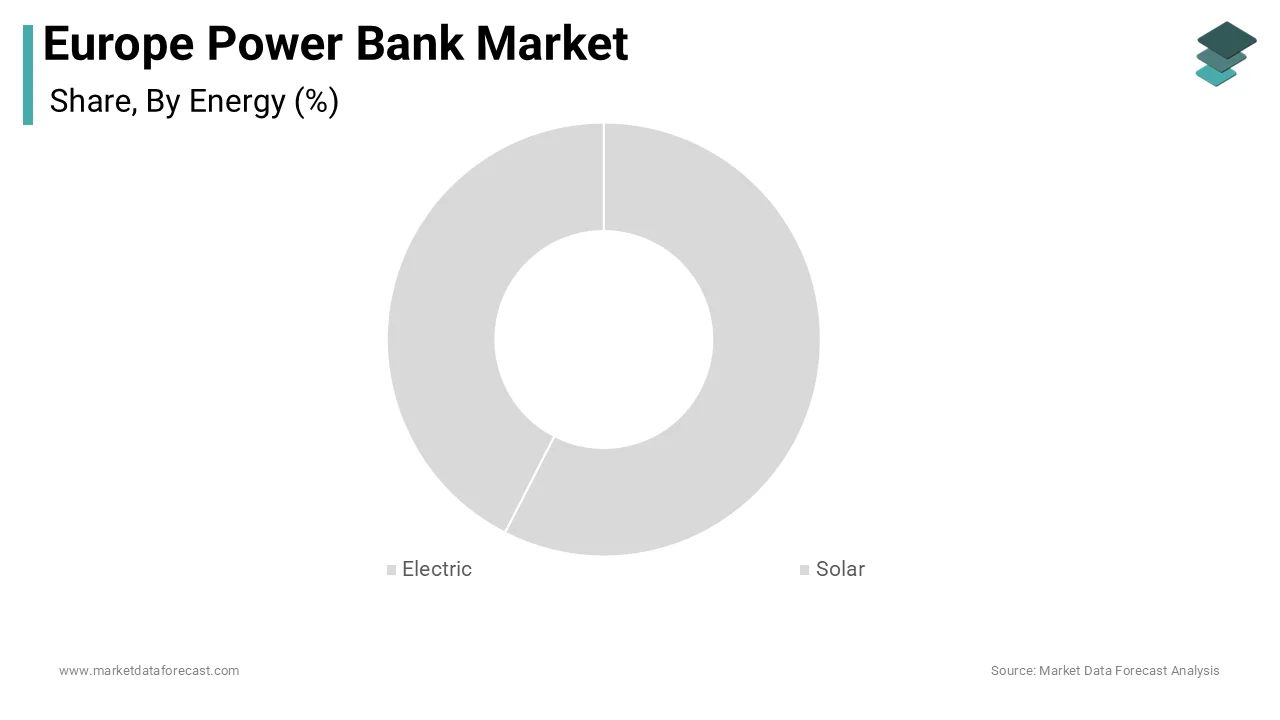
The electric-powered (grid-charged) power banks segment dominated the European market by capturing a substantial share in 2024. Their superior energy efficiency, faster recharge cycles, and widespread compatibility with existing charging infrastructure are driving the growth of the electric-powered (grid-charged) power banks segment. Unlike solar models, which require prolonged exposure to direct sunlight, electric power banks can be fully recharged in 1.5 to 3 hours using standard USB-C or wall adapters, which is important for urban consumers with time-constrained lifestyles. According to most, households in Western Europe have access to reliable electricity, enabling seamless integration into daily routines. Furthermore, the European Commission’s 2024 common charger directive, mandating USB-C across all mobile devices, has accelerated the adoption of compact and high-efficiency electric power banks.
The solar-powered power banks segment is projected to grow at a CAGR of 12.6% from 2025 to 2033 due to the rising environmental consciousness and the expansion of outdoor and off-grid activities. As per a study, millions of Europeans participated in nature-based tourism, such as hiking, camping, and cycling, representing an increase. In response, consumers are seeking sustainable, off-grid charging solutions that align with eco-tourism values. Countries like Sweden, Austria, and Slovenia have integrated solar power banks into national park visitor kits and emergency preparedness programs.
By Distribution Channel Insights
The E-commerce segment dominated the Europe power bank market by capturing a substantial share in 2024. The growth of the e-commerce segment is driven by the convenience of online shopping, extensive product comparisons, and competitive pricing models offered by platforms such as Amazon, Zalando, and MediaMarkt.de. As per a study, many consumers prefer purchasing electronics online due to faster delivery, customer reviews, and access to premium and niche brands not available in physical stores. Apart from these, flash sales and seasonal promotions, such as Black Friday and Prime Day, drive significant volume spikes, with Amazon reporting a year-on-year increase in portable charger sales during the holiday season. The integration of AI-driven recommendation engines and same-day delivery in major cities further strengthens e-commerce’s appeal among younger and tech-savvy demographics.
The brick-and-mortar retail segment is predicted to witness the highest CAGR of 6.8% during the forecast period, owing to experiential retail and urgent-purchase behavior. As per research, electronics retailers are transforming stores into interactive tech hubs where consumers can test charging speed, port configuration, and build quality before purchase. In addition, some last-minute travelers buy power banks at airport electronics kiosks, according to a study. Similarly, telecom providers like Vodafone and Orange have begun bundling certified power banks with high-end smartphone contracts, enhancing trust and convenience. According to a study, many mobile accessory sales occur at carrier points of sale, where consumers prioritize reliability and immediate availability over price. This tactile and trust-based purchasing model is revitalizing physical retail in a digital-first market.
By Battery Type Insights
The lithium-ion (Li-ion) batteries segment led the European power bank market by capturing a significant share in 2024. The growth of the lithium-ion (Li-ion) battery segment is driven by its cost efficiency, high energy density, and mature manufacturing infrastructure. Li-ion cells typically offer 250–300 charge cycles with minimal degradation, making them ideal for daily-use power banks. According to the research, many power banks sold in the EU use Lithium-Polymer (Li-Po) cells in addition to Lithium-Ion (Li-ion) cells. Apart from these, economies of scale from electric vehicle and grid storage production have reduced Li-ion cell costs, as per a study.
The lithium-polymer (Li-polymer) batteries segment is estimated to register a CAGR of 9.3% from 2025 to 2033 due to the demand for slim, lightweight, and flexible form factors in premium power banks. Unlike rigid Li-ion cells, Li-polymer batteries can be molded into ultra-thin profiles, enabling sleek designs ideal for fashion-conscious and business users. As per an analysis, many new power banks launched in Scandinavia and the Benelux region utilized Li-polymer cells to achieve thicknesses below 12 mm. These batteries also exhibit superior safety, with lower risks of leakage and thermal runaway, a factor emphasized by the European Committee for Electrotechnical Standardization (CENELEC). In premium segments, brands like Belkin and Nomad use Li-polymer power banks weighing under 180 grams, appealing to frequent travelers.
COUNTRY LEVEL ANALYSIS
Germany Power Bank Market Insights
Germany was the top performer in the European power bank market in 2024 and accounted for a 24.6% share 2024. The domination of Germany in the regional market is primarily driven by its high smartphone penetration, advanced digital infrastructure, and strong consumer emphasis on product safety and durability. According to the study, most Germans own a smartphone, with substantial daily usage, intensifying demand for reliable charging solutions. German consumers exhibit a preference for CE-certified, high-wattage power banks with GaN technology, favoring brands that comply with TÜV Rhineland safety standards. Retailers dominate sales, often bundling power banks with mobile contracts. Apart from these, the country’s robust e-waste recycling system under the ElektroG law ensures responsible disposal, which supports consumer confidence in sustainable electronics consumption.
United Kingdom Power Bank Market Insights
The UK power bank market was ranked second with 20.5% the market share in 2024. The growth of the United Kingdom in the regional market is driven by high urbanization and digital engagement. As per a study, a portion of UK adults use smartphones for navigation, mobile banking, and remote work, with Londoners having many connected devices per person. This digital intensity, combined with extensive public transit usagee which fuels demand for compact and fast-charging power banks. According to the research, a substantial number of passenger journeys were made on UK trains, many of which lack onboard charging, prompting commuters to carry portable power. E-commerce platforms like Amazon UK and Currys account for a notable share of sales, with Black Friday consistently recording the highest power bank transaction volumes.
France Power Bank Market Insights
France grew steadily in the Europe power bank market due to a progressive consumer base that values design, safety, and sustainability. According to ARCEP, France’s telecom regulator, smartphone ownership is high, with mobile data consumption growing annually due to video streaming and social media usage. However, consumer trust remains sensitive to product certification, with a notable share of French buyers verifying CE and NF markings before purchase, as per the report. Retail chains like Fnac and Boulanger dominate sales, offering curated selections emphasizing eco-design and energy efficiency. In 2021, the French government introduced a reparability index, prompting brands to enhance product longevity. This regulatory and cultural environment favors established and transparent brands, which shapes a market that prioritizes reliability over novelty.
Italy Power Bank Market Insights
Italy grew steadily in the Europe power bank market, with demand heavily influenced by seasonal tourism and regional disparities in digital infrastructure. According to the study, millions of tourists visited Italy, many relying on smartphones for navigation, translation, and ticketing in historic cities with limited public charging. Major airports have reported an increase in power bank sales at duty-free and convenience kiosks. Domestic consumption is rising in urban centers such as Milan and Florence, where remote work has increased mobile dependency. However, rural areas still face connectivity gaps, supporting the need for portable power. Retailers like Unieuro and ePrice are expanding online and in-store offerings, while local brands like Energy Sistem are gaining traction with competitively priced, multi-device models tailored to Italian consumer habits.
Spain Power Bank Market Insights
Spain is expected to be the most lucrative region in the European power bank market during the forecast period, owing to a young, mobile-first population and one of Europe’s most vibrant tourism sectors.. The country welcomed millions of international tourists, according to the research, many of whom engaged in outdoor and cultural activities that drain device batteries. Beach resorts, hiking trails, and public transport systems often lack charging points, increasing reliance on portable solutions. E-commerce platforms have seen a surge in power bank sales, particularly for models with high mAh capacity and dual USB-C ports.
COMPETITIVE LANDSCAPE
KEY MARKET PLAYERS
Companies playing a leading role in the Europe power bank market are
- Beijing Xiaomi Technology Co., Ltd.
- Lenovo Group Ltd.
- Microsoft Corporation
- Panasonic Corporation
- Sony Corporation
- AsusTeK Computer Inc.
- Anker Technology Co.
- ADATA Technology Co., Ltd.
- Intex
- uNu Electronics Inc.
- Syska
- Portronics
- Others
TOP LEADING PLAYERS MARKET
Anker (SZ DJI Technology Co., Ltd.)
Anker has established a dominant presence in the European power bank market through its focus on high-performance engineering, advanced GaN (gallium nitride) technology, and robust consumer trust. The brand has consistently introduced compact, multi-port power banks with rapid charging capabilities, aligning with the region’s demand for efficiency and portability. The company has strengthened its distribution through partnerships with major e-commerce platforms and telecom retailers like Vodafone. Apart from these, Anker has invested in localized customer support and extended warranties by enhancing brand reliability. Its integration of Power Delivery 3.1 and adaptive temperature control systems reflects a commitment to safety and innovation, which supports its dominance in premium portable energy solutions.
Xiaomi Corporation
Xiaomi has significantly influenced the European power bank landscape by delivering high-capacity, affordably priced models with a minimalist design and energy efficiency. The company’s Mi and Redmi-branded power banks have gained widespread acceptance due to their compatibility with global charging standards and seamless integration into Xiaomi’s broader ecosystem of smart devices. The company has expanded its retail footprint through collaborations with electronics chains such as MediaMarkt and Fnac, while leveraging online marketplaces for rapid scalability. Xiaomi also emphasizes sustainability, using recyclable aluminum casings and reducing standby power consumption.
Belkin International, Inc.
Belkin has carved a niche in the European power bank market by prioritizing safety, design, and integration with premium mobile ecosystems, particularly Apple’s device lineup. As an official MFi (Made for iPhone) certified accessory provider, Belkin ensures seamless compatibility and charging optimization for iPhone and iPad users, an important advantage in markets like the UK and Scandinavia. Belkin has strengthened its presence through partnerships with Apple retail stores and authorized resellers across major European capitals. The company also adheres to stringent EU safety and environmental standards, incorporating flame-retardant materials and advanced circuit protection.
TOP STRATEGIES USED BY KEY MARKET PARTICIPANTS
Key players in the Europe Power Bank Market are deploying strategies such as technological differentiation through GaN integration, expansion of e-commerce and retail partnerships, product localization for regional usage patterns, emphasis on safety certifications and sustainability, and bundling with mobile devices or service contracts. Companies are investing in ultra-fast charging, multi-device compatibility, and compact designs to meet evolving consumer demands. Strategic collaborations with telecom providers and electronics retailers enhance market penetration, while eco-design initiatives align with EU circular economy goals.
COMPETITION OVERVIEW
The competition in the Europe Power Bank Market is characterized by a blend of technological innovation, regulatory compliance, and strategic branding across premium and budget segments. While global brands dominate through advanced engineering and ecosystem integration, regional players and retailers are gaining ground by offering certified, value-driven alternatives. The market is highly fragmented, with differentiation hinging on charging speed, build quality, safety features, and environmental credentials. Consumer awareness of counterfeit risks has elevated the importance of certification and after-sales support, favoring established brands. Simultaneously, the rise of GaN technology and sustainability mandates under EU directives are reshaping product development.
EUROPE POWER BANK MARKET NEWS
- In February 2025, Anker collaborated with Deutsche Bahn to pilot a power bank rental system at major German railway stations, integrating portable charging into public transit infrastructure and expanding reach among daily commuters and travelers.
MARET SEGMENTATION
This europe power bank market research report has been segmented and sub-segmented into the following categories.
By Energy
- Electric
- Solar
By Distribution Channel
- E-Commerce
- Brick & Mortar
By Battery
- Lithium-ion (Li-ion)
- Lithium-polymer (Li-polymer)
By Country
- UK
- France
- Spain
- Germany
- Italy
- Russia
- Sweden
- Denmark
- Switzerland
- Netherlands
- Turkey
- Czech Republic
- Rest of Europe