- Product Description Description
- Table of Contents TOC
- List of Table & Figure LOT
- Get Free Sample PDF Sample PDF
Market Size, 2025
$3.53 BnMarket Estimate, 2026
$3.93 BnMarket Forecast, 2034
$9.30 BnCAGR, 2026–2034
11.36%Europe Early Childhood Education Market Size
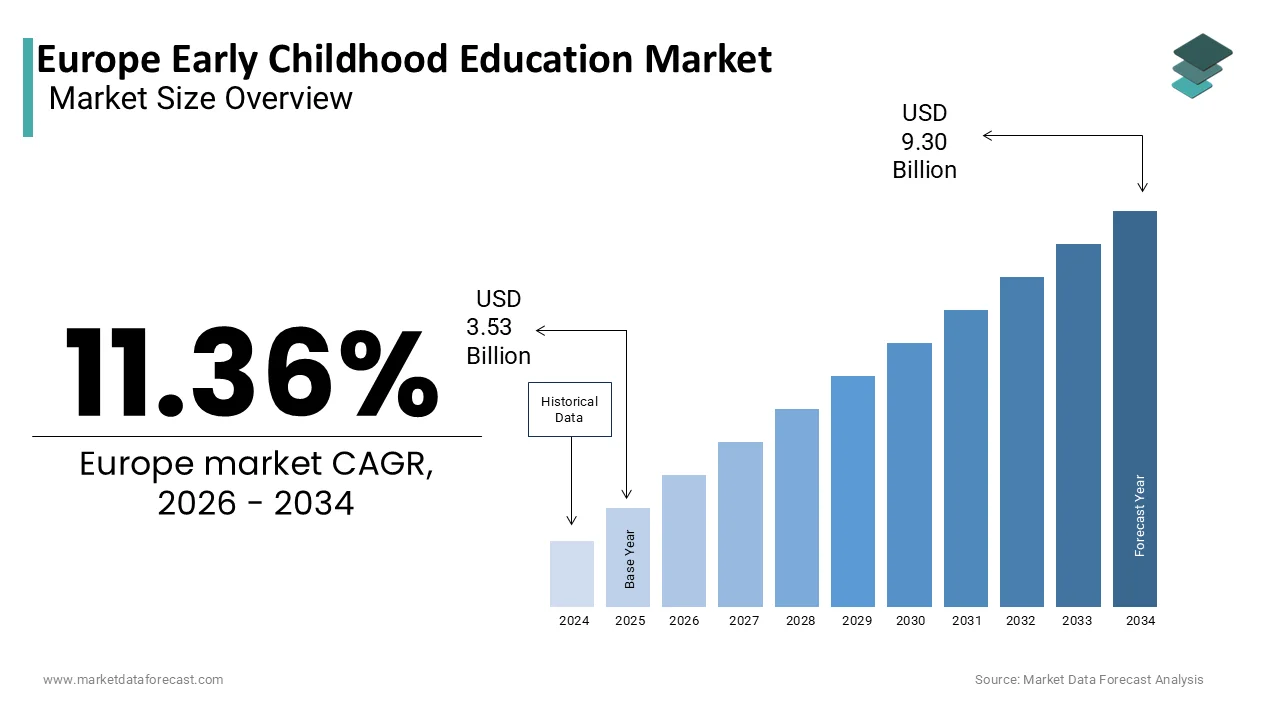
The Europe early childhood education market was valued at USD 3.53 billion in 2025, is estimated to reach USD 3.93 billion in 2026, and is projected to reach USD 9.30 billion by 2034, growing at a CAGR of 11.36% from 2026 to 2034.
Early Childhood Education (ECE) refers to the period of learning and development that occurs from birth to age eight. This market includes public nurseries, private kindergartens, home-based care, and increasingly, digital learning platforms tailored for cognitive and social development. The region treats early education not merely as childcare but as a foundational pillar for lifelong learning and social equity. Early Childhood Enrollment: In 2024, data from the European Commission indicated that 39.3% of children under three years old in the European Union participated in formal childcare, reflecting a steady upward trend in enrollment driven by the expansion of legal frameworks enabling access. Furthermore, the European Commission reported that 95% of children between four years old and the starting age of compulsory primary education were enrolled in early childhood education and care (ECEC) programs across the EU, effectively meeting previous benchmarks. These figures underscore a robust institutional framework supported by the European Pillar of Social Rights, which aligns with the revised Barcelona Targets to ensure at least 45% participation for children under three and 96% for children from age three to compulsory school age by 2030. The market is characterized by a mix of state-funded provision and a growing private sector responding to dual-income household needs. Pedagogical approaches are shifting toward play-based and holistic development models. As a result, the definition of early education now expands to include emotional intelligence and digital literacy, reshaping the operational landscape for providers throughout the continent.
MARKET DRIVERS
Rising Female Labor Force Participation Necessitates Formal Childcare Solutions
The increasing integration of women into the professional workforce accelerates the expansion of the European early childhood education services market. The demand for reliable, high-quality childcare has become critical. This shift is driven by the fact that more households must rely on dual incomes to navigate current economic pressures. According to Eurostat, the employment rate for women in the European Union was significantly higher at 70.8%, marking a historic high and creating a structural need for external care during working hours. This demographic shift forces parents to seek formal education settings that offer extended hours and educational value beyond basic supervision. Governments recognize this link, with many nations tying childcare availability directly to female employment targets. The scarcity of informal care networks, such as extended family living nearby due to urbanization, further amplifies reliance on institutional providers. Consequently, the market sees sustained growth as employers and states collaborate to expand capacity. The correlation is evident in Northern European countries where high female employment coincides with near-universal early education coverage. This trend is rapidly permeating Southern and Eastern Europe. Consequently, the pressure on existing infrastructure is intensifying, driving investment in new facilities and innovative care models to accommodate the working population.
Government Mandates and Strategic Investment in Early Developmental Outcomes
Aggressive government policies and substantial public funding aimed at improving long-term educational and social outcomes act as a powerful engine for the growth of the European early childhood education market. European nations increasingly view early childhood education as a strategic investment to reduce future social inequality and boost economic productivity. Under the European Education Area (EEA) framework, the 96 % benchmark applies to children between the ages of three and the starting age for compulsory primary education, with a target date of 2030. A previous benchmark of 95 % for children aged four and over has already been achieved. As per data from the Organisation for Economic Co-operation and Development, public expenditure on early childhood education and care in Europe averaged 0.8 % of Gross Domestic Product in 2024, with countries like Sweden and Denmark exceeding 1.5 %. These funds facilitate the construction of new centers, subsidize fees for low-income families, and improve educator training standards. The focus has shifted from mere custodial care to rigorous pedagogical frameworks that emphasize cognitive and social skill acquisition. National recovery plans following recent economic disruptions often allocate specific tranches to modernize early education infrastructure. This top-down approach ensures a stable revenue stream for providers and guarantees access for broader demographics, thereby expanding the total addressable market through state-sponsored inclusion initiatives.
MARKET RESTRAINTS
Severe Shortage of Qualified Early Childhood Educators Limits Capacity
A critical deficit in skilled professionals capable of delivering high-quality ECE hampers the expansion of the European early childhood education market. The sector faces a perfect storm of an aging workforce, low remuneration relative to other teaching professions, and challenging working conditions that deter new entrants. The European Trade Union Committee for Education reported in 2024 that nearly 40% of early childhood education staff in the EU are over the age of 50, signaling an impending retirement wave that threatens to deplete the workforce further. Despite rising demand, recruitment remains stagnant because salaries often lag behind those of primary school teachers, despite similar qualification requirements. This shortage forces many centers to operate below capacity or maintain high child-to-staff ratios that compromise quality and regulatory compliance. In countries like Germany and France, thousands of nursery places remain unfilled simply due to a lack of certified personnel to supervise them. The rigorous certification processes in many European nations, while ensuring quality, also slow down the pipeline of new educators. Competitive wage structures and improved career progression pathways are essential for the sector's health. Without them, the supply of talent will continue to constrain the market's ability to meet the growing needs of families, effectively capping potential growth.
High Operational Costs and Affordability Barriers for Families
The escalating costs associated with running ECE facilities create a constraint that limits accessibility for many families and restricts the growth of the European early childhood education market. Providers face rising expenses related to real estate, energy consumption, safety compliance, and staff wages, which inevitably translate into higher fees for parents. According to a study by the European Platform for Investing in Children, childcare costs in several major European cities can consume up to 30% of a median dual-income household's budget, rendering formal education unaffordable for lower and middle-income families. In nations where state subsidies are insufficient or means-tested strictly, large segments of the population are forced to rely on informal, unregulated care or withdraw one parent from the workforce. The financial strain is exacerbated by inflationary pressures on utilities and food supplies, which disproportionately impact small private providers who lack the economies of scale of larger chains. Consequently, demand remains suppressed in price-sensitive regions, preventing the market from achieving universal coverage. Some governments offer vouchers or tax credits to help with costs. However, these measures often fail to keep pace with the actual cost of service delivery. This affordability gap creates a fragmented market where access is determined by socioeconomic status rather than educational need, hindering overall sector growth.
MARKET OPPORTUNITIES
Integration of Digital Learning Tools and Hybrid Educational Models
The adoption of advanced digital technologies and hybrid learning frameworks opens up major possibilities for the European early childhood education market expansion. These tools can significantly enhance both pedagogical outcomes and operational efficiency. As digital natives become parents, there is a growing acceptance of screen-free yet technology-enabled learning tools that foster creativity and cognitive skills. ECE centers across Europe are increasingly adopting immersive and interactive technologies to foster early interest in scientific and technical creativity, moving away from purely didactic teaching methods. These tools allow for personalized learning paths and real-time progress tracking, appealing to data-conscious parents. Furthermore, hybrid models that combine physical attendance with secure digital platforms for parent engagement and home-based activities are gaining traction. Such platforms facilitate continuous learning loops between school and home, increasing the perceived value of the service. The post-pandemic acceleration in edtech investment has lowered the cost of entry for these technologies, making them accessible to smaller providers. Companies that develop age-appropriate, privacy-compliant digital solutions stand to capture significant market share by addressing the dual needs of modernizing education and enhancing parental connectivity. This digital evolution opens new revenue streams through software licensing and content subscriptions within the traditional care setting.
Expansion of Private and Corporate-Sponsored Early Education Facilities
The increasing inability of public systems to meet demand has created a fertile ground for the growth of private providers and corporate-sponsored childcare initiatives across the region, which is likely to promote the expansion of the European early childhood education market. In major urban centers, parents are increasingly turning to private alternatives due to public nursery waitlists that last months or years. These private options offer the flexibility and premium services that many families now require. The early childhood education market is experiencing steady expansion, particularly in the private sector, as government policies and workforce demands drive a consistent increase in formal childcare participation across major European economies. Corporations are increasingly recognizing childcare as a vital employee benefit, leading to a surge in on-site nurseries and partnerships with private operators to retain talent. This trend is supported by government incentives in several countries that offer tax breaks to companies investing in employee childcare. Private players are capitalizing on this by offering extended hours, bilingual programs, and specialized curricula that public institutions often cannot provide. The rise of micro-nurseries and home-based franchise models further diversifies the supply side, offering scalable solutions for underserved neighborhoods. The stigma around private care is diminishing while the quality gap narrows. Consequently, this segment is poised for robust growth, driven by an urgent need for slots that the public sector alone cannot provide.
MARKET CHALLENGES
Regulatory Fragmentation and Complex Compliance Landscapes
The diverse and often conflicting regulatory frameworks across European nations impede operators seeking to scale or standardize ECE services and the European early childhood education market. Each country maintains distinct laws regarding staff qualifications, child-to-staff ratios, facility safety standards, and curriculum requirements, creating a complex web of compliance obligations. The European Commission noted in 2024 that while broad goals are set at the EU level, implementation varies drastically, with some nations requiring university degrees for lead teachers while others accept vocational training. This fragmentation hinders the ability of large chains to replicate successful models across borders, increasing administrative burdens and operational costs. Cross-border providers must navigate varying inspection regimes and licensing procedures, which can delay market entry and stifle innovation. Furthermore, frequent changes in national legislation regarding data privacy and child protection add layers of uncertainty for investors. The lack of harmonization also complicates the portability of qualifications for educators, exacerbating workforce shortages. For digital solution providers, differing rules on data handling for minors create additional technical hurdles. Until greater alignment is achieved, the market will remain highly localized, limiting economies of scale and slowing the dissemination of best practices across the continent.
Socioeconomic Disparities in Access and Quality of Care
Persistent inequalities in access to high-quality ECE based on socioeconomic status and geographic location remain a daunting challenge for the European early childhood education market. Despite universal aspirations, children from disadvantaged backgrounds and rural areas often receive inferior care compared to their affluent urban peers, perpetuating cycles of inequality. The European Social Policy Network reported in 2024 that the participation gap in formal childcare between the lowest and highest income quintiles exceeds 25% points in several member states. Rural regions frequently suffer from a "care desert" phenomenon where no facilities exist within a reasonable distance, forcing families to rely on informal arrangements. Even where services exist, the quality varies significantly, with underfunded public centers in deprived areas struggling to attract qualified staff and maintain resources. This disparity undermines the core mission of early education as a tool for social mobility. Addressing this challenge requires targeted funding and innovative delivery models, yet political will and budget constraints often stall progress. The resulting two-tier system risks alienating vulnerable populations and diminishing the overall societal return on investment in early education, making it a critical issue that stakeholders must resolve to ensure sustainable market development.
REPORT COVERAGE
| REPORT METRIC | DETAILS |
| Market Size Available | 2025 to 2034 |
| Base Year | 2025 |
| Forecast Period | 2026 to 2034 |
| Segments Covered | By Type of Childcare, Age Group, Ownership Structure, and Region. |
| Various Analyses Covered | Global, Regional, and Country-Level Analysis, Segment-Level Analysis, Drivers, Restraints, Opportunities, Challenges; PESTLE Analysis; Porter’s Five Forces Analysis, Competitive Landscape, Analyst Overview of Investment Opportunities |
| Countries Covered | UK, France, Spain, Germany, Italy, Russia, Sweden, Denmark, Switzerland, Netherlands, Turkey, Czech Republic, Rest of Europe |
| Market Leaders Profiled | Bright Horizons Family Solutions Inc., KinderCare Learning Centers, Learning Technologies Group PLC, Spring Education Group, International Schools Services, The Learning Journey Day Nursery, London Early Years Foundation, Reggio Children Foundation, Kiddie Academy, G8 Education Ltd. |
SEGMENTAL ANALYSIS
By Type of Childcare Insights
The kindergarten schools segment was the largest segment in the European early childhood education market and captured a 42.7% share in 2025. The prominence of the segment is supported by the universal recognition of kindergarten as the critical bridge between home care and formal primary education, supported by near-mandatory enrollment policies across most European nations for children aged three to six. The widespread implementation of compulsory or near-compulsory attendance laws for kindergarten-aged children serves as the primary engine for this segment's leadership. Most European countries have legislated that children must attend some form of early education starting at age three or four, effectively guaranteeing a captive audience for kindergarten schools. EU member states are generally seeing an upward trajectory in preschool enrollment as they move toward the European Education Area target of 96%. These policies are rooted in the understanding that kindergarten provides essential socialization and cognitive foundation required for later academic success. Governments prioritize funding for this specific age group to ensure equity before primary school begins. The legal requirement removes the element of parental choice regarding whether to enroll, creating a stable and massive demand base that other childcare types, which are often optional, cannot match. This regulatory backbone ensures that kindergarten schools remain the most utilized and financially significant component of the early childhood education landscape. The integration of kindergarten into the formal national education framework distinguishes it from informal childcare and drives its dominance through perceived educational value. Unlike nurseries or drop-in centers, kindergarten schools operate under standardized curricula designed to prepare children specifically for the rigors of primary school, making them the preferred choice for parents focused on academic readiness. There is a growing international shift toward integrating socio-emotional learning and foundational literacy into standardized early childhood curriculum frameworks. This standardization assures parents that their children are receiving high-quality, consistent instruction regardless of the specific institution. Teachers in these settings typically hold higher qualifications comparable to primary educators, further enhancing credibility. The seamless transition from kindergarten to first grade reduces anxiety for families and streamlines the administrative process for school districts. As European education systems increasingly emphasize early intervention to close achievement gaps, the role of kindergarten as the foundational year of schooling becomes even more entrenched, securing its position as the leading segment in terms of enrollment and institutional presence.
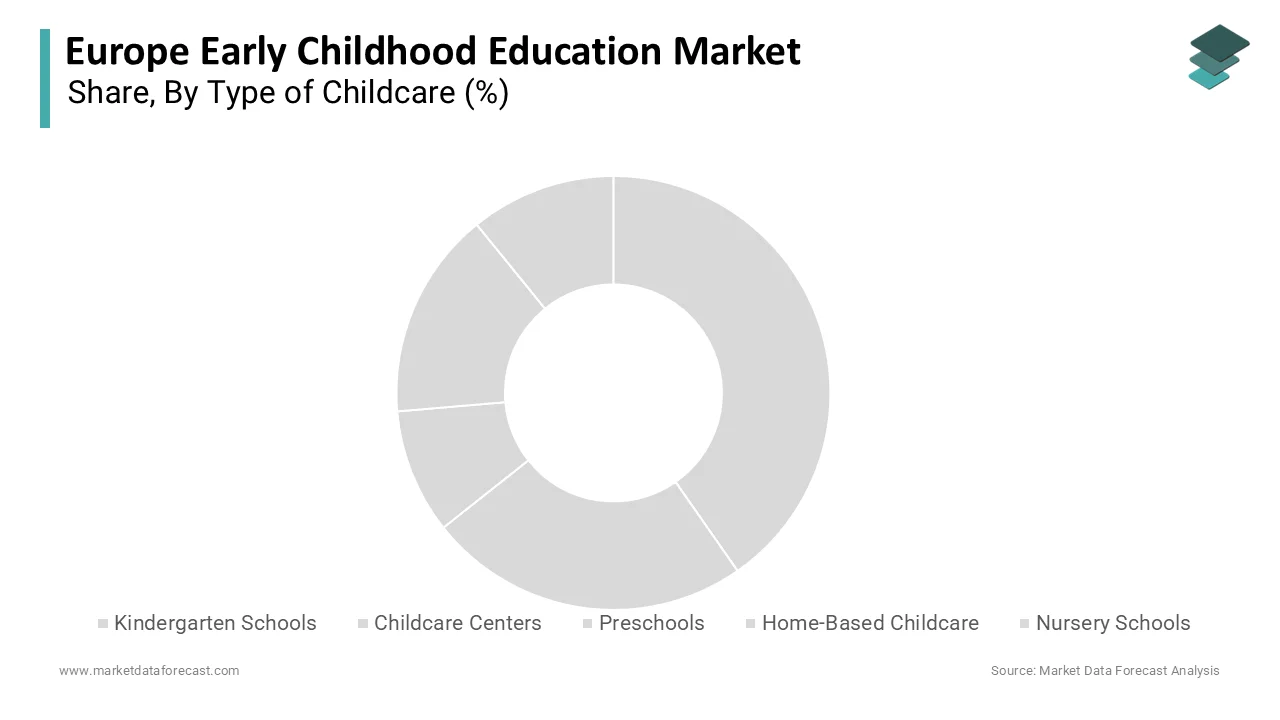
The childcare centers segment is likely to experience the fastest CAGR of 6.8% from 2026 to 2034 due to the urgent need for flexible, full-day care solutions that accommodate the evolving work patterns of modern dual-income households and the rising participation of women in the labor force. The steady increase in the number of working mothers across Europe has created an unprecedented demand for full-day childcare services that extend beyond the limited hours of traditional kindergartens. As women pursue careers with greater intensity, the need for reliable care from early morning until late afternoon becomes critical. The gender employment gap in the European Union is narrowing as female labor market participation continues to hit historic peaks. Traditional kindergarten schools often operate on half-day schedules or close during school holidays, leaving a significant gap that working parents cannot fill. Childcare centers address this by offering extended operating hours, weekend care, and holiday programs tailored to professional schedules. This flexibility makes them indispensable for dual-income families who cannot rely on informal networks. The economic necessity of two incomes in the face of inflation further cements this trend, as families cannot afford for one parent to stay home. Consequently, the market for flexible, full-day childcare centers is expanding rapidly to meet this structural shift in the workforce demographics. A growing trend of corporations investing in on-site or partnered childcare facilities is accelerating the growth of the childcare center segment. Companies are increasingly recognizing that providing accessible childcare is a powerful tool for talent retention, employee productivity, and diversity initiatives. Despite policy pushes for better work-life balance, access to employer-sponsored childcare remains limited and uneven across different Western European sectors. These corporate-backed centers often operate as specialized childcare facilities that cater specifically to the employees of the sponsoring organization, offering convenience and peace of mind. This model reduces absenteeism and allows parents to return to work sooner after maternity leave. Government incentives, such as tax deductions for companies investing in employee welfare, further encourage this development. As the competition for skilled labor intensifies, more firms are adding childcare to their benefits packages, directly fueling the construction and operation of new childcare centers. This public-private synergy creates a robust growth trajectory for the segment, distinct from the publicly funded kindergarten system.
By Age Group Insights
The preschoolers age group (3-5 years) segment dominated the European early childhood education market and accounted for a 48.3% share in 2025. This dominance is driven by the convergence of mandatory education policies, the developmental readiness of children for structured learning, and the alignment of this age group with the start of compulsory schooling in most European jurisdictions. Apart from all the factors, the primary driver for the dominance of the preschooler segment is the extensive legislative framework across Europe that mandates or strongly encourages attendance for children aged three and above. Nearly all European Union member states have established a legal right to an early education place for children from age three, with several making it compulsory. According to data from the European Commission's Education and Training Monitor 2024, approximately 93% of children between the ages of four and the starting age of compulsory primary education were enrolled in early childhood education across the EU. This near-universal participation rate creates a massive, guaranteed volume of users for services targeting this specific age bracket. Governments view this period as critical for social integration and language acquisition, particularly for children from migrant backgrounds, leading to aggressive outreach and funding. The statutory nature of this enrollment ensures that the preschooler segment dwarfs infant and toddler care, where attendance remains largely discretionary and dependent on parental employment status. This policy-driven saturation makes the 3-5 year age group the cornerstone of the entire early childhood education market. Parents and educators alike prioritize the 3-5 year age range as the most vital period for acquiring foundational skills necessary for future academic success, driving high investment and enrollment in targeted programs. During these years, children undergo rapid cognitive, linguistic, and social development that sets the trajectory for their entire educational journey. The Organisation for Economic Co-operation and Development emphasized initsr 2024 report that high-quality early education for preschoolers yields the highest return on investment regarding long-term educational outcomes and reduced need for remedial support later in life. Programs for this age group focus on literacy, numeracy, executive function, and peer interaction, which are seen as non-negotiable prerequisites for primary school. Consequently, parents are highly motivated to secure spots in reputable preschools, often competing fiercely for places. The perception that missing this window could disadvantage a child forever creates intense demand. Furthermore, the curriculum for this age group is highly standardized and recognized by primary schools, facilitating a smooth transition. This universal acknowledgment of the strategic importance of the preschool years ensures sustained dominance in market share and resource allocation.
The Infants age group (0-12 months) segment is on the rise and is expected to be the fastest growing segment in the market by witnessing a CAGR of 7.2% during the forecast period owing to shorter maternity leave durations in certain sectors, the rising cost of living necessitating earlier returns to work, and a growing awareness of the benefits of early socialization. Despite generous statutory maternity leaves in many European countries, economic realities and career pressures are forcing many parents, particularly mothers, to return to the workforce earlier than planned, driving demand for infant care. Inflation and the rising cost of housing have made single-income households increasingly unsustainable, pushing families to seek dual incomes immediately after birth. Despite robust leave policies, many European women experience pressure to return to the workforce early to mitigate career stagnation and financial gaps. This shift creates an immediate and urgent need for specialized care facilities capable of handling infants as young as a few months old. Historically, infant care was provided exclusively by family members, but changing family structures and geographic mobility have eroded this support network. As a result, the market for professional infant care is expanding rapidly to fill the gap left by shortened parental availability, transforming what was once a niche service into a critical infrastructure component for the modern economy. A paradigm shift in understanding infant brain development is encouraging parents to enroll babies in professional care settings earlier to stimulate cognitive and sensory growth. Neuroscientific research has demonstrated that the first year of life is a period of explosive neural connectivity, where responsive caregiving and enriched environments significantly impact future capabilities. Academic focus is moving toward the "quality of interaction" and "sensory engagement" in various care settings as the key factor in early neurodevelopment. Modern parents, armed with this knowledge, are increasingly viewing infant care centers not just as babysitting services but as developmental hubs. Providers are responding by introducing specialized curricula for infants that include music, movement, and sensory play, led by trained specialists. This elevation of infant care from basic supervision to active education appeals to ambitious parents who want to give their children a head start. The stigma surrounding childcare for very young children is diminishing as awareness and program quality improve. Consequently, this previously underserved segment is experiencing robust growth.
By Ownership Structure Insights
The public ownership segment held the majority share of 58.3% of the European early childhood education market in 2025 because of the European social model, which views early childhood education as a fundamental public good and a right for every child, leading to massive state investment and direct provision of services. The enduring strength of the welfare state model across Europe ensures that governments remain the primary provider of early childhood education, viewing it as a constitutional right rather than a commodity. Many European constitutions and national laws explicitly guarantee access to early education, obligating the state to fund and operate sufficient facilities. Public investment in early childhood services is generally increasing across the EU as governments prioritize social infrastructure to support working parents. Countries like Sweden, Denmark, and France have long-standing traditions of state-run nurseries and kindergartens that are heavily subsidized, making them affordable or free for the majority of families. This deep-seated cultural and political commitment prevents the private sector from overtaking the market, as the state actively maintains a monopoly or majority share to ensure equity and quality control. The public sector's ability to offer services at below-market rates due to subsidies makes it the default choice for most families. This structural advantage, backed by decades of policy consistency, secures the public segment's overwhelming dominance in the European landscape. The sheer scale of government funding dedicated to early childhood education creates an insurmountable barrier for private competitors to match in terms of reach and affordability. European governments deploy complex subsidy mechanisms, including direct grants to institutions, fee caps, and income-based vouchers, which overwhelmingly favor public providers. There is a sustained international trend toward government-led financing to ensure the affordability and sustainability of early education centers. This financial architecture ensures that public centers can maintain large capacities and hire qualified staff without relying on high tuition fees that would exclude lower-income families. In contrast, private providers often struggle to compete on price without similar levels of subsidy. The stability of public funding, often protected by law even during economic downturns, allows for long-term planning and infrastructure development that private entities cannot replicate. This financial hegemony ensures that the public sector remains the bedrock of the early childhood education system, serving the vast majority of the population.
The private ownership segment is expected to exhibit a noteworthy CAGR of 8.5% over the forecast period. This rapid expansion is fuelled by the inability of public systems to keep pace with demand, leading to long waiting lists and a rising middle-class desire for premium, specialized educational offerings. The main factor for private sector growth is the persistent failure of public infrastructure to meet the exploding demand for childcare places, resulting in waitlists that force parents toward private alternatives. In major urban centers across Europe, the gap between available public slots and the number of applicants has reached crisis levels. Major European metropolitan areas continue to face a shortage of public nursery places, leading to significant delays for families seeking state-subsidized care. This scarcity leaves working parents with no option but to turn to private providers who can offer immediate enrollment. The rigidity of public budgeting and bureaucratic hurdles slows the construction of new public facilities, whereas private operators can react swiftly to market signals by opening new centers. As the frustration with waiting lists grows, the social acceptance of paying for private care increases, even among families who would traditionally prefer public options. This supply-demand mismatch creates a fertile environment for private expansion, as they effectively act as the release valve for a pressured system. A growing segment of affluent and aspirational parents is driving the private market by seeking specialized curricula, bilingual instruction, and holistic approaches that public schools often cannot provide. As global competition intensifies, parents are increasingly viewing early education as a strategic investment in their child's future competitiveness, willing to pay a premium for perceived advantages. There is an observable rise in parental demand for alternative and bilingual early education models, particularly in urban centers where public options are limited. Private providers are agile in adopting innovative teaching methods, integrating technology, and offering extended hours that cater to high-income professionals. They market themselves as offering a superior, personalized experience with lower child-to-teacher ratios and enhanced facilities. This differentiation strategy appeals to parents who feel that the standardized public system is too rigid or generic. The willingness to invest in premium private services is climbing alongside the expansion of the middle class and rising disposable incomes. Consequently, these regional shifts are driving rapid growth and diversification across the sector.
COUNTRY LEVEL ANALYSIS
France Early Childhood Education Market Analysis
France was the top performer in the European early childhood education market and occupied a 19.9% share in 2025. The supremacy of the French market is driven by a centuries-old tradition of state-led early education, epitomized by the école maternelle system, which is integrated into the national education framework and attended by nearly all children from age three. France maintains a global lead in early childhood education participation due to its long-standing policy of making preschool a mandatory part of the educational path. This near-universal coverage is supported by a dense network of publicly funded crèches for younger children, although demand still outstrips supply in urban areas. The government's strong commitment to natalist policies drives continuous investment in childcare infrastructure to support working parents. France also boasts a highly qualified workforce, with early education teachers holding civil servant status, ensuring high standards and stability. The centralized nature of the French system allows for uniform curriculum implementation and equitable access across regions, though rural areas sometimes face logistical challenges. The combination of mandatory attendance, heavy subsidization, and cultural prioritization of early academic socialization cements France's role as the regional leader in both enrollment volumes and pedagogical influence.
Germany Early Childhood Education Market Analysis
Germany followed closely in theEuropeane early childhood education market and captured a 16.5% share in 2025 because of a rapidly expanding infrastructure following significant legal reforms aimed at guaranteeing childcare rights. Historically lagging in coverage, Germany has undergone a transformative boom in early childhood education since the introduction of the legal claim to a childcare place for children over one year old. Germany is seeing a persistent increase in the number of children in daycare, though infrastructure expansion continues to lag behind high parental demand. This growth is driven by high female labor participation and a societal shift away from the traditional male-breadwinner model. The market is a mix of public providers and a strong non-profit sector, largely dominated by religious organizations and welfare associations that receive substantial state funding. Germany faces acute challenges in staffing, with thousands of vacancies limiting capacity, yet investment remains robust at both federal and state levels. The decentralization of responsibility to the Länder (states) leads to variations in quality and availability, but the overall trajectory is one of aggressive expansion. The German market is defined by its focus on balancing care and education (Bildung und Betreuung), with a growing emphasis on language support for migrant children, driving continued demand and development.
United Kingdom Early Childhood Education Market Analysis
The United Kingdom maintains a significant position in the European market owing to a complex mixed-economy model heavily reliant on private and voluntary providers supplemented by government vouchers. Unlike its continental neighbors, the UK does not have a fully state-run universal system for under-fives, instead relying on a marketplace of private nurseries, childminders, and school-based nurseries. The Department for Education reported in 2024 that over 80% of early years providers in England are private or voluntary entities, operating within a framework of government-funded free hours for three and four-year-olds. This structure has fostered a dynamic but fragmented market where quality and cost vary significantly. High costs remain a barrier for many families despite subsidies, leading to ongoing political debate and reform efforts. The UK market is highly responsive to consumer demand, with a proliferation of premium chains and specialized franchises catering to affluent demographics. Recent government initiatives aim to expand free hours to younger age groups to boost female employment, which is expected to further stimulate demand. The reliance on the private sector makes the UK market uniquely sensitive to economic fluctuations and labor costs, yet it remains a hub for innovation in early years pedagogy and business models.
Italy Early Childhood Education Market Analysis
Italy saw consistent growth in the European early childhood education market. It is marked by a stark North-South divide in coverage and a strong reliance on municipal services alongside a growing private sector. The Italian early childhood education landscape is characterized by high-quality public offerings in the northern regions, contrasted with significant shortages in the south. Italy faces a stark divide in childcare access, with high participation in traditional preschools but limited availability of nursery services for infants and toddlers. This disparity drives a robust private market in underserved areas and among working families in major cities like Milan and Rome. Italy has a rich tradition of pedagogical innovation, notably the Reggio Emilia approach, which influences global early education practices and attracts interest domestically. Recent national recovery plans have allocated billions of euros to build new nurseries and reduce the territorial gap, signaling a strong push for growth. The market is also influenced by low birth rates, which pressure providers to compete for fewer children while maintaining high standards. As the government pushes to meet EU targets for under-three coverage, the Italian market is poised for significant structural expansion and modernization.
Spain Early Childhood Education Market Analysis
Spain is predicted to expand in the European market during the forecast period due to a dual system of public schools and a vibrant network of subsidized private centers known as concertados. The Spanish market has seen remarkable growth in early education participation, particularly for the zero-to-three age group, fueled by regional government investments and changing family dynamics. Spain has rapidly expanded its early childhood care for toddlers, though it has not yet reached its most ambitious national coverage targets for the youngest age groups. The concertado model, where private entities provide publicly funded education, plays a crucial role in extending reach without direct state management of all facilities. This hybrid approach allows for diverse educational projects while maintaining affordability. Spain benefits from a strong cultural emphasis on socialization and community, with schools often serving as community hubs. However, the market faces challenges related to the precariousness of teaching contracts and overcrowding in urban centers. The decentralization of education to autonomous communities results in varied policies and funding levels, creating a patchwork of opportunities and deficits. Despite these complexities, the strong societal value placed on early education and continued public investment ensure Spain remains a key player in the European market.
COMPETITIVE LANDSCAPE
The competition within the European early childhood education market is characterized by a highly fragmented landscape where large multinational chains coexist with countless small independent providers and public institutions. Public sector entities dominate the market share in many countries due to heavy state subsidies and constitutional mandates for universal access, creating a high barrier for private entrants in terms of pricing. However, the private sector is gaining ground by offering flexibility, extended hours, and specialized curricula that public systems often lack. Competition is intensifying as demographic shifts and rising female employment drive demand beyond the capacity of existing public infrastructure. Large private chains are aggressively consolidating the market through mergers and acquisitions to achieve economies of scale and improve operational efficiency. The battle for qualified staff has become a primary competitive frontier, with providers vying to offer better wages and working conditions to attract talent in a tight labor market. Differentiation increasingly relies on the integration of technology, unique pedagogical approaches, and superior facility amenities. Regulatory compliance and quality ratings serve as critical differentiators that influence parental choice in this trust-driven industry.
KEY MARKET PLAYERS
Some of the companies that are playing a dominating role in the global europe early childhood education market include
- Bright Horizons Family Solutions Inc.
- KinderCare Learning Centers
- Learning Technologies Group PLC
- Spring Education Group
- International Schools Services
- The Learning Journey Day Nursery
- London Early Years Foundation
- Reggio Children Foundation
- Kiddie Academy
- G8 Education Ltd.
TOP LEADING PLAYERS IN THE MARKET
- Bright Horizons Family Solutions stands as a preeminent global provider of early childhood education and employer-sponsored childcare services. The company contributes significantly to the international market by setting high standards for corporate childcare partnerships and developing innovative curriculum frameworks. In Europe, Bright Horizons operates numerous centers across the United Kingdom and other key nations, focusing on delivering premium care that supports working parents. Recently, the organization has expanded its footprint by acquiring independent nursery groups to consolidate its presence in major urban centers. They have also invested heavily in digital platforms that allow parents to monitor child development and communicate with educators in real time. Their strategic focus on sustainability includes upgrading facilities to meet rigorous environmental standards. Bright Horizons prioritizes workforce training and implements robust health and safety protocols. These efforts continue to strengthen its reputation as a trusted partner for families and businesses seeking reliable early education solutions.
- The Froebel Trust plays a pivotal role in the European early childhood education sector by championing the pedagogical principles of Friedrich Fröbel, the founder of the kindergarten concept. Although primarily a charitable foundation based in the United Kingdom, its influence extends globally through the promotion of play-based learning and nature-oriented curricula. The trust actively funds research projects and professional development programs that equip educators with the skills to implement Froebelian methods effectively. Recent initiatives include launching extensive training modules for practitioners across Europe to revive outdoor learning and creative play in early years settings. They collaborate with universities and policymakers to ensure that early education frameworks prioritize child-led exploration over rigid academic instruction. By advocating for the importance of the first years of life, the Froebel Trust shapes educational policies and practices that benefit thousands of children. Their commitment to preserving and evolving these timeless educational philosophies ensures their continued relevance and leadership in shaping high-quality early childhood experiences throughout the region.
- Busy Bees Childcare is a leading operator of private nurseries and early years settings with a substantial presence across the United Kingdom and expanding operations in Europe. The company is renowned for its award-winning approach to child development, which blends structured learning with playful exploration. Busy Bees contributes to the global market by exporting its successful operational models and training programs to international partners. Recently, the organization has strengthened its market position by acquiring several regional nursery chains to increase its capacity and geographic reach. They have introduced innovative programs focused on sustainability and mental well-being for both children and staff. Busy Bees also leverages technology to enhance parent engagement through apps that provide daily updates and developmental milestones. Their dedication to recruiting and retaining high-quality staff through competitive benefits and continuous professional development sets them apart in a competitive labor market. Busy Bees consistently delivers exceptional care and education. By doing so, it solidifies its status as a dominant force in the European early childhood landscape.
TOP STRATEGIES USED BY KEY MARKET PARTICIPANTS
Key players in the European early childhood education market predominantly employ expansion strategies through acquisitions of smaller independent nurseries to rapidly increase their capacity and geographic coverage. Companies frequently invest in advanced digital technologies to streamline administrative tasks and enhance parent communication through dedicated mobile applications. Another vital strategy involves forming strategic partnerships with large corporations to provide on-site childcare services as an employee benefit, thereby securing stable revenue streams. Market leaders also focus heavily on staff retention by offering competitive salaries and comprehensive professional development programs to address the critical shortage of qualified educators. Furthermore, operators are increasingly adopting sustainable practices and green building standards to appeal to environmentally conscious parents and comply with regulatory requirements. Differentiation through specialized curricula such as bilingual immersion or nature-based learning helps providers attract niche demographics. Finally, participants actively engage with government bodies to secure funding and influence policy decisions that favor the growth of the private and non-profit sectors.
MARKET SEGMENTATION
This research report on the europe early childhood education market is segmented and sub-segmented into the following categories.
By Type of Childcare
- Kindergarten Schools
- Childcare Centers
- Preschools
- Home-Based Childcare
- Nursery Schools
By Age Group
- Infants (0–12 Months)
- Toddlers (1–3 Years)
- Preschoolers (3–5 Years)
By Ownership Structure
- Public
- Private
By Country
- France
- Germany
- United Kingdom
- Italy
- Spain
- Netherlands
- Sweden
- Rest of Europe