- Product Description Description
- Table of Contents TOC
- List of Table & Figure LOT
- Get Free Sample PDF Sample PDF
Market Size, 2025
$0.58 BnMarket Estimate, 2026
$0.63 BnMarket Forecast, 2034
$1.21 BnCAGR, 2026–2034
8.54%Europe Endoscope Reprocessing Market Size, Growth, Trends & Forecast (2026–2034)
The European endoscope reprocessing market size was valued at USD 0.58 billion in 2025, is estimated to be worth USD 0.63 billion in 2026, and is projected to scale up to USD 1.21 billion by 2034, registering a compound annual growth rate (CAGR) of 8.54% during the forecast period from 2026 to 2034. Driven by the rising incidence of gastrointestinal disorders, expanding endoscopic procedural volumes, and stringent EU Medical Device Regulations, the regional industry continues to expand steadily.
Key Executive Metrics (At-a-Glance)
- 2025 Base Valuation: USD 0.58 Billion
- 2026 Current Valuation: USD 0.63 Billion
- 2034 Forecast Valuation: USD 1.21 Billion
- Compound Annual Growth Rate (CAGR): 8.54% (2026–2034)
- Dominant Product Segment: Automated Endoscope Reprocessors (AERs) (holding major market share due to consistent, validated high-level disinfection and regulatory compliance)
- Fastest-Growing Product Segment: Endoscope Tracking Systems (projected at a 14.9% CAGR driven by EU MDR full traceability mandates)
- Dominant End User Segment: Hospitals (accounting for a substantial market share backed by high procedural volumes and complex multi-specialty services)
- Dominant Country Market: Germany (top market performer anchored by rigorous KRINKO standards, high university hospital density, and advanced infection control protocols)
Core Market Drivers
- Rising Gastrointestinal Disorders: Increasing prevalence of digestive diseases resulting in hundreds of millions of diagnostic and therapeutic endoscopies across Europe.
- Stringent EU MDR Mandates: Implementation of EU Medical Device Regulation (MDR) 2017/745 requiring fully validated, documented, and traceable reprocessing protocols.
- Digital Workflow Integration: Growing adoption of smart IoT-enabled systems for real-time cycle parameter monitoring and automated audit reporting.
Primary Market Restraints & Challenges
- Staff Shortages: Deficits of certified sterile processing technicians leading to inconsistent protocol execution and human errors.
- High Costs & Protocol Discrepancies: Significant capital and ongoing operational expenses of AER systems limiting smaller facility adoption, alongside manufacturer instruction fragmentation.
Europe Endoscope Reprocessing Market Segmentation Breakdown
| Segment Category | Leading Sub-Segment (2025 Base) | Fastest-Growing Sub-Segment (2026–2034) |
|---|---|---|
| By Product | Automated Endoscope Reprocessors (AERs) (dominant volume leader ensuring auditable disinfection) | Endoscope Tracking Systems (growing at a 14.9% CAGR driven by strict EU traceability laws) |
| By End User | Hospitals (dominant share supported by large procedural volumes and stringent regulatory oversight) | Ambulatory Surgery Centres (expanding at an 11.3% CAGR via outpatient care decentralization) |
| By Country | Germany & United Kingdom (leading market shares anchored by centralized NHS networks and rigorous hygiene rules) | France & Netherlands (advancing through hospital modernization and digital health/sustainability initiatives) |
Major Industry Players Profiled
Key enterprises shaping the competitive European endoscope reprocessing market include Custom Ultrasonics, STERIS, Steelco, Getinge, ENDO-TECHNIK, BES Decon, ARC Healthcare Solutions, Metrex Research, Advanced Sterilization Products (ASP), Cantel Medical, Laboratories Anios, Olympus, and Wassenburg Medical.
Europe Endoscope Reprocessing Market Size
The endoscope reprocessing market size in Europe was valued at USD 0.58 billion in 2025. The European market is estimated to be worth USD 1.21 billion by 2034 from USD 0.63 billion in 2026, growing at a CAGR of 8.54% from 2026 to 2034.
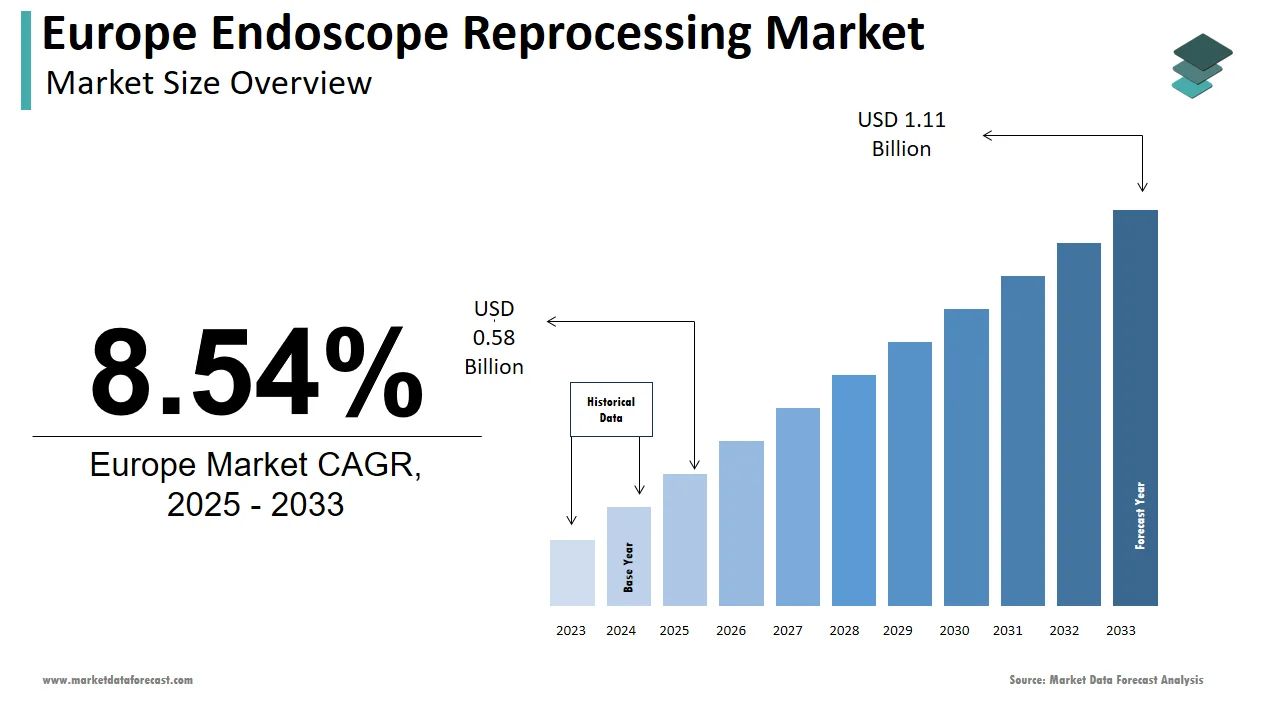
Endoscope reprocessing refers to the systems, consumables, and protocols used to clean, disinfect, and sterilize flexible and rigid endoscopes between patient uses in accordance with stringent regulatory and infection control standards. Unlike single-use devices, reusable endoscopes, which account for a significant share of procedures across the EU, require meticulous multi-step reprocessing to eliminate microbial contamination and prevent cross-infection. This process involves manual pre-cleaning, enzymatic washing, high-level disinfection, and drying, often supported by automated endoscope reprocessors (AERs) and specialized detergents. According to research, Endoscopic procedures are a major component of healthcare in the EU, particularly for colorectal cancer screening, which is a significant health concern in Europe. Concurrently, as per sources, endoscopic procedures are widely utilized in healthcare systems across the EU. A prominent application is for the screening and prevention of colorectal cancer, a key public health initiative in Europe. This trend emphasizes the importance of endoscopic technology in managing prevalent health conditions within the region. These clinical and regulatory imperatives position endoscope reprocessing not as a support function but as a critical determinant of patient safety, institutional liability, and operational continuity across European healthcare systems.
MARKET DRIVERS
Rising Incidence of Gastrointestinal Disorders Drives Endoscopy Volume and Reprocessing Demand
The growing burden of digestive diseases in the region is increasing the number of endoscopic procedures, thereby amplifying demand for reliable and compliant reprocessing. This propels the growth of the Europe endoscope reprocessing market. According to a 2019 analysis from the United European Gastroenterology (UEG), there were an estimated 332 million prevalent cases of digestive diseases across Europe. This epidemiological pressure has translated into a steady rise in diagnostic and therapeutic endoscopies. As per a study, screening initiatives have contributed to a rise in the number of colonoscopies performed across the UK's National Health Service. Similarly, Germany's healthcare system performs a significant volume of upper gastrointestinal endoscopies annually, with the procedure volume trends and quality standards being topics of study in various medical publications and by institutes. Each procedure necessitates full reprocessing of complex endoscopes with narrow lumens and delicate components, placing immense strain on sterile processing departments. Hospitals are responding by upgrading to automated reprocessors and investing in staff training to maintain turnaround times without compromising safety, which makes reprocessing infrastructure a non-negotiable element of endoscopy service scalability.
Stringent EU Medical Device Regulations Mandate Validated and Traceable Reprocessing Protocols
The implementation of the EU Medical Device Regulation (MDR) 2017/745 has fuelled the growth of the Europe endoscope processing market. This has fundamentally reshaped endoscope reprocessing by placing legal responsibility on healthcare facilities to ensure that every reprocessing cycle is validated, documented, and traceable. As per the European Commission, reusable medical devices, including endoscopes, must be accompanied by manufacturer-validated instructions for use that detail specific cleaning agents, exposure times, and compatibility with reprocessing equipment. National competent authorities now conduct audits to verify compliance. Furthermore, the European Committee for Standardization’s EN ISO 15883 series sets performance criteria for automated endoscope reprocessors, requiring periodic testing with biological and chemical indicators. These regulatory mandates have compelled hospitals to replace manual methods with auditable, closed-loop AER systems that generate digital records for each cycle, which transforms reprocessing from a procedural task into a legally defensible and quality-managed process.
MARKET RESTRAINTS
Shortage of Trained Sterile Processing Personnel Compromises Reprocessing Consistency
The region faces a deficit of certified sterile processing technicians, which leads to inconsistent execution of complex protocols, and ultimately restricts the growth of the Europe endoscope reprocessing market. According to research, there is a shortfall of trained reprocessing staff across the EU, with particularly acute gaps in Southern and Eastern member states. This shortage is exacerbated by high turnover and limited standardized training programs. Manual steps, such as brushing of internal channels or leak testing, are highly technique-dependent, and deviations can leave biofilm residues that harbor pathogens like Pseudomonas aeruginosa or carbapenem-resistant Enterobacteriaceae. This personnel gap will remain a systemic vulnerability until workforce development speeds up through EU health workforce initiatives.
High Capital and Operational Costs of Automated Reprocessing Systems Limit Adoption in Smaller Facilities
Automated endoscope reprocessors (AERs) offer superior consistency and traceability, but their high initial investment and ongoing consumable expenses create financial obstacles for smaller hospitals and outpatient clinics, which in turn constrain the expansion of the Europe endoscope reprocessing market. According to studies, implementing compliant automated endoscope reprocessors (AER) systems involves considerable initial and ongoing costs, including purchase, installation, and maintenance. For ambulatory endoscopy centers in countries like Italy and Spain, where reimbursement rates are tightly controlled, this expenditure is often prohibitive. A substantial number of healthcare facilities, especially private clinics, continue to use manual reprocessing methods despite the associated infection risks. Even in publicly funded systems, budget constraints delay upgrades. Public health systems also face challenges, with many endoscopy units using AERs beyond their recommended service life. The persistence of disparities in reprocessing quality across the healthcare landscape is a direct result of the lack of targeted EU or national funding mechanisms for modernization subsidies.
MARKET OPPORTUNITIES
Integration of Digital Monitoring and IoT in Reprocessing Workflows Enhances Compliance and Safety
The adoption of smart and connected reprocessing systems that embed real-time monitoring and data analytics into every cycle is providing major opportunities for the growth of the Europe endoscope reprocessing market. Leading AER manufacturers now offer Internet of Things-enabled platforms that automatically log cycle parameters, such as temperature, disinfectant concentration, and contact time, and transmit them to hospital-quality dashboards. As per studies, facilities using connected reprocessing systems reduced documentation errors and shortened audit preparation time. These digital trails also support rapid root cause analysis during infection investigations. Furthermore, predictive maintenance alerts prevent downtime by flagging filter replacements or pump wear before failures occur. IoT-enabled reprocessing represents a convergence of patient safety, operational efficiency, and regulatory preparedness, a key trend as European hospitals move deeper into digital health transformation.
Shift Toward Sustainable and Eco-Friendly Reprocessing Chemistries Aligns with EU Green Hospital Initiatives
Growing demand for low water consumption systems and biodegradable detergents signifies that environmental sustainability is emerging as a strategic driver in the Europe endoscope reprocessing market. The European Green Deal’s Sustainable Hospitals Initiative encourages healthcare facilities to reduce chemical discharge and water usage, directly impacting reprocessing choices. According to research, hospitals using enzymatic cleaners with neutral pH and rapid biodegradability can significantly reduce their hazardous waste output, aligning with broader trends toward sustainable chemical management in healthcare. Similarly, Newer Automatic Endoscope Reprocessor (AER) models increasingly incorporate closed-loop water recycling systems and reduced cycle times to enhance water conservation during reprocessing procedures. Public procurement guidelines in many nations are starting to include eco-friendly and sustainability criteria for medical devices, encouraging vendors to provide environmental product declarations. The pressure on healthcare institutions to meet national climate law targets for carbon and waste reduction is leading to a new axis of innovation and differentiation in the market, where sustainable reprocessing solutions offer ecological as well as reputational value.
MARKET CHALLENGES
Inadequate Standardization of Reprocessing Protocols Across Endoscope Manufacturers
The lack of harmonization in manufacturer instructions for use, which vary significantly in cleaning methods, compatible disinfectants, and drying requirements, hinders the growth of the Europe endoscope processing market. This fragmentation forces sterile processing departments to maintain multiple detergents, brushes, and validation records, increasing complexity and error risk. Implementation of common reprocessing standards remains voluntary, despite the International Medical Device Regulators Forum's advocacy for them. Healthcare facilities will continue to struggle with operational inefficiency and compliance vulnerability in high-volume endoscopy settings until the EU requires standardized reprocessing interfaces or chemical compatibility across all devices.
Persistence of Biofilm Formation in Complex Endoscope Channels Despite Current Methods
The intricate design of flexible endoscopes, with long, narrow lumens and movable parts, remains conducive to biofilm formation, posing a persistent infection risk that challenges the expansion of the Europe endoscope processing market. These biofilms shield pathogens like Mycobacterium abscessus from standard disinfectants, enabling cross-contamination even when protocols are followed correctly. Current reprocessing standards do not require biofilm-specific testing. The European Centre for Disease Prevention and Control has called for the development of biofilm-disruptive detergents and ultrasonic or pulsed lavage adjuncts, but regulatory pathways for such innovations remain unclear. The unresolved scientific and clinical challenge of device-associated infections in European endoscopy will persist until reprocessing validation evolves to address biofilm resilience.
REPORT COVERAGE
| REPORT METRIC | DETAILS |
| Market Size Available | 2025 to 2034 |
| Base Year | 2025 |
| Forecast Period | 2026 to 2034 |
| Segments Covered | By Product, End User, and Region. |
| Various Analyses Covered | Global, Regional and Country-Level Analysis, Segment-Level Analysis, Drivers, Restraints, Opportunities, Challenges; PESTLE Analysis; Porter’s Five Forces Analysis, Competitive Landscape, Analyst Overview of Investment Opportunities |
| Countries Covered | UK, France, Spain, Germany, Italy, Russia, Sweden, Denmark, Switzerland, Netherlands, Turkey, Czech Republic, and the Rest of Europe. |
| Market Leaders Profiled | Custom Ultrasonics, STERIS, Steelco (Italy), Getinge (Sweden), ENDO-TECHNIK (Germany), BES Decon (U.K.), ARC Healthcare Solutions, and Metrex Research, Advanced Sterilization Products (ASP), Cantel Medical, Laboratories Anios (France), Olympus, Wassenburg Medical (The Netherlands)., |
SEGMENTAL ANALYSIS
By Product Insights
In 2024, the automated Endoscope Reprocessors (AERs) segment led the Europe endoscope reprocessing market by capturing a 28.1% share. The growth of the automated Endoscope Reprocessors (AERs) segment is driven by their vital role in ensuring consistent, validated, and auditable high-level disinfection in compliance with the EU Medical Device Regulation. AERs eliminate human variability in manual reprocessing by precisely controlling disinfectant concentration, exposure time, temperature, and rinse cycles, factors directly linked to infection prevention. According to sources, healthcare facilities using AERs were less likely to receive non-conformance notices during inspections compared to those relying on manual methods. This regulatory advantage has driven widespread adoption in high-volume endoscopy units across Germany, France, and the UK. Furthermore, the rising incidence of endoscope-associated outbreaks linked to procedural deviations also propels the growth of this segment. In addition, national guidelines strongly advise or mandate AER use for all flexible endoscopes. Hospitals facing increasing procedural volumes and staffing shortages view AERs not as optional equipment but as essential risk mitigation infrastructure. Their integration with digital logging further supports real-time quality monitoring and rapid incident traceback, which supports their dominance in Europe’s safety-conscious healthcare environment.
The endoscope tracking systems segment is anticipated to witness the fastest CAGR of 14.9% from 2026 to 2034 due to the EU Medical Device Regulation’s requirement for full traceability of reusable medical devices, from patient use through reprocessing and back to clinical service. As per research, a share of hospital inspection failures involved incomplete endoscope usage or reprocessing records, which prompts urgent investment in digital tracking. A further growth accelerator is the operational need to optimize endoscope utilization and maintenance cycles. Endoscopes are high-value assets, and hospitals must track usage counts to schedule timely servicing. These systems also prevent “orphan scopes” from being lost in manual logs and ensure no scope is used before completing reprocessing. The digitization of European hospital sterile processing departments under national eHealth strategies is transforming endoscope tracking from an inventory management task into a crucial element of patient safety and asset governance.
By End User Insights
The hospitals segment dominated the Europe endoscope reprocessing market by accounting for a substantial share in 2024. The expansion of the hospitals segment is fuelled by its high procedural volumes, complex multi-specialty endoscopy services, and stringent regulatory oversight. Academic medical centers and large public hospitals in Europe perform thousands of endoscopies annually, ranging from routine colonoscopies to advanced ERCP and bronchoscopy, each requiring rigorous reprocessing. A different supporting factor is the legal liability hospitals bear under the EU Medical Device Regulation. As per sources, healthcare institutions are directly responsible for ensuring that every reprocessing cycle complies with manufacturer instructions and national hygiene standards. This accountability has driven hospitals to invest in integrated reprocessing ecosystems, including automated equipment, digital logs, and staff certification programs, far beyond the capacity of smaller facilities. Apart from these, national infection control mandates, such as Sweden’s requirement for annual reprocessing audits in all acute care settings, further entrench hospital leadership in this market.
The ambulatory surgery centres segment is likely to experience the fastest CAGR of 11.3% from 2026 to 2034, owing to the European trend toward outpatient care decentralization, where less complex endoscopic procedures, such as diagnostic colonoscopies and upper GI endoscopies, are increasingly performed outside hospitals to reduce costs and wait times. An additional growth driver of this segment is the regulatory tightening of reprocessing standards in non-hospital environments. The regulations compel ambulatory centers to upgrade from manual methods to compliant, compact reprocessing systems. Vendors are responding with modular, space-efficient AERs and bundled consumables tailored to lower volume settings. Ambulatory centers are driving demand for scalable, regulatory-ready reprocessing solutions because Europe's healthcare systems are prioritizing efficiency and access.
COUNTRY LEVEL ANALYSIS
Germany Endoscope Reprocessing Market Analysis
Germany outperformed other regions in the Europe endoscope reprocessing market by occupying a share of 23.4% in 2024. The domination of the German market is primarily driven by its dense network of university hospitals, high-endoscopy volumes, and rigorous infection control standards. The country performs millions of endoscopic procedures annually, which drives consistent demand for advanced reprocessing infrastructure. Germany’s Commission for Hospital Hygiene and Infection Prevention (KRINKO) mandates automated reprocessing for all flexible endoscopes and requires annual staff competency assessments. Apart from these, the Federal Joint Committee ties hospital reimbursement to documented compliance with hygiene protocols, which creates strong financial incentives for investment. Germany, with its mature medical technology industry and early adoption of EU MDR requirements, establishes the standard for reprocessing excellence and drives innovation in automated and traceable systems throughout the region.
United Kingdom Endoscope Reprocessing Market Analysis
The United Kingdom followed closely in the Europe endoscope reprocessing market and accounted for a 17.7% share in 2024. The growth of the UK is propelled by its centralized National Health Service and robust outbreak surveillance mechanisms. The NHS performs a significant number of endoscopies yearly, with ambitious targets to clear pandemic backlogs, which increases procedural pressure on reprocessing units. The UK Health Security Agency’s rapid response to endoscope-associated outbreaks has further accelerated the adoption of traceability systems. Post Brexit, the UK maintains alignment with EU MDR principles, ensuring continued demand for validated, auditable reprocess solutions in both public and private settings.
France Endoscope Reprocessing Market Analysis
France grew steadily in the Europe endoscope reprocessing market, with its universal healthcare system and recent regulatory reforms targeting outpatient safety. Widespread insurance coverage contributes to a high number of endoscopy procedures being performed across France. Recent findings indicate issues with how some private clinics document the cleaning of equipment, prompting efforts for stronger adherence to rules. New government policy will require all locations that perform these procedures to use electronic methods to track their devices. This regulatory momentum, combined with strong public investment in hospital modernization, positions France as a high-compliance, high-accountability market for reprocessing technologies.
Italy Endoscope Reprocessing Market Analysis
Italy witnessed moderate growth in the Europe endoscope reprocessing market due to its mix of public hospitals and a rapidly growing private outpatient sector. The country has one of Europe’s highest colorectal cancer screening participation rates, driving a large number of colonoscopies annually as per the Italian National Institute of Health. However, reprocessing practices have historically been fragmented, with regional variations in standards enforcement. Apart from these, rising private investment in specialized endoscopy clinics, particularly in Lombardy and Lazio, is fueling demand for compact, cost-effective reprocessing systems. Italy's market is transitioning toward standardized, technology-enabled workflows due to its alignment with the EU MDR and strengthened national oversight.
Netherlands Endoscope Reprocessing Market Analysis
The Netherlands is predicted to expand in the Europe endoscope processing market from 2026 to 2034 due to its world-class infection prevention infrastructure and digital health leadership. Dutch hospitals operate under strict national guidelines from the Working Party on Infection Prevention, which requires real-time monitoring of reprocessing parameters and full endoscope traceability. The country also leads in sustainable reprocessing, with a share of facilities adopting low water, biodegradable chemistries in line with the National Green Hospital Program. Furthermore, the Netherlands serves as a pilot hub for EU MDR implementation, influencing best practices across Northern Europe. This combination of regulatory rigor, technological adoption, and environmental stewardship defines the Netherlands as a highly sophisticated, future-oriented reprocessing market.
COMPETITIVE LANDSCAPE
The Europe endoscope reprocessing market is characterized by intense competition among global medical technology leaders and specialized consumables providers, all operating under the stringent oversight of the EU Medical Device Regulation. Differentiation hinges on regulatory compliance, digital traceability, and compatibility with diverse endoscope brands. Incumbents leverage integrated ecosystems, combining hardware, chemistry, and software, to lock in hospital customers through validated workflows and service support. At the same time, the persistent threat of endoscope-associated infections drives demand for innovation in biofilm removal, drying efficacy, and staff training. Smaller players compete on niche chemistries or cost-effective AERs for ambulatory settings, but face high barriers due to validation costs and hospital procurement complexity. As European healthcare systems digitize sterile processing departments and enforce stricter accountability, competition is shifting from product features to end-to-end risk mitigation, regulatory trust, and lifecycle management capabilities.
KEY MARKET PLAYERS
Some of the companies that are playing a dominating role in the Europe endoscope reprocessing market include
- Custom Ultrasonics
- STERIS
- Steelco
- Getinge
- ENDO-TECHNIK
- BES Decon
- ARC Healthcare Solutions
- Metrex Research
- Advanced Sterilization Products
- Cantel Medical
- Laboratories Anios
- Olympus
- Wassenburg Medical
TOP PLAYERS IN THE MARKET
- STERIS plc is a global leader in infection prevention and contamination control, with a significant presence in the Europe endoscope reprocessing market through its comprehensive portfolio of automated endoscope reprocessors, high-level disinfectants, and verification tools. The company supplies major hospital networks across Germany, the UK, and France with integrated reprocessing solutions that align with EU Medical Device Regulation requirements. It also expanded its training academy in Dublin to offer MDR-aligned certification programs for sterile processing technicians, reinforcing its role as a trusted partner in patient safety and regulatory readiness.
- Cantel Medical (a subsidiary of STERIS) remains a key contributor to the European endoscope reprocessing landscape through its specialized consumables, including detergents, test strips, and drying systems designed for compatibility with complex endoscope geometries. The company’s Medivators brand is widely used in ambulatory surgery centers and university hospitals for its validated chemistries and rapid-acting disinfectants. It also introduced RFID-enabled endoscope storage cabinets integrated with tracking software, enabling seamless traceability from reprocessing to the point of care across EU healthcare settings.
- Olympus Corporation plays a dual role in the Europe endoscope reprocessing market as both an endoscope manufacturer and a provider of dedicated reprocessing solutions. Recognizing that reprocessing efficacy directly impacts device safety and brand reputation, Olympus offers proprietary AERs, detergents, and leak testers specifically validated for its endoscope portfolio. This system, now deployed in over 200 hospitals across Germany and the Netherlands, ensures compliance with manufacturer instructions for use, a core requirement under the EU MDR, and positions Olympus as a vertically integrated partner in endoscope lifecycle governance.
TOP STRATEGIES USED BY THE KEY MARKET PARTICIPANTS
Key players in the Europe endoscope reprocessing market prioritize full compliance with the EU Medical Device Regulation by ensuring their products and workflows meet validated reprocessing and traceability requirements. They invest in digital integration by embedding RFID barcoding and cloud-based logging into reprocessing systems to support real-time audit readiness. Companies offer bundled solutions that combine automated reprocessors, detergents, test strip,s and training to simplify procurement for hospitals. Strategic expansion of European training academies and certification programs addresses the critical shortage of skilled sterile processing staff. Continuous innovation in biofilm-resistant chemistries and low water consumption technologies aligns with national green hospital initiatives and enhances sustainability credentials across the region.
MARKET SEGMENTATION
This Europe endoscope reprocessing market research report is segmented and sub-segmented into the following categories.
By Product
- High-Level Disinfectants And Test Strips
- Detergents And Wipes
- Automated Endoscope Reprocessors
- Endoscope Drying
- Storage And Transport Systems
- Endoscope Tracking System
- Other Products
By End User
- Hospitals
- Ambulatory Surgery Centres
- Others
By Country
- UK
- France
- Spain
- Germany
- Italy
- Russia
- Sweden
- Denmark
- Switzerland
- Netherlands
- Turkey
- Czech Republic
- Rest of Europe