- Product Description Description
- Table of Contents TOC
- List of Table & Figure LOT
- Get Free Sample PDF Sample PDF
Market Size, 2025
$334.1 MnMarket Estimate, 2026
$363.2 MnMarket Forecast, 2034
$705 MnCAGR, 2026–2034
8.64%Europe Capsule Endoscopy Market Report Summary
The Europe capsule endoscopy market was valued at USD 334.1 million in 2025, is estimated to reach USD 363.2 million in 2026, and is projected to reach USD 705 million by 2034, growing at a CAGR of 8.64% from 2026 to 2034. Market growth is driven by the increasing prevalence of gastrointestinal disorders, rising demand for minimally invasive diagnostic procedures, and advancements in wireless imaging technologies. Capsule endoscopy provides a non-invasive and patient-friendly alternative to traditional endoscopic procedures, enabling accurate visualization of the gastrointestinal tract. Additionally, the growing adoption of advanced diagnostic technologies across hospitals and specialized gastroenterology centers is further supporting market expansion across Europe.
Key Market Trends
- Increasing adoption of minimally invasive gastrointestinal diagnostic technologies.
- Rising prevalence of gastrointestinal bleeding, Crohn’s disease, and colorectal cancer.
- Technological advancements in wireless capsule imaging and real-time data transmission.
- Growing demand for outpatient diagnostic procedures.
- Expansion of gastroenterology diagnostic infrastructure across Europe.
Segmental Insights
- Based on accessories, the wireless capsule segment dominated the Europe capsule endoscopy market by holding the largest share in 2025, driven by its superior diagnostic efficiency, ease of use, and ability to capture high-resolution images throughout the gastrointestinal tract.
- Based on product, the small bowel capsule endoscopy segment held the majority share of the Europe capsule endoscopy market in 2025, supported by its effectiveness in detecting small intestine abnormalities, including bleeding, tumors, and inflammatory diseases.
- Based on application, the obscure gastrointestinal bleeding segment led the Europe capsule endoscopy market in 2025, driven by the widespread use of capsule endoscopy as a primary diagnostic tool for identifying bleeding sources that cannot be detected through conventional endoscopy.
Regional Insights
The Europe capsule endoscopy market is witnessing steady growth across major economies, supported by advanced healthcare infrastructure, growing adoption of minimally invasive diagnostics, and increasing awareness of gastrointestinal health.
- Germany dominated the Europe capsule endoscopy market by accounting for 23.2% of the regional market share in 2025, driven by its advanced healthcare infrastructure, strong gastroenterology research ecosystem, and widespread adoption of innovative diagnostic technologies.
- France held the second-largest share of the Europe capsule endoscopy market in 2025, supported by its centralized healthcare system, strong hospital network, and increasing focus on early diagnosis of gastrointestinal disorders.
- The United Kingdom is anticipated to register a promising CAGR in the Europe capsule endoscopy market during the forecast period owing to the National Health Service’s expanding adoption of minimally invasive diagnostic procedures and growing private sector investment in advanced gastroenterology technologies.
Competitive Landscape
The Europe capsule endoscopy market is characterized by strong competition among global medical device manufacturers and specialized endoscopy technology providers. Companies are focusing on product innovation, enhanced imaging capabilities, and integration with advanced data analytics platforms to strengthen their market position.
Leading companies operating in the Europe capsule endoscopy market include Boston Scientific Corporation, Medtronic, Olympus Corporation, and CapsoVision, Inc., along with emerging players such as IntroMedic Co., Ltd. and Chongqing Jinshan Science & Technology Co., which are driving innovation in wireless capsule imaging technologies.
Europe Capsule Endoscopy Market Size
The Europe capsule endoscopy market was valued at USD 334.1 million in 2025, is estimated to reach USD 363.2 million in 2026, and is projected to reach USD 705 million by 2034, growing at a CAGR of 8.64% from 2026 to 2034.
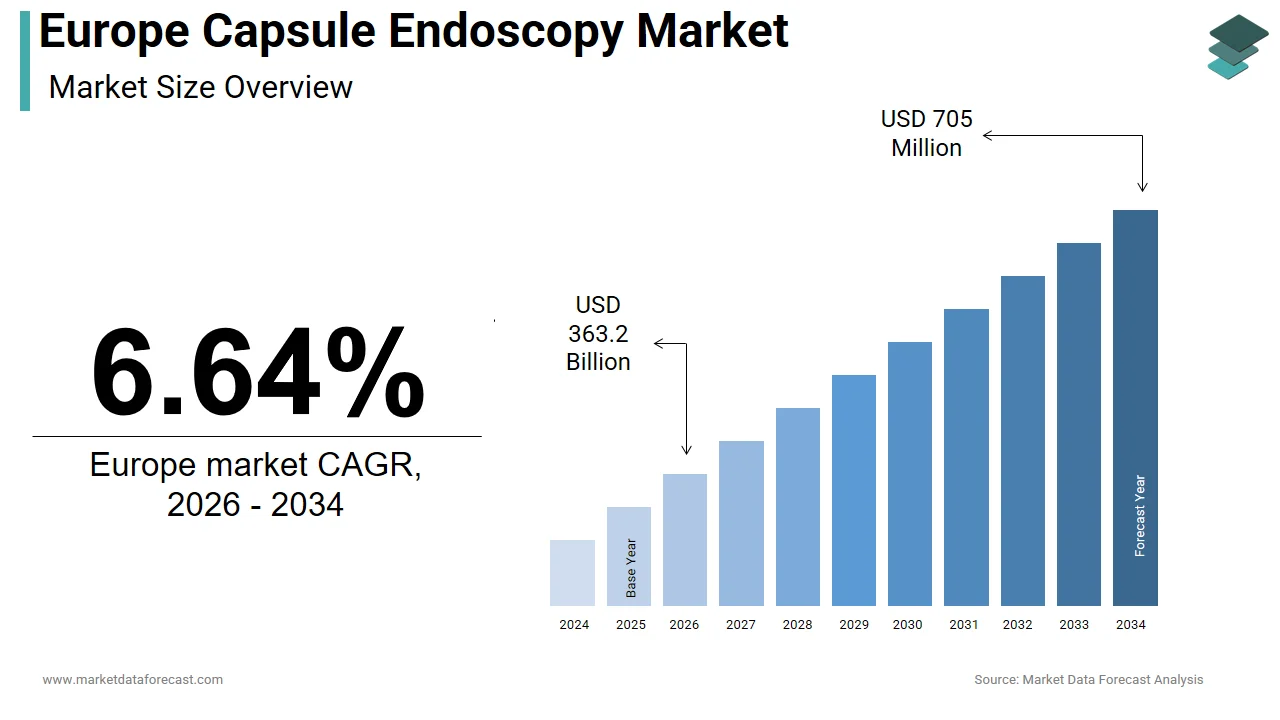
Capsule endoscopy is a minimally invasive diagnostic procedure that utilizes a pill-sized wireless camera to capture high-resolution images of the gastrointestinal tract, particularly the small intestine, which is difficult to access with conventional endoscopy. The patient swallows the capsule, which transmits real-time video to a data recorder worn on a belt, enabling comprehensive visualization without sedation or radiation exposure. In Europe, this technology has become an integral component of gastroenterology practice, especially for evaluating obscure gastrointestinal bleeding, Crohn’s disease, and celiac complications. The market encompasses ingestible capsules, external data recorders, and proprietary software for image analysis. Europe’s leadership in medical device innovation and its robust healthcare infrastructure support widespread adoption. According to the European Society of Gastrointestinal Endoscopy, capsule endoscopy has become a firmly established diagnostic tool across EU member states, with over 250,000 procedures performed in 2024. This procedural volume reflects its clinical utility in detecting small bowel bleeding, Crohn’s disease, and other chronic digestive disorders. The trend is underpinned by aging populations, rising prevalence of gastrointestinal conditions, and strong reimbursement frameworks in countries like Germany and France, where national health systems actively support adoption. Capsule endoscopy’s minimally invasive nature and ability to visualize areas inaccessible to traditional scopes further reinforce its role as a cornerstone of modern gastroenterology practice in Europe.
MARKET DRIVERS
Rising Prevalence of Chronic Gastrointestinal Disorders
The escalating burden of chronic gastrointestinal diseases across Europe is a primary driver of the European capsule endoscopy market. Conditions such as Crohn’s disease, ulcerative colitis, and obscure gastrointestinal bleeding require frequent and precise monitoring of mucosal integrity, particularly in the small bowel, where traditional endoscopy is limited. According to the European Centre for Disease Prevention and Control, inflammatory bowel disease is a growing concern in the EU, with incidence rates continuing to rise among young adults. As per the Federal Statistical Office, gastrointestinal bleeding remains a significant cause of hospitalization in Germany. Capsule endoscopy offers a non-invasive, patient-friendly alternative that enables early diagnosis and therapeutic planning without the risks associated with sedation or radiation. Its ability to visualize the entire small intestine in a single procedure makes it indispensable for managing these complex conditions, driving consistent demand from gastroenterology departments and specialized clinics across the region.
Strong Reimbursement Policies and Healthcare Infrastructure
Favorable reimbursement frameworks and advanced healthcare systems in Western and Northern Europe significantly accelerate the adoption of capsule endoscopy, which is further boosting the expansion of the European capsule endoscopy market. Countries like Germany, France, and the Netherlands provide partial or full coverage for capsule endoscopy under national health insurance when used for approved indications such as obscure gastrointestinal bleeding or Crohn’s disease monitoring. As per the European Observatory on Health Systems and Policies, Germany’s statutory health insurance provides extensive reimbursement for medically indicated capsule procedures, reducing out-of-pocket costs for patients and encouraging physician utilization. Furthermore, Europe hosts some of the world’s leading academic medical centers, such as Charité in Berlin and Karolinska University Hospital in Stockholm, that serve as early adopters and training hubs for new endoscopic technologies. This combination of financial accessibility and clinical expertise creates a supportive ecosystem that not only sustains current usage but also facilitates the integration of next-generation capsules with extended battery life, controlled locomotion, and AI-assisted diagnostics.
MARKET RESTRAINTS
High Procedure Cost and Limited Reimbursement in Certain Regions
A significant restraint on the broader adoption of capsule endoscopy in Europe stems from its relatively high cost and inconsistent reimbursement policies, particularly in Southern and Eastern member states. The procedure typically ranges from 800 to 1500 euros per use, depending on the capsule type and healthcare setting, which can be prohibitive in countries with constrained public health budgets. According to the European Commission’s State of Health in the EU report 2024, nations like Greece, Romania, and Bulgaria provide limited or no reimbursement for capsule endoscopy, restricting access to private pay patients. Even in wealthier nations, prior authorization requirements and restrictive indication criteria, such as mandating negative findings from other imaging modalities, first delay timely diagnosis. This financial and administrative barrier restricts utilization primarily to tertiary care centers, preventing wider deployment in community hospitals and primary gastroenterology practices, thereby slowing market penetration despite proven clinical benefits.
Inability to Perform Therapeutic Interventions During Diagnosis
A fundamental limitation of capsule endoscopy is its purely diagnostic nature, which acts as a key restraint in clinical decision-making. Unlike traditional endoscopy, the capsule cannot obtain biopsies, control bleeding, or remove polyps during the same procedure, often necessitating a follow-up invasive intervention if abnormalities are detected. This two-step process increases patient burden, extends diagnostic timelines, and raises overall healthcare costs. As per the United European Gastroenterology Journal, a considerable proportion of patients who undergo capsule endoscopy for obscure bleeding require subsequent push or balloon enteroscopy for therapeutic action. Until therapeutic capsule platforms become clinically viable, which remain in experimental stages, the diagnostic-only capability will continue to constrain their role as a first-line tool in comprehensive gastrointestinal care.
MARKET OPPORTUNITIES
Integration of Artificial Intelligence for Automated Image Analysis
The incorporation of artificial intelligence into capsule endoscopy workflows presents a transformative opportunity for the European market. The procedure generates a large number of images per exam, creating a substantial burden for gastroenterologists who must manually review hours of footage. AI algorithms can now automatically detect and flag lesions, ulcers, and bleeding sites with high sensitivity, drastically reducing reading time and improving diagnostic accuracy. As per the European Medicines Agency, an AI-powered detection system received a CE mark in 2024 after demonstrating strong performance in clinical trials conducted across multiple EU countries. Leading manufacturers are embedding these tools directly into their software platforms, enabling real-time analysis during live transmissions. This advancement not only enhances clinical efficiency but also expands the feasibility of capsule endoscopy in understaffed regions, democratizing access to high-quality diagnostics and positioning Europe at the forefront of intelligent endoscopic innovation.
Expansion into Extraintestinal and Pediatric Applications
Emerging clinical applications beyond the small bowel offer significant growth potential for the Europe capsule endoscopy market. New generation capsules are being validated for esophageal screening, colon evaluation, and even pancreatic duct imaging, broadening their utility across gastroenterology. Of particular promise is the pediatric segment, where the non-invasive nature of the procedure is highly advantageous for children with suspected Crohn’s disease or chronic abdominal pain. According to the European Society for Paediatric Gastroenterology, Hepatology and Nutrition, capsule endoscopy is now recommended as a first-line diagnostic tool for small bowel assessment in children over eight years old. Dedicated, smaller diameter capsules and child-friendly protocols have improved compliance and safety. As clinical guidelines evolve and training programs expand, these novel indications are expected to drive adoption in previously untapped patient populations and specialty clinics across Europe.
MARKET CHALLENGES
Shortage of Trained Personnel and Standardized Interpretation Protocols
A persistent challenge facing the Europe capsule endoscopy market is the scarcity of healthcare professionals adequately trained in both performing and interpreting the procedure. Reading a full capsule study requires specialized expertise to distinguish normal variants from pathological findings, yet formal training programs remain limited outside major academic centers. As per the European Board of Gastroenterology, a significant portion of gastroenterology fellows across the EU do not receive structured capsule endoscopy training during residency. This gap leads to interobserver variability, delayed reporting, and underutilization in rural or community hospitals. The absence of universally accepted interpretation standards further compounds the issue, resulting in inconsistent diagnostic outcomes. Without coordinated efforts to standardize education and certification, such as those proposed by the European Training Committee in Digestive Endoscopy, the full clinical potential of the technology cannot be realized, hindering equitable access and optimal patient care across the continent.
Regulatory Hurdles for Next Generation Capsule Technologies
The development and commercialization of advanced capsule endoscopy systems in Europe face significant regulatory challenges that delay market entry and increase innovation costs. Novel features such as active locomotion, drug delivery mechanisms, or integrated biopsy tools are classified as high-risk medical devices under the EU Medical Device Regulation, requiring extensive clinical validation and conformity assessments. The notified body review process can take considerable time, during which manufacturers incur substantial compliance expenses without revenue generation. As per the European Association of Medical Device Manufacturers, many innovative capsule projects experienced delays in 2024 due to evolving regulatory interpretations and limited notified body capacity. These bottlenecks disproportionately affect small and medium enterprises, stifling competition and slowing the introduction of breakthrough technologies that could address current limitations like therapeutic capability or real-time control. Streamlining regulatory pathways while maintaining safety standards remains critical to sustaining Europe’s leadership in this field.
REPORT COVERAGE
| REPORT METRIC | DETAILS |
| Market Size Available | 2025 to 2034 |
| Base Year | 2025 |
| Forecast Period | 2026 to 2034 |
| Segments Covered | By Accessories, Product, Application, and Country. |
| Various Analyses Covered | Global, Regional, and Country-Level Analysis, Segment-Level Analysis, Drivers, Restraints, Opportunities, Challenges; PESTLE Analysis; Porter’s Five Forces Analysis, Competitive Landscape, Analyst Overview of Investment Opportunities |
| Countries Covered | UK, France, Spain, Germany, Italy, Russia, Sweden, Denmark, Switzerland, Netherlands, Turkey, Czech Republic, and the Rest of Europe. |
| Market Leaders Profiled | RF Co. Ltd., IntroMedic Co., Ltd., AccuRead Endoscopy Inc., Boston Scientific Corporation, Medtronic Plc, Olympus Corporation, CapsoVision, Inc., Northside Gastroenterology Endoscopy Center, LLC., Chongqing Jinshan Science & Technology Co., Interscope Inc., and Given Imaging Ltd. |
SEGMENTAL ANALYSIS
By Accessories Insights
The wireless capsule segment dominated the Europe capsule endoscopy market by accounting for the highest share of the European capsule endoscopy market in 2025. The leading position of the wireless capsule segment in the European market is driven by the recurring revenue and procedural volume. Each procedure requires a single-use, sterile capsule, making it the highest turnover item in the ecosystem. Its dominance is sustained by the rising number of indications for small bowel evaluation and the increasing adoption of capsule endoscopy as a first-line diagnostic tool in tertiary care centers. According to the European Society of Gastrointestinal Endoscopy, capsule procedures are widely performed across the EU, each involving one wireless capsule. Technological advancements such as extended battery life, improved image resolution, and pH or temperature sensors have further solidified its clinical value. Leading manufacturers continuously refine capsule design to enhance mucosal coverage and patient comfort, ensuring consistent demand from hospitals and specialized clinics across Western and Northern Europe, where reimbursement supports routine use.
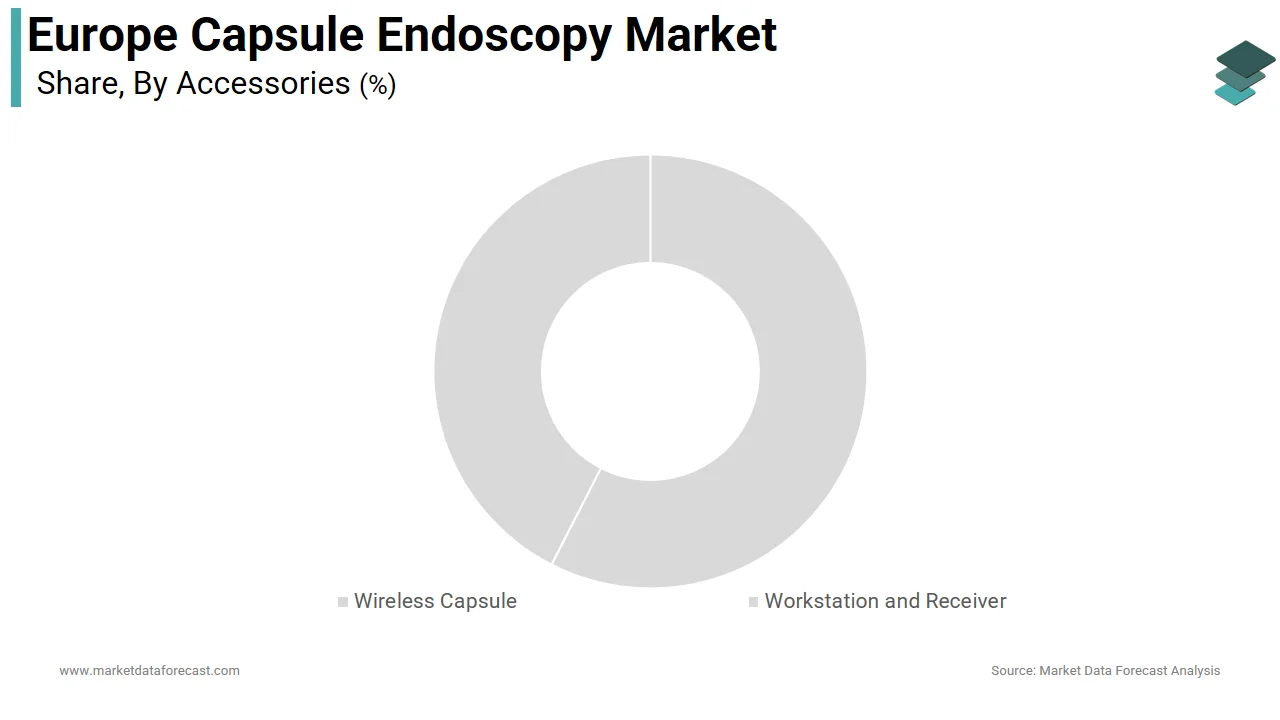
The workstation and receiver segment is the fastest-growing component of the Europe capsule endoscopy market and is estimated to grow at a CAGR of 10.6% over the forecast period, owing to the integration of artificial intelligence and cloud-based data management into diagnostic workflows. Modern workstations are no longer passive recording devices but intelligent platforms that offer real-time image analysis, automated lesion detection, and seamless integration with hospital electronic health records. As per the European Medicines Agency, several AI-enhanced capsule reading systems received CE certification in 2024, requiring upgraded hardware to support advanced computational tasks. Hospitals are investing in next-generation workstations to reduce physician reading time and improve diagnostic accuracy. This shift transforms the workstation from a peripheral accessory into a central diagnostic hub, which is fuelling replacement cycles and new installations across academic and community settings.
By Product Insights
The small bowel capsule endoscopy segment held the largest share of the European capsule endoscopy market in 2025. The small bowel capsule endoscopy is serving as the gold standard for non-invasive visualization of the entire small intestine. Its dominance is rooted in the clinical necessity to diagnose conditions like obscure gastrointestinal bleeding, Crohn’s disease, and small bowel tumors, areas largely inaccessible to conventional endoscopy. The European Crohn’s and Colitis Organisation recommends capsule endoscopy as a key tool for assessing small bowel involvement in inflammatory bowel disease. As per the United European Gastroenterology registry, small bowel capsules accounted for the majority of capsule endoscopy procedures in Europe in 2024. Continuous innovation, including adaptive frame rate technology and dual camera systems for enhanced mucosal coverage, has improved diagnostic yield. This established clinical utility, supported by strong guideline endorsement and reimbursement, ensures its continued leadership in the European landscape.
The colon capsule endoscopy segment is anticipated to register a promising CAGR of 12.5% over the forecast period due to its role as a patient-preferred alternative to traditional optical colonoscopy, particularly for individuals who refuse sedation, have comorbidities, or face long waiting lists. As per The Lancet Gastroenterology, second-generation colon capsules demonstrated strong sensitivity for detecting clinically relevant polyps in multicenter trials. National screening programs in countries like the Netherlands and Denmark are now evaluating the colon capsule as a triage tool to prioritize high-risk patients for full colonoscopy. According to the European Commission, colorectal cancer remains a major health burden in the EU, intensifying demand for accessible, non-invasive screening options and positioning the colon capsule as a transformative solution in preventive gastroenterology.
By Application Insights
The obscure gastrointestinal bleeding segment held the dominating share of the European capsule endoscopy market in 2025. OGIB is defined as persistent or recurrent bleeding of unknown origin after negative upper and lower endoscopy and affects a notable proportion of gastrointestinal bleeding cases in Europe. Capsule endoscopy offers the highest diagnostic yield for identifying sources such as angioectasias, ulcers, or tumors in the small bowel. According to the German Society of Digestive and Metabolic Diseases, capsule endoscopy is recommended as the first-line investigation for OGIB in national guidelines updated in 2024. The procedure’s non-invasive nature is especially critical for elderly patients, who constitute the majority of OGIB cases and often present with multiple comorbidities that increase risks associated with deep enteroscopy. This well-established clinical pathway, supported by robust evidence and reimbursement, ensures OGIB remains the cornerstone application across European healthcare systems.
The Crohn’s disease application segment is the fastest growing in the Europe capsule endoscopy market and is expected to witness a CAGR of 11.6% over the forecast period. The growing use of capsule endoscopy for early diagnosis, disease extent mapping, and monitoring mucosal healing in response to biologic therapies is driving the growth of the Crohn’s disease segment in the European market. The European Crohn’s and Colitis Organisation updated its 2024 consensus guidelines to recommend capsule endoscopy for evaluating small bowel involvement in newly diagnosed patients, particularly when cross-sectional imaging is inconclusive. As per the European Commission, inflammatory bowel disease continues to present a significant healthcare challenge in the EU, making early and accurate assessment crucial to prevent complications. Pediatric gastroenterology centers across Sweden and the UK are adopting smaller diameter capsules for children, broadening the patient base. The ability to detect subtle mucosal inflammation before structural damage occurs positions capsule endoscopy as an essential tool in the precision management of Crohn’s disease.
COUNTRY-LEVEL ANALYSIS
Germany Capsule Endoscopy Market Analysis
Germany dominated the capsule endoscopy market in Europe in 2025 by holding 23.2% of the regional market share. The leading position of Germany in the European market can be credited to its advanced healthcare infrastructure, high procedural volume, and strong reimbursement policies. The country performs a large number of capsule endoscopy procedures annually, supported by statutory health insurance that covers approved indications like obscure bleeding and Crohn’s disease. Germany hosts world-renowned centers such as Charité Berlin and University Hospital Heidelberg, which serve as training hubs and early adopters of AI-integrated systems. As per the Federal Joint Committee, capsule procedures are extensively reimbursed in Germany. This combination of clinical expertise, financial accessibility, and technological readiness establishes Germany as the undisputed market leader and a benchmark for procedural standards across the continent.
France Capsule Endoscopy Market Analysis
France had the second-largest share of the European capsule endoscopy market in 2025. The growth of France in the European market is driven by its centralized healthcare system and proactive adoption of innovative diagnostics. The French Health Authority includes capsule endoscopy in its national guidelines for small bowel evaluation and provides full reimbursement through the national health insurance scheme. As per national reports, capsule procedures are widely performed across France, with uptake in both public university hospitals and private clinics. France is also a key site for clinical trials of next-generation capsules, including colon and esophageal variants, due to its dense network of research institutions like INSERM. The government’s “Ma Santé 2022” digital health strategy further supports integration of capsule data into national electronic health records, enhancing workflow efficiency and data continuity across care settings.
United Kingdom Capsule Endoscopy Market Analysis
The United Kingdom is expected to exhibit a promising CAGR in the European capsule endoscopy market during the forecast period, owing to the unique landscape shaped by the National Health Service and growing private sector demand. While NHS waiting times for traditional endoscopy can be lengthy, capsule endoscopy is increasingly used as a rapid triage tool, particularly for suspected small bowel bleeding. As per NHS England, capsule endoscopy referrals have grown steadily, driven by initiatives to reduce diagnostic delays. The UK is also a pioneer in pediatric capsule applications, with Great Ormond Street Hospital leading protocols for children with inflammatory bowel disease. Despite budget constraints, the NHS Long Term Plan emphasizes investment in minimally invasive diagnostics, ensuring sustained growth. The coexistence of public access and premium private services creates a dynamic and resilient market environment.
Italy Capsule Endoscopy Market Analysis
Italy is estimated to secure a notable share of the European capsule endoscopy market during the forecast period. The high regional variation in adoption, but strong clinical enthusiasm in the north, is driving the Italian market growth. Leading centers in Milan and Bologna perform advanced capsule procedures for Crohn’s disease and obscure bleeding, supported by partial reimbursement from regional health authorities. As per the Italian Society of Digestive Endoscopy, capsule studies are widely conducted, with growing interest in colon capsule for colorectal cancer screening pilot programs. Italy’s aging population, with 24% over 65 years old according to ISTAT, fuels demand for non-invasive options among frail patients. Although southern regions lag due to resource limitations, national efforts to standardize guidelines and expand training are narrowing disparities. This blend of clinical innovation and demographic pressure positions Italy as a key growth market with untapped potential.
Netherlands Capsule Endoscopy Market Analysis
The Netherlands is estimated to grow at a healthy CAGR in the European capsule endoscopy market over the forecast period due to its reputation for healthcare efficiency and preventive medicine. The Dutch healthcare system fully reimburses capsule endoscopy for approved indications, and the country is at the forefront of evaluating the colon capsule for national colorectal cancer screening. As per the National Institute for Public Health and the Environment, nationwide pilots have demonstrated high patient compliance and cost-effectiveness. Academic medical centers like Erasmus MC integrate AI reading systems into routine practice, reducing radiologists' workload. The Netherlands’ compact geography and digitized health infrastructure enable rapid dissemination of best practices, making it a model for scalable, technology-enabled gastroenterology care in Europe.
COMPETITIVE LANDSCAPE
The competition in the Europe capsule endoscopy market is characterized by a mix of established multinational MedTech companies and agile innovators vying for clinical adoption in a highly regulated and guideline-driven environment. The market is not solely defined by hardware performance but increasingly by the sophistication of accompanying software, data integration capabilities, and clinical support services. Leading players compete through continuous technological refinement while also ensuring compliance with the EU Medical Device Regulation. Reimbursement policies and national clinical guidelines heavily influence purchasing decisions, favoring companies with robust health economics data and strong relationships with key opinion leaders. Emerging entrants face high barriers due to regulatory complexity and the need for extensive clinical validation, yet they gain traction by addressing unmet needs like patient comfort or specialized indications. These dynamic fosters a competitive ecosystem where innovation, clinical evidence, and ecosystem integration determine long term success.
KEY MARKET PLAYERS
The leading companies operating in the Europe capsule endoscopy market include:
- RF Co. Ltd.
- IntroMedic Co., Ltd.
- AccuRead Endoscopy Inc.
- Boston Scientific Corporation
- Medtronic Plc
- Olympus Corporation
- CapsoVision, Inc.
- Northside Gastroenterology Endoscopy Center, LLC.
- Chongqing Jinshan Science & Technology Co.
- Interscope Inc.
- Given Imaging Ltd.
TOP PLAYERS IN THE MARKET
- Medtronic is a leading global player in the Europe capsule endoscopy market through its PillCam platform, which offers a comprehensive portfolio for small bowel, colon, and esophageal visualization. The company leverages its extensive clinical evidence base and established relationships with European gastroenterology centers to maintain strong adoption. To reinforce its position, Medtronic has recently integrated artificial intelligence into its RAPID software suite, enabling automated lesion detection and reducing physician reading time. It has also expanded training programs across Germany, France, and the UK in collaboration with academic hospitals. These initiatives enhance clinical utility and user proficiency, solidifying Medtronic’s role as a technology and education partner in advancing minimally invasive diagnostics across Europe and globally.
- Olympus holds a significant presence in the Europe capsule endoscopy market by combining its legacy in endoscopic imaging with innovative capsule solutions like the ENDOCAPSULE system. The company benefits from deep integration within European healthcare systems, where its conventional endoscopy platforms are widely used, facilitating cross-selling of capsule technologies. Olympus has recently focused on workflow optimization by developing unified data management platforms that allow seamless transition between capsule and optical endoscopy findings. It has also partnered with AI startups to enhance real-time image analysis capabilities. These strategic moves strengthen its value proposition beyond hardware, positioning Olympus as a holistic diagnostic solutions provider in both European and global markets.
- CapsoVision has carved a distinctive niche in the Europe capsule endoscopy market with its CapsoCam Plus system, which features a unique panoramic imaging approach and an external data recorder that eliminates the need for body-worn sensors. This design enhances patient comfort and mobility during the procedure, appealing to clinics prioritizing patient experience. To expand its European footprint, CapsoVision has secured CE Mark certification for its next-generation colon capsule and established distribution partnerships with specialized gastroenterology device suppliers in the Netherlands and Sweden. The company also participates in multicenter clinical trials across EU sites to validate diagnostic accuracy. These actions demonstrate its commitment to innovation and clinical validation, enabling it to compete effectively in a market dominated by larger players.
TOP STRATEGIES USED BY THE KEY MARKET PARTICIPANTS
Key players in the Europe capsule endoscopy market are prioritizing the integration of artificial intelligence into image analysis software to reduce reading time and improve diagnostic accuracy. They are investing in clinical education and training programs in collaboration with academic medical centers to build physician proficiency and trust. Companies are expanding their product portfolios to include capsules for colon and esophageal applications, moving beyond the traditional small bowel segment. Strategic partnerships with healthcare providers and digital health firms are being leveraged to integrate capsule data into electronic health records and telemedicine platforms. Additionally, manufacturers are focusing on enhancing patient comfort through ergonomic capsule design and wireless data transmission to differentiate their offerings in a competitive landscape.
MARKET SEGMENTATION
This research report on the European capsule endoscopy market has been segmented and sub-segmented into the following categories.
By Accessories
- Wireless Capsule
- Workstation and Receiver
By Product
- Small Bowel
- Esophageal
- Colon
By Application
- Crohn’s Disease
- OGIB (Obscure Gastrointestinal Bleeding)
- Small Intestine Tumor
- Others
By Country
- UK
- France
- Spain
- Germany
- Italy
- Russia
- Sweden
- Denmark
- Switzerland
- Netherlands
- Turkey
- Czech Republic
- Rest of Europe