Europe Esports Betting Market Size, Share, Trends & Growth Forecast Report By Age Group, By Application, and By Country (United Kingdom, Germany, France, Sweden, Denmark & Rest of Europe) – Industry Analysis and Forecast, 2026 to 2034
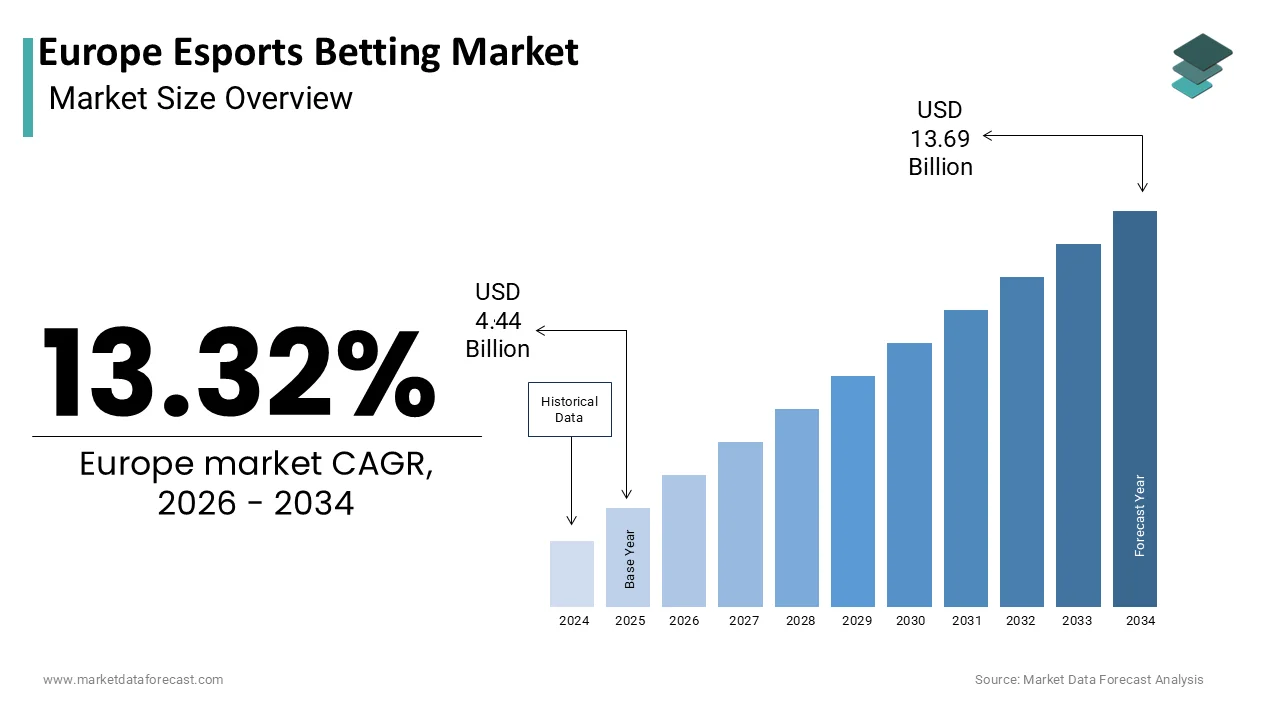
Market Size, 2025
$4.44 BnMarket Estimate, 2026
$5.03 BnMarket Forecast, 2034
$13.69 BnCAGR, 2026–2034
13.32%Europe Esports Betting Market Size
The Europe esports betting market was valued at USD 4.44 billion in 2025, is estimated to reach USD 5.03 billion in 2026, and is projected to reach USD 13.69 billion by 2034, growing at a CAGR of 13.32% from 2026 to 2034.
esports betting represents the convergence of competitive digital gaming and regulated wagering activities across the continent. This sector involves placing financial stakes on the outcomes of professional video game tournaments such as League of Legends or Counter-Strike. Unlike traditional sports betting, this domain relies heavily on digital native audiences who consume content primarily through streaming platforms rather than television broadcasts. The demographic landscape is distinct because the average age of an esports enthusiast in Europe remains significantly lower than that of conventional sports bettors. According to Newzoo, a significant portion of the European esports audience falls within the 18–34-year-old bracket, which is indicating the youth-driven nature of the sector. As per Statista, Germany hosts millions of frequent esports viewers and this is establishing a dense concentration of potential bettors in Central Europe. According to the UK Games Industry Association, a majority of young adults in the United Kingdom play video games regularly, which indicates the deep cultural integration of gaming across the region. This widespread penetration of gaming culture creates fertile ground for wagering activities that are increasingly intrinsic to the viewing experience. The market operates within a complex legal framework, as each nation maintains sovereign control over gambling licenses, resulting in a fragmented yet highly active regional ecosystem shaped by technological adoption and shifting consumer habits.
MARKET DRIVERS
Rapid Expansion of High-Speed Internet Infrastructure Fuels Wagering Participation
The proliferation of high-speed broadband and fifth-generation mobile networks is driving the growth of the European esports betting market. Esports betting differs fundamentally from traditional sports wagering because it often requires real-time data transmission to support in-play markets that change within seconds of gameplay action. As per the Broadband Coverage in Europe report published by the European Commission, a vast majority of European households now have access to fixed very high-capacity networks. This extensive connectivity allows bettors to stream low-latency matches while simultaneously placing wagers without experiencing disruptive lags that could invalidate their strategies. In countries such as Sweden and Denmark, fiber optic coverage is among the highest in Europe, which correlates directly with higher engagement rates in digital betting platforms. The ability to access high-definition streams on mobile devices has also transformed consumption patterns. According to the Global System for Mobile Communications Association, a majority of mobile connections in Western Europe are expected to be on fifth-generation networks by the end of this year. This technological backbone supports the sophisticated algorithms required for live odds calculation and instant payout processing. Without such robust infrastructure, the dynamic nature of esports betting, where match momentum shifts instantly, would be impossible to monetize effectively. The synergy between network capability and user expectation drives continuous platform innovation and attracts a tech-savvy demographic that demands instantaneous interaction.
Deepening Integration of Gaming Culture Among Younger Demographics
The organic embedding of competitive gaming into the daily lives of European youth is further boosting the expansion of the European esports betting market. This generation views esports not merely as entertainment but as a legitimate spectator sport comparable to football or basketball. According to research conducted by YouGov, a considerable portion of individuals aged 16 to 24 in France identify themselves as regular followers of esports competitions. This cultural acceptance translates directly into betting interest because these consumers already possess deep knowledge of teams, players, and game mechanics. The familiarity reduces the barrier to entry for wagering since users do not need to learn complex rules before participating. Additionally, the social aspect of gaming fosters community-driven betting pools and discussions that amplify engagement. As per a study by the Interactive Software Federation of Europe, a majority of gamers in the region engage with online multiplayer modes weekly, reinforcing the social fabric necessary for a thriving betting ecosystem. The rise of influencer culture further cements this trend as popular streamers often discuss odds or partner with betting brands during live broadcasts. This direct line of communication between content creators and fans normalizes the act of betting on digital contests. As these digital natives age and gain disposable income, their lifelong affinity for gaming ensures a stable and growing customer base for operators who can tailor products to their specific preferences and values.
MARKET RESTRAINTS
Stringent and Fragmented Regulatory Landscapes Across Nations
The lack of a unified regulatory framework across the European Union is a significant impediment to the growth of the European esports betting market. Each country maintains its own licensing requirements, tax structures, and compliance mandates, which forces companies to navigate a labyrinth of legal obligations. For instance, the German State Treaty on Gambling imposes strict deposit limits and advertising restrictions that differ vastly from the more liberal approach seen in Malta or Gibraltar. According to analysis by the European Gaming and Betting Association, operators must comply with numerous distinct national regulatory regimes to cover the major European markets effectively. This fragmentation increases operational costs substantially as firms must invest in localized legal teams and customized technology stacks for each jurisdiction. The uncertainty surrounding future legislation also dampens investment appetite among venture capitalists and established gambling conglomerates. In some regions,, such as Belgium, authorities have banned certain types of loot boxes and associated betting mechanisms entirely, creating sudden market contractions. The European Commission has noted that divergent national laws hinder the free movement of gambling services within the single market. Operators face the constant risk of license revocation or heavy fines if they misinterpret local nuances. This regulatory volatility discourages new entrants who might otherwise bring innovation to the sector. The inability to deploy a standardized product across borders limits economies of scale and slows down the overall maturation of the industry despite strong underlying consumer demand.
Persistent Concerns Regarding Match Fixing and Integrity Breaches
The susceptibility of esports to match fixing undermines consumer confidence and threatens the long-term viability of the betting ecosystem, which is further hampering the regional market growth. Unlike traditional sports, where athletes undergo rigorous physical training and oversight, esports players often operate in less regulated environments with lower salaries, making them vulnerable to corruption. As per reports from the Esports Integrity Commission, there have been numerous confirmed cases of match manipulation globally in the past year, with a significant portion originating from European tier two and tier three tournaments. These incidents erode trust among bettors who fear that outcomes may be predetermined rather than skill-based. The anonymous nature of online qualifiers further complicates detection efforts since players can compete from remote locations without direct supervision. Regulatory bodies in the United Kingdom and Sweden have expressed heightened scrutiny over operators that fail to implement robust integrity monitoring systems. The complexity of modern game titles also makes it difficult for casual observers to spot subtle forms of cheating or collusion. When high-profile scandals emerge, betting volumes typically plummet as users withdraw from the market until confidence is restored. Operators must invest heavily in artificial intelligence-driven surveillance tools to detect anomalous betting patterns, yet these measures are not foolproof. The reputational damage caused by even a single verified scandal can have lasting effects on brand perception and customer retention rates across the entire region.
MARKET OPPORTUNITIES
Emergence of Blockchain Technology and Cryptocurrency Payment Solutions
The adoption of decentralized ledger technologies offers a promising opportunity for the European esports betting market. Cryptocurrencies enable near-instantaneous deposits and withdrawals while reducing the friction associated with traditional banking methods that often flag gambling-related transfers. As per Chainalysis, cryptocurrency usage for online gambling in Europe has grown significantly in the past year, indicating a clear shift in user preference. Blockchain-based platforms can provide provably fair gaming mechanisms where every bet and outcome is recorded on an immutable public ledger, thereby addressing integrity concerns directly. This level of transparency appeals to a demographic that values privacy and technological sovereignty. Smart contracts automate payout processes, eliminating the need for manual intervention and reducing operational overhead for operators. Several startups in Estonia and Lithuania are already leveraging these technologies to offer innovative betting products that comply with local anti-money laundering directives while maintaining user anonymity. The integration of non-fungible tokens also opens new avenues for fan engagement through unique digital collectibles tied to betting performance. As regulatory frameworks evolve to accommodate digital assets, early adopters stand to gain significant market share. The ability to bypass cross-border payment restrictions inherent in fiat currency systems allows operators to serve customers in jurisdictions where traditional banking access is limited. This technological leap positions the market for a new era of efficiency and trust.
Strategic Partnerships Between Betting Operators and Esports Organizations
Forming direct alliances with teams, leagues, and tournament organizers provides a lucrative pathway in the European esports betting market. These partnerships allow betting firms to integrate their services directly into the viewing experience through official sponsorship deals and co-branded content. As per Splenid, sponsorship spending in the European esports sector has surpassed hundreds of millions of euros recently, with gambling operators accounting for a growing share of this expenditure. By becoming an official partner, bookmakers gain exclusive access to fan data and marketing channels that yield higher conversion rates than generic advertising. Collaborations often include the creation of bespoke betting markets tailored to specific teams or players, enhancing user engagement and loyalty. Teams benefit from stable revenue streams while operators secure a trusted position within the community. The merger of content and commerce creates a seamless ecosystem where fans can watch a match and place a bet without leaving the platform. Successful examples include major football clubs entering the esports arena and bringing their existing betting partners along. This crossover expands the addressable market by introducing traditional sports bettors to esports wagering. Furthermore, joint initiatives focused on responsible gambling education help mitigate regulatory risks and improve public perception. Such strategic alignment fosters a symbiotic relationship that drives mutual growth and stabilizes the market against external shocks.
MARKET CHALLENGES
Complexity of Real-Time Odds Compilation for Dynamic Game Titles
Generating accurate and profitable odds for esports events is challenging the European esports betting market growth. Traditional sports models rely on historical data and relatively predictable physiological limits, whereas esports matches can change drastically within milliseconds based on software updates or meta shifts. As per Sportradar, the volume of data points generated during a single professional Counter Strike match exceeds that of many traditional sporting events, requiring advanced machine learning models to process effectively. Operators must constantly update their algorithms to account for patch changes that alter character abilities or weapon statistics overnight. Failure to adjust quickly results in significant financial losses as sharp bettors exploit outdated lines. The lack of standardized statistical feeds compared to established sports complicates data acquisition and verification. Many lower-tier tournaments lack reliable data providers, forcing operators to rely on manual observation, which is prone to error and latency. The rapid evolution of game titles means that historical data often becomes obsolete, rendering traditional predictive models less effective. Investing in proprietary data collection infrastructure is costly and resource-intensive, creating a high barrier to entry for smaller operators. The need for specialized traders who understand both gambling mathematics and complex game mechanics further strains human resources. This operational complexity limits the depth of markets available to consumers and increases the risk profile for bookmakers.
Ethical Backlash and Rising Scrutiny Over Youth Exposure to Gambling
The overlap between the underage esports audience and gambling promotions triggers intense ethical debates and potential regulatory crackdowns, which further challenge the expansion of the European esports betting market. Since a large portion of esports fans are below the legal gambling age, any marketing activity risks exposing minors to betting content. As per the Gambling Commission in the United Kingdom, nearly half of children aged 11 to 16 have encountered gambling advertisements while watching esports streams. This exposure raises serious concerns about addiction and the normalization of wagering among vulnerable populations. Regulators across Europe are increasingly pressured to impose stricter advertising bans similar to those enacted for tobacco or alcohol. Several jurisdictions are considering prohibiting the use of esports influencers who have significant youth followings from promoting betting products. The reputational risk for operators is substantial as public sentiment turns against industries perceived to exploit young minds. Parental groups and advocacy organizations are lobbying for mandatory age verification systems that are more rigorous than current standards. Implementing such systems without degrading the user experience remains a technical hurdle. Negative media coverage linking esports betting to youth problem gambling can lead to swift legislative action that restricts market operations. Operators must balance aggressive growth strategies with robust responsible gambling measures to avoid triggering a backlash that could dismantle the industry. The societal license to operate is fragile and depends heavily on demonstrating a genuine commitment to protecting younger audiences from harm.
REPORT COVERAGE
| REPORT METRIC | DETAILS |
| Market Size Available | 2025 to 2034 |
| Base Year | 2025 |
| Forecast Period | 2026 to 2034 |
| Segments Covered | By Age Group, Application, and Region. |
| Various Analyses Covered | Global, Regional, and Country-Level Analysis, Segment-Level Analysis, Drivers, Restraints, Opportunities, Challenges; PESTLE Analysis; Porter’s Five Forces Analysis, Competitive Landscape, Analyst Overview of Investment Opportunities |
| Countries Covered | UK, France, Spain, Germany, Italy, Russia, Sweden, Denmark, Switzerland, Netherlands, Turkey, Czech Republic, Rest of Europe |
| Market Leaders Profiled | Flutter Entertainment plc, Entain plc, Bet365 Group Ltd., Kindred Group plc, 888 Holdings plc, Betsson AB, LeoVegas AB, Unikrn, Real Luck Group Ltd., Rivalry Corp., GG.BET, Pinnacle Sports, Betway Group, DraftKings Inc. |
SEGMENTAL ANALYSIS
By Age Group Insights
The age bracket spanning 19 to 25 years held the major share of 41.5% of the European market in 2025. The dominance of this segment in the European market can be credited to the unique intersection of digital nativity and emerging financial independence within this demographic. Individuals in this cohort have grown up with competitive gaming as a mainstream entertainment form, fostering an intuitive understanding of game mechanics that lowers the barrier to entry for betting. The profound cultural immersion where gaming serves as a central social pillar rather than a mere pastime is further aiding the growth of the segment in this regional market. According to Newzoo, a majority of Europeans aged 18 to 24 actively follow esports tournaments, which is creating a massive addressable audience primed for conversion into bettors. This generation consumes content primarily through digital channels like Twitch and YouTube Gaming, where betting integrations are seamless and immediate. The social dynamics of this age group encourage communal viewing and collective wagering, amplifying participation rates. Furthermore, familiarity with digital wallets and cryptocurrency allows for frictionless transactions that older demographics often find challenging. As per the UK Gambling Commission, individuals in this age range are significantly more likely to place a bet on an esports event than on a traditional sports match. The psychological connection to streamers and pro players also drives engagement, as fans seek to deepen their involvement in the narrative of competitions. This deep-seated cultural alignment ensures that betting is viewed as a natural extension of fandom, securing the segment's leading position in the market hierarchy.
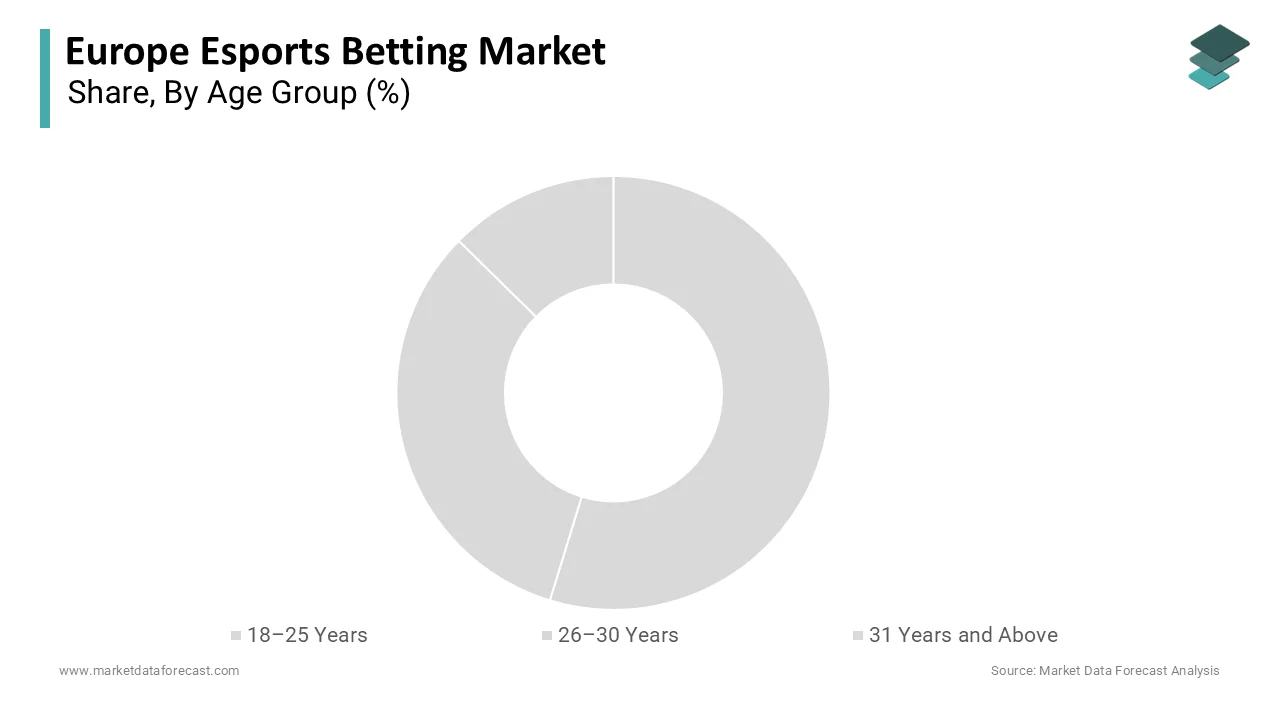
However, the age group comprising individuals 31 years and older is anticipated to record a promising CAGR of 15.1% over the forecast period, owing to the aging of the original gaming generation who now possess significant purchasing power and a nostalgic yet mature interest in competitive gaming. The aging process of the first generation of gamers who are now entering their thirties and forties,s while retaining their passion for the medium, is also supporting the expansion of this segment in the European market. As per the Interactive Software Federation of Europe, the average age of a gamer in Europe has risen to 35, indicating a substantial shift in the demographic profile of the audience. This maturity brings a different betting behavior characterized by higher stake sizes and more strategic wagering compared to younger counterparts. Unlike transient trends, this represents a lifelong engagement pattern where the hobby evolves alongside the consumer. The stability of their careers provides a robust financial foundation that supports sustained betting activity even during economic downturns. Furthermore, this demographic often holds decision-making power within households, influencing broader acceptance of gaming as a legitimate leisure activity. Their presence legitimizes the market and attracts operators who seek high-value customers with lower churn rates. The convergence of nostalgia for classic titles and interest in modern competitive scenes creates a unique dual demand that fuels growth specifically within this age bracket.
By Application Insights
The League of Legends segment captured the leading share of the European esports betting market in 2025. The growth of the League of Legends segment in the European market is driven by the sheer scale of its competitive ecosystem and the depth of engagement it fosters among European fans. The cornerstone of League of Legends' dominance is its highly structured and widely broadcast tournament circuit, particularly the League of Legends European Championship. According to Esports Charts, the LEC finals regularly attract hundreds of thousands of concurrent viewers across all platforms, creating massive liquidity for betting markets. The predictable schedule allows operators to plan extensive marketing campaigns and offer diverse wagering options ranging from match winners to specific in-game events. The global prestige of the World Championship further amplifies interest, drawing in casual fans who place bets during peak seasons. The longevity of the title, having been a staple since 2009, has built a multi-generational fanbase that understands the nuances of the game deeply. This knowledge empowers fans to make informed bets, increasing their confidence and frequency of participation. The visual spectacle and narrative depth of the storylines surrounding teams and players also drive emotional investment, which translates directly into wagering volume. No other title in Europe offers such a cohesive and commercially viable competitive structure that bridges the gap between spectator sport and betting opportunity.
On the other side, the Counter-Strike segment is identified as the fastest-growing segment in the European sports betting market and is expected to register a CAGR of 15.8% over the forecast period, owing to the game's inherent suitability for betting and a resurgence in popularity following major title updates. The explosive growth of the Counter-Strike betting segment is largely attributable to its round-based structure, which is perfectly suited for dynamic in-play wagering. Each round presents a discrete event with clear outcomes, allowing bettors to place rapid successive wagers on pistol rounds, eco rounds, and map winners. As per industry observations from Betway Esports, the volume of live bets placed on Counter-Strike matches often exceeds pre-match volume due to this fast-paced nature. The tactical depth of the game means momentum can shift instantly, creating constant opportunities for arbitrage and value betting that keep users engaged. The transition to Counter Strike Two has further enhanced the viewing experience with improved graphics and server tick rates, reducing latency issues that previously hindered live betting accuracy. This technical improvement builds trust among bettors who rely on real-time data integrity. The simplicity of the core objective, planting or defusing bombs, makes it accessible to casual bettors while retaining enough complexity for experts. This dual appeal broadens the user base significantly. The global nature of the tournament circuit ensures a steady stream of content, but the European scene remains particularly vibrant, driving regional growth rates that outpace other titles.
COUNTRY LEVEL ANALYSIS
United Kingdom Esports Betting Market Analysis
The United Kingdom led the market by holding 26.5% of the European market share in 2025 due to its mature regulatory environment and deep-rooted gambling culture. The UK Gambling Commission provides a clear and stable framework that encourages innovation while protecting consumers, giving operators confidence to invest heavily in esports products. Online gambling participation among adults remains high, with younger demographics increasingly engaging in esports wagering. The presence of headquarters for many global betting giants in London fosters a competitive landscape that drives product quality and marketing intensity. British fans are highly knowledgeable about both traditional sports and esports, creating a unique crossover audience. The widespread availability of high-speed internet and smartphone penetration ensures mobile betting is ubiquitous. Furthermore, the integration of esports betting into mainstream sports media coverage normalizes the activity and reaches a broad audience. The cultural acceptance of gambling as leisure, combined with robust consumer protection measures, creates an ideal ecosystem for sustained market leadership.
Germany Esports Betting Market Analysis
Germany held a promising share of the European esports betting market in 2025 due to its massive population of gamers and a rapidly evolving regulatory landscape. The country boasts the largest number of esports enthusiasts in Europe, providing a vast potential customer base for betting operators. As per the German Games Industry Association, over half of the German population plays video games, creating fertile ground for conversion. The implementation of the new State Treaty on Gambling has brought clarity to the market, allowing licensed operators to offer esports betting legally for the first time on a federal level. This legalization has triggered an influx of investment from international operators. German consumers are known for their high disposable income and willingness to spend on digital entertainment. The strong performance of local esports teams in international competitions fuels national pride and betting interest. Additionally, widespread adoption of cashless payment methods facilitates easy transactions for online wagering. While compliance costs remain high, the sheer scale of the addressable market justifies the investment. Germany’s central location and economic strength make it a critical hub for expansion strategies across the continent.
France Esports Betting Market Analysis
France is expected to showcase a healthy CAGR in the European esports betting market during the forecast period, owing to a passionate gaming community and a state-controlled monopoly model that is gradually adapting to digital realities. The National Gaming Authority regulates all gambling activities, ensuring high levels of consumer trust. ARJEL data indicates a steady increase in online sports betting turnover, with esports contributing an increasingly significant portion. France has a rich history of hosting major esports events such as the League of Legends World Championship finals, which galvanizes local interest and betting volume. French gamers are highly engaged in strategy and shooter titles, aligning well with popular betting games. The government’s modernization of gambling laws to better accommodate esports demonstrates a forward-looking approach. High internet penetration and a tech-savvy youth population drive mobile betting adoption. The cultural importance of gaming cafes and LAN centers fosters communal betting atmospheres. Partnerships between traditional sports clubs and esports organizations bridge the gap between old and new fans. Strict advertising regulations ensure sustainability, appealing to conscientious consumers.
Sweden Esports Betting Market Analysis
Sweden is predicted to showcase a notable CAGR in the European esports betting market during the forecast period due to its status as a global powerhouse in game development and a highly digitized society. The nation is home to major game studios and esports organizations, creating a deeply ingrained gaming culture that naturally extends to betting. According to Statistics Sweden, internet usage is nearly universal, and the population is highly comfortable with digital financial transactions. This readiness facilitates seamless adoption of online betting platforms. Swedish consumers exhibit strong trust in licensed operators, supported by regulation from Spelinspektionen. The success of homegrown esports teams inspires national pride and drives wagering. High English proficiency allows Swedish bettors to access global content effortlessly. The government’s balanced regulatory approach encourages competition while prioritizing player safety. High disposable income levels enable frequent participation. The integration of BankID for instant verification removes friction from registration, boosting conversion rates. Sweden’s innovation-driven economy ensures that betting platforms operating there are often the most advanced in terms of features and user experience.
Denmark Esports Betting Market Analysis
Denmark is estimated to account for a considerable share of the European esports betting market during the forecast period, leveraging its small but affluent and digitally advanced population to punch above its weight in the esports betting sector. Engagement rates per capita are among the highest in Europe, driven by a culture that embraces both gaming and responsible gambling. Data from the Danish Gambling Authority shows that online betting participation is significant relative to population size. Denmark has a strong tradition of esports success, particularly in Counter-Strike, which fuels intense local interest and betting volume. Danish consumers value transparency and security, favoring operators with strong licenses and clear terms. Widespread mobile usage ensures betting is accessible anytime. The regulatory environment is stable and predictable, encouraging long-term investment. High levels of education and digital literacy mean Danish bettors are sophisticated and seek detailed statistical analysis before placing wagers. The close-knit gaming community amplifies social betting trends. Government initiatives promoting digital infrastructure continue to support seamless online platforms. Denmark exemplifies how a small market can achieve significant influence through high engagement and technological adoption.
COMPETITIVE LANDSCAPE
The competition within the European esports betting market is characterized by intense rivalry among established traditional bookmakers and agile digital native startups vying for dominance. Incumbent operators leverage their extensive customer bases and financial resources to rapidly expand their esports offerings, while new entrants differentiate themselves through niche markets and innovative user interfaces. The landscape is fragmented due to varying national regulations, which forces companies to adopt localized strategies for each jurisdiction rather than a unified continental approach. Competitive pressure drives continuous investment in technology, particularly in areas of live data processing and latency reduction to support in-play wagering. Brands compete fiercely for sponsorship rights to high-profile tournaments and influencers to capture the attention of the elusive younger demographic. Price competition is evident as operators offer enhanced odds and generous promotions to attract and retain users in a saturated environment. Trust and security have become key differentiators, with firms highlighting their licensing and responsible gambling tools to appeal to cautious consumers. The dynamic nature of game popularity requires constant adaptation of product portfolios to stay relevant. This high-stakes environment fosters rapid innovation but also leads to consolidation as smaller players struggle to meet compliance costs.
KEY MARKET PLAYERS
Some of the companies that are playing a dominating role in the global europe esports betting market include
- Flutter Entertainment plc
- Entain plc
- Bet365 Group Ltd.
- Kindred Group plc
- 888 Holdings plc
- Betsson AB
- LeoVegas AB
- Unikrn (Esports betting platform)
- Luckbox (Real Luck Group Ltd.)
- Rivalry Corp.
- GG.BET
- Pinnacle Sports
- Betway Group
- DraftKings Inc.
TOP LEADING PLAYERS IN THE MARKET
- Bet365 Group Ltd stands as a preeminent force in the European wagering landscape by offering an extensive array of esports markets that cater to diverse gaming preferences. The company leverages its robust technological infrastructure to provide real-time odds and live streaming services for major tournaments across titles like League of Legends and Counter-Strike.e Its global influence is profound as it sets industry standards for user experience and market depth, which competitors strive to emulate. Recent strategic moves include enhancing its mobile application with dedicated esports sections and integrating advanced data analytics to offer micro betting options. These initiatives allow users to place wagers on specific in-game events, thereby increasing engagement levels. The firm actively partners with leading data providers to ensure accuracy and speed in odds compilation. By prioritizing responsible gambling tools and maintaining strict regulatory compliance across multiple jurisdictions,s Bet365 reinforces its reputation as a trusted operator. This commitment to innovation and security solidifies its position as a key contributor to the evolution of the global esports betting ecosystem.
- Entain plc operates as a diversified sports betting and gaming group with a significant footprint in the European esports sector through its various branded platforms. The company utilizes its vast retail and digital network to capture a broad demographic of bettors who are increasingly interested in competitive gaming. Its global contribution lies in pioneering the integration of esports into traditional sportsbooks,s making these markets accessible to mainstream audiences. Recent actions to strengthen its position involve launching specialized esports promotions and sponsoring high-profile tournaments to boost brand visibility among younger consumers. Entain has also invested heavily in artificial intelligence-driven risk management systems to handle the unique volatility of esports odds effectively. The group focuses on creating seamless omnichannel experiences where users can transition between desktop and mobile interfaces without interruption. By acquiring niche esports betting startups and forming strategic alliances with game publishers, Enainn expands its content offerings. These efforts demonstrate a clear commitment to capturing growth in the digital wagering space while adhering to rigorous safety standards.
- Flutter Entertainment plc maintains a dominant presence in the European sports betting market through its portfolio of well-known brands, including Paddy Power and Betfair. The company drives global market development by introducing innovative betting products, such as exchange betting, specifically tailored for esports events. This unique model allows users to bet against each other rather than the house, fostering a dynamic and liquid market environment. Recent strategic initiatives include the rollout of enhanced live streaming features and interactive stats dashboards that empower bettors with real-time insights. Flutter actively engages with the esports community by sponsoring teams and content creators to build authentic connections with fans. The firm continues to refine its algorithms to offer competitive odds-on emerging game titles, ensuring comprehensive market coverage. Its focus on mobile-first design ensures that users can access betting markets instantly from any location. By prioritizing customer retention through personalized offers and loyalty programs, Flutter cements its status as a leader. These actions collectively enhance its competitive edge and contribute significantly to the maturation of the international esports wagering industry.
TOP STRATEGIES USED BY THE KEY MARKET PARTICIPANTS
Key players in the European esports betting market primarily employ strategies centred on technological innovation and strategic partnerships to secure competitive advantages. Operators heavily invest in advanced data analytics and artificial intelligence to compile accurate, real-time odds that reflect the rapid pace of esports gameplay. This technical superiority allows them to offer diverse micro betting markets that engage users throughout the match. Another prevalent strategy involves forming exclusive sponsorship deals with major tournaments, leagues,s and popular teams to enhance brand visibility and credibility among young demographics. Companies also focus on mobile optimization to ensure seamless betting experiences on smartphones, which are the primary devices for their target audience. Enhancing live streaming integration directly within betting platforms serves as a critical tactic to keep users engaged and reduce churn rates. Furthermore, operators prioritize strict adherence to regulatory requirements and promote responsible gambling initiatives to build trust and ensure long-term sustainability in a scrutinized industry. These combined approaches enable firms to navigate the complex landscape effectively.
MARKET SEGMENTATION
This research report on the europe esports betting market is segmented and sub-segmented into the following categories.
By Age Group
- 18–25 Years
- 26–30 Years
- 31 Years and Above
By Application
- League of Legends
- Counter-Strike
- Dota 2
- Other Esports Titles
By Country
- United Kingdom
- Germany
- France
- Sweden
- Denmark
- Rest of Europe
Related Reports
Access the study in MULTIPLE FORMATS
Purchase options starting from
$ 2000
Didn’t find what you’re looking for?
TALK TO OUR ANALYST TEAM
Need something within your budget?
NO WORRIES! WE GOT YOU COVERED!
Call us on: +1 888 702 9696 (U.S Toll Free)
Write to us: sales@marketdataforecast.com